









Can a Work of Art Change Your Life?
Les Miserables, by Victor Hugo
By Marilyn Green Faulkner
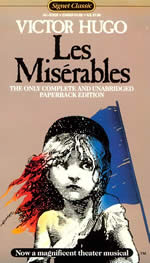 With the furor surrounding the release of Mel Gibson’s new movie, The Passion of Christ, we are again faced with the old question of art and its part in religious faith. Certainly the two cannot be separated, for all real artistic expression is the effort to fulfill the two great commandments: to reach upward toward God and/or outward toward others. Kieth Merrill’s thoughtful review of the film in Meridian reminds us that a great work of art can have an impact on, but cannot be the basis for, a true faith in Christ. Les Miserables, the great national novel of France and Victor Hugo’s masterpiece, is a rare example of art in the service of the Savior that has touched millions of hearts, inspired various theatrical adaptations, and even spawned a religious movement of its own.
Les Miserables is the story of one man’s journey from sin to salvation to sanctification. It is unapologetically sentimental and brutally realistic. The grotesque is juxtaposed against the sublime, and spiritual experiences are reported with the same journalistic detail as battle scenes. In other words, it represents a complete life of a spiritual man, with both seen and unseen forces at work. The protagonist, Jean Val Jean (a true “everyman’s” name) is a simple laborer who steals a loaf of bread to feed his sister’s children. For this he is sent to prison, and his repeated attempts to escape cause him to spend nineteen years in grinding labor, only to be released with the dreaded “yellow passport” that ensures his rejection from every inn and workplace. His fate, however, is not unavoidably tragic, as later realistic novels would paint. No, there is a force at work to save Val Jean, and that force is God. God will intervene to save his soul, and as a result Val Jean will become a new man.
Two Questions
This novel asks two fundamental questions: Can man really change? Will society allow it? Hugo’s answers are respectively yes, and no, and thus the spiritual journey of one man is placed against the history of a nation embroiled in a revolution (inspired by our own) that seesawed back and forth between monarchy and republic. The plot of the novel careens up and down, like a roller coaster, as Val Jean is repeatedly cast down and lifted up; from the tops of trees where he works as a pruner to the depths of the galleys, and back up into the welcoming arms of the Bishop who transforms his life.
Later he sinks from the height of prosperity and respect back again into the galleys, then climbs to the top of a ship to rescue a sailor, then plunges back into the sea, into a new death, to begin yet another life in exile. Later, fleeing the relentless Javert (ultimate symbol of blind justice) he climbs straight up a wall, and then drops into the safety of a convent. Later he descends into a coffin to make an escape. The pattern is repeated over and over through the novel, and with each incarnation Val Jean strips away more of his benighted, bitter, carnal self and takes on the image the of Master he has vowed to serve. The climactic moment when he carries his future son-in-law into the depths of the sewers of Paris, then raises him to life, completes his progression, as he gives all to save one who will take from him his only joy, his daughter Cosette.
The tremendous physicality of Hugo’s writing is one of the reasons we respond to it on so many levels. Hugo, like Dickens, is a visual writer: he is cinematic as well as literary. People don’t just talk in this novel, there is always something happening. It was this combination of inner and outer drama, no doubt, that inspired Alain Boubil and Claude-Michel Schoenberg to create a rock-opera from the novel. Les Miserables has been shown more times than any musical in history. Faithful to the spirit of the work, it strives to portray the inner struggle of the man as well as the action of the novel, and succeeds beautifully.
As each of our children has graduated from High School we have shared a trip together, and as a part of that trip I have taken each one to see “Les Miz” in London, where it has been playing for twenty years or more. To watch each of them experience the closing moments of that musical has been one of the cherished experiences of motherhood for me, since so much of what we have tried to teach them about the purpose of life is encapsulated in those few moments. It is an experience I recommend to any believing parent.
Hugo’s Life
Victor Hugo’s life was even more dramatic than his novels. His father was a general in Napoleon’s army, and fell in and out of favor as the regime changed. The family traveled constantly and the parents were unhappy, so at an early age Victor was separated from his father when his mother took her three sons to live in Paris. He fell in love with the girl next door, Adele Foucher, and married her after the death of his mother, who opposed the match. His brother Eugene also desperately loved the girl, and flew into a psychotic rage at their wedding. He spent the rest of his life in an institution. After the births of their four children, Adele refused to live with Hugo as man and wife any longer, and began a relationship with his best friend. Hugo took a mistress, Juliette Drouet, who remained his companion for the next fifty years. (The morals of this family were so decidedly “French” that when Hugo fled to Brussels as a political exile, he took the wife, the family, and the mistress along with him!)
Hugo was a devoted father, and was devastated by the death of his daughter, pregnant with his grandchild, and her husband in a boating accident soon after their marriage. His other daughter survived the accident but suffered mental damage. He lived to see her committed to an institution and both of his sons die, within three years of each other. Hugo was active in the government and served in the legislature, and was most famous for his poetry and plays. His masterwork was not published until he was sixty years old, but it was an instant success.
Hugo spent nearly twenty years in exile in Brussels, and during this time he searched for a spiritual philosophy that incorporated his firm faith in God and his passion for social justice and reform. He consulted spiritualists and spent many sessions with mediums, attempting the “channel” the spirits of great figures of the past. There is currently a sect of Buddhism, called Cao Dai, which originated in Vietnam and is based on the writings of Hugo during this period. They believe that Hugo and his two sons return to earth as reincarnated beings occasionally. There are over two thousand temples and millions of followers of this strange faith, another illustration of the tremendous impact of Hugo’s work.
The Masterpiece
In 1862, while still in exile, Hugo published Les Miserables, which he had started two decades before. Working feverishly, standing at a desk with a cup of hot chocolate beside him, Hugo completed the 1200 page work in fourteen months. In a remarkable creative effort, he arranged to have the book translated into English the same year it was published in France. C.E. Wilbur’s translation still stands as the definitive Les Miserables, and the double release added to the great popularity of the work. Panned by critics for its sentimentality and condemned by government representatives for its harsh criticism of the legal system, the novel found an immediate place in the hearts of people everywhere.
Though its themes are universal, this is decidedly a novel about France, and Hugo’s love of his native country, exaggerated by his long exile, is evident in the detailed descriptions of Paris life. Hugo finally returned to Paris in 1870 and received a hero’s welcome. When he died in 1885 at the age of 83, two million Frenchmen passed by his coffin under the Arch de Triomphe. He was buried in the Pantheon, the first of a series of cultural heroes to be entombed there. June 1 was declared a national day of mourning and in 1902, on the centenary of his birth, the Maison de Victor Hugo museum was opened in the apartment where he had once lived and worked.
The Best Books Club has been reading classics together for over three years, and I have received many comments about Les Miserables in that time. Whenever I ask people about their most cherished books, this one is mentioned. Here is a typical comment:
” Les Miserables tops my charts overall — I had an experience with that book that I have never had before or since with a fictional work.”
If you have not read Les Miserables in the last decade, or if by chance you have never read it, you have a marvelous experience ahead of you. And if you have read and loved Les Miserables, I would invite you to share your experience with other Meridian readers. I’ll post these in an article in mid-March, so I welcome your comments. Hugo sums up the impact of Les Miserables within the pages of the book itself thus:
“The book which the reader has now before his eyes is, from one end to the other, in its whole and in its details, whatever may be the intermissions, the exceptions, or the defaults, the march from evil to good, from injustice to justice, from the false to the true, from night to day, from appetite to conscience, from rottenness to life, from brutality to duty, from Hell to Heaven, from nothingness to God. Starting point: matter; goal: the soul. Hydra at the beginning, angel at the end.”
Les Miserables is the February selection for the Best Books Club, an informal Internet gathering of readers who love the classics. Join our group by logging on to the website at www.thebestbooksclub.com or writing me at bestbooks@meridianmagazine.
2004 Meridian Magazine. All Rights Reserved.