








When You Just Want to Read a Good Mystery: The Moonstone, by Wilkie Collins and Many More
By Marilyn Green Faulkner
After a brief hiatus (well, alright, it’s been over two years) we’re getting back to the best books at Meridian. Those of you who have read along with the Best Books Club over the years know that we chose a work of fiction each month that met the parameters of classic literature: books that have endured the test of time, received critical acclaim, and exhibited a moral sense that was in keeping with our values.
As the leader of this erstwhile group of bibliophiles, I enjoyed scouting out classic works and doing just enough research and commentary to get a good discussion going. After about five years, however, I found that I began to lose my enthusiasm for the weighty tomes that we were discussing, and had a secret longing that I could no longer deny:
I just wanted to read a good mystery.
So I did. And after that, I read another, then another. Now, two years later, I’ve read a truckload of mysteries and am ready to share some of my favorites with you. I’ve made an effort to find mysteries that are also worthy works of literature; i.e. they are well written, offer a greater depth of characterization and avoid the sordid and vulgar. So let’s nudge Tolstoy and Austen aside for a moment and talk about that underrated genre that actually accounts for over one third of all fiction sold in the English-speaking world: the mystery novel.
Mysteries, Myth and Meaning
Why do we like to read mysteries? The obvious answers are that we read such stories for entertainment, escape, and in order to solve a puzzle. However, these reasons fail to account for the universal appeal of mystery stories, since a good crossword would satisfy all those requirements. The love of a good mystery crosses all lines of class, race, economic status and lifestyle. Everybody likes them and new mysteries constantly appear to great acclaim. Marie Rodell, in her book Mystery Fiction, (1943) digs a little deeper into why everybody likes to find a body in the library. People, she said, read mysteries to get:
- The vicarious thrill of the manhunt. carried on intellectually in the cleverness of detective and reader.
- The satisfaction of seeing the transgressor punished.
- A sense of identification with the people [the hero principally] and events in the story which will make the reader feel more heroic.
- A sense of conviction about the reality of the story.
I’m not sure if I buy the fourth reason, but I do think Ms. Rodell is on to something when she talks about identification with the hero. This leads us into a realm far deeper than literary device, because the modern mystery is an outgrowth of the ancient myth. Mythical themes, or “functions,” are as old as the human ability to tell stories, and the mystery novel ties into one of the oldest: the journey of the hero.
In every good mystery the mythical elements are in place. Death (the body in the library) comes as a result of evil (the murderer) and is overcome by reason (the clever work of the detective) and bravery (often facing the criminal alone). Our hero ventures into the world of the crime, is challenged and threatened, then overcomes through reason and courage, and the reader is left with an assurance that the unknown dangers that terrify us (the greatest of which is death) may be faced successfully. So the mystery is more than an escape; it is a way of preparing the mind and spirit to face the next real challenge by placing ourselves in the archetypical myth of the hero. And you thought you were just killing a couple of hours by the pool!
Would You Like That Hard-boiled, or Cozy?
Mysteries come in all shapes and sizes, but my two favorites are the detective and the cozy mystery. A “cozy mystery” is one that takes place in an enclosed or secluded place (a country house, quaint village, or monastery for example) that we would not normally associate with murder and mayhem.
The hero that solves the crime is usually an unlikely character such as an old woman (Agatha Christie’s Miss Marple), a priest (Ellis Peters’ Brother Cadfael) or even an archaeologist (Elizabeth Peters’ Amelia Peabody).
Some of my personal favorites in this genre are the Lord Peter Wimsey mysteries by Dorothy Sayers, a friend of C.S. Lewis and a scholar in her own right, Sayers’s mysteries are intricately plotted and full of fascinating detail. I also heartily recommend a complete reading of Agatha Christie’s novels, which could keep you occupied for many summers to come! Few novelists have written so much, so well.
Detective mysteries, which range from Sherlock Holmes’s elegant, urbane sleuthing to the troubled, wounded P.I.’s of Raymond Chandler and Dashiell Hammett, actually began with the book we are featuring this month. Though many Victorian novels had a mystery as a part of the plot, Wilkie Collins was the first to fashion the entire story around a crime and its solution by a brilliant detective. It was while watching and reporting on a court trial that Collins got the idea to present a mystery through a series of narrators, much as the evidence in a trial is established through a series of witnesses:
“It came to me then that a series of events in a novel would lend themselves well to an exposition like this. Certainly by the same means employed here, I thought, one could impart to the reader that acceptance, that sense of belief, which I saw produced here by the succession of testimonies so varied in form and nevertheless so strictly unified by their march towards the same goal. The more I thought about it, the more an effort of this kind struck me as bound to succeed. Consequently, when the case was over I went home determined to make the attempt.”
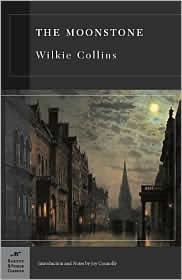 The result of this experiment was The Moonstone, described by T. S. Eliot as “the first, the longest and the best of the English detective novel.” Published in serial form in Dickens’s periodical, The Moonstone caused quite a sensation among the public. On publishing days anxious crowds waited for the latest number, and bets were placed on where the moonstone might be found at last, and who the culprit would turn out to be.
Wilkie Collins was the son of a famous landscape artist, William Collins, and grew up in the heart of the London literary movement of the 1800’s. He was first a playwright and penned the two plays in which Dickens famously performed. Afflicted with rheumatoid arthritis, Collins suffered from chronic pain in his back, and became severely addicted to the opiate Laudanum, which he took for the pain. Opium figures prominently in the story, and one of the characters, Ezra Jennings (writer and opium addict) is modeled after Collins himself.
The Moonstone combines several elements of interest: a young girl with a fabulous gem as an inheritance, sinister figures from the East (who actually have more right to the stolen gem than the hapless girl who inherits it), hypocritical religious “do-gooders” whose charitable acts mask secret lives, and of course, the wonderful Inspector Cuff, dragged out of retirement with his beloved rose garden to solve a seemingly unsolvable puzzle. In addition, the Yorkshire dales provide a marvelously eerie setting reminiscent of Wuthering Heights. Collins is adept at using the physical landscape to evoke the emotions of the characters. Here the “Shivering Sands,” an area of quicksand that will play a terrible role in the story, is described by the first narrator to chilling effect:
“The last of the evening light was fading away; and over all the desolate place there hung a still and awful calm. The heave of the main ocean on the great sand-bank out in the bay, was a heave that made no sound. It was now the time of the turn of the tide; and even as I stood there waiting, the broad brown face of the quicksand began to dimple and quiver – the only moving thing in all the horrid place.” (131)
Even in this tiny sample you can tell that I haven’t abandoned our parameters; this is a classic piece and the writing is superb.
Collins uses a series of narrators to tell the story, and each is a complex character in his/her own right. The young “victim” of the crime, Rachel Verinder, is far more than a damsel in distress. Collins wrote that he attempted to make the action spring from what the characters would actually have done, rather than simply placing figures in various situations. As a result this book, though set in Victorian drawing rooms, has a strangely modern feel to it. It is as much a psychological study of the hidden motivations and inner desires of its characters as it is a thrilling whodunit.”
The Best of the Best
The Moonstone was the first “detective novel,” a genre that has grown so large and unwieldy that it is difficult to discuss. However, there are a few classic authors that you may not actually have read. Arthur Conan Doyle penned the Sherlock Holmes series between 1887 and 1927. Over fifty short stories and four novels featured the Baker Street sleuth. Begin with “A Study in Scarlet” and move right through the stories to see a truly great character in the making. If you like the drama of the detective story but want to skip serial killers and the more shocking brutality common today, try P.D. James’s novels featuring Adam Dalgliesh, or Margery Allingham’s Robert Campion series. In the cozy category you must read G.K. Chesterton’s Father Brown series and Ellis Peters’ Brother Cadfael stories. And if you haven’t yet met Rumpole of the Bailey and his beloved wife Hilda (“she who must be obeyed”) you are in for a hilarious treat.
The Mystery Writers of America recently compiled a list of the hundred best mystery novels, and out of those I would recommend twenty that I particularly love. Cozy and detective mysteries both figure in this list, and most of these are part of a series by a truly talented author so you have lots of reading in store – it’s going to be a great summer by the pool!
Write and share your favorite mysteries with the rest of us and I’ll post them next month: [email protected]. If you send me your email address I’ll put you on the list for the Best Books Club, an informal gathering of booklovers on the internet. It’s the perfect book club: no meetings, no refreshments, and you can come in your jammies!
Next month’s featured book will be Crossing to Safety, by Wallace Stegner, and we’ll talk about the challenge of presenting “goodness” in literature.