






 There is nothing harder in life that parenthood. Given all the challenges that go along with it, who in their right mind would purposefully choose to become a parent? And yet, for many people it is the most intense desire of their life despite the lack of fun they might experience or the hardships it may create for them. It is a paradox indeed.
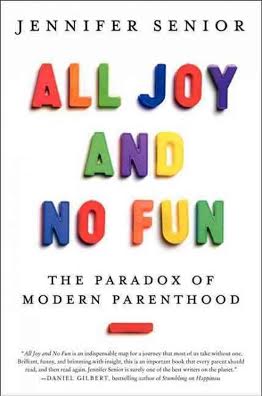
All Joy and No Fun is a recently released book by Jennifer Senior and is a sociological study of how having children affects the lives of parents. Jennifer Senior tries to show parenthood from the alternative perspective of parents themselves rather than the often explored, “how do parents affect their children?”
One might assume that this is yet another guide to parenting, but that’s not the case at all. Senior does not discuss strategies or methods for parenting, she simply details the experiences of several different families and talks about the results shown in studies to help her readers gain an idea of what parenting in our modern culture is like. She focuses on middle-class American families and she is very clear to make sure her readers are aware of this fact. Experiences would obviously be different for child-rearing in other circumstances. Each chapter she has is devoted to a particular time of childhood (i.e. toddler years, elementary school, adolescence) and she concentrates on the challenges that parents face in each of those times of life.
I could relate well to a lot of the situations that Senior outlines. I, myself, am a middle-class parent just coming into the teenage years with my oldest and still remembering the toddler years pretty well, while currently being firmly entrenched in the elementary school scene. I also started working recently in a high school library so the adolescence section is of particular interest to me as well. Reading some of these situations made me realize that I have a lot of things to consider as I move forward in my parenting journey. I also have come to realize that I have it pretty darn lucky with my kids – they are good boys (at least up to this point).
The New Family Dynamic
There are several very interesting things that Senior brings up about parenting that I found really compelling – things I had not considered before. One of the most profound ideas for me that she mentions is that, until the last 70 years (WWII) or so, children were not guarded and protected, indeed not considered as “precious,” to their parents as they are now-a-days. Children in older generations had a place in the family economy – they were expected to work just like everyone else, tasks that included taking care of younger children, working in the fields and factories, cooking, and cleaning. Their childhood was not considered as sacred and they were encouraged to embrace adult ideas like duty, responsibility, and hard work early on. Many times today, it seems children are not even required to do daily chores in the home. I know that I have felt like the “mean mom” on the block because my children have to do certain things before they are allowed to play with friends or do other free-time activities, and they have a number of Saturday chores to do every week. My children are lucky enough to get some allowance money for these jobs, but they would be required to do them regardless of compensation.
The problem that seems to be occurring now for children who do not have a place in the family economy is that they get bored and require more attention from parents who are already incredibly busy. I think, too, that parents are frustrated by the lack of help from their kids and even lack of interest that their children show towards the household that is supporting them. I think all this leads to a lot more conflict between parents and children. The teenage years are for more trying these days because the adolescent kids don’t have as much purpose or responsibility to keep them out of trouble. Not having responsibilities also robs them of a sense of accomplishment they were able to get when they performed tasks well. Senior includes a thought from Jerome Kagan saying, “The modern useless child cannot point to a plowed field or a full woodpile as a sign of his utility.’ Hence children were at risk of becoming overly dependent on praise and repeated declarations of love to build their confidence.” So the parents are required to fill in the gaps that hard work used to provide. In addition, children who need constant attention no longer know how to deal with boredom. Senior asserts that, “[Children] seldom experience boredom, which means they really don’t know how to tolerate boredom, which means they look to their parents to help them alleviate it.”
Another difference in parenting today that Senior points out is that there is so much more uncertainty about how to prepare our children for their futures out in the big, wide world. Children end up living with their parents for far longer these days and when they do get ready to leave home are perhaps less prepared to make their own way in the world. In former days, the children were trained up in the same industry as their parents. If their parents were a farmer or blacksmith then the children were groomed for that trade as well. But these days, the markets are global and the competition for jobs is fierce. Our children have to be able to compete with people from all over the world and the jobs they will work at may not have even been invented yet (look at how far technology has progressed in the last 10 or 20 years). How can we foresee what the world will be like for them and prepare them for it? Sometimes we may even struggle to operate in the world our children are growing up in, trying to keep up with learning technologies that have been in their hands since the day they were born.
Parenting Pressures
Another interesting thing that Senior brings up is our constant quest to try and make our children happy. In past generations, the goal of parents was to make them dutiful, responsible citizens. The focus was on how they could make meaningful contributions in the world and not what the world should be doing for them as individuals. Now we feel as if we need to spare our children any pain or discomfort and make them happy in all aspects of their lives. This really is an unrealistic goal, and it may even be detrimental to our children as well as ourselves. Senior quotes Dr. Spock on this idea: “It is unrealistic, I think-and by unrealistic’ I mean that it is a demand that cannot be met-to assume that if all goes well in a child’s life, he or she will be happy. Not because life is the kind of thing that doesn’t make you happy, but because happiness is not something one can ask of a child. Children, I think, suffer-in a way that adults don’t always realize-under the pressure their parents put on them to be happy; which is the pressure not to make their parents unhappy, or more unhappy than they already are.
” Senior also points out that happiness should not be an end unto itself. She says, “Happiness should be a by-product, not a goal.”
Reading this book also made me wonder why we put so much pressure on ourselves as parents to raise the perfect child (at least I know this is something that I do). Senior makes the argument that since we have more freedom in this day and age to choose whether we will sign up for the adventure that is parenthood, we feel like parenthood owes us more. It should be completely fulfilling and wonderful at every moment. At the same time, since many people are waiting to have children at much later ages, the amount of freedom they had for so many years without children is sometimes very hard to give up. They want their lives as parents to be as exciting and stimulating as pre-child life may have been. So as parents we work very hard to make sure that our children are prefect to make up for the fact that we gave up so much to be their parents.
The book points out that the new era of parenting is still evolving and so we don’t really know how we should proceed. As Senior puts it, “Today we are far less clear about what parenting’ entails. She says, “The modern family is just that – modern – and all of our places in it are quite new. Unless we keep in mind how new our lives as parents are, and how unusual and ahistorical, we won’t see that the world we live in, as mothers and fathers, is still under construction. Modern childhood was invented less than seventy years ago – the length of a catnap, in historical terms.” I think because we don’t really know what to expect, we feel like we must try harder and that can be overwhelming.
Making Life Worth Living
One thing Senior fails the take into account is how much having a strong religious faith can help us in our parenting challenges. She only mentions religion in passing, being a small aspect of the lives of some of the families she interviews. As a member of the LDS church, I feel like I do have a little more direction in how I should raise my children. I know exactly the kinds of values I want them to have and I think my faith helps ground me in my sense of duty and hard work, which I constantly strive to pass on to my children. I also have the greater perspective of knowing that my family unit is eternal and that what I am doing here in this life is not just for the short term. I know that every effort I make now for my children will have consequences forever, so even when it gets hard, it is totally worth it. I have these children forever and I need to make certain that I do right by them.
Senior does mention that children can make life more worth living. She cites studies that say that parents are less likely to commit suicide and usually have better health overall. She maintains that, “having children is a way to exploit our potential, to give design and purpose to a life. Robin Simon puts the finest point on it: Children are a reason to get up in the morning.'” Simon says, “that for single, non-churchgoing people, Sunday mornings are the lowest point of their week, for the simple reason that they have no demands placed on their attention. . . . His therapeutic recommendation in situations of distress, always, is to add meaningful activity to a life. That activity doesn’t need to be pleasurable. It can even open up a person to pain. That isn’t the point. The point is to have a reason to keep going. . . . And that’s what choosing parenthood does: gives strength and structural integrity to one’s life through meaningful tension.” I believe that is true. My children have definitely been the drive that has kept me going in life and in my efforts to consistently keep improving.
Recommendation
I would definitely recommend this book to parents and non-parents alike. Even though it doesn’t give specific advice about child-rearing, it brings up a lot of good issues to think about. By reflecting on the issues Senior addresses, one can figure out for themselves solutions to their parenting challenges. And this book could help non-parents understand parents in a better way, in addition to helping parents understand themselves why their roles as mothers and fathers can sometimes be so difficult. It is an easy read with a lot of intelligent, pragmatic ideas. It is definitely worth your time.