







My focus is laser-sharp and my time is impeccably calculated as I prepare for an upcoming research trip to Sparta, Greece. I’ll be joined by family for a week of sightseeing in Athens, Sparta and Patras. When they return home, the serious part of my travel begins. With a colleague, I will journey again to Sparta where we will spend several days at the Archives and Diocese, combing through aging records of old Greek script to find my people.
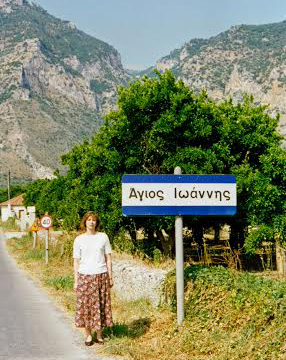 At my ancestral village, Agios Ioannis (St. Johns), Sparta, Greece, 1996.
Reading foreign records is a barrier to most peoples’ research, and it surely is in mine. There are limited records available from Greece. Some are found on the website of the Greek General State Archives (GAK); some have been microfilmed by FamilySearch. When I first broached these documents, panic hit. I saw familiar letters formed into unfamiliar patterns-names, places, occupations and descriptions that I could not read, despite my elementary knowledge of the language.
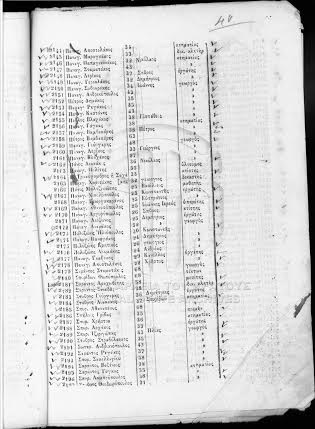 1872 Election Roll, Agios Ioannis, Lakonia. Line 2146, Panagiotis Papagiannakos (my great-grandfather), age 34, father: Nikolaos; occupation: landowneFor a brief time, I turned away and focused on tracking my immigrant family in the U.S. Until…I picked up the scriptures and read the words of the Apostle Paul in 1 Corinthians 12:1-11:
Now concerning spiritual gifts….there are diversities of gifts, but the same Spirit….For to one is given by the Spirit… divers kinds of tongues; to another the interpretation of tongues….
I felt an instant uplift as these words registered in my mind: because the “interpretation of tongues” is a gift given by the Spirit, I can choose to accept this spiritual gift and use it in the temporal work of genealogy research.
With renewed enthusiasm, I found my old Greek language books, downloaded a Rosetta Stone app, and went to work. Soon I was able to read the names on records that are typewritten: Election Lists, Juror’s Lists, and Military Rolls. For those that are handwritten, I needed help and I found it online. Through Facebook, blogs and websites, I have connected with the Greek community and we assist each other. One individual is helping me by reading the handwritten records I cannot interpret. As I look at his extractions and translations, I am slowly (very slowly) learning how my surnames are composed in script. I am hopeful that by the time I go to Sparta, I will be able to recognize these names in the old records.
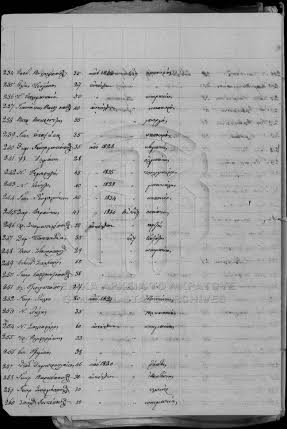 1844 Election Roll, Mystras, Sparta. Line 239, Ioannis Eftaxas (my great-great grandfather), age 35, farmer
There will come a day when almost every researcher will need to access foreign records. Online help, both through social media and websites, is the key. Look for blogs and Facebook pages that are country-oriented: FamilySearch has 106 community pages on Facebook, one for every U.S. state and 56 countries. There are handwriting guides and foreign language research outlines online at FamilySearch, Ancestry, and other websites. MyHeritage.com supports 39 languages and is heavily used by people outside the U.S.
My first visit to Greece in 1996 was during the era when research was constrained by time and money. Now, the internet has brought records literally to my fingertips. As I use both temporal and spiritual resources, my family history success increases. With a combination of faith and fortitude, I am prepared for my upcoming trip in a way that was unthinkable fifteen years ago. I recognize that I have been given a spiritual gift to perform a temporal work that is important to the Lord and to my family. For this, I am eternally grateful.
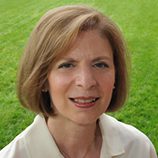
Carol Kostakos Petranek is a Co-Director of the Washington DC Family History Center, a FamilySearch Volunteer Coordinator, and a Citizen Archivist at the National Archives in Washington, D.C.




Lou NackosMarch 24, 2014
Good to see someone working on their Greek genealogy. My dad, James C Nackos, was one of the few Greeks in SLC that joined the church about 1939. He had spent his youth in Greece. About 1975-1980 my father and mother were sent to Athens for 3 years by the General Authorities to seek permits from the Greek Gov for the church to be recognized and be able to hold local church services. While there he was able to get the Greek gov. to allow the church to do microfilms of vital family records in various areas of Greece. He also was able to arrange for the permissions for the church to hold meetings in Greece. While in Greece my dad work very hard at gathering family genealogy records but with little success. He was able to go back to his great grandparents. May the Lord bless you in your research.
CaryMarch 22, 2014
From reading Sis. Petranek's articles before, I am sure she approaches all of her projects with considerable spiritual humility. And that comes out in this article as well. All of us who embark on this sacred work of searching and finding our priesthood lineage through our ancestors, with whom we have made solemn and tender covenants, must also have this humility and vision of the sacred service. My experience has been with trying to interpret Swedish records from the 19th and 18th century and often difficult handwriting on fragile records. The best help for this difficult interpretation comes from a heart willing to be humble and praying for help at the beginning and throughout and accepting the guidance that comes. And then prayer of gratitude at the end. It surely helps in coming to realize that these are real people whom you can feel and come to love.