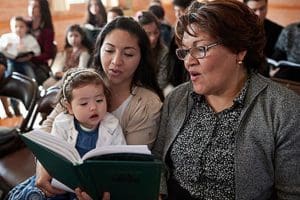






In the world of family history, this annual conference is the springboard for learning, seeing, and experiencing the newest technology that is making research fun. Four thousand youth attended the Saturday session, and their enthusiasm could be felt throughout the venue. This is the time for people of all ages to get involved!
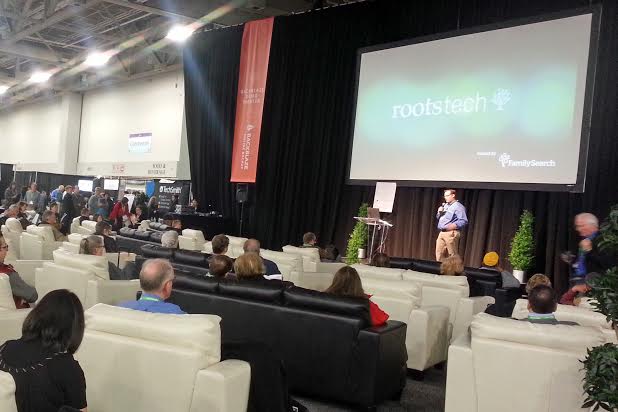
As a FamilySearch volunteer, I am especially thrilled to see that FamilySearch continues to be the trendsetter as a key sponsor, collaborator, and innovator. Its executives are on top of the tech evolution and are quick to express their excitement about this rapidly changing field.
The FamilySearch Family Tree, the world’s family tree, is gaining momentum among researchers. People are now able to upload photos, documents, stories and sources which sifts out the bad data and substantiates the correct information. These features are drawing young people into family history and strengthening families as they work together. Soon we will be able to:
1.Share information with living people so families can collaborate on both deceased and living relatives.
2.Have FamilySearch automatically find matching records for people in the tree. We will be able to click on a possible match, view its details, and if it is a match, attach it instantly.
3.View ancestors on a Descendancy Chart, starting with the ancestor, then his children and spouses for as many generations as we choose. FamilySearch will look for matching records for these people while in this view, and we will be able to attach relevant records to the correct individual.
Coming this year are new mobile apps which will allow user interface with the website. I was stunned to hear that by 2016, 50% of all internet traffic and 50% of FamilySearch usage will be on mobile devices! As FamilyTree goes mobile, its app will enable us to work offline while it stores information locally, then upload and sync to Family Tree when a web connection is available:
1.Family Tree Viewer, going to Android beta testing in March, will enable us to view the online Family Tree. Future enhancements will allow us to add or edit information. We will also be able to add a source by scanning or taking a photo with our cell phone cameras and the image will be attached automatically to a specific individual in the tree.
2.Family Tree Memories, currently in IOS beta testing. From our mobile devices, we will be able to take and tag photos, write stories, and record audio (video will come later). We will then upload the data to the Family Tree.
3.SMS Text. FamilySearch is exploring ways for people who have cell phones (not smartphones) to be able to work on the Family Tree through simple a simple text application. This feature must be able to support a minimum of 10 languages so it can be used worldwide.

From FamilySearch Executives: Dennis Brimhall, FamilySearch CEO and David Rencher, FamilySearch Chief Genealogy Officer:
1.Recording booths are being set up at Family History Centers (currently in Riverton and St. George). Patrons will be able to record their own stories, using personal photos projected behind them on a screen; or, they can interview others. We should all be finding ways to preserve our own living memories for our great-grandchildren to have. (Note: the Washington DC Family History Center has an oral history room for patron use.)
2.DNA testing will continue to expand. However, it will augment, not replace, sound research.
3.FamilySearch will continue to work closely with partners to expand digitization efforts. Organizations will not compete for records; rather, they will coordinate efforts to access and digitize.
4.FamilySearch initiatives to capture oral and tribal histories in Africa and among Native American tribes is continuing. [A RootsTech presentation by Dr. Osei-Aguemang Bonsu described these efforts in sub-Sahara Africa.]
5.Researchers must learn the handwriting and/or the foreign language of the original record so as to be able to review and capture all the relevant information.
6.Proper sourcing and citations of documents, photos and stories are critical. Future researchers must be able to find the exact information that we are referencing.
7.Access the original record! Do not depend on indexed records! Do not depend on digitized records! Beware of online pedigree charts!
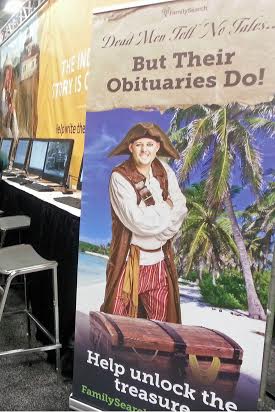 FamilySearch has initiated an endeavor to index obituaries, which are often mini-stories of a person’s life. An obituary can be attached to an individual in the Family Tree, thus providing a summary of his life. Naming 2014 as “The Year of the Obituary,” thousands of additional indexers are needed for this innovative project. This brief video provides an overview.
In coming months, countless hearts will surely be turned to their fathers. Although technological advances are astounding, they cannot replace our hearts or our minds – both of which are needed equally in this work. As David Rencher said, “It will be hundreds of years before the power of technology can match the power of the brain in your head.”
Carol Kostakos Petranek is a Co-Director of the Washington DC Family History Center, a FamilySearch Volunteer Coordinator, and a Citizen Archivist at the National Archives in Washington, D.C.