










I love Thanksgiving! I love it because it’s all about being with loved ones, having a wonderful dinner together, and giving thanks for all of our blessings. And there are lots of people in this country that happen to agree with me! The fact that 51% of Americans regard Thanksgiving as one of the nations’ most important holidays, and that it is the heaviest traveled day of the year, is evidence enough that America still values, and wants to be part of, family traditions–in spite of what some would have you believe.
Traditions are what bind us–hold us together. Traditions are to people what mortar is to bricks. You can certainly stack bricks without mortar and they will stay. However, they can easily be displaced, or knocked down, with very little effort. But if you add mortar, they will bond to each other and become strong, steadfast, fixed and firm, able to endure even some of the hardest blows.
Out of all the activities we Americans love to do to celebrate this treasured holiday; recounting the story of the First Thanksgiving is one of my personal favorites.
Nowhere in America’s history is the merciful hand of Almighty God more evident than in the story of the First Thanksgiving. When you consider all of the challenges and human suffering these brave souls – whom we call Pilgrims – were able to endure and overcome; the only possible explanation is that God preserved them.
In November of 1620, when the small ship Mayflower with its maxed out load of 102 passengers (an assortment of religious separatists seeking freedom of worship, and some others who went along in search of land ownership and prosperity in the New World) reached Massachusetts Bay, they were suffering from all kinds of ailments and deficiencies.
The 65-day ocean voyage was harsh cold and damp; on a very ill equipped ship. And since it was wooden, fires for warmth or cooking were prohibited. Imagine being on the high seas for over two months on an overcrowded wet wooden ship, with no way to get warm or cook your food! Makes me feel sick just thinking about it!
But thankfully the Massachusetts Bay area, specifically Plymouth Bay, which had been named and mentioned in the journals of Captain John Smith in 1614, held great hope for these weary and religiously oppressed travelers.

A Heartbreaking Beginning
Plymouth Bay offered an excellent harbor with a large inland waterway, which would serve as a good resource for fish. However, their greatest fear, and concern, was attack by the local Native American Indians. But the tribes who inhabited the Plymouth area proved to be peaceful and non-threatening.
That first winter brought exceptional cold, snow and sleet, which was devastating to these “first comers”– the name given them in the Plymouth records. The fierce elements made it impossible for them to construct their settlement so most of them remained on board the Mayflower seeking protection from the storms; where they instead suffered from outbreaks of scurvy and other contagious diseases. Of the 102 passengers, less than 50 survived that first winter.
But in the spring of 1621, an event took place that would secure the Pilgrims future and their place in history.
In late winter as the cruel weather began to subside, those who were still alive moved ashore, and by March of 1621 the small band of survivors had built crude huts and a common house on the shores of Plymouth Bay.
It was early one day in March of 1621 that the struggling Plymouth settlement received a visit from an Abnaki Indian named Samoset, who greeted them in English! Three days later he returned with another Native American from the Patuxet band of the Wampanoag tribe, who spoke fluent English. His name was Tisquantum or “Squanto.” He told the Pilgrims that he knew of their tremendous sufferings, loss and hardships, and that he had come to help them.
God Doth Provide
Squanto’s personal history was complicated. He shared with them the story of his abduction by the white man, and of his many voyages across the ocean to England and Spain.
He spoke of his employment as a servant to an Englishman named John Slaney where he learned to speak English. There in Slaney’s employment, he became acquainted with an explorer by the name of Thomas Dermer who took him back to the New World as a guide in 1619–back to the region of his birth– only to find out that his tribe, the Patuxet, were wiped out by the plague. A few who escaped the “black death” joined up with the Wampanoag tribe.
If we look at the critical roll that Squanto played in the survival and success of the Pilgrims, I think we will all agree that they would not have survived without his help.
It was Squanto who taught the Pilgrims what plants they could eat, which ones were poisonous, and which ones had medicinal powers. (See Alma 46:40) He taught them how to tap the maple trees for sap and how to plant and fertilize their crops using decaying fish. And he taught them how to plant and harvest Indian corn, which became one of their main staples.
He introduced the Pilgrims to the neighboring tribes and acted as an intermediary between the two cultures, establishing trade relations that enabled them to secure seeds and other crucial supplies.
But most importantly, Squanto was able to convey the Pilgrim’s desire for peace with the local “European wary” Wampanoag. He negotiated a treaty which Massasoit, chief of the Wampanoag Confederation, signed with the Pilgrims in 1621; which lasted for more than 50 years.
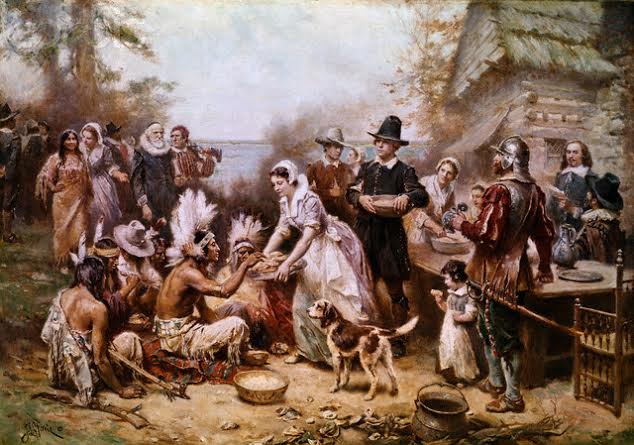
As a result, the two groups rejoiced and feasted together that first bounteous harvest–and often thereafter–sustaining and protecting each other through many difficult and challenging times. Together they enjoyed lasting friendships and years of peaceful coexistence.
In November of 1623, while guiding an expedition of newly arrived English settlers from Plymouth to Cape Cod, Squanto fell ill with what was described as “Indian fever” and died within a few days.
Upon Squanto’s death William Bradford, Governor of Plymouth Colony, declared him a “spetiall instrument sent of God for our good”; as quoted by John H. Humins in New England Quarterly, Squanto’s dying wish was to “go to the Englishmen’s God in Heaven,” and left what little property he had to his English friends as a token of his love for them.
Tisquantum – Sent of God?
Like many others God has raised up to accomplish His purposes, Tisquantum’s path, I believe, as did Governor William Bradford, was one of Divine Providence.
As I ponder the amazing details of this story, it becomes apparent that a higher power was the moving force in Squanto’s life.
That it was God who prepared this Lamanite son to be in the right place at the right time; not only with the knowledge of how to survive and work the land, but also completely fluent in English … the Pilgrim’s spoken language!
I also believe that it was the Holy Spirit’s influence upon the hearts of the Wampanoag–to preserve and protect the Pilgrims–that allowed the seed of religious freedom to be planted and take root in this great land …God’s Covenant land; to grow and flourish into an environment that brought forth the birth of America, and the restoration of the Gospel of Jesus Christ.
This Thanksgiving as we gather together with family and friends, let’s all take a moment and talk about the First Thanksgiving–the Pilgrims, Tisquantum and the Wampanoag. Perhaps even “raise our glass” in honor of them; and give thanks to God our Father for these extraordinary ancestors who stand proudly at the very root of this treasured and beloved holiday.
Considering the importance and meaning of this day in their mortal lives and earthly mission, I feel quite certain that they will hear our praise and prayers of gratitude for them, and be deeply touched.
Come, Ye Thankful People
Come, ye Thankful people come; Raise the song of harvest home.
All is safely gathered in ere the winter storms begin.
God, our Maker, doth provide for our wants to be supplied.
Come to God’s own temple, come; Raise the song of harvest home. *
Happy Thanksgiving!
* Text: Henry Alford, 1810-1871
Music: George J. Elvey, 1816-1893





PaulaNovember 28, 2013
I concur with and appreciate Marie's comment. I love this day of "gathering" and pondering on the most important gifts--faith, family, and friends. Thank you for providing the historical perspective of this day.
Jill ConnellyNovember 27, 2013
So great to be reminded of the first and REAL reason for one of my favorite holidays. Not football. I love history. I love our brave pilgrims. I love how you reminded us all of this amazing remarkable true part of our history. Thanks once again talented Rynna.