








Lecture and Exhibition of his Paintings for the motion picture The Ten Commandments
by Rose Datoc Dall
World-renowned painter and illustrator of western heritage and epic historical themes, Arnold Friberg, made a rare appearance on July 14th as lecturer and exhibiting artist at the Ellen Eccles Theatre in Logan, Utah. This event was sponsored by the Paint Utah Art School and concurred with the Utah Festival Opera’s Classic Film Festival in downtown Logan.
The main topic for this one-time event was his series of paintings commissioned by Cecil B. DeMille to be the visual basis for the movie, The Ten Commandments. The series of 15 paintings were also part of DeMille’s worldwide touring exhibition in 1957-1958 honoring the 100th year of Hollywood. Mr. Friberg’s work on the film earned him an Academy Award nomination.
Mr. Friberg is well known for his Book of Mormon paintings, and other religious depictions, The Prayer at Valley Forge, and scores of works dedicated to the Canadian Mounties and intercollegiate football. In addition, Mr. Friberg received the distinguished appointment by Prince Philip, Duke of Edinburgh, into the Royal Society of Arts (RSA), even though an American. Later Mr. Friberg obtained the commissions to paint the royal equestrian portraits of Queen Elizabeth II and Prince Charles.

In an unexpected tribute, July 14th was declared “Arnold Friberg Day” by the city of Logan, and he was made an honorary citizen of the city. The state of Utah, in particular, regards Mr. Friberg as one its most preeminent artists and by the warm reception of the very generous crowd, it was obvious to observe their love and respect for him.
The gentlemanly Mr. Friberg, a wonderful orator at the age of 90, delighted a full house of attentive listeners, fans and fellow artists with his reflections while working on The Ten Commandments, which remains one of Mr. Friberg’s most beloved projects. Mr. Friberg has kept the series intact in his own studio for that reason.

From his witty ruminations, we discovered that while so often people have told Mr. Friberg that his work resembles a scene out of a DeMille movie, it indeed was the other way around. In 1953, Cecil B. DeMille conducted a worldwide search for a biblical artist who could capture the look, the scale and the feel of his movie, The Ten Commandments then in its early stages of production. Mr. DeMille saw prints of some of Mr. Friberg’s work commissioned for The Children’s Friend magazine, by Adele Cannon Howells, General Primary President of the Church of Jesus Christ of Latter-day Saints. The series, which was at that time incomplete, would later be included as illustrations for the Book of Mormon. DeMille had finally found his man. He particularly loved Friberg’s The Finger of the Lord, a depiction of the brother of Jared who beheld the Lord touching the sixteen stones to illuminate their sea-faring vessels. DeMille loved that image so much that requested that Friberg design something very similar for the image of Moses and the Burning Bush.

What DeMille was asking Friberg to do was, in that day, quite revolutionary. At that time, Hollywood was only using designs on the scale of production sketches, and nothing on the scale of DeMille’s project. In addition to character and costume sketches, Friberg then painted full-scale scenes for the movie that DeMille and the production team could use for all the design elements. Friberg would spend more than the next three years in Hollywood working on the epic production. He later adapted them to fit the format of a children’s picture book, a collector’s item today.
The practice of using accomplished illustrators as chief designers for film is used today in current visual masterpieces. Examples would be the modern and stylized conceptual designs by artist Eyvind Earle for the animated Disney Classic Sleeping Beauty, and the fantastical conceptual designs of Middle-earth by illustrators, Alan Lee and John Howe for the 2001 release of the Peter Jackson film, Lord of the Rings and The Fellowship of the Ring to only name a couple.
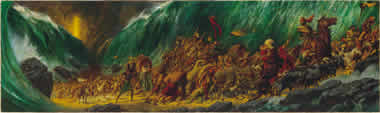
Apart from DeMille himself, as chief artist, Friberg was the first and the last word on the design elements on the film. In one of Friberg’s more amusing stories, he tells of Charleton Heston’s reaction after viewing some of his designs for the young Prince Moses, which were rendered in the standard Fribergesque style (broad and robustly muscular). Heston felt a little intimated by the pumped image of the character that he was to play and was sent packing for the gym, so to speak.
From costume to props, all had to look and to feel authentic. DeMille was adamant that the costume designs not have the look of “Hollywood costume design.” Even water plants from the Nile and truckloads of Egyptian sand, which has a unique golden color to it, were shipped onto the set for the sake of authenticity. Friberg even grew a long bushy beard himself from which he could paint Moses since he could not find anyone in Hollywood to model that had a biblical-looking beard. With great humor, Friberg remarked how even DeMille did not recognize Friberg when he walked on set with his formidable growth of whiskers.


Furthermore, DeMille gave the task of designing the opening text for the film to Friberg as well, which needed to be consistent with the look of the film. Friberg, who, like DeMille, had a for detail, also designed the character inscriptions for the tablets of the Ten Commandments themselves. The work must have brought Friberg back to his early beginnings as a 15-year-old apprentice in the sign business before he studied commercial art. Useful at being a jack-of-all-traits, Friberg was given full visual artistic authority on set in almost every stage.

Friberg was available all the time for what he describes as “distress calls” on set. He was often called to come to the technical and design rescue at times when things went awry. Costume issues would arise for example, where perhaps a designer had deviated too far off-center and it was Mr. Friberg’s job to identify what changes needed to be made if Mr. DeMille wasn’t pleased, then correct them. By other accounts, DeMille was known to be a demanding autocrat on set, but nevertheless, seemed to have implicitly trusted Friberg’s opinions. Both DeMille and Friberg got along rather well.
The insistence to have an artist who could keep the holistic integrity of all the design elements of the film left us an enduring classic of an epic film and an amazing feast for the eyes. The Ten Commandments received Academy Award nominations for Best Picture, Best Cinematography (Color), Best Interior Decoration (Color), Best Costume Design (Color) in addition to Best Sound, and Best Editing and ultimately won in the category of Best Special Effects. The Ten Commandments was also Cecil B. DeMille’s last film. DeMille died only a few years later in 1959.
It is no wonder that Friberg truly loved working on this project, the sort of which an artist can only dream. To have worked with a movie great “The Father of Hollywood,” Cecil B. DeMille, three-time Academy Award nominee and one-time winner (for his movie The Greatest Show on Earth) is a rare thing to claim. And to have been given the opportunity with such a high degree of artistic control with all the access afforded by the DeMille engine is even more rare indeed. Friberg told with great zest how his “talents poured out” while working on the film, stimulated for DeMille. It was well known that DeMille had a habit for surrounding himself with extremely talented people, as well as fledgling performers whom he shaped into greats. Some of his protgs include Gloria Swanson, Gary Cooper, and Charlton Heston to name a few from a long list.
And it is clear that Friberg had hit his stride. The Ten Commandments came right in the middle of his Book of Mormon commission, which the Church deemed important enough to allow Friberg to interrupt his work for the Church which would still be there for him to complete when he returned from Hollywood. Friberg had by then developed a vividly lush illustrative style in keeping with other contemporary illustrators of his time, like N.C. Wyeth, Norman Rockwell, and Harvey Dunn, having studied with the latter two. These artists flourished as book and magazine publishing was in its heyday and classic American illustration hit its golden age.
The reason that DeMille chose Friberg is the same reason that his artwork has such tremendous appeal even until this day. Arnold Friberg paints in a very cinematic style, which speaks to a cinematic age. We have, been so conditioned as a pop culture in the language of media, that his narrative artwork fits very comfortably in the crossover between illustration and film. That is not to say, however, that his work is photographically hyper-realistic, but cinematic implies drama in his compositions, with a keen use of color and lighting as a vehicle, with a high saturation of color. His images are epic and spectacular and almost fantastical. His figures, although idealized, seem believable and the viewer is transported into another time and a real place. Friberg has the ability to say it all in one frame. There are few multi-figure genre artists alive today who can approach the technical prowess of Arnold Friberg.
Friberg’s story also gives hope to many young artists who too find themselves having to make their way in the world by beginning in illustration. Friberg’s own beginnings were in cartooning and sign making as a boy and youth who went onto illustration. Friberg stuck with what he did best, which was figurative, narrative illustration, largely ignoring the modern trend toward non-representational art. Friberg probably had little use for the ideologies of strict formalism. He was a master figurist of both equestrian and human figure in the traditional sense. Those were the subjects that interested him.
By doing what he did best, his work thus gained the attention of some powerful engines like Cecil B. DeMille, The Church of Jesus Christ of Latter-day Saints, and British Royalty amongst others. Then somewhere along the way, Friberg’s more mature work became grouped as a significant contribution to American historical and American western genre painting. Arnold Friberg is not only living the American dream, but the dream of the American artist. All he has ever wanted to do is “tell a story.” And the way that he describes himself is “the guy down the street who paints pictures.”
Friberg’s vision, like DeMille’s was to do justice to the biblical subject in The Ten Commandments. And perhaps Friberg’s inclination to pay tribute to whatever subject he was painting appeals to a society’s sense of idealism, which might also account for his wide popularity. Referring to the exhibition of the paintings from The Ten Commandments, DeMille told the press that he had hoped that “someday, a boy would see these paintings and [be] influenced [by] them.”
I think that it is safe to say that his work has moved many. I personally remember those vividly colored illustrations with figures in large Technicolor in my first Book of Mormon when I received my first copy at the age of 13 before I had joined the Church. I remember fondly being moved to think “wow, this all must have really happened. It’s all here in color.” I also remember viewing The Ten Commandments as a child and thinking the same thoughts, though not realizing who Arnold Friberg was, nor that he was connected with the Book of Mormon illustrations.
Yet, on some level, haven’t we all felt that way about Mr. Friberg’s artwork? I remember as a child, scrutinizing his illustrations, which further fed my desire to one day become an artist myself. This inspiration is shared by many artists like Michael Bingham of the Paint Utah Art School who invited Mr. Friberg to lecture at this occasion. Bingham remarks how it was a fulfillment of a personal dream to pay tribute to Mr. Friberg.
With great charm and moved with emotion to the warm reception of the crowd, Arnold Friberg summed his remarks with a statement that he hopes that his artwork would one day be “worthy to put upon the altar of God.” Moreover, if there was one more reason to love and appreciate this man, it is his graciousness and humility. In more ways than one is Arnold Friberg an inspiration to us all.
Mr. Friberg, at age 90, resides in Salt Lake City, Utah and still continues to paint.

To view more of Arnold Friberg’s paintings, visit www.fribergfineart.com.
2003 Meridian Magazine. All Rights Reserved.