











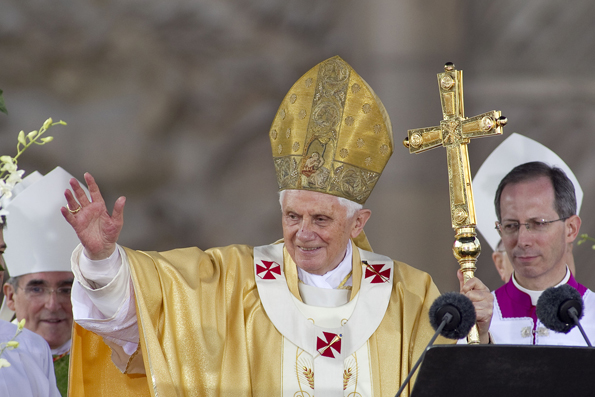
On February 28, 2013, at 8 p.m. Vatican time, the seat of St. Peter went vacant, “sede vacante.” Pope Benedict XVI resigned his seat, the first resignation of a Pope in 600 years.
The process of electing a new pope is deeply rooted in two thousand years of tradition, with a few small similarities to how a new president is chosen and called in the Church of Jesus Christ of Latter-day Saints.
The Election of the Supreme Pontiff
When the “seat of St. Peter is vacated” (whether by death of a Pope or resignation), the “interregnum” (period when normal government is suspended between successive reigns or regimes) is governed by ancient rituals that release all Vatican positions, with a few exceptions. The only officials to remain in their post are the vicar of Rome (who cares for the Romans), and the major penitentiary (the official who grants absolutions and dispensations).
Approximately 15 to 20 days after the death or, or in this case, resignation of the previous Pope, the Papal Conclave begins. (This allows for the Cardinal electors to travel to the Vatican from around the world.) Similarly, out of respect for the prophet, the Quorum of the Twelve Apostles waits until after the funeral, before meeting. The lack of a prophet and president for either church for a short duration is not significant. (There are reports that in the case of the resignation of Pope Benedict that the Papal Conclave may occur sooner, since the Cardinals are able to plan in advance to travel.)
The word “conclave” comes from the Latin cum + clavis, which means, “locked with the key.” The voting Cardinals (Cardinal electors) are literally locked inside the Vatican until a new Roman Pontiff is elected. The 115 Cardinal electors are “sealed” inside the Sistine Chapel. However, they do have access to other rooms. They may be in there for several days (or weeks), and living arrangements are made for them in rooms attached to the chapel. When the Cardinals enter into the Conclave, they swear an oath to secrecy concerning the events of the Conclave. In short, the Cardinals will vote by secret ballot until a pope is chosen.
During the voting, the Cardinal electors are by themselves. A two-thirds majority of votes cast by the cardinal electors is necessary for the election of the pope. The voting takes places as each Cardinal elector is given a card on which they write the name of the Cardinal of his choice for the next pope. The paper ballots are rectangular in shape and printed with the phrase “Eligo in Summum Pontificem” (“I elect as Supreme Pontiff”) at the top with space below for the cardinal elector to write his choice. After making his selection, preferably in disguised handwriting that cannot identify him, he folds the ballot twice.
A receptacle and plate are placed upon the altar in the Sistine Chapel. In order of precedence, each elector holds his ballot so it is visible and carries it to the altar. When in front of the altar, he swears, “I call as my witness Christ the Lord who will be my judge, that my vote is given to the one who before God I think should be elected.” He then places it on the plate, deposits the ballot into the receptacle, bows to the altar, and returns to his place.
After the last cardinal elector has voted, the receptacle is shaken several times to mix the ballots. The ballots are then counted to certify that they equal the number of electors; if they do not, the ballots are burned. Each ballot is then unfolded, the name is recorded by the first scrutineer (one of three cardinals selected to oversee the voting). The name is recorded again by the second scrutineer. Finally, the third scrutineer reads the name aloud and again records it.
As each ballot is read, the third scrutineer pierces it with a needle through the word eligo, and all of the ballots are strung on a string; after the reading of the last ballot, the ends are tied, and the ballots are placed in a receptacle or on one side of the table. All of the electors can record the names as they are read.
After the last vote is counted, the scrutineers tally the number of votes for each name. If a nominee obtains a two-thirds majority, the new pope has been elected. Three other cardinals certify the count.
The ballots are then burned and white smoke appears in the air over the Sistine Chapel, alerting the crowd waiting in St. Peter’s piazza that a new pope has been elected. (This may be seen of the first uses of “mass communication.”)
If no nominee receives a two-thirds majority, the ballots are burned with wet straw (or chemicals in modern times) to cause black smoke, which alerts the crowds that a new pope has not been elected.
If the Cardinal electors do not agree on a person after three days, there is a day of rest for prayer and discussion before voting resumes. There are breaks every seven votes from then on until the 30th ballot. After the 30th ballot, only an absolute majority was needed for a valid election. This last rule was changed in 2007 by Pope Benedict so that the 2/3 majority is required for a valid election no matter how many ballots have been completed.
When a new pope has been elected, the Cardinal Dean asks the elected person for his consent saying: Do you accept your canonical election as Supreme Pontiff? And after the consent he also asks: By what name do you wish to be called? And the man will answer. (Interesting note: there have been 265 popes but only 81 names used.) After the acceptance, he is immediately made the Bishop of the Church of Rome, true Pope, and Head of the College of Bishops. If he has not already received episcopal ordination he is immediately consecrated as a bishop. The Cardinal Dean will also announce to the city of Rome and to the world the name of the new Roman Pontiff.
Who Will Be the Next Supreme Pontiff?
It is not uncommon for there to be a great deal of lobbying, both in and outside of the Catholic Church, for the next Pope. Technically the Pope could be any one of the 1.2 billion Catholics, as there is no qualifying rule other than that the pope must be a baptized, male, Catholic. However, more realistically, the next pope will be chosen from among the College of the Cardinals. The men who are eligible to become the next Pope are referred to as the papabili.
The Catholics believe it is the Holy Spirit who guides the process and so the Cardinal electors are constantly in prayer and discernment to choose the next pope. Outside of the Catholic Church, some “protestors” or “thought leaders” have called for the next Pope to be a woman, or a minority from the Southern Hemisphere. There are many who expect that the next pope will be from Africa or Latin America.
The conclave, which historically is held 2-3 weeks after the death of the pope (as described above), is expected to be held sooner due to the unprecedented resignation.
The College of the Cardinals will meet on March 4th to begin discussions.
The College of the Cardinals could easily be mistakenly compared to the Quorum of the Twelve Apostles, due to their access to the pope, and power in the election. However, a more accurate comparison would be to the Quorum of the Seventy within the Church of Jesus Christ of Latter-day Saints. In the past, the College of Cardinals was limited to seventy, in reflection of the 70 elders who assisted Moses (Exodus 24:1), and the 70 men who assisted Christ (Luke 10:1) Pope Paul VI and Pope John Paul II increased the size of the college to better minister around the world. Today there are 183 cardinals, including 115* electors (an elector must not have reached his 80th birthday in order to vote). (There is no true direct comparison or equivalent of the Quorum of the Twelve Apostles within the modern-day Catholic Church.)
Notable- the cardinals live all around the world and when they gather together for the conclave many of them will meet each other for the first time. To outsiders what may appear to be “lobbying,” is considered normal and natural to insiders who may have not yet met the man they will elect to be their supreme pontiff.
Many people wonder why the cardinals wear red. There have been different reasons given throughout history. In February 2012, Pope Benedict said of the cardinals, “From now on, they devote even more to work with me in governing the universal Church, and to be witness to the Gospel to the point of sacrificing their own life: this is the meaning of the red color in their clothes.“
In his retirement, Pope Benedict (now to be known as Pope Emeritus) will continue to wear a simple white cassock rather than his papal clothes and trade in his famous red shoes (symbolic of the blood of the early Christian martyrs) for brown.
When Pope Benedict stepped down on Thursday there were 144 cardinals present at his final service, including both cardinal-electors, and cardinals who are not eligible to vote for the next pope (due to age), according to Vatican spokesman, the Rev. Thomas Roscia. An audience was held with the cardinals inside the Apostolic Palace with the pope. The Holy Father wore his crimson velvet cape and used a cane, while he bid farewell to his closest advisers. The cardinals were permitted to bow and kiss the pope’s fisherman’s ring for the last time. (The “Fisherman’s Ring” is a special signet ring which contains the Pope’s name and is impressed to validate certain official documents, is expected to be destroyed along with the lead seal of the pontificate.)
The Succession and Calling of a Mormon Prophet
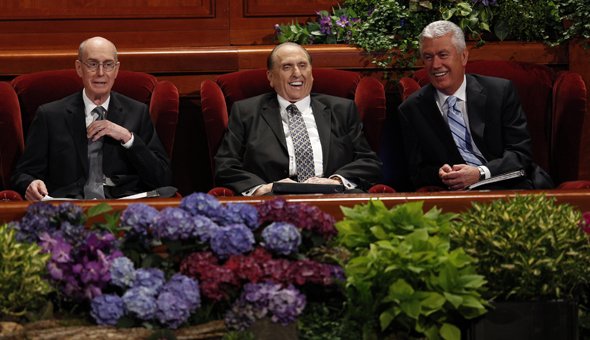
When the president of the Church of Jesus Christ of Latter-day Saints passes away and it becomes necessary for the appointment of a new president of the Church, the process occurs in an orderly way with very little fanfare, if any at all. There is no internal lobbying or electioneering, in keeping with the deeply ingrained tradition in the Church that personal aspiration for leadership at any level is inappropriate. Instead, the emphasis is on personal worthiness and a humble willingness to serve when invited.
It is important to note, all members of the First Presidency and Quorum of the Twelve Apostles are prophets, seers, and revelators. When the president of the Church passes away, it is the position of president that is refilled. In this respect, there is still always a prophet- prophets– on the Earth that continue to lead, guide, and administer the Church until the position of president is called and sustained.
President Harold B. Lee explained, “All members of the First Presidency and the Twelve are regularly sustained as prophets, seers, and revelators… This means that any one of the apostles, so chosen and ordained, could preside over the Church if he were chosen by the body [which has been interpreted to mean, the entire Quorum of the Twelve], appointed and ordained to that office, and upheld by the confidence, faith, and prayer of the church.” (D&C 107:22, Conference Report, April 1970, see also Teachings of the Presidents of the Church: Harold B. Lee [2000].)
The order of events for when the president of The Church of Jesus Christ of Latter-day Saints passes away, and a new president is called:
1. The First Presidency is automatically dissolved.
2. The two counselors in the First Presidency revert to their places of seniority in the Quorum of the Twelve Apostles. Seniority is determined by the date on which a person was ordained to the Twelve, not by age.
3. The Quorum of the Twelve Apostles, now numbering 14 and headed by the senior apostle, assumes Church leadership.
4. The senior apostle presides at a meeting of the Quorum of the Twelve to consider two alternative propositions:
i. Should the First Presidency be reorganized at this time?
ii. Should the Church continue to function with the Quorum of the Twelve presiding?
5. After discussion, a formal motion is made and accepted by the Quorum of the Twelve Apostles.
6. If a motion to reorganize the First Presidency is passed, the Quorum of the Twelve unanimously selects the new president of the Church. The new president chooses two counselors and the three of them become the new First Presidency. Throughout the history of the Church, the longest-serving apostle has always become the president of the Church when the First Presidency has been reorganized.
7. Following the reorganization of the First Presidency, the apostle who has served the second longest is sustained as the president of the Quorum of the Twelve. When the second-longest-serving apostle has also been called into the First Presidency as a counselor, the third-longest-serving apostle becomes acting president of the Twelve.
8. The president of the Quorum of the Twelve, along with the rest of the apostles, sets apart the new president of the Church through a formal laying on of hands.
The simplicity of the succession and calling of the next Mormon prophet and president of the Church, may be best summed up in the words of Elder N. Eldon Tanner, following President Harold B. Lee’s death.
“Following President Lee’s funeral, President Kimball [then President of the Council of the Twelve] called a meeting of all the Apostles for Sunday, December 30, at 3 p.m. in the Salt Lake Temple Council Room. President Romney and I [who had been in the First Presidency] had taken our respective places of seniority in the council, so there were fourteen of us present.
“Following a song, and prayer by President Romney, President Kimball, in deep humility, expressed his feelings to us.
He said that he had spent Friday in the temple talking to the Lord, and had shed many tears as he prayed for guidance in assuming his new responsibilities and in choosing his counselors.
“Dressed in the robes of the holy priesthood, we held a prayer circle; President Kimball asked me to conduct it and Elder Thomas S. Monson to offer the prayer. Following this, President Kimball explained the purpose of the meeting and called on each member of the quorum in order of seniority, starting with Elder Ezra Taft Benson, to express his feelings as to whether the First Presidency should be organized that day or whether we should carry on as the Council of the Twelve. Each said, We should organize now,’ and many complimentary things were spoken about President Kimball and his work with the Twelve.
“Then Elder Ezra Taft Benson nominated Spencer W. Kimball to be the President of the Church. This was seconded by Elder Mark E. Petersen and unanimously approved. President Kimball then nominated N. Eldon Tanner as First Counselor and Marion G. Romney as Second Counselor, each of whom expressed a willingness to accept the position and devote his whole time and energy in serving in that capacity.
“They were unanimously approved. Then Elder Mark E. Petersen, second in seniority in the Twelve, nominated Ezra Taft Benson, the senior member of the Twelve, as President of the Quorum of the Twelve. This was unanimously approved.
“At this point all the members present laid their hands upon the head of Spencer W. Kimball, and President Ezra Taft Benson was voice in blessing, ordaining, and setting apart Spencer W. Kimball as the twelfth President of The Church of Jesus Christ of Latter-day Saints” (in Conference Report, Oct. 1979, pp. 62-63; or Ensign, Nov. 1979, pp. 43-44).
Both the pope and the president are considered to be the highest priesthood holder within their respective religions. Both are ordained by the men who have been called and chosen to dedicate their lives in service to God. Both are chosen under prayer by these same servants, in the most holy rooms of the churches.
Similarities Between President Monson and Pope Benedict
There are a few interesting similarities between President Monson and Pope Benedict. Both men are 85 years old and have been in service to God and church for the majority of their lives.
President Monson is the 16th president of the Church. He became the president of the Church on 3 February 2008. He was sustained to the Quorum of the Twelve Apostles on 4 October 1963 and ordained an apostle on 10 October 1963 at the age of 36. He was born in Salt Lake City, Utah, 21 August 1927.
Pope Benedict XVI (born Joseph Aloisius Ratzinger) is the 265th pope. He was elected on 19 April 2005, and inaugurated 24 April 2005. He is one of the oldest popes ever elected, at the age of 78. He was born in Marktl, Bavaria, Germany, 16 April 1927. He was created a cardinal 27 June 1977.
*There have been reports of 115, 117, and 118 cardinal electors.
Erin Ann McBride is the author of “This Just In,” and “You Heard It Here First,” both available on Amazon and Barnes and Noble. She is a marketing and communications consultant with her own firm, McBride Marketing. She blogs almost daily at the Story of a Nice Mormon Girl.
McBride recently launched a new website to help self-published and commercially published LDS authors reach their audiences directly. Check out www.mormonbooksandauthors.com to find the latest books from your favorite writers!





ElseMarch 11, 2013
I have shared this informative article on my FB profile. I found the article so good and I actually have a higher respect for the Catholic church now than before. I am a devout LDS person, and my Testimony is my whole life, but I appreciate knowing more about the Catholics. Thank you for the wonderful information.
Chuck WhickerMarch 6, 2013
Historically, when the law of common consent was set in place by the Lord, it was understood that the church had the right and responsibility to discern their leaders and literally vote them in or out -- even the president. Joseph Smith, for instance, once tried to give Hyrum the position as president of the church, so that he himself would be more free to deal with other aspects of the overall kingdom, of which the church was but a part. The church voted it down, and so Joseph continued as president of the church. D&C 107:82-84 instructs the church how to excommunicate a president of the church should he become a transgressor; and so you can see that our current tradition in thinking "the Lord will never allow the president of the church to lead the church astray" is false doctrine, or the Lord would never have revealed that possibility. Notice, also, that whenever the ancient church apostatized, it was the ordained, official leadership who had led the apostasy. They were the ones in possession of the temple, as in the days of Jeremiah, and also in the days of Jesus, who acknowledged that the scribes and Pharisees "sit in Moses' seat" (Matt. 23:2). Thus, it is always a mistake for the people to think that there are any guarantees outside of their own spirituality and discernment.