






Reviewed by Margaret Blair Young
Years ago, film maker Richard Dutcher expressed a concern that LDS movies were becoming cultural burlesque routines, based on a series of inside jokes gently mocking home teaching, singles wards, and other peculiarities of Mormonism. He was concerned that we were not focusing on the real power of our faith: the atonement of Jesus Christ. I knew that his next movie, eventually titled States of Grace but known in Utah as God’s Army 2 would be Dutcher’s answer to this concern.
He has made a masterpiece.
As the film begins, we meet Elder Lozano (Ignacio Serricchio) and Elder Farrell (Lucas Fleischer), missionary companions from opposite backgrounds – the bright-cheeked Farrell from some predominantly Mormon community, and the more worldly Lozano from a violent Hispanic barrio. They are serving in Los Angeles.
Shortly after we are introduced to these characters, they leave their P-Day basketball game and are confronted by a Black gang. The confrontation ends abruptly with a drive-by shooting, which kills one gang member and leaves another near death.
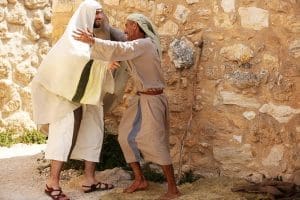
Immediately, Lozano begins treating the man who moments before was threatening him. Reminiscent of the Good Samaritan, he binds the wounds with his tie, and then demands that Elder Farrell give his tie also. When Lozano removes his shirt, we see his name tattooed across his back, as well as gang symbols, and soon learn that, years ago, he was nearing initiation into a gang when a rival gang murdered his two brothers and nearly killed him. It was in the hospital that Lozano first learned the gospel; his roommate was a missionary who had been injured in a car accident, and Lozano became his first baptism.
Then the real story of redemption begins – and all of the major characters in this film (including the missionaries’ neighbor, Holly – beautifully acted by BYU alumnus Rachel Emmers) will realize how helpless they are without the gift of the atonement.
Elder Lozano remains by the bedside of the wounded gang member, Carl (LaMont Stevens), who later tells him that during a moment of consciousness, he had seen the missionary praying for him and wonders if that prayer saved his life. Carl begins asking questions about baptism and wants to be baptized immediately. He’s disappointed that he will need to learn something about the gospel before that can happen.
Meanwhile, the missionaries find a homeless, alcoholic preacher unconscious near a dumpster. Lozano insists that they take him to their apartment, evoking a Christmas allusion with the words, “We have room.”
As other reviewers, I don’t want to give a full summary of this movie, because its unexpected plot points should not be spoiled. I will say that scriptures ran through my mind throughout this film, and tears ran down my cheeks.
click to enlarge 
When Holly talks to Elder Farrell as though she were at a confessional and reveals her tragic choices and their consequences, I could imagine the Savior saying, “Her sins, which are many, are forgiven, for she loved much” (Luke 7:47).
As Elder Farrell confronts his own potential for sin and realizes his dependence on the love of God, I could again imagine the Savior whispering, “He that believeth in Me, though he were dead, yet shall he live” (John 11:25).
For me, one of the most moving moments was Carl’s baptismal interview, conducted by Elder Banks (a returning cast member from God’s Army, Desean Terry). Carl is concerned about his past, and Banks recounts the story of the People of Ammon, who buried their weapons in the ground. When Carl asks what happened to those people, Banks responds, “Somewhere, deep in the earth, those weapons are buried still.”
click to enlarge 
There are moments of brilliant, deeply symbolic filmmaking, the most obvious being the stylized juxtaposition of Carl’s confirmation with the gang murder of a young teen. We see one circle of men attacking, and then another circle of men surrounding this new convert to lay their hands on his head. The gang’s victim closes his eyes; Carl opens his. We see the victim abandoned by his murderers, and immediately move to the priesthood circle, where the men are embracing each other and Carl.
It is a one-minute microcosm of what the gospel does: invites all who would partake to open their eyes and see the potential of each person around them, to bury their weapons and be reborn into a new life of love and inclusion.
The world that Dutcher presents is full of temptation, sin, violence, and hopelessness – but also, because of its focus, full of redemption, renewal, and hope. He offers no easy answers to the hard questions we encounter in these seductive times, but portrays the need of a Savior and the power of the atonement better than I have ever seen it portrayed before.
click to enlarge
Viewers should be warned that he does depict the chaotic neighborhoods of our world realistically, and earns the PG-13 rating. I would not take a child under age twelve to this movie because of the violence, though I did take my fourteen-year-old and my sixteen-year-old, and both were deeply moved by it. (My sixteen-year-old began naming people in her life who “need to see” States of Grace.)
I am extremely selective about the movies I see and even more about the DVD’s I’ll have in my home. I have done something very rare with States of Grace. Not only did I see the premiere with my husband, but I took my children to it three days later and paid full price. (We generally wait until movies come to the dollar theaters.) And I can guarantee that the Youngs will get one of the first copies available of the DVD when it is released – which I hope will not happen for a long while.
This is one movie I want available in the movie theaters throughout the country for many months. I believe it speaks to the essential concerns of all Christians, and Dutcher makes an effort to include a variety of religions in his characters – Baptist, Pentacostal, Lutheran and Catholic.
We are now in the Christmas movie rush time. Harry Potter will shortly fill the theaters, and movies devoted to fantasies about the North Pole will doubtless lure many families. It would be a great shame if States of Grace got lost in the rush of the season. I believe it is the best and most faith-affirming Christmas movie you could attend. It is consciously geared to the great gift of the Son of God, and ends with a nativity scene as a fitting climax to all “the heart-ache and the thousand natural shocks that flesh is heir to” (Hamlet III:1) – which the audience will feel it has just witnessed. This film left my family and me with a renewed commitment to live more lovingly and more forgivingly in our own states of grace, facing our challenges with gratitude for the possibilities the Savior opened the night the angels sang, “Glory to God in the highest, and on earth peace, good will toward men” (Luke 2:14).
click to enlarge
2005 Meridian Magazine. All Rights Reserved.