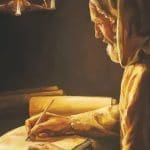








Now the queen having heard of the fame of Ammon, therefore she sent and desired that he should come in unto her. (Alma 19:2)
A heavenly vision comes to a Lamanite queen, similar to that of her husband’s, King Lamoni, when Ammon testifies of the Savior. Before the event of the queen’s vision, she enacts two measures of faith when she’s told that her husband is dead, first she puts off burying her husband, and second, she consults with the Nephite, Ammon. These are significant since it demonstrates that the queen is already acting on her faith, and only after these valiant efforts, does the vision come.
Our church leaders have taught us that, many times, the testimony or confirmation comes only after relying on faith. Praying, fasting, and keeping our temple covenants are all acts of faith when we are seeking answers to important questions. Like the Lamanite queen, we may have to take these leaps before the answer comes.
The queen’s first act of faith occurs when she puts off burying the king, skeptical about her advisors who claim that he is dead (Alma 19:5). The second instance is when she consults with Ammon, a Nephite prince and servant of the king. In the queen’s Lamanite kingdom, Ammon is a former enemy and now a servant (Alma 19:2-5). Why should she listen to a Nephite, let alone a servant? Especially over her trusted advisors?
We know the answer-the Spirit has been whispering to her and going against any other preconceived reaction that a Lamanite queen should have. The answers to her prayers may surprise her, as do answers to our own prayers when they are not what we expect. And like the queen, sometimes it takes being brought to our knees in grief and sorrow in order to be receptive to the Lord’s message. The queen seems to be at a point of such deep humility that she’s ready to listen to a Higher Voice, even though she doesn’t completely understand who He is. The promptings of the Spirit give her the courage to act in a manner that may not be in her character.
These bits of faith enacted on the queen’s part are not insignificant and act as a precursor to the greater event to come-an event that touches her soul and changes the religious fiber of her court. Up until Ammon teaches the king and his court, the Lamanite queen would have worshiped idols such as the jaguar god, so the queen’s vision becomes a three-sixty turnaround event.[i]
Despite her previous religious beliefs, her convictions obviously change dramatically when she becomes a witness to Ammon’s teachings through her personal vision from the Lord. This complete change can be compared to those of us who are converts to the Church, in which our lives undergo a drastic change in order for us to be baptized. For those of us raised in the Church, we still experience a change of heart when we pray to gain our own testimony or are faced with the need to repent.
The queen’s change of heart comes when she is willing ask a Nephite for advice. She has to tread carefully because, while her husband is temporarily comatose, she is the only functioning ruler of the kingdom. [ii] Not only is the fate of her husband at stake, but also her position and her children’s royal future in the kingdom.
Asking for help in various areas of our lives can be difficult, even when we’ve been prompted or taken a step of faith in order to do it. Despite the queen’s inspired decision to seek Ammon’s counsel, she had valid concerns, and possibly doubts, in doing so. What if the king is truly dead and the people hold Ammon responsible? Will they turn on the queen because she seeks a Nephite’s advice? The seed of faith takes firm root when she pushes her worries aside and asks Ammon for his opinion. Her faith is rewarded when Ammon tells her that, yes, Lamoni is alive, and then asks her, “Believest thou this?” (Alma 19:9).
Her reply is bold, yet humble: “I have had no witness save thy word, and the word of our servants. Nevertheless I believe that it shall be according as thou hast said” (Alma 19:9).
Ammon’s answer is remarkable, especially when we consider that he is the son of King Mosiah. He’s also a contemporary of Alma the Elder and Alma the Younger, and has done a great deal of missionary work throughout the land of Zarahemla. “Blessed art thou because of thy exceeding faith; I say unto thee, woman, there has not been such great faith among all the people of the Nephites” (Alma 19:10, emphasis added).
Here we meet a Lamanite woman, a queen no less, who is now counted among one of the most faithful of her generation. This great faith of a Lamanite queen is further attested to when she is called “blessed” by King Lamoni when he arises the next day (v 12). She becomes an energetic example of how we can follow a single prompting of the spirit and how that consequence can bless many others.
As soon as Lamoni testifies of the Redeemer and falls to the ground again, the queen falls to the floor, herself overcome by the power of God. She experiences her own marvelous vision (see Alma 19:13-15). The queen no longer operates on faith alone, but now on divine knowledge. It is important to note the expenditure of faith spent by the queen before her vision comes. She acted on her faith, before the knowledge arrived, a pattern of truth that resonates with us today.
When the queen’s servant, Abish, witnesses the miraculous events, she hurries out of the palace to inform the citizens. She returns with people in tow, but their reaction is one of fear. Abish touches the queen’s hand, and the queen awakens and says, “O blessed Jesus, who has saved me from an awful hell! O blessed God, have mercy on this people!” (Alma 19:29). We don’t know exactly what the queen sees in her vision besides her own salvation. Regardless, she is filled with joy and testifies to her people, “speaking many words which were not understood” (v 30).
This vision of the queen’s precipitates a major transformation, from an idol-worshiping queen, to a woman with faith in the true Lord. It seems that in a short time, she has been “saved” from her previous sins, yet we must remember she has an open heart and is ready to accept the Lord’s message. If our hearts are open, and we take our own steps of faith, our lives can be transformed as we repent of past mistakes.
The queen’s two acts of faith lead to a marvelous vision, enabling her to become a sure witness of the Savior and the plan of salvation. Although we may not experience this sort of vision, the queen’s experience demonstrates that, if we are willing to step forward in faith, our own vision’ will come.
Heather B. Moore is the author of <a href="https://www.
<hr class=’system-pagebreak’ />amazon.com/gp/product/1608618617/ref=as_li_ss_tl?ie=UTF8&camp=1789&creative=390957&creativeASIN=1608618617&linkCode=as2&tag=momeofclarand-20″>Christ’s Gifts to Women and Women of the Book of Mormon as well as several award-winning historical novels, including: Daughters of Jared. Visit her website: www.hbmoore.com
_______________________________________