






Editor’s Note: This is part of an on-going look at the political crisis in Mali, where LDS father and Brigham Young University graduate, Yeah Samake, is running for president. The following report has been gathered from accounts written by Samake’s wife, Marissa Coutinho Samake, with her permission.
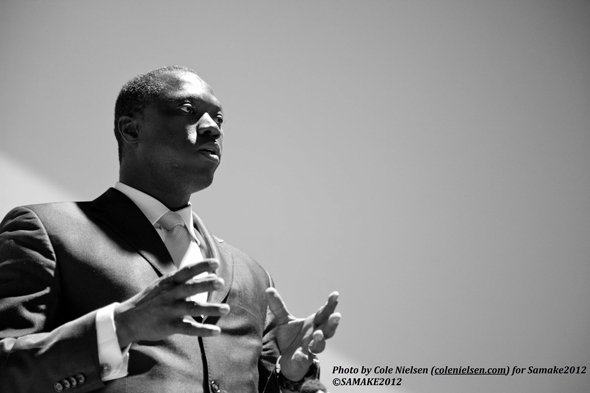
The Situation in Mali is Bleak
Due to the military coup, ongoing conflicts, and unrest throughout the country, Mali has postponed their presidential elections until May 2013. But Yeah Samake continues to work to help the people of his country.
Samake is currently in the United States giving world leaders an insider’s view of the situation. He has met with U.S. elected officials, as well as state department representatives and United Nations officials to inform them about his country’s struggles.
“There is significant human suffering going on right now in Mali. People are hungry. They can’t provide meat for their families. They sit and watch their kids and worry about providing daily meat to them. As a father and as a mother that hurts,” he said.
On Monday, July 16, Samake will speak at a private home in Lehi, Utah about his experiences meeting the displaced Malian refugees that fled to Burkina Faso. The event is open to the public. Details are available at FirstLadyMali2012.
One of the reasons I am here is to help women and children in those situations,” Samake said. “I’ve been in the refugee camps. I’ve met with the people. I’ve talked with the Red Cross and UNHR and have tried to find the needs of the people. Truly food shortage is significant. But tents are lacking, as well as hygiene kits. And the children that are out of school, they also need a playground and toys to play with.”
Malian Refugees
On June 10th, Yeah Samake was a man on a mission. His mission was to truly investigate the conditions of the refugee camp in Burkina Faso and the state of the refugees living in them, so he could get the international community and the Malian government more involved.
Samake went to visit the Malian refugees in Burkina Faso. The UNHCR (High Commission for Refugees UN), reports 180,060 refugees displaced all over Mali, Burkina Faso, Mauritania and Niger. 65009 refugees are in Burkina Faso as of June 9, 2012. Of these numbers, almost 60% are children. About 38% are aged 18-59 and about 3% are 60 and older. The situation in these camps is getting more and more desperate. The flow of aid is unable to match the need. Samake went with Malian journalist Yaya Samak (not a relative) to document the situation and hear firsthand what the refugees and officials had to say.
Mali Ambassador to Burkina, Seydou Traor, admitted that they had not been to visit the Malian refugees situated in Burkina Faso. They told Samake that the Malian government had not given any aid to Burkina Faso to deliver to the refugees, further evidence that the government does not care about its own people. Samake was the first Malian to have visited the refugees in Burkina.
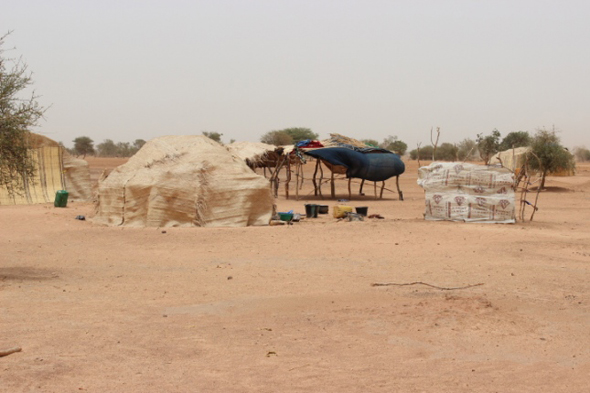
Yeah visited the Mentao, Damba and Djibo camps which is in the Soum province, 250 km from Burkina’s capital of Ouagadougou, with the country head of UNHCR, Fata Courouma. According to the UNHCR, these camps house 14,506 individuals and 2,472 households.
The refugees in these areas hail mainly from the Tombouctou area. Also among the refugees there are people who have served in the armed forces of Mali. Conditions are getting worse because of the rainy season coming in. The tents available are inadequate to deal with the rainy season. The number one need right now is protection from the elements. Even though food is being served, the rations do not meet the nutritional requirement and are lower than what a person would eat on a daily basis. Children that are displaced are not receiving an education. There are limited health services provided by the UNHCR and the CR-BKF. There are no words to describe the situation in these camps. It is unbelievable that it has come to this and that nothing is being done to help these individuals.
These individuals were so happy that a fellow Malian had finally come to hear what was happening to them in these camps. They expressed their gratitude to the Burkina officials and were frustrated with the Malian government because no one had come to help them. To them, it seemed like they had been forgotten by their own government.
Samake told them, “I am not come to you on behalf of the Malian government. I came to see you as a brother wounded at the situation as you live. Your suffering is our suffering. Your expectations are not met, not because the government does not have the will, but because the country is almost stopped. Let us all pray for the speedy return of peace, so you can find your homeland. We will always be by your side”.
Samake promised the camp leaders that he would do more to help them and raise awareness to the growing humanitarian situation.
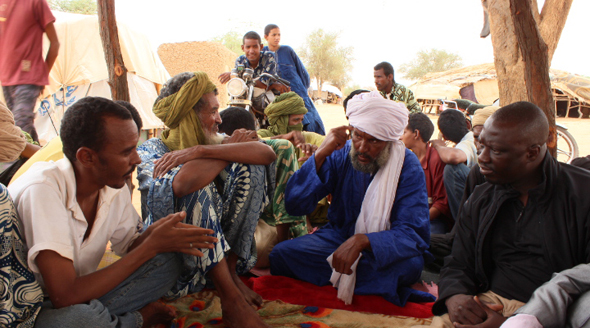
 Aghali Ag Hamidou
Samake met one camp representative by the name of Aghali Ag Hamidou , who is from the Tombouctou region and was teaching in Bamako when the fighting broke. He left his job in Bamako and returned to Burkina Faso to help his tribe in the refugee camp. Another camp leader Almahil Ag Almouwak of the South camp said “I prefer the Malian tree to another tree.” Despite the harsh conditions the refugees are under, he was quick to say that Mali will always be their home. They want to return home. He cautioned that not all Tuaregs are rebels and vice versa and cautioned the government to stop treating them as such.
The Political Situation in South Mali
The political situation South Mali remains quite stable. The Prime Minister seems to have gotten his team together so that the country can be run. The Interim-President Diacounda Traore remains absent as he continues to have treatment in Paris. To be honest, it really matters little that he is not here as much of the government running is done by the Prime Minister and his transitional government while the President remains in name alone.
There are pitter-patters of discontent from the political circle in regards to the government management. The transitional government that was formed left out all political parties- a feature that has received international credit, but has caused contention among Mali’s political class who feel they should have been included in the government. While it seems admirable that no old guards from the political parties were represented among the transitional government, it would have been advisable to have a few fresh faces from Mali’s political circle as advisers.
The result now is that there are many parties, mainly the big ones that are creating a stir by saying the Prime Minister is ineffective and the country is not making progress.
Samake formed a political coalition ADPS (Alliance des Dmocrates Patriotes pour la Sortie de crise) with other political parties.
Recently, members of some of the political parties claimed they wanted to ask the Prime Minister Diarra to resign and have a new government be created.
Samake refused to go along with this and advised PACP’s official position as such: “The Political Bureau of the Party for Civic and Patriotic Action(PACP) informed the Executive Board of the Alliance of Democrats for the Patriots out of the crisis (ADPS) of our decision to disengage from the memorandum between the ADPS and FDR. Given the principles and values that led to the creation of the ADPS, PACP will reserve from partnering with FDR. Our party is committed, in this delicate moment in the life of the nation, to support the government of Mali in its mission to regain territorial integrity of our country and the organization of upcoming elections.”
It is crucial that Mali not retreat to the position it was in three months ago. To return back to a non-recognized form of government would create more uncertainty in Mali and encourage further rebel actions in Mali’s North. Already, the Northern region has declared their independence and is looking for Mali to separate from that region. The question is not whether Mali will relinquish its hold, it’s when it will start to regain its territory so that it’s displaced people in Niger, Mauritania and Burkina Faso can return home. Also letting the Northern region go will mean doom to other ethnic groups that form the majority in these regions as they will be driven out and suffer the same fate that the refugees suffer today. Also, already the activities of rebels and AQIM are pointing in the direction that the North will become Al-Qaeda’s new playground.
The Political Situation in Northern Mali
The story in the North seems to be a different story altogether from that of the southern part of the country. With two different operating standards and governments, Mali has indeed been divided, with the north declaring its separation from the rest of the country. Until late June, Mali’s north was governed heavily by the Tuareg rebels. For centuries this nomadic group has waged its war for independence. The success of the Tuaregs in Mali came at a weak moment for the Malian government, but it came nonetheless.
With no recognized security in Northern Mali and a weak Malian army, no ground has been made in regaining the North. In June, Ansar Dine, overtook the region and became the major players. At least with the two sharing power, it seemed that the Tuaregs in Tombouctou would still get their hope to lead themselves. However that was not to be. Last week, the Tuaregs were ousted by the Islamist extremist group, Ansar Dine, or the “Protectors of the Faith.”
Ansar Dine and the Tuaregs
How dangerous is Ansar Dine? With Ansar Dine being corrupted with elements of AQIM and Boko Haram, Ansar Dine is indeed a tremendous danger to returning stability to the region. The main aim of Ansar Dine is to make North Mali another depot for extremist Islam. And so far they are having much success.
[Editor’s Note: Since this article was written and submitted for publication, the situation with the Ansar Dine has worsened. According to various reports cited in the New York Times, several hundred members of the government-backed Gandakoy militia appear to have broken ranks and joined the Islamist group Ansar Dine, bolstering its edge over ethnic Tuareg rebels.]
Areas such as Tombouctou are teeming with Islamic extremists. While Islam was the practiced religion of the region, it was practiced moderately. In fact, Tombouctou was known for its age-old monuments that depicted broad-minded Islamic teaching.
With Shariah in place now, Islam has become the imprisonment for the people of North Mali. Religious freedoms are no longer allowed, alcohol banned, women made to clothe themselves from head to toe despite the summer heat of 130F and men and women not allowed to mix. Many of these individuals have grown up free to practice Islam and their way of life. They have been part of something bigger when they were part of Mali. Now they are dispensable pawns in an extremist Islamic agenda.
The Tuaregs are a minority (6%) compared with other ethnicities that call Mali home. By giving the Tuaregs a separate land, the Mali government would be condemning another ethnic group. If the Tuaregs had stood with the Malian army and defeated the Islamic rebels, then the North would probably not be in this state. Yes, the initial failure was the coup, but the domino effect could have been halted by the Tuaregs. Instead, in a moment of personal gratification, the country now is in a fallen state that has been impossible to overcome because of the buildup of rebel groups, each group crazier than the one before it.
Mali’s failure has come from groups that believe in their personal agenda, first the politicians of old, then the junta and now the Tuaregs. The Tuaregs have long distrusted the Malian government believing that they have been marginalized. Other groups in Mali like the Bambara on the other hand believe that the Tuaregs are given special preference over other ethnic groups that Mali has a higher majority of like the Songhai and Peul and believe this is unfair. This was the perfect storm that could have gone either way. Standing with the Mali army would have strengthened the trust relationship. Standing against them was opening the door to a stronger group taking over.
 The Plight of Women in Mali
Another group that has received some attention from Samake’s PACP is the women. Malian women are strong. They work dawn to dusk taking care of their families and are usually the first to wake up and the last to go to bed. Usually they will bear anywhere from 4-10 children. Their responsibilities do not stop there. They cook, clean, chop firewood and often try to start small businesses so that they can bring in some income. All of this is usually done with a child on their back or one to two in tow. In Mali, women and men have separated incomes. The man is responsible for providing money for food and the general running of the household. Any money the women bring in can be used by her at her discretion. Having a business teaches these women how to sustain themselves. The culture in Mali is rapidly changing and it is very common to see small street businesses run by women selling anything from household items to produce.
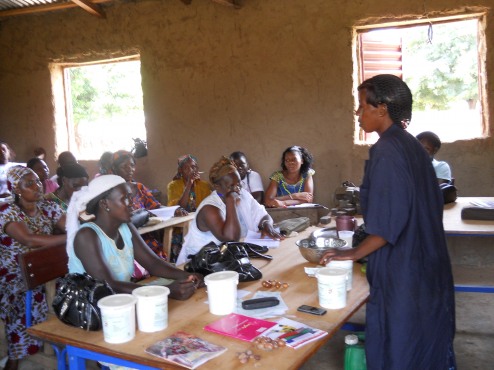
PACP in an effort to encourage increased women entrepreneurship hosted a free workshop for 25 women, led by PACP member Kone, to teach women how to make soap and shea butter. The women in a 5-day workshop received the benefit of formal training in a classroom setting as well as on-the-job training.
This was an awesome opportunity for Malian women to learn a business that they could then take back to their own regions and implement. Shea butter is a very essential product in Mali everyday life.
It is used for anything from a cosmetic value to a medicinal use. People in Mali will often use shea butter when they have a cold or sore throat and many will swear by its effectiveness. In addition it is used in cooking and some will even add a perfume into it and make it a cream.
Soap as well is an essential part of everyday life in Mali. As polluted as Mali is, Malian women do the best they can do to keep their surroundings and personal/family items clean. These two items are essential in Mali’s economy and there can never be too much of either product.
By teaching these women how to make these products, PACP is providing them the tools to learn a skill that could change their lives. This knowledge can be shared not only with the next generation, but more importantly with other women in their communities. Women are very social in Mali and by teaching one woman you are in essence teaching the entire group she will associate with. On their final day of training the group met with Yeah in Ouelessebougou, where he expounded to them the importance of the training and what the women could gain from it if used.
Hope for Mali
Samake remains hopeful for his country’s future. He also remains optimistic about his chance of becoming the country’s next president. He hopes his current efforts will show the Malians that he genuinely cares for his country and that he has the ability to get things done to get his country on the right track.
“People are looking at me. And this struggle is an opportunity for me to rise up as a leader for my people to see what I can do for the country,” he said. “Together I believe we can make a difference in the lives of the refugees that have been displaced. I pray that soon our Malian brothers and sisters will come home. I cannot imagine the conditions they are being subjected to. The shelter they have is no match for the hot, humid weather mixed with rain showers. The food cannot meet the constant pains of hunger. Imagine sitting 15-20 hours without doing anything, day in and day out. The supplies are running out soon and we need to help continue the aid till we can bring them home. This is not a life and I would never wish it even on my worse enemy.”