








Here is a story of love and courage and struggle, and a classic retelling of the archetypal myth of the hero.
by Marilyn Green Faulkner
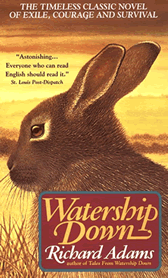 Watership Down is the story of a bunch of bunnies that get crowded out of a field by a housing development and have to find a new place to live. It is also a classic retelling of the archetypal myth of the hero. It is also the most realistic depiction of animals in a children’s book you will ever find. It is a story of love and courage and struggle, and a publishing phenomenon. Richard Adams, an English civil servant, wove the tale to entertain his two daughters on a trip to Stratford-upon-Avon one summer. The girls urged him to write it down, and the task took him about two years, working in his spare time. After several rejections it was finally published in 1972, with a run of only 2,500 copies, and was immediately hailed by critics and readers as a children’s classic. By 1985 it was second on Penguin’s list of all-time bestsellers with over five million copies in print, and continues to be one of the most popular books ever written for children or adults. Watership Down was the Harry Potter of the seventies.
Irritated by the sentimental stories published for children and discouraged by the permissive society of the 1960’s, Adams set out to create a fictional world that combined everyday reality and mythical ideals. The rabbits of Watership Down (a field in the English countryside that becomes their eventual home) are not cuddly or cute; they fight, eat, defecate, mate and generally struggle to stay alive. Adams used technical information about warrens and their ways (from R.M. Lockley’s, The Private Life of Rabbits) to give the story a realistic feel. Since this is a fantasy, however, these rabbits also speak, in a language called lapin. Every language captures the unique cultural characteristics of its speakers, and lapin is no exception. We are given new words to describe activities and emotions unique to rabbits. For example, the word tharn refers to the stupefied, frozen fear that rabbits experience when faced with sudden danger. Silflay means to go above ground to feed. There may be no more than about fifty words of lapin in the text, but the exercise of learning these words helps the reader begin to think like a rabbit and fully participate in the imaginative world of Watership Down.
Even with all the interesting facts and cool bunny language, why would a fantasy tale about rabbits be so popular? It is, of course, because this tale of rabbits tells us a great deal about what it means to be human. As the rabbits journey they encounter various predators; men, dogs, trains, and a whole warren of fascist rabbits that are truly terrifying. Their struggles against these adversaries mirror our own human conflicts. But above all, Watership Down has a memorable hero named Hazel who wins not only the love and respect of his followers, but ours as well. The adventure begins when Hazel, a quiet, unassuming fellow (the lapin equivalent to a civil servant, I suppose) wanders out to silflay one evening with his cousin Fiver. Fiver has a gift – he can sense the future at times – and he has a vision of destruction looming over the warren when he sees a notice board go up in the field. Unable to convince the chief rabbit that danger is imminent, Hazel persuades a few rabbits to flee with him and Fiver in search of a new home. Hazel becomes a Moses (with Fiver as his faithful Aaron) and his character development taps into our collective recognition of the heroic myth, described by Joseph Campbell:
“There is a certain typical hero sequence of actions which can be detected in stories from all over the world and from many periods of history. Essentially, it might even be said there is but one archetypal mythic hero whose life has been replicated in many lands by many, many people. A legendary hero is usually the founder of something – the founder of a new age, the founder of a new religion, the founder of a new city, the founder of a new way of life. In order to found something new, one has to leave the old and go in quest of the seed idea, a germinal idea that will have the potentiality of bringing forth that new thing.” (The Power of Myth, p.136)
This is one of those books that creates a cult following. Interwoven between the action scenes are stories from rabbit mythology about the great El-ahrairah, the first rabbit. Adams creates not only a physical, but also a spiritual and emotional world for these rabbits that is truly believable. (In my research I found Watership Down websites with painstaking studies of the religion, myths and customs of the warren. It reminded me of those people who show up at Star Trek conventions speaking Klingon to each other.) It is no accident that the story inspires an almost religious devotion in readers. Like Star Wars and, most recently, the Harry Potter series, these tales create an alternative universe that is more manageable than our own. The problems are difficult but there is a hero to believe in who will lead the people and bring peace and safety at last. We want to believe that the meek truly will inherit the earth, that good will overcome evil and that the last will one day be first, because in our hearts we know that these are correct beliefs. Books that strengthen our faith in these eternal truths are good for the soul. They are the most moral tales, for they speak directly to our spirits. We love Hazel for his leadership, Fiver for his spirituality and Bigwig for his courage. These bunnies become real to us, and their journey enlightens us about our own spiritual path. After all, rabbits aren’t the only creatures that experience tharn. Fear is common to all of us, and these tales give us hope.
Here is a sample of Adams’s wonderful writing style, which combines realism, fantasy, humor and pathos to a remarkable degree. Each rabbit in the warren contributes something vital to the survival of the group, and some of the most interesting passages are the ones where the rabbits, with their limited intelligence, work together to solve a problem they have never faced. In this case, they are being chased by the evil General Woundwort and his army, and actually figure out how to float downriver in an abandoned boat. But, eventually, they are forced to swim to shore, something most rabbits would rather avoid. Often when I read I ask myself how I would describe a certain experience. What does it feel like for a rabbit to swim in a fast-moving stream? Notice how Adams gives us this experience through Hazel’s limited frame of reference, which includes little more than weather, the earth, and light and dark:
“There was an instant shock of cold. But more than this, and at once, he felt the pull of the current. He was being drawn away by a force like a high wind, yet smooth and silent. He was drifting helplessly down a suffocating, cold run, with no hold for his feet. Full of fear, he paddled and struggled, got his head up and took a breath, scrabbled his claws against rough bricks under water and lost them again as he was dragged on. Then the current slackened, the run vanished, the dark became light and there were leaves and sky above him once more.
“
If you have a child or grandchild who likes to read, share Watership Down together. I was rather reluctant to begin this book, but so many club members recommended it that I took the plunge. It took me about fifty pages to get involved in the narrative, and by then I was hooked, and was as anxious as my son Blake to find out what happened next. The sweet, final moments when, after a long and courageous life, Hazel is called to the next world are truly fine. Even without Fiver’s gift I can predict you will shed tears, and that you will never look at a bunny in quite the same way again.
Watership Down is the July selection for the Best Books Club, an informal gathering of readers who like the classics. I welcome your comments about this or any other books you like. If you would like to be on the mailing list, log on to the website at www.thebestbooksclub.com. Our selection for August will be Vanity Fair, by William Makepeace Thackeray.
Readers Share Other Favorite Children’s Books:
We’ve read many great books with our children–the Redwall Series, Robinson Crusoe, The Wind in the Willows, and others, but one of the best has been “The Bronze Bow” by Elizabeth George Speare. It was given the Newberry Medal several years ago, but I doubt it would get one today–not because of the writing (it was wonderful!) and the story (it kept my 7 year old begging for more), but it has such a strong spiritual message. In today’s moral climate books involving Jesus Christ don’t always make it to the Award Winner’s list. Reading it was an emotional experience, especially towards the end. I was in tears as I felt the incredible love of the Savior for all mankind.
I will probably read this with my kids again in a few years–it was that good. Rosalie
—–
My favorite as a child was Anne of Green Gables. I enjoyed all eight books, but the first was best. I felt it gave me a love for nature that I never had before. And the way she survived such a sad childhood was an inspiration as I had a very secure childhood. I also enjoy the Girl of the Limberlost and Freckles. I loved Little Women, and could hardly believe that Louisa M. Alcott hated writing it and only did it to make money. She really wanted to write adult books. I’ve read it several times so guess it’s true.
Also loved the OZ books. In my late teens I loved the Jalna series by Mazo Del La Roche. Still do, and read the entire series every ten years or so. Beth
—–
Some of the books that come to my mind, which I enjoyed when I was between 10 and 14 years old, are: A Wrinkle in Time, The Light in the Forest, My Side of the Mountain, Cheaper by the Dozen, the “Little House” series and my first favorite (and first “chapter” book only we didn’t call them that then) which I read in the fourth grade: A Swiss Family Robinson. I think of these more as “youth” books. I also really love the littler “children’s” books (or picture books) and here are some of my favorites: The Giving Tree, Horton Hatches the Egg, Conrad’s Castle, anything by Mercer Mayer, Mr. Willowby’s Christmas Tree. Vic
—–
I love the Giving Tree. As a classroom teacher, I read this book to my students where I taught mostly fifth grade. Another book that I found touching for myself and my school children is Where the Red Fern Grows. I could relate to the main character so well because of my love of animals. Betty