





The world events of the last few years have been devastating, yet educational. For example, the average American now has a visual impression of the living conditions in Iraq. We know the difference between the political climate in Fallujah and Baghdad. We know who the Kurds are and where Kuwait is, and share strong feelings about characters named Hussein and Bin Laden. Sadly, this cultural literacy comes rather too late. After the atrocities of 9/11 the intelligence community found themselves hopelessly ignorant – only a few agents spoke Arabic – and no one seemed to know much about this new enemy that knew so much about us. We were left to play catch-up with deadly consequences. One wonders, if only we had understood a bit more about the troubled region that now claims the lives of American soldiers every day, would things be different now?
There are other troubled, and troubling regions in the world, regions that may yet be the focus of the nightly news. One of these is China, that vast land with over a billion people, about which most of us know very little. An ancient empire with a long history of corruption, China fell to Mao Zedong and his forces after World War II and continues today as one of the last bastions of old-style Communism. Chairman Mao’s Cultural Revolution has metamorphosed into a China that welcomes capitalist investment. Yet Tiananmen Square looms as a reminder that capitalist investment does not mean freedom.
|
click to buy
|
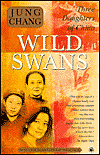 |
How shall we understand a people as complex as the Chinese? One of the best ways is through studying the lives of individuals as they move through its history. There have been a handful of outstanding autobiographical works written by Chinese exiles. Among the best is Jung Chang’s, Wild Swans: Three Daughters of China. Published in 1991 to great acclaim, this dense, fascinating account of three generations of women in China has sold over 8 million copies, and continues to be a favorite with readers.
From Concubine to Communist
Chang’s history begins with the story of her maternal grandmother, who was sold as a concubine to a warlord at the age of fifteen. I thought I knew something about foot-binding, the horrifying custom which created tiny feet at the price of lifelong suffering and pain, but I was unprepared for the reality:
“My grandmother’s feet had been bound when she was two years old. Her mother, who herself had bound feet, first wound a piece of white cloth about twenty feet long round her feet, bending all the toes except the big toe inward and under the sole. Then she place a large stone on top to crush the arch. My grandmother screamed in agony and begged her to stop. Her mother had to stick a cloth into her mouth to gag her. My grandmother passed out repeatedly from the pain.” (24)
This process lasted several years. Mothers who, in pity, released their daughters from the torment and allowed their feet to grow to normal size, saw them unable to attract suitable husbands, or suffer the contempt of the husband’s family. Even grown women could not untie their feet, for they would immediately begin to grow. The painful process of foot binding became a metaphor for me as I read about these remarkable women and men, who were willing to reshape their minds to conform to a regime that demanded unquestioning loyalty, even at the expense of reason and common sense.
One of the delights of this unusual memoir is Jung Chang’s ability to isolate sweet moments that are unique to Chinese society, yet seem familiar to all of us. As Chang grew to womanhood, she became caught up in the Communist lifestyle. Like other young Communists, she cut off her hair, wore shapeless clothing, and eschewed all things feminine as bourgeois. Yet each morning, she watched her beautiful old grandmother, the former concubine, care for her hair in the traditional Chinese fashion:
“My grandmother kept her hair tied up neatly in a bun at the back of her head, but she always had flowers there… She never used shampoo from the shops, which she thought would make her hair dull and dry, but would boil the fruit of the Chinese honey locust and use the liquid from that. She would rub the fruit to produce a perfumed lather, and slowly let her mass of black hair drop into the shiny, white, slithery liquid. She soaked her wooden combs in the juice of pomelo seeds, so that the comb ran smoothly through her hair, and gave it a faint aroma…. I remember watching her combing her hair. It was the only thing over which she took her time.” (265)
Precious moments like this make Jung Chang and her family real for us. There are no longer just a billion Chinese. There are families: women, men and children who love each other and hope for all the same things we do. When the Cultural Revolution shatters this family, we feel shattered as well. Chang’s father, a devoted Communist from his youth, comes under condemnation for no particular reason, and the Red Guards (young people given free reign by Mao to terrorize the populace) storm his home and destroy his precious collection of ancient Chinese manuscripts:
“Mrs. Shau slapped my father hard. The crowd barked at him indignantly, although a few tried to hide their giggles. Then they pulled out his books and threw them into huge jute sacks they had brought with them. When all the bags were full, they carried them downstairs, telling my father they were going to burn them… My father had spent every spare penny on his books. They were his life. After the bonfire, I could tell that something had happened to his mind.” (330)
Wild Swans is compulsively readable. (I determined to skim much of it and found myself reading every word.) Chang has a remarkable eye for detail and a strong sense of where her narrative must lead us. Whether these stories have been embellished is impossible to tell, but her account offers us a way to track China’s journey to Communism and see that world through new eyes. If you are interested in this type of memoir, there is another book you must read. Life and Death in Shanghai, by Nien Cheng, gives an account of the same period from another Chinese viewpoint. There may be no way to understand a billion Chinese people, but we can understand one woman, one family, and in so doing may take the first step across the cultural gulf that divides us.
Wild Swans: Three Daughters of China, is the July selection for the Best Books Club, an Internet gathering of readers that love the classics.
Our selection for August is The House of the Seven Gables, by Nathaniel Hawthorne. To join the Best Books Club log on to our website at www.thebestbooksclub.com .