








William Faulkner is the most famous American author that no one reads. My basis for saying this is an unofficial poll I have been conducting ever since I married into a family of the same name, in which I ask people who comment on the name if they have read Faulkner, and they invariably answer in the negative!
Nearly everyone, it seems, has read some Dickens and struggled through Hamlet, but the works of Faulkner, winner of the Nobel Prize for Literature and two Pulitzer Prizes, appear to be largely uncharted territory. One Faulkner scholar explains: “For many readers Faulkner remains an Everest too steep and craggy to climb. His dense, at times overwrought prose, his exceedingly complex plots; the intertwined genealogies that connect his books to each other, and the sheer immensity of his ouvre – these and other challenges scare people away.” (Jonathan Yardley, “William Faulkner’s Southern Draw: The Reivers,” The Washington Post, January 6, 2004, p.C01)
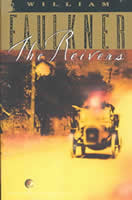 We know Faulkner is great, but we don’t know him. It’s time to change that, and an easy place to start is with the last book he wrote. The Reivers was published a month after Faulkner’s death in 1962 and won for him (posthumously) his second Pulitzer Prize. It is the most accessible and the most hopeful of all his works – both a serious moral tale and a very funny book.
Like most of Faulkner’s novels, The Reivers is set in rural Mississippi, in a fictional county called “Yoknapatawpha.” Though he began by writing of more exotic locales, Faulkner was advised by a friend to write about the place he knew best. He said, “Beginning with Sartoris (his third novel) I discovered that my own little postage stamp of native soil was worth writing about and that I would never live long enough to exhaust it.” (Lion in the Garden, 255.)
“Reivers” is an old Scottish word meaning “robbers,” and this rollicking novel is actually the story of a series of thefts. The theft that starts everything in motion happens when “Boss” Priest, a venerable family patriarch, leaves town with his wife, son and daughter-in-law for a funeral, entrusting his eleven-year-old grandson Lucius to the care of his black servants and his beautiful new Winton Flyer automobile (one of only eleven in Mississippi) to the care of his white hired man, Boon Hogganbeck. To say Boon loves this automobile is a gross understatement, and in Faulkner’s description of the car and the man you may begin to see his genius. His down-home, folksy narration (the voice is that of the boy, Lucius, now grown to be an old man himself) has the wandering digression that makes your grandfather’s stories both fascinating and infuriating, with a wonderful dry sarcasm about everything modern. Faulkner critic Malcolm Cowley called this “a sort of homely and sober-sided frontier humor that is seldom achieved in contemporary writing.”
“So he bought the automobile, and Boon found his soul’s lily maid, the virgin’s love of his rough and innocent heart. It was a Winton Flyer … You cranked it by hand while standing in front of it, with no more risk (provided you had remembered to take it out of gear) than a bone or two in your forearm; it had kerosene lamps for night driving and when rain threatened five or six people could readily put up the top and curtains in ten or fifteen minutes, and Grandfather himself equipped it with kerosene lantern, a new axe and a small coil of barbed wire attached to a light block and tackle for driving beyond the town limits.”
Boon, left alone with the car, the key, and four empty days, cannot resist the temptation to take it to Memphis (an eighty mile journey over dirt roads), and young Lucius becomes his willing hostage, along with the black servant Ned, who stows away in the rumble seat. If you’ve read Dickens’s, The Pickwick Papers, or the adventures of Mr. Toad in The Wind in the Willows, you are familiar with a picaresque novel, one that rambles through a set of adventures, with our heroes getting into one scrape after another. The stolen car gets traded (don’t ask me how or why) for a stolen racehorse named Lightning. The racehorse must be ridden in a race to win back the car, and Lucius must ride it. Underneath the comedy however, The Reivers deals with some very serious themes – morality, Christian virtue and racism – and does so with the same gift of understatement that characterizes its humor.
Issues of morality and the Christian virtues turn up on virtually every page of this novel. Lucius, the cherished eldest son of a prosperous family, must work every Saturday morning while his fellows play ball. He has been strictly raised to behave as a “gentleman,” and worships his old grandfather, Boss Priest, who embodies for him all the virtues that title implies. Shielded from evil by a loving family, Lucius assumes that he is a good boy. Yet from the moment that Lucius consents to accompany Boon in the stolen car, he enters a losing battle with his conscience.
What Lucius doesn’t realize is that the stolen car is just the beginning, and he is being thrown into a situation far more evil and perilous that he could have imagined. For Boon is on his way to Memphis to visit a prostitute in a Memphis “bawdy” house, and through him Lucius is exposed to the seamy underside of city life. He meets the alcoholic proprietor of the house, the crooked lawmen who frequent it, and a despicable young nephew who is visiting and acts as the worst possible guide to this strange new world. Then there is the woman herself, Corrie, whose obvious goodness wins his heart immediately. She is the kind of person of whom Jesus was speaking to the Pharisees: “The publicans and the harlots go into the kingdom of God before you. For John came unto you in the way of righteousness, and ye believed him not; but the publicans and the harlots believed him.” (Matthew 21:31-32)
Through Otis, the despicable nephew, Lucius learns the tragic history of Corrie’s life, and becomes her champion. Lucius is overwhelmed by the revelation of so much, so soon. He says, “I knew too much, had seen too much. I was a child no longer now; innocence and childhood were forever lost, forever gone from me.” Meanwhile, Corrie is watching this young boy, thrown into a veritable cauldron of evil, and calling upon his covenants to keep him afloat. Though he may have made a mistake in coming along for the ride, Lucius is indeed a “good boy,” and proves himself so over and over. My favorite moment in the book (and one I have shared with my own young son) occurs when the owner of the house offers Lucius a beer. Though the man is so offensive that I must edit out his language, Lucius keeps his morals, and his manners:
“Is yours a beer-head too?”
“No sir,” I said.
“I don’t drink beer.”
“Why?” Mr. Binford said. “You don’t like it or you can’t get it?”
“No sir,” I said. “I’m not old enough yet.”
“Whiskey, than?” Mr. Binford said.
“No sir,” I said. “I don’t drink anything. I promised my Mother I wouldn’t unless Father or Boss invited me.”
“But your mother’s not here now,” he said. “You’re on a tear with Boon now. Eighty – is it? – miles away.”
“No sir,” I said. “I promised her.”
It is the quiet resolve of the young boy that causes Corrie to rethink her life. Orphaned and forced into prostitution at a young age, she now realizes that she can choose to change, and does. Her transformation and Lucius’s fearless defense of her against grown men, even against the man who loves her, form one of the very serious and inspiring themes of this novel. Another is its portrayal of blacks and whites in the deep South. Ned McCaslin is a wonderful character: the natural descendant of a white plantation owner and a black slave, he has a unique perspective on the delicate racial balance of the South. He has no rights, yet he has the respect of his white overseers, and forms a tenuous friendship with Sam, the white railroad worker who assists them, based on their shared interests. Foremost among the black characters, however, is old Uncle Parsham, a mirror image in his black family of the revered Boss Priest. Lucius chooses to stay with Uncle Parsham rather than with a white family, and Faulkner’s account of the family meal says, with characteristic subtlety, that all good people are alike:
“Bow your head,” and we did so and he said grace, briefly, courteously but with dignity, without abasement or cringing: one man of decency and intelligence to another: notifying Heaven that we were about to eat and thanking It for the privilege, but at the same time reminding It that It had had some help too; that if someone…hadn’t sweated some, the acknowledgment would have graced mainly empty dishes, and said Amen and unfolded his napkin and stuck the corner in his collar exactly as Grandfather did, and we ate.”
Faulkner’s life spanned the Jim Crow years of segregation in the South, and the novel, set in 1905, reflects the rampant prejudice of the time. Against this backdrop Faulkner creates a world of equals. His black and white characters are equally complex, neither all good nor all bad, and this respect for the humanity of the black man was revolutionary in its time. Though this is a novel about a child, it is not for children. The bad people use bad language (though not nearly as bad as it would be today) and the subject matter is adult. This is a fearlessly moral novel, however, fierce in its assertion that goodness is worth preserving and defending, and that every soul is of value. Lucius Priest is a young man worth knowing, and the final scene where he confesses all to his grandfather will move you to tears. The transformation of the harlot Corrie is a pure example of what Jesus was trying to say, that those who believe, and are willing to repent, will find the kingdom of heaven.
William Faulkner’s famed acceptance speech for the Nobel Peace Prize is a profound commentary on the meaning of literature and offers a fitting summation for The Reivers:
“The human heart in conflict with itself…alone can make good writing because only that is worth writing about, worth the agony and the sweat…leaving no room in his workshop for anything but the old verities and the truths of the heart, the universal truths lacking which any story is ephemeral and doomed – love and honor and pity and pride and compassion and sacrifice…[Man] is immortal, not because he alone among creatures has an inexhaustible voice, but because he has a soul, a spirit capable of compassion and sacrifice and endurance. The poet’s, the writer’s duty is to write about these things. It is his privilege to help man endure by lifting his heart…”
The Reivers is a great favorite of mine, and provides a door into the works of a great author. I’ll be interested to know if you find it as funny, touching and inspiring as I did. The Reivers is the October selection for the Best Books Club, an informal gathering of readers who enjoy the classics together. Our selection for November is Dombey and Son, by Charles Dickens, or any Dickens that you’ve been meaning to read! Long winter nights seem made for a good thick book, and there are no better than Dickens’s novels. If you’d like to receive a monthly email about our selection, write me at [email protected]“>[email protected], or log onto my website at www.jadefalconpress.com. I look forward to sharing your comments with the group.
Readers comment on past selections of the Best Books Club:
The Power of One, by Bryce Courtenay
 We read The Power of One for our book club a few months ago. I was struck by how, although the boy himself was extraordinary, it was through the influence and mentoring of others that he reached his potential. And as he reached his potential, he used all of his learning, power and feelings to help others. Throughout the book he is always “serving” the “underdog”. The author had a wonderful way of really helping the reader feel as if they were there–describing the locations as well as the political struggles.
What many in the group found difficult was the foul language that was used throughout the book. Many did not read the book for this reason.
I look forward to reading your review. Thank you for your time. Danelle Hall
*
This is one of my favorite books of all times. Having visited South Africa several times and sending my daughter there as a missionary made a rereading even more powerful. I have wanted my younger sons to read the book but a few parts are too graphic. I tried to get the children’s version but it seemed to be available only in Australia. Do you know a good source for the youth version?
Thanks for your great reviews.
Bonnie Pace
*
Just wanted to make you aware, in case you weren’t, that there is an excellent movie based on Bryce Courtenay’s book, also titled The Power of One. Very powerful cast, including Morgan Freeman, Armin Mueller-Stahl, John Gielgud, Stephen Dorff (in his first movie), among others. I don’t know how you feel about movies based on books, but this movie version is one of our family’s favorites because of its beautiful vistas, moving music and insightful development of the “power of one” theme. It enhances the book rather than detracting from it.
If you haven’t seen it, I would highly recommend it to you and your readers.
I hope the prospect improves for your mother-in-law. Those events in our lives can be emotionally draining, but also reassuring in a way, as familial bonds of love and commitment are reinforced and given opportunities to strengthen and broaden and deepen.
Thank you for your efforts to expand our literary perspective. What a wonderful contribution to be able to make! Lowell Steele
The Woman in White, by Wilkie Collins
I recently read The Woman in White by Wilkie Collins because I saw that it was one of your choices this year for the Meridian Magazine book club. It was a great book! My new favorite! There were even a couple of times when I gasped out loud (when Count Fosco reads and writes in Marian’s diary). I have recommended it to a couple of friends and nobody has been disappointed! It reminded me a lot of Rebecca, which was one of our favorites. Thanks Marilyn! Denise