










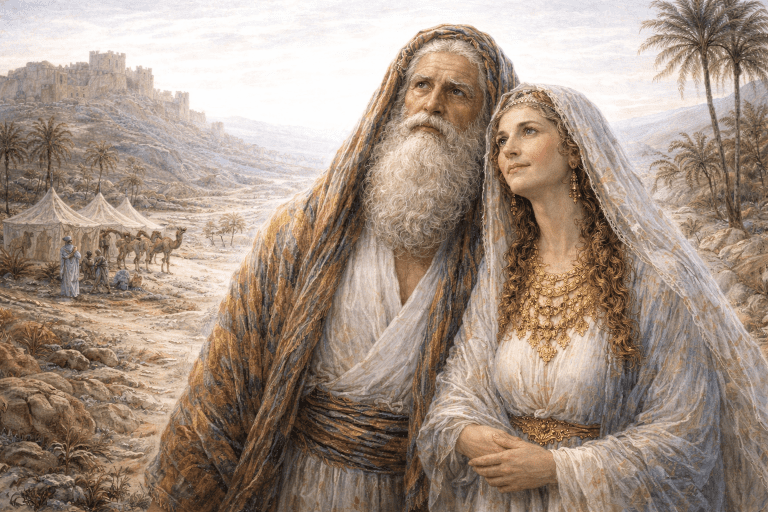


The Abraham story is wonderfully larger than Abraham. When the prophet Isaiah (whose “great words,” the Savior declared, should be searched “diligently” [1] ) addressed those who “seek righteousness,” he urged them to remember not only their illustrious forefather but also their equally illustrious foremother: “Look unto Abraham your father, and unto Sarah that bare you.. For the LORD shall comfort Zion.” [2]
The story of Abraham and Sarah is truly the story of Zion, beginning with two hearts united as one in one of the greatest love stories on record. It is a story that continues to this day and of which we are very much a part.
Their names at first were Abram – the “the father is lifted up” – and Sarai – “princess.” Whatever connection she may have had with a ruling earthly dynasty, she was surely a princess in both appearance and demeanor. Her striking physical beauty would turn the heads of kings, but her true beauty, which would only increase through the years, was that of the soul. She was indeed Abraham’s match, appointed to be his wife, says Jewish tradition, even before they were born. And what had been arranged in heaven came to pass on earth, we are told, because of the virtuous lives they led growing up. [3]
Of Sarai we hear little before her marriage to Abram, but their close blood relationship may well suggest that they were acquainted with each other early on. We might even surmise that her faith and prayers had already made a difference in the severe trials he was called upon to face as a young man. What we know with certainty is that she was, as recounted by the first century Jewish scholar Philo of Alexandria, “the darling of his heart,” and their love for each other was profound. [4]
Their talents and spiritual gifts were complementary, with some of hers exceeding his in important ways. But from the beginning of their marriage she was ever his ardent support, faithful friend, and close confidant.
“Everywhere and always,” wrote Philo, “she was at his side,. his true partner in life and life’s events, resolved to share alike the good and the ill.” [5] Theirs was the quality of relationship enjoyed by the ancient inhabitants of Enoch’s city of Zion, so named, we are told, “because they were of one heart and one mind.” [6]
The joint labors of Abraham and Sarah are legendary. In the Book of Abraham, when the patriarch is obediently preparing to leave Haran for a land he has never seen, he mentions that he and Sarah took with them “the souls that we had won.” [7] Their cooperative efforts in winning souls is widely attested in Jewish tradition, which reports that wherever they settled, they held perpetual open house, welcoming all in need to partake of physical and spiritual refreshment. “Abraham our father used to bring [people] into his house and give them food and drink and be friendly to them,” offering to teach God’s truths to all interested. “Abraham used to convert the men and Sarai the women.” [8] In a world notorious for its violence and cruelty, one couple was reaching out in love to bless mankind.
Such efforts brought a remarkable divine promise that from then on, all who received the gospel would be accounted Abraham’s seed. [9] It seemed a divine vindication of the mothering and fathering roles that Sarah and Abraham had already been playing in blessing the needy and bringing souls to Christ. In this sense Abraham and Sarah were already the parents of a new and flourishing community of the righteous, a new Zion in the making.
But the divine promise went further, foretelling that Abraham would have literal posterity through whom God would bless all the nations and families of the world. Nothing could have brought greater joy to the heart of Abraham and Sarah, who up to that point had been childless. What excitement this promise must have elicited, what discussions it must have prompted, what dreams it must have inspired. With the highest of hopes, Abraham and Sarah left Haran to receive the promised blessings of a posterity that would change the world.
But Sarah continued childless, while their journey seemed to bring them into one hardship after another. To their everlasting credit, the record of those travails speaks of their prayers, not protests, as they met their difficulties with deepening patience and faith. One of those trials was the grievous famine that set in soon after they had arrived in the promised land. So dire was the situation that they were forced to go to Egypt, where crops depended not on rainfall but on the annual flooding of the Nile.
On the very night before they were to cross the border, Abraham was divinely apprised that this journey would expose him to mortal danger, which would be averted if – and the Lord willed that it be so – Sarah would say she was Abraham’s sister. This divine directive is not mentioned in the Bible, but is found in the Book of Abraham and one of the Dead Sea Scrolls, which adds that Sarah wept that night and did not want to go Egypt. It is a telling detail, showing that she would rather face the ravages of famine than deny her marriage and the eternal covenants she had made. Integrity was one of her hallmarks.
With his wife weeping, Abraham inquired of the Lord about the necessity of going to Egypt, only to learn that they must go. How did Abraham in turn convince Sarah? By patience and persuasion. All would be right, he reassured her, if they followed the Lord’s instructions.
But when she was later forcibly taken by Egyptian soldiers to Pharaoh’s palace, she faced the greatest dilemma of her life. To obey the counsel of her husband, she must say that she was Abraham’s sister, thus hiding the marital relationship. And to be true to her covenants, she could not let Pharaoh have his way with her, even though her refusal would mean certain death.
Abraham had hearkened to the voice of the Lord. Would she hearken to the counsel of her husband, even at the sacrifice of her life? Or would she choose to conveniently relinquish the hardships and toils of her life to become the new queen of Egypt with all the dazzling wealth and fame that this world could offer?
At the peril of her life she chose to keep her covenants, proving her absolute loyalty to her husband and God. God responded by sending an angel to protect her from Pharaoh’s advances and afflict the king and his court with sore plagues. The whole incident in Egypt was considered by the ancients as “a crucial event in the history of mankind,” [10] with the end result being what is depicted in Facsimile 3 of our Book of Abraham, showing Abraham sitting by invitation on Pharaoh’s throne.
Returning to the promised land with the lavish wealth that Pharaoh had bestowed upon them, Abraham and Sarah resumed their joint ministry of love. In the words of a modern rabbi, they “were not just ‘a married couple’ but a team, two people working in harmony” and “walking together along the same path, united in thought, word, and deed.” [11] Together they served, together they obeyed, and together they believed in the promises of posterity, naturally supposing that these promises were meant for both of them as parents.
Until one day Sarah was overwhelmed with the thought that the promises had never specifically mentioned her as the mother. So she, as the legal codes of the day required, brought to her husband a second wife. The accounts indicate that she was doing it for Abraham’s sake, but knew he would not agree unless he thought that she truly desired it for her own sake – that thereby the offspring would be hers by adoption. Hence her plea to Abraham, asking him to do it for her sake. Each sought first the happiness of the other, with Abraham accepting her suggestion only after he had received revelation on the matter.
Sarah’s action in giving her maid Hagar to Abraham is lauded as one of the great unselfish acts of her life in ancient sources and modern revelation. Abraham’s union with Hagar immediately produced a son, Ishmael. Was this then the fulfillment of the promises in which Sarah had for so long believed? Only time would tell.
As her biological clock continued to tick and she finally entered menopause, Sarah now saw that the great promises of Abraham’s posterity would not include her as the biological mother. Even so, there was no bitterness, no harsh words as she selflessly gloried in her husband’s success. She was the personification of charity itself, which “suffereth long, and is kind, and envieth not, and is not puffed up, seeketh not her own, is not easily provoked, thinketh no evil, and rejoiceth not in iniquity but rejoiceth in the truth, beareth all things, believeth all things, hopeth all things, endureth all things.” [12]
One day when she overheard what appeared to be a casual comment by an unknown traveler mention that she would have a son, she silently chuckled to herself. But the traveler turned out to be a messenger from the Almighty, sent to bestow a blessing that would literally change the course of nature and finally grant to her the great desire of her heart. “What is it,” the Danish philosopher Soren Kierkegaard commented on this story, “to be God’s elect? It is to be denied in youth the wishes of youth, so as with great pains to get them fulfilled in old age.” [13]
Sarah’s baby was named Isaac, from the Hebrew verb “to laugh” or “to rejoice.” The name was both a reminder of his parents’ inexpressible joy at the birth of their son, as well as a foreshadowing of the joy to be brought by Isaac’s descendant Jesus, similarly to be born by miraculous means.
Sarah’s joy in obtaining what she had longed for over decades did not diminish her service to others. She continued to work alongside her husband to build the kingdom of God and serve the needy. Together, according to ancient tradition, they labored tirelessly to welcome “all the lowly and oppressed, the needy and miserable, the suffering and the downtrodden.” [14] Sarah’s lamp was always lit, and she carried with her the presence of the Spirit in such abundance as to be manifest to those around her. As remembered in Jewish sources, Sarah was “without blemish, and of complete faith,” a veritable “tapestry of perfection” in “wisdom, in beauty, in innocence, in accomplishment, in consistency.” [15] Her nobility is attested even in Muslim tradition by no less an authority than the learned Al-Tabari. Although descended from Hagar, he recorded that Sarah “was one of the best human beings that ever existed.” [16]
But her greatest glory came not by individual accomplishment but in proving faithful to something larger than herself, her eternal companionship with Abraham as they sought to establish Zion – beginning with their own marriage. Their mutual selflessness and sacrifice for each other provide a pattern, for “when both sides of the equation are reduced,” notes Nibley, “the remainder on both sides is only a great love.” [17]
No wonder that at her passing Abraham wept, joined in sorrow by vast multitudes who came from far and wide to pay their grateful respects to this godly woman who had been like a mother to them. She was gone, but the love of Abraham and Sarah was too strong to be broken by death. The great latter-day revelation about eternal life holds up both Abraham and Sarah as the type of the exalted couple who enjoy continuing and eternal increase as vast as the stars of heaven. Here on earth, their posterity also continues to increase as the sands of the seashore. As part of that posterity, Latter-day Saints are commanded to emulate their example and thereby qualify to join them as forever families in the presence of God. We are and forever will be part of their continuing story.
[1] 3 Nephi 23:1.
[2] Isaiah 51:2.
[3] See Zohar 91b, in Harry Sperling and Maurice Simon, translators, The Zohar, 2nd ed. (5 vols.; London: The Soncino Press, 1984), pp. 300-301.
[4] On Abraham 42, in Philo VI, The Loeb Classical Library, 289 (Cambridge, Massachusetts: Harvard University Press, 1966), p. 121.
[5] Ibid.
[6] Moses 7:18.
[7] Abraham 2:15 (emphasis added); and see corresponding verse in Genesis 12:5.
[8] Midrash Rabbah on the Song of Songs 1:3:3, in H. Freedman, Midrash Rabbah: Song of Songs, 3rd ed. (London: The Soncino Press, 1983), p. 39.
[9] Abraham 2:10.
[10] Ben Zion Wacholder, “How Long Did Abraham Stay in Egypt?” Hebrew Union College Annual 35 (1964):43.
[11] Adin Steinsaltz, Biblical Images: Men and Women of the Book (New York: Basic Books, Inc., Publishers, 1984), pp. 21, 24.
[12] Moroni 7:45.
[13] Sren Kierkegaard, Fear and Trembling and Sickness unto Death (Princeton, New Jersey: Princeton University Press, 1968), p. 32.
[14] Angelo S. Rappaport, Ancient Israel: Myths and Legends, 3 Volumes in 1 (New York: Bonanza Books, 1987) 1:276-277.
[15] Rabbi Nosson Scherman and Rabbi Meir Zlotowitz, Bereishis: Genesis – A New Translation with a Commentary Anthologized from Talmudic, Midrashic and Rabbinic Sources, 2nd ed., ArtScroll Tanach Series: A Traditional Commentary on the Books of the Bible (2 vols., 1(a) and 1(b); Brooklyn, New York: Mesorah Publications, Ltd., 1986), 1(a):821.
[16] William M. Brinner, translator, The History of al-Tabari: Volume II, Patriarchs and Prophets Bibliotheca Persica, Series in Near Eastern Studies (Albany, New York: State University of New York Press, 1987), p. 62.
[17] Hugh Nibley, Old Testament and Related Studies, The Collected Works of Hugh Nibley, vol. 1 (Salt Lake City: Deseret Book, and Provo, UT: Foundation for Ancient Research and Mormon Studies at Brigham Young University, 1986), p. 99.
2006 Meridian Magazine. All Rights Reserved.







FrancineFebruary 22, 2026
I only hope Hagar receives such a marriage in eternity. Someone who has always loved her. Someone who wants her for herself, not as a way to fulfill prophecy. A real marriage.
C. BayFebruary 21, 2026
Theirs was indeed a great love story. But why pretend that they were perfect? Renenber that Sarah's generosity selflessness faltered in the face of contempt from Hagar. Her reaction in sending Hagar and Ishmael into the desert to die was less laudable. If we remove her humanity and fallibility, we make her achievements less impressive. When people with mortal weaknesses — like us — do extraordinary things, they're all the more amazing.