



To sign up for Meridian’s Free Newsletter, please CLICK HERE.
The following is the second installment of a serialization of the novel, Abinadi by H.B. Moore. To read the previous installment, click here. More information about H.B. Moore can be found: www.hbmoore.com
Chapter One
And thou shalt love the Lord thy God with all thine heart.
(Deuteronomy 6:5)
Three Years Earlier
A breeze ran like a tremor through the green stalks of maize, bending the matured plants in the heat of the sun. It was as if they bowed to acknowledge the melancholy sound of the conch shell, which was announcing another marriage for King Noah.
At least the sound was melancholy to Abinadi. A Nephite girl born beautiful and noble had little choice in her destiny. He thought about all of those women for King Noah’s court alone . . . Abinadi lifted his gaze and stared across the neat rows of crops planted in the field at the northern edge of the city of Nephi. This was his homeland. He had been born here, four and twenty years ago, during King Zeniff’s reign.
His family had once owned this parcel of land under Zeniff’s rule, but when the king’s son Noah took over the kingdom, the people were so heavily taxed that eventually most sold their homesteads to the king just to survive. Abinadi focused once more on carrying his load up the path. The bundle on his back was strapped to his head, held in place with a band that stretched across his forehead. The bundle was packed with ripened maize, ready to be sold at the market. But first he had to stop at the king’s treasury to pay his one-fifth part in taxes.
On the way to the treasury he would pass her house—a young woman whose beauty exceeded that of most of the ladies already at court. As he moved forward at a labored pace, Abinadi’s pulse involuntarily quickened beneath the heat of the sun. Whisperings throughout the town had said that she was close to becoming betrothed, so Abinadi had been relieved to hear that the king’s new wife was a different woman. The king seemed to marry at least twice a year—the number of his wives totaled a healthy dozen already. At least for now Raquel was saved from the greedy king.
Raquel. The name hovered in his mind, although he dared not speak it. Just saying it aloud might somehow allow another to discover his thoughts. He had watched her from afar over the past year. Although she was outwardly beautiful, he was drawn to more than her appearance. He’d seen her wander the market, stopping to help an elderly person or young child. It was as if her beauty and kindness radiated from within and she couldn’t help but share it.
If only he had a chance to make his feelings known . . .
Abinadi scoffed at himself, stopping in his path. How could he entertain such a possibility or expect a woman like Raquel to do so? He had nothing. He labored in the fields day after day, with no wealth to show for it, only food on the table for his elderly mother.
And his home was a lonely one. His two sisters had long since married and moved into their in-laws’ homes. His older brother, Helam, lived in a secluded settlement organized by a group of elders—former priests in Zeniff’s court. His brother preferred seclusion, for his face made many uncomfortable. When Helam was twelve, he and his father had cleared a field for planting. They’d burned the debris, and the intensity of the fire had gone out of control—Helam was surrounded by the flames and suffered severe deformities. Usually Abinadi helped with crop-burning too, but that day he’d been ill. Their father never recovered from the guilt and abandoned both his family and the city of Nephi, never to return—leaving Abinadi with an equal burden of guilt. He thought that if he’d just been there to help, he might have been able to somehow prevent his brother’s injuries.
Abinadi’s thoughts returned to somewhat less painful subjects, settling, of course, on Raquel. She lived in close proximity to Noah’s court in a stately home, her father a high priest and military commander. Abinadi was far below Raquel’s class, so her family would never take an offer of marriage seriously. What was he next to a military commander or a high priest? Just a quiet, poor farmer . . . no one significant.
“Abinadi, the Teacher sent me to find you.”
He turned to face the young boy who ran toward him along the dusty path. Abinadi smiled as the lad came to a swift stop. “The Teacher knows I’m selling at the market today, Ben.”
The boy’s breathing came heavily, and his thin chest expanded and sank with each gasp. He glanced quickly about him, then whispered, “There’s a meeting tonight among the elders from the city, and the Teacher wants you to discuss the plan.”
Abinadi nodded and placed his sweaty palm on the boy’s shoulder. “I’ll be there,” he whispered back. The boy took his task very seriously, and Abinadi was grateful for it. Though he couldn’t help but smile at Ben’s enthusiasm for keeping a secret, Abinadi also knew that there would indeed be real danger if the meetings were ever discovered. Every month the “Teacher”—an elder named Gideon—came from his secret settlement to the city in order to meet with the elders who still lived within the land of Nephi.
Abinadi handed the boy an ear of maize and received a gapped grin in return.
“You’ve lost more teeth?”
“Two more.” A grave look passed over Ben’s face. “But I can still eat this.” He waved the golden vegetable in front of him.
“Very good.” Abinadi refrained from laughing. “Be on your way, then.”
With haste, Ben turned on his heel and ran back in the direction he’d come. It seemed the boy had another message to deliver—with equal discretion and enthusiasm.
If only everyone could be as pure and eager to learn as Ben, Abinadi mused. He’d heard stories from his mother about how things used to be, before the reign of King Noah. People like his brother, Helam, would not have become outcasts. The poor, the ill, and the crippled were taken care of under Zeniff’s rule. Perhaps, if that were still the case, his father would have stayed. Perhaps. Yet, as Abinadi neared his twenty-fifth year, he had an increasingly difficult time understanding how his father could have deserted his family—guilt-ridden or not.
I could never abandon the ones I love, no matter what the reason. Abinadi pushed forward again, stretching his neck against the weight of the bundle. The activities he’d participate in tonight would be another deterrent to someone like Raquel. If the secret meetings were ever discovered, Raquel’s father would be the first to prosecute Abinadi.
I might as well forget about her now. But it was too late for that. As he rounded the final stretch of maize, he saw the outer courtyard that belonged to her home. Since it was late afternoon, he assumed she’d be inside, far away from his curious eyes. Yet he couldn’t help but wonder what she was doing inside those walls. Then his step slowed, and he nearly lost his footing.
She sat in the courtyard, alone, working at a freestanding loom. Her back was to him, but he knew it was Raquel. Her ginger-colored hair spilled over her shoulders, intermingling with the delicate iridescent blue and green feathers that adorned her exquisite cape.
Abinadi didn’t know whether to creep past her without a sound or to increase his pace and rush by. Before he could decide, he heard her humming. The sound stopped abruptly as he neared, and he glanced over at her, just catching a glimpse of her profile. Her lashes were lowered over her dark eyes—eyes that contrasted with her golden skin. She did not lift her head, but continued her methodical weaving of the fine cottony thread from a ceiba tree.
Abinadi’s stomach tightened at the sight of her slim fingers deftly working the loom. He wished he could sit on the outer wall and simply watch her.
Since she gave him no acknowledgment, he continued silently, knowing it would be impolite to interrupt her work with a greeting. Raquel was stoic as he passed, not even casting a wayward glance in his direction. It was as if he were as invisible as he felt. He focused his gaze on the path as he leaned forward and put more strength into carrying the bundle.
This is the last time I’ll pass by this place. Raquel was likely to be betrothed before the end of the year, and his heart would need to be well turned from her when it happened.
“Farewell,” he mouthed. But he still couldn’t bring himself to utter her name. Farewell, dear . . .
* * *
Raquel kept her head down until Abinadi passed. She hoped he hadn’t noticed the tremble in her hands as she wove the shuttle through the kapok threads. When he was a good two dozen paces away, she raised her eyes. She could only see the back of him now, but that didn’t change the memory of his face in her mind—the deep, sorrowful eyes, amber-colored complexion, heavy eyebrows, and angular chin. He was tall, far taller than her father and other men who came around the house. And he was younger, probably in his mid-twenties, than those men who continually cajoled her as she explored the herbs at the market.
She’d heard the women discuss him at the well in the center of town, but she’d always kept quiet. He was not the most handsome man in the city, but he had a commanding presence, one strangely combined with humility. Yet he was so quiet that Raquel couldn’t recall ever hearing him speak. She knew without asking what her father thought of him. He was associated with the tribe of elders, a dying breed who had been part of King Zeniff’s court, and although Abinadi was much too young to have advised Zeniff, any association with the elders immediately put a black mark upon a man in her father’s eyes.
Late at night, she’d lain awake listening to her father’s plans to discover the elders in some act of defiance or treasonous activity against King Noah. Then they would be hauled off to the court. Only one punishment was handed down to the treasonous: death by fire. They would burn for their beliefs—beliefs that were contrary to the laws of the land. Beliefs that made Raquel think more than she should. But whenever she asked her mother about God or about their ancestors’ beliefs, her mother quickly reprimanded her by saying those were things only the high priests knew about.
Raquel’s aching hands slowed their pace, and she realized that she’d been absentmindedly working for several moments. “Oh no,” she muttered, looking at the threads she’d missed. She’d have to undo part of the weaving.
From her position in the courtyard, she heard occasional joyous shouts and equally joyous singing. King Noah had taken another wife today—Maia, a girl younger than Raquel by a full year. Not that Raquel was old at seventeen, but most of her friends were at least discussing marriage with their mothers. Raquel could never bring herself to mention such a thing, although she knew her parents talked about it when she wasn’t in the same room.
That could only mean one thing, she knew. They would choose someone she didn’t like—someone old or short. Or even a man who had a brood of children but no wife to care for them. It would probably serve me right, Raquel thought. She hadn’t exactly been the devoted daughter that she should be. Maybe in deed, but not in mind. She wondered if any other daughter in the city felt so disgusted with her surroundings.
With a tug, Raquel tightened the shuttle and began weaving again. She knew she was ungrateful and spoiled. She wore luxurious clothing, ate the finest food, and had servants to do the heavy chores. In fact, her mother didn’t even like her to weave, but Raquel insisted that it was better than embroidery. She never could get her clumsy hands to cooperate with a small bone needle and such thin thread. Fortunately her mother didn’t bother her if she was weaving or spending time in the garden cultivating the herbal plot—though that was also something her mother thought a waste of time. Growing and collecting herbs had been her grandmother’s passion, and now it was the only way Raquel could hold on to her grandmother’s memory. The herbal practices were said to have been handed down from woman to woman all the way back to one of the daughters of Father Lehi.
This is why Raquel visited the market to ask questions of the Kaminaljuyú tribal women who came to sell their herbal remedies. They had solutions for everything from a painful tooth to childbirth pains.
During the afternoons when Raquel wasn’t in the garden, she sat in the courtyard, mindlessly weaving blocks of fabric. She didn’t know where they went when she finished, and she didn’t care. The activity gave her peace and quiet away from the household to think about her secret. The secret that she knew she could die for, no matter who her parents were.
* * *
That evening, when Abinadi slipped out of his childhood home, his mother had been asleep for quite some time. He moved silently through the fields that led to the city.
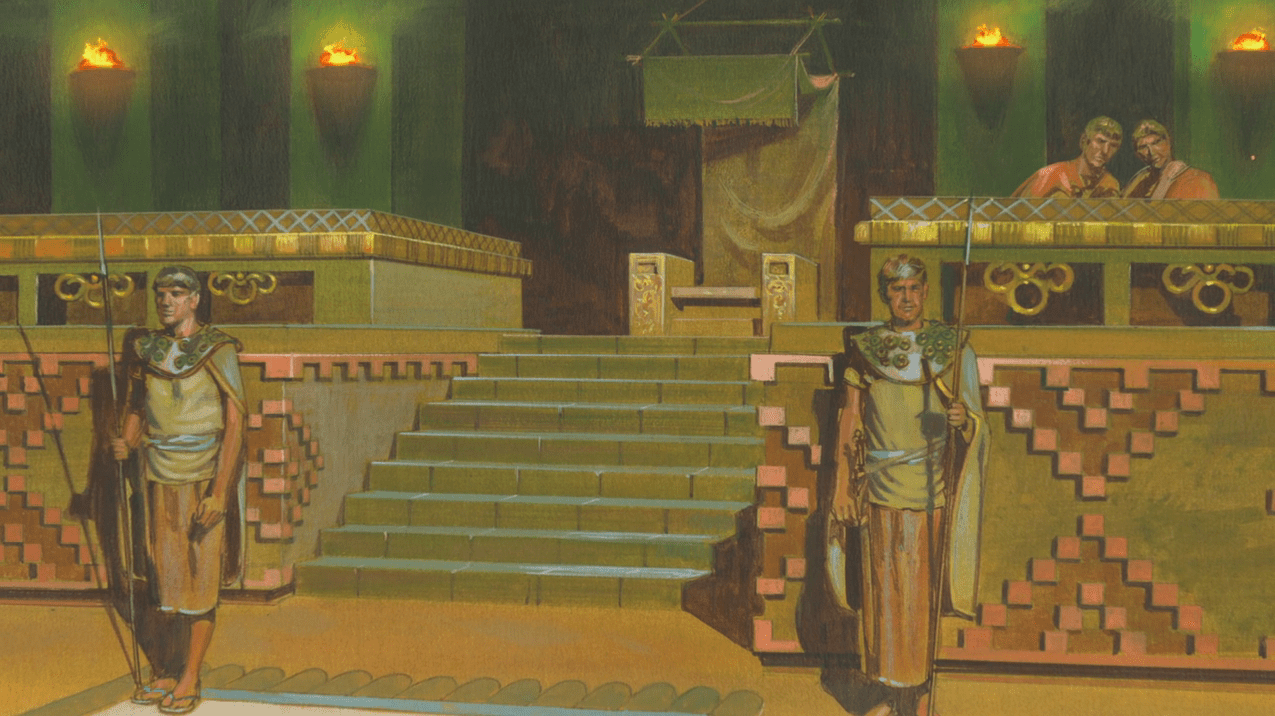
In the distance, torches blazed, surrounding King Noah’s expansive home. The palace sat upon a hill near the reconstructed temple that had originally been built by their ancestor Nephi. The newer walls topped the crumbled ones. It was a scene of contrasts: the wicked had survived and flourished; the righteous had fallen into decay, almost forgotten.
Almost.
The thought sent Abinadi scurrying across the final path, and he breathed a sigh of relief as he reached the last rows of maize. As on many previous nights, he found it easy to blend in with the crops—easier than trying to fit in with the people of King Noah.
In the thin light of the moon, Abinadi made his way through the rows. The breeze had cooled enough that he drew his cloak about his waist and fastened it with a sash. In his mind he went over the new things he’d been taught over the past several moons—specifically the plan of salvation. It made more sense than any doctrine he’d heard from Noah’s priests. And tonight he would recite it for the elders. A shiver traveled along his arms. He knew that the words of God were true, but he wished he didn’t have to speak in front of others. Helam was the one with the gift of speech—yet he rarely appeared at public meetings, preferring to study alone or with the elders only. He also remained hidden in the elders’ settlement, away from curious stares. But the few times Abinadi had heard his brother teach had been astonishing.
Abinadi’s own belief in God was personal, sacred, quiet. He’d rather toil in the fields all night long than preach in front of other people about what was most dear to him. Abinadi moved more quickly, as if running faster would calm his nervous heart. As he reached the edge of the maize field, he moved upward along the sloping hill. He hurried as fast as he dared through the agave vineyards, not wanting to attract attention from the guards. Noah valued his agave wine so much that he’d positioned guards day and night around the spiked plants. But it seemed no guards were in place tonight—a rare occasion possibly due to the marriage celebration.
The smell of the sweet honeylike nectar of the agave accosted Abinadi’s senses. For an instant, he nearly sympathized with Noah’s passion for abundant wine. The sweet aroma made Abinadi want to languish among the plants and let the night slip away uninterrupted. But he pressed forward and soon cleared the heady vineyard. When he entered the line of trees he breathed a second sigh of relief. He was now well out of view of any guards or the odd soldier on the king’s errand.
He slowed when he neared the cave entrance that wasn’t noticeable to the casual observer. But Abinadi knew what he was looking for, so he soon spotted the outline of the narrow opening through the foliage. Quietly he moved to the entrance. Then he picked up a pebble and threw it into the long shaft—the customary announcement of his arrival. He waited for the small rock to be thrown back, a sign that he could safely enter.
A minute passed, then two. Abinadi’s heart started to pound as he thought of reasons why there would be no return pebble. He picked up another and tossed it into the interior, hearing the reverberation of the rock against stone. But no return signal came.
Straining to hear any sound or movement, Abinadi waited several moments, wondering if they’d left. Or perhaps he was early. His pulse drummed as he thought about the final possibility: they’d been discovered and ambushed. What if one of the elders was injured with no one to help?
With his heart thumping against his chest, Abinadi took a few steps into the cave. The sudden cool was expected, but tonight it prickled his skin, seeming to seep into his bones. He spotted a crumpled head covering. As he picked it up, his stomach twisted. Someone had fled this cave quickly. He moved forward again, and a half dozen paces ahead, the walls glowed with firelight. He hoped he was wrong and they just hadn’t heard his signal. With a more confident step, he continued forward, thinking the elders had moved to the blessings. That would explain the delay in signaling him to enter.
The cave was more of a vault, said to have been originally constructed by Fathers Nephi and Jacob to conceal the Liahona, the sword of Laban, and the brass plates. Since then, the vault had been widened into a cavern that could hold several dozen people—perfect for secret meetings. Each time Abinadi entered, he felt as if he were somehow walking on hallowed ground.
As he rounded the bend that opened into the cavern, Abinadi stopped short. A small fire crackled in a pit in the center of the room, but the chamber was empty. Various mats surrounded the fire pit as if they were waiting for their occupants to return. Abinadi spun around, searching for clues.
Abinadi circled the fire, glancing around the empty room, trying to understand where everyone had gone. He crouched against the ground and studied the footprint patterns, seeing nothing unusual. Then he saw a spot of color on the other side of the fire pit. A brilliant green feather lay on the ground. None of the elders or the apprentices wore anything as costly as feathers, which meant that it belonged to an outsider—a wealthy Nephite or . . . a Lamanite.
Abinadi snapped his head up at the realization, then he retrieved the feather and tucked it into his sash, out of sight. With swift strokes he kicked dirt over the fire, then, feeling his way through the new darkness, he moved out of the tunnel toward the fresh night air.
He exited the cave, finally straightening his tall frame outside the low opening. A thud echoed in his ears, and he felt a tremendous pressure on his neck, squeezing so hard that he gasped for air. It took him a second to realize that a pair of strong hands was choking him. He brought his own hands up in defense and tried to wrench away from the assailant. A voice hissed in his ear. “Make another sound and this blade will cut out your heart.”
* * *
Raquel knew she shouldn’t do this week after week, yet as she tied a turban over her head, covering her hair and part of her face, excitement coursed through her. She wore a rough-sewn tunic common to the young boys of the city. She tied a pouch to a rope around her waist—just in case she came across any useful plants. Once a week, Raquel joined the group of shepherds who tended her father’s flocks. Thinking she was just another hired servant, none of the shepherds ever bothered her. And when they spoke to her, she merely answered with a masculine grunt.
It was her one escape from the mundane lifestyle she had to endure day after day. Only her cousin Seth knew her secret. He was the one who’d made the suggestion in the first place after growing tired of hearing her complaints. Her father’s flocks grazed the land just north of King Noah’s vineyards. Typically the flocks required only two or three shepherds to watch, but since a recent raid by the Lamanites, the number of shepherds had doubled. Seth had been called in to help, and Raquel went with him. The threat of the Lamanites only made the adventure more exciting, she decided. Spending time with her younger cousin on a quiet hillside wasn’t nearly as thrilling as listening to the shepherds’ stories of past battles. And now, with the added danger, the shepherds spent most of their time predicting what might happen.
Seth had warned her against coming tonight because of the celebratory nature of the king’s court—the streets would be filled with drunken and brazen men. But Raquel was sure that none of them would bother her if she were dressed as a shepherd boy. A smile, concealed by her scarf, widened across her face as she moved through her parents’ courtyard. All she had to do was make it to the road and no one would be able to tell where she’d come from.
Before leaving the house, she crept through the rear garden and stopped at a small hut that housed the tools for gardening and her herbal collection. She pulled open the reed door, splashing moonlight and illuminating the baskets and jars filled with dried herbs and plants. Raquel’s practiced eyes scanned the contents to see if she was low on any one particular herb, evaluating the groupings of dried hibiscus, apple leaves and magnolia tree leaves, dried papaya, and leaves from the sour orange plant. She peered inside the jar of willow bark. Only two strips left. She’d have to remember to search for more of the pain-relieving bark along the way. Listening for any stirring within the house, she quietly slipped through the garden, around the house, and into the courtyard.
Sticking to the side paths, Raquel hurried along, enjoying the freedom that the lightweight men’s tunic gave her. Her beaded and feathered clothing left at home, she felt as if a burden had been lifted. She only wished that her hands and feet were calloused like the shepherds’. As it was, her feet throbbed with blisters, which she would carefully tend to by applying her homemade guava paste when she returned home from the fields.
Loud laughter rang out a few paces ahead, and Raquel came to an abrupt stop. She hesitated, wondering if she dared pass by the two people who seemed to be embracing. She turned right and made her way through a narrow passageway between two houses. This part of the city was known for its riotous living. She had overheard stories from the servants, and now she marveled to herself, thinking about what her mother would say if she were caught.
“Come inside, young man, I have something special for you.”
Raquel whirled to face the speaker. She was startled to see a tall, beautiful woman standing in front of her. An easy smile crept to the woman’s face.
“Ah, you are inexperienced.” The woman’s eyes took in Raquel’s appearance. “Tonight will be my gift to you.”
Raquel opened her mouth in shock then closed it quickly. She managed to mutter in a deepened voice, “N-no thank you.” She hurried past the woman, her pulse wild with fear. It wouldn’t take much for her identity to be discovered—and to be found in such a place would definitely anger her parents. She shuddered, grateful that the woman didn’t pursue her or send someone after her. Raquel started running, passing the sounds of laughter and music coming from the surrounding buildings.
She nearly vowed not to take this chance again, but still she did not turn for home. If this was to be her last time out, she’d make it worthwhile.