







Sign up for Meridian’s Free Newsletter, please CLICK HERE
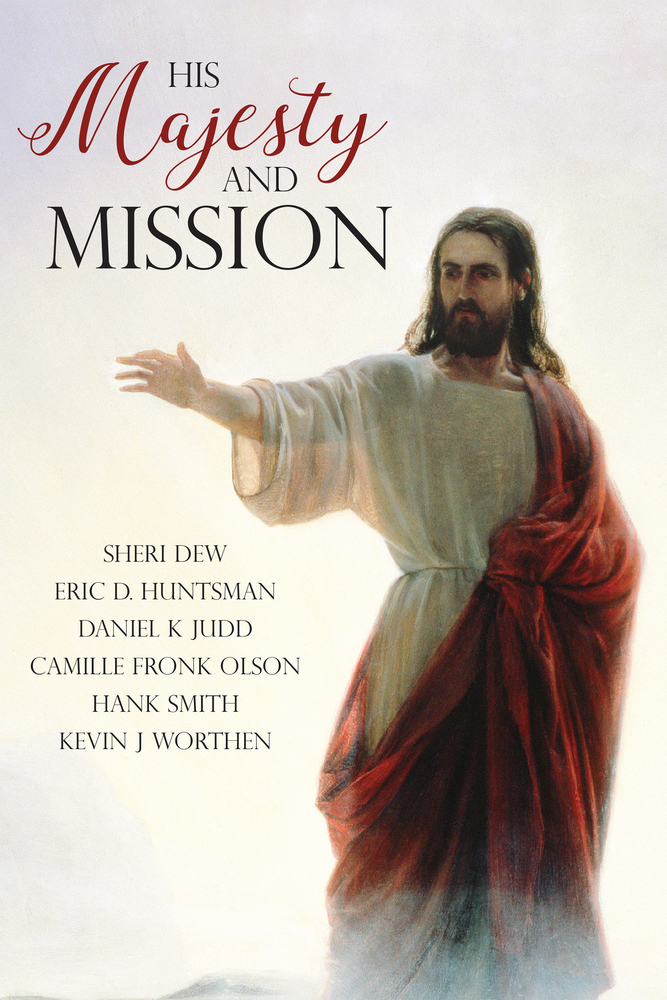
The following is an excerpt from a new book entitled, His Majesty and Mission. It is a compilation of presentations given at BYU’s annual Easter Conferences published by the Religious Studies Center at Brigham Young University in cooperation with Deseret Book. Authors include Sheri Dew, Kevin J. Worthen, Eric D. Huntsman and others.
The following is an excerpt of a presentation by Hank R. Smith, an assistant professor of ancient scripture at BYU.
Click here to get your copy of ‘His Majesty and Mission’.
On the spring morning of Sunday, 20 March 1842, Joseph Smith stood in a grove of trees near the construction site of the Nauvoo Temple. He was speaking to a group of Saints who had gathered to hear him preach on baptism. However, because of the recent death of a young child, a two-year-old girl named Marian S. Lyon, the Prophet had altered his remarks to include thoughts on death and resurrection. At one point in his sermon, the Prophet said, “[We] mourn the loss but we do not mourn as those without hope.”
Joseph’s statement may be taken to mean that in the Church of Jesus Christ of Latter-day Saints we do mourn the deaths of our beloved friends and family members, but we mourn differently than others. One might say we mourn with hope. Where does the hope that Joseph spoke of stem from? The answer to this question is significant. Death is both universal and personal–perhaps more than any other experience in mortal life. All of God’s children must deal with deep loss throughout mortal life, and all must eventually contemplate their own assured death.
The Sting of Death
Each individual has experienced or will experience the aching and sometimes overwhelming grief that comes with the passing of a cherished individual. Our Heavenly Father has given each of us a remarkable mind. With concentration, we can recall in our minds the voices and the laughter of those we love who have died. The human mind’s ability to draw on memories from even decades ago is astounding. In our minds eye, many can still recall a smile of a loved one now passed on or a familiar phrase they would often repeat. Despite the time that has gone by, in a still moment we may hear the voice of a cherished family member or friend echoing across our memories, often with incredible clarity–a voice of a person whom we long to see again, to talk to again, to laugh with again. In such moments we feel both sweet happiness and piercing heartache. These experiences bring to mind the scriptural phrase, “the sting of death”–the deep and inescapable pain of missing terribly a beloved mother or father, grandmother or grandfather, sister or brother, aunt or uncle, a close friend, or perhaps most painful of all, a child.
Jacob, the fifth son of Lehi, described death and hell as a monster. With this unique description, Jacob may teach us, at least in part, why human beings are naturally afraid of death. The word “monster” might take us back to our childhood bedrooms. How is death like the monsters of a dark closet or the dreaded monsters we were sure were lurking under our bed? What is it that children actually fear? Perhaps our fear of a monster was actually fear of the unknown. Without knowing what the monster actually looked like, our young imagination was free to create the most hideous and fearsome creature it could devise. We knew the monster was both powerful and merciless. We knew that no matter how we struggled to fight or how sincerely we cried out for sympathy, the monster could not be stopped and would choose to stop until we were destroyed.
Perhaps Jacob used this description because death may seem both unknown and merciless. The fear of death is natural to our human experience and it, amid other reasons, keeps us striving to stay alive as long as possible. Like children, we feel vulnerable in the face of the unknown, the powerful, and the merciless. Epicurus, the ancient Greek philosopher wrote, “Against all other hazards it is possible for us to gain security for ourselves but so far as death is concerned all os us human beings inhabit a city without walls.” In other words, death brings a sense of vulnerability unmatched by any other fact of life. We stand in its path, completely exposed and without any form of defense.
When we experience the passing of a loved one, we may, in the grip of inescapable grief, even cry out in anguish or anger against the monster of death and hell. Said Ralph Waldo Emerson, “Sorrow makes us all children again–destroys all differences of intellect. The wisest know nothing.” The monster seems to steal our cherished loved ones without remorse.
….
Said Roman poet Horace, “Death with impartial step knocks at the huts of the poor and at the palace of kings.” All humanity will experience death–both as an observer and participant. Sorrow, fear, and despair are the common response, especially to those without knowledge of the plan of salvation. Modern philosopher and Cambridge professor Stephen Dave has said, “We have to live in the knowledge that the worst things that can possibly happen one day surely will, the end of all our projects, our hopes, our dreams, of our individual world. We each live in the shadow of a personal apocalypse. And that’s frightening. It’s terrifying.” British novelist Howard Jacobson wrote, “How do you go on knowing that will never again–not ever, ever–see the person you have loved? How do you survive a single hour, a single minute, a single second of that knowledge? How do you hold yourself together?” Ancient Greek playwright Euripides wrote to a loved one who had passed away, “Come back! Even as a shadow/even as a dream.”
…
Light, Life and Hope
When the people of the Book of Mormon were encompassed in the overwhelming darkness described in 3 Nephi 8, the record states that they were “mourning and howling and weeping” (3 Nephi 8:21). Sometime toward the end of the three days of complete darkness, they heard a voice. Amid the message given to them they heard, “I am Jesus Christ the Son of God…I am the light and the life of the world.” Not long after the voice had spoken, “the darkness dispersed from off the face of the land..and the mourning, and the weeping, and the wailing…did cease; and their mourning was turned into joy, and their lamentations into the praise and thanksgiving unto the Lord Jesus Christ, their Redeemer.”
Not long after, the resurrected Lord appeared to the Nephite people. Their confusion about what was happening slowly turned into comprehension. As they processed the reality of his presence, and all that it meant, they fell to the earth in worship. This was not a dream. This was not a hallucination. It was Jesus Christ. He was right there in front of them to see, hear, and touch. It was overwhelming in every sense. Among many other things, his presence was an irrefutable witness of life after death–his life after death and the life after death of so many loved ones. Annihilation quickly became a myth of yesterday. After this day, all about yesterday would seem like a completely different life. It is no wonder why Elder Jeffrey R. Holland referred to it as “the day of days!”
The Lord Jesus Christ, our Savior and Redeemer, our brother and friend, turns darkness into light and mourning into joy. His entire existence witnesses the reality that death is not the end. Like the first glimmer of dawn turns into a glorious morning sun after the darkest and coldest of nights, he has gloriously risen as the supreme embodiment of light and life. Weeping did endure for a night, but joy has come with the rising Son.
To read the full presentation from Hank R. Smith and the other incredible Easter messages in “His Majesty and Mission“, get your copy by clicking here.