











What is tricky about being a covenant member of Jesus Christ’s church is picking our way through what sometimes appear as competing demands. The reigning virtue of our secular world is tolerance, a virtue that Latter-day Saints would acknowledge as critically important.
We think of tolerance as a friendly, respectful and fair attitude toward others and the different opinions and practices they hold. We have vividly seen what a world looks like without tolerance, when radical jihadists murder or terrorize those who do not hold their opinions or when society is shredded by those who demand that the rest of us see it their way—or else. The wreckage that was once a kosher Jewish shop in Paris and the editorial offices of the Charlie Hebdo are smoldering and terrible reminders of intolerance.
In fact, the Lord’s people look to a much higher virtue than tolerance. In scripture we are not asked to be tolerant. The word tolerance is mostly used to discuss what the Lord won’t tolerate. Instead we are called to the much higher standard of charity.
The New Tolerance
So what is difficult about this? Isn’t this straightforward? So far this doesn’t seem to present competing demands. As Elder Dallin H. Oaks said in a speech, “Balancing Truth and Tolerance, “All persons are brothers and sisters under God, taught within their various religions to love and do good to one another.” He added, “This living with differences is what the gospel of Jesus Christ teaches us we must do.”
Here’s where it gets more complex as we seek to follow these commandments. Tolerance today is not defined in the simple way we used to think. No, today, tolerance, in its new politically correct iteration makes its own demands. The New Tolerance requires that we assent to this: all points of view and behavior are morally equal, normal and justified, especially if it is “authentically” felt by an individual.
This, of course, discounts all truth claims. By this definition it is intolerant to claim that you are guided by a higher truth in your philosophy or behavior. Everyone’s “authentic” voice and sense of morality is posed as equal in a world that claims there is no truth. If there is no absolute truth, how else could you possibly choose between all opinions? Their answer? Truth is not absolute. Truth is relative. You have your truth and I have mine, so all is well.
The Fallout
The fallout in this point of view can mean an alarming loss of discernment. Our daughter was teaching ethics in an eastern university on 9/11, the day the jets crashed into the World Trade Towers. That day as bodies were hurling from the windows to escape the fire, not one of her students could say that what had happened was an “evil act.” Not one! Where all points of view are equal, there is no evil. There is no wrong.
While this new view of tolerance was meant to enlarge our understanding of each other, it presents more pitfalls than can be quickly described. It spawns sentiments like this: “One man’s terrorist is another man’s freedom fighter.” Segments of our society cannot call terrorism what it is.
Another daughter in the Virginia school system was taught about the American Revolution one day and the Haitian revolution the next, while the teachers asserted that they were morally equivalent. Not only did studying the Haitian revolution take away time from more thoroughly understanding the American Revolution, giving both revolutions equal time sent a strong message that neither was based on ideals more important than the other.
Where tolerance is the reigning virtue in a society, every other virtue must yield. We have lost our standard by which to judge what is excellent, praiseworthy, and good.
A Snare
Here are two of the explosives in this minefield. First, we, who so much want to be tolerant, can be blinded to believe that we must condone sin, that we must accept all viewpoints as morally equal. The young may be particularly susceptible to this. They want to please others by “not judging” them as if even righteous judgments based in truth are unacceptable.
Elder Lynn G. Robbins said, “This peer pressure tries to change a person’s attitudes, if not behavior, by making one feel guilty for giving offense. We seek respectful coexistence with those who point fingers, but when this fear of men tempts us to condone sin, it becomes a “snare” according to the book of Proverbs (see Proverbs 29:25). The snare may be cleverly baited to appeal to our compassionate side to tolerate or even approve of something that has been condemned by God.”
Why this New Tolerance is so difficult for believers is described by Elder Oaks. “We believe in absolute truth, including the existence of God and the right and wrong established by His commandments. We know that the existence of God and the existence of absolute truth are fundamental to life on this earth, whether they are believed in or not. We also know that evil exists and that some things are simply, seriously, and everlastingly wrong.”
He continues, “In this troubled circumstance, we who believe in God and the corollary truth of absolute right and wrong have the challenge of living in a godless and increasingly amoral world. In this circumstance, all of us—especially the rising generation—have a duty to stand up and speak out to affirm that God exists and that there are absolute truths that His commandments establish.”
Covenant believers cannot accept this new version of tolerance because of the commitments they’ve made “to stand as witnesses of God at all times and in all things, and in all places” (Mosiah 18:9). We cannot be quiet disciples with soft convictions.
In contrast, according to Elder Oaks, “The weaker one’s belief in God and the fewer one’s moral absolutes, the fewer the occasions when the ideas or practices of others will confront one with the challenge to be tolerant. For example, an atheist has no need to decide what kinds and occasions of profanity or blasphemy can be tolerated and what kinds should be confronted. Persons who don’t believe in God or in absolute truth in moral matters can see themselves as the most tolerant of persons. For them, almost anything goes. This belief system can tolerate almost any behavior and almost any person.”
The New Tolerance is Intolerant
In other words, moral relativists have it easy in this new “tolerant world.” The New Tolerance doesn’t ask them to abandon the same core convictions.
Yet, ironically, there is one place where this New Tolerance becomes blazingly intolerant—that is with Christians who “believe that there is a God who should be respected and that there are moral absolutes that should be observed.” Here the intolerance can range from sneering to punishing, from disdainful to distancing. A believer must be hammered until they see the light and abandon their truth claims.
Oh, how do we negotiate this world? We want to have both conviction and compassion. We want to give tolerance, because we also need the tolerance of others. It is very clear that you can not expect to receive what you are not willing to give. We want to be full of charity, while at the same time stand our ground on truths that cannot bend.
We wonder what does that look like in our day-to-day interaction? What does this mean for our participation in the public square and more important what does it mean as we interact with close family members who have chosen different directions? Of course, we love them and include them, but do we also need to make it clear that we cannot condone or facilitate immoral choices? If so, how do we do it?
It is clearly the Spirit that must guide us through these knotty decisions as we try to give responses that are both compassionate and convicted. Perhaps it is our wrestle with the Spirit to find answers on how to do this in this darkening world that will enable us to be a greater force for Light. We turn with real intent for answers that are not always easy to perceive as we pick our way through these demands upon us.
A Call from a Son
One woman said that her son called to tell her that he’d moved in with his girl friend. This was not entirely surprising news as he’d been making choices far away from what she’d taught him for many years. Still, in that moment she could only respond with silence while a score of possible responses leaped through her mind. This was a son who had stayed close to the family and was close to her. She knew he was sometimes made miserable by his choices. She also knew there were many things he did not tell her because he didn’t want her counsel or implied criticism. What to say?
Certainly not “Congratulations” or “Glad you’ve found someone you like.” Certainly not a note of condemnation. “You know how wrong this is.” If she’d said that the calls from him would quit coming. But then charity—the pure love of Christ—is much bigger and tougher than just being “nice.” Charity is kindness, but being “nice” is a bit squishy and accommodating, so what to say?
Often, the kindest thing you can do is tell the truth. Alma certain did with his straying son, Corianton. Alma said with love and warning, “These things are an abomination in the sight of the Lord (Alma 39:5). But was this one of those times right now? She’s still wrestling with it in prayer. She wants to know what it looks like to be loving and at the same time not condoning.
Christ as Perfect Example
We look to the life of Christ as the perfect example of conviction and compassion. He ate with publicans and sinners—which means, of course, that he was mingling with them in a most personal way. When the woman taken in adultery was thrown at his feet, the Pharisees reminded him that the law stated that she should be stoned, but what did he say. We know the answer well. They may condemn her but he would not. His compassion is clear, but so also is his conviction. “Go, and sin no more.”
As we agonize over how to be both convicted and compassionate, the Church, itself stands as a remarkable example.
Religious Freedom Press Conference
The press conference on religious freedom held recently sounded the alarm that our first freedom in America is being aggressively attacked and contracted, particularly by the LGBT community. We can no longer take our religious freedom for granted as we have too often in the past.
Elder Jeffrey R. Holland spelled out in detail what religious freedom means without apology—which is a far more robust set of freedoms than many want to allow. In many areas these religious freedoms are on a collision course with the rights the LGBT community claims. Still the Church asserts these rights (conviction), but at the same time acknowledges that in many ways the rights of LGBT people have been overlooked and trammeled (compassion).
Elder Holland asserted, “Nothing is achieved if every side resorts to bullying, political point scoring or accusations of bigotry.” He said, “These are serious issues, and they require serious minds engaged in thoughtful, serious discourse.”
The conclusion? “Every citizen’s rights are best guarded when each person and group guards for others those rights they wish guarded for themselves.”
This press conference was not just an assertion of principle, but also a model of how to behave and respond in very difficult circumstances.
The LDS Church Responds to California’s Prop 8
When a constitutional amendment protecting traditional marriage was on the ballot in California, the Church supported it, raising money, training volunteers, and organizing citizens. It was an effort born of conviction.
When some responded by putting graffiti on the wall around the temple and others chose to protest, carrying banners, the missionaries at the temple brought them water and some folding chairs. This was a response born of compassion.
The LDS Church Responds to The Book of Mormon Musical
 To have a book of scripture that is sacred to you turned into a musical that trivializes your beliefs, caricatures your missionaries and blasphemes your God is offensive by anyone’s estimation. How tempting to howl in protest.
This was the LDS Church’s official response:
“The production may attempt to entertain audiences for an evening, but the Book of Mormon as a volume of scripture will change people’s lives forever by bringing them closer to Christ.”
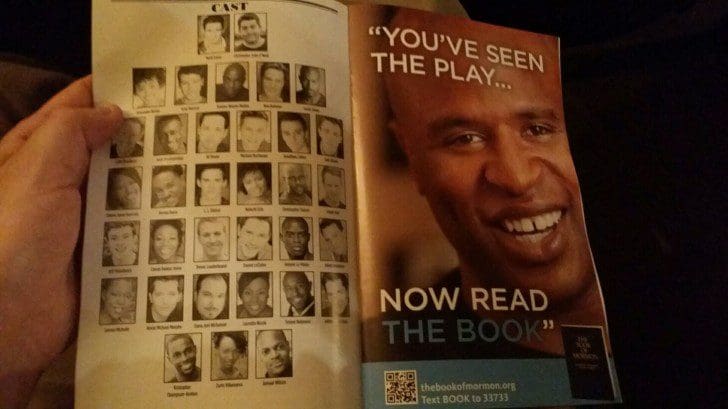
The church took out ads in the Playbill that read, “The book is always better,” and “I’ve read the book.”
Commenting on the violent responses of Muslims when Mohammed was mocked, journalist Jonathan S. Tobin wrote, “The biggest hit on Broadway for the last few years has been The Book of Mormon, a satirical musical comedy that mocks the Church of Jesus Christ of Latter-day Saints. But rather than venting outrage, organizing protests, or seeking to shut down the play in New York or on its national tour, Mormons have commendably turned the other cheek. “
Another journalist, Jim Picht, wrote similarly, “People who go to Broadway to see The Book of Mormon musical don’t fear violent reprisals from angry Mormons. Their greatest danger is that a Mormon missionary might try to hand them an actual copy of The Book of Mormon. Rather than explode in furious indignation, LDS (Latter-day Saint, the church’s preferred term) leaders decided in good humor to piggy back on publicity for the musical and use it as an opportunity to introduce people to actual Mormons.”
In this case compassion taught conviction.
The LDS Church Response to Big Love
Big Love is a television show about fundamentalist polygamists in Utah, and apparently in one episode they attempted to depict parts of the temple ceremony. Here is the LDS Church’s response.
“Certainly Church members are offended when their most sacred practices are misrepresented or presented without context or understanding. Last week some Church members began e-mail chains calling for cancellations of subscriptions to AOL, which, like HBO, is owned by Time Warner. Certainly such a boycott by hundreds of thousands of computer-savvy Latter-day Saints could have an economic impact on the company. Individual Latter-day Saints have the right to take such actions if they choose.
“The Church of Jesus Christ of Latter-day Saints as an institution does not call for boycotts. Such a step would simply generate the kind of controversy that the media loves and in the end would increase audiences for the series. As Elder M. Russell Ballard and Elder Robert D. Hales of the Council of the Twelve Apostles have both said recently, when expressing themselves in the public arena, Latter-day Saints should conduct themselves with dignity and thoughtfulness.
The statement on lds.org said that the HBO series “once again blurs the distinctions between The Church of Jesus Christ of Latter-day Saints and the show’s fictional non-Mormon characters and their practices. Such things say much more about the insensitivities of writers, producers and TV executives than they say about Latter-day Saints.”
It was a response with conviction, but not with any sense of coercion or retribution.
The LDS Church’s Response to Supreme Court’s Ruling Negating Utah’s Marriage Law
When the Supreme Court refused to hear Utah’s appeal to keep its constitutional amendment protecting marriage intact, same-sex marriage became the law in Utah. Here’s the LDS Church’s response:
“The succession of federal court decisions in recent months, culminating in today’s announcement by the Supreme Court, will have no effect on the doctrinal position or practices of The Church of Jesus Christ of Latter-day Saints, which is that only marriage between a man and a woman is acceptable to God. In prizing freedom of conscience and Constitutional guarantees of the free exercise of religion, we will continue to teach that standard and uphold it in our religious practices.
“Nevertheless, respectful coexistence is possible with those with differing values. As far as the civil law is concerned, the courts have spoken. Church leaders will continue to encourage our people to be persons of good will toward all, rejecting persecution of any kind based on race, ethnicity, religious belief or non-belief, and differences in sexual orientation.”
This is Our Time
Conviction and compassion do not need to compete with each other for our allegiance. It is clear that we can be both, but how to do it will require considerable inspiration for each of us.
As Elder Oaks said, “Our Savior also taught that His followers will have tribulation in the world (see John 16:33), that their numbers and dominions will be small (see 1 Nephi 14:12), and that they will be hated because they are not of the world (see John 17:14). But that is our role. We are called to live with other children of God who do not share our faith or our values and who do not have the covenant obligations we have assumed.”
We can do it with grace.




MikeFebruary 4, 2015
Thank you, Maurine. Another well-reasoned article that is substantiated by the teachings of our leaders. In the Journal of Discourses, 23:284-85, Joseph F. Smith teaches that while we are to love all of our brothers and sisters, there are lines of distinction that are appropriately taken so as to protect ourselves, our families, our communities and the Church. Evil, and the purveyors of evil, are the enemies of those things that we hold sacred. While the purveyors of evil must be loved by us, the way that we show our love is different than those who are striving to live in the truth of God's love. While current political, sociological, and psychological thought generally fail to recognize the existence of evil - it is there and should be kept at a safe distance from those things that we hold sacred. The Holy Ghost helps us to understand where those boundaries exist.
hollandparkFebruary 4, 2015
It is most important that we teach youth/young adults what Maurine has outlined here. They, as a group, are being swept along into believing there is nothing wrong with SSM and that we should be tolerant of all things LGBT. There ARE absolutes but we, for our safety, must be careful how and where we engage the 'the other side'. They are just licking their lips waiting for chances to try to take us on and take us down. Pres. Hinckley said: "As the work grows, we may expect a strengthening of the efforts of the adversary against it. Our best defense is the quiet offense of allegiance to the teachings which have come to us from those whom we have sustained as prophets of God. The Prophet Joseph Smith gave us instruction pertinent to the situation in which we find ourselves. Said he: “Go in all meekness, in sobriety, and preach Jesus Christ and Him crucified; not to contend with others on account of their faith, or systems of religion, but pursue a steady course. This I delivered by way of commandment; and all who observe it not, will pull down persecution upon their heads, while those who do, shall always be filled with the Holy Ghost; this I pronounced as a prophecy.” ....There need be nothing of argument or contention in any of them. If we will pursue a steady course in the implementation of our religion in our own lives, we shall advance the cause more effectively than by any other means. There may be those who will seek to tempt us away. There may be those who will try to bait us. We may be disparaged. We may be belittled. We may be inveighed against. We may be caricatured before the world. There are those, both in the Church and out, who would compel us to change our position on some matters, as if it were our prerogative to usurp authority which belongs alone to God. We have no desire to quarrel with others. We teach the gospel of peace. But we cannot forsake the word of the Lord as it has come to us through men whom we have sustained as prophets. We must stand and say...“This is what I believe. This I will do and that I will not do. This is my code of behavior and that is outside it." Ensign Jan. 2005