“Crawling Over, Under, or Around Section 132”: The Debate Over Joseph Smith and Polygamy

Among the criticisms that I’ve seen of our Becoming Brigham series is one that blames Brigham Young for the invention of nineteenth-century Latter-day Saint plural marriage. The accusation tends, I think, to be made by people who want to preserve their trust in Joseph Smith but who cannot abide polygamy.
For many of those who want to distance Joseph from the idea and practice of plural marriage, Brigham Young and the Quorum of the Twelve have become the fall-guys. Some allege that he, or others working with and for him, forged Doctrine and Covenants 132 in whole or in part, and that their motive was to establish polygamy within the Church.
Some even accuse John Taylor and Willard Richards, rather than the anti-Mormon mob in Carthage, Illinois, of having murdered Joseph Smith and his brother, Hyrum—acting on orders of Brigham Young. Curiously, during their trial for the murders at Carthage Jail, the members and instigators of that mob failed to mention that the Smiths had been killed by somebody else. Several of them even boasted of their own participation in the crime.
The motivation of those who want to blame Brigham Young for polygamy is scarcely difficult to understand: Plural marriage is an uncomfortable idea for many, even within the Church of Jesus Christ of Latter-day Saints and not only for women. There was opposition to it from its beginning.
Brigham Young himself, although he later became famous—and, outside the Church, notorious—for his practice of “the Principle,” is reported to have expressed deep emotional distress upon first learning of plural marriage. (We should remember that this was in the early Victorian Era, with all that that term implies.) “It was,” Brigham later remembered, “the first time in my life that I had desired the grave” and he recalled that he “had to pray unceasingly” before he came to accept it.
Those who seek to exonerate Joseph Smith and to blame Brigham Young for plural marriage are sometimes called “polygamy deniers.” But that term may be a bit confusing, because they don’t actually deny that polygamy was practiced among early Church members.
A more accurate term might be “polygamy revisionists,” since they hope to revise the common understanding among Latter-day Saints and historians of the Restoration (both Latter-day Saints and nonmembers) of how polygamy came to be practiced among early members of the Church. They deny that Joseph ever practiced polygamy and insist that, in fact, he fought against it.
The practice of polygamy in the Church, they claim, was promoted after Joseph’s death by Brigham Young and carried on by his successors, all of whom are complicit in the deception and some of whom were actually guilty of murder.
The charge that Brigham Young, John Taylor, and Willard Richards conspired to assassinate the Prophet and the Patriarch is, in my judgment and in that of every historian with whom I’ve spoken on the subject, simply daft (as the English might say). With regard to the documentary evidence for Joseph’s not having practiced polygamy, though, the revisionists aren’t entirely without evidence on their side. It seems to support their position, at least superficially and at first glance.
They point out, for example, that every relevant revelation and statement on Church policy that was published during Joseph Smith’s lifetime prohibited polygamy, including the 1844 edition of the Doctrine and Covenants that was at the press when he was martyred in June 1844. He certainly never publicly endorsed plural marriage.
Moreover, on several occasions, especially late in his life, Joseph denied being involved in secret polygamy. And not only that: He seems to have investigated and disciplined those in the church who were engaged in it. Surely, argue the polygamy revisionists, the Prophet wouldn’t have denied plural marriage and even fought against it while, at the same time, he was actually practicing it.
Furthermore, Joseph’s surviving immediate family denied that he had other wives. Emma Smith, in particular, was adamant that she was his only wife. His son Joseph Smith III, who was eleven years old at the time of the martyrdom, also knew nothing of his father having plural wives or having quarreled with Emma over the issue.
Another argument that is central to the claim that Joseph Smith had no connection with plural marriage is the text of Doctrine and Covenants 132, because it’s the only thing that Joseph purportedly said on the subject. Significantly, though, the handwriting of the document that we know as Section 132 isn’t Joseph’s. Even believers in the revelation’s authenticity acknowledge that it was dictated to William Clayton, then copied by Joseph Kingsbury for Newel K. Whitney, who later delivered the copy to Brigham Young.
And this complex chain of custody, coupled with the handwriting issue, definitely leaves room for speculation that the words of the revelation are not those of Joseph Smith. Thus, some polygamy revisionists denounce Doctrine and Covenants 132 as a “complete fabrication.”
Furthermore, they declare their subjective confidence that the style of Section 132 simply doesn’t sound like Joseph Smith’s. Rather, they declare, it sounds like Brigham Young. Or, anyway, like somebody—perhaps William Clayton—other than Joseph.
Accordingly, in some of the correspondence and comments that have been directed at me, and more generally, Brigham is dismissed by some as too wicked a man to defend—or, perhaps better, as so wicked a man that he should be condemned and rejected.
However, a few who take this position will still admit the possibility that priesthood keys and authority might be transmitted through so evil a person and that, in fact and given his other obvious gifts, he might even have been the Lord’s choice to lead the Church in his day. As several such people have told me, “God can work through evil men.”
Well, of course the Lord works through imperfect people. That’s a trivial observation, though, since no other people are on offer. As the late Elder Jeffrey R. Holland put it in his April 2013 General Conference address, “Except in the case of His only perfect Begotten Son, imperfect people are all God has ever had to work with. That must be terribly frustrating to Him, but He deals with it. So should we.”
But I’m here to stand with Brigham Young. He was a prophet of God, and I will not look idly on while he’s traduced and maligned.
The case against Joseph Smith’s involvement in plural marriage, while superficially plausible, doesn’t hold up well to close scrutiny—which is why even scholars and leaders of the Community of Christ, formerly known as the Reorganized Church of Jesus Christ of Latter Day Saints, an organization that was founded in part out of opposition to plural marriage, now (disapprovingly) admit Joseph’s practice of it.
There are simply too many witnesses, including Joseph’s plural wives, whose testimony is impossible to dismiss. When it is said that Joseph Smith opposed plural marriage, it should be clarified that he fought against unauthorized abuses of the idea: John C. Bennett, for instance, used it immorally as a tool of seduction.
And, while it’s true that we have nothing in Joseph’s hand that endorses polygamy, the fact is that we actually possess very little that was written by the hand of Joseph—about anything at all.
But if Joseph Smith is, in fact, the earthly author of Doctrine and Covenants 132, efforts to prove that he never advocated or engaged in polygamy are futile. It makes no difference, for example, that—as seems, thus far, to be the case—Joseph has no known genetic descendants by any other wife but Emma.
If Joseph actually wrote Section 132 and, thereafter, simply kept the revelation and the practice of polygamy private, speaking about it only among a limited number of close confidants, his public denials of plural marriage ultimately mean nothing, and the revisionists’ argument fails. And he had sufficient reason to keep these matters private: The Illinois Criminal Code would not have recognized plural marriage, and Joseph Smith may have believed that he could not be prosecuted for adultery or fornication so long as the practice of polygamy was not, in the phrasing of the law, “open and notorious.”
It would scarcely have been prudent on his part, however divinely authorized he may have felt himself to be, to openly advocate polygamy or to publicly proclaim Section 132. It wasn’t until 28 August 1852, when the Latter-day Saints were safely isolated in their own federally recognized Utah Territory, that the Church officially and openly announced the practice of plural marriage.
The first revelation regarding polygamy seems to have been given in 1831. It may, of course, be pure coincidence that members of the Church were being accused of polygamy at just about that time.
According to Brian and Laura Hales, the “Evangelical Magazine and Gospel Advocate,” printed in Utica, New York, leveled the charge in its issue dated 5 February 1831. And it may be mere coincidence that, as they observe, “Joseph Smith was working with Genesis in February and March of 1831, where he would have found accounts of polygamous patriarchs like Abraham and Jacob.”
Furthermore, they note an 1883 recollection from Joseph B. Noble, who reported the Prophet Joseph’s saying that the doctrine of celestial marriage had been revealed to him while he was engaged in translating the scriptures, but that the Lord had also told him that the time for the practice of that principle had not arrived. After careful analysis, independent historian Don Bradley has concluded that the first plural marriage took place in mid-1836.
In my judgment, the notion that Brigham Young and his henchmen forged Section 132 was dealt a devastating blow by the still relatively-recent publication of Paul Fields, Steven T. Densley Jr., Matthew Roper, and Larry Bassist, “Historical and Stylometric Evidence for the Authorship of Doctrine and Covenants 132,” Interpreter: A Journal of Latter-day Saint Faith and Scholarship 67 (2025) : 1-70.
The paper is divided into three portions. The first, “Current Controversy About the Authorship,” summarizes the arguments that polygamy revisionists have been making.
The second, “Historical Evidence for Authorship,” demonstrates that the revelation was known among both those who accepted it and those who rejected it during the lifetime of Joseph Smith, and that they believed that it came from him.
Part Three, “Authorial Stylometric Analysis,” deploys sophisticated statistical tools that render it very difficult indeed to maintain that anybody other than Joseph Smith Jr. was the earthly author of the entirety of Doctrine and Covenants 132. Indeed, the closest stylometric match found for Section 132 is the early canonized revelations in the Doctrine and Covenants—which matches very well Joseph’s apparent claim to have received the revelation on plural marriage in the early 1830s.
If Fields, Densley, Roper, and Bassist are right, the text that we know as Doctrine and Covenants 132 was already widely known to exist among the inner circles of the Church in essentially its current form during the lifetime of Joseph Smith and it most likely came through Joseph Smith. Which, if true, is fatal to claims that Joseph wasn’t involved with the origination of plural marriage.
As the first part of the article itself concludes, “While those who claim that Joseph Smith never supported polygamy argue that there is no evidence directly from Joseph Smith in this regard, the obvious rejoinder to this is that section 132 came through Joseph Smith. To paraphrase what Elder Jeffrey R. Holland said about the Book of Mormon, if someone is to take the position that Joseph Smith was not a polygamist, it must be done by crawling over, under, or around section 132.”
**
For further details and arguments, see Paul Fields, Steven T. Densley Jr., Matthew Roper, and Larry Bassist, “Historical and Stylometric Evidence for the Authorship of Doctrine and Covenants 132,” Interpreter: A Journal of Latter-day Saint Faith and Scholarship 67 (2025): 1-70. (https://interpreterfoundation.org/journal/historical-and-stylometric-evidence-for-the-authorship-of-doctrine-and-covenants-132)
Other and perhaps more immediately accessible expositions of the arguments advanced by Fields et al., are
“The Stylometry of Doctrine and Covenants 132,” a brief written summary by Kyler Rasmussen (https://interpreterfoundation.org/interpreting-interpreter-the-stylometry-of-doctrine-and-covenants-132)
“The Stylometry of Doctrine and Covenants 132,” a brief summary video by Kyler Rasmussen (https://www.youtube.com/shorts/4P5jyw12xuE)
“New Research on Joseph Smith & Brigham Young | What We Found in Section 132,” a 55-minute interview with Paul Fields on Let’s Get Real with Stephen Jones (https://www.youtube.com/watch?v=u64NQos-zIA)
For a dramatic film about the succession of Brigham Young and the Twelve to the leadership of the Church of Jesus Christ of Latter-day Saints, see Six Days in August (https://witnessesfilm.com/six-days-in-august-official-site/). An ongoing series of short documentary features about Brigham Young and the rise of the apostles is appearing at becomingbrigham.com.
Becoming Brigham, Episode 14 — The Prophet’s Shadow
How did Brigham Young come to accept radical doctrines like the three degrees of glory and plural marriage when they initially shocked him? Why was Brigham Young willing to follow Joseph Smith even when he didn’t fully understand or even like what Joseph was teaching? What would the Church of Jesus Christ of Latter-day Saints look like today without Brigham Young’s absolute loyalty to the Prophet Joseph Smith?
John Wilson continues his conversation with historian Dr. Gerrit Dirkmaat. They explore Brigham Young’s deep, unwavering loyalty to Joseph Smith and how it shaped his life and leadership. The discussion highlights how Brigham wrestled with some of Joseph’s most radical doctrines, such as the three degrees of glory, baptism for the dead, and plural marriage. Even when these teachings conflicted with his previous beliefs, Brigham ultimately chose to accept them because they came through the Prophet Joseph Smith.
Becoming Brigham: The Video Series Premieres

For well over a year now, Redbrick Filmworks and the Interpreter Foundation have been working on a series of mini-documentaries bearing the title “Becoming Brigham.” The first episode goes live today, Monday, 26 January, at noon. (And one of the places where it will be accessible is right here at “Meridian Magazine.”). Further installments will appear on successive Mondays. Each episode—of which there will eventually be about 70 or 75—will run approximately fifteen minutes.
They’re hosted by Camrey Bagley Fox, who portrayed Emma Smith in the Interpreter Foundation’s 2021 dramatic film “Witnesses” and its 2024 film “Six Days in August”; by John Donovan Wilson, who played Brigham Young in the latter film; and by a retired Brigham Young University professor of Islamic studies and Arabic who shall remain nameless lest potential audiences be dissuaded from watching. Each episode features footage shot on location in New York, Ohio, Illinois, Iowa, Nebraska, and Utah, as well as extensive interviews with numerous Latter-day Saint historians who are experts on the subjects being discussed.
In fact, one of the most pleasant aspects of the project has been the wonderful support that it’s received from the Church History Department in Salt Lake City and from the overseers of the historical sites where filming has been done. The creators of “Becoming Brigham” have worked closely with Brent Rogers,
Managing Historian of the Church History Department, and have thus far completed interviews with such scholars as Thomas G. Alexander, James B. Allen, Susan Easton Black, LaJean Carruth, Gerrit Dirkmaat, Brett Dowdle, Ron Esplin, Matt Godfrey, Casey Griffiths, Brittany Chapman Nash, Reid Neilson, John Peterson, Paul Reeve, and Lisa Olsen Tait.
What’s behind the project? A significant factor behind it comes from my disappointment, over the past two or three years, at encountering active members of the Church of Jesus Christ of Latter-day Saints who disparage Brigham Young, the Church’s second president.
Some seem compelled to open any discussion of Brigham by describing him as “flawed.” And in an important sense, of course, this is surely true: Jesus Christ excepted, we’re all flawed—including Brigham’s critics. He certainly didn’t claim perfection for himself. “There are weaknesses manifested in men that I am bound to forgive,” he said on one occasion in 1860. “I am right there myself. I am liable to mistakes,” he continued, acknowledging that he was just as set in his feelings as any man alive, but, he said, “I am where I can see the light. I try to keep in the light.”
Often, the clear insinuation of describing Brigham as flawed seems to be that he was somehow uniquely flawed. Trying to reassure me that, despite his imperfections, they still accept him as the Lord’s instrument in his day, some people have explained to me that, well, God can work through wicked men. But I object to such statements. While he surely had his limitations and his flaws, Brigham Young wasn’t a wicked man. He was a good man.
Some go beyond merely talking him down. There are those who say that Brigham Young and the Quorum of the Twelve engineered an “apostolic coup” to usurp leadership of the Church. One active Church member told me that Sidney Rigdon should have assumed the presidency (or, as Sidney liked to call it, the “guardianship”) instead, but was tragically cast aside by the machinations of Brigham and the apostles. A few former members even assert that it was Brigham Young, using John Taylor and Willard Richards as his “hit men,” who planned the death of Joseph and Hyrum Smith at Carthage Jail—perhaps so they could forge Doctrine and Covenants 132 and impose plural marriage upon the Church. This would be mere laughable nonsense—no serious historian of whom I’m aware accepts it—if it weren’t so repugnant, slanderous, and evil. (The mob and the Carthage Greys must have been surprised and baffled when, having arrived to murder Joseph and Hyrum, they found that Elders Taylor and Richards had already done the killing. But they kept the secret throughout their lives, even when some of them were on trial for the crime. Amazing? No, ludicrous.)
The real historical Brigham Young was the last man who would ever have raised his hand against Joseph Smith. He was absolutely dedicated to the Prophet, both before and after the martyrdom in 1844.
An important scene in the Interpreter Foundation’s 2024 feature film “Six Days in August,” solidly rooted in history, beautifully illustrates his dedication. It depicts Brigham and Heber and others traveling secretly to Far West, Missouri, in obedience to Doctrine and Covenants 115:11 and 118:5, which directed them to depart for their mission to England from the temple site there on 26 April 1839. Such direction made perfect sense when the Saints were still located in Missouri. On 27 October 1838, however, Missouri’s governor, Lilburn W. Boggs, had issued his infamous “extermination order” against the Latter-day Saints and, by April 1839, the Church was gathering to western Illinois. Thus, returning to Far West for a departure to England made little earthly sense—it was in the wrong direction, for one thing—and, in fact, being there as a Latter-day Saint was extraordinarily dangerous. For Brigham and Heber and their companions, though, if Joseph Smith said to depart from Far West, they would do it.
In the early days of the Church, many once-faithful Saints fell away because they would no longer sustain Joseph as the Lord’s anointed prophet. In fact, Joseph said of the leaders in Kirtland that there were only two who had never “lifted their heel” against him—”namely Brigham Young and Heber C. Kimball.” (Heber C. Kimball, of course, was Brigham’s closest friend, even before their joining the Church, and eventually served as Brigham’s first counselor in the Church’s First Presidency.)
Another famous story illustrates Brigham’s deference to the Prophet Joseph. On one occasion, Joseph severely rebuked Brigham—who, you may recall, eventually came (for good reason) to be known as “the Lion of the Lord.” After the Prophet’s chastisement, everyone in the room waited for Brigham’s response, perhaps expecting an eruption. But his reply was, sincerely and simply, “Joseph, what do you want me to do?”
“I felt in those days,” Brigham later recalled of the time before he encountered the Book of Mormon and the Church, “that if I could see the face of a prophet, such as had lived on the earth in former times, a man that had revelations, to whom the heavens were opened, who knew God and his character, I would freely circumscribe the earth on my hands and knees.” And, in Joseph, he knew that he had found such a man.
“I know how I received the knowledge that I have got,” Brigham reflected in 1866. Remembering his early years with Joseph, he said “I had but one prayer, and I offered that all the time. And that was that I might be permitted to hear Joseph speak on doctrine, and see his mind reach out untrammeled to grasp the deep things of God.” Of his own relationship to Joseph, Brigham said that “an angel never watched him closer” and that he “would constantly watch him and if possible learn doctrine and principle beyond that which he expressed.” It required several years of this close attention to the Prophet, he declared with a bit of exaggeration, “before I pretended to open my mouth to speak at all.” Brigham Young took care never to “let an opportunity pass of getting with the Prophet Joseph and of hearing him speak in public or in private, so that I might draw understanding from the fountain from which he spoke.” “This,” he insisted, “is the secret of the success of your humble servant.”
Brigham Young often spoke of Joseph and his work: “I honor and revere the name of Joseph Smith,” he said in 1870. “I delight to hear it; I love it. I love his doctrine.” “I feel like shouting hallelujah, all the time,” he said in 1855, “when I think that I ever knew Joseph Smith, the Prophet whom the Lord raised up and ordained.” “I am bold to say,” he testified in 1862, “that, Jesus Christ excepted, no better man ever lived or does live upon this earth. I am his witness.”
On his deathbed, according to reports, the last words uttered by Brigham Young were “Joseph! Joseph! Joseph! Joseph!” If this is true, it wouldn’t surprise me to learn that the Prophet personally came to welcome his great successor and faithful disciple into the next world. Intriguingly, in this context, it’s reported that Emma Smith’s last words, spoken in Nauvoo on 30 April 1879, were, “Joseph! Joseph! Joseph!” and “Joseph, I am coming!” Just days before her death, she said that she had seen him in a dream, along with their deceased son Don Carlos and the Savior. Joseph, she said, took her to a beautiful mansion and promised her that she would have all of her children in the world to come.
One of the themes that have emerged from the making of “Becoming Brigham” is that, as the historian Ronald K. Esplin says in an interview for the series, among all the claimants to Church leadership who emerged after the murders of Joseph and Hyrum in mid-1844, it was only Brigham and the Twelve who wanted to carry out the full program and carry on the teachings that Joseph had laid out in Nauvoo. Prominent elements of Joseph’s agenda were the completion of the temple and, somewhat paradoxically, forsaking it for the Great Basin West. No other claimant to the succession—including Sidney Rigdon—was so committed to moving forward with those goals. And (no small point!) it was with the Twelve that the keys of priesthood authority resided after the deaths of Joseph and Hyrum.
On 8 August 1844, in the dark days following the martyrdom of the Prophet and the Patriarch, Brigham made this clear to the Saints, “You cannot appoint a prophet,” he said, “but if you let the Twelve remain and act in their place, the keys of the kingdom are with them and they can manage the affairs of the church and direct all things aright.”
Brigham Young and his fellow apostles understood the importance of completing the Nauvoo Temple, as many other would-be leaders (including, apparently, Sidney Rigdon) did not. But it wasn’t only a legacy project for them, an inheritance from their departed friend, Joseph Smith. And the challenges and threats from enemies of the Saints continued, while the pressure on them mounted to abandon Nauvoo and to leave. As the chief apostle, Brigham sought and received revelation. Having inquired of the Lord whether they should stay and finish the temple, he recorded simply in his diary for 24 January 1845: “The answer was we should.”
As President James E. Faust observed, Brigham Young had unwavering confidence in what he was doing because he knew that the plan was not his own. As he told the Saints nearly a decade after their arrival in the Valley of the Great Salt Lake, “I did not devise the great scheme of the Lord’s opening the way to send this people to these mountains.” Well then, who did? “It was the power of God that wrought out salvation for this people,” he insisted. “I never could have devised such a plan.” As one nineteenth-century non-Latter-day Saint visitor to his office recorded (and as others also noted), Brigham had remarkable self-confidence and “absolute certainty of himself and his own opinions.”
“Becoming Brigham” is an attempt to portray Brigham’s earliest encounter with the Restoration, his conversion, his training as an apostle for eventual leadership of the Church, the rise of the Twelve from their initial role as an outwardly-oriented missionary quorum to their eventual leadership of the overall Church. It will discuss Brigham Young’s presidency of the Church, including unvarnished examinations of controversial issues such as violence in Utah Territory (e.g., the notorious Mountain Meadows Massacre), race and slavery, relations with Native Americans, and plural marriage.
It relies upon the best available research concerning Brigham Young and the Twelve to provide a picture of the man that differs from the image in many minds. When I was growing up, I knew of Brigham as the great colonizer, a practical man, an organizational genius. But there was much more to him than that. As the late historian D. Michael Quinn pointed out, “One of the recurring themes in non-Mormon biographies of President Brigham Young is the idea that he was not a very spiritual man. Such interpretations, however, not only misrepresent his character, they also totally disregard the evidence, both published and unpublished, that refutes such a stereotype.”
Nor is the image of Brigham as harsh, callous, and autocratic true to the historical record. “Those of us who have worked with Brigham Young’s words,” says LaJean Carruth in an interview for “Becoming Brigham,” “we see a completely different man, a kinder man. A caring man. A loving man. . . . He wanted to serve God, and he strove with everything he had to lead the Saints.”
“I came to know a man,” says Ron Esplin, “whose heart was with the Lord from the very beginning. . . . He believed in Jesus. He believed enough to follow a disciple of Jesus named Joseph Smith.” As Lisa Olsen Tait puts it, “I do think that Brigham Young, fundamentally at the core of his soul, wanted people to flourish . . . and the way that would happen was by embracing the gospel of Jesus Christ . . . . I kind of like Brigham Young, actually. I think he’s very down-to-earth. I think he’s very human.” “And the people who knew these people best,” says Gerrit Dirkmaat, “like the people who knew Joseph, the people who knew Brigham, well, they’re the ones who are certain that they’re prophets.”
Members of the Church of Jesus Christ of Latter-day Saints today who disparage Brigham Young’s character and divinely-ordained leadership, whether they realize it or not, are sawing away at the branch of the tree on which they themselves sit, the line through which modern priesthood authority and temple ordinances come.
Modern prophets and apostles know better: President Gordon B. Hinckley, for example, kept a portrait of Brigham directly behind his desk, finding strength and inspiration in contemplating it. He often referred to the portrait, commenting that Brigham seemed to “watch over” the work of the Church.
But those who disdain Brigham Young aren’t wrong because accepting their opinions would have bad implications for the Church. They’re wrong because they’re wrong.
**
Several of the quotations used above may be found, with supporting references, in an excellent speech by President James E. Faust, entitled “Brigham Young: A Bold Prophet” (https://speeches.byu.edu/talks/james-e-faust/brigham-young-bold-prophet/).
A Great Question: What DO We Believe? The Articles of Faith and Official Declarations 1 and 2

Scot
We know that the Prophet Joseph Smith wrote the Articles of Faith as part of a larger request from Mr. John Wentworth, editor and proprietor of the Chicago Democrat, a brand-new newspaper in the young, bustling city of Chicago. The Democrat would be published for just seven years, from 1842 to 1849. Mr. Wentworth wanted a concise history of the fledgling Church of Jesus Christ of Latter-day Saints and he wanted it written by its founder, Joseph Smith. The piece was also to be a part of the history of New Hampshire, being compiled by a Mr. George Barstow, a friend of John Wentworth. Joseph agreed to write the piece with this agreement: “As Mr. Barstow has taken the proper steps to obtain correct information, all that I shall ask at his hands is that he publish the account entire, ungarnished, and without misrepresentation.” Joseph carefully compiled the letter but it was never published in the newspaper or any history of New Hampshire. But this letter has become one of the great treasures of Church History.
Maurine
Welcome to Meridian Magazine’s Come Follow Me Podcast. We are Scot and Maurine Proctor and we are delighted to be with you again this week. We’ve entitled this lesson: A Great Question: What DO we believe? and this covers the Articles of Faith and Official Declarations 1 and 2.
One of the ways we support this podcast is through the yearly sale of Come Follow Me calendars. They are simply beautiful and the one for this coming Old Testament year truly sends you back to that ancient world where the Old Testament happens. These feature Scot’s remarkable photography with the Come Follow Me lessons for each week listed so you can help yourself keep track. They are a great gift for all those many people you’d like to give a meaningful gift to, but you don’t know what to do. Order as many as you’d like at flat rate shipping. Now that’s a deal. Go to latterdaysaintmag.com/2026. That’s latterdaysaintmag.com/2026.
Scot
I’ve always loved the Articles of Faith. Haven’t you? Those of you who grew up in the Church, didn’t you memorize all 13 of them in primary? I had the wonderful privilege of having my angel mother, Martha Proctor, teach me these amazing lines of doctrinal teaching. I want us to explore a little background about the Articles of Faith and then talk about some of the doctrines they underline. I remember once, Maurine, when some of my classmates in Rolla, Missouri, during lunch time, questioned what I believed as a Mormon (as we called ourselves in those bygone days). You have to understand that in our little town of 11,320 people, there were fifty-four different religious denominations. Four or five of my evangelical friends asked me what we really believed—but it wasn’t in a “I’d really like to understand you and your religion better” kind of way. It was like, “You are bizarre and freaky and who are you anyway” sort of way—a complete view of ignorance. I said, “Well, first of all, We believe in God the Eternal Father, and in His Son, Jesus Christ, and in the Holy Ghost.” That kind of got their attention. They said, “Yeah, well we believe in them too.” I said, “I know you do and We believe that men will be punished for their own sins, and not for Adam’s transgression.” They started staring at me, a little dumbfounded. I don’t think they really expected me to actually answer the question they had posed. They just wanted to create some contention. I continued, “We believe that through the Atonement of Christ, all mankind may be saved, by obedience to the laws and ordinances of the Gospel.” Okay, they stopped questioning me and made body language like they were done. I caught them in their motions to move and said, “We also believe that the first principles and ordinances of the Gospel are: first, Faith in the Lord Jesus Christ; second, Repentance; third, Baptism by immersion for the remission of sins; fourth, Laying on of hands for the gift of the Holy Ghost.” I wish you could have seen their faces at this point. I understood for the first time what the words confounded and dumbfounded meant. They were speechless and started to leave, I told them I had plenty more to tell them, but they said, “thanks, but we understand now,” and they left. And they never questioned me again. These statements of pure truth and doctrine are powerful.
Maurine
I love that story because these truly are salient, concise, perfect truths combined into powerful sentences and statements that teach our doctrines perfectly. And, if you look carefully at these 13 Articles of Faith, we see that Joseph covered these doctrines and teachings:
- The Godhead
- The Fall
- The Atonement
- The Saving Ordinances
- Priesthood Authority
- The Divine Organization of the Church
- Spiritual Gifts
- The Holy Canon of Scripture
- Continuing Revelation
- The Covenants made with Israel
- Religious Freedom
- Submission to Law
- The Godly Attributes
This is a lot of heavy material to put in just 411 words! And I think it’s interesting to understand that some articles of faith had been worked on and compiled by other leaders of the Church for eight years before Joseph published his. Oliver Cowdery made an attempt in 1834 and published them in the Messenger and Advocate. Oliver was known for his beautiful prose and eloquent language. Listen to Oliver’s approach to the doctrine of the Godhead:
“[1] We believe in God, and his Son Jesus Christ. We believe that God, from the beginning, revealed himself to man; and that whenever he has had a people on earth, he always has revealed himself to them by the Holy Ghost, the ministering of angels, or his own voice.
Of course, all of that is true and beautiful. But when Joseph was asked to give a short history of The Church of Jesus Christ of Latter-day Saints and to talk about its beliefs, he had to be more concise and right to the point in all areas.
Scot
Well, and Maurine, that point is well taken when we read Orson Pratt’s article of faith on the Atonement in 1840. Listen to this and think about Primary children memorizing this one:
“[3] We believe, that through the sufferings, death, and atonement of Jesus Christ, all mankind, without one exception, are to be completely, and fully redeemed, both body and spirit from the endless banishment and curse, to which they were consigned, by Adam’s transgression. … After this full, complete, and universal redemption, restoration, and salvation of the whole of Adam’s race, through the atonement of Jesus Christ, without faith, repentance, baptism, or any other works, then, all and every one of them, will enjoy eternal life and happiness, never more to be banished from the presence of God, if they themselves have committed no sin. …” (Orson Pratt, Interesting Account of Several Remarkable Visions and of the Late Discovery of Ancient American Record, 1840) Try putting that one to primary music! Of course, if Janice Kapp Perry is listening, knowing her, I’m sure she could and it would become a favorite.
I think Elder B.H. Roberts (by the way, B.H. stands for Brigham Henry) summed it up wonderfully when he wrote about the Prophet Joseph’s Wentworth letter, of which the Articles of Faith were the final words: “The letter is one of the choicest documents in our church literature; as also it is the earliest published document by the Prophet personally, making any pretension to consecutive narrative of those events in which the great Latter-day work had its origin. … For combining conciseness of statement with comprehensiveness of treatment of the subject with which it deals, it has few equals among historical documents, and certainly none that excel it in our church literature.” (History of the Church, 4:535–41)
Maurine
Elder Dallin H. Oaks, then of the Quorum of the Twelve, spoke at the Harvard Law School on February 26, 2010, said that “our Articles of Faith,” found at the end of the Wentworth Letter, remain today as “our only formal declaration of belief.”
“The impact of this sacred document lingers today.”
“President Thomas S. Monson wrote in the June 2011 Friend magazine about a man named Sharman Hummel, whom he worked with in the printing business.
“Mr. Hummel learned of the Church when he sat next to a girl on a bus and posed the question “What do you Mormons believe?” The girl recited the Articles of Faith.
“Mr. Hummel got off the bus, looked up the Church, and requested the missionaries come and teach him more. He joined the Church and now claims a large posterity of Latter-day Saints (Monson, Thomas S., “All Because a Child Knew the Articles of Faith,” The Friend, June 2011.)
Elder L. Tom Perry taught in his April 1998 general conference address that if members will use the Articles of Faith as a guide to direct their studies of the Savior’s doctrine, they will find themselves prepared to declare their witness of the restored, true Church of the Lord.
“The Articles of Faith were not the work of a team of scholars but were authored by a single, inspired man who declared comprehensively and concisely the essential doctrines of the gospel of Jesus Christ,” Elder Perry said. “They contain direct and simple statements of the principles of our religion, and they constitute strong evidence of the divine inspiration that rested upon the Prophet Joseph Smith.
“I encourage each of you to study the Articles of Faith and the doctrines they teach. … If you will use them as a guide to direct your studies of the Savior’s doctrine, you will find yourselves prepared to declare your witness of the restored, true church of the Lord. You will be able to declare with conviction: ‘We believe these things’” (Perry, L. Tom, “The Articles of Faith,” General Conference, April 1998).
Scot
I just have to say one other thing about these amazing Articles of Faith. Over the years I interviewed hundreds of BYU kids for their Ecclesiastical Endorsement to be at BYU. The interview had a number of questions and was committing the students to live and act in exacting ways. Of course, I agreed with everything in the BYU Code of Honor. As I very prayerfully considered how I was to interview those precious students I received a wonderful answer. And this is how I did it:
I would first ask a little bit about them and about their background and a little bit about their family if I didn’t yet know them well. And then I said, “Could you please recite for me the 13th Article of Faith?” “The 13th?”, they would ask. “Yes, it starts with ‘We believe…” They would laugh nervously and then would say. “That’s the long one, right? I think I can. Let’s see, “We believe in being honest, true, chaste, benevolent, virtuous, and in doing good to all men;” then they would usually pause here and say, “Uhhh, indeed, we may say that we follow the admonition of Paul—We believe all things, we hope all things, we have endured many things, and hope to be able to endure all things. If there is anything virtuous, lovely, or of good report (and I usually had to prompt them to remember this last thing) or praiseworthy, we seek after these things.” I would say, “Well done! Now, do you believe what you have just recited?” “Yes, I do.” “If you will live your life based on what you have just recited, this amazing 13th Article of Faith, I have no need to ask any more questions.” They would say, “I will.” And that was the interview. And we always felt the Spirit confirming this meeting. And you know, in all the years I did that I only had two students who needed help because they were converts in their late teens and didn’t memorize the Articles of Faith in their primary years. This was so inspiring to me!
Maurine
We could certainly gladly talk about the Articles of Faith all day, but let’s use the 9th Article of Faith as a seg way into the next section of this podcast: “We believe all that God has revealed, all that He does now reveal, and we believe that He will yet reveal many great and important things pertaining to the Kingdom of God.” This is the definition of what President Russell M. Nelson calls “the ongoing Restoration.” Remember what President Nelson said, ““We’re witnesses to a process of restoration. If you think the Church has been fully restored, you’re just seeing the beginning. There is much more to come. … Wait till next year. And then the next year. Eat your vitamin pills. Get your rest. It’s going to be exciting.” I remember standing outside the White House with President Gordon B. Hinckley when he received the Medal of Freedom from then President George W. Bush. He was asked by the press something like, “Is this a great day for the Church, is this a pinnacle of achievement?” And he said, “Oh, we have only just begun to scratch the surface of this great work.”
Scot
Which reminds me of the context of the placement of the Articles of Faith in the Wentworth Letter, by the way. Do you want to know what comes immediately before the Articles of Faith? Listen:
“[T]he Standard of Truth has been erected; no unhallowed hand can stop the work from progressing; persecutions may rage, mobs may combine, armies may assemble, calumny may defame, but the truth of God will go forth boldly, nobly, and independent, till it has penetrated every continent, visited every clime, swept every country, and sounded in every ear; till the purposes of God shall be accomplished, and the Great Jehovah shall say the work is done.” (Wentworth Letter, March 1, 1842, Times and Seasons, Nauvoo) And then the next sentence is:
We believe in God the Eternal Father, and in His Son Jesus Christ, and in the Holy Ghost!
That is so great to see that placement and to think about the ongoing and unfolding Restoration. If you are a little rusty on the Articles of Faith from Primary days, or you have never memorized them, well, take it upon yourself to memorize all 13 of them, a total of 411 words. It will bless your life forever, I promise. I have a personal witness of the power of the Articles of Faith.
Maurine
So, in the process of ongoing revelation let’s go back to the mid 1800’s and explore ever so briefly the growing Church in Utah in those early days and the importance of continuing revelation. Plural marriage was in full bloom. Many of the sisters and brethren in the Church were living “the principle.” One of them that we all know well, and whom Scot and I know especially well, was Parley Parker Pratt. Parley had 11 wives, ten of whom were living. Parley fathered 31 children. Now, all of us take a little Nephite pride in the number of our grandchildren, right? We see it all the time on the Church History tour. It’s kind of a badge of honor or something—at least it feels that way. We are swamped all the time by people who say they have 47 grandchildren and one recently said to us, “My mother had 11 children just like you guys and she had 78 grandchildren.” Sheesh. Well, sit down for a moment, because Parley P. Pratt had 264 grandchildren. And he was martyred before he even got to meet the very first one! That’s a lot of posterity! AND a tremendous loss for him to not get to know his grandchildren on this side of the veil.
Scot
It certainly is! And there were many others, George Q. Cannon had 43 children. Heber C. Kimball had 66 children. Brigham Young had 57. Wilford Woodruff had 34. Joseph F. Smith had 48. John Taylor 34. My own 2nd Great Grandfather, George Facer, had six wives and 29 children (and two of his wives bore no children!). This all makes sense from the Book of Mormon where the Lord said, “For if I will, saith the Lord of Hosts, raise up seed unto me, I will command my people; otherwise they shall hearken unto these things.” (Jacob 2:30) And the antecedent to “these things” is one man with one wife. (See Jacob 2:25-30)
Now, the Saints had been practicing plural marriage for almost 50 years. They were fairly isolated from the rest of the country as they lived in the Great Basin amongst the Rocky Mountains. And remember Deseret or Utah was a territory and had not obtained statehood yet. The Church of Jesus Christ was gaining converts and was growing in numbers and gaining national attention.
Maurine
And in the meantime, laws were being enacted in the United States, including the Edmunds Anti-Polygamy Act of 1882. Signed into law on March 23, 1882 by President Chester A. Arthur, the law declared polygamy a felony in all the federal territories of the United States, which included the Utah Territory. Enforcement of the act started as early as 1882 and in all, more than 1,300 men in Utah were imprisoned, including George Q. Cannon of the First Presidency and apostles Lorenzo Snow and Rudger Clawson. Elected officials in Utah vacated their offices because of their declared belief in polygamy.
In 1887 an amendment was passed, unsigned by the President, to the Edmunds Act to form the Edmunds-Tucker Act, specifically aimed at The Church of Jesus Christ of Latter-day Saints.
Scot
The act:
- Disincorporated The Church of Jesus Christ of Latter-day Saints and the Perpetual Emigrating Fund Company, with assets to be used for public schools in the Territory.
- Required an anti-polygamy oath for prospective voters, jurors and public officials.
- Annulled territorial laws allowing illegitimate children to inherit.
- Required civil marriage licenses (to aid in the prosecution of polygamy).
- Abrogated the common law spousal privilege for polygamists, thus requiring wives to testify against their husbands.
- The act disenfranchised women (who had been enfranchised by the Territorial legislature in 1870), and also a number of other things.
This, of course, caused Church President Wilford Woodruff to be extremely prayerful about what to do. Would the Lord require the dismantling of the Kingdom by continuing to live plural marriage? President Woodruff issued the Official Manifesto in General Conference, read by President Lorenzo Snow, on September 24th, 1890. Polygamy, or plural marriage, by revelation, officially came to an end.
President Woodruff later stated in November 1891:
The question is this: Which is the wisest course for the Latter-day Saints to pursue—to continue to attempt to practice plural marriage, with the laws of the nation against it and the opposition of sixty millions of people, and at the cost of the confiscation and loss of all the Temples, and the stopping of all the ordinances therein, both for the living and the dead, and the imprisonment of the First Presidency and Twelve and the heads of families in the Church, and the confiscation of personal property of the people (all of which of themselves would stop the practice); or, after doing and suffering what we have through our adherence to this principle to cease the practice and submit to the law, and through doing so leave the Prophets, Apostles and fathers at home, so that they can instruct the people and attend to the duties of the Church, and also leave the Temples in the hands of the Saints, so that they can attend to the ordinances of the Gospel, both for the living and the dead?
Maurine
President Woodruff continued:
“The Lord showed me by vision and revelation exactly what would take place if we did not stop this practice. If we had not stopped it, you would have had no use for … any of the men in this temple at Logan; for all ordinances would be stopped throughout the land of Zion. Confusion would reign throughout Israel, and many men would be made prisoners. This trouble would have come upon the whole Church, and we should have been compelled to stop the practice. Now, the question is, whether it should be stopped in this manner, or in the way the Lord has manifested to us, and leave our Prophets and Apostles and fathers free men, and the temples in the hands of the people, so that the dead may be redeemed. A large number has already been delivered from the prison house in the spirit world by this people, and shall the work go on or stop? This is the question I lay before the Latter-day Saints. You have to judge for yourselves. I want you to answer it for yourselves. I shall not answer it; but I say to you that that is exactly the condition we as a people would have been in had we not taken the course we have.
“… I saw exactly what would come to pass if there was not something done. I have had this spirit upon me for a long time. But I want to say this: I should have let all the temples go out of our hands; I should have gone to prison myself, and let every other man go there, had not the God of heaven commanded me to do what I did do; and when the hour came that I was commanded to do that, it was all clear to me. I went before the Lord, and I wrote what the Lord told me to write. …
“I leave this with you, for you to contemplate and consider. The Lord is at work with us. (Cache Stake Conference, Logan, Utah, Sunday, November 1, 1891. Reported in Deseret Weekly, November 14, 1891.)
Scot
And Maurine, this law that had been introduced quietly in Nauvoo in the early 1840’s and then publicly in Utah in 1850, was extremely hard to live, but the people had been living it for 50 years. These were husbands and wives and children who loved each other and were striving to keep the Lord’s commandments. And in those days, because this practice was in place, the Spirit of the Lord would testify to anyone who was asked to live it, that the practice was true and sanctioned by the God of Heaven. But when the Manifesto was issued in that fall General Conference of 1890, many of the Saints openly wept at this change. They loved their families. This would be a hard change for everyone and yet, it was what the Lord now required of His people. This is the Kingdom of God on the earth and there is continual and continuing revelation. The Lord had spoken and His people obeyed.
Maurine
Now, let’s talk about how Official Declaration number 2 came about. This change brought universal joy and happiness in the Church. But it was slow, by our standards, in coming. We want to talk about it in some detail, mainly so you can see the careful process of revelation to the Prophet of God.
If you had already been born and were a member of the Church, June 9, 1978, you remember in vivid detail exactly where you were the minute you heard that President Spencer W. Kimball had received a revelation extending the priesthood to all worthy males.
Elder Marion D. Hanks, an emeritus General Authority who was there said, “Hallelujah. I thank God I lived long enough to see this day.”
Scot
Church historian, Leonard Arrington, said that within five minutes “my son Carl Wayne telephoned from New York City to say he had heard the news. I was in the midst of sobbing with gratitude for this answer to our prayers and could hardly speak with him. I was thrilled and electrified. I felt like the Prophet Joseph Smith said we should feel about the gospel: “A voice of gladness! A voice of mercy from heaven; and a voice of truth out of the earth; glad tidings for the dead; a voice of gladness for the living and the dead; glad tidings of great joy.” (Doctrine and Covenants 128:19)
Rarely has news of an event spread faster than this one, taken the breath away of a people, most of whom had been long pained by the denial of the priesthood to those of African descent.
Maurine
Newspapers delayed their editions to add the announcement. Time and Newsweek stopped their presses on their weekend editions. The New York Times made it a front-page story, and newspapers that had been neutral or hostile to the Church carried laudatory editorials. U.S. President Jimmy Carter commended President Spencer W. Kimball for “compassionate prayerfulness and courage.”
“All of us had the sense of discomfort at the continuing policy that kept good and honorable people from the blessings of their possibilities,” said Elder Hanks. “For 39 years I was a General Authority and had to find ways to respond to what was a troubling reality that there were those worthy and wonderful people who were not yet permitted to hold the priesthood. You can’t respond to questions about this for years, and know that the Lord tells us that he “esteemeth all flesh in one” (1 Nephi 17:35) and not look forward to a change.”
He remembers being on the top of a hill in Vietnam, long before the revelation, talking to a young black member of the Church who had just had his legs blown off, holding his hand and weeping. “All I could say to him is that one day there will be additional information on this subject, and when that happens the Lord will give it to the president of the Church.”
Scot
President Kimball had long been sensitive to this issue. For instance, in March 1976, he was present for the laying of the cornerstone of the Sao Paulo, Brazil temple and met Ruda and Helvecio Martins, devoted black members, converted in 1972. They had donated money and time to the temple, knowing full well that as things stood, they would not be receiving its blessings. The bank account, which they had carefully saved for their son’s mission, went to another young man who would be able to serve. Seeing their devotion–and many others like them–moved and grieved President Kimball.
President Kimball wasn’t the first prophet to ponder and pray over the exclusion policy of the priesthood. Other prophets had made pronouncements to the effect that someday the priesthood would be made available to all worthy male members.
President Kimball had a long record of reaching out to people of many ethnicities. In his early years as an apostle, his assignment had been to the Indian nations, adding to his sensitivity.
Maurine
Beginning in 1976 as the prophet, he began a systematic routine of praying, fasting and supplicating the Lord on this matter.
It was, then, with both keen desire, and awe and reverence for God, that he began his heart-felt petitions, not believing for a moment that the matter was merely in his hands to make a change.
Scot
The spring of 1978 found the First Presidency and the Twelve discussing the subject often in the upper rooms of the temple at their Thursday meetings.
According to Joseph Fielding McConkie, “President Kimball did not act in isolation on the matter. He freely sought the feelings of his counselors and the Quorum of the Twelve. In March of 1978 he invited any of the Twelve who desired to do so to make any expressions they desired to him in writing so that he could carefully consider them. Three members of that Quorum responded to this invitation, Elders Monson, Packer, and McConkie. Elder McConkie’s memo centered on the doctrinal basis for conferring the Melchizedek Priesthood on the Blacks. After the revelation was received, he freely shared with his family the scriptural chain of thought that he had suggested to President Kimball. The power of it was in its simplicity. He simply saw things in passages of scriptures that the rest of us had conditioned ourselves not to see.
Maurine
Joseph McConkie continued: “Dad reasoned that inherent in any passage of scripture that promised that the gospel would go to all mankind was the promise that it–with all its blessings-must go to the Blacks. The Third Article of Faith, for instance, states that we believe that through the atonement of Christ ‘all mankind may be saved, by obedience to the laws and ordinances of the Gospel’ (italics added.) The word saved as used in this text, he said, meant to be exalted or obtain all the blessings of the celestial kingdom. To illustrate this point he quoted D&C 6:13, ‘If thou wilt do good, yea, and hold out faithful to the end, thou shalt be saved in the kingdom of God, which is the greatest of all the gifts of God; for there is no gift greater than the gift of salvation,’ and Joseph Smith’s statement that ‘Salvation consists in the glory, authority, majesty power and dominion which Jehovah possesses and in nothing else.’ (Lectures on Faith, 7:9; Italics added.)
“He also reminded us that all those who accept the gospel become the seed of the family of Abraham and are entitled to all of the blessings of the gospel. Jehovah told Abraham that his seed would take the gospel and the ‘Priesthood unto all nations,’ and that ‘as many as receive this Gospel shall be called after thy name, and shall be accounted thy seed, and shall rise up and bless thee, as their father.’ This, of course, is the matter of being adopted into the house of Israel.
“Jehovah also promised Abraham that when his literal seed took the message of salvation to ‘all nations,’ that then ‘shall all the families of the earth be blessed, even with the blessings of the Gospel, which are the blessings of salvation, even of life eternal.’ (Abraham. 2:9-11.)
“In his funeral address for Elder McConkie, Elder Packer observed that ‘President Kimball has spoken in public of his gratitude to Elder McConkie for some special support he received in the days leading up to the revelation on the Priesthood.’ It would be hard to suppose that that ‘special help’ did not include the assurance of his gospel understanding as found in the doctrinal analysis just reviewed.
Scot
“President Kimball described his own process of seeking revelation this way: “I remember very vividly that day after day I walked to the temple and ascended to the fourth floor where we have our solemn assemblies and where we have our meetings of the Twelve and the First Presidency. After everybody had gone out of the temple, I knelt and prayed. I prayed with much fervency. I knew that something was before us that was extremely important to many of the children of God. I knew that we could receive the revelations of the Lord only by being worthy and ready for them and ready to accept them and put them into place. Day after day I went alone and with great solemnity and seriousness in the upper rooms of the temple, and there I offered my soul and offered my efforts to go forward with the program. I wanted to do what he wanted. I talked about it to him and said, “Lord, I want only what is right. We are not making any plans to be spectacularly moving. We want only the thing that thou dost want, and we want it when you want it and not until.”
President Gordon B. Hinckley said in an October 1988 Ensign, “I was not present when John the Baptist conferred the Aaronic Priesthood. I was not present when Peter, James, and John conferred the Melchizedek Priesthood. But I was present and was a participant and a witness to what occurred on Thursday, June 1, 1978. My memory is clear concerning the events of that day.
“Each first Thursday of the month is a day for fasting and the bearing of testimony by the General Authorities of the Church. So many of the Brethren are absent from home on the first Sunday of the month because of assignments to stake conferences that we hold our monthly testimony meeting in an upper room of the Salt Lake Temple the first Thursday of the month. The Thursday of which I speak was June 1, 1978. We heard testimonies from some of the brethren, and we partook of the sacrament of the Lord’s Supper.
“It was a wonderfully spiritual meeting, as are all such meetings in these holy precincts and under these circumstances. Then the members of the First Quorum of the Seventy and the Presiding Bishopric were excused, while there remained the president of the Church, his two Counselors, and ten members of the Council of the Twelve-two being absent, one in South America and the other in the hospital.
Maurine
President Hinckley continued: “The question of extending the blessings of the priesthood to blacks had been on the minds of many of the Brethren over a period of years. It had repeatedly been brought up by Presidents of the Church. It had become a matter of particular concern to President Spencer W. Kimball.
“Over a considerable period of time he had prayed concerning this serious and difficult question. He had spent many hours in that upper room in the temple by himself in prayer and meditation.
“On this occasion he raised the question before his Brethren—his Counselors and the Apostles. Following this discussion, we joined in prayer in the most sacred of circumstances. President Kimball himself was voice in that prayer. I do not recall the exact words that he spoke. But I do recall my own feelings and the nature of the expressions of my Brethren. There was a hallowed and sanctified atmosphere in the room. For me, it felt as if a conduit opened between the heavenly throne and the kneeling, pleading prophet of God who was joined by his Brethren. The Spirit of God was there. And by the power of the Holy Ghost there came to that prophet an assurance that the thing for which he prayed was right, that the time had come, and that now the wondrous blessings of the priesthood should be extended to worthy men everywhere regardless of lineage.
Scot
“Every man in that circle, by the power of the Holy Ghost, knew the same thing.
“It was a quiet and sublime occasion.
“There was not the sound “as of a rushing mighty wind,” there were not “cloven tongues like as of fire” (Acts 2:2-3) as there had been on the Day of Pentecost. But there was a Pentecostal spirit, for the Holy Ghost was there.
“No voice audible to our physical ears was heard. But the voice of the Spirit whispered with certainty into our minds and our very souls.
“It was for us, at least for me personally, as I imagine it was with Enos, who said concerning his remarkable experience, “And while I was thus struggling in the spirit, behold, the voice of the Lord came into my mind.” (Enos 1:10.)
“So it was on that memorable June 1, 1978. We left that meeting subdued and reverent and joyful. Not one of us who was present on that occasion was ever quite the same after that. Nor has the Church been quite the same.”
Leonard Arrington, who interviewed many of those present said, “At the end of the heavenly manifestation [President] Kimball, weeping for joy, confronted the church members, many of them also sobbing, and asked if they sustained this heavenly instruction. Embracing, all nodded vigorously and jubilantly their sanction. There had been a startling and commanding revelation from God-an ineffable experience.”
Maurine
Those Arrington interviewed said, “the gathering, incredible and without compare, was the greatest singular event of their lives. Those I talked with wept as they spoke of it. All were certain they had witnessed a revelation from God.”
An official announcement of the revelation, dated June 8, 1978, was announced to the press the next day, on June 9. Arrington wrote, “Here was indisputable evidence of God’s presence and direction in these latter days-divine reaffirmation of the faith and values of our church.” It read:
To all general and local priesthood officers of The Church of Jesus Christ of Latter-day Saints throughout the world:
As we have witnessed the expansion of the work of the Lord over the earth, we have been grateful that people of many nations have responded to the message of the restored gospel, and have joined the Church in ever-increasing numbers. This, in turn, has inspired us with a desire to extend to every worthy member of the Church all of the privileges and blessings which the gospel affords.
Aware of the promises made by the prophets and presidents of the Church who have preceded us that at some time, in God’s eternal plan, all of our brethren who are worthy may receive the priesthood, and witnessing the faithfulness of those from whom the priesthood has been withheld, we have pleaded long and earnestly in behalf of these, our faithful brethren, spending many hours in the Upper Room of the Temple supplicating the Lord for divine guidance.
Scot
He has heard our prayers, and by revelation has confirmed that the long-promised day has come when every faithful, worthy man in the Church may receive the holy priesthood, with power to exercise its divine authority, and enjoy with his loved ones every blessing that flows therefrom, including the blessings of the temple. Accordingly, all worthy male members of the Church may be ordained to the priesthood without regard for race or color. Priesthood leaders are instructed to follow the policy of carefully interviewing all candidates for ordination to either the Aaronic or the Melchizedek Priesthood to ensure that they meet the established standards for worthiness.
We declare with soberness that the Lord has now made known his will for the blessing of all his children throughout the earth who will hearken to the voice of his authorized servants, and prepare themselves to receive every blessing of the gospel.
Sincerely yours,
Spencer W. Kimball
N. Eldon Tanner
Marion G. Romney
The First Presidency
Maurine
In an interesting note, Scot, when I interviewed Camilla Kimball for a video on her life, as you know, she explained her experience of the event. She said she had known that Spencer had been troubled and concerned for some time over a matter that absorbed him. She remembered that one day as they were returning from the Salt Lake airport, he had asked to be let off at the temple because he wanted to spend some time in meditation and prayer. She did not know about the revelation on the priesthood until after her daughter, who had heard the announcement on television, called her on the morning of June 9. President Kimball was a man who could keep confidences.
Scot
I love this intimate view of the process of revelation in the Church at the highest level. Now, I remember when we interviewed William (Billy) Johnson in Ghana, a man who heard about the Church in 1964 and had 10 congregations of faithful Ghanaians ready for baptism as soon as they could get missionaries. He told us, “We used to sing Come, Come Ye Saints in our meetings and with tears in our eyes we would cry, “When will our brothers from the West come for us?” They finally did come!
These congregations and others have grown exponentially. Ghana now has 113,470 members in 387 congregations in 31 stakes. Nigeria has 250,341 members in 840 congregations in 80 stakes. The Democratic Republic of the Congo has 102,862 members in 269 congregations in 42 stakes. The list goes on and on—and this is just the growth since the Church officially came into West Africa in late 1978!
Maurine
When I stood next to William (Billy) Johnson going into the Temple dedication in Accra, he told me he had spent all night prostrate upon the floor in a prayer of gratitude to the Lord for bringing the Temple to them. What faith and humility and gratitude! But even more impressive was when I walked out of the Temple with Brother Johnson, one of the most amazing people we have ever met in all the world, he told me that during the singing of The Spirit of God he was given to see a vision of the hosts of the Ghanaian dead. “They were all there, led by their tribal chiefs in all their full royal dress and they had come to have their work done for them!”
This is the faith of a people who had waited so long to have the full blessings of the Gospel and now these blessings are freely extended to all on both sides of the veil.
Scot
That’s all for today. These are marvelous truths and a perfect view of continuing revelation in this, The Church of Jesus Christ. We’ve loved being with you. Next week our lesson will be on: The Family: A Proclamation to the World. We’re grateful to Jenny Oaks Baker for the music and to our daughter, Michaela Proctor Hutchins for producing this show. Have a wonderful, joyous week and see you next time.
“Come, Thou Fount of Every Blessing” Performed by Jenny Oaks Baker. Used with permission © 2003 Shadow Mountain Records
Facing the Uncomfortable: Rethinking Our Approach to the Latter-day Saint History of Plural Marriage
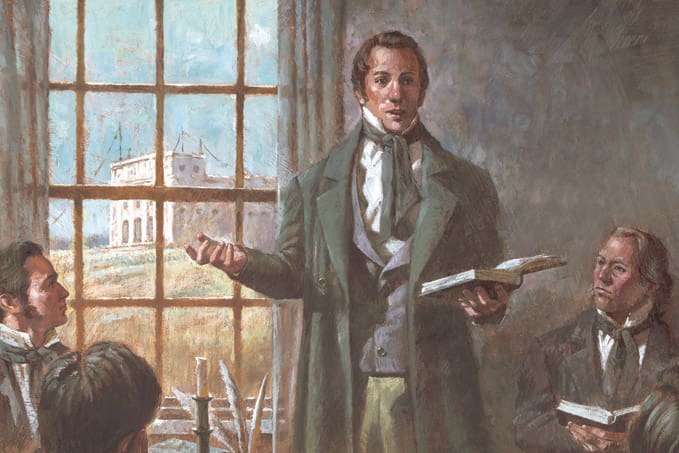
Among the many complexities of Latter-day Saint history, few subjects evoke as much unease, confusion, or silence as plural marriage. For modern members of the Church, it is often a topic easier to set aside than to engage with openly. The practice, central to early Church life yet wholly absent from our current experience, can seem at odds with our understanding of eternal marriage as a sacred covenant between one man and one woman. For some, the tension is deeply personal—how could something so contrary to our moral instincts have once been commanded by God?
That tension creates what psychologists might call cognitive dissonance—an uncomfortable clash between what we believe and what we know. Modern Saints are taught marriage reflects unity, fidelity, and equality before God, yet we also revere prophetic figures who practiced plural marriage under divine direction. Faced with this conflict, many members instinctively turn away, choosing to focus instead on other, more spiritually comfortable aspects of the gospel. It is easier, after all, to emphasize missionary work, charity, or the Atonement—uplifting and inspiring truths—than to dwell on unsettling history.
This pattern of avoidance is understandable, but it is also indicative of something deeper than discomfort—a cultural inheritance of secrecy reaching back to the 19th century. In its early days, plural marriage was practiced under conditions of misunderstanding and persecution. Those who entered it did so quietly, often in fear of external hostility or internal division. Even after the Manifesto of 1890 officially ended the practice, a reticence about discussing the subject remained. For generations, faithful Saints learned—often unconsciously—that silence was safer than transparency. This habit has persisted, passed quietly from teacher to student, parent to child. The result is that even today, many Latter-day Saints sense plural marriage is a sensitive or off-limits topic, best left to Church historians or avoided altogether.
Another reason for silence lies in our desire to protect faith, both our own and others’. Leaders and parents sometimes fear discussing plural marriage, especially its more troubling details, such as Joseph Smith’s plural wives or the secrecy of early practice, might damage trust in prophetic authority. Yet, ironically, this silence can make faith more fragile, not less. When members later discover these facts from secular or critical sources, they may feel blindsided or even betrayed, wondering why they were not trusted with the truth earlier. The real threat to testimony is not the history itself, but the sense that it was hidden.
To move forward, we must rediscover a truth central to the Restoration… all truth—spiritual, moral, or historical—belongs to God. Faith and inquiry are not enemies. If we believe in continuing revelation, we need not fear the weight of complexity. Honest study, approached prayerfully, can deepen rather than diminish testimony. As Elder Ballard has taught, There is no need to fear questions. The Church is not afraid of questions. Faith seeking understanding is itself an act of discipleship.
Part of our difficulty also stems from confusing eternal principles with historical practices. The everlasting covenant of marriage, central to God’s plan, endures as a doctrine of unity and exaltation. The command to practice plural marriage, however, was temporary—a specific directive for a specific time and purpose, much as other divine commands throughout scripture were adapted to their own eras. When we distinguish between the enduring principle and the historical commandment, we can sustain prophetic authority without feeling compelled to defend every historical circumstance. We can acknowledge Joseph Smith was a prophet of God and still wrestle with the human and cultural realities surrounding his prophetic calling. Faith does not require us to silence discomfort. It asks us to bring our discomforts honestly before God and trust Him to enlarge our understanding.
Seeing the Saints who lived plural marriage as real, complex human beings also transforms our perspective. Too often, we reduce them to symbols of controversy rather than disciples of Christ. Yet the journals and letters of early Saints reveal ordinary men and women—people of faith, doubt, and sacrifice—struggling to obey a commandment they often did not fully understand. Many resisted at first, some accepted reluctantly, and nearly all suffered deeply. And yet, in their suffering, they showed extraordinary devotion. Their lives remind us that discipleship sometimes means trusting God when His purposes remain obscure. Their obedience under uncertainty invites compassion rather than judgment from us, their spiritual descendants.
For the modern Church, creating faithful spaces for these conversations is crucial. Gospel classrooms, family councils, and youth discussions should be safe environments where hard questions can be explored openly, guided by the Spirit and grounded in official sources such as the Gospel Topics essays and Saints history volumes. Leaders and teachers need not fear that openness will erode belief. On the contrary, honesty builds trust, while silence breeds suspicion. When we model curiosity and faith side by side, we teach the rising generation that difficult history is not a threat to testimony, but a natural part of a living, growing faith.
Plural marriage also shows us a humbling truth about divine revelation. God works through imperfect people in imperfect contexts. His commandments unfold according to time, culture, and need. The Restoration has always been a process, not an event—a continuing dialogue between heaven and earth. As President Uchtdorf has candidly observed, To be perfectly frank, there have been things said and done that were not in harmony with our values, principles, or doctrine. That honesty does not diminish prophetic authority; it reinforces our belief that revelation is ongoing, and the Lord’s Church is capable of correction and refinement as His purposes unfold. Just as plural marriage served a divine but temporary role in the 19th century, so too did its end reflect continuing revelation and divine mercy. God’s moral arc bends toward perfect justice, even if we perceive it only gradually.
Plural marriage will always remain one of the most perplexing chapters in our history, but its difficulty need not make it shameful. To face it faithfully is to live the very principle Joseph Smith taught—by proving contraries, truth is made manifest. Wrestling with the past can strengthen, not weaken, our discipleship. When we stop fearing our history, we find it holds not scandal but soul—stories of obedience, sacrifice, and the unfolding of divine will among fallible people striving to do right.
For too long, we have inherited silence as our coping mechanism. The time has come to replace silence with understanding. When we confront our history with both faith and humility, we honor the spirit of the Restoration itself—a movement born from the courage to ask, to seek, and to believe truth, however complex, will ultimately lead us closer to God. In doing so, we find not a threat to our faith, but an invitation to deepen it—to let our testimonies grow from simple conviction to mature trust in the God who reveals truth line upon line, here a little and there a little, until the whole light of eternity unfolds.
Podcast: Heaven, Law, and Love: Joseph Smith’s Astonishing Teachings on Eternity” Doctrine and Covenants 129-132

Maurine
The lesson we study today has some of the most transcendent and astonishing teachings that Joseph Smith gave us, opening our ideas to what really is in the eternities and how we can obtain the blessings we desire. We will also be talking about what is sometimes a challenging principle, that has puzzled many for a lifetime, and at least once, led me to tears—plural marriage. Stay tuned.
Scot
Hello, we’re Scot and Maurine Proctor and welcome to Meridian Magazine’s Come, Follow Me podcast where today we discuss Sections 129-132 of the Doctrine and Covenants, a scripture so rich that we could go on and on.
It is so good to get your Christmas shopping finished, early, and this year we suggest the Come Follow Me Old Testament calendar for 2026 that features some of Scot’s beautiful photography. This calendar is not only luscious to look at and something classy for your wall, but it is also keeps you up week by week on your Come Follow me reading assignments. This is a great gift for brothers and sisters to whom you minister, for family, or anyone you want to remember in a meaningful way. See them at latterdaysaintmag.com/2026. That’s latterdaysaintmag.com/2026.
Maurine
Want to know more about heaven? In these next sections, we get glimpses. Joseph tells us in Section 129, about two types of beings in heaven. The first are resurrected personages having bodies of flesh and bone, and the other the spirits of just men made perfect, who have not yet been resurrected. This is a prelude, however, to the next thing taught, which is more rare knowledge, and therefore for a purpose. We know this section was given sometime before 27 June, 1839, because on that date Wilford Woodruff recorded it in his journal as the Prophet had revealed it to members of the First Presidency and the Quorum of the Twelve before they left on their missions to England. Wilford Woodruff drew tiny symbolic keys by his recording.
Steven Harper notes, “In April 1842, [Joseph] introduced the principles recorded in [the section]— to the Relief Society. The following month he gave the Saints a temple preparation sermon, including the explanation that there are “certain signs and words by which false spirts and personages may be detected from true—which cannot be revealed to the Elders till the Temple is completed.” (Steven C. Harper, Making Sense of the Doctrine and Covenants). In May, a few of the Church leaders were given a temporary endowment in the top floor of his redbrick store.
Scot
In other words, Section 129 needs the addition of temple understanding to be fully clear, but its essence is how to detect a false messenger from a true one who claims to be representing God with a message for you. This is something Joseph would have had to know, for we learned in Section 128, for instance that the devil had appeared to him on the banks of the Susquehanna disguised as an angel of light.
The instructions were offer to shake his hand. If he is an angel, “he will do so and you will feel his hand. If he be the spirit of a just man made perfect he will come in his glory; for that is the only way he can appear”, but he will not move. An interesting note here, is that a resurrected being can withhold his glory, but a just man made perfect cannot. Think of Christ on the road to Emmaus with his two traveling companions. He was a resurrected being, but they only saw him as a man, because He withheld His glory.
Maurine
However, when the devil comes as an angel of light, seeking to deceive you, “he will offer his hand, and you will not feel anything; you may therefore detect him (vv. 5-8). This is a very esoteric piece of knowledge—unless you need it, which Joseph assumed his followers did. That gives you something to ponder.
More opens to our view in Section 130. On Saturday, 1 April 1843, Joseph Smith went to preach to a congregation of Saints in Ramus, taking along Orson Hyde and William Clayton to act as scribe. That morning, Orson Hyde preached to the congregation, taking as his text three scriptures and said that the Savior “will appear on a white horse as a warrior, and maybe we shall have some of the same spirit. Our God is a warrior. (John xiv, 23.) It is our privilege to have the Father and Son dwelling in our hearts.”
Scot
Joseph later wrote that after the morning meeting, “we dined with my sister Sophronia McCleary, when I told Elder Hyde that I was going to offer some corrections to his sermon this morning. He replied, “They shall be thankfully received.” That afternoon and evening in his talks he gave the information that became Section 130.
Joseph taught from the personal knowledge of having seen the Savior several times, “When the Savior shall appear we shall see him as he is. We shall see that he is a man like ourselves” (v.1). In other words, we are not of a different species than God. We are not His creatures, nor His subjects, nor His possessions, but His children at a different stage of progression. By the grace of God, we are in a developmental period to grow to be like Him, and become “partakers of the divine nature” (2 Peter 1:4). That is much to comprehend, but that invitation through the Spirit is open to us.
Maurine
“And that same sociality which exists among us here will exist among us there, only it will be coupled with eternal glory, which glory we do not now enjoy” (v. 2). H. Dean Garrett and Stephen E. Robinson note, “”Sociality” is not a word normally used to describe relationships between beings of different species. When Christ comes again…we will be his friends and family, for friendship and family relations are the highest and greatest expressions of sociality. Moreover, life in the resurrection will be much like righteous living is here and now, with similar types of activities and relationships. Our existence then will still be recognizable as a glorified extension of the best of human life as we know it in mortality.
“Orson Pratt taught that ‘a saint, who is one in deed and in truth, does not look for an immaterial heaven, but he expects a heaven with lands, houses, cities, vegetation, rivers, and animals; with thrones, temples, palaces, kings, princes, priests, and angels; with food, raiment, musical instruments, etc; all of which are material. Indeed, the Saints’ heaven is a redeemed, glorified, celestial, material creation, inhabited by glorified material beings, male and female, organized into families, embracing all the relationships of husbands and wives, parents and children, where sorrow, crying, pain, and death will be known no more.’” (H. Dean Garrett, Stephen E. Robinson, Commentary on the Doctrine and Covenants, Vol. 4, Salt Lake City, Deseret Book)
Scot
Orson Hyde, at the morning meeting, had interpreted John 14:23 incorrectly. The verse in John reads: “Jesus answered and said unto him, If a man love me, he will keep my words: and my Father will love him, and we will come unto him, and make our abode with him. He read it that the Father and the Son can actually personally dwell in our heart.
Joseph corrects this in verse 3 of Section 130: “John 14:23—The appearing of the Father and the Son, in that verse, is a personal appearance; and the idea that the Father and the Son dwell in a man’s heart is an old sectarian notion, and is false.”
What’s even more telling is what Joseph told the Twelve four years earlier, concerning the text of John 14:23. “Now what is this other Comforter? It is no more nor less than the Lord Jesus Christ Himself; and this is the sum and substance of the whole matter; that when any man obtains this last Comforter, he will have the personage of Jesus Christ to attend him, or appear unto him from time to time, and even He will manifest the Father unto him.” (See Ehat and Cook, Words of Joseph Smith, 44; see also Woodford, “Historical Development,” 2:1703.)
Maurine
That promise is breathtaking. Now Joseph answers a question about time: “Is not the reckoning of God’s atime, angel’s time, prophet’s time, and man’s time, according to the planet on which they reside?” Look at the interesting assumption there. God lives on a planet. Yes, He does. Joseph already knew this from translating the book of Abraham: “Kolob was after the manner of the Lord, according to its times and seasons in the revolutions thereof; that one revolution was a day unto the Lord, after his manner of reckoning, it being one thousand years according to the time appointed unto that whereon thou standest” (Abraham 3:4)
Now we know that we live on a planet whose time is reckoned by our revolution around the sun, making 365 days to our year. But a day unto the Lord, is a thousand years to us. Planets orbit their suns in different times. This answer to this question, however, opens a whole new door of understanding.
Scot
“Yes. But there are no angels who minister to this earth but those who do belong or have belonged to it. But they reside in the presence of God, on a globe like a sea of glass and fire, where all things for their glory are manifest, past, present, and future and are continually before the Lord. The place where God resides is a great Urim and Thummim.”
Garrett and Robinson write. “The planet on which God dwells has already passed through a process of change similar to death and resurrection and has been glorified in the same way that the earth will eventually be glorified.14 This great change in glory will dissolve the heavens and melt the very elements “with fervent heat” (see 2 Peter 3:12). Just as sand becomes glass when heated and purified, so the earth, when glorified, will be a new, celestial globe “sanctified and immortal” (v. 9) like that upon which God now dwells. According to Brigham Young, “This earth, when it becomes purified and sanctified, or celestialized, will become like a sea of glass; and a person, by looking into it, can know things past, present, and to come; though none but celestialized beings can enjoy this privilege. They will look into the earth, and the things they desire to know will be exhibited to them, the same as the face is seen by looking into a mirror.”
Maurine
That the past, present, and future are continually before the Lord, is hard to comprehend for us in our linear, time-bound experience where we can’t remember yesterday accurately and the future is only vague shadows. Garrett and Robinson again: “While there is time with God (v. 4), it is not time as we mortals now perceive it. He sees our time as one great, eternal ‘now’ present before him. With God, the past is not yet over, and the future is already known. Thus, all things over which he presides are known perfectly by him, and all knowledge for the maximum glorification of his children and of their worlds is before him (Moses 1:39; D&C 76:43). God does not calculate, plot, or guess the future. Neither does he extrapolate it from what he knows about the past and present. The future is present before him, already known in infinite detail.”
Of course, that is why we can perfectly trust Him when He gives us counsel for which we cannot see the reason. The natural man wants to demand an explanation, but God rarely gives them. Perhaps that is because we just couldn’t comprehend and we can’t see all the conditions that play into leading us to what will bring us joy.
Scot
I remember Maurine, you told me a story about a 16-year-old boy, Marty, who just loved boats and his Sunday School teacher knew that. When Marty came to class on Sunday, the teacher had a stack of magazines about boats there, and Marty started looking at them and became quickly engrossed. Then the teacher asked for Marty to put the magazines down so they could have an opening prayer. Marty was too caught up to do it. The teacher then held up a sign that he had made previous to the class period that said, “Marty, put down the magazines so we can have the prayer.” The lesson that day was how God can see all things, but it was couched as if the Lord knows us so well, He can see what lies ahead. That is false. The truth is what we have been saying. You and I may not fathom how this can be but the past, present and future are continually before Him. You can absolutely trust a Father whose knowledge is so crystalline.
Maurine
Joseph tells us, “I was once praying very earnestly to know the time of the coming of the Son of Man, when I heard a voice repeat the following:
“Joseph, my son, if thou livest until thou art eighty-five years old, thou shalt see the face of the Son of Man; therefore let this suffice, and trouble me no more on this matter” (vv. 14, 15). Since Joseph Smith didn’t live to be 85, the conditions upon which this was given were not met, but this is not surprising. God, who knows all things, appears to make this deliberately vague.
We live in a day where there is much speculation about the time of the Second Coming—and we can see tangibly that the world is in tumult—but no one, not even the head of this dispensation was given that specific information.
Scot
Now two gems: “Whatever principle of intelligence we attain unto in this life, it will rise with us in the resurrection. And if a person gains more knowledge and intelligence in this life through his diligence and obedience than another, he will have so much the advantage in the world to come” (vv. 18, 19). What a glorious thought. We get to keep what we have learned, and remember what we think we have forgotten. Our minds will be expanded, and that yearning to understand more will be fulfilled.
Right now is a moment in eternity, and not a time to waste. We are surrounded by distractions. We fritter our time away, looking for some relief from stress. We fill our minds with cotton candy instead of meat. As we do not take seriously the striving for knowledge, we waste away our potential and our lives are caught in the thick of thin things.
Maurine
I like that word diligence applied to learning. In spiritual learning, the more you learn, the more you see. You and I have spent much time in seeking spiritual knowledge, and the more you dig, the more gold you find.
Now this, “There is a law, irrevocably decreed in heaven before the foundations of this world, upon which all blessings are predicated—And when we obtain any blessing from God, it is by obedience to that law upon which it is predicated.
Scot
What this means is described by Garrett and Robinson, “God’s universe is not random or arbitrary. There is a plan by which he governs all things, from the motions of the planets (D&C 88:42) to the salvation of his children (Article of Faith 3). God’s plan, or law, has many provisions, principles, promises, conditions, requirements, and consequences, but it is the same for all existence. It is the same for all men and women. It is irrevocable.
“Among other things, this doctrine denies the belief of some churches in the arbitrary grace of God, the idea that God treats some people differently than others—saving these or damning those—simply because he feels like it and for no special reason. The rules and principles of mortality and eternity were established before we ever came here, and they are the same for everyone. Considering the whole of our existence and all stages of life, the playing field is absolutely level, and the rules will never be changed in the middle of the game (see Abraham 3:25).” God is God because he perfectly understands and lives the law. We must too, to be like Him.
Maurine
Section 132 is beyond glorious in laying out that eternity is a family affair, and just as we have a Heavenly Father and Mother bound in marriage, so we can be sealed and bound to our spouses forever. But I didn’t always feel this way about this section. When I was in college, I was falling in love with a young man and things were growing serious. One day he wrote me a note and signed it, Doctrine and Covenants Section 132 with his name. Of course, I went immediately to that section and read the whole thing, but instead of being overjoyed that he was indicating we should think about an eternal marriage, I came away in tears. Since that long ago time, my tears have dried up and I realized that I had come away with false assumptions reading this section. I assumed that eternal marriage and plural marriage were one thing and that if you were sealed, at some point in the next life polygamy would be a requirement. Before we start this discussion about Section 132, I want to tell you what I wished I’d known when I first read it.
The Introduction to Official Declaration 1 in the latest version of the scriptures makes it clear. “The Bible and the Book of Mormon teach that monogamy is God’s standard for marriage unless He declares otherwise.” Jacob told the Nephites, “Wherefore, my brethren, hear me, and hearken to the word of the Lord: For there shall not any man among you have save it be one wife; and concubines he shall have none…For if I will, saith the Lord of Hosts, raise up seed unto me, I will command my people; otherwise they shall hearken unto these things.” So there are special cases, when the Lord commands it to raise up seed, but it is not the usual practice.
Scot
Valerie Hudson Cassler said this, “the Lord says in Doctrine and Covenants 49:16 “Wherefore, it is lawful that he [man] should have one wife, and they twain shall be one flesh, and all this that the earth might answer the end of its creation.” In the beginning, when the earth was empty and sorely needed replenishing, God gave Adam but one wife, Eve, that the pattern of his law of marriage might be set from the dawn of time in the very first human marriage on earth (see also Moses 5:3). Joseph Smith said, “ I have constantly said no man shall have but one wife at a time, unless the Lord directs otherwise.” Bruce R. McConkie concurs: “According to the Lord’s law of marriage, it is lawful that a man have only one wife at a time, unless by revelation the Lord commands plurality of wives in the new and everlasting covenant.” Of course, taking a plurality of wives outside of the new and everlasting covenant, outside of being commanded to do so by the Lord, is always a grievous sin.” (Valerie Hudson, “Polygamy”( https://www.squaretwo.org/Sq2ArticleCasslerPolygamy.html)
Maurine
Not only that but Joseph Smith himself did not say that God’s people would have to live polygamy to be exalted. With this, and much of the research on polygamy to follow, we depend on the work of Brian and Laura Hales, who has passed away, and if you have questions or want to explore further, you can at their website which is josephsmithspolygamy.org They report the following.
Here’s Wilford Woodruff: “When asked: ‘Did Joseph Smith ever teach at Nauvoo or anywhere else during his lifetime, that in order for a man to be exalted in the hereafter, he must have more than one wife,” He answered, “ I don’t know that I ever heard him make use of that expression.”
Bathsheba Smith: “When asked: “Did Joseph Smith teach you that a man must have more than one wife to be exalted?” Nauvoo polygamist and Apostle George A Smith’s wife Bathsheba Smith responded: “I never heard of that.”
Joseph C. Kingsbury “Did Joseph Smith ever teach that a man could not be exalted in the hereafter unless he had more wives than one?” Kingsbury replied: “No sir. He did not teach me that.” Kingsbury also recalled: “I heard it preached from the stand that a man could be exalted in eternity with one wife.”
Scot
After researching the topic deeply, Brian Hales concludes that polygamy was commanded for these possible reasons. It was a specific trial for a time and place. It may have been part of the restitution of all things. It was to multiply and replenish the earth.
I wonder, Who knows but that the Lord had to have certain of His children born to be a large enough group to carry off the restoration? A few years ago, we attended the Lucy Mack and Joseph Smith Sr. family reunion, and there we learned that there was a vast difference in the downline between Joseph Smith and his brother Hyrum. When it was practiced, Joseph’s posterity did not participate in polygamy and Hyrum’s did. Joseph only has between 1800 and 2000 people in his downline while Hyrum has nearly 30,000.
We’ve done firesides all over the church in the United States on Joseph Smith, and once in awhile we’ve asked the audience how many had ancestors who were polygamous. Where there are fewer converts, it was often the majority of the people.
Maurine
A significant comment was made by Elder Quentin L. Cook and published in the July 2020 Ensign. He said, “In the senior councils of the church, there’s a feeling that plural marriage, as it was practiced, served its purpose. We should honor those Saints, but that purpose has been accomplished. Now, there are unanswered questions. But I want you to know that we have a loving Heavenly Father who has a perfect plan, that His plan is one of happiness, and that we have a Savior who did everything for us. We can trust in Them.”
A fourth reason for polygamy is certainly to allow all worthy men and women to be sealed in marriage and become candidates for exaltation. We had just been taught in Section 131 that: “In the celestial glory there are three heavens or degrees;
“And in order to obtain the highest, a man must enter into this order of the priesthood [meaning the new and everlasting covenant of marriage]
“And if he does not, he cannot obtain it.” (vv. 1-3).
Scot
If the irrevocable law is that all must enter into the covenant of marriage to enter the highest degree of the Celestial kingdom, of course, the Lord, who loves His children will provide the way open for them. What we believe is that “Vicarious (and living) ordinances prior to the resurrection will assure that all worthy beings are sealed to joyful marriages they have chosen.” For all the reasons we’ve stated, neither woman nor men should fear eternal polygamy.
Here’s the context on Section 132. The Prophet Joseph Smith recorded this section on 12 July 1843, but he had known about it much earlier, perhaps, while translating the Old Testament in the spring of 1831. Since some of the Old Testament patriarchs practiced plural marriage, the prophet asked for a justification or more knowledge of this. Even so, the revelation was not recorded at that time and was not publicly announced until August 1852 in the Utah Territory.
On that 12 July 1843 morning, the prophet Joseph Smith met with his brother Hyrum and his clerk, William Clayton where they talked about the difficulties, Emma, Joseph’s wife, was having about accepting and living the practice. Hyrum said that Joseph should dictate the revelation because he believed that if he took it to Emma she would believe it. Joseph said, in effect, you do not know Emma as well as I do. Joseph was right, because not only did Emma not accept it, but she apparently burned the revelation, but other copies had been created. She had stood by Joseph while he took other wives in the spring, but had changed her mind by this July date.
Maurine
Let’s turn to the revelation for a moment, and then return to some of the questions. This section can be divided into three parts. As this section opens, it is clear that Joseph has asked about those in the Old Testament who had many wives, but the Lord gives a bigger answer. It is like when Joseph went into the grove to see which Church he should join and is given the immense response or the First Vision; or when he is 17 and is seeking forgiveness for his sins, and is given that, but so much more because Moroni visits him and shows him where to find the plates. What is opened to Joseph is about eternal marriage, of which polygamy is only a subset when rarely commanded.
So the first part of this section is about eternal marriage and sealing. The Lord is revealing the new and everlasting covenant whose astounding promise for those who enter it is this: “Then shall they be gods, because they have no end; therefore shall they be from everlasting to everlasting, because they continue; then shall they be above all, because all things are subject unto them. Then shall they be gods, because they have all power, and the angels are subject unto them” (v. 20).
Scot
An important note here is that everything in the gospel is new and everlasting. It is new and everlasting because it is divine truth which does not grow old. All the covenants and the ordinances of the gospel are part of the new and everlasting covenant, not just marriage. It is a covenant within the new and everlasting covenant or the fulness of the gospel.
The promise to those who marry “by the new and everlasting covenant, and it is sealed unto them by the Holy Spirit of promise” is that they shall “come forth in the first resurrection; and shall inherit thrones, kingdoms, principalities, and powers, dominions, all heights and depths.” This promise is incomprehensible to us—we say it but we can’t fathom it– in our mortal and limited state, but we do know the very center of what these gifts are contingent upon.
The Lord says, “But if ye receive me in the world, then shall ye know me, and shall receive your exaltation; that where I am ye shall be also…This is eternal lives—to know the only true God, and Jesus Christ whom he hath sent. I am he. Receive ye, therefore, my law (vv. 22,23).
Maurine
It is significant that in our temples we make these eternal marriage covenants over an altar that symbolizes Christ’s great sacrifice for us. In order to receive these promises, we are literally sacrificing our old rebellious, resistant selves for promises that are so immense our eyes cannot see nor our hearts comprehend. Our marriage is a three way commitment of unity and power. Just as the Lord’s atonement was a whole-souled sacrifice to make us one with Him and our Father again, so it is what makes us one with our eternal companions. The root of atonement, of course, is at-one-ment.
Elder Bruce C. Hafen, speaking of a time when he was sealing a couple, said, “I invited them to the altar, and as the groom took the bride by the hand, I realized that they were about to place upon that altar of sacrifice their own broken hearts and contrite spirits—an offering of themselves to each other and to God in emulation of Christ’s sacrifice for them.”
This sealing power is bound by the sacrifice of the Savior. Kneeling by that altar makes it clear to us.
Scot
I once had a young inactive Latter-day Saint couple say to me of their marriage, “We don’t need to be sealed. God wouldn’t separate us in the hereafter because we love each other.” Actually, God’s house is a house of order and He offers these eternal blessings to us through his authority and his law. He is clear, “If a man marry him a wife in the world, and he marry her not by me nor by my word, and he covenant with her so long as he is in the world and she with him, their covenant and marriage are not of force when they are out of the world; therefore, they are not bound by any law when they are out of the world” (v. 15).
So, to have our family connections eternal, we follow the law. Generously, the Lord gives us every opportunity for these blessings. He knows we live in a messy world where all have not had the same opportunity, including those who have lived on this earth before the Restoration, those whose lives take turns or have disappointments they couldn’t have anticipated. All the righteous who want these temple blessings will be afforded them.
Maurine
Now the second part of Section 132, beginning with verse 34, begins to discuss polygamy. Critics will say that Joseph introduced polygamy for his own interests, but they ignore the statements from Joseph’s own contemporaries about his extreme hesitancy. Benjamin F. Johnson remembered that Joseph “put it off” and waited until an angel with a drawn sword stood before him and declared that if he longer delayed fulfilling that command he would slay him.” Lorenzo Snow recalled that the Prophet “hesitated and deferred from time to time” and he “foresaw the trouble that would follow and sought to turn away from the commandment.” Erastus Snow reported that the angel accused the Prophet of “being neglectful in the discharge of his duties” and spoke “of Joseph having to plead on his knees before the Angel for his Life.” (See josephsmithspolygamy.org https://josephsmithspolygamy.org/beginnings-mormon-polygamy/)Apparently the angel visited him three times between 1834 and 1842.
Scot
Think, Joseph had weathered all things; he had learned to follow the Lord’s commandments through the greatest difficulties, when to do so seemed to put him and his people at risk. When it seemed impossible to build a temple in poverty and without skills in Kirtland, he led out. When people were apostatizing in Kirtland in 1837, he sent his most loyal lieutenants to England on a mission. Even as they were driven from Far West, he followed the Lord’s command to send the Twelve to England. He built again in Nauvoo and began building that temple, all to follow the Lord. He did the Lord’s will at all hazards, but this was truly difficult for him.
It was clear to Joseph that it would be disrupting and troubling to his family, to Emma’s heart and to the Saints who would be asked to live this principle. For it he endured, mockery, opposition, ostracism, persecution, beatings imprisonment and murder. He once said, “Many men will say, ‘I will never forsake you, but will stand by you at all times.’ But the moment you teach them some of the mysteries of the kingdom of God that are retained in the heavens, and are to be revealed to the children of men when they are prepared for them, they will be the first to stone you and put you to death. It was this same principle that crucified the Lord Jesus Christ, and will cause the people to kill the prophets in this generation (Orson F. Whitney, Life of Heber C. Kimball, p. 322).
Maurine
To help both his potential plural brides and other leaders with their initial heartbreak and bewilderment, Joseph promised them that they, too, would have spiritual witnesses.
Joseph proposed a plural marriage to Lucy Walker in 1842 and she wrote, “My astonishment knew no bounds. This announcement was indeed a thunderbolt to me. She said, “I thought I prayed sincerely but was so unwilling to consider the matter favorably that I fear I did not pray in faith for light.” She went through excruciating bouts of what she called ‘darkness,’ praying, like Christ, ‘Oh let this bitter cup pass. And thus, I prayed in the agony of my soul…It was near dawn after another sleepless night. While on my knees in fervent supplication, my room became filled with a holy influence. To me it was a comparison like the brilliant sunshine bursting through the darkest cloud… My soul was filled with a calm sweet peace that I never knew. Supreme happiness took possession of my whole being and I received a powerful and irresistible testimony.” (Lucy Walker Kimball, Autobiographical Sketch, Church History Library, Salt Lake City}.
Scot
Heber C. Kimball became sick and overwhelmed with anxiety when Joseph commanded Heber to take another wife without disclosing it to his wife Vilate. His daughter, Helen Kimball, wrote of it. “Finally . . . his misery became so unbearable that it was impossible to control his feelings. He became sick in body, but his mental wretchedness was too great to allow of his retiring at night, and instead of going to bed he would walk the floor; and the agony of his mind was so terrible that he would wring his hands and weep, beseeching the Lord with his whole soul to be merciful and reveal to his wife the cause of his great sorrow, for he himself could not break his vow of secrecy. His anguish and my mother’s were indescribable and when unable to endure it longer, she retired to her room, where with a broken and contrite heart, she poured out her grief to [God]. She returned to my father, saying, Heber, what you have kept from me the Lord has shown me. She related the scene to me and to many others, and told me she never saw so happy a man as father was, when she described the vision and told him she was satisfied and knew it was from God.” (Helen Mar Whitney, Women’s Exponent 10 (Octobe 15, 1881): 74.
Maurine
Mary Elizabeth Lightner Rollins had a unique experience. When Joseph talked to her about it, he said, “’Pray earnestly, for the angel said to me you should have a witness’…I made it a subject of prayer, and I worried about it because I did not dare to speak to a living being except Brigham Young. I went out and got between three haystacks where no one could see me…I knelt down and if ever a poor mortal prayed, I did. A few nights after that an angel of the Lord came to me and if ever a thrill went through a mortal, it went through me. I gazed upon the clothes and figure but the eyes were like lightning. They pierced me from the crown of my head to the soles of my feet. I was frightened almost to death for a moment. I tried to waken my aunt but I could not. The angel leaned over me and the light was very great although it was night.
“Joseph came up the next Sabbath. He said, ‘Have you had a witness yet?’ ‘No.’ ‘Well,’ said he, ‘the angel expressly told me you should have.’ Said I, ‘I have not had a witness, but I have seen something I have never seen before. I saw an angel, and I was frightened almost to death. I did not speak.’ He studied a while and put his elbows on his knees and his face in his hands. He looked up and said, ‘How could you have been such a coward?’ Said I, ‘I was weak.’ ‘Did you think to say, “Father, help me?”’ ‘No.’ ‘Well, if you had just said that, your mouth would have been opened for that was the angel of the living God. He came to you with more knowledge, intelligence and light than I ever dared to reveal.’ I said, ‘If that was an angel of light, why did he not speak to me?’ ‘You covered your face.’ Said I, ‘Will it ever come again?’ He thought for a moment and said, ‘No, not the same one, but if you are faithful you shall see greater things than that.’” (from Mary Elizabeth Lightner Rollins family records).
Scot
Questions swirl around Joseph’s involvement with polygamy, so, let me answer a few quickly to the best of our knowledge. He doesn’t personally leave us a record of his own thoughts and feelings. First, it appears we see three kinds of plural marriages in Joseph’s life—eternity only, time and eternity and time only. There is no polyandry, in other words a woman taking two husbands and living conjugally with both. Those instances where Joseph is sealed to married women, it is usually that their husbands are not members or believers, and the sealing blessings are being extended to them. It was a practice throughout the nineteenth century to sometimes seal single women to Joseph or Brigham so that they could have the sealing blessings.
Second, Joseph apparently has no children from these unions. There have been candidates over the years and family traditions that some one was a son or daughter of Joseph, but that has not borne out in DNA tests. To this point, the only children that we know he had is with Emma.
Third, as we see with the example with Heber C. Kimball, in the Nauvoo period, plural marriage was very much under the radar with a secrecy that the Lord demanded.
What we can say, looking back at that time is that we recognize that those who participated faced an Abrahamic test, including Joseph, and we acknowledge their sacrifice.
Maurine
That’s all for today. This has been Scot and Maurine Proctor with Meridian Magazine’s Come Follow Me podcast. Next week we’ll study Doctrine and Covenants 133-134, “Prepare Ye for the Coming of the Bridegroom.” Thanks to Jenny Oaks Baker for the music and to Michaela Proctor Hutchins who produces this show.
“Come, Thou Fount of Every Blessing” Performed by Jenny Oaks Baker. Used with permission © 2003 Shadow Mountain Records
A Site of Faith: Wilford Woodruff’s Farmhouse

In May of 1859, Wilford Woodruff traveled with his son Wilford Jr. and his son-in-law Robert Sholes up Harkers Canyon, searching for lumber to construct a farmhouse on Wilford’s farm located between 1600 and 1500 South in Salt Lake City.[1] Over a period of two days, wading through eight-foot-deep snow and mud, they cut down over three hundred “poles” and eighty “pine house logs” to be used for the new farmhouse. No longer the young man who had helped build Kirtland, Far West, and Nauvoo, at fifty-two years old Wilford noted that the work left him “cold,” “sore and stiff.”[2] But the men’s labor over the next year resulted in a comfortable home on Wilford’s farm that still stands today.
This farmhouse played a significant role in Wilford Woodruff’s life and was a site of harvests, celebrations and tragedies, family gatherings, and revelation. Events that played out within the walls of this home reverberated far beyond the simple frontier life of Wilford and his family and had an impact on the history of the Church.

Wilford Woodruff’s Journal, May 1859
A Place of Work and Independence
Between 1859 and 1862, Wilford continued to cultivate the twenty acres he owned around the farmhouse, primarily focused on producing goods for his family. He grew sugarcane, wheat, and fruit, in addition to raising livestock. His farm enabled him to provide for his family and be unfettered by financial dependence on the outside world. This was a necessity based on their isolated location, as well as a goal shared by many Latter-day Saints and their leaders, such as Wilford, who sought to anchor themselves to each other and to the Church instead. While Wilford and other Saints still sought to build economic relationships with non–Latter-day Saints, particularly those who were friendly towards the Saints, they did not want to become dependent.[3]
This focus on becoming economically independent became more urgent as Church leaders sought to prevent the exploitation of Latter-day Saints at the hands of merchants and businesses that increasingly looked to Utah Territory as a place to gain wealth following the Civil War. Some of these merchants in turn used their resources to push for harsher punishments against the Saints. As the transcontinental railroad neared, Latter-day Saint leaders including Wilford Woodruff encouraged the Saints to participate in home production and the cooperative movement.
A Place of Growth and Trial
Wilford Woodruff championed the value of home production and the co-ops throughout the three decades he called the farmhouse his home. But the farmhouse represented much more than that to him—it was also a place of joy and sorrow, of new life and goodbyes.
Wilford’s daughter Susan Cornelia and her husband, Robert Scholes, were the original occupants of the farmhouse for several years and helped with the farm.[4] In 1866 Wilford moved his seventh wife, Emma Woodruff, to the farmhouse with their children. Emma called this home for the majority of her married life and invested countless days of work to make the arid soil blossom as the rose. Emma and Wilford welcomed five children in the farmhouse, though they lost little Ann Thompson, who only lived seven hours and fifteen minutes after her birth. Wilford did not share details of the child’s death in his journal, though surely the mother and father were exhausted and devastated by the loss.[5]

While raising her children, Emma shared her home for a time with one of Wilford’s other wives, Delight, and her children. In his sixties, Wilford continued to work alongside his children and hired hands in tending to the crops and improving the land. Wilford also spent time with his families at the farm, in spite of the nearly constant stream of both religious and secular assignments.[6] Though not as quick as he had been in his younger years, he continued to be a strong worker, spent a great deal of time at the farm, and made the land around the farmhouse flourish.[7]
However, on September 25, 1873, Wilford’s mortality came clearly into view. When he went out in the fields near the farmhouse after a busy day in Salt Lake City, he had “a strange feeling” come over him and he hurried home. The “feeling” was likely a heart attack or stroke, and led Wilford to write, “I very soon felt as though I was struck with death and could not live. It seemed to be paralysis and death. I felt that I could not live an hour. All my blood, spirit, and life seemed to be leaving my limbs and closing around my heart and vitals and I felt as though I would soon die.”[8]
Wilford sent for his wife Phebe and his friend George Q. Cannon. He also asked for his neighbor William Wagstaff to administer a priesthood blessing to him, after which Wilford declared, “I was liberated instantaneously.”[9] In an era when the medical condition of a heart attack remained unclear, understudied, and untreatable, it was miraculous that Wilford rose from his bed at all.[10]

Wilford Woodruff, 1878, Salt Lake City, Utah
A Place of Faith and Revelation
Many years later, Wilford moved all of his possessions to the farmhouse after the death of his wife Phebe in November 1885.[11] For the next four years until Wilford was called as President of the Church, he made the farmhouse his main residence, though he was often forced to go into hiding as federal officials raided members’ homes, searching for those practicing polygamy. By 1887 he noted to his and Emma’s daughter Clara that he did not “expect to be able to visit the farmhouse much.” He noted, “Prudence would deprive me of this these times. The vigilance of our enemies will now be increased and I shall have to use great caution.”[12]
Yet his fears were soon alleviated when the new federal Marshal, Frank Dyer, informed Wilford that he would “leave him alone.” This was, in part, because Dyer wanted to strike a moderate stance and prosecute only those who contracted new plural marriages. Wilford was free, for the moment, to once again stay at his farm.[13]
Wilford Woodruff Farmhouse, 1880s
It was here that Wilford watched as the federal government intensified its persecution of the Latter-day Saints, forcing more men into hiding or prison and putting stress on countless families. Furthermore, federal officials were preparing to seize Church properties through the Edmunds–Tucker Act.
While at the farmhouse and pondering what to do regarding the federal government and plural marriage, Wilford received a revelation from the Lord counseling him to “pray for the Holy Spirit, which shall be given [the Presidency of my Church] to guide them in their acts.” Wilford likely took comfort knowing that the Lord promised to “hold the courts, with the officers of government, and the nation responsible for their acts towards the inhabitants of Zion.”[14] The Saints were counseled to continue the practice of plural marriage.
Seven months later, Wilford returned to the farmhouse after a long trip and was met with reports of increased hostilities against the Saints due to their continued practice of polygamy. The new federal receiver was determined not to honor the government’s 1888 agreement to exempt the temples from confiscation. On August 16, 1890, with the Territorial Court’s decision on the subject looming, Wilford declared, “We must do something to save our Temples.” The following month, Wilford recorded the following in his journal:
I have arrived at a point in the history of my life as the President of the Church of Jesus Christ of Latter-day Saints where I am under the necessity of acting for the temporal salvation of the Church. The United States government has taken a stand and passed laws to destroy the Latter-day Saints upon the subject of polygamy or patriarchal order of marriage. And after praying to the Lord and feeling inspired by his Spirit I have issued the following Proclamation which is sustained by my counselors and the 12 Apostles.[15]
His proclamation, the Manifesto, directed the ending of all new plural marriages in the Church. Wilford explained to the Saints, “I have had some revelations of late, and very important ones to me, and I will tell you what the Lord has said to me. . . . what would take place if we did not stop the practice.” As difficult as it was to understand, the Lord showed him in a vision that ending polygamy was the only way to ensure “the Prophets and Apostles and fathers [would remain] free men, and the temples [would remain] in the hands of the people, so that the dead may be redeemed.”[16] He must have spent many hours on his knees in the farmhouse seeking guidance from the Lord to understand His will concerning the temples and the future of the Church.
George Q. Cannon, a member of the First Presidency, recorded that Wilford Woodruff “felt strongly impelled to do what he has. . . . He has stated that the Lord had made plain to him that this was his duty, and he felt perfectly clear in his mind that it was the right thing.”[17]

First Presidency, April 6, 1893, Salt Lake City, Utah
For the rest of his life, Wilford Woodruff testified that the Savior had given additional revelation and guidance on the issue. Though he was willing to suffer anything the Lord asked him to pass through in order to continue plural marriage, he knew beyond a doubt that God had revealed the change. Wilford knew that the Lord had accepted the offering of the Saints and that God knew why the change needed to occur. As a result, the temple work for the living and the dead continued unabated as federal persecution of the Saints quieted. Millions on both sides of the veil were impacted as a result of the revelation given.[18]
The farmhouse remains today a historic site available to the public for tours. Though simple in many regards, this home stands as a testament to the faith and dedication of Wilford and his family. It was a place where Wilford spent over forty years of his life working the land and building his family. It was a place of new life, a place of death, a place of miracles and revelation where the Savior Jesus Christ aided His prophet in guiding the Church forward.

Hailing from Bonners Ferry, Idaho, Robert Swanson received his BA in History from Brigham Young University and his MA in History from Rutgers University–Camden, and he is currently a History PhD student at the University of Missouri focusing his work on abolitionism in the Early American Republic while still dabbling in Church history. He is married to his best friend, Bridget Garner Swanson, and they have two little girls who have made life even more of a fantastic adventure than they thought possible.
The Wilford Woodruff Papers Foundation’s mission is to digitally preserve and publish Wilford Woodruff’s eyewitness account of the Restoration of the gospel of Jesus Christ and make his records universally accessible in order to inspire all people, especially the rising generation, to study and to increase their faith in Jesus Christ. For more information, please explore wilfordwoodruffpapers.org.
Notes:
[1] Jennifer Ann Mackley, “Wilford Woodruff’s Homes,” http://www.wilfordwoodruff.info/p/wilford-woodruff-first-arrived-in-salt.html.
[2] Wilford Woodruff’s Journal, May 19–20, 1859, p. 408, The Wilford Woodruff Papers, https://wilfordwoodruffpapers.org/p/GZz7. Spelling and capitalization standardized.
[3] For Latter-day Saint economic history see: Leonard Arrington, Great Basin Kingdom: An Economic History of the Latter-day Saints, 1830–1900 (Lincoln, NE: University of Nebraska Press, 1966). For more on growth of the rest of the West see: Elliot West, Continental Reckoning: The American West in the Age of Expansion (Lincoln, NE: University of Nebraska Press, 2023).
[4] Wilford Woodruff’s Journal, July 26, 1860, p. 60, The Wilford Woodruff Papers, https://wilfordwoodruffpapers.org/p/nZ37.
[5] Thomas G. Alexander, Things in Heaven and Earth: The Life and Times of Wilford Woodruff, a Mormon Prophet (Salt Lake City, UT: Signature Books, 1993), p. 225; Wilford Woodruff’s Journal, April 10–11, 1867, p. 72, The Wilford Woodruff Papers, https://wilfordwoodruffpapers.org/p/DkQx; Jennifer Mackley, “Wilford Woodruff’s Wives: Emma Smith,” http://www.wilfordwoodruff.info/p/wilfords-wives.html. (Later Wilford’s brother Azmon died at the farmhouse as well. See Epistle to the YMMIA from Wilford Woodruff, February 1889, p. 1, The Wilford Woodruff Papers, https://wilfordwoodruffpapers.org/p/OqQr.)
[6] For more on Emma Smith Woodruff see Jennifer Mackley, “Wilford Woodruff’s Wives: Emma Smith,” http://www.wilfordwoodruff.info/p/wilfords-wives.html; Laurel Thatcher Ulrich, A House Full of Females: Plural Marriage and Women’s Rights in Early Mormonism, 1835–1870 (New York: Vintage Books, 2017), pp. 274–279.
[7] In 1874 Wilford put in six miles of fencing. See Wilford Woodruff’s Journal, September 29, 1874, p. 97, The Wilford Woodruff Papers, https://wilfordwoodruffpapers.org/p/2vgM.
[8] Wilford Woodruff’s Journal, September 25, 1873, p. 53, The Wilford Woodruff Papers, https://wilfordwoodruffpapers.org/p/pQ2y.
[9] Wilford Woodruff’s Journal, September 25, 1873, p. 53, The Wilford Woodruff Papers, https://wilfordwoodruffpapers.org/p/pQ2y. Spelling, punctuation, and capitalization standardized.
[10] “History of Heart Attack: Diagnosis and Understanding,” Heart Attack Prevention, University of Minnesota (2012), http://www.epi.umn.edu/cvdepi/essay/history-of-heart-attack-diagnosis-and-understanding/.
[11] Alexander, Things in Heaven, pp. 240–243.
[12] Letter from Wilford Woodruff to Clara Martisha Woodruff Beebee and Ovando Collins Beebe, ca. 1887, p. 1, The Wilford Woodruff Papers, https://wilfordwoodruffpapers.org/p/m63r. Capitalization standardized.
[13] Alexander, Things in Heaven, p. 246.
[14] Wilford Woodruff’s Journal, November 24, 1889, p. 279, The Wilford Woodruff Papers, https://wilfordwoodruffpapers.org/p/79EG.
[15] Wilford Woodruff’s Journal, September 25, 1890, p. 328, The Wilford Woodruff Papers, https://wilfordwoodruffpapers.org/p/Y719. Spelling and capitalization standardized.
[16] Official Declaration 1, Doctrine and Covenants.
[17] George Q. Cannon, Journal, September 24, 1890, The Journal of George Q. Cannon, Church Historian’s Press, https://www.churchhistorianspress.org/george-q-cannon/1890s/1890/09-1890#p84.
[18] “The Manifesto and the End of Plural Marriage,” Gospel Topics Essays, ChurchofJesusChrist.org; Jed Woodworth, “The Messenger and the Manifesto,” in Revelations in Context, ed. Matthew McBride and James Goldberg (Salt Lake City, UT: The Church of Jesus Christ of Latter-day Saints, 2016), https://www.churchofjesuschrist.org/study/manual/revelations-in-context/the-messenger-and-the-manifesto?lang=eng.
Avoiding Testimony Casualties Over Plural Marriage

[Author’s Name Withheld]
On November 11, 2014, the New York Times posted an article by its award-winning national religion writer Laurie Goodstein on the new LDS Gospel Topics Essays on plural marriage. The article, entitled, “It’s Official: Mormon Founder Had Up to 40 Wives.” [i] Goodstein opened her article with the line, largely addressed Joseph Smith’s practice of plural marriage. Goodstein wrote: “Mormon leaders have acknowledged for the first time that the church’s founder and prophet, Joseph Smith, portrayed in church materials as a loyal partner to his loving spouse Emma, took as many as 40 wives, some already married and one only 14 years old.” This provocatively titled article was the article most shared article on Facebook, most Tweeted, most e-mailed, and most viewed article of the day on the Times’ website.[ii]
Strictly speaking, the Church has acknowledged many times that Joseph Smith had been sealed to more than one woman.[iii] Church Historian Andrew Jenson collected affidavits from women near the end of the 19th century who attested to the fact that they had been married to Joseph Smith.[iv] Various Church periodicals and priesthood manuals have published references to Smith’s plural marriages. Available resources do not mean, however, that every person would have found the information. Regardless of the information’s availability, it is still a difficult topic for many Mormons who are only now hearing the information to digest.
A Crucial Key to Understanding Plural Marriage
What many well-meaning, faithful Mormons fail to recognize is that information that doesn’t bother us often causes spiritual and emotional harm to others. Many well-meaning members, and church manuals, present the Gospel of Jesus Christ as if it has never changed. Of course, this is not strictly speaking, true. D&C 27 references using wine in the sacrament, for instance. The Church, as a true and living entity, has changed and will change (D&C 1:30). Revelation guarantees that this will happen. It should be noted, though, that even with revelation there are many things that remain the same.
Mormonism balances, mostly successfully, many Old Testament concepts with teachings from the New Testament, the Book of Mormon, and modern revelation. It’s one of the strengths of Mormonism—we believe that God directs His Church in the circumstances in which it exists, but that He does not change things for the sake of changing them. Still, many aspects of Mormonism have evolved as Mormonism has matured and continues to mature as a world religion. To pretend that things have not changed, or that they will not change in the Church, only sets up people for the pain associated with finding previously unheard information. If we don’t prepare students for the reality that our understanding changes, they can easily become “needless casualties of testimony.” I use the term “needless casualty of testimony” to describe those become disenchanted with Mormonism because new information is brought forward that shatters their view of some aspect of Mormonism.
Plural marriage is a subject that can often lead to casualties of testimony. It is also something that the LDS Church has understood in many different ways over the past 150 years. Allow me to explain.
Smith never referred to the relationships he entered into or authorized as “marriages.” Those who participated in plural marriage used the term after Smith’s death. A much more appropriate term would be “sealing” or “woman he was sealed to.” Smith believed that those who were sealed to him, or other men, would secure their salvation in the eternities through a connection to a righteous couple (man and woman, such as Joseph and Emma Smith). Joseph Smith taught that the sealing ordinances secured a person’s “posterity so that they cannot be lost but will be saved by virtue of the covenant of their father.”[v] In Smith’s world, all those who participated in the sealing ordinance counted as the “posterity” of the couple they were sealed to. Those who were sealed to couples also saved their families. This may explain why Heber C. Kimball was so keen to have his 14-year-old daughter sealed to the Prophet. Helen forged a link between the Kimballs and the Smiths, but also vouchsafed the Kimball family’s salvation.
In this scenario, Helen Mar Kimball was an agent securing her family’s salvation. Although she undoubtedly felt pressure to be sealed to Smith, she understood the theology behind the ordinance. It was Helen, not Heber, who could ensure their family’s salvation. It is completely understandable for many to be upset, even revolted, with the fact that Joseph Smith was sealed to a 14 year old girl, much less that she only agreed to participate in the ordinance after being pressured by her father and prophet.
With this theological base in mind, however, it makes sense that the sealing ordinances was a means of creating “welding links” between himself and other Saints as well as ensure their salvation. Through utilizing a little “Craftiness,” or through some careful thinking, the entire human race could be saved together through the sealing ordinance.[vi]
This theological explanation, of course, has largely disappeared from LDS discourse. Mormons, as much as non-Mormons, equate polygamy with sexuality. Of course, Joseph Smith may have had sexual relations with many of the women sealed to him before his death. The Book of Mormon, after all, states that polygamy could be instituted by God to “raise up seed.” But sexual relationships were not the impetus for polygamy. Salvation and kinship were at the core of the sealing ordinance during Smith’s lifetime. The practice and logic of plural marriage changed over time, as do many things in the history of Mormonism. The principles behind the sealing ordinance (salvation, eternal families, etc.) have remained the same—but the ways we understand how the ordinance work has changed. The same could be said of how we understand the nature of family organization in the eternities.[vii]
How We Can Help Those Who Struggle
Within 24 hours of posting the article on Facebook, I had corresponded by text message, e-mail, and Facebook message with more than a dozen people with questions about plural marriage. Many had been seeking for someone to discuss Joseph Smith’s plural marriage for quite a while. It provided me an opportunity to speak with people who were coming to grips with the fact that Joseph Smith practiced plural marriage. Several mentioned they had been mocked for not knowing the information in other conversations. Others had been called liars by their family or local leaders when they asked questions about Joseph Smith’s polygamy. These people were dismissed or castigated for asking about, or pointing to, topics in our Church’s history that many were not aware of. Today, a mere 14% of Mormons believe polygamy is morally appropriate. Those who don’t believe polygamy is morally correct will have a hard time coming to grips with this new information.[viii]
For many, especially, but not limited to, women, it is devastating to learn about plural marriage, especially to learn that Joseph Smith was sealed to more than 30 women, including a 14 year old girl. Realizing that Smith, the prophet with the marvelous ruffled shirts was sealed to someone the age of a Mia Maid, can be a punch to the gut. It feels like you missed a stair climbing a staircase. Some told me about becoming physically ill or not feeling comfortable going to church.
Worse, many feel like they cannot trust anyone in the Church because they feel like the Church has been hiding this information from them. What else, they wonder, hasn’t the Church told me about? The Internet provides a rabbit hole that anyone can go down, but is difficult to navigate if you’re not sure whom to trust. A dear friend from high school has left the Church over Smith’s sealing to Helen Mar Kimball, among other women. My aunt stopped going to church for several years when she found out. I could go on, but I think you get the gist by now. Learning this information can be incredibly difficult for hearers, despite their love for the Church, whether they have served a mission, or if they have been a Relief Society President or an Area Seventy.[ix]
Goodstein quotes Emily Jensen, an LDS blogger, who I believe hits the nail on the head:
Joseph Smith was presented to me as a practically perfect prophet, and this is true for a lot of people,” said Emily Jensen, a blogger and editor in Farmington, Utah, who often writes about Mormon issues. She said the reaction of some Mormons to the church’s disclosures resembled the five stages of grief in which the first stage is denial, and the second is anger. Members are saying on blogs and social media, “This is not the church I grew up with, this is not the Joseph Smith I love,” Ms. Jensen said.[x]
How can we help those who are distressed? After all, we cannot expect every person, especially young person, to have read about plural marriage. There are precious few seminary teachers, bishops, parents, or friends who are prepared to provide answers about plural marriage. If someone has not encountered the information before, it is very difficult to reconcile with illustrations of a monogamous Joseph Smith dancing in meadows with Emma or the image we get of our beloved prophet in films shown on Temple Square.
It is extremely difficult to reconcile the image of a perfect Joseph Smith with this new information. And the ease with which many can access and produce commentaries leaves most members as reactionaries rather than on the offensive. The defensive position turns faithful members into grassroots responders of internal and external criticism that they may know little about or, perhaps, have “shelved” their questions as unnecessary to their membership and testimony of the church. For either of these parties, questions can be met with unwelcome responses and this is to be expected. The Church’s attempt at public transparency over a historically complex issue has taken many by surprise—some pleased with the move toward clarity and others have responded like those described above.
Thousands of words have been written about how it is not only appropriate but necessary to ask questions about the Church to strengthen our testimonies. After all, Joseph Smith’s questions led him to the Sacred Grove. Further questions led to revelations on the Plan of Salvation, temple work, and other doctrines that we hold dear. So how can we actually help someone who is asking questions encountering issues that they haven’t heard before? Or perhaps, more simply, how do those who knew before the essays were published help those who have not heard the information in a safe place. As Kristine Haglund said on PBS,
People tend to assume that their experience in what they’ve known is the same as what everyone else knows. That turns out not to be true at all with respect to polygamy. Some lifelong members have grown up with a family history of polygamy and so they know about it, or they’ve had a teacher who was more comfortable talking about it and so they’ve heard some of the details that some members are just hearing for the very first time and finding very distressing.[xi]
As someone who is in regular correspondence with many individuals finding out about aspects of Mormon History that cause anguish, I would like to suggest four essential steps to remember when speaking with those who have questions.
First: Take the time necessary to listen. To quote Elder Holland, “Perhaps even more important than speaking is listening. These people are not lifeless objects disguised as a baptismal statistic. They are children of God, our brothers and sisters, and they need what we have. Be genuine. Reach out sincerely. Ask these friends what matters most to them.” Ask them about how they feel. If they have opened up to you about something that’s troubling with them, they need to know that that they are loved above anything else. Again quoting Elder Holland, “If we listen with love, we won’t need to wonder what to say. It will be given to us—by the Spirit and by [those who have questions].” Creating safe places to faithfully discuss historically complex issues should be a priority for responders to internal questions and concerns.
Second: acknowledge that a person’s feelings are valid. I have never met anyone who has faked spiritual trauma. There are too many in the Church who become needless casualties of testimony because they could not find someone to talk to about their issues or their pain was dismissed because they asked questions. Many people with questions have never faced a situation like they are experiencing at that moment of crisis. Many people with questions are already on the margins of LDS Culture: feminists, intellectuals, single women, and those who lean liberal in their politics often lack the type of support network that other Mormons enjoy. They already have trouble feeling like they don’t belong in the Church.
Most with questions about Church History are generally looking for reasons to stay, not reasons to leave. When they reach out for help, they are making themselves vulnerable by asking for help. Don’t reward their trust in you by telling them to “just get over it.” They need help. Don’t let them down. Acknowledge that their pain and anguish are valid. People don’t fake spiritual trauma for attention. They are genuinely suffering and they are asking for help.
Remember this quote from B.H. Roberts, one of the Church’s foremost faithful defenders and historians:
“Suppose your youth receive their impressions of church history from ‘pictures and stories’ and build their faith upon these alleged miracles [and] shall someday come face to face with the fact that their belief rests on falsehoods, what then will be the result? Will they not say that since these things are myth and our Church has permitted them to be perpetuated …might not the other fundamentals to the actual story of the Church, the things in which it had its origin, might they not all be lies and nothing but lies? … [Some say that] because one repudiates the false he stands in danger of weakening, perhaps losing the truth. I have no fear of such results. I find my own heart strengthened in the truth by getting rid of the untruth, the spectacular, the bizarre, as soon as I learn that it is based upon worthless testimony.”[xii]
Folklore, meaning explanations that don’t match up with history or the Church’s position, are “worthless testimony.” They will ultimately harm those you are trying to help.
Third: If you don’t know the answer to their questions, don’t make something up. Many who have questions already feel like they were lied to by members of the Church. Don’t just say the first thing that comes to your mind if you don’t know. Don’t make it worse. It is much more honorable to say “I don’t know” and to research the topic for an answer than to say something that might not be true. They trust YOU as a good source for information; don’t let them down. They can check what you say within 5 seconds of reading it.
Of course, not all questions have answers. That’s ok. You’re not responsible for knowing everything. However, you can use resources like the Gospel Topics page to find many available answers. Within the last two years, the Church has released information on race and the priesthood, plural marriage, Mountain Meadows Massacre, and several other sensitive subjects. The Church operates to bring people to Christ. If providing information helps one person stay in the Church, their investment in time, effort, energy, and promotion is well-served. Why else would the Church invest so much in projects like the Joseph Smith Papers Project and Gospel Topics pages?
Fourth: follow up with them. Remember the eunuch in Acts 8:
27 And [Phillip] arose and went: and, behold, a man of Ethiopia, an eunuch of great authority under Candace queen of the Ethiopians, who had the charge of all her treasure, and had come to Jerusalem for to worship,
28 Was returning, and sitting in his chariot read Esaias the prophet.
29 Then the Spirit said unto Philip, Go near, and join thyself to this chariot.
30 And Philip ran thither to him, and heard him read the prophet Esaias, and said, Understandest thou what thou readest?
31 And he said, How can I, except some man should guide me? And he desired Philip that he would come up and sit with him.
We need to help others understand what they are reading, even after we have answered questions and provided initial support. Coming to grips with many things in our history is often a long, painful, difficult process. It will most likely not be resolved in a week. Keep in contact with them and ask how they are doing every so often.
If we are going to continue to support asking questions within the Church, we must be prepared to have difficult conversations by individuals in pain. These pained individuals are children of God. Every individual is raised in different circumstances, to different families, with different education levels, and different individual concerns. Everything from how a person was raised to engage with faith and knowledge, their political beliefs, how many siblings they have and where a person was born in their family, among 10,000 other principles shape who we become. Just as many factors are important in how and when a person hears about difficult issues in the Church.[1]We cannot expect everyone to feel the same way we do. Every person should, however, expect love, understanding and empathy when they turn to individuals for help. After all, it “becometh every [person] who has been warned to warn his neighbor” (D&C 88:81).
There will always be those who will leave. It, unfortunately, has always been so and always will be. But WE CAN do everything we can to help those who ask for love and assistance when they are searching for answers. We are not our brother’s keepers, but we are our brother’s brothers. We are our sister’s sisters. We cannot leave people in crisis. We must love and we must help, not only because we can, but because we must.
Notes:
[1] Read different accounts of how lifelong members and converts learned about Joseph Smith’s polygamy: “”When did you first hear about Joseph Smith’s Polygamy and Other Difficult Issues?,” posted November 11, 2014, https://www.juvenileinstructor.org/when-did-you-first-hear-about-joseph-smiths-polygamy-and-other-difficult-issues/
[i] Laurie Goodstein, “It’s Official: Mormon Founder Had Up to 40 Wives,” The New York Times (New York City, NY), published November 10, 2014, https://www.nytimes.com/2014/11/11/us/its-official-mormon-founder-had-up-to-40-wives.html?_r=1.
[ii] Laurie Goodstein, Twitter post, November 11, 1914, November 11, 1914, https://twitter.com/lauriegnyt/status/532387504859529216.
[iii] Examples listed here: BHodges, “Polygamy as Discussed in the Church Today,” By Common Consent, published November12, 2014, https://bycommonconsent.com/2014/11/12/plural-marriage-as-discussed-in-the-church-today/.
[iv] Andrew Jenson, The Historical Record: A Monthly Periodical Devoted Exclusively to Historical, Biographical, Chronological and Statistical Matters Volume 6 (Salt Lake City, Published by Andrew Jenson, 1887), 219-234. See https://books.google.com/books?id=ogg9AAAAIAAJ&vq=wives&pg=PA233#v=snippet&q=wives&f=false.
[v] Andrew F. Ehat and Lyndon W. Cook, Words of Joseph Smith: The Contemporary Accounts of the Nauvoo Discourses of the Prophet Joseph (Salt Lake City: Bookcraft, 1980), 241–42.
[vi] Transcriptions of several accounts of the sermon can be found here: “Sermon delivered at Nauvoo temple grounds on March 10, 1844,” Book of Abraham Project, accessed November13, 2014, https://www.boap.org/LDS/Parallel/1844/10Mar44.html.
[vii] Jonathan A. Stapley, “Adoptive Sealing Ritual in Mormonism,” Journal of Mormon History 37, no. 3 (Summer 2011): 53-118.
[viii] Amy Choate-Nielsen,” Mormons say polygamy is morally wrong, Pew poll shows,” Deseret News (Salt Lake City, UT), published January 15, 2012, https://www.deseretnews.com/article/700215181/Mormons-say-polygamy-morally-wrong-Pew-poll-shows.html?pg=all
[ix] Laurie Goodstein, “Some Mormons Search the Web and Find Doubt,” The New York Times (New York City, NY), published July 20, 2014, https://www.nytimes.com/2013/07/21/us/some-mormons-search-the-web-and-find-doubt.html?pagewanted=all
[x] Goodstein, “It’s Official: Mormon Founder Had Up to 40 Wives,” https://www.nytimes.com/2014/11/11/us/its-official-mormon-founder-had-up-to-40-wives.html?_r=1.
[xi] “In releasing history, Mormon Church grapples with origins and polygamy,” Public Broadcasting System, posted November 11, 2014, https://www.pbs.org/newshour/bb/releasing-history-mormon-church-grapples-origins-polygamy/#.VGLEdgUyUSw.facebook.
[xii] Truman G. Madsen, Defender of the Faith: The B. H. Roberts Story (Salt Lake City, Bookcraft, 1980), 363.
Mormon Polygamy: Joseph Smith’s Teenage Bride

Helen Mar Kimball became the plural wife of Mormon prophet Joseph Smith a few months shy of her 15th birthday. While taking a bride so young startles us in this day and age, it was not uncommon in the early 19th century. Plural marriage was practiced in about 85% of the world, but the idea was repugnant among European and American Christians.
Plural marriage had barely begun as an institution in the Mormon Church, and only Joseph Smith and a few church leaders had begun to practice it. Helen’s father, Heber Kimball, taught her about it.
Heber C. Kimball had been ordained to The Quorum of the Twelve Apostles in 1835, five years after the organization of The Church. Because of his faithfulness, he was one of the first (after Joseph Smith) commanded to live the principle of plural marriage in 1842 in Nauvoo, Illinois.
Helen’s Parents, Heber and Vilate Kimball, were Shaken by the Principle of Plural Marriage
Heber and Vilate Kimball were among the first of the Saints asked to live plural marriage.
When Joseph Smith taught Heber C. Kimball the principle and called upon him to live it, his first thought was to see if two elderly ladies would want to marry him.. They were friends to Vilate, and they were the least likely to bring jealousy into what was an ideal marriage. But Joseph wanted Heber to marry “…an English lady named Sarah Noon, nearer my mother’s age, who came over with the company of Saints in the same ship in which father and Brother Brigham returned from Europe. She had been married and was the mother of two little girls, but left her husband on account of his drunken and dissolute habits. Father was told to take her as his wife and provide for her and her children, and he did so” (Journal of Helen Mar Kimball).
Continue reading this story on LDS.net.
The Questions You Wanted to Ask about Polygamy
If you are LDS, at some point in your life, you may have asked perplexed, even agonizing questions, about the early practice of plural marriage in the Church. In its on-going series of articles aimed at tackling the toughest, sometimes sticky areas where the Church is often misunderstood, the LDS Church website has published two new articles on plural marriage on the LDS Church’s website under the heading“Gospel Topics”
The two new essays are “Plural Marriage in Kirtland and Nauvoo” and “The Manifesto and the End of Plural Marriage. Difficult questions are not side-stepped in these highly footnoted papers.
The article acknowledges that “Latter-day Saints believe that monogamy—the marriage of one man and one woman—is the Lord’s standing law of marriage.” Plural marriage “was among the most challenging aspects of the Restoration—for Joseph personally and for other Church members. Plural marriage tested faith and provoked controversy and opposition. Few Latter-day Saints initially welcomed the restoration of a biblical practice entirely foreign to their sensibilities. But many later testified of powerful spiritual experiences that helped them overcome their hesitation and gave them courage to accept this practice.”
Here’s a brief sampling of some the questions often asked about plural marriage, each with an excerpt from these new articles from the Church.
Why don’t we know more about the early practice of plural marriage in the Church?
“Many details about the early practice of plural marriage are unknown. Plural marriage was introduced among the early Saints incrementally, and participants were asked to keep their actions confidential. They did not discuss their experiences publicly or in writing until after the Latter-day Saints had moved to Utah and Church leaders had publicly acknowledged the practice. The historical record of early plural marriage is therefore thin: few records of the time provide details, and later reminiscences are not always reliable. Some ambiguity will always accompany our knowledge about this issue. Like the participants, we “see through a glass, darkly” and are asked to walk by faith.3”
Why was plural marriage instituted?
“The revelation on plural marriage was not written down until 1843, but its early verses suggest that part of it emerged from Joseph Smith’s study of the Old Testament in 1831.”
“When God commands a difficult task, He sometimes sends additional messengers to encourage His people to obey. Consistent with this pattern, Joseph told associates that an angel appeared to him three times between 1834 and 1842 and commanded him to proceed with plural marriage when he hesitated to move forward. During the third and final appearance, the angel came with a drawn sword, threatening Joseph with destruction unless he went forward and obeyed the commandment fully.”
Did Joseph practice plural marriage in Kirtland?
“Fragmentary evidence suggests that Joseph Smith acted on the angel’s first command by marrying a plural wife, Fanny Alger, in Kirtland, Ohio, in the mid-1830s. Several Latter-day Saints who had lived in Kirtland reported decades later that Joseph Smith had married Alger, who lived and worked in the Smith household, after he had obtained her consent and that of her parents.”
Why were the Latter-day Saints willing to practice plural marriage?
Latter-day Saints’ motives for plural marriage were often more religious than economic or romantic. Besides the desire to be obedient, a strong incentive was the hope of living in God’s presence with family members. In the revelation on marriage, the Lord promised participants “crowns of eternal lives” and “exaltation in the eternal worlds.”17 Men and women, parents and children, ancestors and progeny were to be “sealed” to each other—their commitment lasting into the eternities, consistent with Jesus’s promise that priesthood ordinances performed on earth could be “bound in heaven.”
How widely spread was early polygamy?
“The first plural marriage in Nauvoo took place when Louisa Beaman and Joseph Smith were sealed in April 1841.19 Joseph married many additional wives and authorized other Latter-day Saints to practice plural marriage. The practice spread slowly at first. By June 1844, when Joseph died, approximately 29 men and 50 women had entered into plural marriage, in addition to Joseph and his wives. When the Saints entered the Salt Lake Valley in 1847, at least 196 men and 521 women had entered into plural marriages.20 Participants in these early plural marriages pledged to keep their involvement confidential, though they anticipated a time when the practice would be publicly acknowledged.”
Was Joseph Smith sealed to women who were already married?
“During the era in which plural marriage was practiced, Latter-day Saints distinguished between sealings for time and eternity and sealings for eternity only. Sealings for time and eternity included commitments and relationships during this life, generally including the possibility of sexual relations. Eternity-only sealings indicated relationships in the next life alone.
“Evidence indicates that Joseph Smith participated in both types of sealings. The exact number of women to whom he was sealed in his lifetime is unknown because the evidence is fragmentary…”
“Following his marriage to Louisa Beaman and before he married other single women, Joseph Smith was sealed to a number of women who were already married. Neither these women nor Joseph explained much about these sealings, though several women said they were for eternity alone. Other women left no records, making it unknown whether their sealings were for time and eternity or were for eternity alone.
There are several possible explanations for this practice. These sealings may have provided a way to create an eternal bond or link between Joseph’s family and other families within the Church. These ties extended both vertically, from parent to child, and horizontally, from one family to another.“
Both essays answer many more important questions and are valuable for our understanding of something Latter-day Saints are often probed about.