


“Stand Still and See the Salvation of God”—Come, Follow Me for Sunday School, Exodus 14-17

Throughout the scriptures, whenever the people of the Lord have needed courage and faith, they have often called to remembrance the account of Israel’s miraculous deliverance on the shores of the Red Sea. The children of Israel were trapped with the Red Sea at their backs, and the army of Pharaoh advancing toward them. It seemed like they were doomed for destruction. But nothing is too hard for the Lord. He wanted them to remember the miracle for generations to come: “Fear ye not. … The Lord shall fight for you” (Exodus 14:13–14). We, too, need to “stand still, and see the salvation of the Lord” and remember how “the Lord saved Israel that day out of the hand of the Egyptians” (Exodus 14:13, 30).
Even after the horror of the death of the firstborn, Pharaoh’s change of heart was only temporary. When he realized that the children of Israel were really gone, he decides to force them back to servitude in Egypt. He took six hundred chariots with him, and he pursued after them. Chariots were the most sophisticated military technology at the time. Israel had nothing, except that they went out with “boldness.” The gist of this Hebrew term (ruwn yad) includes the idea of rebellion against authority. Such a spirit was good when it was directed against Pharaoh, but they sometimes used it against the Lord and his prophet Moses.
Try to imagine the terror the Israelites must have felt as they saw Pharaoh’s army closing in on them. It is no wonder that they “cried out unto the Lord” (Exodus 14:10). And yet, in spite of all the miracles Israel had seen, they still looked back to the flesh pots[i] of Egypt. Their words to Moses showed little faith and a loss of confidence in God. They murmured to Moses, “Hast thou taken us away to die in the wilderness? . . . For it had been better for us to serve the Egyptians, than that we should die in the wilderness” (Exodus 14:11-12). They had only been out of Egypt a week, and they were already distorting their past experiences, thinking it was better for them in Egypt than it was really was.
They needed to move forward, but they were still looking back. A new generation has to arise who have nothing to look back to. Moses assures them to fear not and “stand still and see the salvation of the Lord,” and to “hold [their] peace,” for they would never see the Egyptians again. That must have been hard for them to believe! I wonder if Moses had any idea how God would help them in that situation. But he knew that in their situation, God had to come through. He didn’t know the details of the plan, but he knew that somehow the enemies of the Lord would be destroyed.
“Go Forward”
Exodus 14:15 Notice that the first command in the miracle, before the water even started to part was, “Go forward.” Maybe it was that a Caleb went forward into the surf before it was divided. Many times the Lord expects us to do this as well. Sometimes the Lord does not remove the problems and obstacles in our lives, but instead, strengthens us to be able to “go through” them.
The Lord asks Moses, “Why are you crying unto me?” There is a time to pray and a time to act. Move forward! This suggests that faith precedes the miracle. Doctrine and Covenants 8:2-3 reads: ‘Yea, behold, I will tell you in your mind and in your heart, by the Holy Ghost which shall come upon you and which shall dwell in your heart. Now, behold, this is the spirit of revelation; behold, this is the spirit by which Moses brought the children of Israel through the Red Sea on dry ground.” I have always been amazed by this scripture. When the Lord commanded Moses to perform this miracle, the revelation came in the same way that we most often receive revelation—in the mind and the heart, by the power of the Holy Ghost. There was no dramatic voice from heaven that immediately opened the water.
“Lift thou up thy rod, and stretch out thine hand over the sea.” These were the simple instructions that resulted in a mighty miracle—the parting of the sea. Neither Moses nor his rod could be an effective instrument in a work which could be accomplished only by the omnipotence of God.[ii] The Lord had finally answered Pharaoh’s question from Exodus 5:2. “Who is the LORD, that I should obey his voice to let Israel go?” God used the miracle of parting the mighty waters to speak to Egypt as much as he used it to speak to Israel. “The Egyptians shall know that I am the LORD” (Exodus 14:18).
“The children of Israel were “baptized” in the Red Sea. (See 1 Corinthians 10:2 ff esp. 11) “All things are examples to us,” symbolizing that baptism precedes entrance into the promised land. “And the children of Israel went into the midst of the sea upon the dry ground: and the waters were a wall unto them on their right hand, and on their left” (Exodus 14:22). “The Lord caused the sea to go back by a strong east wind all that night, and made the sea dry land, and the waters were divided.”[iii]
Psalm 77:16-20 is a poetic rendition of the water crossing, describing the rain, thunder, and lightning that were present as they crossed over the divided waters. Exodus 14:19-20 God sent both a specially commissioned angel, as well as a pillar of cloud as a barrier between the children of Israel and the pursuing Egyptian chariots. This same pillar was a familiar sight to the children of Israel, as it had protected them by day as they traveled in the wilderness, as well as the pillar of fire which protected them by night. The architecture of the Provo and Logan Temples reflects the presence of the cloud and the pillar of fire which testified to the children of Israel that they Lord was with them on their journey.
We learn many important details of how the Lord overthrew the Egyptians in the midst of the sea. He took off the wheels of their chariots, as the Egyptians sought to “flee from the face of Israel.” It may have been that their chariot wheels “became clogged with the soft ooze in the sea bed.” [iv] The Egyptians even admitted that the Lord fought for Israel against them. When Moses stretched forth his hand again, “the waters returned and covered the chariots, and the horsemen” and “there remained not so much as one of them.” Alonzo Gaskill notes that there might be something significant about the Egyptians suffering death by drowning. He writes:
It has been suggested that a sort of ‘tit for tat’ is at play here in the taking of Egyptian lives by water. Some eighty years earlier, Pharaoh had taken the lives of the male Israelite children by drowning them in the Nile. Now Israel’s God would drown Pharaoh’s armies in the Red Sea. Ironically, the very man God used to bring to pass the watery destruction of the Egyptians was Moses, who himself was rescued by God from the Nile when he was but an infant. [v]
The Israelites saw the Egyptians “dead upon the seashore.” This was confirmation to them that their deliverance was complete, and that God had saved them in seemingly impossible circumstances. No wonder “the people feared the Lord, and believed the Lord, and his servant Moses” (Genesis 14:31). This was the intended purpose of the Lord, to fortify the faith of the Israelites as well as deliver them from the Egyptians. Unfortunately, Israel was not able to maintain this faith, despite the grandeur of the miracle. They quickly went back to their murmuring. But for the moment, they are exultant and they break out into praises. Their joy was so great that it could only be expressed through song.
Genesis 15 is known as the “Song of Moses” or “Song of the Sea. ”This extraordinary song seems to have come spontaneously as they realized their salvation was real, and God had “triumphed gloriously.” In the Hebrew scripture, this song is written out in poetic form, denoting careful composition. It is written in a style of Hebrew much older than the rest of Exodus. According to Jewish tradition, the Israelite people sang this song in gratitude for the victory God had wrought over the Egyptians who were drowned in the Sea of Reeds. [vi] “Presumably, this text is called a ketuba (“marriage contract”) because the relationship between God and the Jewish people is traditionally described as a marriage, and the splitting of the sea is considered to be an important event leading to that marriage, which ultimately took place 42 days later, at Mt. Sinai.” [vii] The phrase “the Lord is my strength and my song, and he is become my salvation ” is very familiar to us because it is the source of our beautiful hymn, “The Lord is My Light.” Miriam, the sister of Moses, leads the women in a dance with timbrels. Everything seems wonderful and everyone has a joyful heart.
“I Am the LORD That Healeth Thee”
That is, everything is wonderful until they travel in the wilderness for a few days and realize that there is no water. Three days is not a very long time, but it was long enough for Israel to forget the mighty miracle they had just witnessed. Three days without water is long enough to bring out the natural man and natural woman in all of us. After looking for water for three days, they finally find it. It must have seemed like a cruel joke that they found the water to be undrinkable. The waters were bitter, so they called them the waters of Marah, which means “bitter” in Hebrew. The people panic and murmur, and ask Moses. “What shall we drink?” (Genesis 15:23-25). Moses cries to the Lord and is shown a tree, which he then casts into the waters, and they become sweet.
I always wondered about how this could be possible, but it may have a scientific explanation. Jamie Buckingham, an expert in desert conditions, and author of A Way Through the Wilderness, explains how this may have worked. “The chemicals in the sap of the broken limb drew the mineral content down to the bottom of the pools and left only good water on top. He further speculates that even though the waters were now drinkable, there was still a significant magnesium and calcium content in the water. The laxative effect of this would clean out the digestive systems of the children of Israel, cleansing them of common Egyptian ailments such as amoebic dysentery and bilharzia, a weakening disease common among Egyptian peasants. In addition, calcium and magnesium together form the basis of a drug called dolomite – used by some athletes as a performance enhancer in hot weather conditions. At Marah, God provided the right medicine to both clean out their systems, and prepare them for a long, hot march to Sinai.” [viii]
On a symbolic note, the reference to healing by the means of a tree cannot be missed—the use of wood as foreshadowing the cross of Christ, the means by which the bitterest of life’s waters may be healed. Consider this verse from 1 Peter 2:24: “Who his own self bare our sins in his own body on the tree, . . . by whose stripes ye were healed.”
How do you think the Lord felt about Israel’s short lived faith and gratitude? God was not only interested in getting Israel out of Egypt, he was interested in getting Egypt out of Israel. After the waters were made sweet, Moses “made for them a statute and an ordinance, and there he proved (tested) them.” The Lord said, as I healed the waters of Marah, so I will heal thee if you will “hearken diligently to the voice of the Lord.” They were to DO what is right, GIVE EAR to the commandments, and KEEP all the statutes. (see Genesis 15:25b-26)
The Lord had to determine whether the children of Israel were a worshipping people who occasionally murmured, or if they were a murmuring people who occasionally worshipped. [ix]
As they left the “flesh pots” and headed into the wilderness, the children of Israel must have wondered, “What will sustain us in the wilderness?” We, too, can ask this question. What willsustain us in life? If we are not going to be nourished in life by the things of this world, what will sustain us? Will we, too, murmur if life does not go as we expected? Or will we remember to take a lesson from the life of Joseph, son of Jacob? Joseph was strong because of his trials. He responded to them with a positive attitude. It would have been pretty easy for Joseph to get bitter when he lost his birthright, or his position in Potiphar’s house. But he never murmured, and tried to make the best of every situation in which he found himself.
When you find yourself living the unexpected life, make the best of it, and don’t blame it on God. Consider the “antifragility principle” developed by Nassim Nicholas Taleb in his book Antifragile. “Antifragility” is a property of systems in which they increase in capability to thrive as a result of stressors, shocks, volatility, noise, mistakes, faults, attacks, or failures. Certain things in life get stronger the more stress that they encounter. This is true of muscles. If muscles are not used, they become weak. When they are forced to work hard and lift weights they become strong. Bones are the same way. If bones are not required to move the body around, they will become weak. This is also true of people. Nobody grows strong from having everything work out every time for them. People become strong because they endure trials valiantly. The Lord has made earth life difficult for a reason. He wants to make his sons and daughters strong and able to bear the glory he desires to bestow upon them.
But there are times that the Lord allows us to have a break from all these “growing pains.” He knows that a bow cannot stay tightly strung all the time. He created the Sabbath day. Even he needed a rest. The children of Israel needed a break before their sojourn in the desert. They came to Elim, where there were twelve wells of water and seventy palm trees. After their desert wanderings, this must have been a great relief. We have all encountered times of “bitter waters,” where we have reached out to the God of healing. There we have found strength by exercising our spiritual muscles. We can more fully appreciate the times when the Lord brings us to our own “Elims,” where we can find peace and enjoy the rest of the Lord.
The Sin of Murmuring
In chapter 16, Israel journeyed from the comforts of Elim into the wilderness of Sin towards Sinai, a place to meet with God and receive his law. Apparently the supplies they had carried with them from Egypt had begun to run out. They went from singing to murmuring very quickly. Don’t you just love that word? It seems every time the going gets tough, they murmur. “The whole congregation” of Israel murmured against Moses and Aaron. The phrase “whole congregation” indicates this was not the behavior of a few troublemakers, but a wholesale rebellion. They said, “Would to God we had died by the hand of the Lord in the land of Egypt, when we sat by the flesh pots, and when we did eat bread to the full.” They twisted the past to support their murmuring. They accuse Moses and Aaron of bringing them out into the wilderness to kill them with hunger. Of course, this is absolutely untrue, and this is a horrible accusation to make. We ask ourselves, “How long has it been since you saw the mighty parting of the waters of the Red Sea?” A month?
Neal A. Maxwell spoke about “The Sin of Murmuring” in October General Conference in 1989. He gave some fascinating insights into what we are actually doing when we murmur. He said:
Murmurers have short memories. Israel arrived in Sinai, then journeyed on to the Holy Land though they were sometimes hungry and thirsty. But the Lord rescued them, whether by the miraculous appearance by quail or by water struck from a rock. (See Num. 11:31; Ex. 17:6.) Strange, isn’t it, brothers and sisters, how those with the shortest memories have the longest lists of demands! However, with no remembrance of past blessings, there is no perspective about what is really going on.
Perhaps when we murmur we are unconsciously complaining over not being able to cut a special deal with the Lord. We want full blessings but without full obedience to the laws upon which those blessings are predicated. For instance, some murmurers seem to hope to reshape the Church to their liking by virtue of their murmuring. But why would one want to belong to a church that he could remake in his own image, when it is the Lord’s image that we should come to have in our countenances?” (See Alma 5:19.)
The doctrines are His, brothers and sisters, not ours. The power is His to delegate, not ours to manipulate!
Damage to ourselves is sufficient reason to resist murmuring, but another obvious danger is its contagiousness. Instead of murmuring, therefore, being of good cheer is what is needed, and being of good cheer is equally contagious. We have clear obligations to so strengthen each other by doing things “with cheerful hearts and countenances.” (D&C 59:15; see also D&C 81:5.)
Murmuring can also be noisy enough that it drowns out the various spiritual signals to us, signals which tell us in some cases to quit soaking ourselves indulgently in the hot tubs of self-pity!
Nonmurmurers are permitted to see so much more. Ancient Israel was once compassed about with “a great host” of hostile horses and chariots. Elisha counseled his anxious young servant, “Fear not: for they that be with us are more than they that be with them.” The prophet then prayed that the Lord would “open” the young man’s eyes, “and he saw: and, behold, the mountain was full of horses and chariots of fire round about Elisha”! (2 Kgs. 6:14–17.)
Elisha’s counsel can help Church members today to silence our murmuring. Regardless of how things seem, or come to seem, in troubled times, “They that be with us are more than they that be with them.” My brothers and sisters, if our lips are closed to murmuring, then our eyes can be opened.” (“The Sin of Murmuring,” October Conference 1989)
Would that we could get out of the “hot tubs of self-pity” and open our eyes to see the chariots of fire around us.
The Lord Provides Bread from Heaven
Nothing is too hard for the Lord. He can provide resources from sources we never knew existed. Exodus 16:4 “Behold, I will rain bread from heaven for you; . . . that I may prove them, whether they will walk in my law, or no.” Again we see that the Lord wants to “prove” or “test” the children of Israel to see whether they will gather and partake of what he has provided, or long for the flesh pots of Egypt. They needed to gather a certain quota of the heavenly manna every day. This responsibility would test the obedience of these Israelites. On the sixth day, they were to gather twice as much, so they could rest on the seventh day, the sabbath.
Moses and Aaron tell Israel that they will “see the glory of God.” Here they had been complaining, but the God, in his mercy, is going to bless them with what they are longing for. They would not see his face, but they would see him lovingly providing for his people in yet another miraculous way. In his mercy, he didn’t demand that they stop their murmuring before they ate. He would give them “bread from heaven” in the morning, and in the evening they would receive flesh to eat. God had heard them longing for the pots of stewed meat they ate in Egypt. Thus, they would know that “I am the LORD your God” (Genesis 16:6-9). Moses and Aaron point out that their complaints are not against them, but against the Lord. Those in our own day who murmur against those called by the Lord should keep this in mind.
Even so, “as Aaron spake unto the whole congregation of the children of Israel, that they looked toward the wilderness, and, behold, the glory of the Lord appeared in the cloud” (Genesis 16:10). The last time that the Lord appeared in a cloud was in Exodus 14:24 as the children of Israel were crossing through the sea. The cloud was a sign that God was present with them and that he would protect them. The Lord told the Israelites that he had heard their murmurings, and he was going to give them meat in the evening and “in the morning they would be filled with bread” (Exodus 16:12).
In a miraculous way, God provided the children of Israel with quails who covered the camp in the evening. (Exodus 16:13) He could have responded with judgment for their murmuring, but instead, he gave them meat. I wondered how the Lord could have caused this to happen, as he created the earth and is well acquainted with its workings. I learned that the Sinai is on the migratory route of quail. These birds do not fly well, so when they migrate, they fly until they are exhausted, and when they land they are unable to fly again for some time. It could have been that the Lord engineered the landing of the quail in their exhausted state right next to the children of Israel, where they would be able to gather the quails easily.
And in the morning, “the dew lay around the host,” and when it was gone up,” the Israelites found “a small round thing” upon the face of the wilderness. Commentators have described this as a small and round and “like hoarfrost,” and it needed to be gathered early before it melted. It required diligence to gather, since it was in the form of small flakes, before it could be prepared by grinding and baking. Tradition says that the taste was like fresh oil and like wafers made with honey.
Israel did not know what to call it, so they called it man-hu, meaning, “What is it?” (Exodus 16:15). God provided for them, but they did not recognize it. When God’s provision comes, do we sometimes do not recognize it?
There were several strict rules for the people on how to gather and store the heavenly bread. They were to collect only one omer (about five pints) per person per day. Some gathered more, while others gathered less, but when they came to prepare and eat the manna, everyone had the same amount to eat. (see Exodus 16:17-18) The Lord knew what each person needed, and he provided it for them. If a person tried to hoard extra manna “it bred worms and stank” (Exodus 16:20). The double portion of manna that was to be gathered the day before the Sabbath did not spoil. In this way, the manna was preserved in a way that enabled them to keep the sabbath day holy. (see Exodus 16:22-26)
The Israelites called it manna, but what did the Lord call it? He called it “bread.” Deuteronomy is a commentary on Exodus, Leviticus, and Numbers, and in Deuteronomy 8:2-3, the Lord tells the people that their forty-year journey through the wilderness was to “humble” them, and to “prove” them. It was so that God would know what was in their hearts, and whether they would keep his commandments or not—a good explanation of mortality for all of us. He allowed them to suffer hunger and be fed with manna, so that they would know that “man doth not live by bread alone, but by every word that proceedeth out of the mouth of the Lord doth man live.” The Savior quoted this scripture to Satan when he tempted him to turn the stones into bread.
Manna comes in little flakes. This implies that it must be gathered a little at a time, like great truths need to be gathered from many places in the scriptures. What lesson can we learn from this? We too must gather it every day. There is work involved. In the wilderness, there was a need to gather manna every day, just like reading the scriptures provides daily nourishment. We all need to eat every day to sustain ourselves physically, but we also must partake dailyof spiritual nourishment to sustain our souls. It is the doing of a thing day in and day out that has power to save.
The Lord commanded Moses, “Fill an omer of [manna] to be kept for your generations that they may see the bread wherewith I have fed you in the wilderness, when I brought you forth from the land of Egypt” (Exodus 16:32). This pot of manna was kept in the ark of the covenant as a symbol of how the Lord had fed the Israelites for forty years while they journeyed in the wilderness. [x]
“The children of Israel ate manna for forty years, until they came into an inhabited land” (Genesis 16:35). As important as it was for God to provide this bread from heaven, it was also important for God to stop providing it at some point. It was essential that Israel be put again in the position to receive the food that God provided through the hard work of cultivating it, which in itself is a blessing of God.[xi]
Jesus reminded the Jews that all must eat of the bread of life in order to live forever. Manna was a symbol of something far greater than mere physical food. In John 6, Jesus says that “as the living Father has sent me, and I live by the Father: so he that eateth me, even he shall live by me. This is the bread which came down from heaven: not as your fathers did eat manna, and are dead: he that eateth of this bread shall live forever” (John 6:57-58). He said, “I am the bread of life”( John 6:35). “Moses gave you not that bread from heaven; but my Father giveth you the true bread from heaven. For the bread of God is he which cometh down from heaven, and giveth life unto the world” (Exodus 16:32-33).
The message is clear. Jesus is the bread from heaven, and we need to receive him like the children of Israel received the manna. We need to be hungry and aware of our need. We need to do it every day and with humility, perhaps even on our knees. We need to do it with gratitude, knowing that it is a gift we have not earned. We need to take it inside ourselves, to the innermost part of our being.[xii] There is a saying, “You are what you eat.” We need to make the Savior a part of who we are.
Drinking Living Water from the Rock
Exodus 17 deals with what we drink in this earth life’s experience. When the children of Israel set out on their way from the wilderness of Sin,[xiii] they camp at a place called Refidim, but find that there is no water to drink. They angrily confront Moses and again murmur: “Thou hast brought us up out of Egypt, to kill us and our children and our cattle with thirst” (Ex. 17:3). Moses explains that their complaints against him are in reality an attack on Jehovah (see Ex. 16:7–8; Ex. 17:2, 7). The people are prideful and slow to understand who Jehovah is. Moses must have been very frustrated, even more than frustrated, for he fears for his life. He cries unto the Lord, saying, “What shall I do unto this people? they be almost ready to stone me” (Exodus 17:4).
George Q. Cannon spoke about the way prophets have been received throughout the ages.
Was there ever a prophet of God—a man who had a message from God who was received by the generation among whom he lived? From Noah down, one prophet after another was rejected by the generations unto whom they were sent and unto whom they bore messages from the Almighty. Even Moses, though successful in leading out the children of Israel, with difficulty escaped being stoned to death by his own adherents. And so with every prophet until the days of the Savior himself. Jesus was persecuted; Jesus was derided, Jesus was rejected. Jesus, who came—his coming having been predicted by the holy prophets and the whole nation being in expectation of him—was rejected because he did not come according to the ideas, the preconceived notions of the people—that is of his own kindred unto whom he was sent. [xiv]
The Lord instructs Moses to walk on ahead of the people from Rephidim to Mount Sinai and stand near “the rock of Horeb” (Ex. 17:6). There the Lord tells him to perform another incredible miracle. God directs Moses to get out before the people, and to take with him some of the elders of Israel, and to use his rod to smite the rock. Moses trusts God and he had seen him use that same rod to do great miracles before. The Lord assures Moses that he will not stand alone. “Behold, I will stand before thee there” (Exodus 17:6). One of the great themes of this journey from Egypt to Canaan was that God was with them each and every step of the way.
The people gather, and the Lord appears in a cloud before them upon the rock. As instructed, Moses strikes the rock with his rod, and water comes gushing out. This was a remarkable miracle because everybody, including Moses, knows that water does not normally come from rocks in that way. The Lord was indeed generous in providing this miracle because he gives no word of reproach in spite of their unbelief. There is enough water to quench the thirst of this great body of people, and they drink.
The apostle Paul wrote of the spiritual meaning of this event in 1 Corinthians 10:4: “And did all drink the same spiritual drink: for they drank of that spiritual Rock that followed them: and that Rock was Christ.” (see Isa. 48:21; 1 Ne. 17:29). Christ is the Rock of Israel and out of it flows living water. A power is released from the rock by the prophet, the power of the priesthood being represented by the rod of Moses.
Many scriptures speak of trees planted by water. (see Psalm 1:3, Jeremiah 17:8, Numbers 24:6-7) We are trees planted by water, living water, as we are nourished by the spirit. We can also liken Lehi’s dream to what is happening here. The great and spacious building is Egypt, and the manna is the rod of iron. The fountain and the fruit of the tree of life are the love of God. The love of God will sustain us in the wilderness until we get to the land of promise. (see 1 Nephi 11:25) I love the words of Jesus to the Samaritan woman at the well in John 4:14: “Whosoever drinketh of the water that I shall give him shall never thirst; but the water that I shall give him shall be in him a well of water springing up into everlasting life.”
Moses names the place as a rebuke to the children of Israel. He called it Massah, which means “testing,” or “trying,” as they had tested the Lord’s patience. Under stress, the Israelites doubted the one fact of which they had overwhelming evidence, that God was with them and loved them. It was also called Meribah, which means “strife” or “complaint.” The Israelites have just seen God bring forth living water from a rock. God has control of the elements. But because he has given his children agency, does the Lord have a difficult time bringing the spirit into their hearts which, at times, can be just as hard as a rock?
Israel Prevails
“Then came Amalek and fought with Israel in Rephidim” (Exodus 17:8). This was an unprovoked attack by the Amalekites against Israel, and Moses called Joshua to lead the armies of Israel into battle to defend them. The method of attack used by Amalek was despicable. Deuteronomy 25:17-18 says: “Remember what Amalek did to you on the way as you were coming out of Egypt, how he met you on the way and attacked your rear ranks, all the stragglers at your rear, when you were tired and weary; and he did not fear God.” The Amalekites picked off the weak and the discouraged. This sounds like a tactic that Satan often employs.
This was a significant first experience of warfare for ancient Israel. They had lived for hundreds of years as slaves, and God fought the Egyptians for them. Now they had to learn rely on God as they fought a military battle. Moses tells Joshua[xv] to choose men to go out and fight against Amalek, and that he will stand on the top of the hill with the rod of God in his hands. (Exodus 17:9-12) Moses, Aaron, and Hur, the brother-in-law to Moses, went to the top of the hill.
“And it came to pass, when Moses held up his hand, that Israel prevailed: and when he let down his hand, Amalek prevailed.” Holding up one’s hands describes the Israelite posture of prayer, even as people bow their heads today. Moses had to pray and keep on praying, because their very survival depended on it. We can all take a lesson from his example, because our spiritual survival depends on prayers that get past the ceiling.
“But Moses’ hands were heavy; and they took a stone, and put it under him, and he sat thereon; and Aaron and Hur stayed up his hands, the one on the one side, and the other on the other side; and his hands were steady until the going down of the sun” (Exodus:17:12). What is the symbolism here? How could it be more obvious? When the authority of the prophet is upheld, the Church prevails. When we uphold the prophet, we win battles. This chapter also illustrates how a prophet is sustained by his counselors.
Boyd K. Packer said: “The wicked who now oppose the work of the Lord, while different from, are no less terrible than the plundering Amalekites. The sustaining of the prophet is still an essential ongoing part of the safety of this people. Should age and infirmity cause his hands to grow heavy, they are held up by his counselors at his side. Both are prophets, seers, and revelators, as is each member of the Quorum of the Twelve.” [xvi]
When we criticize the prophet, it is like handing him rocks. What then is our responsibility? Doctrine and Covenants 107:22 tells us that the leaders of the Church are upheld by “confidence, faith, and prayers” of its members.We too can hold up those hands.
President Harold B. Lee, then a member of the First Presidency, cited the example of Moses standing atop the hill at Rephidim and said: “The hands of [the President of the Church] may grow weary. They may tend to droop at times because of his heavy responsibilities; but as we uphold his hands (D&C 81:5), and as we lead under his direction, by his side, the gates of hell will not prevail against you and against Israel (D&C 21:6). Your safety and ours depends upon whether or not we follow the ones whom the Lord has placed to preside over His Church. He knows whom He wants to preside over this Church, and He will make no mistake. The Lord doesn’t do things by accident. He has never done anything accidentally.” [xvii]
As members of the Church, how do we do our part in “supporting” the hands of the prophet? President Joseph F. Smith explained, “It is an important duty resting upon the Saints who … sustain the authorities of the Church, to do so not only by the lifting of the hand, the mere form, but in deed and in truth.” [xviii]
Elder George Albert Smith said, “The obligation that we make when we raise our hands … is a most sacred one. It does not mean that we will go quietly on our way and be willing that the prophet of the Lord shall direct this work, but it means … that we will stand behind him; we will pray for him; we will defend his good name, and we will strive to carry out his instructions as the Lord shall direct.” [xix] This gives a lot to think about as we sustain our leaders. Are we doing all we promised to do?
God commanded Moses to write about his experiences “for a memorial in a book, and rehearse it” to Joshua (Exodus 17:14). There are five times in the Pentateuch where Moses wrote things down at the command of God. Similarly, recording our spiritual experiences will help us and our loved ones remember the Lord’s goodness. These recorded memories can become a book of remembrance like the one Adam kept, and can be revered as family scriptures.
Conclusion
Israel’s exodus from Egypt was a type of God’s plan for his children. Hugh Nibley has written, “The Exodus was not only a real event, but also ‘a type and shadow of things’ representing both escape from the wicked world and redemption from the bondage of sin.”[xx] The parallels between God’s plan of salvation and events in the Exodus are numerous. The most beautifully obvious is the deliverance of Israel through the death of the firstborn son, echoing the sacrifice of God’s Firstborn Son to deliver all mankind from sin and death. As Moses was the deliverer of the children of Israel, so Christ is our Redeemer. The crossing of the Red Sea is symbolic of baptism and other ordinances that precede entrance into the ultimate Promised Land. The cloud and pillar of fire represent our need to be guided by the Holy Ghost throughout our journey through the wilderness of mortality. We must be sustained daily by manna from heaven, the word of God, just as the Israelites were sustained physically by the Bread of Life.
[i] Out of curiosity I looked up the meaning of “fleshpots.” The first definition was “places providing luxurious or hedonistic living.” It also refers to a cooking pot, but I like the modern definition, too, for it has such rich application to the lives of so many swayed by the materialism and pleasure-seeking of our day.
[ii] Clark Bible Commentary.
[iii] According to a Los Angeles Times article by Thomas H. Maugh titled “Research Supports Bible’s Account of Red Sea Parting” (March 14, 1992):
“Sophisticated computer calculations indicate that the biblical parting of the Red Sea, said to have allowed Moses and the Israelites to escape from bondage in Egypt, could have occurred precisely as the Bible describes it. Because of the peculiar geography of the northern end of the Red Sea, researchers report Sunday in the Bulletin of the American Meteorological Society, a moderate wind blowing constantly for about 10 hours could have caused the sea to recede about a mile and the water level to drop 10 feet, leaving dry land in the area where many biblical scholars believe the crossing occurred.”
[iv] John Dummelow’s Commentary [on Exodus 14:25]).
[v] Alonzo Gaskill, Miracles of the Old Testament, 80.
[vi] The Hebrew text which is translated in the KJV as “Red Sea” is yam suph which means “reed sea.” Scholars have proposed several sites for the location of the actual crossing. In this article, I have used the term Red Sea to adhere to the KJV text.
[vii] Accessed from https://en.wikipedia.org/wiki/Song_of_the_Sea.
[viii] Accessed from Enduring Word Bible Commentary, https://enduringword.com/bible-commentary/exodus-15/
[ix] Ibid.
[x] See David Ferrell, “The Lord is Among Us!” Ensign, February 2002, 34-36.
[xi] This principle applies to giving welfare to those in temporary need until they are able to provide for themselves.
[xii] Ideas from David Guzik, at enduringword.com
[xiii] This is a Hebrew word, not an English one. It is related to the name Sinai.
[xiv] Cannon, in Journal of Discourses 22:177.
[xv] It is good to remember that the name Jesus is simply the Greek way of rendering the name Joshua. It’s the same name, meaning “salvation.”
[xvi] “The Shield of Faith,” Ensign, May 1995, 8.
[xvii] “Let’s keep our eye on the President of the Church and uphold his hands” (in Conference Report, October 1970, 152–53).
[xviii] Teachings of the Presidents of the Church, Joseph F. Smith [1998], 211.
[xix] “Sustaining the Prophets,” October 2014 General Conference.
[xx] Hugh Nibley, Approach to the Book of Mormon, 146.
The Joseph Smith Translation: Study, Pray, & Obey; A Personal Journey
Successful people follow a set of principles aligned with their specific goals. Often those principles are defined by an expression, a mantra, or set of mantras, relative to the objectives they were trying to accomplish. In the Church we have our own mantras such as “Come Follow Me” or “Hear Him,” which stimulate and focus our minds and souls on the Savior. These expressions are designed to help us keep the Savior forefront and active in our hearts and minds as we pursue our personal mortal journey. Perhaps another guiding mantra worthy of our consideration would be “Study, Pray, and Obey.”
In this Church we have been taught that in order to obtain a kingdom of glory we must become perfect. Presumably, that means that we must become Celestially perfect, Terrestrially perfect, or Telestially perfect to enter into whatever kingdom our behavior in this mortal sojourn qualifies us for. This can be a stressful thing to contemplate. It is particularly so when we realize that no mortal person is perfect nor will they be in this second act of the three act play we call the Plan of Salvation. While not a discussion to pursue here, D&C 93:38 does provide one interesting view on a possible reason for the far-reaching effects of the Atonement and why our role as actors in this play is essential.
My first encounter with this overwhelming objective of becoming perfect came as a young man attending Seminary. It was more than my adolescent mind could deal with at the time. A sashay into D&C 82:7 almost derailed any optimism. It reads “And now, verily I say unto you, I, the Lord, will not lay any sin to your charge; go your ways and sin no more; but unto that soul who sinneth shall the former sins return, saith the Lord your God.” (italics and bolding are mine) How could a person be expected to achieve perfection when each time we sin, “the former sins return”? It seemed like trying to pay down a credit card at 29% interest. You might pay a large monthly sum, but depending on what you owe, it can go up faster than you can pay it down.
As Gospel maturity gradually made its appearance, it became apparent that none of us were ever going to achieve that complete, and required, perfection in this life. However, something else began to appear. The reason “the former sins return” had everything to do with the word obey. The pattern, Study, Pray, and Obey began to take shape.
When we encounter the phrase “but unto that soul who sinneth shall the former sins return” our hearts may sink. But simply put, whenever we sin or transgress, we are in disobedience of God’s commands, His laws. In other words, disobedience is the sin. Therefore, when we repent of a sin and return even to a different one, “the former sins return” because we are once again disobedient. One could look at obey as the only command God has ever really given to us.
Much of what we generally call commandments were given as a result of disobedience to God’s instructions that He had previously given to His Prophets. The nature of disobedience may vary, as well as the relative consequences, but regardless, we fail the test of perfection required to enter any kingdom of glory through disobedience. When considered in the light of the Gospel it is also clear that through the atonement of Jesus Christ, and sincere repentance, we can escape the just consequences of almost any disobedience. Somehow, in a way no mortal fully understands, Jesus’ atonement, through sincere repentance, compensates for disobedience.
Such thinking led to a logical next step. What if we could become of an obedient nature? Then any significant decisions we faced would simply require us to study it out and pray for strength to identify and follow the obedient path. Having an obedient nature would tend to push us in the proper direction. When faced with more general experiences we would have already identified the proper response and our obedient nature could again serve to propel us in the right direction. Can we submit to the Lord our heart and soul in such a way as to allow Him to change us from the “natural man” to a “saint”? He can change our fundamental nature if we will allow Him to help us do so.
Missionary service gave a new perspective into this yet undeveloped mantra. In the missionary discussions, potential converts were committed to study, pray, and attend Church. Attending Church was simply an act of obedience. That pattern solidified the expression. We must study the words of the Lord to his prophets, pray to obtain a testimony and gain strength to follow the truths we learn, and then obey those truths to the best of our ability. It all began to fit!
All these thoughts and experiences prompted a deeper study into why the Lord would give a commandment, to be perfect, that He knew was impossible for us to achieve in this life. Gradually, through study, prayer, then doing our best to obey, it becomes more apparent. It is also some relief to note that Moroni teaches in Ether 12:27, “And if men come unto me I will show unto them their weakness. I give unto men weakness that they may be humble; and my grace is sufficient for all men that humble themselves before me; for if they humble themselves before me, and have faith in me, then will I make weak things become strong unto them.” (italics are mine) God actually gave us some of the weaknesses we have and stands by to help us develop strength to overcome them.
We wouldn’t presume to attribute all our weaknesses to God, nor would it be appropriate to presume that God gave weaknesses of an evil nature. It does appear that He gave each of us a fundamental set of flaws that would makes us stronger if we overcame them. Again the pattern to overcome those weaknesses is the same. We study the scriptures to understand God’s will, pray for strength and direction to work through those difficulties, and obey the promptings of the Holy Ghost to conquer them. While perfection may not completely occur in this mortal life, there are areas where it can be achieved. We can be perfect at saying our prayers. Most of us can be perfect payers of tithes and offerings. Most can be perfect at not murdering anyone. We can obey the Word of Wisdom perfectly. Attending Church, serving and numerous other character traits can become perfect. The pattern “Study, Pray, and Obey” continues to emerge. It is a cyclic thing.
Only through study of the words of the Savior and His prophets, combined with meaningful prayer for strength and insight, and obedience to the truths we learn, can we obtain the assurance that the course we are pursuing, though not perfect, is acceptable to God. We must study “…that you [we] may be instructed more perfectly in theory, in principle, in doctrine, in the law of the gospel, in all things that pertain unto the kingdom of God, that are expedient for you to understand;” (D&C 88:78) and continue to “Search the scriptures; for in them ye think ye have eternal life: and they are they which testify of me.” (John 5:39) We must “Pray always, lest you enter into temptation and lose your reward.”, (D&C 31:12) Finally we must “… Obey my voice, and I will be your God, and ye shall be my people: and walk ye in all the ways that I have commanded you, that it may be well unto you.” (Jeremiah 7:23)
It should be obvious to us by now that in surrendering our will to God we become more closely aligned to the Savior. It was Jesus who declared that He came “not to do mine own will, but the will of him that sent me” (John 6:38). He also taught us that if we do [obey] His will, we would know “of the doctrine, whether it be of God, or whether I speak of myself.” (John 7:17) If a being so strong, so powerful, and so perfect as Jesus Christ could voluntarily submit himself to the will of the Father, is it not likely that if we were to do the same, the very nature of our being would be transformed as well?
Let us turn to some of the words of Joseph Smith and his namesake Joseph who was sold into Egypt.
On March 7, 1831, Joseph Smith received the revelation found in D&C 45. In that revelation, and almost parenthetically, the Lord in verses 60-62 instructed Joseph to cease translating the Genesis chapter he was engaged with and begin working on the New Testament. The Lord further indicated that in doing so, he would “be prepared for the things to come” and “that great things await you.” By the time he received this revelation, Joseph had worked his way to Genesis 24:41.
By this time Joseph had learned a great deal about obeying the Lord. The day following receipt of D&C 45, March 8, 1831, he immediately began his translation of Matthew Chapter 1, in the New Testament. He did not return to work in the Old Testament until some 16 months later in July 1832. This quickness to obey the Lord’s commands had become a mantra for Joseph. Later, in November 1834, he wrote: “No month ever found me more busily engaged than November [1834]; but as my life consisted of activity and unyielding exertions, I made this my rule: When the Lord commands, do it.”1
Joseph who was sold into Egypt was also one who embodied strict obedience to the Lord’s commands. The story of Joseph is recounted in Genesis 37-50, taking up 28% of the LDS King James Version of that book. The lessons we learn from Joseph of Egypt, as well as Joseph Smith, include obedience to the Lord’s commands quickly and absolutely. We learn how to weather adversity, great or small, how to fear God rather than man, how to remain morally clean and a host of other principles including prayer, study, obedience, integrity, honesty, and faith. We also learn that we must never excuse ourselves, regardless of how seemingly small the sin may be, for the sin is always disobedience, therefore “all the former sins return.”
After Joseph Smith completed the New Testament in July 1832, he redirected his attention to the Old Testament where he had previously left off, in Genesis 24. He quickly came to the story of Joseph of Egypt. He did not significantly modify the story of Joseph of Egypt until near the end. It is a marvelous ending to a beautiful story regarding the progenitor of many people including members of the Church, as revealed in their Patriarchal Blessings.
Genesis 50:22-31
22 And Joseph dwelt in Egypt, he, and his father’s house; and Joseph lived an hundred and ten years.
23 And Joseph saw Ephraim’s children of the third generation; the children also of Machir the son of Manasseh were brought up upon Joseph’s knees.
24 And Joseph said unto his Brethren brethren, I die, and go unto my Fathers; and I go down to my grave with Joy. The God of my Father Jacob be with you, to deliver you out of affliction in the day of your bondage; for the Lord hath visited me, and I have obtained a promise of the Lord, that out of the fruit of my loins, the Lord God will raise up a righteous branch, out of my lines; and unto thee, whom my Father Jacob hath named Israel, a prophet, not the Masiah, who is called Shilo; and this prophet shall deliver my people out of Egypt, in the days of thy bondage.
25 And it shall come to pass, that they shall be scattered again, and a branch shall be broken off, and shall be carried into a far country; nevertheless they shall be remembered in the covenants of the Lord, when the Masiah cometh; for he shall be made manifest unto them in the latter days, in the spirit of power; and shall bring them out of darkness unto light; out of hidden darkness, and out of captivity unto freedom.
26 A seer shall the lord my God raise up, who shall be a choice seer unto the fruit of my lines. Thus saith the lord God of my fathers unto me, a choice seer will I raise up out of the fruit of thy loins, and he shall be esteemed highly among the fruit of thy loins. And unto him will I give commandment, that he shall do a work for the fruit of thy loins, his brethren; and he shall bring them to the knowledge of the covenants which I have made with thy father; and he shall do whatsoever work I shall command him; and I will make him great in mine eyes; for he shall do my work; and he shall be great like unto him whom I have said I would raise up unto you, to deliver my people, O house of Israel, out of the land of Egypt; for a seer will I raise up out of the fruit of thy lines, to deliver my people out of the land of Egypt; and he shall be called Moses, and by this name he shall know that he is of thy house, for he shall be nursed by the Kings daughter and shall be called her son.
27 And again, a seer will I raise up out of the fruit of thy loins, and unto him will I give power to bring forth my word unto the seed of thy loins; and not to the bringing forth my word only, saith the Lord, but to the convincing them of my word, which shall have already gone forth among them in the last days. Wherefore, the fruit of thy loins shall write, and the fruit of the loins of Judah shall write; and that which shall be written by the fruit of thy loins, and also that which shall be written by the fruit of the loins of Judah shall grow together unto the confounding of false doctrines, and laying down of contentions, and establishing peace among the fruit of thy loins, and bringing them to the knowledge of their fathers in the latter days; and also to the Knowledge of my covenants, saith the Lord. and out of weakness shall be made strong, in that day when my work shall go forth among all my people, which shall restore them who are of the house of Israel in the last days. And that seer will I bless, and they that seek to destroy him shall be confounded; for this promise I give unto you, for I will remember you from generation to generation; and his name shall be called Joseph, and it shall be after the name of his Father; and he shall be like unto you; for the thing which the Lord shall bring forth by his hand, shall bring my people unto salvation.
Using The Joseph Smith Translation, Red-Letter Edition, Old Testament, we readily identify insights from Joseph of Egypt. In verse 24 we learn that the people of Jacob who will go into bondage will be released by the efforts of a Seer, identified in verse 26 as Moses. Verse 24 also affirms that Shiloh, referred to in Genesis 48:10, is definitely the Messiah, Jesus Christ. Verse 25 promised Joseph of Egypt that a branch of his descendants would be broken off and taken into a far country. We recognize this branch as the peoples of the Book of Mormon, particularly the Nephites and Lamanites. We learn from verse 27 that Joseph of Egypt saw the latter-days and identified Joseph Smith2 as the Seer of the last dispensation and that his work in bringing forth The Book of Mormon would result in reclaiming all of scattered Israel.
All these promises from the Lord came only through the process of Study, Pray, and Obey as it was so powerfully exhibited in the lives of Joseph of Egypt and the Prophet Joseph Smith. The stories of both prophets vividly show the results of following the mantra Study, Pray, and Obey even while under great duress and in the case of Joseph Smith at the expense of his own life.
We are indebted to the Prophet Joseph Smith who through his efforts to Study, Pray, and Obey, The Joseph Smith Translation was created. It provided much of the foundation for his own learning for the restoration of the Gospel of Jesus Christ in the last days. Once again Joseph Smith has shown us that he was the Lord’s Prophet, Seer, Revelator, and Translator.
1. Joseph Smith, History of The Church of Jesus Christ of Latter-day Saints, 7 vols., introduction and notes by B. H. Roberts [Salt Lake City: The Church of Jesus Christ of Latter-day Saints, 1932-1951], 2: 170.)
2. In 2 Nephi :15 Lehi describes how, from the Brass Plates, he knew of the vision of Joseph of Egypt wherein he described Joseph Smith and his ministry in the Latter-Days. Joseph Smith obviously added missing text to the bible in these verses and their truth is borne out by The Book of Mormon.
Rejoicing in Christ: Sunday General Conference Talk Excerpts

Sunday Morning

Alive in Christ
By President Dallin H. Oaks
President of the Church
Living worthy to meet Christ is no easy task. Many current writers characterize the time in which we live as “toxic,” a time of “contempt” or “hostility” toward adversaries. This hostility affects many different relationships in society, involving many whose Christian beliefs should orient them otherwise.
Our Savior Jesus Christ taught us how to relate to one another. The great commandments in the law, He taught, were to love—God and neighbor (Matthew 22:37-39).
Asked who is my neighbor? Jesus answered with a parable that praised the merciful action of the Samaritan, a group the Jews isolated and held in contempt. But Jesus’ teachings about the circle of love went far beyond Samaritans. In the Sermon on the Mount, He declared:
“Ye have heard that it hath been said, Thou shalt love thy neighbour, and hate
thine enemy.
“But I say unto you, Love your enemies, bless them that curse you, do good
to them that hate you, and pray for them which despitefully use you, and persecute
you” (Matthew 5:43-44).
What a revolutionary teaching for personal relationships! Love even your enemies! But who are our enemies? Its full meaning, in the sources from which King James’ translators chose the word enemies, include military foes and even extends to any who actively oppose one another. Today we might say that we are commanded to love our adversaries. All mortals are beloved children of God. As President David O. McKay taught, “There is no better way to manifest love for God than to show an unselfish love for one’s fellowmen.”1

Encounter at the Empty Tomb
By President Dieter F. Uchtdorf
Acting President of the Quorum of the Twelve Apostles
What Mary and those with her discovered on that Sunday morning changed the world
forever. “They found the stone rolled away from the tomb, but when they went in they did not find the body of the Lord Jesus. While they were perplexed about this, behold, two men stood by them in dazzling apparel … [and] said to them, ‘Why do you seek the living among the dead? He is nothere, but has risen.’”
This encounter at the empty tomb changed them forever.
It changed the world.
Many might picture Jesus as a carpenter from Nazareth or a traveling preacher from Galilee. They might note the significant influence He had on the world’s religious history. But the bold message of the empty tomb is that Jesus Christ is not merely a historical figure.
We do not seek Him among the dead. He is risen!
We understand He is not confined to the pages of a book any more than He was confined to that grave of stone. The scriptures teach us not only who Jesus was but who He is.
Because of what happened on that Sunday morning, we can speak of Jesus Christ in thepresent tense.
He lives!
Today.
At this moment.

Best Days and Worst Days
By President Emily Belle Freeman
Young Women General President
Isn’t it amazing how you can go from best day to worst day in a matter of minutes?
This is mortality. A proving ground. A place designed for growth. I have learned that
God allows mortality to do its work in us—and that includes both best days and worst days.
I don’t know what your story looks like right now, if today is a best day or a worst day.
But here is my advice for you. On that worst day with Greg several weeks ago, I opened my Forthe Strength of Youth guide wondering if the eternal truths, invitations, and promised blessingsfrom the guide could really help Greg and I find strength in Christ.
Here is what I read. Maybe these words will help you.
“God’s plan is for you. … He has all power and knows all things. You can trust Him, even when life is hard.”
“God wants to communicate with you.” He knows you. He knows your name. “Pour out your heart to Him. … Be still and listen for His answers.”
“Jesus Christ will help you. … When you are worried, afraid, or struggle in any way, He
will comfort you.”

I Feel My Savior’s Love
By Elder Pedro X. Larreal
Of the Seventy
The sacrament represents the Atonement of Jesus Christ. During that sacred moment, when we give our full attention to Him and focus on His Atoning sacrifice, How can we not feel His great love for us? How can we not feel important when we remember that He willingly volunteered to be the advocate between us and the Father? not feel His In Luke 22:19 and 20, we read:
“And he took bread, and gave thanks, and brake it, and gave it unto them, saying: This is my body, which is given for you; do this in remembrance of me.
“Likewise, also the cup after supper, saying, This cup is the new testament in my blood,which is shed for you.”
When Christ spoke, these words found in Luke, He was focused on us; the sacrament wasgiven for our benefit. Notice again what He says: “This is my body, which is given for you”; and in the following verse, He says, “This cup is the new testament in my blood, which is shed for you.”

Choose Jesus Christ as Your Guide
By Elder Edward B. Rowe
Of the Seventy
While the Savior’s Atonement is infinite, His invitation is individual. He invites you andme to accept Him as our personal guide. He suffered not just for humanity—He suffered for each of us individually. As President Russell M. Nelson taught: “Jesus Christ took upon Himself your sins, your pains, your heartaches, and your infirmities.”10 In short, He knows you personally and thus how to guide you based on your distinct strengths, weaknesses, and circumstances.
Though our paths in life are unique, each is to be within the covenant path. For that is Christ’s path. We enter that path and connect ourselves to Jesus Christ as our guide through exercising faith in Him, repenting, and making sacred promises, or covenants, with Him. We follow in His footsteps within the covenant path by being in holy places, like the temple, and by having sacred experiences through partaking of the sacrament, praying, studying the scriptures, and ministering to others. The more time we spend with our guide in this way—and strive to follow His example—the more we will develop a deep bond and special relationship with Him.

“He Is Risen”
By Elder Ronald A. Rasband
Of the Quorum of the Twelve Apostles
Accounts in The Book of Mormon, Another Testament of Jesus Christ, also bear witness of Him Resurrected. A gathering at a temple in the new world in the land Bountiful21 heard a voice from the heavens saying, “Behold my Beloved Son in who I am well pleased, in whom I have glorified my name—hear ye him.”
Then, they beheld a “Man descending out of heaven; and he was clothed in a white robe;
and he came down and stood in the midst of them.” And “he stretched forth his hand.” I love that image of Him stretching forth His hand. He said, “Behold, I am Jesus Christ, whom the prophets testified shall come into the world.”
That outstretched hand was well-known in His earthly ministry. His hand rescued Peter as he began to sink in the choppy waves of the Sea of Galilee.26 His hand motioned for the crippled man at the Pool of Bethesda “to rise. . . and walk.”27 His hands washed the feet of his disciples28 and His hands “took bread, and gave thanks, and brake it” initiating the sacrament in “remembrance” of Him.”29 He promised the prophet Isaiah “Fear thou not; for I am with thee. . .for I am thy God; . . .I will uphold thee with the right hand of my righteousness.” That promise is for us all.

Because of Jesus Christ
By Elder Dale G. Renlund
Of the Quorum of the Twelve Apostles
I cannot add more time to your days or eliminate the many concerns modern life brings.
But I can offer this counsel: Not all matters are of equal value, and maintaining an eternal perspective helps us prioritize the things that are of greatest value. On this Easter Sunday, let us consider why focusing on Jesus Christ and the “infinite virtue of His great atoning sacrifice” is of greatest value and helps us no matter how many other concerns we must manage. His life, mission, and the fruits of His Atonement bless us infinitely and daily.
Focusing on the Savior, His infinite Atonement, and what He has done for us will bring
joy and clarity into our lives,31 no matter how many other concerns we have. This is why ancient and modern prophets have always and will always direct us to Christ.32 You may remember that President Russell M. Nelson taught, “Whatever questions or problems you have, the answer is always found in the life and teachings of Jesus Christ.”33 And President Dallin H. Oaks, the Lord’s living prophet today, counseled, “Jesus Christ is the way.”
You need not be like our little dog, Lady—confused, discouraged, and overwhelmed—when facing too many balls; you do not need to crawl back to bed and cower. Instead, keep your eye on the ball. Focus on the Savior.

The Joy of a Covenant Relationship with God
By Elder Thierry K. Mutombo
Of the Seventy
Our Heavenly Father has a special love for each person who makes the covenant with Him in the waters of baptism. That divine love deepens as additional covenants are made in the house of the Lord and are faithfully kept.
Nathalie and I have experienced this divine love during a very difficult time in our lives as husband and wife and eternal companions. We have been blessed with ten children…
We have experienced the death of four of our children at the beginning of our marriage. After the passing of three of our children, Nathalie and I wondered and asked ourselves so many questions, like the Prophet Joseph Smith asked in Liberty Jail: “Heavenly Father, where art Thou? Do You hear our cries and prayers? What are You trying to teach us through this hardship?”
We soon learned that this was not the end of our trials when Allan Mutombo, our nine-month-old baby, passed away. I found him in his crib. Holding his body in my arms, I cried, begging for a miracle that day. However, as you know, God’s plan for us is perfect, and that day He decided to take Allan back to Him. My prayers did not change His mind and will.
To add to this challenge, after the funeral, our extended families gathered and decided, without consulting us, that Nathalie and I should separate. They told me that tradition required us to separate, and they asked me to take my wife’s belongings outside the house because we had lost many children. I went into the bedroom and prayed to my Heavenly Father, asking for strength to face this adversity…
I remembered the words of our temple sealing and the promises made to God and to each other. I felt great peace and reassurance that Nathalie and I are a daughter and a son of a loving and caring Heavenly Father. I felt the Savior’s love and His hand lifting me up. Understanding our divine identify and potential helped me to know and do what God expected of me.
I came out of the bedroom with empty hands and told the people who were there: “I’m sorry, but Nathalie is my eternal companion. We are striving together to build an eternal family, and the Savior is helping us achieve it.”
They were unhappy and opposed my decision, but exercising my faith in Jesus Christ made me stronger.
A Peculiar Treasure
By Elder Alan R. Walker
Of the Seventy
As we study the scriptures, we encounter the word “treasure” dozens of times—most often as a warning not to set our hearts upon riches or upon the fleeting things of the world. Yet among all those warnings about earthly treasure, there is one passage that reveals something astonishing: the Lord Himself speaks of us as His treasure. I speak of the moment when the Lord addressed the prophet Moses upon Mount Sinai and declared that His people would be a peculiar treasure unto Him, if they would obey His voice and keep His covenant.
Our Heavenly Father’s greatest desire is for us to live with Him again and enjoy eternal life by His side. His work and glory is “to bring to pass the immortality and eternal life of man.” In order to make this possible, He designed the plan of salvation. He sent His Beloved Son, Jesus Christ, to break the bands of death and atone for the sins of the world. This sacrifice is the greatest expression of our Father’s infinite love for all His children…
In His benevolent teaching to Moses, the Lord established a pattern of application not only to the ancient children of Israel, but to all those who desire to become His treasure—the Lord’s covenant people. That pattern includes two simple but powerful conditions: to obey His voice, and to keep our covenants with Him. Then we will be a peculiar, or special, treasure; and as such we will be blessed, strengthened, and favored through the Savior’s atoning sacrifice.
Sunday Afternoon
The Character of Christ
By President D. Todd Christofferson
Second Counselor in the First Presidency
Since we know that the Lord will come and establish a new earth where righteousness prevails, Peter asks, “What manner of persons ought ye to be?” He counsels that we should be preparing diligently now so that when the Lord comes, He will find us “in peace, without spot, and blameless,” leading lives of holiness.
As I have pondered Peter’s question, “What manner of persons ought ye to be?,” I have decided to speak today about the character of Jesus Christ. It is in emulating the character of Christ that we become the “manner of persons” we ought to be. Acquiring the character of Christ is one of the most important ways we take His name upon us.
When we consider the character of the Savior we tend to focus immediately on His attributes, such as virtue, integrity, humility, compassion, and courage, but we should also consider, what is it in Jesus that gives rise to such character traits? I believe they are the natural fruit of the thoughts, desires, and intents of His heart. Christlike character grows out of a Christlike heart. Thus, if we are to succeed in developing a Christlike character, we must possess His motivations—His thoughts, desires, and intents of the heart. For us, it will require what the scriptures call a “mighty change of heart”…
In the case of King Benjamin’s people, and some others, this spiritual rebirth with a changed heart was almost instantaneous. For most of us, our “mighty change of heart” occurs incrementally over time. In either case, the outcome is the same and equally valid. And in all cases, it requires faith in Christ, repentance, a baptismal covenant of obedience, and the grace of Jesus Christ through the Holy Spirit.1
Yes, it requires a consistent and sustained effort on our part, but remember, it is not
simply a matter of our striving. The good news of the gospel of Jesus Christ is that we, each of us, can call on the grace of Jesus Christ to help us.

Remember “Remember, remember”
By Elder Chi Hong (Sam) Wong
Of the Quorum of the Seventy
Do you still remember the five sets of “Remember, remember” verses in the Book of Mormon?
They are:
- We can dwell with God in a state of never-ending happiness if we keep His
commandments.
- We will be cut off from God’s presence if we do not keep His commandments.
- We can only be saved through the atoning blood of Jesus Christ.
- We will not fall if we build our foundation upon Jesus Christ.
- We were given knowledge and agency to choose and act wisely.

“I Glory in My Jesus”
By Elder Aaron T. Hall
Of the Quorum of the Seventy
As the Book of Mormon prophet Nephi concludes his teaching, he shares this powerful
witness, “I glory in plainness; I glory in truth; I glory in my Jesus, for he hath redeemed my soul from hell.”
That short phrase, “I glory in my Jesus,” beautifully captures Nephi’s loving relationship with the Son of God, the Messiah, the Redeemer. In the books of 1st and 2nd Nephi, there are over 60 different names for Jesus Christ. Each name reveals something of His majesty, character, and His mission as the Savior of the World. Yet, in this expression of love, Nephi refers to Him in a very endearing way: My Jesus.
To Nephi, Jesus Christ was not someone distant or merely known by name. No, to Nephi, the name of Jesus was his salvation. As Nephi experienced trials, and the joy of deliverance, the name of Jesus Christ became even more personal to him.
Nephi came to know that “there was none other way, nor name given under heaven whereby men can be saved in the Kingdom of God…” The name of Jesus Christ was Nephi’s redemption, and he gloried in it.

“Here Am I, Send Me”
By President Susan H. Porter
Primary General President
Wake up each day with purpose and confidence, knowing that Jesus will walk with you. Follow His example and say in prayer to Heavenly Father, “Here am I, send me.” Then listen for thoughts and ideas. What will He send you to do? Through His Spirit He may send you to comfort someone who is lonely, help your family, learn important lessons at school, or teach someone to pray. He can help you stand for truth so you can bring His light to others.
Do you remember learning about Jesus feeding more than 5,000 people? Jesus had been teaching all day, and the people were hungry. Somewhere in this large group there was a youngboy who had five loaves of bread and two small fishes. He knew that this food could not feed very many people, but he decided to give Jesus what he had. Jesus took the food and thanked Heavenly Father for it. That food fed thousands of people!
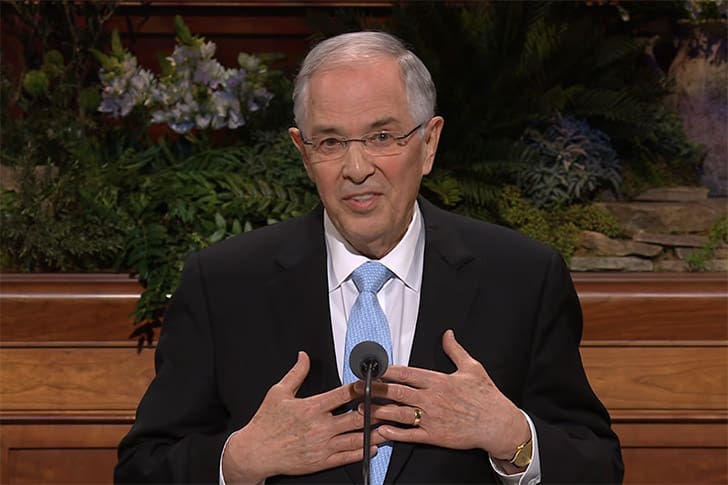
Eternal Marriage Is an Eternal Journey
By Elder Neil L. Andersen
Of the Quorum of the Twelve Apostles
In my 74 years, there are only a few experiences where nearly every emotion and feeling
are solidly cemented in my conscious mind. One of the most poignant is as I knelt across the altar from Kathy in a holy temple of God. The hopes, the dreams, the love we shared, all burst in a kaleidoscope of anticipation as we heard those unforgettable words, “for time and for all eternity.”
To you in this vast worldwide congregation who lovingly remember that day in your life, I speak especially to you. At that moment, kneeling across the altar, we have a growing realization of the depth of our commitment to God and each other. The sacred ordinance binds us together with our eternal companion and with God. We solemnly vow to keep the covenants, and the Lord promises us as we are faithful, unspeakable blessings in mortality and beyond; including thrones, powers, and dominions in the eternal world.
Our even greater hope, however, is a desire to refine our very nature, to become more like our Savior, allowing us one day to live with Him. Within our sacred marriage, bound to God and to each other, we find ourselves in a crucible of spiritual development where vital qualities: sacrifice, charity, patience, and oneness; the very character of Christ can become a greater part of us.
As we increase our love for the Savior, our love for each other grows. Like our own discipleship, our eternal marriage is not a short-term experiment but a journey, an eternal journey of becoming who God desires us to become.

Keys, Covenants, and Easter
By Elder Quentin L. Cook
Of the Quorum of the Twelve Apostles
Elijah was a remarkable prophet who held sacred priesthood keys and through whom mighty miracles were performed. Christians, Muslims,12 and Jews the world over accept Elijah as a prophet. Muslims believe that Elijah was a prophet sent by God (Allah) to call people away from idol worship – especially the worship of Baal – and back to the worship of the one true God.
The Jews have been waiting for Elijah’s return for over twenty-nine hundred years, as a forerunner to the coming of the Messiah. Prior to Jesus Christ’s mortal ministry, the prophet Elijah exercised the sealing power of the Melchizedek Priesthood.
It is noteworthy to me that Elijah also appeared, with Moses, at the time of the transfiguration of Christ. Elijah conferred priesthood keys of the sealing power upon Peter, James, and John. It is also significant that when Christ visited the people on the American continent, He specifically recited to them the Old Testament account in Malachi concerning Elijah and his role in uniting families eternally prior to the Second Coming of Christ.
Because of the Restoration, we understand the important and pivotal role Elijah has playedin the salvation of mankind. Elijah “committed” to Joseph Smith the priesthood keys pertaining to the sealing power to bind sacred ordinances and covenants on earth and in heaven. This includes the vicarious ordinances of salvation and exaltation that must be performed here on earth in the temples of the Lord.
The sealing ordinances are effective after this life and in the eternities – to seal husbands and wives, parents and children. Without these keys, there are no eternal families and the “whole earth would be utterly wasted.”

Come Unto Christ—Together
By Elder Taniela B. Wakolo
Of the Seventy
“The doctrine of The Church of Jesus Christ of Latter-day Saints centers on the family.Essential to our doctrine on the family is the temple. The ordinances received there enable us to return as eternal families to the presence of our Heavenly Father. …The gospel plan…is implemented through our mortal families, and its intended destiny is to exalt the children of Godin eternal families.”
The Lord has also declared that “marriage is ordained of God…that the earth might
answer the end of its creation,” and without the sealing authority needed to enter these eternal covenants that unite families forever, “the whole earth would be utterly wasted at his coming.”
The temple stands as a symbol of hope, not pressure. The crowning ordinance of temple sealings invite us into the divine order of God. The gospel of Jesus Christ is not a wedge to divide families but a bridge to unite them, eternally. We must ensure that our discipleship reflects the Savior’s patience, His gentleness, and His perfect love.
My dear brothers and sisters, some of you are from families yet to be sealed in the temple. Some of you who are listening are not members of the Church. Others of you who are members of the Church may have spouses not of our faith. Today, I say to each of you: You are essential to God’s plan.

Abide with Me; ‘Tis Eastertide
By Elder Gerrit W. Gong
Of the Quorum of the Twelve Apostles
Jesus Christ walking with His disciples on the road to Emmaus reveals a covenant
pattern. Sometimes, on our dusty roads to Emmaus, we feel alone, misunderstood, burdened, unseen. But as He “talk[s] with us by the way,” His words in scripture can cause our hearts to burn. As He breaks and blesses the sacramental bread, His ordinances and covenants can help us know Him.
As we walk by faith with Him, abiding in Him, and Him in us, we come to know He lives. His Easter promises are real.
Just as the disciples on the road to Emmaus ask Jesus to abide with them, Jesus Christ
promises to abide with us. In the gospel of John chapters 14 and 15, Jesus teaches His disciples and us how He can remain, belong, walk with us. His faithfulness is stronger than the cords of death.
When we have a question, problem, or joy, Jesus Christ says, I am your answer – your way, your truth, your life. To abide with us in our darkest days, in John 14 Jesus promises us the First and Second Comforters.
The First Comforter Jesus speaks of is the Holy Ghost. “And I will pray unto the Father, and he shall give you another Comforter, that he may abide with you for ever.” “The Comforter, which is the Holy Ghost, whom the Father [shall] send in my name, he shall teach you all things, and bring all things to your remembrance.”
The Second Comforter Jesus speaks of is Himself. Jesus promises, “I will not leave youcomfortless: I will come to you.”“For “he that loveth me shall be loved of my Father, and I will love him, and will manifest myself to him.” Indeed, “if a man love me, he will keep my words: and my Father will love him, and we will come unto him, and make our abode with him.”

Closing Remarks
President Dallin H. Oaks
President of the Church
Truly, Jesus Christ is the way to peace in this world, and eternal life in the world to come. He knows and loves each of us perfectly, and invites us to walk with Him, abide in Him, and follow His example of ministering to others one by one in charity and love. We have been reminded of the central role of marriage and families in our Heavenly Father’s plan for the eternal destiny of His children. May we demonstrate the pure love of Christ in our families, in our communities, and in all of our interactions with God’s children.
As the messages from this conference are published, I invite all to study and ponder them prayerfully, and to act in faith on the principles they explain. The Lord has promised: “unto him that receiveth I will give more.”1 As we treasure up and act upon the teachings of this conference, the Lord will continue to teach and inspire us with personal revelation and guidance.
Reflections on “the Meridian of Time”

From the editors: When we formulated the idea of a magazine for Latter-day Saints, we wanted just the right name that would have our purpose in its meaning. We wanted a name that invited excellence and illumination, and so we chose Meridian. We knew that it meant the highest point of light in one sense and a measure of the world in another. Author Jeff Lindsay is on the same wavelength in this article.
Readers of Meridian Magazine may have thought about the meaning of “meridian” in the scriptures. There’s an interesting range of possibilities and a puzzle or two to ponder.
Four times the Book of Moses uses an extremely rare English term, “the meridian of time,” to describe the time when Christ would come:
For they would not hearken unto his voice, nor believe on his Only Begotten Son, even him whom he declared should come in the meridian of time, who was prepared from before the foundation of the world. (Moses 5:57)
Wherefore teach it unto your children, that all men, everywhere, must repent, or they can in nowise inherit the kingdom of God, for no unclean thing can dwell there, or dwell in his presence; for, in the language of Adam, Man of Holiness is his name, and the name of his Only Begotten is the Son of Man, even Jesus Christ, a righteous Judge, who shall come in the meridian of time. (Moses 6:57)
And now, behold, I say unto you: This is the plan of salvation unto all men, through the blood of mine Only Begotten, who shall come in the meridian of time. (Moses 6:62)
And it came to pass that Enoch looked; and from Noah, he beheld all the families of the earth; and he cried unto the Lord, saying: When shall the day of the Lord come? When shall the blood of the Righteous be shed, that all they that mourn may be sanctified and have eternal life?
And the Lord said: It shall be in the meridian of time, in the days of wickedness and vengeance.
And behold, Enoch saw the day of the coming of the Son of Man, even in the flesh; and his soul rejoiced, saying: The Righteous is lifted up, and the Lamb is slain from the foundation of the world; and through faith I am in the bosom of the Father, and behold, Zion is with me. (Moses 7:45–47)
We first consider relevant meanings of “meridian.” Linguist Stanford Carmack kindly sent me some definitions and examples of use from the extensive Oxford English Dictionary, 2nd edition:
2.2 The point at which the sun or a star attains its highest altitude.
c1450 Lydg. Secrees 347 Phebus‥In merydien fervent as the glede.1647 Crashaw Poems 130 Sharp-sighted as the eagle’s eye, that can Outstare the broad-beam’d day’s meridian.a1667 Cowley Ess., Greatness, There is in truth no Rising or Meridian of the Sun, but only in respect to several places.1728 Pope Dunc. iii. 195 note, The device, A Star rising to the Meridian, with this Motto, Ad Summa.1843 James Forest Days viii, The sun had declined about two hours and a half from the meridian.
b.2.b fig. The point or period of highest development or perfection, after which decline sets in; culmination, full splendour.
1613 Shakes. Hen. VIII, iii. ii. 224 And from that full Meridian of my Glory, I haste now to my Setting.1638 Sir T. Herbert Trav. (ed. 2) 93 Yet in the meridian of his hopes [he] is dejected by valiant Rustang.c1645 Howell Lett. (1655) III. ix. 17 Naturall human knowledg is not yet mounted to its Meridian, and highest point of elevation.1673 Temple United Prov. Wks. 1731 I. 67, I am of Opinion, That Trade has, for some Years ago, pass’d its Meridian, and begun sensibly to decay among them. 1700 Dryden Fables Pref. *Bb, Ovid liv’d when the Roman Tongue was in its Meridian; Chaucer, in the Dawning of our Language. a1761 Cawthorn Poems (1771) 61 My merit in its full meridian shone.a1859 Macaulay Hist. Eng. xxiii. (1861) V. 67 This was the moment at which the fortunes of Montague reached the meridian. The decline was close at hand.1893 G. Hill Hist. Eng. Dress II, 268 Dress was in its meridian of ugliness.
c.2.c The middle period of a man’s life, when his powers are at the full.
c1645 Howell Lett. i. vi. lx. (1655) 307 You seem to marvell I do not marry all this while, considering that I am past the Meridian of my age.1703 E. Ward Lond. Spy xvii. (1706) 406 As for her Age, I believe she was near upon the Meridian.1795 Mason Ch. Mus. ii. 133 When Purcel was in the meridian of his short life.1864 H. Ainsworth John Law Prol. iii. (1881) 19 Though long past his meridian, and derided as an antiquated beau by the fops of the day.1873 Hamerton Intell. Life iv. ii. (1875) 143 Any person who has passed the meridian of life.
The origins of the word “meridian” are explained at Etymology Online:
mid-14c., “noon, midday,” from Old French meridien “of the noon time, midday; the meridian; a southerner” (12c.), and directly from Latin meridianus “of midday, of noon, southerly, to the south,” from meridies “noon, south,” from meridie “at noon,” altered by dissimilation from pre-Latin *medi die, locative of medius “mid-” (from PIE root *medhyo- “middle”) + dies “day” (from PIE root *dyeu- “to shine”).
The cartographic sense of “a great circle or half-circle of a sphere passing through the poles” is attested from late 14c., originally astronomical. Figurative uses tend to suggest “point of highest development or fullest power,” implying a subsequent decline. [emphasis added]
“Meridian” is thus related to noon, the high point of time, the time of greatest light, with the figurative sense of fullest light or divine power, after which there would be a decline. While it has sometimes been understood as a chronological midpoint in 7,000 years of sacred history, it may be fruitful to consider more figurative meanings such as a high point, a time of fulness in power and authority, etc.
A Parallel to “the Meridian of Time” in the Book of Mormon?
One of the surprising things about the Book of Moses is that numerous passages in the small book are reflected in the Book of Mormon, sometimes with precisely matching language or language expressing related concepts, often with a common context – without being readily explained by an appeal to the King James Bible.
This possibility was first raised by Noel B. Reynolds in 1990 in “The Brass Plates Version of Genesis” where thirty-three parallels were found, including several that pointed to an unexpected direction of influence from the Book of Moses to the earlier translated Book of Mormon — a surprise that led Reynolds to hypothesize that a text related to our Book of Moses may have been on the brass plates.
In collaboration with Reynolds, that work was expanded in 2021 in “‘Strong Like unto Moses’: The Case for Ancient Roots in the Book of Moses,” bringing the number of proposed parallels up to ninety-six. In 2024, “Further Evidence from the Book of Mormon for a Book of Moses-Like Text on the Brass Plates” raised the number to 133, and then a project looking at statistics and the distribution of parallels further raised the number to 146 in a 2025 two-part publication (see Part 1 and Part 2 at Interpreter: A Journal of Latter-day Saint Faith and Scholarship).
Currently there are 162 proposed parallels. (The list is published at and will continue to be updated as needed at both AriseFromTheDust.com and JeffLindsay.com.) With that many parallels and with many of them occurring in multiple places in the Book of Mormon, 10.2% of the verses of the Book of Mormon (after excluding the chapters from the Bible that are essentially quoted in the Book of Mormon) are involved in one or more parallels with the Book of Moses.
That average of 10.2% comes from a highly non-uniform distribution, with parallels being nearly twice as frequent in the small plates text (15.8%) as in the remainder of the Book of Mormon (8.67%). The non-uniform distribution may in part be due to the high familiarity with the brass plates of early prophets such as Lehi, Nephi, and Jacob. On the other hand, in Mormon’s writings in his book of Mormon, the number is just under 4.0%.
A recently proposed and still tentative parallel, #162, involves the coming of Christ in the “meridian of time.” But how can this be a parallel when the Book of Mormon does not use the term “meridian of time” or even the word “meridian” at all? In this case, the parallel is not based on identical language but on semantically related language.
In light of the dictionary definitions and etymology of “meridian” discussed above, I propose that the “meridian of time” may be tantamount to “the fulness of time” used by Lehi twice in 2 Nephi 2 and by Nephi in 2 Nephi 11:
Wherefore, thy soul shall be blessed, and thou shalt dwell safely with thy brother, Nephi; and thy days shall be spent in the service of thy God. Wherefore, I know that thou art redeemed, because of the righteousness of thy Redeemer; for thou hast beheld that in the fulness of time he cometh to bring salvation unto men. (2 Nephi 2:3)
And the Messiah cometh in the fulness of time, that he may redeem the children of men from the fall. And because that they are redeemed from the fall they have become free forever, knowing good from evil; to act for themselves and not to be acted upon, save it be by the punishment of the law at the great and last day, according to the commandments which God hath given. (2 Nephi 2:26)
For if there be no Christ there be no God; and if there be no God we are not, for there could have been no creation. But there is a God, and he is Christ, and he cometh in the fulness of his own time. (2 Nephi 11:7)
Nephi appears to be reciting Lehi’s words, not just in using a phrase similar to “the fulness of time” but also Lehi’s words: “And if these things are not there is no God. And if there is no God we are not, neither the earth; for there could have been no creation of things” (2 Nephi 2:13).
Lehi’s phrasing may have other connections to the Book of Moses to consider. In 2 Nephi 2:3, Lehi includes the term “salvation” in “in the fulness of time he cometh to bring salvation unto men,” related to “This is the plan of salvation unto all men” in Moses 6:62 (Parallel 13).
Further, 2 Nephi 2:3 also includes “dwell safely,” perhaps influenced by another parallel with the Book of Moses, Parallel 93, “Dwell in safety forever,” involving Moses 7:20 and 2 Nephi 1:9.
Lehi’s words in 2 Nephi 2:26 include “to act for themselves and not to be acted upon,” which involve Parallel 125, “Agents unto themselves” with Moses 4:3 and 6:56, coupled with 2 Nephi 2:26, 10:23; Alma 12:13; and Helaman 14:30.
Connections to the Book of Moses are also evident in the adjacent verses around 2 Nephi 2:26, as shown with inline annotations:
Adam fell that men might be; and men are, that they might have joy [Parallel 144: “Adam fell that men/we might be” with Moses 6:48]. (2 Nephi 2:25)
Wherefore, men are free according to the flesh; and all things are given them which are expedient unto man. And they are free to choose liberty and eternal life [with v. 28, part of Parallel 14, “eternal life” with Moses 1:39] , through the great Mediator of all men, or to choose captivity and death, according to the captivity and power of the devil [with v. 29, part of Parallel 9, “devil-lead-captive-his will” with Moses 4:4]; for he seeketh that all men might be miserable like unto himself [with vv. 5, 11, 13, 18, and 23, part of Parallel 44, “Misery (either for Satan or his followers)”]. (2 Nephi 2:27)
2 Nephi 2 is one of the richest in the Book of Mormon for parallels with the Book of Moses. In terms of parallels per 1,000 words, it is essentially tied with Ether 8 for the most parallel-rich chapter (Ether 8 is rich in parallels pertaining to secret combinations, but lacks the thematic diversity of Lehi’s speech). Thirteen different parallels are found in its 30 verses, involving seventeen verses, seven of which have more than one parallel.
Lehi’s heavy use of Book of Moses-related material (material not easily explained by an appeal to the KJV Bible) in this chapter increases the likelihood that the reference to the time of the coming of the Messiah might have been influenced by the Book of Moses, even though “the meridian of time” was used in the English translation of the Book of Moses instead of “the fulness of time.”
Time(s) and Fulness in the New Testament
The parallel involving Lehi’s “fulness of time” and the Book of Moses is weakened by similar but not identical language in the New Testament that must be considered. While New Testament language would not have been available to influence Nephi or Lehi, it could have influenced Joseph Smith if or when the choice of wording was his, and likewise could have influenced the choice of English given to Joseph Smith in the translation process (e.g., it could have influenced wording choice by a hypothetical angelic agent assisting in the translation, if such were part of the translation process). Galatians 4:4 speaks of “the fulness of the time”:
But when the fulness of the time was come, God sent forth his Son, made of a woman, made under the law, . . .
“Fulness of the time” conveys an important difference relative to Lehi’s phrasing. It points to a specific time, with the concept of fully reaching a specific moment in time rather than an era that is the zenith of time or history. The Greek word chronos is used here for time, referring to a specific time, a chronological event. The New International Version of the Bible (NIV) has “when the set time had fully come,” while the New English Translation (NET) has “when the appropriate time had come.” Without the definite article before “time,” Lehi’s “fulness of time” seems more analogous to “the meridian of time.”
The other New Testament verse to consider is one often heard in Latter-day Saint discourse, Ephesians 1:10:
That in the dispensation of the fulness of times he might gather together in one all things in Christ, both which are in heaven, and which are on earth; even in him:
This is still slightly different from Lehi’s “fulness of time.” This verse is not about the time of Christ’s mortal ministry, nor about a precise time per se, but about a dispensation. The phrase “fulness of times” in this context may point to the completion of history or the culmination of time (or of multiple eras) when everything is finally put under Christ and united. Latter-day Saints generally understand our current era, called the “dispensation of the fulness of times,” to be the culminating era in the “last days” before the Second Coming of the Lord, preparing the world for the great Millennium.
Paul’s use of the term “dispensation” (sometimes translated as “administration”) can refer to the administrative era of the Restoration when authority and apostolic organization have been restored and the work of gathering begins in earnest, preparing mankind for the Millennium.
The era of “dispensation of the fulness of times,” a phrase used several times in the Doctrine and Covenants (see Doctrine & Covenants 27:13, 76:106, 112:30, and 124:41) can be considered to point to the era of the Restoration in the last days leading up to the Millennium. This need not be the same time as “the fulness of times” itself, as we glean from Doctrine and Covenants 76:106, referring to the punishment of the impenitent wicked:
These are they who are cast down to hell and suffer the wrath of Almighty God, until the fulness of times, when Christ shall have subdued all enemies under his feet, and shall have perfected his work.
In summary, “the dispensation of the fulness of times” begins with the Restoration and leads to the Millennium, while the “fulness of times” itself can point to the final completion of mortal time at the end of the Millennium when Christ has conquered all. But this is an entirely different issue than what Lehi refers to with “the fulness of time” when Christ shall come as a mortal to earth.
Neither of the two New Testament passages can adequately serve as the source for concepts and language in the Book of Mormon verses about the coming of Christ in “the fulness of time.” Thus, in spite of the overlapping New Testament language that weakens the parallel, it is still offered tentatively as a possible conceptual parallel for consideration.
More Puzzles: The Rarity of “Meridian of Time” and Its Presence in Doctrine & Covenants
A puzzling aspect of this inquiry into a potential parallel is how rare “meridian of time” is in English. Searching Google Books reveals no instances of this term before 1870 (obviously missing many Latter-day Saint publications). However, there are two instances of use in the Early Modern English Era, which ran from roughly the late 1500s to about 1700. For example, Sir Thomas Browne (1605-1682) wrote Hydriotaphia, urne-buriall, or, a discourse of the sepulchrall urnes lately found in Norfolk, published in 1658, accessible via Early English Books Online, which has this passage:
… even old ambitions had the advantage of ours, in the attempts of their vain-glories, who acting early, and before the probable meridian of time, have by this time found great accomplishment of their ddsignes [designs], whereby the ancient heroes have already out-lasted their monuments, and Mechanicall preservations: but in this latter scene of time we can not expect such mummies unto our memories, when ambition may fear the prophecy of elias that the world may last but fix [six] thousand years…
This does not seem to involve the coming of Christ, but about a future time — relative to more ancient days — of greater development with respect to the topic of burial urns.
Two more finds were shared with me by linguist Stanford Carmack, whose studies identifying Early Modern English influences on the originally dictated language of the Book of Mormon translation have opened significant new vistas of understanding. The first comes from Joseph Cooper in Misthoskopia, A prospect of heavenly glory for the comfort of Sion’s mourners, written no later than 1699 (the year of Cooper’s death) and published in 1700, roughly at the end of the Early Modern English era:
The good things of this Life, they are only calculated for the Meridian of Time, and do only shine with a borrowed light: So that when Death shall seize upon you, and Judgment overtake you, they will then be gone, and like a Shadow disappear for ever.
This seems to refer to the meridian of one’s mortal life, after which comes decline and death.
A second find also kindly provided by Carmack occurs shortly after the Early Modern English era in Benjamin Bennet (1674–1726), The christian oratory: or, the devotion of the closet (London: S. Chandler, 1725):
The RESOLUTION. ND am I immortal? Doth my Spirit at Death return to God, and exist for ever in a separate State? I wou’d henceforth resolve to live for Eternity, to prepare for my Return: In order to which I resolve Lord, help me by thy Grace to have my Eye fixed on the other World; and, in all my Designs, Undertakings and Ations [Actions], to preserve a constant Reference thither. I wou’d esteem every thing as little, as nothing comparatively, that’s calculated only for the Meridian of Time, that ferveth [serveth] only a present State. I resolve to chuse, prefer, pursue things, as they stand related to Eternity, judging of them by this Mark and Property.
This also refers to one’s fleeting mortal life, contrasting it with the eternal afterlife.
At least these finds may suggest that “the meridian of time” was a part, though perhaps a rare part, of Early Modern English, consistent with Stanford Carmack’s find that the dictated language of the Book of Moses reflects a strong Early Modern English component. This is related to his impressive work on examining the language of the originally dictated text of the Book of Mormon and finding a unique signature of Early Modern English influence that cannot be explained by imitating KJV language or by Joseph’s dialect, but points to elements of Early Modern English that sometimes significantly predate the King James Bible. For a collection of important papers on this topic, see Carmack’s list of publications at Interpreter: A Journal of Latter-day Saint Faith and Scholarship. For his work on the Book of Moses, see his 2021 paper, “The Original English of the Book of Moses and What It Indicates About the Book’s Authorship.” Carmack examined 30 different linguistic categories and compared their traits across the Book of Moses, the Book of Mormon, the King James Bible, Joseph’s early writings, and pseudo-archaic texts that sought to imitate archaic biblical syntax. Carmack’s findings are significant:
Joseph Smith’s native usage can explain 30 percent of Book of Moses usage, pseudo-archaism 44 percent, and King James usage 37 percent. The Book of Mormon, however, is able to account for most of the patterns and forms investigated: 86 percent of them, by this count. (It is possible, of course, to include other features, which would change the percentages somewhat.) But the Book of Mormon falls short of being able to explain a few of the linguistic features mentioned in table 2, most notably the past-tense usage. The few usage issues it cannot explain occur in the early modern period. Indeed, broader early modern usage (most of the time not Joseph Smith’s modern usage) accounts for all the linguistic features. Thus the simplest explanation of the Book of Moses’s English usage would be to adopt an early modern perspective—in other words, that a text showing true early modern sensibility in language use was revealed to Joseph Smith in 1830. [pp. 634–35]
The prominent use of the rare and apparently Early Modern English phrase “meridian of time” in the Book of Moses may be one more factor to consider regarding the linguistic influences on the Book of Moses text. As with the Book of Mormon, the existence of non-KJV Early Modern English in either the Book of Mormon or the Book of Moses is something that scholars did not expect. It is not a conclusion driven by any kind of apologetic agenda. It is based on objective data that may require us to reconsider common and sometimes simplistic assumptions about the translation process(es) related to both texts. Why that influence exists is still a matter of debate, though Early Modern English, especially the kind found in both texts, appears to be well suited to simplifying translation in many languages.
Yet another significant puzzle involves the Doctrine and Covenants, where the rare term “meridian of time” occurs twice, both shown here in context:
That as many as would believe and be baptized in his holy name, and endure in faith to the end, should be saved—
Not only those who believed after he came in the meridian of time, in the flesh, but all those from the beginning, even as many as were before he came, who believed in the words of the holy prophets, who spake as they were inspired by the gift of the Holy Ghost, who truly testified of him in all things, should have eternal life…. (Doctrine and Covenants 20:25–26)
Hearken and listen to the voice of him who is from all eternity to all eternity, the Great I Am, even Jesus Christ—
The light and the life of the world; a light which shineth in darkness and the darkness comprehendeth it not;
The same which came in the meridian of time unto mine own, and mine own received me not. (Doctrine and Covenants 39:1–3)
Section 39 was given in January 1831. According to the timeline for Joseph Smith’s work of his translation of the Bible given by Kent P. Jackson in Understanding Joseph Smith’s Translation of the Bible (Provo, UT: Religious Studies Center, Brigham Young University, and Salt Lake City: Deseret Book, 2022), pp. 3–4, the portion of that project that became the Book of Moses was given between June 1830 and December 30, 1830. Thus, it is logical that the 1831 text of Section 39 would employ a colorful and meaningful phrase from the unique Book of Moses.
The problem is that Section 20, which also uses “the meridian of time,” is based on revelation said to have been given in April 1830, although it was not published until 1835. The generally accepted April 1830 date is well before Joseph Smith began work on his translation of the Bible in June 1830. Was the term “meridian of time” something Joseph picked up from the dictation of the Book of Moses, that was later edited into our Section 20 of the Doctrine and Covenants? Was there a revelatory process associated with Section 20 that brought this term to Joseph’s mind for some reason? Or was “meridian of time” a term from the Book of Lehi in the lost 116 pages of the initial Book of Mormon translation?
While we don’t seem to have original manuscripts from 1830 related to Section 20, there are a few manuscripts prior to the 1835 Doctrine and Covenants that help us better understand the timing of the use of “the meridian of time.” One such source is provided in the Joseph Smith Papers website as “Articles and Covenants, circa April 1830, as Recorded in Gilbert, Notebook [D&C 20].” The Gilbert manuscript does not use “meridian” at all. Here is the passage corresponding to the part of Section 20 that has had “the meridian of time” at least since 1835:
[A]nd that he ascendid into heaven to sit down on the right hand of the Father to reign with Almighty power according to the will of the father that as many as would believe and be baptized in his name & endure in faith to the end should be saved, yea even as many as were before he came in the flesh from the beginning which believed in the words of the holy Prophets which were inspired by the gift of the Holy Ghost which truly testified of him in all things as well as they which should come after which should believe in the gifts & callings of God by the Holy Ghost, which beareth record of the Father & of the son, which father and son and the holy Ghost is one God infinite, eternal without end, Amen. [p. 4, emphasis added]
So in 1831, the relevant revelation had “even as many as were before he came in the flesh” instead of “those who believed after he came in the meridian of time, in the flesh” as we now have in Section 20.
A related manuscript on the Joseph Smith Papers website, “Articles and Covenants, circa April 1830, Symonds Rider Copy [D&C 20],” also contains a copy of the material related to Section 20. It was copied by Symonds Rider in May 1831, again without “the meridian of time.”
Surviving copies of the 1833 Book of Commandments, the publication of which was interrupted by a mob destroying the Church’s printing press, also show that “the meridian of time” had not yet entered what is now Section 20. Like the 1831 copies of the “Articles and Covenants,” it has “even as many as were before he came in the flesh, from the beginning,” with no mention of “the meridian of time.”
However, Chapter 41, with its January 1831 revelation related to our Section 39, has “The same which came in the meridian of time unto my own” in v. 2, the same as our Section 39. It seems plausible that in the final edits made for the 1835 publication, that Section 20 was edited to include its current language with the poetic phrase from the Book of Moses.
Conclusion
The “meridian of time” as used in the Book of Moses may be a particularly appropriate figurative and poetic term for describing the time of Christ’s mortal ministry and the spiritual revolution He brought. This was a meridian or a zenith of history in which the Son of God lived with humans on the earth, founded His church, and completed His infinite work. After the rapid growth of the church, there was decline in both the Old World and the New World that required correction by the Restoration in these last days.
When Lehi spoke of the coming of the Messiah that was to be in the “fulness of time,” his language may have been reflecting a concept he encountered in the brass plates having a version of Genesis closely related to our modern Book of Moses. The four passages there about the coming of Christ in “the meridian of time” may be reflected in Lehi’s related statements in 2 Nephi 2 associating the birth of Christ with “the fullness of time,” where “fullness” has connections to figurative meanings of “meridian,” possibly forming a parallel between the Book of Mormon and the Book of Moses, one of many. Given similar language in the New Testament and the conceptual nature of the parallel, this parallel may be one of the weakest among the 162 proposed so far, but may still be worth considering.
The English translation with “the fullness of time” may reflect word choices by Lehi from his speech, by Nephi in his written record, and by the translation process that gave us the English. When faced with the complex relationships between these inspired and miraculously translated texts, we generally cannot say exactly who intended what and why.
Nevertheless, much can be learned by exploring how similar words and concepts are used elsewhere and considering what that might suggest about the intent of authors or translators, or the depth of meaning in the texts. The word choices in the scriptures are often worth pondering.
Readers of Meridian Magazine may wish to reflect upon the meaning of “meridian” and related concepts in the scriptures, as well as the welcome role this publication plays in bringing more light into these troubled times before the Millennium.
The Cosmic Dance: Learning to Keep Time with Eternity

This is part 5 of a series on re-enchantment, helping us awaken and see the restored gospel in its expansiveness. To read the others in this series, click on the author’s name.
I. The God Above the Grocery Store
In The Screwtape Letters, C. S. Lewis captures the exact moment when hell feels most endangered by a new convert. It is not when the convert is standing on a mountain peak, overcome by the sublime. It is when he is standing in a dull, ordinary church service.
Screwtape, the senior devil, writes anxiously to his nephew Wormwood:
“One of our great allies at present is the Church itself. Do not misunderstand me. I do not mean the Church as we see it spread out through all time and space and rooted in eternity, terrible as an army with banners… But, fortunately, it is quite invisible to these humans.”1
Instead, Screwtape urges his protégé to weaponize the banality of the local congregation:
“Make him look at the local grocer with the oily expression… Make him notice that the woman in the next pew has squeaky boots.”2
Lewis was not simply being clever; he was being accurate. This is the lived experience of the Saints—the perennial complaint of mortals expecting Sinai and finding, instead, a folding chair and a hymnbook.
In the April 2025 general conference, Elder Dieter F. Uchtdorf bore witness that pierces the heart of this very struggle. He told of a Sunday years ago in Germany when he brought a dear friend—a cultured, spiritual woman not of our faith—to a local branch.3
Like any of us who have ever dared to bring a visitor to church, Elder Uchtdorf was suddenly seized with that peculiar terror: the terror of imperfection. He wanted the aesthetic to match the theology. He wanted the majesty of the Restoration.
Instead, he got the grocery store—the kingdom apparently renting above the canned goods.
The branch met in rented rooms on the second floor of a market. To reach the chapel, they climbed a back staircase that smelled sturdily of produce and cheese. When the meeting began, the disenchanted eye could not help but tally defects. The singing was thin and wavering. The speakers stumbled. The children were restless, creating that specific, chaotic friction that parents optimistically call “reverence.”
Elder Uchtdorf admits he sat and cringed while an inner Screwtape hissed: Is this it? Is this the Kingdom of God? This? He saw the squeaky boots. He heard every off-key note.
But driving his friend home, armed with apologies for the amateurish performance, he never got to use them.
“That was beautiful,” she said.
He was speechless. He had seen a failed performance; she had seen a holy people.
“I’m so impressed with how people treat each other,” she continued. “They all seem to come from different backgrounds, and yet it’s clear that they genuinely love each other. This is what I imagine Christ wanted His Church to be like.”
He had wanted a picture-perfect meeting. She had seen a heart-perfect community. He saw clumsy wooden shoes; she saw the dance—the corps de ballet of the redeemed, as yet wobbly on their feet.
Re-enchantment of worship begins the moment we admit the visitor was right. We must learn to look through the squeaky boots to the reality they conceal. What looks like a boring meeting above a grocery store is, in fact, a rehearsal for the Great Dance of the universe.
II. The Theology: The Social Trinity and the Rhythm of Being
To understand what that friend saw—and what we so often miss—we have to zoom out. We must stop thinking of God as a lonely statue, frozen in solitary perfection, and begin to see Him as a living event, a fellowship, not a figurine.
Restoration theology recovers a stunning truth about the Godhead: the Father, the Son, and the Holy Ghost are not a metaphysical blur, nor three monarchs politely sharing a throne. They are a community.
We are told plainly that “the Father has a body of flesh and bones as tangible as man’s; the Son also” (Doctrine and Covenants 130:22). This is a God who occupies space, who can be touched, who can smile, embrace, and actually be with His children.
Their oneness is not a loss of self but a perfect harmony of will and love. The Lord explains this mystery in the Doctrine and Covenants: He is in the Father and the Father in Him, not by being absorbed like a drop in the ocean, but “because he gave me of his fulness” (see Doctrine and Covenants 93:3–4). They are distinct, embodied Persons moving in such perfect rhythm that they function as One—a kind of eternal pas de trois of love.
The early Christian Fathers had a word for this divine relationship: perichoresis—literally, “dancing around.” The life of God is not a static sitting on a throne; it is a dance of mutual indwelling, an eternal flow of love given and love received—a perichoretic waltz rather than a celestial board meeting, less minutes and motions, more music and mercy.
This reorients our entire view of the Plan of Salvation. We are not only called to obey a Sovereign; we are invited to join a Family. When the Savior prays in John 17, “That they all may be one; as thou, Father, art in me, and I in thee, that they also may be one in us,” He is sending us an engraved invitation to the Dance, a summons written, as it were, in blood and light.
Salvation is not simply acquiring a mansion; it is learning the steps. It is slowly trading our beloved clumsiness for His belovedness—our spiritual slapstick for His splendor. It is the long, patient work of fitting our jagged, selfish little selves into the seamless rhythm of divine love until we discover, with some surprise, that charity has taught our feet what pride never could.
III. The Rehearsal: Why We Go to Church
This changes everything about the “boring” Sunday service.
If the universe is a Dance, then the ward is the dance studio: a modest gymnasium in which we are being fitted for an imperial ball, a celestial cotillion that begins, inconveniently, under basketball hoops. And like any dance studio, it is full of beginners—people who are clumsy, who step on toes, who are out of breath and off the beat and not entirely sure why their hands are supposed to go there.
We often say we “get frustrated” with our wards, as if frustration were a kind of invisible pollen that drifts in through the chapel vents. But as the philosopher Brett Savage reminds us, frustration is something we generate. It is the emotional residue of a demand that the world (or the ward) be other than it is. It is what we feel when our private script for how things ought to go collides with other people’s agency.
So when we sit in the pew and seethe because the lesson is meandering, or the talk is awkward, or the baby is crying, we are not merely enduring a trial—we are actively declining an invitation. We are bringing a consumer mindset into a covenant setting, reviewing a performance instead of joining a rehearsal.
God has gathered this very specific community of beginners—the awkward high priest, the exhausted single mother, the over-eager intellectual, the erratic teenager—not to entertain us, but to polish us, to knock the corners off our souls until they stack together like living stones.
Paul told the Ephesians that we are “no more strangers and foreigners, but fellowcitizens with the saints,” and that we are “fitly framed together” to become a holy temple (Ephesians 2:19–21). Stones do not fit together naturally; they scrape and grate until they are shaped.
You cannot practice charity on a mountaintop by yourself; solitude has no elbows to bump. Charity requires another person—usually one who annoys you. It requires the very concrete promise to “bear one another’s burdens” (Mosiah 18:8). The friction of the ward is not a glitch in the system; it is the whole point—the sand in the oyster from which pearls are meant to emerge. And heaven, if Revelation is any guide, is strangely fond of pearls.
The Church is the laboratory where we learn to stop acting out and start acting with. The Lord’s command is blunt: “Be one; and if ye are not one ye are not mine” (Doctrine and Covenants 38:27).
When we sing the hymns—even off-key—we are literally vibrating together, tuning our wills to a shared text, our theology, for a few verses, set to the same pitch. When we partake of the sacrament, we are not merely eating bread and sipping water; we are synchronizing our covenants. We are, in a small and stumbling way, practicing the rhythm of the Atonement of our Lord.
To the disenchanted eye, it is just a meeting above a grocery store. To the re-enchanted eye, it is a clumsy, beautiful, holy attempt to keep time with the rhythm of the Father and the Son—a celestial symphony played, for now, on very human instruments.
IV. The Public Square: The Saint in the World
The Dance, however, does not stop at the chapel doors. The closing prayer is not an ending; it is a deployment.
A re-enchanted Saint does not leave “holy ground” on Sunday to return to “secular ground” on Monday. According to the theology of the Restoration, there is no such thing as neutral ground: every square inch is either being hallowed or profaned. “The earth is the Lord’s, and the fulness thereof” (Psalm 24:1). Revelation teaches that “the herb, and the good things which come of the earth… are made for the benefit and the use of man… to please the eye and to gladden the heart” (see Doctrine and Covenants 59:17–19). The world, in other words, is arranged as sacrament, not scenery.
The parking lot, the office cubicle, the school hallway, the voting booth, the grocery aisle—these are all territories of the King, currently occupied by amnesiacs who have forgotten the song.
We return here to C. S. Lewis, whose voice has echoed through this series. As we step into the ordinary world of Mondays, we must remember his warning in The Weight of Glory:
“There are no ordinary people. You have never talked to a mere mortal. Nations, cultures, arts, civilization—these are mortal, and their life is to ours as the life of a gnat. But it is immortals whom we joke with, work with, marry, snub, and exploit—immortal horrors or everlasting splendors.”4
This is the lens of the re-enchanted Saint. We follow Paul’s admonition: “Whatsoever ye do, do it heartily, as to the Lord, and not unto men” (Colossians 3:23).
The receptionist is not a “function” to get you past the door; she is an eternal queen in embryo. The irritating client is not an obstacle; he is a brother with whom you co-existed for ages before this earth was formed. The spreadsheet you are building is not meaningless busywork; it is a tiny exercise in organizing matter, a faint echo of the Creation itself.
This is the Saint in the world. We do not go out to conquer the world with criticism; we go out to re-enchant it with recognition. We go out to see the immortal in the mortal, the choreography in the drudgery, the Dance hiding in the daily grind—to treat even Tuesday afternoon as something that has wandered in from Revelation.
V. Final Vision: The Submerged Sunrise
We began this series with the image of the “Amnesiac King”—the man in the factory who has forgotten he is royalty. We end with that same king stepping out of the factory and seeing the sunrise.
Re-enchantment is simply the recovery of sanity—not an escape from reality, but an escape from the thin, anxious parody we have been calling “reality.” It is waking from the nightmare of materialism—the nightmare that told us we were accidents, that our brains were just computers, that our dead were gone forever, and that the universe was cold and empty.
The Restoration wakes us up. It tells us the “Submerged Sunrise” is real. It testifies that “Man was also in the beginning with God” (Doctrine and Covenants 93:29). We are not accidents; we are ancient.
- Essay 1 told us we are eternal intelligences, co-eternal with God, and that our longing is a kind of homesickness.
- Essay 2 told us we are not victims of chaos, but agents authorized to organize our lives through the power of the Word.
- Essay 3 told us scripture is a romance, not a repair manual—more ballad than blueprint.
- Essay 4 told us our bodies and our bread are holy vehicles of glory.
- Essay 5 tells us we belong to a Cosmic Dance that spans the galaxies and includes our neighbors, from Kolob to the cul-de-sac.
Chesterton once wrote, “We do not want a religion that is right where we are right. What we want is a religion that is right where we are wrong.”5
We are wrong about so much. We are wrong when we think we are small. We are wrong when we think we are alone. We are wrong when we think the world is boring. It is not the world that is dull, only our eyes.
The gospel of Jesus Christ is right. It is the good news that the world is our Father’s house, that the walls between worlds are thin, and that the family is gathering. Paul writes that “the earnest expectation of the creature”—the creation itself—“waiteth for the manifestation of the sons of God” (Romans 8:19). The world is waiting for us to remember who we are—for the dancers to arrive, laces tied, at the edge of the floor.
So—look up. The service is over. The organ postlude is playing. But the Dance is only just beginning. Step out of the chapel and into the world, and look at it—really look at it—with the eyes of one who has remembered heaven.
You will find that the whole earth is “crammed with heaven, and every common bush afire with God. But only he who sees takes off his shoes.
The rest sit round it and pluck blackberries”6—busy with the berries, oblivious to the Burning.
Footnotes
1. S. Lewis, The Screwtape Letters, annotated ed., ed. Paul McCusker (New York: HarperOne, 2013), 12.
2. Lewis, The Screwtape Letters, 13.
3. Dieter F. Uchtdorf, “Our Heartfelt All,” The Church of Jesus Christ of Latter-day Saints, General Conference, April 2025, https://www.churchofjesuschrist.org
4. C.S. Lewis, The Weight of Glory and Other Addresses, rev. and expanded ed. (New York: HarperOne, 3029), 45
5. G.K. Chesterton, Heretics, in The Collected Works of G.D. Chesterton, Vol. 1 (San Francisco: Ignatius Press, 1986), 71.
6. “Earth’s crammed with heaven, and every common bush afire with God; But only he who sees, takes off his shoes—The rest sit round it and pluck blackberries…”(Elixabeth Barrett Browning. Aurora Leigh, ed. Margaret Reynolds {Athens, OH; Ohio University Press, 1992], bk. 7, llines 820-823).
Your Hardest Family Question: How do I protect our children from the unhealthy influence of their older sister?

Question
We sent our oldest daughter across the country to an Latter-day Saint school and felt a sigh of relief as we hoped she would be surrounded by goodness, faithfulness, and similar morals. Unfortunately, we discovered that instead, our child is now smoking weed and drinking alcohol, among other things. After finding this out we were completely heartbroken. It is hard to describe the feelings in a parent when your child makes these choices. It’s one of the most terrible and painful things I’ve ever gone through, and I am very familiar with grief and heartache.
We have always done everything right: Family Home Evening every week, scriptures, and prayers every night, church every Sunday, all the church activities, …. literally textbook happy, Latter-Day Saint family. We never saw this coming. While this child struggled with her testimony often…. we were still completely blindsided by this.
We have come to terms with everything and have come to a place where we have accepted it. Unfortunately, for all parents everywhere…. free agency exists. We, of course, will never stop parenting and have our opinions, thoughts and standards be known, as well as our sadness and disappointment. We have made sure to let her know we still love her. So much! And thankfully, our relationship has survived, and we still talk often and happily.
However, there’s one problem we find harder to figure out. This child is the oldest of five kids. Eventually she will want to come home to visit. I would rather she not come at all. I want to protect all our impressionable, young, still developing kids…. some who look up to her so much!
We are terrified of the effect she will have on our other children. We dread the example she will set. We can’t stand the thought of these things happening in our house. We feel the heartbreak all over again when thinking of explaining all of this to our other children. How will we prepare them? How will we protect them? How will we explain it?
We obviously can’t tell our own child to not come home. But how do we let her come home?
Answer
You’ve worked hard to accept the reality of your daughter’s current priorities and it sounds like all this work has been done at a distance. It’s quite different to experience the contrast in person while wondering what influence and impact she’ll have on your efforts to guide your children at home. Even though you can’t program any of your children’s paths, you can still have peace and maintain close relationships with them. Let’s talk about how you can do this.
Before we get into the logistics of how to handle your daughter’s homecoming, I’d like to address your response to the doctrine of agency. In your question, you used the word, “unfortunately”, when talking about the reality of agency. While I do understand the parental pain of watching agency in action as a child disregards God’s laws, I believe it’s important to not blame agency as the problem. In fact, agency is the solution to our fallen state! Elder Robert D. Hales reminded us of this core truth:
“Our agency—our ability to choose and act for ourselves—was an essential element of this plan. Without agency we would be unable to make right choices and progress. Yet with agency we could make wrong choices, commit sin, and lose the opportunity to be with Heavenly Father again. For this reason, a Savior would be provided to suffer for our sins and redeem us if we would repent. By His infinite Atonement, He brought about ‘the plan of mercy, to appease the demands of justice.’”[i]
I want to invite you to trust in agency and rejoice in the fact that you, your daughter, and all your children possess the ability to choose their own path. Even though your daughter isn’t following God’s laws right now, she is living the plan of salvation. Resist the tendency to believe that it should be any other way. You are conscientious and intentional about guiding your children back to the presence of our Heavenly Parents, so I see how painful this is for you. I also believe that when we fully embrace the truth about moral agency, it can flood us with peace and purpose as we trust in God’s plan.
Another truth that can bring you peace is recognizing that your daughter’s journey is far from over. She is currently discovering the law of opposites and will have firsthand knowledge of tasting the bitter, “that [she] may know to prize the good.”[ii] Remember that our Heavenly Parents built a world full of surprises, temptations, dangers, and tragedies. It’s a wild and unpredictable classroom designed to help their children grow to be just like Them.
None of us know what she will choose next or how long it will take for her to learn these important lessons. However, it’s critical that we don’t limit the love and patience of our perfect Heavenly Parents and our Savior, Jesus Christ. C.S. Lewis discovered this Divine Love in his early thirties after years of stubborn atheism:
“I gave in, and admitted that God was God, and knelt and prayed: perhaps, that night, the most dejected and reluctant convert in all England. I did not then see what is now the most shining and obvious thing; the Divine humility which will accept a convert even on such terms. The Prodigal Son at least walked home on his own feet. But who can duly adore that Love which will open the high gates to a prodigal who is brought in kicking, struggling, resentful, and darting his eyes in every direction for a chance of escape? . . . The hardness of God is kinder than the softness of men, and His compulsion is our liberation”[iii]
You are doing all you can do to guide and bless your daughter and your children at home. Please don’t forget that you’re co-parenting with the loving partnership of our Heavenly Parents who are the architects and champions of the role of agency in their great plan of happiness. President Harold B. Lee reassured all earthly parents with this important reminder: “We forget that we have a Heavenly Father and a Heavenly Mother who are even more concerned, probably, than our earthly father and mother, and that influences from beyond are constantly working to try to help us when we do all we can.”[iv]
As you contemplate her returning home and eventually exposing her siblings to her lifestyle choices, it’s critical that you hold tightly to the principles I’ve shared above. I don’t minimize the pain of watching your children practice their agency in ways that bring regret and sorrow. It’s truly a soul-stretching experience that we both love and hate. However, your response to her and your other children will be influenced by your trust in the principle of moral agency.
When your daughter returns home, she’ll be returning as an adult guest who can be expected to follow the house rules. Even though she’s familiar with the home rules and routines, there’s nothing wrong with reviewing your expectations. Speak kindly and clearly to her about what you expect from her as a guest in your home. I also think it’s important to remind her that respecting your rules also means not undermining your authority and influence on your other children. She’s not their parent and can practice deference and respect while she’s in your home.
Even though you can decide whether she enters your home, she still might choose to contact them outside of your home and share her experiences, behaviors, and beliefs with your other children. This is where it’s important to once again embrace the principle of agency and hope that all your children will sense the difference between bitter and sweet. You’ve taught them the sweet and they will eventually encounter the bitter (which may initially taste artificially sweet). Continue offering them light and truth by precept and example.[v]
Of course, you don’t need to broadcast her choices or your disappointment in your daughter’s path. At the same time, you don’t need to hide the reality of her life from your children when it’s presented to them. When your other children discover her lifestyle choices, you can stay close to them and process what they’re seeing, feeling, thinking, and experiencing. You still have a responsibility to reinforce your standards and teach truth to your children. These are excellent opportunities to help them embrace the law of opposites and decide what matters to them.[vi] It’s a gift to your children to help them make sense of opposing feelings and thoughts in the supportive presence of loving parents.
This is also a powerful opportunity for them to learn how to treat others who are different from them. They can learn how to be inclusive, loving, and open to their sister and others. Your children can learn lessons about agency and love as they observe you interact with your daughter. As they watch you stay connected to your daughter and treat her with respect and love, they will know that nothing can separate them from the love of their parents.[vii]
Geoff will answer a new family and relationship question every Friday. You can email your question to him at [email protected]
Download Geoff’s FREE guide to help you quickly end arguments with your spouse: https://www.geoffsteurer.com/3-steps-to-end-your-marriage-argument
You can connect with him at:
Website: www.geoffsteurer.com
Facebook: www.facebook.com/GeoffSteurerMFT
Instagram: @geoffsteurer
Twitter: @geoffsteurer
About the Author
Geoff Steurer is a licensed marriage and family therapist in private practice in St. George, Utah. He is the co-author of “Love You, Hate the Porn: Healing a Relationship Damaged by Virtual Infidelity”, host of the podcast, “From Crisis to Connection”, and creates online relationship courses. He earned degrees from Brigham Young University and Auburn University. He is married to Jody Young Steurer and they are the parents of four children.
[i] https://www.churchofjesuschrist.org/study/general-conference/2010/10/agency-essential-to-the-plan-of-life?lang=eng
[ii] Moses 6:55
[iii] Lewis, C. S., & Barfield, O. (1955). Surprised by joy: The shape of my early life. Chicago. pp. 228-229
[iv] Harold B. Lee, “The Influence and Responsibility of Women,” Relief Society Magazine 51, no. 2 (Feb. 1964): 85.
[v] https://www.churchofjesuschrist.org/study/ensign/1981/12/the-power-of-example?lang=eng
[vi] 2 Nephi 2:11-28
[vii] Romans 8:39
Hope Is Not Wishful Thinking—It Is Power Anchored in Christ

Recently, in the midst of a difficult experience meant to refine rather than comfort, I was surprised to feel hope. This unexpected awareness helped me recognize the source of what I was feeling—my testimony of Jesus Christ and the covenants and promises which shape my personal relationship with Him. The hope I felt did not remove the challenge, but it turned me toward Christ and opened my heart to what He was teaching me. Rather than eliminating hardship, hope gave it context and direction. It reminded me spiritual growth often begins not with relief, but with trust.
Hope is not a decorative virtue in the gospel of Jesus Christ. For members of The Church of Jesus Christ of Latter-day Saints, hope is a living spiritual force. It sustains faith, strengthens obedience, and steadies the soul when life feels uncertain. It reaches far beyond optimism or positive thinking. Gospel hope is rooted in Jesus Christ and in the promises made possible through His Atonement and Resurrection. It nourishes spiritual health in deeply personal ways and provides perspective and courage during seasons of upheaval.
Latter-day Saint teachings consistently place hope alongside faith and charity as essential to discipleship. When hope weakens, faith often falters, and charity can begin to fade. When hope is alive, discipleship becomes resilient and active. Hope allows us to trust God even when outcomes remain unclear. It anchors the heart to eternal truth when mortal circumstances feel fragile. This kind of hope does not deny pain. It acknowledges hardship while affirming God is present and purposeful.
On a personal level, hope shapes how we understand ourselves and our relationship with Heavenly Father. Many spiritual struggles are rooted in discouragement or fear. Hope gently counters those forces by affirming divine worth and future possibility. It whispers growth is still possible, forgiveness is real, and progress continues even when our steps feel small. This is the same hope that, in moments of personal trial, turns us toward Christ rather than inward toward despair. It sustains prayer when answers seem delayed and strengthens covenant keeping when obedience feels costly.
Hope also protects spiritual health by giving meaning to suffering. Trials can distort perspective, making problems feel permanent and identity feel diminished. Hope restores balance by pointing beyond the present moment. It invites us to see adversity as part of mortal learning rather than evidence of abandonment. This does not minimize pain, but it prevents despair from taking root. A hopeful heart remains open to instruction, correction, and divine guidance.
The Book of Mormon repeatedly links hope with movement. Disciples are taught to press forward with steadfastness in Christ and a brightness of hope. This image suggests progress rather than paralysis. Hope motivates action. It inspires repentance, service, and perseverance. It encourages continued trust even when the road ahead is unclear. In this way, hope becomes an expression of faith rather than a substitute for it.
Hope also deepens charity. When we believe God is still at work in our lives, we become more willing to extend grace to others. Hope widens perspective and softens judgment. It allows us to see people not only as they are, but as they may become through Christ. This outlook nurtures compassion and patience, strengthening families, wards, and communities.
Beyond the personal sphere, hope plays a vital role during times of global upheaval. War, natural disasters, social division, and economic uncertainty can leave many feeling anxious and exhausted. In moments like these, hope becomes a stabilizing influence. It grounds us in the plan of salvation and affirms history is neither random nor abandoned. God’s purposes continue even amid confusion and chaos.
This broader hope encourages engagement rather than retreat. Trusting God’s plan does not excuse inaction—it invites responsibility. Hope motivates service, generosity, and peacemaking. It moves us to lift burdens, comfort the grieving, and participate in healing wherever we can. It fuels the conviction small acts of goodness still matter.
Hope also protects us from fear-based discipleship. Fear narrows vision and isolates. Hope expands vision and strengthens connection. It allows us to face uncertainty without surrendering to cynicism or panic. This steadiness becomes a quiet witness of faith to a world desperate for reassurance.
The doctrine of the Resurrection gives particular power to Latter-day Saint hope. It teaches loss is not final and death does not have ultimate authority. This belief shapes how we experience grief and suffering. It does not remove sorrow, but it fills sorrow with expectation. The promise of restoration allows us to mourn with faith rather than despair.
Ultimately, hope keeps our focus on Christ. When hope is anchored in Him, it does not rise and fall with worldly conditions. It rests on His character, His promises, and His victory over sin and death.
The same hope steadies us in personal trials, sustains us in uncertain times, and draws us toward light rather than fear.
In an unstable world, hope remains a sacred, covenant-shaped gift. It sustains individuals through private trials and empowers communities to respond with compassion and courage. For disciples of Jesus Christ, hope is not passive—it is a commitment to trust God and move forward in faith. It strengthens the soul, enriches discipleship, and quietly testifies God is still at work—both within us and across the world.
Are All People Latter-day Saint at Their Core?

Terryl Givens, researcher and author of “The God Who Weeps” and other excellent writings on the gospel of Christ, recently had a podcast interview with current traditional Christian thinkers and theologians. He stated, “Many are disassociating from Christianity but still want to explore their relationship to God.”
He went on further to say these scholars and theologians tire of the beliefs of Christianity that teach of a God that is, “An angry, retributive God, who is primarily concerned with justice and equity.” New England preacher Jonathan Edwards famously wrote that we are, “Sinners in the hands of an angry God.” The scholars Givens met with are now touting, “a pre-existence, and a generous, capacious plan for those who die without the gospel.” Stunning.
Across the world I’ve spoken to so many people about business, life, conflicts, and religions. In formal settings such as with a Saudi prince or with Supreme Soviets of the USSR, on their state radio, in Tanzania, China, Peru, New Zealand/Australia or England – wherever – I’ve had the chance to observe what they believe and hope for. An epic journey for me. Let me share with you a brief summary of what they all have in common. There isn’t space enough to list their similarities because people have far more experiences and thoughts that unite us than divide.
As my hair turns whiter, I conclude one simple fact: deep down, past the clutter of cultures and propaganda, at their core, most people are, at their heart, Latter-day Saints. Latter-day Saints in embryo. Wow! What a slanted perspective. But wait. Consider these evidences:
1. Premortal existence. Most have NO formal training or a concept of a premortal existence. But as we just listen to our inner soul, we hear, over and over, that we didn’t just spring out of mud. Maybe the best English poet, William Wordsworth, wrote:
Our birth is but a sleep and a forgetting: The Soul that rises with us, our life’s Star,
Hath had elsewhere its setting, And cometh from afar:
Not in entire forgetfulness, And not in utter nakedness,
But trailing clouds of glory do we come From God, who is our home:
Heaven lies about us in our infancy!
Either people wish to know they had elsewhere a start – preexistence – or already believe it even though in the Christian traditional world, they teach “ex nihilo” – that God made EVERYTHING out of NOTHING. I postulate no one really believes that.
2. Nature of God. Nicene Christian belief made up in 325 AD, that God created all things out of nothing, and thus created Lucifer and thus created Sin. This God is without body, parts, or passions. Somehow, He’s an amalgam of The Father, The Son, and The Holy Spirit. Worse still, He is focused on destroying most everything He creates. He created a hostile world and put people on it who will NEVER hear one word about this God, who will have a miserable life and their reward is for this “God” to send them to everlasting punishment in Hell.
For those few who do not end up in Hell, their reward is to sing praises to this megalomaniac God forever. Mark Twain in his short story Captain Stormfield’s Visit to Heaven has fun showing Capt. Stormfield finally getting his wings, harp and halo with directions from St. Peter as to the location of the cloud the Captain and another fellow are to go to and play songs of praise forever. After strumming their harps through the songs a few times – and with little if any musical skill, the two ask if the other knew any other songs. Neither did, so they stood up, tossed away their harps and strolled around heaven.
No one really believes such a post-earth life makes any sense, either in heaven or hell. It doesn’t ring true.
My wife’s English grandmother lived in India where her husband taught school. They were about to return to England with their two children where a relative was a preacher who planned to baptize the infant. The infant contracted polio and died. No preacher for any Christian church would bury their daughter because “she wasn’t baptized so she’s in Limbo.” No immediate salvation. Imagine such a religious belief. Sad.
People deep down want there to be a reason for this earth life, a compassionate and loving God who doesn’t expect perfection but progress, and a loving God who communicates with us.
In other words, they want a logical, passionate, beautiful Plan of Salvation – from preexistence to earthly reasons for existence and something after this life that pulls it all together. Again, the beautiful Plan of Salvation that has been restored by modern prophets God has called because He said, “Surely the Lord God will do nothing except He reveals His secrets to His prophets.”
3. Eternal Progress. This is a chance or opportunity to become like our Father. In the first place, anyone who reads the Bible knows that those who meet the Father’s expectations, “have all my Father hath.” We are His children and heirs to his kingdoms. Who would NOT like to live knowing the eternal plan of the Father of goodness and inheritance?
With that wish and desire embedded deep in our souls, we feel the goodness of the Father and the Son through the Holy Spirit – each one making their presence and expectations known to us. YET…we know we may not measure up in this life. We may die before becoming a child, or before becoming an adult, or before receiving the Good Word of God. Is it in anyone’s deep consciousness that this is fair? Godlike? And if not, wouldn’t He have some way of allowing us to prove ourselves – prove our devotion to Him – AFTER this earth life and before the Judgement?
Well, there is. For one thousand years following this earth life and before the Final Judgement, we are in Paradise where we seek to become more like the Father with his angelic tutors helping us toward some kind of perfection. Who wouldn’t want to believe that?
4. Eternal love. How many song lyrics declare one’s love for another that will last forever. Eternal love. Forever yours. In virtually every society, that is in the heart and mind of all lovers.
But modern Christianity drops the ball. They point, erroneously, to one verse that reads “neither marry nor given in marriage.” With glee I’ve had some Christians roundly decry notions of eternal marriage as false. To them they temporarily rejoice that marriage is ONLY an earthly thing and thus, the Christians and other faiths declare marriage is “until death do you part.” NO ONE wants that.
5. Eternal families. Sometimes when our kids are teenagers, we’re not so sure about this one. But no one has children with a short vision. The bonds that bring a man and woman together to have children – either naturally or by adoption – form a family bond that NO ONE wants broken. Ever. We crave to have Eternal families.
Those are just a few core beliefs in humanity that tell me deep down in our core, we are all Latter-day Saints – wishing and hoping that those beliefs of a loving Father, in a pre-earth life knew us and prepared a Plan of Salvation for eternal happiness and joy, who sent us to earth at OUR choice, relying upon Jesus to atone for our errors, find joy on earth serving each other and having a chance – now or in the post-life or Millenium – to fully prepare ourselves for a hoped for, meaningful Eternal Life with our spouse and family. Is that too much to hope for? Not when the Creator has said, “This is MY Work and my Glory, to bring to pass the immortality and eternal life of man.”
Who doesn’t believe that at their core? Who would prefer the vision of heaven given by Joseph F. Smith (D&C Sec. 138) over that of Dante Alighieri’s Inferno or vacuous Paradiso.
At every person’s core – they want fairness, the blessings rather than condemnation from a loving Father. Everyone wants to be like their devoted Father.
In summary, the late General Authority, Tad Callister, said something about this that is special:
Suffice it to say, I can live with some human imperfections, even among prophets of God—that is to be expected in mortal beings. I can live with some alleged scientific findings contrary to the Book of Mormon; time will correct those. And I can live with some seeming historical anomalies; they are minor in the total landscape of truth.
But I cannot live without the doctrinal truths and ordinances restored by Joseph Smith, I cannot live without the priesthood of God to bless my family, and I cannot live without knowing my wife and children are sealed to me for eternity.
That is the choice we face—a few unanswered questions on one hand versus a host of doctrinal certainties and the power of God on the other. And for me, and I hope for you, the choice is an easy one and a rational one.
I certainly agree and believe these Eternal Truths that are consistent and logical are imbedded in everyone in the “Light of Christ” that all receive.
Three Creation Accounts – One Divine Plan

In Latter-day Saint belief, the Creation is revealed through three complementary accounts: Genesis in the Old Testament, the Book of Moses, and the Book of Abraham in the Pearl of Great Price. These records do not compete with one another. Together, they offer a richer understanding of God’s nature, humanity’s identity, and the purpose behind the earth’s creation.
Genesis offers the most familiar account. Traditionally attributed to Moses as the author, it presents Creation in a majestic and orderly manner, describing how God formed the heavens and the earth, organized life, and created man and woman in His image. The language is formal and universal, emphasizing divine authority and the goodness of God’s work. Genesis teaches what happened—the world was created deliberately, with order and purpose. It preserves the core narrative upon which later revelation builds.
The Book of Moses expands the narrative through modern revelation. As Joseph Smith worked on the Joseph Smith Translation of the Bible, he received inspired clarification and restoration of Genesis material. The earliest portions of that work are now published as the Book of Moses, which can be understood as Genesis revealed anew rather than rewritten. This record strengthens the traditional view of Mosaic authorship by portraying Moses as a prophet who spoke directly with God and received divine instruction about Creation and humanity’s role within it.
The Book of Moses therefore shifts the focus from events to intent. Instead of opening with the formation of the earth, it begins with Moses learning who God is and why Creation matters. God declares, This is my work and my glory—to bring to pass the immortality and eternal life of man. Creation is framed as part of a plan centered on humanity. The earth exists not merely as a beautiful world, but as a place where God’s children can exercise agency, form families, and progress toward Him. The Fall of Adam and Eve is presented not as a failure, but as a necessary step toward making joy, growth, and redemption possible.
The Book of Abraham reaches even further back, describing events before the earth was formed. Abraham records a premortal council where God presented His plan to His spirit children. Creation is portrayed as a carefully organized process, carried out in stages through divine cooperation. This account emphasizes intention and preparation rather than sudden creation. It also teaches human beings existed as spirits before mortality and were known and instructed by God long before their birth on earth.
Read together, these accounts reveal Creation and salvation are inseparable. Genesis teaches what God did. The Book of Moses explains why He did it. The Book of Abraham shows how it was planned. Each prophet received revelation suited to his mission and audience, and God repeated the story not to correct earlier accounts, but to deepen understanding as His children were prepared to receive more.
This combined view also addresses common questions. The days of Creation need not be literal twenty-four-hour periods but can represent extended phases of organization. The Fall becomes a purposeful part of God’s design rather than a tragic disruption. Faith in Creation does not require rejecting science, since Latter-day Saint doctrine allows for divine direction working through natural processes.
Together, these records demonstrate how revelation works. God teaches gradually, adapting truth to the needs and understanding of His children. Genesis spoke to an ancient covenant people. The Book of Moses sought humanity’s place in an eternal plan. And the Book of Abraham contemplated the heavens and God’s work beyond the earth. Each account reflects both divine consistency and divine patience.
These Creation accounts also invite personal engagement. Believers are encouraged to seek understanding through study, prayer, and continuing revelation. The same God who instructed Moses and Abraham invites individuals to gain insight suited to their own lives. The Creation thus becomes more than doctrine—it becomes a witness of God’s involvement and care.
Above all, these accounts teach identity. If life existed before the earth, if a plan was prepared in heaven, and if the world was created with humanity in mind, then no person is an accident. Each individual has divine potential and an eternal purpose. The Creation story, as revealed in Genesis, and through Moses and Abraham, is ultimately about who we are, where we came from, and where God invites us to go. Together, these three witnesses testify the world was created with love, intention, and eternal purpose, and that every child of God has a place in His plan.
Sneaking Past the Watchful Dragons: Re-enchantment and the Sanctified Imagination

I. The Film of Familiarity
We are drowning in data, yet we starve for wonder. In our Sunday School classes, our family councils, and our private devotions, we suffer from a peculiar spiritual vision loss. It is not that we are blind; it is that we see so much that we no longer see anything in particular. We have looked at the universe until it has become, not enormous, but merely obvious. It is what Samuel Taylor Coleridge and William Wordsworth called the “film of familiarity.”1 It is a thin, invisible dust that settles on our eyes, making the miraculous look mundane simply because we have seen it a thousand times.
We possess the doctrines. We have memorized the answers. We can sketch the Plan of Salvation on a chalkboard from memory—premortal life on the left, the veil here, the three degrees of glory stacked neatly on the right.
But somewhere in the repetition, the film thickens. We begin to mistake the map for the country. We are like a starving man who has memorized a menu and believes he has eaten a dinner. We treat the heuristic sketch as if it were the weight of glory itself. What once felt like discovery now feels like review; the thunderous themes of eternity drift past us like notices on a foyer bulletin board—acknowledged, agreed with, but scarcely attended to.
T. S. Eliot’s haunting interrogation has become our biography: “Where is the Life we have lost in living? Where is the wisdom we have lost in knowledge? Where is the knowledge we have lost in information?”2
The very truths that should unmake and remake us lie stacked in the mind—filed, familiar, and functionally inert. Why does this happen? How do truths that once struck like lightning now read like a tax code? The trouble with many of us is not that we doubt the commandments, but that we file them. Thunder is terrifying in the sky; it is quite tolerable when reduced to a numbered subsection in a manual.
C. S. Lewis, the patron saint of the re-enchanted mind, diagnosed the malady with a single image: the “watchful dragons.”
Lewis observed that when we approach religion head-on—when we march up to the front gate of the soul with a clipboard of “thou shalts”—something within us locks the door. We feel guilt, or pressure, or simply the glaze of the over-familiar. Our reason posts itself like a sentry at the gate.
And reason, in our fallen state, is not always the noble faculty we imagine. It can be the soul’s most cunning defense attorney. When we choose badly or harbor secret sin, our reason does not rush to condemn us; it rushes to exonerate us. It constructs arguments. It drafts alibis. It suppresses the truth to protect the ego. It becomes a dragon—guarding the hoard of our own self-will, keeping the sharp, saving sword of the Gospel at bay.
If we desire re-enchantment—if we wish to pierce the film of familiarity and move from dry assent to a living awe—we cannot simply storm the front gate with better syllogisms. We must learn to sneak past the dragons. We must find the back door of the imagination, where the defenses are down and the heart is still listening.
This is not a project of manipulation, but of revelation. It is the logic of parable, type, and shadow. It is the art of the “True Myth.”3
II. The Watchman’s Warning: “Straight and Undiluted”
Here, however, a serious objection arises, particularly for the Latter-day Saint teacher: Is not this talk of “sneaking” and “imagination” a strategy for watering down the hard truths of the Gospel? Are we proposing to distract our youth with fairy tales because they cannot handle the doctrine straight?
President J. Reuben Clark gave voice to this concern in his seminal address, The Charted Course of the Church in Education. Speaking to seminary and institute teachers in 1938, he offered a steely warning against diluting the faith for a secular age.
“You do not have to sneak up behind this spiritually experienced youth and whisper religion in his ears; you can come right out, face to face, and talk with him,” he declared. The youth, he insisted, are “hungry for the things of the Spirit,” and “they want it straight, undiluted.”4 But “straight” does not mean “sterile.” A child does not ask for distilled water; he asks for living water, preferably if it is splashing, sparkling, and liable to get on his shoes.
That warning is vital. If “re-enchantment” meant turning the Gospel into religious entertainment or soft moral uplift, we should reject it out of hand. If imagination meant disguising truth, President Clark would be our fiercest opponent.
But notice what he was actually defending. He was not arguing for a dry, abstract, disenchanted religion. He was arguing for the power of revealed reality. He urged teachers not to “disguise religious truths with a cloak of worldly things” but to offer them “in their natural guise.”
And here is the crux, the twist in the tale: What is the “natural guise” of the Gospel? If reality were left entirely to the modern theologian, he would clothe it in footnotes; God, being more traditional, preferred clouds and trumpets and a burning bush.
It is not a textbook. It is not a manual of ethics. The “straight” Gospel is the story of Gods and angels, gold plates and burning bushes, seer stones that shine in the dark, and a tomb that refused to stay full. To strip the Gospel of its dragons and golden plates in the name of ‘plainness’ is not to make it naked; it is to dress it in the drab costume of a bank clerk. The “natural guise” of the Restoration is, by definition, enchanted. It is the account of a farm boy walking into a grove of trees and seeing a pillar of light that made the noon sun look like a candle.
When we shrink this cosmic drama down to abstract principles and behavioral management, we are the ones disguising the truth. We are the ones diluting it.
To “sneak past the watchful dragons” is not to hide the Gospel; it is to reveal it in a way that bypasses our modern cynicism. It is to do precisely what President Clark demanded: to present the Gospel in its full, terrifying, joyous, and utterly real glory, rather than as a “colorless instruction… in elementary ethics.” Re-enchantment does not lower the bar; it raises it. It demands we present the truth so vividly that it cannot be ignored.
III. The Archetypal Example: The King and the Lamb
If we wish to see how sanctified imagination disarms a hardened heart, we must turn to the scriptures. The Bible is not written as a systematic theology; it is history, vision, parable, and song. One story gives us the pattern.
Consider King David in 2 Samuel 12. David has taken Bathsheba and arranged the death of her husband, Uriah. He is living in unrepentant sin. Yet he is not a man without a conscience; he is the “sweet psalmist of Israel.” How does he endure himself?
The answer is that his “watchful dragons” are fully awake. His reason has built a fortress of excuses: I am the king. War is complex. The circumstances were exceptional. He has, as Paul would later put it, “held the truth in unrighteousness” (Romans 1:18).
If the prophet Nathan had marched into the throne room and read David the Ten Commandments, David might have agreed with every word—while quietly exempting himself. The law, delivered frontally, strikes the frontal lobe, where the dragon reigns. The commandments can bounce harmlessly off the skull like hailstones on a helmet; a story, on the other hand, has the impudence to slip in through the ear.
So Nathan does not begin with law. He begins with a story.
He tells David of a rich man with flocks in abundance, and a poor man with nothing “save one little ewe lamb.” The poor man nourishes it; it grows up with his children; it eats of his own meat and drinks of his own cup. Then, when a traveler arrives, the rich man spares his own flock and steals the poor man’s lamb to feed his guest.
Watch the dragons. They do not roar. They do not even stir. David is listening to a tale, not a charge sheet. He can, for a moment, forget himself.
And because he forgets himself, he finally sees himself. He does what he cannot yet do with his own sin: he judges the case clearly. He feels the kingly rage of a man who loves justice. “As the Lord liveth,” he cries, “the man that hath done this thing shall surely die.”
Only then does Nathan spring the trap. “Thou art the man.”
The truth is already inside the fortress. Before David can raise his shields, the arrow has found his heart. This is not “whispering religion” in the sense of timidity. It is a thunderclap delivered in a form that ensures it will be heard. This is the power of the re-enchanted narrative: it allows us to see ourselves by looking at something else.
IV. Restoration Narratives: The Word Made Tangible
We see this divine strategy woven throughout the Restoration. We speak of the “still small voice,” and rightly so. But the Lord does not content Himself with abstractions. He does not merely whisper ideas; He drops miracles on doorsteps. Heaven is far too courteous to shout in our ears all the time, so it leaves things on the porch—plates, compasses, pillars of light—and waits to see whether we will open the door. He gives us “types and shadows”—solid, visible things that demand we engage our imaginations to understand spiritual law.
Consider three examples of how scriptural imagination slips past our modern dragons.
1. The Fruit of Desire (1 Nephi 8) Many of us know the “Dragon of Duty.” We think of the Gospel as a moral chore chart. Our reason signs off on the rules, but our hearts remain cold. We obey, but we do not delight.
Lehi’s dream of the Tree of Life does not begin with a rule. It begins with an appetite. The Lord does not begin His lesson with a blackboard, but with a banquet.
He does not describe the fruit in terms of doctrines. He speaks in the language of taste and sight: it was “most sweet, above all that I ever before tasted,” and “white, to exceed all the whiteness that I had ever seen.” The vision does not lecture his intellect; it awakens his desire. Before Nephi ever identifies the tree as “the love of God,” Lehi experiences that love as the satisfaction of the soul’s deepest hunger.
This is what Lewis called Sehnsucht—that bittersweet, piercing longing that makes every lesser pleasure taste like ashes. By presenting holiness as delicious, the dream slips past our suspicion of commandments. It reminds us that we are not keeping rules to impress God; we are seeking food because we are starving.
2. The Compass of Providence (Alma 37) We also face the “Dragon of Complexity.” We imagine that divine guidance must be abstract or philosophically dense. When revelation feels small or simple, we doubt its reality.
The Lord’s answer to Lehi in the wilderness was not a treatise on revelation. It was a brass ball in the sand. It is one of the Lord’s oldest jokes that when we demand a theory, He hands us a thing.
The Liahona is a masterpiece of divine pedagogy. Alma calls it a “type” and a “shadow.” (see Alma 37:43-45). It is a tangible, enchanted object that teaches the doctrine of diligence more powerfully than any lecture. It works “according to the faith and diligence” of those who heed it; it fails when they are slothful. It condenses the abstract principle of “heeding the word of Christ” into a device you can hold in your hands. It is the Gospel “straight,” as President Clark demanded, but also the Gospel incarnate.
To imagine that trembling needle is to understand, in miniature, how the Holy Ghost actually guides: sensitive, responsive, quietly insistent, requiring our active response.
3. The Pathos of the Vineyard (Jacob 5) Finally, we contend with the “Dragon of Abstraction.” We nod when told that God is love, but we quietly picture Him as a distant administrator. To cure this, the Lord does not simply repeat, “I care about Israel.” He gives us Zenos’s allegory of the olive tree.
Why a long story about grafting, roots, dung, and branches? Because prose theology can tell us what God is like; a story can make us feel it.
In Jacob 5, we hear again and again the cry of the Lord of the vineyard: “It grieveth me that I should lose this tree.” We watch Him dig and dung and prune. We sense His exhaustion and His strange, stubborn hope. By the end, we know—viscerally—that the scattering and gathering of Israel is not just a timeline; it is the heartbreak and perseverance of divine love.
As Tolkien’s idea of “sub-creation”5 invites us into a fictional world so that we can return seeing the real world more clearly, Zenos invites us down into the soil of the vineyard so that we can see the heart of the Father. The story re-enchants history itself.
V. Analogies for the Modern Saint
How, then, do we bring this home to our classrooms, dinner tables, and ward councils? We must relearn the art of the living analogy—the image that wakes us up.
Lewis provides a powerful tool in his essay “Meditation in a Toolshed.”6 He describes standing in a dark shed when a beam of sunlight breaks through a crack in the door. There are, he says, two ways to relate to that beam. You can look at it, watching the dust motes dance, measuring its angle. Or, you can step into the beam and look along it. When you do, you stop seeing the beam itself and start seeing through it—out to the leaves, the sky, and the sun beyond.
Reason looks at the beam. Reason is forever measuring the window; imagination is forever wanting to jump out of it. It studies Church history, analyzes Hebrew syntax, and maps the cultural background of commandments. All of that is good and necessary. But imagination looks along the beam. It steps into the story and sees the world by that light. We need stories like the ewe lamb or the Liahona not just to illustrate points, but to move us from studying the beam to standing inside it.
The sanctified imagination does not replace doctrine; it launches us from flat ink-lines into lived terrain. It takes us to the dust of Gethsemane, the hill of Cumorah, the waters of Mormon, and the shadows of Liberty Jail.
This is the Incarnation Principle. God did not send a syllabus to save the world. He sent a Son. Heaven’s great scandal is that the curriculum arrived crying in a manger. The Word was made flesh, not footnote. A syllabus can be filed; a Baby must be fed and worshipped. In the same pattern, the Lord gave Joseph plates you could heft, a Urim and Thummim you could touch, and witnesses who could feel engravings under a cloth. These are not decorations on the margins of theology; they are theology translated into touch and sight. They are the “bright shadows” that lead us back to the light.
VI. Conclusion: Recovering the “True Myth”
C. S. Lewis traced his final step into Christian faith to a long, late‑night walk in Oxford with J. R. R. Tolkien and Hugo Dyson. In a letter to his friend Arthur Greeves, he recalls that he had long been stirred by the old pagan tales—stories of sacrifice, of gods who die and rise again—but only on one condition: that they stayed safely outside the Gospels. The moment they appeared in Matthew, Mark, Luke, or John, the enchantment vanished.7
What Tolkien and Dyson pressed upon him was the astonishing alternative. The gospel, they argued, is not less than myth but more. As Lewis later put it, “the story of Christ is simply a true myth: a myth working on us in the same way as the others, but with this tremendous difference that it really happened,” God’s own myth rather than one of “men’s myths.” Through that insight he came to see that the Christian story does not choose between imagination and fact; it weds the two. In Christ, the deep music of myth and the solid timbers of history are joined in one and the same story.
This is the inheritance of Latter-day Saints. We belong to a faith that is a True Myth through and through. The Restoration is not a set of propositions; it is a saga—a farm boy, a buried book, angels in the night, a God who still speaks. It is the one religion modernity should have found incredible and instead has merely found inconvenient.
In such a faith, we are called to be “sub-creators,” in Tolkien’s phrase—to shape words, images, and stories that echo the great Story. Whether we are teaching Primary, talking with our teenagers, or bearing testimony, we will not argue the dragons into submission with tax-code theology.
We must tell the stories. We must hold up the images: the fruit, the compass, the vineyard, the lamb. We have tried long enough to save the rising generation with graphs; perhaps we might dare to try galaxies, gardens, and graves rolled open at dawn.
In doing so, we are not retreating from President Clark’s counsel, but fulfilling it. We are giving the youth the Gospel “straight,” in its “natural guise”—the guise of wonder. For the straight truth is that we live in a universe held together by the word of Christ, where stones can shine, trees can weep, and a boy in a grove can see God.
In such a universe, we must, like Nathan, be brave enough to finally say, “Thou art the man.” We must still call for repentance, covenant, and change. But we will be heard only if we have first been loving enough—and imaginative enough—to tell the kind of story that can slip past the watchful dragons and wake the heart. For in the end, the dragon we must outwit is not doubt, but dullness.
1. Samuel Taylor Coleridge, Biographical Sketches of My Literary Life and Opinions, ed. James Engell and W. Jackson Bate, vol. 7 of The Collected Works of Samuel Taylor Coleridge (Princeton, NJ: Princeton University Press, 1983), 2:6–7.
2. T. S. Eliot, Choruses from “The Rock,” in The Complete Poems and Plays: 1909–1950 (New York: Harcourt, Brace, 1952), 96.
3. C. S. Lewis, “Myth Became Fact,” in God in the Dock: Essays on Theology and Ethics, ed. Walter Hooper (Grand Rapids, MI: William B. Eerdmans, 1970), 66.
4. J. Reuben Clark Jr., “The Charted Course of the Church in Education,” in Charge to Religious Educators, 3rd ed. (Salt Lake City: The Church of Jesus Christ of Latter-day Saints, 1994), 3–16.
5. J. R. R. Tolkien, “On Fairy-Stories,” in Tolkien On Fairy-stories, expanded ed., ed. Verlyn Flieger and Douglas A. Anderson (London: HarperCollins, 2014), 52–55.
6. C. S. Lewis, “Meditation in a Toolshed,” in God in the Dock: Essays on Theology and Ethics, ed. Walter Hooper (Grand Rapids, MI: William B. Eerdmans, 1970), 212–13.
7. C. S. Lewis to Arthur Greeves, 18 October 1931, in C. S. Lewis, The Collected Letters of C. S. Lewis, vol. 1, Family Letters 1905–1931, ed. Walter Hooper (London: HarperCollins, 2000), 977–78. See also C. S. Lewis to Bede Griffiths, 21 December 1941, in C. S. Lewis, The Collected Letters of C. S. Lewis, vol. 2, Books, Broadcasts and the War 1931–1949, ed. Walter Hooper (London: HarperCollins, 2004), 505, where Lewis calls Tolkien and Hugo Dyson “the immediate human causes” of his own conversion.

FEATURES