




The Man Who Entered Alone: How Israel’s High Priest Pointed to Christ
On the tenth day of the seventh month, Israel stopped. The plow waited in the field, the oven cooled, the market fell silent. Not Rome’s world, or Babylon’s, or the merchant routes winding down through the Levant. This was Israel’s world, the world shaped by covenant and sacrifice and the long thunder of Sinai. On Yom Kippur, the Day of Atonement, Israel watched her high priest do something stranger than putting on glory. He took it off.
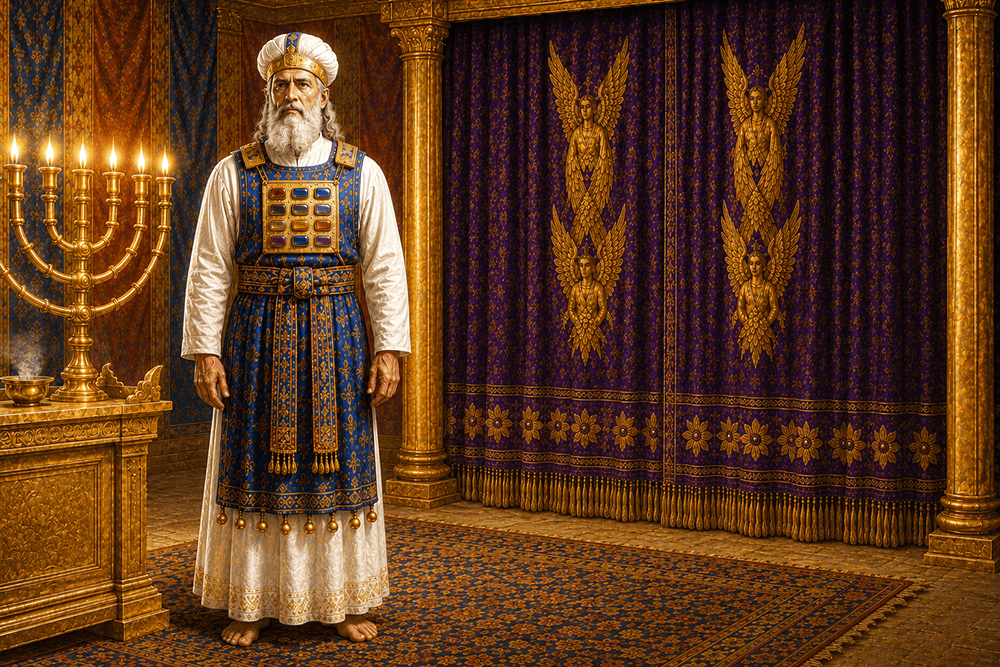
He laid aside the ephod threaded with gold, the breastplate blazing with twelve stones, the mitre with its plate of pure gold engraved Holiness to the Lord. He bathed. He dressed in plain white linen. And in that linen, alone among living men, he passed through the great embroidered veil into the Holy of Holies, carrying the one thing no sinner could afford to spill and no sinner could live without.1
Hold both pictures in mind: the gold and the linen, the splendor and the plainness. The whole rite turns on the moment one becomes the other. So does the gospel. Heaven’s door swings on the hinge of humility.
Names on His Shoulders
Begin with the gold, since Israel did. The garments described in Exodus 28 are not a tailor’s catalogue. They are theology in cloth and stone. Aaron’s ephod bore on its two shoulder-pieces the names of the twelve tribes, six and six on two onyx stones, “for stones of memorial unto the children of Israel: and Aaron shall bear their names before the Lord upon his two shoulders for a memorial” (Exodus 28:12). The breastplate doubled the freight. Twelve stones, twelve names, one for each tribe, arranged in four rows and pressed over his heart. Inside that breastplate lay the Urim and Thummim, “lights and perfections,” by which the divine will could be sought and declared.2 He was no clerk of holy things. He carried a nation on his shoulders, judgment over his heart, revelation near his hand. Israel did not send him to God with paperwork. Israel sent him with names. Above his forehead the gold plate read Holiness to the Lord, “that Aaron may bear the iniquity of the holy things, which the children of Israel shall hallow in all their holy gifts” (Exodus 28:38). Even Israel’s finest gifts arrived with dust on them. The lamb was clean, the flour was sifted, the oil was bright; still the hands that brought them needed mercy. Someone had to stand at the threshold bearing what the worshipers could not wash out of themselves.
The Gold Comes Off
Then, on this one day in the year, the gold came off.
This is the part the eye keeps sliding past. The high priest entered the innermost place, the Holy of Holies, not in his glory but in the white of a slave or a corpse-washer. Aloneness was sewn into the linen itself. No attendant followed him. No second priest stood at his elbow. No music covered the silence. The rubric of Leviticus 16 is severe on this point. “There shall be no man in the tabernacle of the congregation when he goeth in to make an atonement in the holy place” (Leviticus 16:17). One man, one veil, one bowl of blood, and behind him the breath of a nation held still.
He went in alone because the logic of the rite required it. Only one who can stand where holiness burns and sin crushes. A mortal man can hold that place for a moment at most, like a candle carried into a storm. So the rite was repeated, year after year, generation after generation, always provisionally, always pointing forward.
A Lamp Leaning Toward Christ
Jacob, son of Lehi, makes this observation:
For, for this intent have we written these things, that they may know that we knew of Christ, and we had a hope of his glory many hundred years before his coming; and not only we ourselves had a hope of his glory, but also all the holy prophets which were before us.
Behold, they believed in Christ and worshiped the Father in his name, and also we worship the Father in his name. And for this intent we keep the law of Moses, it pointing our souls to him; and for this cause it is sanctified unto us for righteousness, even as it was accounted unto Abraham in the wilderness to be obedient unto the commands of God in offering up his son Isaac, which is a similitude of God and his Only Begotten Son (Jacob 4:4-5).
This is not accident read backward as design. It is design read forward as hope. The law of Moses was not a puzzle Christians later solved by candlelight. It was a lamp given to Israel, and its flame leaned toward Christ from the beginning.
A Priesthood That Cannot Die
Hebrews names the reason without flinching. The Aaronic order was mortal in two senses at once. The priests could not outlive death, and the sacrifices could not outlast sin. “They truly were many priests, because they were not suffered to continue by reason of death” (Hebrews 7:23). An atonement performed by a man who will himself one day need atoning is a promissory note, never the payment.
This is why the calendar kept turning back to the tenth of Tishri. The gold was put on and taken off. The linen was donned. The veil was crossed. The blood was sprinkled. The priest came out; in time, he lay down in his grave. Then another son of Aaron took up the bowl. The argument the rite could not finish, Hebrews finishes. Christ’s priesthood is not a renewed instance of the same office. It is a different kind of office altogether, “not after the law of a carnal commandment, but after the power of an endless life” (Hebrews 7:16). He “ever liveth to make intercession” (Hebrews 7:25). He “needeth not daily, as those high priests, to offer up sacrifice, first for his own sins, and then for the people’s: for this he did once, when he offered up himself” (Hebrews 7:27). Once was enough because the one who offered it cannot die again. The category is changed at the root. The author of Hebrews therefore reads the older sanctuary as a thing speaking of its own incompleteness: “the Holy Ghost this signifying, that the way into the holiest of all was not yet made manifest, while as the first tabernacle was yet standing” (Hebrews 9:8).3 The veil was not merely a curtain. It was an announcement. Not yet. Not yet.
One Enters, the Other Departs
Two goats stood waiting outside. This too belongs to the aloneness, though at first it looks like company. Lots were cast over them. One goat, “the Lord’s goat,” was slain, its blood carried alone behind the veil and sprinkled upon the mercy seat. The other, the goat “for Azazel,” was not killed. Aaron laid both hands upon its head, confessed over it “all the iniquities of the children of Israel, and all their transgressions in all their sins, putting them upon the head of the goat,” and a fit man led it into the wilderness, out of the camp, away from the dwelling of God and the dwelling of Israel both (Leviticus 16:21).
One goat goes inward, behind the veil, toward mercy. The other goes outward, beyond the camp, toward desolation. One enters the place no sinner could enter; the other bears sin to the place no covenant people could call home. Unus intrat, alter exit: one enters, the other departs. Between them, the whole drama of redemption is staged in a single morning. Jeffrey M. Bradshaw, drawing on the Apocalypse of Abraham and the older temple traditions standing behind it, has proposed that the scapegoat is best understood not as a second figure of Christ but as the formal expulsion of evil to its source.4 In that pseudepigraphal text, Azazel is no innocent creature. He is a fallen power, an adversary, the one to whom sin is sent back because sin began with him. The two-handed laying-on, on this reading, is a ritual of return: guilt restored to its origin, the camp swept clean for the priest’s ascent. The Lord’s goat carries Israel inward toward mercy. The scapegoat carries corruption outward: the long undoing of Eden’s exile, evil driven into the wilderness where it has always belonged. The Day of Atonement, taken whole, opens heaven and silences the accuser in the same hour. Between the goat that enters and the goat that departs stands the high priest in linen, the lone man at the hinge of mercy and judgment.
Here the ancient picture nearly cracks under what it is trying to hold. The goat that walks into the wilderness in Leviticus walks there forever. The chapter does not bring it back. But the figure to which the goat pointed did come back. Christ went out of the camp, “suffered without the gate” (Hebrews 13:12), and cried from the cross the cry of one driven into the far country: Eloi, Eloi, lama sabachthani (Mark 15:34). He went into the wilderness of death itself, the lone and dreary world made absolute. He was the slain goat whose blood entered the holiest place. He was the sin-bearer whose exile reached the bottom of exile. The accuser was not appeased. The accuser was answered. The footsteps of Adam and Eve out of Eden were walked back by One strong enough to come home, dragging the keys of death and hell behind Him. The scapegoat’s long walk ended, at last, not in desolation but in resurrection.
Shadow by Design
For Latter-day Saint readers, Alma 13 widens the picture and guards against a common mistake: provisional does not mean failed. Alma speaks of ancient priests not as men who happened, in retrospect, to resemble Christ, but as men “ordained after the order of his Son, in a manner that thereby the people might know in what manner to look forward to his Son for redemption” (Alma 13:2).5 The priesthood order was a signpost by design, not by accident. These priests were “called and prepared from the foundation of the world” (Alma 13:3), the shadow planned before the body arrived to cast it. This is what distinguishes typology from literary cleverness: the connection between Israel’s ceremonies and Christ’s person was not a ribbon tied on later by pious readers. It was woven into the cloth from the first. Israel’s worship was holy worship, given of God, meaningful in its own season, and aimed from the beginning at the Messiah who would bring it to its proper end. Fulfillment is reverence completed, not reverence dismissed. To say that these rites were fulfilled in Christ is not to say they were empty before Him. The veil was torn in honor of what it had so long protected.
Rituals are not lectures. They are truths with hands and feet. They teach by making the body remember what the mind has not yet learned how to say. Every Yom Kippur, Israel watched a man dress in white, take up blood, vanish behind the veil, and emerge again alive. For centuries they rehearsed the grammar of atonement: blood, veil, linen, return. So when the final Word was spoken, faithful Israel would recognize the voice.
At the crucifixion, the veil of the temple was torn in two, from the top downward (Matthew 27:51).6 Not from below, where human hands could clutch and tug, but from above, where only God could lay hold of it. Curtains torn by men tear upward. This one tore as the sky tears. The Holy of Holies stood open. The great High Priest, having offered not the blood of bulls and goats but “his own blood,” had “entered in once into the holy place, having obtained eternal redemption for us” (Hebrews 9:12). And He carried more than twelve names. He carried every name ever whispered over a cradle, carved on a stone, forgotten by the world, or remembered with tears.
The Uniform of the Work
This is where the linen comes back. On Yom Kippur, Aaron laid aside the gold to enter the place of blood and mercy. He divested himself of visible glory to do the inmost work. Read the Incarnation here. Glory did not cease to be glory when it became humble. “Being in the form of God,” Christ “thought it not robbery to be equal with God: but made himself of no reputation, and took upon him the form of a servant, and was made in the likeness of men” (Philippians 2:6–7). He laid aside glory. He clothed Himself in the linen of our humanity: hunger, weariness, skin that could bruise, blood that could be shed. Then He walked through the veil we could not cross. The plain white was never a demotion. It was the uniform of the work.
He went in alone.
The ancient high priest could go where Israel could not, but he could not remain where Israel needed him, nor bring Israel where he had gone. He came out as he had gone in, a mortal man whose own atonement would be needed again next year. Christ has gone where none of us could go and has opened what none of us could open. We do not climb into God’s presence by standing on our own offerings. Our gifts cannot wash the hands that bring them. The veil is no thinner for our trying. We come because He has gone before us. We repent because His atonement is real. We pray in His name because He lives to intercede. We approach the Father not as intruders but as those invited in by the Son.
What Aaron rehearsed in shadow, year after year, Christ performed in substance, once and forever. The old ceremony, in all its solemn beauty, pointed beyond itself to the true High Priest entering the heavenly holy place with His own blood, dressed in the linen of our flesh, alone.
And because He entered alone, we do not remain alone.
Footnotes
1. On Yom Kippur as described in Leviticus 16, see Gordon Wenham, The Book of Leviticus, New International Commentary on the Old Testament (Grand Rapids: Eerdmans, 1979), 228–235.
2. On the Urim and Thummim, see Victor P. Hamilton, Exodus: An Exegetical Commentary (Grand Rapids: Baker Academic, 2011), 484–486. Their exact form and function remain disputed. The description here follows the dominant reconstruction.
3. F.F. Bruce, The Epistle to the Hebrews, New International Commentary on the New Testament (Grand Rapids: Eerdmans, 1990), 112.
4. See Jeffrey M. Bradshaw, “The Ezekiel Mural at Dura Europos: A Tangible Witness of Philo’s Jewish Mysteries?,” BYU Studies Quarterly 49, no. 1 (2010), and Bradshaw’s discussion of the Apocalypse of Abraham and Azazel in Temple Themes in the Book of Moses (Salt Lake City: Eborn, 2014).
5. On Alma 13 as a typological chapter and its relationship to Hebrews, see John W. Welch, “The Melchizedek Material in Alma 13:13–19,” in By Study and Also by Faith, ed. John M. Lundquist and Stephen D. Ricks (Salt Lake City: Deseret Book, 1990), 2:238–272.
6. On the tearing of the temple veil, see Raymond E. Brown, The Death of the Messiah (New York: Doubleday, 1994), 2:1098–1102. Brown reviews the evidence for the veil as the inner curtain before the Holy of Holies.
What Joseph Smith Saw in Exodus That We’ve Been Missing

Among the five books of Moses, Exodus is another precious jewel. In this book we find some of the greatest details about the character of Moses. We see his learning curve, his weaknesses, and his great strengths that make him so revered among the Jews even today. In this article we will use The Joseph Smith Translation, Red-Letter Edition, Old Testament to examine the significant changes made by Joseph Smith. We will also highlight some of the characteristics of Moses and the children of Israel as they made their way to their land of promise as revealed in the JST. 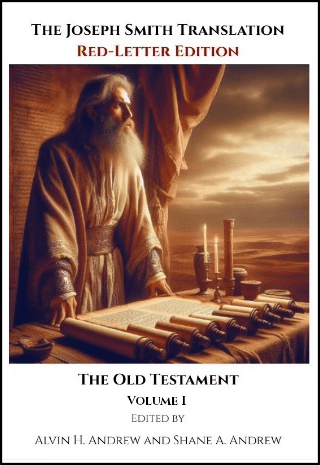
Joseph Smith did not make as many changes to the other books of the Old Testament as he did to Genesis. After he was commanded by the Lord to move his translation efforts to the New Testament (D&C 45:60-32) he did not return to work on the Old Testament until 16 months later. Also, beginning with John 6 Joseph adopted a shorter, more efficient method of transcribing the translation. Prior to John 6 Joseph dictated his changes and the scribes wrote out the complete chapters and verses along with the alterations. Something prompted him to change his method when he got through John 5. From John 6 through Revelation and then from Genesis 25:41 through Malachi Joseph would mark his reference bible where changes were to be made. The scribe would then enter on the manuscript pages, only the references and the changes. This sped up the work substantially but left us guessing about the intent of some of those changes.
Joseph did not make all the changes that he could have made to the Old and New Testament. A well known example of this is found in Malachi. When Moroni appeared to Joseph on the night of 21-22 September 1823, he quoted some verses from Malachi differently than they appear in the King James Version (KJV). When Joseph got to Malachi in his translation process, he made no changes to the book at all.1 There is evidence within the JST manuscripts as well as several of his sermons that he could have modified other verses in the KJV but did not.
Exodus may not have received all the changes of which Joseph was aware. Only 19 of the 40 chapters2 of Exodus were modified and several of those did not have substantial changes. However, some of the modifications were very significant in helping us understand the stories correctly. Among the more well known changes were the story of Moses’ failure to circumcise his son, and Pharoah hardening his heart rather than the Lord hardening Pharoah’s heart.
Exodus 4:24-26
24 And it came to pass, that the Lord appeared unto him as he was in
bythe way, byinthe Inn.inn, that theThe Lord was angry with Moses, and his hand was about to fall upon him,met him, and soughtto kill him, for he had not circumcised his son.25 Then Zipporah took a sharp stone, and circumcised her son, and cast the stone
cut off the foreskin of her son, and cast itat his feet, and said, Surely thou art a bloody husband unto me. art thou to me.26 And the Lord spared Moses, and
So helet him go, because Zipporah, his wife circumcised the child. Andthenshe said, thou art aAbloody husband.thou art, because of the circumcision.And Moses was ashamed, and hid his face from the Lord, and said, I have sinned before the Lord.
While this incident may seem a bit harsh to us, we must remember that by this time Moses had conversed with the Lord on more than one occasion. He was well aware of the covenant of circumcision and for whatever reason had neglected to observe it properly with his son. Moses’ sin was significant because he had not obeyed the Lord’s commandment to circumcise his son at eight days old. Moses had a good wife, Zipporah, who forcefully reminded him of his duty, then she herself performed the ceremony of circumcision.
The outcome of this event is somewhat reminiscent of Joseph Smith’s experience after losing the 116 pages of The Book of Mormon. Joseph lost his opportunity to continue translating for a year by not obeying the voice of the Lord. The Lord foresaw the incident with Joseph and instructed Nephi to write the small plates of Nephi which compensated for the loss of those pages. It’s amazing how this pattern of Study, Pray, and Obey just continues to manifest itself.
Joseph’s modifications to the reactions of Pharaoh, while not particularly surprising, give us a more correct insight into that story as well.
Exodus 4:21
21 And the Lord said unto Moses, When thou goest to return into Egypt, see that thou do all those wonders before Pharaoh, which I have put in thine hand and I will prosper thee; but Pharoah
but Iwill harden his heart, and he willthat he shallnot let the Peoplepeoplego.
Exodus 7:3, 13
3 And Pharoah I will harden his
Pharaoh’sheart, as I said unto thee; and thou shall multiply my signs, and my wonders, in the land of Egypt,13 And Pharoah hardened his
he hardened Pharaoh’sheart, that he hearkened not unto them, as the Lord had said,
Exodus 9:12
12 And the Pharoah hardened his heart,
Lord hardened the heart of Pharaoh,and he hearkened not unto them; as the Lord had spoken unto Moses.
Exodus 10:1, 20, 27
1 And the Lord said unto Moses, Go in unto Pharaoh for he hath
I havehardened his heart, and the hearts heart of his servants, therefore, I willthat I mightshew these my signs before him,20 But
thePharoah hardened his heartLord hardened Pharaoh’s heart, so that he would not let the children of Israel go.27 But
thePharoah hardened his heartLord hardened Pharaoh’s heart,and he would not let them go.
Exodus 11:9-10
9 And the Lord said unto Moses, Pharaoh will
shallnot hearken unto you, thereforethatmy wonders shallmaybe multiplied in the land of Egypt.10 And Moses and Aaron did all these wonders before Pharaoh, and they went out from Pharaoh, and he was in a great anger. And Pharoah hardened his heart,
and the Lord hardened Pharaoh’s heart,so that he would not let the Childrenchildrenof Israel go out of his land.
Exodus 13:4, 8, 17
4 And
IPharoah will harden hisPharaoh’sheart, that he shall follow after them; and I will be honoured upon Pharaoh, and upon all his host; that the Egyptians may know that I am the Lord. And they did so.8 And the Pharoah hardened his heart,
Lord hardened the heart of Pharaohking of Egypt, and he pursued after the children of Israel; and the children of Israel went out with an high hand.17 And I say unto thee
behold, I will hardenthe hearts of the Egyptians shall be hardened and they shall follow them; and I will get me honour upon Pharaoh, and upon all his host, upon his chariots, and upon his horsemen.Another slight but significant change had to do with Jethro, Moses’ father-in-law. Jethro was “the high priest of Midian” and as such would have held the Melchizedek Priesthood, since the lesser law had yet to be imposed upon the children of Israel. Jethro also appears to have been a mentor to Moses prior to the Exodus itself.
Exodus 18:1
1 … Jethro, the high priest of Midian, Moses’ father in law, heard of all that God had done for Moses, and for Israel his people, and that the Lord had brought Israel out of Egypt; …
When the Lord instructed Moses about the judgements he would need to make concerning certain behaviors among the children of Israel, he gave him some very specific instructions. Joseph Smith modified several of those verses as follows.
Exodus 21:20-21
20 And if a man smite his servant, or his maid, with a rod, and he die under his hand; he shall be put to death.
surely punished.21 Notwithstanding, if he continue a day or two and recover, he shall not be put to death,
punished; for he is his servant.money.
Exodus 22:18, 28
18 Thou shalt not suffer a murderer
witchto live.28 Thou shalt not revile against God,
the gods,nor curse the ruler of thy people.
Exodus 23:
3 Neither shalt thou countenance a wicked
poorman in his cause.
In the following verses Joseph Smith provides us with some additional insight when Moses brought the first set of plates down from the mount. Moses had been gone for so long that the children of Israel decided he was not going to return and they needed a God to continue to lead them. They convinced Aaron to make the golden calf for them to worship. While such behavior may seem strange to us, we must acknowledge that for more than 400 years the children of Israel had been in bondage to a polytheistic society, the Egyptians.
Following the death of Joseph who was sold into Egypt, there was no known Prophet among them until Moses appeared on the scene. This situation would be tantamount to the time between the last faithful member of Christ’s Church and the restoration of the Gospel by Joseph Smith, although the latter lasted more than twice as long. These situations bring to mind the Proverb “Where there is no vision, the people perish” (Proverbs 29:18).
Exodus 32:7-14, 35
7 And the Lord said unto Moses, Go, get thee down; for thy people, which thou broughtest out of the land of Egypt, have corrupted themselves;
8 They have turned aside quickly out of the way which I commanded them; they have made them a molten calf, and have worshipped it, and have sacrificed thereunto, and said, These be thy gods, O Israel, which have brought thee up out of the land of Egypt.
9 And the Lord said unto Moses, I have seen this people, and, behold, it is a stiffnecked people;
10 Now therefore let me alone, that my wrath may wax hot against them, and that I may consume them; and I will make of thee a great nation.
11 And Moses besought the Lord his God, and said, Lord, why doth thy wrath wax hot against thy people, which thou hast brought forth out of the land of Egypt with great power, and with a mighty hand?
12 Wherefore should the Egyptians speak, and say, For mischief did he bring them out, to slay them in the mountains, and to consume them from the face of the earth? Turn from thy fierce wrath, and thy people will repent of this evil therefore come thou not against them.
against thy people.13 Remember Abraham, Isaac, and Israel, thy servants, to whom thou swarest by thine own self, and saidst unto them, I will multiply your seed as the stars of heaven, and all this land that I have spoken of will I give unto your seed, and they shall inherit it for ever.
14 And the Lord said unto Moses, if they will repent
Lord repentedof the evil which they have done, I will spare them, and turn away my fierce wrath; but, behold, thou shalt execute judgement upon all that will not repent of this evil this day. Therefore, see thou do this thing that I have commanded thee, or I will execute all that which I hadhethought to do unto myhispeople,35 And the Lord plagued the people, because they worshipped made the calf, which Aaron made.
The JST rendering of the following verses provide a great deal more insight into man being able to see the Lord than the KJV allows. These verses also show the love Moses had developed for the Lord as well as the Lord’s love for Moses.
Exodus 33:17-23
17 And the Lord said unto Moses, I will do this thing also that thou hast spoken; for thou hast found grace in my sight, and I know thee by name.
18 And he said, I beseech thee, shew me thy glory.
19 And he said, I will make all my goodness pass before thee, and I will proclaim the name of the Lord before thee; and will be gracious to whom I will be gracious, and will shew mercy on whom I will shew mercy.
20 And he said, unto Moses, Thou canst not see my face at his time, least mine anger is kindled against thee also, and I destroy thee and thy people; for there shall no man among them see me at this time and live, for they are exceeding sinful, and no sinful man hath at any time, neither shall there be any sinful man at any time, that shall see my face and live,
21 And the Lord said, Behold, thou shalt stand upon a rock, and I will prepare
there isa place by me, for thee;and thou shalt stand upon a rock;22 And it shall come to pass, while my glory passeth by, that I will put thee in a cleft of a
clift of therock, andwillcover thee with my hand, while I pass by,23 And I will take away mine hand, and thou shalt see my back parts, but my face shalt
shallnot be seen, as at other times; for I am angry with my people Israel.
A final significant change of the JST within Exodus provides greater detail on the Priesthood restrictions the Lord placed upon the children of Israel. It was at this time that they lost general access to the Melchizedek Priesthood, the holy order, and the ordinances associated with it. Prior to this time that order of Priesthood had been among the people to one degree or another. At this juncture, all that changed.
Exodus 34:1-3, 14
1 And the Lord said unto Moses, Hew thee two other tables of stones
stonelike unto the first, and I will write upon them also, the words of the Law, according as they were written at the first on thethese tables the words that were in the firsttables, which thou breakest;brakest.but it shall not be according to the first, for I will take away the priesthood out of their midst; therefore my holy order, and the ordinances thereof, shall not go before them; for my presence shall not go up in their midst least I destroy them. But I will give unto them the law as at the first, but it shall be after the law of a carnal commandment; for I have sworn in my wrath, that they shall not enter into my presence, into my rest, in the days of their pilgrimage. Therefore do as I have commanded thee, and be ready in the morning, and come up in the morning unto mount Sinai, and present thyself there, to me, in the top of the mount,2 And be ready in the morning, and come up in the morning unto mount Sinai, and present thyself there to me in the top of the mount.
3 And no man shall come up with thee, neither let any man be seen throughout all the mount; neither let the flocks nor herds feed before that mount.
14 For thou shalt worship no other god; for the Lord, whose name is Jehovah,
Jealous,is a jealous God;
Moses had transformed from being a fearful individual, lacking in confidence and afraid his limitations would hamper him, to becoming a friend to the Lord and a beacon of strength to the children of Israel. There was a mighty and magnificent change in him. To this day Moses is revered and considered one of the most, if not the most, preeminent Old Testament Prophet among the Jews and much of the Christian world. The Joseph Smith Translation brings important clarity into the life of Moses as well as the children of Israel during the exodus.
Through the remainder of the books of Moses, namely Leviticus, Numbers, and Deuteronomy, Joseph made very few changes. Leviticus only has 3 chapters with changes, Numbers has 2 chapters, while Deuteronomy has 4. Some books had significant changes, but that is a conversation for next time. Today we relish the light and inspiration given in Exodus from Joseph Smith, Prophet, Seer, Revelator, and Translator.
1. The JST manuscript simply says “Malicah Correct”, (sic) “Finished on the 2d day of July 1833”.
https://www.josephsmithpapers.org/paper-summary/old-testament-revision-2/126.
2. Chapters in Exodus modified by Joseph included 1, 3-7, 9-12, 14, 18, 20-23, 27, 32-34.
A Culmination of the Restoration
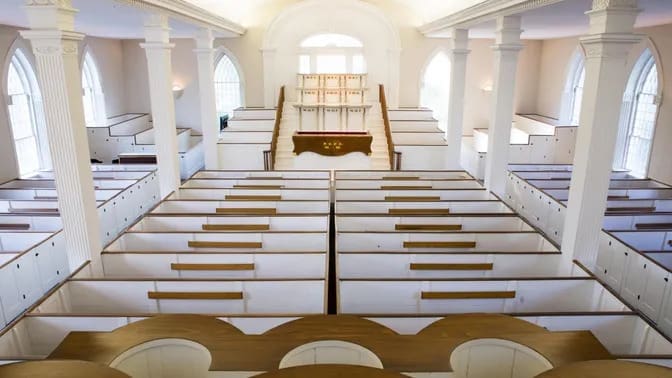
One hundred and ninety years ago, in a remarkable series of visions inside the newly dedicated Kirtland Temple, Joseph Smith and Oliver Cowdery received the keys of temple work. This series of three articles seeks to increase understanding of the priesthood keys restored on that occasion. It includes excerpts from The Heart of Our Covenants: Temple Principles that Draw Us unto Christ by Valiant K. Jones. Used by permission. See www.valiantjones.com or www.cedarfort.com.
This is part 3 of 3.
See the first part article in this series here.
See the second part article in this series here.
This series of articles has expounded on the remarkable series of visions that occurred in the Kirtland Temple on April 3, 1836. The reception of priesthood keys on this occasion was a culmination of a series of restoration experiences. The following table summarizes the most significant of the priesthood restoration events of this dispensation.
Priesthood Restoration Events for Joseph Smith and Oliver Cowdery
| Restorer | When | Where | Purpose and Keys Restored |
| John the Baptist | May 15, 1829 | On the banks of the Susquehanna River, near Harmony, Pennsylvania | Aaronic Priesthood: the keys of the ministering of angels and of repentance and baptism (see D&C 13) |
| Peter, James, and John | Most likely in late May 18291 | In the wilderness between Harmony and Colesville, Pennsylvania (see D&C 128:20) | Melchizedek Priesthood: the keys of spiritual blessings, including the Holy Ghost, and the keys of church administration (see D&C 27, 84, 107) |
| Moses | April 3, 1836 | Temple in Kirtland, Ohio | The keys of the gathering of Israel (see D&C 110) |
| Elias | April 3, 1836 | Temple in Kirtland, Ohio | The keys of the Abrahamic covenant including eternal marriage (see D&C 110) |
| Elijah | April 3, 1836 | Temple in Kirtland, Ohio | The keys of sealing for all ordinances for the living and the dead (see D&C 110) |
Let us review the succession of the receipt of these priesthood keys and see how they build on one another. John the Baptist first appeared to Joseph Smith and Oliver Cowdery to “confer the Priesthood of Aaron, which holds the keys of the ministering of angels, and of the gospel of repentance, and of baptism by immersion for the remission of sins” (D&C 13:1). Next, Peter, James, and John restored the Priesthood of Melchizedek, which holds the “keys of all the spiritual blessings of the church” (D&C 107: 18), including the gift of the Holy Ghost. They also “committed the keys of the kingdom, and a dispensation of the gospel for the last times” (D&C 27:13). Furthermore, “this greater priesthood administereth the gospel and holdeth the key of the mysteries of the kingdom, even the key of the knowledge of God” (D&C 84:19).
At this point, Joseph and Oliver possessed the keys and authority to perform all the ordinances of salvation, but they lacked the authority to spread this work of salvation globally. Moses came and filled this gap, providing “the keys of the gathering of Israel from the four parts of the earth” (D&C 110:11). Joseph and Oliver also lacked the keys and authority necessary to perform the exaltation ordinances of the endowment and eternal marriage. This was remedied with the bestowal of the keys of the Abrahamic covenant by Elias who “committed the dispensation of the gospel of Abraham” (D&C 110:12).
The keys and authority necessary to perform all ordinances had now been restored; however, this was still not enough. Up to this point, any ordinances were provisional and could only be performed for the living. Additional keys were needed to be able to seal the eternal validity of these ordinances in heaven and to make it possible to perform the same ordinances for the dead. These keys were restored by Elijah who restored keys “to turn the hearts of the fathers to the children, and the children to the fathers, lest the whole earth be smitten with a curse” (D&C 110:15).
We might ask why Jesus could not have conferred all these priesthood keys Himself. Certainly He held all priesthood keys, so surely, He could have. However, Christ respects and honors those He calls into stewardship under Him, and He provides opportunities for participation and personal growth as broadly as He can.
Similar to Joseph and Oliver, Christ’s apostles Peter, James, and John received priesthood keys from Moses and Elijah on the Mount of Transfiguration (see Mathew 17, Mark 9, and Luke 9). These two Old Testament prophets had gone to heaven without tasting death, allowing them to be able to return and corporally lay their hands on the heads of Peter, James, and John for the transmission of priesthood keys before Christ broke the bands of death and made resurrection possible. In addition, Joseph Smith has implied that John the Baptist was present.2 However, the Baptist could only have been there in spirit since he had recently died (see Matthew 14:1-12). Therefore, his presence could not have been for the transfer of his keys. That transfer of Aaronic Priesthood keys, although not recorded in the New Testament, had undoubtedly occurred while John the Baptist was living. Perhaps the Baptist came, in spirit, to the Mount of Transfiguration in order to be instructed by Jesus on the future transfer of the priesthood keys that everyone present would participate in 1800 years later: Jesus, John the Baptist, Peter, James, John, Moses, and Elijah.
We might wonder why the keys of Moses, Elias, and Elijah needed to be restored to Joseph Smith, since the work of the priesthood was already under way by the time they came. Their visits occurred in April of 1836, yet the Church had been organized in April of 1830. During the intervening six years, many members had been baptized and received the gift of the Holy Ghost, and many brethren had been ordained to the priesthood. Were these ordinances performed on earth without being sealed in heaven? Also, Samuel Smith had already been set apart in June of 1830 as the first official missionary of the Church, and he had already been sharing copies of the Book of Mormon throughout New England.3 Was this not the start of the gathering of Israel? Furthermore, Joseph Smith had received some degree of revelation regarding eternal marriage as early as 1831,4 and he performed anointings in the upper rooms of the incomplete temple in January of 1836.5
Clearly, the spirit of the restoration of the priesthood keys was already at work on the earth before Moses, Elias, and Elijah appeared. However, all of those early events were very limited in scope. Until the final restoration of the priesthood keys in the Kirtland temple, those actions and ordinances were only provisional. The Lord was laying the foundation of the restoration line upon line and precept upon precept. The work of gathering Israel and the work of forming eternal families could not expand beyond their early limited scopes until all priesthood keys were restored. In addition, the work of salvation for the dead could not and did not occur until after Elijah’s visit.
It appears that Joseph Smith was able to take those initial steps to begin the work of salvation under the authority of the Melchizedek priesthood and the mantle of his prophetic calling. This preliminary authority may have been what Joseph and Oliver received as a pronouncement from God when “the voice of God in the chamber of old Father Whitmer, in Fayette, Seneca county” (D&C 128:21) instructed them on steps to take to establish the Church. In his 1838 history, Joseph Smith placed this sacred, authorizing event shortly after the visit of John the Baptist.6 BYU professor Michael Hubbard MacKay has researched this event and suggested that it brought priesthood authority to Joseph before the bestowal of the keys of the Melchizedek Priesthood by Peter, James, and John.7
Clearly, the scope of Joseph’s early priesthood efforts was limited until he received the fulness of priesthood keys in the Kirtland temple. It is interesting to note that the quorum of the Twelve Apostles had only been established less than a year prior to the restoration of these priesthood keys, and their missionary endeavors had not yet extended beyond short, regional missions in North America. The foundation was being laid so that Joseph could share these keys with the new apostles. After these keys were restored, Joseph started sending missionaries to distant nations across the oceans.8 All of the priesthood keys necessary to direct the work of salvation for the living and the dead were once again upon the earth.
President Packer taught, “Elijah came . . . and bestowed the keys of the sealing power. Thereafter ordinances were not tentative, but permanent. The sealing power was with us. No authorization transcends it in value. That power gives substance and eternal permanence to all ordinances performed with proper authority for both the living and the dead.”9
Restored Keys Extend Christ’s Atonement to All
Because of the events at the Kirtland Temple on April 3, 1836, the restored keys of Moses, Elias, and Elijah are now carried out as a unified system of priesthood ordinances in hundreds of temples scattered throughout the world. The purpose of these keys is to expand the reach of the Atonement of Jesus Christ to everyone who has ever lived upon the earth.
The Prophet Joseph Smith explained why this work is so important: “The greatest responsibility in this world that God has laid upon us is to seek after our dead. The apostle says, ‘They without us cannot be made perfect;’ (Hebrews 11:40) for it is necessary that the sealing power should be in our hands to seal our children and our dead for the fulness of the dispensation of times . . . . It is necessary that those who are going before and those who come after us should have salvation in common with us; and thus hath God made it obligatory upon man. Hence, God said, ‘I will send you Elijah the prophet before the coming of the great and dreadful day of the Lord: he shall turn the heart of the fathers to the children, and the heart of the children to their fathers, lest I come and smite the earth with a curse.’ (Malachi 4:5.)”10
Without the keys restored by Moses, Elias, and Elijah, “the whole earth would be utterly wasted at [Christ’s] coming” (D&C 2:3). But now, through the great work of gathering Israel on both sides of the veil, and through temple work performed under the keys of Elias and Elijah for the living and the dead, the purpose of the creation of the earth is being fulfilled, and Christ will not need to smite it with a curse when He comes. Instead, He will be joyful knowing that the earth’s purpose has been fulfilled, facilitated by the restoration of priesthood keys.
These keys of the priesthood continue with us today. At the time of the death of Joseph Smith, most of the twelve apostles were away on missions. Apostle Wilford Woodruff and quorum president Brigham Young were in New England, and they met together in Boston shortly after learning of the martyrdom. Later, when President Woodruff was prophet himself, he recounted the following memory of that occasion:
“We were overwhelmed with grief and our faces were soon bathed in a flood of tears. … After we had done weeping we began to converse together concerning the death of the prophets [Joseph and Hyrum Smith]. In the course of the conversation, [Brigham] smote his hand upon his thigh and said, ‘Thank God, the keys of the kingdom are here.’ . . .
“President Young . . . referred to the last instructions at the last meeting we had with the Prophet Joseph before starting on our mission. . . . On that occasion the Prophet Joseph rose up and said to us: ‘Brethren, I have desired to live to see this temple built. I shall never live to see it, but you will. I have sealed upon your heads all the keys of the kingdom of God. I have sealed upon you every key, power, principle that the God of heaven has revealed to me. Now, no matter where I may go or what I may do, the kingdom rests upon you.’ . . .
“The keys of the kingdom of God are here, and they are going to stay here, too, until the coming of the Son of Man. Let all Israel understand that. They may not rest upon my head but a short time, but they will then rest on the head of another Apostle, and another after him, and so continue until the coming of the Lord Jesus Christ in the clouds of heaven.”11
We are blessed to have these keys with us today, held active and viable by a living prophet who is a modern apostle of Jesus Christ. It is under the direction of these keys that sacred priesthood ordinances are now performed in temples throughout the earth.
President Nelson said, “Consider how your life would be different if priesthood keys had not been restored to the earth. Without priesthood keys, you could not be endowed with the power of God. Without priesthood keys, the Church could serve only as a significant teaching and humanitarian organization but not much more. Without priesthood keys, none of us would have access to essential ordinances and covenants that bind us to our loved ones eternally and allow us eventually to live with God.
“Priesthood keys distinguish The Church of Jesus Christ of Latter-day Saints from any other organization on earth. Many other organizations can and do make your life better here in mortality. But no other organization can and will influence your life after death.
“Priesthood keys give us the authority to extend all of the blessings promised to Abraham to every covenant-keeping man and woman. Temple work makes these exquisite blessings available to all of God’s children, regardless of where or when they lived or now live. Let us rejoice that priesthood keys are once again on the earth!”12
We do rejoice! We are blessed to live in a time when these priesthood keys are active on the earth, allowing us to participate in the work of salvation and exaltation on both sides of the veil. Besides maintaining our own personal righteousness, there is no better way to show our love for Jesus Christ and to prepare for His Second Coming than to gather the children of Israel under the direction of these priesthood keys so that all have the opportunity to progress along the covenant path toward exaltation.
I Shall Love Thee Better after Death
Many poets have written about a romantic love that will last forever. Eternal love has been a topic of sonnets, songs, and poems throughout all literature. Such longings speak to one of the deepest and most profound emotions men and women experience. However, simply declaring one’s love for another person will not create a bond that will last throughout eternity. Only sealing ordinances administered through priesthood keys will do that.
In her sonnet, “How Do I Love Thee,” Elizabeth Barrett Browning wrote, “How do I love thee? Let me count the ways./ . . . I love thee with the breath,/ Smiles, tears, of all my life; and, if God choose,/ I shall but love thee better after death.13
Desires expressed in poems and songs cannot create bonds that will be sanctioned by God throughout eternity. A person may claim, “I shall but love thee better after death,” but this is only possible if two conditions are met. First, a couple must have an eternal marriage that is solemnized by an authorized temple sealer who has been set apart under the delegated authority of the living prophet of God. And second, that couple must embrace their temple covenants in such a way that those covenants start to change their natures. Only through living our temple covenants can we become sanctified in Christ and have our marriage “sealed by the holy spirit of promise” (D&C 132:7). That process may not be completed in this life, but if we will stay on the path—the covenant path—it will eventually be achieved with the help and grace of Jesus Christ.
This is why the keys of temple work matter. They create the foundation of sanctioned authority upon which eternal marriages can be established as well as the covenant environment in which eternal family relationships can flourish. In his own poetic prose, Elder Parley P. Pratt described the feelings he experienced when he first learned the doctrine of eternal families and the joy that came to him from knowing these eternal truths:
“It was Joseph Smith who taught me how to prize the endearing relationships of father and mother, husband and wife; of brother and sister, son and daughter. It was from him that I learned that the wife of my bosom might be secured to me for time and all eternity; and that the refined sympathies and affections which endeared us to each other emanated from the fountain of divine eternal love. It was from him that I learned that we might cultivate these affections and grow and increase in the same to all eternity . . . .
“I had loved before, but I knew not why. But now I loved—with a pureness—an intensity of elevated, exalted feeling, which would lift my soul from the transitory things of this groveling sphere and expand it as the ocean. I felt that God was my heavenly Father indeed; that Jesus was my brother, and that the wife of my bosom was an immortal, eternal companion . . . . I could now love with the spirit and with the understanding also.”14
This eternal love, so beautifully described by Elder Pratt, is possible because of the sacred temple keys that were restored in the Kirtland temple on April 3, 1836. What a blessing to have these keys effective today under the direction of a living prophet of God in hundreds of temples throughout the world. Like Elder Pratt, I, too, am grateful to be sealed to the wife and children of my bosom for eternity. Only in the Church of Jesus Christ of Latter-day Saints are these eternal blessings available because of the restoration of the sacred priesthood keys of temple work. This is the foundation for a love that truly will be “better after death.”
Valiant K. Jones is the author of The Heart of Our Covenants: Temple Principles that Draw Us unto Christ. For more information, see www.valiantjones.com
Footnotes
1 Larry C. Porter, “The Restoration of the Aaronic and Melchizedek Priesthoods,” Ensign, December 1996, churchofjesuschrist.org/study/ensign/1996/12/the-restoration-of-the-aaronic-and-melchizedek-priesthoods?lang=eng. In June 1829, Joseph Smith received D&C 18, which stated that Oliver Cowdery and David Whitmer were to be called as apostles (verse 9) and were to select additional members of that quorum. This implies that the Melchizedek Priesthood had already been restored by that time.
2 The Joseph Smith Translation of Mark 9:3 says, “And there appeared unto them Elias with Moses, or in other words, John the Baptist and Moses,” and under “Elias” in the Bible Dictionary says, “The curious wording of JST Mark 9:3 does not imply that the Elias at the Transfiguration was John the Baptist, but that in addition to Elijah the prophet, John the Baptist was present.”
3 Ryan Carr, “The First Latter-day Missionary,” New Era, Sept. 2004, lds.org/new-era/2004/09/the-first-latter-day-missionary?lang=eng.
4 The heading to D&C 132 says, “Evidence indicates that some of the principles involved in this revelation [on Eternal Marriage] were known by the Prophet as early as 1831.”
5 Richard O. Cowan, “The Unfolding Restoration of Temple Work,” Ensign, Dec. 2001, lds.org/ensign/2001/12/the-unfolding-restoration-of-temple-work?lang=eng.
6 Joseph Smith, History, 1838–1856, volume A-1 [23 December 1805–30 August 1834], p. 27, The Joseph Smith Papers, josephsmithpapers.org/paper-summary/history-1838-1856-volume-a-1-23-december-1805-30-august-1834/33.
7 Michael Hubbard MacKay, “Event or Process? How “the Chamber of Old Father Whitmer” Helps Us Understand Priesthood Restoration,” BYU Studies Quarterly, Vol. 60, No. 1, 2021, p. 73, byustudies.byu.edu/article/event-or-process-how-the-chamber-of-old-father-whitmer-helps-us-understand-priesthood-restoration/.
8 “Chapter 24 Truth Shall Prevail,” Saints Volume 1, site.churchofjesuschrist.org/study/history/saints-v1/24-truth-shall-prevail?lang=eng.
9 Boyd K. Packer, “Ordinances,” ibid.
10 Joseph Smith Jr., Teachings of the Prophet Joseph Smith, p. 356; see also Joseph Smith Jr., “Chapter 41: Becoming Saviors on Mount Zion,” ibid.
11 Wilford Woodruff, “The Keys of the Kingdom,” Ensign, April 2004, churchofjesuschrist.org/study/ensign/2004/04/the-keys-of-the-kingdom?lang=eng.
12 Russell M. Nelson, “Rejoice in the Gift of Priesthood Keys,” Liahona, May 2024, churchofjesuschrist.org/study/liahona/2024/05/57nelson?lang=eng.
13 Elizabeth Barrett Browning, “How Do I Love Thee? (Sonnet 43),” Academy of American Poets, accessed October 20, 2024, poets.org/poem/how-do-i-love-thee-sonnet-43.
14 Parley P. Pratt, “He Taught Me the Heavenly Order of Eternity,” Ensign, August 2015, churchofjesuschrist.org/study/ensign/2015/08/he-taught-me-the-heavenly-order-of-eternity?lang=eng; formatting modified.
Updated Church Handbook Expands Leadership Opportunities for Women in Sunday School
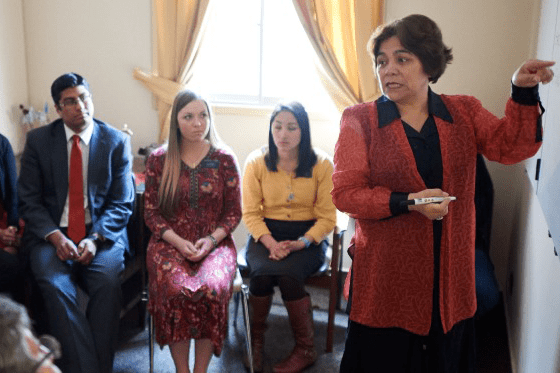
A recent update to the General Handbook of The Church of Jesus Christ of Latter-day Saints has opened new leadership opportunities for women at the ward level, allowing bishops to call either a man or a woman to serve as ward Sunday School president.
In a letter sent to Church leaders worldwide on March 18, 2026, the First Presidency and Quorum of the Twelve Apostles explained the change.
“The First Presidency and Quorum of the Twelve Apostles have determined that, effective immediately, the bishop may call a man or a woman to serve as ward Sunday School president.”
Under the updated guidelines, if a man is called as Sunday School president, he must hold the Melchizedek Priesthood and his counselors and secretary must be male members of the ward. If a woman is called as Sunday School president, her counselors and secretary will be female members of the ward.
Church leaders emphasized that local leaders should seek inspiration when extending such callings.
“Local leaders should seek the guidance of the Spirit in determining whom to call.”
New Possibilities in Wards Worldwide
With nearly 32,000 congregations worldwide, the change means that thousands of women could potentially serve in Sunday School presidencies for the first time.
“In any given ward, Sunday School presidencies may at times be composed of men and at other times of women, based on circumstances in the unit and the inspiration of leaders,” the First Presidency stated.
The change is reflected in the March 18 update to the Church’s General Handbook. The revised material is now available online and will appear in the Gospel Library app within the next several days.
Strengthening Gospel Teaching
Sunday School General President Paul V. Johnson noted that the adjustment expands the options bishops have when considering who can best strengthen gospel learning in their congregations.
“This important change gives bishoprics additional options as they prayerfully consider who should lead the effort of teaching and learning in their wards,” Johnson said.
He added that when the current Sunday School general presidency was called in 2024, the First Presidency invited them to help improve teaching and learning throughout the Church.
“There are many capable women and men who can help strengthen gospel instruction and foster spiritual growth,” he said.
Part of a Broader Pattern
The change comes during a period of continuing adjustments designed to strengthen home-centered gospel learning and ward participation.
In 2018, the Church shifted to a two-hour Sunday meeting schedule, with Sunday School classes now held twice a month in conjunction with the Come, Follow Me curriculum. That adjustment emphasized gospel study both in the home and in church.
Over the past decade, women have also been given expanded opportunities to participate in Church service and leadership in various ways. These include serving as official witnesses for baptisms and temple sealings, participating in Church executive councils, and serving as chaplains and sister training leaders in missionary work.
Church leaders have consistently emphasized the importance of women’s voices in ward councils, where they counsel with bishops and priesthood leaders to help guide the work of the ward.
Continuing Roles of Service
Women already lead the worldwide organizations of Relief Society, Young Women, and Primary at ward, stake, and general levels. The new handbook adjustment provides an additional way for women to contribute their leadership and teaching gifts in ward Sunday School.
Stake Sunday School presidencies and the general Sunday School presidency will continue to be filled by men who hold the priesthood.
Still, the new option for ward Sunday School presidencies reflects a growing recognition of the many faithful women and men who help strengthen teaching, learning, and spiritual growth in congregations across the Church.
As bishops seek guidance from the Spirit, the updated handbook provides additional flexibility to place capable leaders where they can best bless the members of their wards.
The Importance of Discerning Authorized Messengers
This article was originally published by Public Squre Magazine. To read more from them, CLICK HERE.
Never before have knowledge and information been so accessible, and yet harmful. Like a flash flood, information, opinions, and facts have breached boundaries once built to maintain order and safety. Just as water can be both life-saving and life-threatening, the flood of information now inundating us can either save or destroy our souls.
In his first public address at Brigham Young University (BYU) as President of The Church of Jesus Christ of Latter-day Saints, President Dallin H. Oaks commented on this rising threat and on the “abundance of speculation and false information in podcasts and on social media.” He reemphasized the necessity of the Holy Ghost in discerning truth, adding soberly: “You live in a season where the adversary has become so effective at disguising truth that if you don’t have the Holy Ghost, you will be deceived.”
This deception is not new.
With recent advancements in AI, manipulative algorithms, fake news, and the rise of social relativism, his warning feels especially relevant. What a paradox! We live in the greatest age of advancement and knowledge and yet feel so confused and unsure about what is true. Jesus put it best in Doctrine and Covenants 95 when he said that some “are walking in darkness at noon-day.”
Yet this deception is not new. It has been employed from the very beginning by Satan, “that being who beguiled our first parents, who transformeth himself nigh unto an angel of light.” In the Garden of Eden, Satan disguised his true identity and convinced Eve to partake of the fruit of the tree of knowledge of good and evil, in violation of God’s commands. We know from modern prophets and scriptures that the Fall was ultimately part of God’s plan. It ushered in mortality, the ability to have children, and enabled Adam and Eve to progress and become like God. President Oaks even taught that we should “celebrate Eve’s act and honor her wisdom and courage.”
So what was the problem? The problem was the messenger: Satan offered what he did not have the authority to give, obscured its consequences, and enticed Eve to disobey God. Gratefully, God’s plan cannot be frustrated, even by Satan’s most cunning deception, and God provided a way forward in Christ. But Adam and Eve never forgot the sobering lesson they learned: by following an unauthorized messenger, they almost lost everything.
Learning from their mistakes, Adam and Eve were determined to listen only to true messengers from God once they arrived in the lone and dreary world. But how could they know who was a messenger from God and who wasn’t, especially knowing that Satan can disguise himself? Ironically, by giving Eve the fruit of knowledge of good and evil, Satan gave Eve power to detect him. Further, the temple teaches that God also provided Adam and Eve with certain means, which Satan cannot imitate, to identify true messengers so that Adam and Eve could know of a surety who was an authorized messenger from God and who was not.
Light and truth will flow more abundantly
Like Adam and Eve, Joseph Smith had personal experience with the importance of discerning authorized messengers. Although the details are sparse, we learn in Doctrine and Covenants 128 that the voice of Michael was heard on the banks of the Susquehanna River “detecting the devil when he appeared as an angel of light” and that “the voice of Peter, James, and John” was also heard near the Susquehanna “declaring themselves as possessing the keys of the kingdom, and of the dispensation of the fulness of times!” Little was recorded about the details of the restoration of the Melchizedek Priesthood, except that it was restored somewhere near the Susquehanna River by Peter, James, and John. It may be that this noted appearance of Satan near the Susquehanna was an attempt by Satan to once again give that which he did not have authority to give: this time, presumably the Melchizedek Priesthood. But instead, the Lord entrusted authorized messengers to restore the priesthood power. As the Restoration could not move forward without this higher priesthood, it is likely that Satan would, again, at a key crossroad, seek to deceive.
It also does not feel coincidental that Section 129 of the Doctrine and Covenants immediately follows this account with instructions on how to detect ministering angels, or authorized messengers, from false spirits, revealing the “grand keys whereby you may know whether any administration is from God.”
The Apostle John taught early Christians to “believe not every spirit, but try the spirits whether they are of God: because many false prophets are gone out into the world.” But how do we “try the spirits” to know whether they are of God? John tells us: “We”—meaning the apostles—“are of God: he that knoweth God heareth us; he that is not of God heareth not us. Hereby know we the spirit of truth, and the spirit of error.”
We are blessed to live in a day when ordained prophets and apostles serve as authorized servants of God. They are called of God, and although they are not perfect, we can trust them. Jesus Christ Himself admonished as much when He came to the Americas, called twelve servants, and then declared, “Blessed are ye if ye shall give heed unto the words of these twelve whom I have chosen from among you to minister unto you, and to be your servants; and unto them I have given power …”
The scriptures, likewise, are filled with the words and teachings of past authorized messengers. They are a powerful, authorized source of truth. Elder Richard G. Scott taught that, “Because scriptures are generated from inspired communication through the Holy Ghost, they are pure truth. We need not be concerned about the validity of concepts contained in the scriptures.” President Ezra Taft Benson further testified, “The scriptures are the key to holding on to that iron rod. If we want to taste for ourselves the pure love of God, we must learn to cling to the power that is our scriptures. … The Book of Mormon is the instrument God designed to bring us to Christ.”
Light and truth will flow more abundantly into our minds and hearts.
If we approach these authorized sources—living prophets and scriptures—first when seeking revelation, rather than podcasts or AI bots, light and truth will flow more abundantly into our minds and hearts. Although there is much truth to be found throughout the world, like water, it is better to drink upstream at the head of the fountain, where it is less likely to be contaminated with impurities. Truth found downstream from unauthorized messengers may, as the temple narrative teaches, contain the philosophies of men, mingled with scriptures. And just like water, it takes a filter to separate the impurities from the truth. Gratefully, the Lord has given us another authorized servant who can be with us at all times to help us filter out and discern between the alluring philosophies of men and eternal truths—namely, the Holy Ghost.
Before Christ’s death, He prepared His apostles for His separation from them by explaining that He would give them “the Comforter, which is the Holy Ghost, whom the Father will send in my name.” Thus, the Holy Ghost is an authorized messenger of God. Christ taught His apostles that they can trust the Holy Ghost because He will “guide [them] into all truth” for “he shall not speak of himself; but whatsoever he shall hear [from the Lord], that shall he speak.” This is an essential qualifier of authorized messengers. They do not speak for themselves–only what God gives them.
In President Oaks’ recent remarks at BYU, he reemphasized the need for the Holy Ghost, quoting the prophetic warning of his predecessor President Russel M. Nelson, that “In coming days, it will not be possible to survive spiritually without the guiding, directing, comforting, and constant influence of the Holy Ghost.”
From the Garden of Eden to the Dispensation of the Fulness of Times, Satan seeks to deceive and frustrate God’s plan. And while Satan’s tactics are becoming more sophisticated, the solution to deception is the same as the one God first gave to Adam and Eve: learn how to recognize and follow authorized messengers.
The temple narrative clearly shows that one of the primary struggles of living in a fallen world, separated from God, is discerning whom to follow. If we consider ourselves like Adam and Eve, we must be as vigilant as they were in distinguishing between authorized messengers from God and unauthorized ones.
I find it significant that multiple times a year, during General Conference and in local Stake and Ward Conferences, God declares who His authorized messengers are. Their names are read publicly. Nothing is done in secret. And we are given the opportunity to either sustain or oppose them. God makes it very clear who we should follow and accept as reliable sources of truth. (D&C 43:2-7; D&C 28:12-13.)
God makes it very clear who we should follow.
Raising our hands to the square to sustain the Lord’s servants in these meetings is a sign of ancient origin. A square is a tool used in building or drafting to draw straight lines. This tool has been used since the beginning of time to navigate the stars and build sure foundations. The square is also used as a sign to spiritually draw a straight line to God and to reveal the order and foundation of God’s kingdom. Each time we raise our hand to the square to sustain prophets, apostles, or any church leaders, God is making it clear to us who His authorized servants are. We can trust this sign. It points a straight line back to God.
So, while deception abounds in our AI age and the deluge of information drowns many, the Lord has continued his pattern of sending authorized messengers to teach His children truth. Satan continues his efforts to deceive, but prophets and the Holy Ghost are authorized messengers, and we, like Adam and Eve, must be vigilant in hearing their voices above others. Jesus Christ again said it best in Doctrine and Covenants 1:
Wherefore, I the Lord, knowing the calamity which should come upon the inhabitants of the earth, called upon my servant Joseph Smith, Jun., and spake unto him from heaven, and gave him commandments … And also gave commandments to others, that they should proclaim these things unto the world … that man should not counsel his fellow man, neither trust in the arm of flesh … But that every man might speak in the name of God the Lord, even the Savior of the world … What I the Lord have spoken, I have spoken, and I excuse not myself … whether by mine own voice or by the voice of my servants, it is the same. For behold, and lo, the Lord is God, and the Spirit beareth record, and the record is true, and the truth abideth forever and ever. Amen.
The Book of Mormon Includes These Doctrines That the Bible Leaves Out

To read part 1, “Truths of Restoration and the Bible Verses that Support Them,” CLICK HERE.
In Part 1 of this article, we considered doctrine and history in which the Bible excels. Here in Part 2, we’ll look at areas in which the Book of Mormon excels.
Here are a few doctrines that, in my reading, are either not taught or not taught clearly in the Bible, but this list is not necessarily exhaustive.
God has a Plan
Although the Christian world generally recognizes that God has a plan for his children (and Christians do discuss the “plan of salvation”), neither the word “plan” nor a well-developed concept that God has a plan exists in either the Old or New Testaments.
However, the Book of Mormon liberally teaches that God has a plan, and it is variously called the Plan of Salvation, Plan of Happiness, Plan of Redemption, Merciful Plan of the Great Creator, Plan of our God, Plan of the Eternal God, Plan of Restoration, Plan of Mercy, and Plan of Deliverance from death. (See for example 2 Nephi 9:6,13; 2 Nephi 11:5; Jacob 6:8; Jarom 1:2; Alma 12: 25,33; 17:16; 22:13; 34:9,16; and 42:5,8,15. This list is not exhaustive.)
The Fall and Opposition
While most of the Christian world laments the fact that Adam and Eve ate the forbidden fruit, the Book of Mormon teaches that if they had not eaten, we would not even be here! In 2 Nephi 2, Lehi teaches the precious knowledge that the fall was not only foreseen by God, but that it was a necessary part of God’s plan, providing the essential mortal experience that we must pass through, and allowing Adam and Eve to have children.
Related to that, Lehi explains why there must be an opposition in all things. Alma further explains (Alma 12) the role of opposition, including the purpose for two opposing trees in the garden of Eden—one of life, and one of death—and how God in his mercy prolonged our mortal state, so that we can repent. An understanding of the fall, such as was restored to the earth by the Book of Mormon, is essential for a complete understanding of the plan of salvation and the role of the Savior.
Knowledge of Christ as Son of God Before His Birth
From the Book of Mormon, we know that before Christ was born, people knew that God had a Son, who would be the Savior, and His name would be Christ. However, the Old Testament is not clear on this—probably due to “plain and precious” things taken out and/or lost from it (see 1 Nephi 13:29).
As Joseph F. McConkie states, “We depend on the testimony of Book of Mormon Prophets for our understanding of the doctrine of the divine Sonship of Christ. As we presently have it, the Old Testament makes no reference to the Messiah’s being the Son of God; the Book of Mormon, from the writings of Nephi to those of Moroni, does so consistently.”1
The closest the Old Testament comes are scriptures such as Psalms 2:7 (“I will declare the decree: the Lord hath said unto me, Thou art my Son; this day have I begotten thee”), Isaiah 7:14 (“Behold, a virgin shall conceive, and bear a son, and shall call his name Immanuel.”), Isaiah 9:6 (“For unto us a child is born, unto us a son is given: and the government shall be upon his shoulder: and his name shall be called Wonderful, Counsellor, The mighty God, The everlasting Father, The Prince of Peace.”) Also, Daniel 3:25 refers to the Son of God, but this is spoken by a heathen non-believer, who was unaware of the significance of what he said.
The Old Testament also includes historic events that foreshadow Christ, such as Abraham’s near-sacrifice of Isaac, and Moses lifting up the brazen serpent, symbolic of the crucifixion. In fact, the Old Testament is full of types, symbols, Messianic scriptures, and prophecies of Christ, but these are not plainly stated and often do not imply that Christ is the Son of God.
In contrast, the Book of Mormon is full of explicit and plain prophecies and statements about Christ made before He was born.
- Christ is the Son of God: 2 Nephi 25:16,19 [worship the Father in his name]; Mosiah 3:8 and 4:2; Alma 6:8 and 36:17-18; Helaman 3:28; 5:12 and 14:12.
- Be baptized in the name of the Son: 2 Nephi 31:11-12.
- Father, Son, and Holy Ghost: 2 Nephi 31:21; Mosiah 15:1-3 and 7-8; Alma 11:44.
- The premortal Jehovah looked like he would later look as a mortal: Ether 3:15-16.
- Only Begotten Son: Jacob 4:5,11; Alma 5:48; 9:26; 12:32-34; 13:5-9.
- Book of Mormon prophets quote other prophets regarding God’s Son: Alma 33:13-19 and Helaman 8:13-22.
- More on the Son of God: Alma 5:50; 7:13;11:38-40; 24:13; 34:2,10-14; Helaman 14:2,8.
In the first edition of the Book of Mormon (1830), 1 Nephi chapter 11 verses 18, 21, and 32 read “God,” “Eternal Father,” and “Everlasting God” rather than “Son of God,” “Son of the Eternal Father,” and “Son of the Everlasting God,” as they read today.
Joseph Smith changed the text for clarification, but it stands correct either way, since one of the Book of Mormon’s main messages is that Christ is God (Title page). Note that other nearby verses, namely 1 Nephi 10:17 and 11:6,7 and 24, have always read “Son of God,” and that throughout these chapters, the “Lamb of God” phrase is original to the 1830 edition.
How Jesus is Both the Father and the Son
Speaking of the Savior, Isaiah says that “he shall be called…The everlasting Father” (Isaiah 9:6). But the Book of Mormon teaches us why2: First, Jesus is the “Father of Heaven and Earth,” meaning that He created them (see Mosiah 3:8, Alma 11:38-39, Helaman 14:12, Ether 4:7).
Second, Jesus is the Father through spiritual rebirth (Alma 5:14) of those who come unto him through the principles and ordinances of the Gospel. These people are called His “sons and daughters” (Mosiah 5:7; Mosiah 27:25; 3 Nephi 9:17; Ether 3:14), or His “seed” (Mosiah 15:11-12). (See also the biblical scriptures 2 Corinthians 6:18 and Ephesians 1:5). This is a natural extension of the idea discussed below that by baptism we take upon ourselves Christ’s name.
Third, He is the Father by divine investiture of authority. Mosiah 15:1-5 explains that Christ is called both the Father and the Son—the Father because He was conceived by the power of God, giving Him the power and divine attributes of God. The same idea is expressed in 3 Nephi 1:14, and Ether 4:12.3
Perhaps the closest Bible scripture that hints at the divine investiture of authority concept is John 14:9: “…he that hath seen me hath seen the Father,” but it isn’t as explicit, and has actually caused some confusion in the Christian world, which often misinterprets the verse to mean that the Father and Son are the same being.
The Holy Ghost as a Member of the Godhead and Known in Old Testament Times
The Old Testament does not contain the term Holy Ghost, although a very few references about God’s spirit imply the Holy Ghost. (There are three Old Testament references to “holy spirit”: two in Isaiah 63, and one in Psalms 51, and neither is very plain.) However, even in those cases, not enough information is given to show that the Holy Ghost is a separate individual, let alone a member of the Godhead.4
The Bible never explicitly states that the Holy Ghost is a God or a member of the Godhead. There are, of course, several New Testament references about the power and roles of the Holy Ghost, and His effect on people, all of which combined are used by the Christian world to show that He is a God. Two of these references are: Matthew 28:19 “Go ye therefore, and teach all nations, baptizing them in the name of the Father, and of the Son, and of the Holy Ghost” and 1 John 5:7 “For there are three that bear record in heaven, the Father, the Word, and the Holy Ghost: and these three are one.”
While being one with the Father and the Son as this scripture strongly implies, the Holy Ghost is God. Jesus prayed that believers may also be one with the Father and Son (John 17:21). Therefore, the Bible lacks specific evidence that being one with the Father and Son makes the Holy Ghost God.
In contrast, the Book of Mormon makes it clear that the Holy Ghost was operative and known in Old Testament times, and that He is a member of the Godhead.
Here are a few of a multitude of examples: 2 Nephi 31:13 “then shall ye receive the Holy Ghost; yea, then cometh the baptism of fire and the Holy Ghost; and then can ye speak with the tongue of angels.” verse 18: “and ye have received the Holy Ghost, which witnesses of the Father and the Son, unto the fulfilling of the promise which he hath made.” verse 21: “and now, behold, this is the doctrine of Christ, and the only true doctrine of the Father, and of the Son, and of the Holy Ghost, which is one God, without end. Amen.” Alma 11:44 “before the bar of Christ the Son, and God the Father, and the Holy Spirit, which is one Eternal God.”

Several Items on Baptism
First, the Book of Mormon explains why Jesus was baptized (2 Nephi 31). While the New Testament informs us that Jesus was baptized to “fulfill all righteousness” (Matthew 3:15), the Book of Mormon is much more explicit on how Jesus’ baptism “fulfills all righteousness.” Nephi tells us that Jesus was baptized first as an example for us, and second to show His humility and obedience before the Father.
This second reason requires some explanation, which the Book of Mormon gives us in the phrase, “according to the flesh”: “But notwithstanding he being holy, he showeth unto the children of men that, according to the flesh he humbleth himself before the Father, and witnesseth unto the Father that he would be obedient unto him in keeping his commandments.” (2 Nephi 31:7, italics mine). Jesus’ situation was unlike any other: He was innocent, like little children are, but He was accountable, and temptable of the devil, like we are.
In contrast, little children are unaccountable, because they don’t yet understand good and evil, and cannot be tempted by the devil; and all accountable individuals besides Jesus are not entirely innocent. So, it was important that even sinless Jesus show, by baptism, that according to the flesh, He was humble and obedient to the Father. In other words, even though He was subject to temptations of the devil, as well as the passions and feelings of the human body, He would use his agency and His knowledge of good and evil to be completely obedient.
Second, the Book of Mormon shows that baptism was a necessary ordinance from the beginning and was practiced before the time of Christ. Scriptures throughout the Book of Mormon command water baptism, but of most interest here are those from the BC era, showing that baptism was practiced before Christ’s time, and that it was done looking forward to Him. Some relevant scriptures from before Christ’s birth are 2 Nephi 9:23; 2 Nephi 31; Mosiah 18; Alma 5:3,62; 7:15; 8:10; and 48:19; Helaman 5:19.
Third, the Book of Mormon teaches that infant baptism is wrong, because “little children are alive in Christ” (Moroni 8), meaning that Christ’s atonement has paid for Adam’s fall—the effects of which we all inherit—so that we are punished only for own transgressions. Christian churches today are divided on the issue of baptism for children, some prohibiting and others encouraging it. The Book of Mormon provides exactly what they need: an authoritative statement on the issue.
Fourth, the Book of Mormon teaches that, at baptism, we take upon us the name of Christ. The phrase “take upon the name of Christ” or similar phrases are absent from the Bible, as is the connection between our taking on ourselves Christ’s name, and our baptism (although Paul says that we “put on Christ” by baptism, Galatians 3:27). Some of the Book of Mormon scriptures addressing this topic are: 2 Nephi 31:13; Mosiah 5:8, 6:2; Alma 34:38; 46:18, 21; 3 Nephi 27:5-6; and Moroni 6:3.
Furthermore, not only do individual saints take upon themselves Christ’s name, but the name of the church itself is to be “called in [Christ’s] name” (3 Nephi 27:8). Thus, the fact that The Church of Jesus Christ of Latter-day Saints is called in His name points to its authenticity.
Fifth, the covenant of baptism is clearly spelled out in Mosiah 18:8-10 (cf. D&C 20:37). God’s part of the covenant includes giving us the Holy Ghost (2 Nephi 31:13; Mosiah 18:10). Although baptism is associated with repentance in the New Testament, it is not clearly put into a covenant context. In fact, many Christians today think that water baptism is optional, not part of any covenant, and not a prerequisite for the gift of the Holy Ghost.
Sixth, despite many biblical evidences that baptism must be performed by immersion, many Christians today practice other methods. The Book of Mormon, however, is very clear on the proper method of baptism (3 Nephi 11:25-26). Thus, in many ways, the Book of Mormon teaches the true doctrine of baptism.
Grace and Works
The Book of Mormon is very clear that we are saved only through God’s grace, and it is also clear that we cannot access that grace without faith in Christ, repentance, baptism, and the gift of the Holy Ghost. While many today are confused about man’s role in his salvation, especially from a misunderstanding of Paul’s writings, a study of the Book of Mormon scriptures will clear up the confusion. The relationship between grace and works is taught with special clarity in the Book of Mormon—especially for me in Alma chapters 12, 34, 41, and 42, but in many other places as well.
These chapters explain how God is both just and merciful, and how, through the atonement, “only the penitent are saved” (Alma 42:12-24). No other passage in all of scripture explains so well the relationship between justice and mercy and how Christ’s atonement has made Him full of both. Much of the Christian community fails to understand the profound distinction in being saved from our sins and being saved in our sins, which Amulek and Helaman taught so clearly (Alma 11: 34-37; Helaman 5:10-11)!
Nephi’s Vision
Earlier, we briefly considered the biblical treasure that is the Revelation of St. John, and how the first part of that vision was recorded by Nephi. Nephi’s vision contains the unique doctrines of the Great and Abominable Church, explains the loss of “plain and precious truths” during the apostasy, of the divine inspiration of Columbus, the Lord’s hand in the establishment of the USA, the restoration of the gospel, and the idea of the “condescension of God” (see 1 Nephi chapters 11-14). It also contains the beautiful and motivating imagery of the tree of life, the iron rod, and the warnings of the great and spacious building.
The Resurrection
The New Testament, and to a lesser degree, the Old Testament, does teach about the resurrection. Some notable passages are:
- Matthew 27:52-53 “And the graves were opened; and many bodies of the Saints which slept arose, and came out of the graves after his resurrection, and went into the holy city, and appeared unto many.”
- Luke 24:39/John 20:19, 26 Christ’s resurrection story in which He demonstrates that resurrected bodies can eat, be felt, and enter locked rooms.
- 1 Corinthians 15:20-23 How Christ is the “firstfruits” of the resurrection, implying our resurrection will be similar to His.
- Job 19:26 “Yet in my flesh shall I see God.”
However, these can be and are subject to various interpretations, and thus, the Christian world does not have a uniform concept of the resurrection.
In fact, Joseph F. McConkie points out that
One may search the Bible from cover to cover in hopes of finding a definition of the word resurrection, but the effort will be in vain. The Old Testament does not even mention the word, and the closest we can come in the New Testament is Paul’s statement in 1 Corinthians 15:44 that we are ‘raised a spiritual body,’ which has led many to conclude that the resurrection is not corporeal. The Book of Mormon, by contrast, plainly teaches the nature of the resurrection5. (McConkie goes on to cite Alma 11:43-45 and Alma 40:23.)
There is more: Only the Book of Mormon contains the teaching that the physical resurrection is necessary to avoid being subject to Satan in the hereafter (2 Nephi 9:8-9).
First and Second Spiritual Deaths
Spiritual death is being cut off from the Lord. The first spiritual death occurred through the transgression of Adam in the Garden of Eden. Adam and Eve, previously able to walk and talk with God, were shut out of His presence. All of us inherit this death through Adam, and thus we are born into the world away from God’s presence.
However, since Christ has atoned for Adam’s transgression, the first spiritual death will be overcome for each of us, and we will all be brought back into Christ’s presence to be judged. The second spiritual death is the one caused by our own sins (but is only complete for those who become sons of Perdition—see D&C 76:37).
The Book of Mormon clearly teaches the concept of the two spiritual deaths in Helaman 14:15-18. (See also Alma 12:16 and Mormon 9:13-14). The only mentions of “second death” in the Bible are four references in Revelation, but these give no concept of the two different spiritual deaths described in the Book of Mormon. The phrase “spiritual death” occurs five times in the Book of Mormon and is not found in the Bible.
Infinite Atonement
Christ’s atonement/sacrifice was infinite. This term is not used to describe the atonement in the Bible, but is used several times in the Book of Mormon (2 Nephi 9:7; 2 Nephi 25:16; and Alma 34:10, 12, 14). Although the Book of Mormon authors who used this term do not explain it, its mere use prompts us to ponder its meaning, and as we do so, our understanding of the atonement increases.
Some of the many ways in which the atonement is infinite are6: 1) The Infinite of the divineness of the one sacrificed. 2) Infinite in power. 3) Infinite in time, applying retroactively and into the future. 4) Infinite in coverage, applying not only to humans but to all of creation. 5) Infinite in depth – covers everything. 6) Infinite in degree of suffering. 7) Infinite in love. 8) Infinite in blessings it bestows, including the fact that through the atonement, persons can be exalted, thus making them infinite beings. Each of the items in this list is an entire topic of study.

Christ Visited the New World; His Revelations to the Branches of Israel
The Book of Mormon makes clear that Christ is concerned with the entire house of Israel, not only the branch that was in Jerusalem during His mortal life. He visited the New World branch of Israel (3 Nephi 11-28), thus fulfilling His “other sheep” promise to His disciples (compare John 10:16 with 3 Nephi 15:12-18).
Furthermore, He promised to visit the lost ten tribes as well. We are informed by Nephi (2 Nephi 29:12-13) that the lost tribes also have scriptures which we expect to receive someday. Jesus taught the Nephites about the gathering of Israel in the last days, which will commence with the dissemination of the Book of Mormon (3 Nephi 21). Thus, while many Christians today find little relevance in the Old Testament, the Book of Mormon reminds us that God still remembers the covenants He made with Israel in Old Testament times and is now fulfilling them.
Sacrament Prayers
Just as baptism must be performed in the way Jesus has commanded if it is to be acceptable by God, so too the sacrament must be administered properly, and thus it is important that the Book of Mormon teaches that there are proper words that must be said in the sacrament prayer, and teaches what these words are (Moroni 4 and 5; these were repeated in 1830 in a revelation at the organization of the Church—see D&C 20:77,79).
Furthermore, the wording of the prayers make it clear that the sacrament puts us under covenant, a concept that is not found in the New Testament (as predicted by Nephi’s vision, in which he learned that “many of the covenants have they taken away”—1 Nephi 13:26.) The content of these prayers yields further insights, which is beyond the scope of this discussion, except to point out that once again, as noted in the baptism section above, the sacrament prayers teach that we are to “take upon us the name of [God’s] Son.”
Information on Melchizedek and the Melchizedek Priesthood
Paul’s discussion of the correlation in the change in laws from the lower law of Moses to the higher law, with the change in priesthood from Aaronic to Melchizedek, is profound (Hebrews 7). Yet information is lacking in both the Old and New Testaments about just who Melchizedek was, and what it means to hold the Melchizedek priesthood.
This information has been restored in many ways in this dispensation: through Joseph Smith’s translation of the Bible, through revelations such as D&C 84 and 107, and through Alma chapter 13. From this Book of Mormon chapter, we learn that Melchizedek was king of the wicked city of Salem, but that he successfully persuaded his people to repent. Furthermore, we learn that those who receive the Melchizedek priesthood were foreordained to such in the premortal existence.
The New Jerusalem to Be Built on the American Continent
Twice in the Book of Mormon, we are taught about the New Jerusalem. The Savior teaches His New World people that those on their land will establish the New Jerusalem (3 Nephi 20:22). Later, Moroni teaches that the New Jerusalem will be built on the American continent and will be a separate place from the Old Jerusalem, which will be rebuilt as a holy city (Ether chapter 13). The Bible speaks of the New Jerusalem only in the Revelation of St. John, and the references there are not clear as to its location, nor are they clear that it would be distinct from the Old Jerusalem.
Conclusion
I have found that I appreciate each volume of scripture more if I search for its special contributions as I read it and ponder on how each volume has affected my total understanding of the gospel. The lists I have presented are a result of my own study and reflect what is important to me; others may have differing lists. I have limited the scope of this discussion to the Bible and the Book of Mormon, but one could also list the veritable flood of new information from the Lord on a variety of topics contained in the Doctrine and Covenants or Pearl of Great Price.
The fact that the Book of Mormon can, in a coherent way, add so much to our understanding of complex gospel topics, clarify ambiguous biblical passages, and yet remain in agreement with the Bible—as well as motivate us to live the gospel—is to me profound evidence of the truth of the book and the divine call of Joseph Smith. This is in addition to direct spiritual confirmation of the book and its translator.
Ultimately, the different volumes of scripture contain more similarities to each other than differences, as each testifies of Jesus Christ, His atonement, His gospel, and teaches us how to apply the atonement in our lives. Truly, both the Bible and the Book of Mormon contain the fullness of the gospel. As we study the gospel by topics, it is most helpful to read all that the Lord has to say on a particular subject throughout the standard works and in the teachings of the living prophets.
Footnotes
1 This is a slightly edited version of a chapter by the same name in Richard D. Gardner, Beneficiaries of the Restoration: Our Privileges, Responsibilities and Attitude Regarding Scripture, History, Truth and Zion (Salt Lake City: Eborn Books, 2018). Used by permission.
2 On November 28, 1841, Joseph Smith said, “I told the brethren that the Book of Mormon was the most correct of any book on earth, and the keystone of our religion, and a man would get nearer to God by abiding by its precepts, than by any other book.” See Teachings of the Prophet Joseph Smith (compiled by Joseph Fielding Smith) (Salt Lake City: Deseret Book, 1976), p. 194. Or, History, 1838–1856, volume C-1 [2 November 1838–31 July 1842], p. 1255, The Joseph Smith Papers, accessed July 15, 2025, https://www.josephsmithpapers.org/paper-summary/history-1838-1856-volume-c-1-2-november-1838-31-july-1842/427?highlight=\
3 Latter-day Saint scholar and teacher Robert L. Millet provides a list of 87 important teachings of the Book of Mormon (many unique to it) in Appendix 1: Powerful Precepts from the Book of Mormon in Remember, Remember: Life Changing Truths from the Book of Mormon (Salt Lake City: Deseret Book, 2023), pp. 229-234.
1 Joseph Fielding McConkie, “A Comparison of Book of Mormon, Bible, and Traditional Teachings on the Doctrines of Salvation,” a chapter in Paul R. Cheesman, ed., The Book of Mormon: The Keystone Scripture (Prove, Utah: BYU Religious Studies Center, 1988), p. 74.
2 The doctrine of Jesus as the Father was formally explained in The Father and the Son: A Doctrinal Exposition by the First Presidency and the Twelve, in 1916. (This is available in the April 2002 Ensign, or in the Encyclopedia of Mormonism Appendix 4: Doctrinal Expositions of the First Presidency, pp. 1670-1677.) A beautiful discussion of this doctrine as contained in the Book of Mormon is given by Robert L. Millet in “The Ministry of the Father and the Son,” a chapter in The Book of Mormon: The Keystone Scripture (see complete citation above). The scriptures I have chosen to illustrate the Fatherhood of Jesus, are not part of the First Presidency proclamation; I found them for myself.
3 See also D&C 93:14. I have discussed at length several of these scriptures in which Christ is called the Father, in The Heart of the Gospel: Explorations into the Workings of the Atonement (Salt Lake City: Eborn Books, 2013), pp. 145-148.
4 I discuss some of the history of the Latter-day Saint understanding of the Holy Ghost in my essay “Who is the Holy Ghost?” in Who is the Holy Ghost? (Salt Lake City: Eborn Books, 2024). In another essay in the same book, “The Holy Ghost’s Roles in the Godhead, and in our Sanctification and Sealing” I discuss why the Holy Ghost and His gift are essential for our salvation.
5 Joseph Fielding McConkie, “A Comparison of Book of Mormon, Bible, and Traditional Teachings on the Doctrines of Salvation” (complete citation above), pp. 80-81.
6 I am indebted to Tad R. Callister for pointing out and discussing the first seven of these in his book, Infinite Atonement (Salt Lake City: Deseret Book, 2000).
7 The one minor exception to the word-for-word agreement of the sacrament prayers as contained in D&C 20 and Moroni 4 and 5 is that the D&C 20:77 version of the bread prayer uses “has” whereas the Moroni 4:3 version uses “hath.”
Come, Follow Me Podcast #38: “The Order of The Son of God”, Doctrine and Covenants 106-108

Scot
If you do a cursory reading of Section 107 of the Doctrine and Covenants, you might think this is just a revelation of priesthood quorums and councils, more like a manual or a handbook. Don’t be deceived! Yes, there are tremendous organizing aids and guidance for all the quorums and councils of the Church, but there are hidden gems and mysteries throughout this amazing section and we will explore some of those together today.
Maurine
Welcome to Meridian Magazine’s Come, Follow Me Podcast. We are Scot and Maurine Proctor, and we are delighted to be with you again this week. We’d like to thank Cardio Miracle, that sponsors this podcast, and we wouldn’t let anyone sponsor this unless it was really important for your health. Scot had a heart attack when he was only 42 and found out the same night that he had diabetes. What a double whammy for us. But his mother told him that if he wanted to live a long life and had an incurable disease, you absolutely had to learn to take good care of yourself. That’s what he did. When Cardio Miracle came available 7 years ago, he started taking it every day, and it makes me feel good that he does what it takes to stay heart healthy. Cardio Miracle signals your body to make nitric oxide which helps your blood vessels to maintain elasticity to carry nutrients to all parts of your body. Cardio-Miracle helps to keep my husband safe. You should try it with a 15% discount at cardiomiracle.com/meridian. That’s cardiomiracle.com/meridian.
Scot
Now, let’s turn right to the first few verses of Section 107, and we will immediately see one of those beautiful gems we referred to at the beginning of the podcast.
1 There are, in the church, two priesthoods, namely, the Melchizedek and Aaronic, including the Levitical Priesthood.
2 Why the first is called the Melchizedek Priesthood is because Melchizedek was such a great high priest.
3 Before his day it was called the Holy Priesthood, after the Order of the Son of God.
4 But out of respect or reverence to the name of the Supreme Being, to avoid the too frequent repetition of his name, they, the church, in ancient days, called that priesthood after Melchizedek, or the Melchizedek Priesthood.
Maurine
What do we know about this man or prophet, Melchizedek?
We know from these verses that he was a great high priest. (D&C 107:2) We know that he is the one who conferred the holy priesthood upon Abraham. (D&C 84:14) We know that he was of a royal family, was a prince, and then Melchizedek became king over the land of Salem. (Alma 13: 17) We know that Abraham paid tithes to Melchizedek. (Alma 13:15; Gen. 14:18-20) We know that his people “had waxed strong in “iniquity and abomination;” and that “they had all gone astray; they were full of all manner of wickedness.” (Alma 13:17) We know that one of his main attributes was his powerful faith, that when he was a child “he feared God, and stopped the mouths of lions, and quenched the violence of fire.” (JST Gen. 14:26) Doesn’t this all make you want to know Melchizedek more?! He truly was a man of extraordinary faith. We know that Melchizedek “exercised mighty faith, and received the office of the high priesthood according to the holy order of God, did preach repentance unto his people. And behold, they did repent; and Melchizedek did establish peace in the land in his days; therefore he was called the prince of peace.” (Alma 13:18)
Scot
Maurine, I have always admired Melchizedek so much. I don’t know exactly how it works on the other side of the veil, but Melchizedek is certainly on my top ten people to meet in the next world, outside my immediate family. And Melchizedek served under his father (see Alma 13:18) and not only did he get his people to repent and humble themselves before God, they all obtained heaven—which in our vernacular means they were like unto the City of Enoch and were taken up and translated. (JST Gen. 14:34) There is so much more we could say about this great and holy man. Even his people called him not only the prince of peace (Alma 13:18) but also the king of heaven. (JST Gen. 14:36)
He was a type of Christ.
Now, let’s explore what his name means. I often would be talking about Melchizedek to my institute classes and I would just say, “What does the name Melchizedek mean in Hebrew?” I would often get shy stares and people looking away so that we would not make eye contact. That’s okay. We don’t study Hebrew very often in the Church, but we do need to know what his name means since we use his name very often.
Maurine
That’s right. We certainly do use his name all the time. The name Melchizedek derives from juxtaposing two Hebrew words, king (melek) and righteousness (ṣedeq). The form of the juxtaposition, malkî-ṣedeq, allows for two different interpretations of the name, “My King is Righteousness” or “King of Righteousness.” That first one, “My King is Righteousness” can infer or point to the King of Kings and that we carry this title or bear this priesthood which clearly point to Him—the King of Righteousness. This is the most obvious interpretation of the name Melchizedek, but there is much more. And Scot, you learned this approach of language interpretation and translation from studying Turkish in your growing up years in Ankara, Turkey.
Scot
Yes, a standard greeting in Turkish, for example, is Gün Aydin, which, in the simplest interpretation, means Good Morning. But these near eastern languages are very fluid in their translations and the deeper meaning of this greeting, looking at the roots of the words, means, “May the light of the sun shine upon you and fill your soul with light throughout the day.” It’s like translating the Sermon on the Mount from the Aramaic, a simple phrase like: Blessed are they that mourn” can be translated as “healed are those weak and overextended for their purpose; they shall feel their inner flow of strength return.” (Maurine Jensen Proctor and Scot Facer Proctor, Source of the Light, Deseret Book Company, Salt Lake City, 1992, p. 85) So, let’s look at the root word Melek or Malak again in the Hebrew and the Aramaic. The Aramaic cognate verb, malak means to consult or counsel, which suggests that the concept of royalty came from wisdom and spiritual prowess rather than a king who used brute force or political strength. This certainly goes along with the righteous use of priesthood power we will discuss when we get to section 121 of the Doctrine and Covenants.
Maurine
And from that same verb in Aramaic malak we learn it means to become a king and the similar Aramaic nouns malka and meleket to become a queen—both of which denote royalty, sovereignty or kinghood and queenhood! Now, there is much more. It’s interesting to know that there is a striking similarity with the noun mal’ak, which is the Hebrew word for angel. In scripture, an angel’s primary mission is to protect and to shield. And even though the noun mal’ak, angel, may not be etymologically related to the noun melek, king, and malak, to be king, there is certainly a strong association between the Hebrew view of angels and kings. And by the way, just as a reminder, you can see all of these things in our podcast manuscripts each week at latterdaysaintmag.com/podcast
Scot
And there is more: Please note that the noun melach or melah means salt. Salt, in the ancient world, was the primary means of preserving food. Salt was also used as a cleaning agent and disinfectant, a purifier, and in some lore, it was even applied to newborn babies. (Ezekiel 16:4) So, taking license from the fluidity of translation from the Near Eastern tongues, Melchizedek could be translated as “a righteous king who takes counsel and gives council, who acts to protect and to shield like an angel and is a preserver of the world.” It also may be that Melchizedek means not only King of Righteousness or My King is Righteousness, and has the duel reference to Queen of Righteousness but the inference is that with this name, the title holder is to become a righteous king or a king of righteousness, to master the law and to live the commandments of the great King of all righteousness. Now, that gives us something to think about, doesn’t it?
Maurine
I do love these Hebrew word studies. They always yield rich treasures. Now, knowing a little deeper meaning of the name Melchizedek, is it any wonder that this higher priesthood has the privilege of receiving the mysteries of the kingdom of heaven, to have “the heavens opened unto them, to commune with the general assembly and church of the Firstborn, and to enjoy the communion and presence of God the Father, and Jesus the mediator of the new covenant”? (D&C 107: 19)
This covenant that God extends to us is everything in the Gospel of Jesus Christ and we will talk a great deal about that in next week’s podcast.
Now we come to a most unique and fascinating treasure of knowledge, seemingly out of the blue, in the middle of Section 107. As readers of this revelation we come to verses 41-52 and the Lord lays out the order of the priesthood as it was instituted in the beginning of time and who ordained whom and when, documenting ten very long generations of priesthood lineage outlined from Adam to Noah.
Scot
Then, beginning in verse 53, we have a fascinating run of five verses giving us an account that we have nowhere else in holy writ. This is an account of the great meeting in the earliest of times, with at least 8 generations present, at Adam-ondi-Ahman. Now, being from Missouri, I have been going to Adam-ondi-Ahman for more than 50 years. I know and love this holy place. Let’s read these verses together and try to glean some of the treasures here:
53 Three years previous to the death of Adam, he called Seth, Enos, Cainan, Mahalaleel, Jared, Enoch, and Methuselah, who were all high priests, with the residue of his posterity who were righteous, into the valley of Adam-ondi-Ahman, and there bestowed upon them his last blessing.
We learn from the Prophet Joseph that Adam lived to be a few days shy of 1,000 years old. That means that at this great gathering he was about 997 years old. He called for his righteous posterity to gather to the great valley of Adam-ondi-Ahman. His son Seth was 867 years old. His grandson, Enos, was 762 years old at this meeting. Adam’s great grandson, Cainan, was 672. His 2nd great grandson, Mahalaleel, was 602 years old. Adam’s 3rd great grandson, Jared, was 537 years old at this meeting. This was a venerable gathering. Adam’s 4th great grandson, Enoch (and yes, this is THE Enoch), was 375—he was certainly one of the younger patriarchs in attendance. And finally, according to the records we have, Adam’s 5th great grandson, who was Enoch’s son, Methuselah, was 310 years old. Now, we don’t know why Lamech (who was by this time 123 years old) was not listed as in attendance. Noah would not be born for another 59 years.
Maurine
It’s interesting to note, Scot, that Enoch probably had the longest journey to get to this great meeting at Adam-ondi-Ahman, because, if the records we have as to chronology and age, are accurate, he, Enoch, and his city, were translated and taken up into heaven just 10 years before this meeting. But, of course, we know that people from the City of Enoch, certainly have had and do have much interaction with this earth long after their translation. (see Genesis 18 and 19, for example)
Now, where is Adam-ondi-Ahman and how many people gathered there for this great meeting—and why did they gather?
First, this sacred and holy place, Adam-ondi-Ahman is located about 80 miles north, northeast of Independence, Missouri. It is in Davies County, Missouri, just a few miles north of the little town of Gallatin. You can type the name Adam-ondi-Ahman right into your Google Maps and it pops right up as in the Grand River Township in Missouri, zip code 64647. We are talking about a very real place.
Now, let’s read together what Elder Bruce R. McConkie had to say about this great meeting in Adam’s day:
“We now come to the least known and least understood thing connected with the Second Coming. It might well be termed the best-kept secret set forth in the revealed word. It is something about which the world knows nothing; it is a doctrine that has scarcely dawned on most of the Latter-day Saints themselves; and yet it is set forth in holy writ and in the teachings of the Prophet Joseph Smith with substantially the same clarity as any of the doctrines of the kingdom. It behooves us to make a needed brief commentary about it.
“Adam-ondi-Ahman, of eternal fame, first comes to our attention because of a great conference held there by Father Adam in his day. “Three years previous to the death of Adam [as we have mentioned above] he called Seth, Enos, Cainan, Mahalaleel, Jared, Enoch, and Methuselah, who were all high priests, with the residue of his posterity who were righteous, into the valley of Adam-ondi-Ahman, and there bestowed upon them his last blessing.”
Scot
Elder McConkie continues:
“Nearly a thousand years had then passed since the first man and the first woman had stepped from Eden’s garden into the lone and dreary world, there to begin the procreative processes that peopled a planet. We do not know how many million mortals made this earth their home in that day, or how many of them were true and faithful to that Lord whom Adam served. Disease and plagues were not then as common and horrendous as they are now. The physical bodies of earth’s inhabitants had not yet degenerated to the disease-ridden, germ-governed shells of their former glory that is now the norm. We can suppose the population of the earth far exceeded that of later ages when the ills of the flesh and a rising infant mortality set a sin-inflicted limit on the numbers of men. And it is not unreasonable to suppose that many righteous spirits were born in that blessed day and that the numbers of the righteous were exceedingly great. We may not be amiss in supposing that many millions responded to the call to come to a general conference in Adam-ondi-Ahman.” End of quote. (McConkie, Bruce R., Millennial Messiah, pp. 578-579, emphasis added) So, we have talked about where this place is and how many people gathered for that meeting, but why did they gather?
Maurine
Let’s go back to the scriptural account, to verse 54 of Section 107:
54 And the Lord appeared unto them, and they rose up and blessed Adam, and called him Michael, the prince, the archangel.
So, Adam had called all the righteous to gather in this sacred and holy place that they might see and be with the great Jehovah, Jesus Christ, who appeared to them. We have not yet discovered the records of the preparations for this great meeting at Adam-ondi-Ahman, but surely the people were told to prepare themselves spiritually, to repent of their sins and that all the pure in heart would see God, just as the people were told in our day to prepare for the dedication of the Kirtland Temple. (See D&C 97:16) They were surely told that He would come, and then He came!
Back to verse 55:
55 And the Lord administered comfort unto Adam, and said unto him: I have set thee to be at the head; a multitude of nations shall come of thee, and thou art a prince over them forever.
Scot
Remember, the name Michael or Micha-el’ means, “one who is like unto God.” So, this first man, Adam, or Michael, was, the archetype of Christ from the beginning. He was, with his wife Eve, one who had walked and talked with God and knew Him and had been personally taught and tutored by both the Father and the Son and by holy angels. He was the first witness of the existence and reality of God. He kept a record of his interactions with God and this became the source to faith for all of his posterity. (See Moses 6:5-6) And now, as if a gift to all of his righteous posterity, they were all graced with the presence of our God and all were given their own personal witness, their own First Vision, of the Redeemer of the world.
Let’s go to verse 56:
56 And Adam stood up in the midst of the congregation; and, notwithstanding he was bowed down with age [remember, he is 997 years old] being full of the Holy Ghost, predicted whatsoever should befall his posterity unto the latest generation.
Can you imagine? Wouldn’t you like to know all those prophecies spoken by the mouth of our father Adam there at that great meeting at Adam-ondi-Ahman? This was the greatest meeting in the history of the world to that point and it was also a type of things to come. Now, here’s one consolation and promise from verse 57:
57 These things were all written in the book of Enoch, and are to be testified of in due time.
Maurine
That does give me such satisfaction to know that someday we will have all these records and we will be able to read of the great visitation of Jesus Christ to the millions who were gathered there at Adam-ondi-Ahman.
Now, in order to understand the significance of this sacred place, Adam-ondi-Ahman, in our day, we have to turn to the Book of Mormon.
The Book of Mormon is a sacred record that begins with a prophecy about the coming of one Jesus Christ, the Messiah, the Savior of the world—and this prophecy was given 600 years before His birth. (See 1 Nephi 1:19; 1 Nephi 10:4) The Nephites and the Lamanites knew about the predicted coming of the Savior of the world and those who were righteous prepared for it. The whole sacred record rings with continual prophecies of the coming of the Lamb of God, the Messiah, the Redeemer of the world. The people were preparing for His coming.
By about 80 B.C., in Alma’s day, the people were even more curious about the coming of the Messiah. Look in Alma chapter 16 verse 20:
20 And many of the people did inquire concerning the place where the Son of God should come; and they were taught that he would appear unto them after his resurrection; and this the people did hear with great joy and gladness. (Alma 16:20)
Scot
Now, wait, Maurine, you just read that verse and it sounded like the people asked where the Savior would come and they were apparently told when.
Maurine
That’s right, but clearly, we don’t have all the record, because the people at the time of the resurrection of Jesus Christ absolutely knew where He would come.
Let’s talk about a pattern here.
They built a temple in Bountiful. They knew that Jesus would come. They knew exactly where He would come. They prepared for Him to come and they gathered there and He came!
Now, Scot, how many people came for this meeting at this ancient Bountiful Temple?
Scot
We know from the record that there were 2,500 men, women and children who were there and become eyewitnesses of the Risen Lord at Bountiful on the first day when He came. (See 3 Nephi 17:25) The very next day, there could have been twelve times that number—30,000 or more. (See 3 Nephi 19: 2-6.)
Maurine, you and I have been to a lot of temple dedications all over the world, have we ever seen 30,000 people gathered to one of these sacred events?
Maurine
No, we certainly haven’t.
Scot
Do we have a temple today where we have enough room to put 30,000 in one room or special area? No. And neither did the Nephites and Lamanites. This special temple in Bountiful was an ‘outdoor temple.’
We said we were going to talk about a pattern. Here it is. This same thing is happening today at Adam-ondi-Ahman. We know He will come. We know the place He will come. We know the approximate season He will come (as we watch the signs of the times and see prophecies fulfilled). The temple is being prepared. It’s an outdoor temple. And He will meet His people there just like He did His people at the temple at the Nephite Bountiful—and just like He did in the days of Adam and the Patriarchs. Will there be more than 30,000 people there? Yes! There will be untold millions who gather at this sacred meeting.
The whole of the Book of Mormon is about a people who were told Jesus was coming, they prepared to meet Him, and then He came! That’s our precedent. That’s the pattern. And the place of preparation begins in our hearts and lives—being worthy to greet Him again.
Maurine
Oh, Scot, can you imagine such a gathering? All of us invited by the Spirit and by holy prophets to prepare ourselves and to actually see and meet with the Savior Jesus Christ. There is hardly a prophecy or coming event that is more thrilling. And yet, the Prophets invite us every six months to gather together, by the millions, in a great General Conference of the Church. As we prepare ourselves, and ask in all humility and sincerity for personal revelation to be given to us, we can receive this each and every conference. It is one of the most glorious things about the Kingdom of God upon the earth. We have a Righteous King who is extremely generous in giving His subjects, or His servants, or better yet, His friends, the knowledge, understanding and power that they need to navigate these turbulent and treacherous waters of mortality. Oh, how we love and trust our great King of Righteousness, the King of Kings, and His trusted servants the prophets!
Scot
I just want to read one last reference to Adam-ondi-Ahman, and, of course, you dear listeners know that we are just scratching the surface of these great things. This is from Elder McConkie again:
“This,” the grand council of Adam-ondi-Ahman, “may take place before some of us leave this stage of action. The Son of Man stands before him, [Adam] and there is given him glory and dominion. Adam delivers up his stewardship to Christ, that which was delivered to him as holding the keys of the universe, but retains his standing as head of the human family.” This explanation is descriptive of the priesthood order of things. Every man is honored in his position; every man is accountable for the manner in which he performs under his divine commission. Adam is at the head, and he supervises all others.
“The Father called all spirits before Him at the creation of man, and organized them.” This was the grand council in heaven of which we so often speak. “He (Adam) is the head, and was told to multiply.” He, under Christ, was at the head in preexistence; and he, under Christ, is at the head so far as all things pertaining to this earth are concerned. “The keys were first given to him, and by him to others. He will have to give an account of his stewardship, and they to him.” And as all the spirits of men attended the grand council in preexistence, so all the righteous shall attend a like council at Adam-ondi-Ahman before the winding-up scenes.” (Millennial Messiah, p. 583)
Maurine
It’s certainly worth all of us reading and studying the ten pages of material that Elder McConkie talks specifically about the gathering at Adam-ondi-Ahman. You can find them in his book, The Millennial Messiah, pages 578-588. If you carefully study those ten pages and follow all the scripture references and quotes throughout, well, this could take you many days of your scripture studies.
Now, let’s take a breath and turn to the last two verses of Section 107 and read them together:
99 Wherefore, now let every man learn his duty, and to act in the office in which he is appointed, in all diligence.
100 He that is slothful shall not be counted worthy to stand, and he that learns not his duty and shows himself not approved shall not be counted worthy to stand. Even so. Amen.
President Thomas S. Monson used to love to quote these two verses and encourage us to do our duty in the Church and he especially emphasized this to the holders of the priesthood.
Let’s look at verse 100 more closely.
Scot
In order to understand this verse I have to tell a story. I have spent a lot of time in Switzerland in my life and have been especially moved by the ancient frescoes that have been uncovered in some of the very old churches, some of them dating to over a thousand years old—but most from the 13th through the 16th centuries. Y0u know that the heads of these parishes or priests used to teach the people, who were mostly illiterate, the various stories of the Bible by means to these paintings, frescoes or stained glass. One of the most interesting frescoes, dating to the 14th or 15th century was one depicting the serpent in the Garden of Eden tempting Eve and Adam. The thing that was different about this fresco was the serpent had two legs and he was standing as he talked to Eve. Since I first saw this one, I have seen this same depiction in Flemish master’s paintings and in other centuries-old art. With that in mind, let’s revisit a very familiar scripture to all of us from Genesis, documenting the curse upon the serpent:
14 And the Lord God said unto the serpent, Because thou hast done this, thou art cursed above all cattle, and above every beast of the field; upon thy belly shalt thou go, and dust shalt thou eat all the days of thy life: (Genesis 3:14)
Maurine
We have heard this so much, I think sometimes we don’t really think about that curse and what it really meant. Our goal as latter-day covenant Israel is to one day be counted worthy to stand in the presence of God, whether at Adam-ondi-Ahman or before the Judgment Bar of God. In the book of Revelation we read:
12 And I saw the dead, small and great, stand before God; and the books were opened: and another book was opened, which is the book of life: and the dead were judged out of those things which were written in the books, according to their works. (Revelation 20:12, emphasis added)
And again in section 128 of the Doctrine and Covenants we read:
24 Behold, the great day of the Lord is at hand; and who can abide the day of his coming, and who can stand when he appeareth? (D&C 128:24, emphasis added)
Even in section 4, the great missionary revelation, we are admonished:
2 Therefore, O ye that embark in the service of God, see that ye serve him with all your heart, might, mind and strength, that ye may stand blameless before God at the last day. (D&C 4:2, emphasis added)
Scot
And President Nelson has said:
“Jesus is the Christ, the Messiah, the Son of God, the Creator, the great Jehovah, the promised Immanuel, our atoning Savior and Redeemer, our Advocate with the Father, our great Exemplar. And one day we will stand before Him as our just and merciful Judge.” (Jesus Christ, the Master Healer, October 2009, emphasis added)
The curse upon Lucifer, Satan, the serpent was symbolically and literally to take away his ability to stand, he would no longer be able to stand in the presence of God.
And back to our verse 100 in section 107:
100 He that is slothful shall not be counted worthy to stand, and he that learns not his duty and shows himself not approved shall not be counted worthy to stand. Even so. Amen.
As from ancient times, we are warned that we will have the same curse as the serpent in the Garden of Eden if we do not remain faithful and true to that God who gave us life.
Maurine
And this brings us to our last thought for this podcast from Section 108. I was so impressed with this as we studied these verses. Remember that the revelations in the Doctrine and Covenants are both very specific and very personal and they are universal. “What I say unto one I say unto all,” (D&C 92:1) and “I say unto you, that this is my voice unto all.” (D&C 25:16) So, with that in mind, let’s look at section 108, verses 1 and 2. Remember, this was given at the request of Lyman Sherman, but the Lord’s voice is to each one of us:
1 Verily thus saith the Lord unto you, my servant Lyman: [You can insert your name right there] Your sins are forgiven you, [and why?] because you have obeyed my voice in coming up hither this morning to receive counsel of him whom I have appointed.
This sounds like a very powerful and personal blessing as we “come up hither” to listen to the voices of and give heed to the counsel of the prophet of God. In our day, and at this podcast, this is listening to the voice of President Russell M. Nelson, and of course, to the other fourteen that we sustain as prophets, seers and revelators. What a promise!
Scot
And look at verse 2:
2 Therefore, let your soul be at rest concerning your spiritual standing, and resist no more my voice.
What great counsel from the Lord: Resist no more my voice! Do we resist His voice? Do we resist promptings from the Holy Spirit? Do we find ourselves in any way resisting the voices of His chosen servants? “Whether by mine own voice or the voice of my servants, it is the same.” (D&C 1:38) And we are taught:
4 Wherefore, meaning the church, thou shalt give heed unto all his words and commandments which he shall give unto you as he receiveth them, walking in all holiness before me;
5 For his word ye shall receive, as if from mine own mouth, in all patience and faith. (D&C 21:4,5)
I personally want to overcome any resistance in my soul whatsoever to hearing and heeding the word of the Lord, however it comes to me. I want someday, with all my heart, to be counted worthy to stand before the Lord.
Maurine
That’s all for today. We have loved being with you. These podcasts are short but we feel it a sacred privilege that you would invite us into your families, your homes, your study groups and your hearts. Thank you so much, dear friends. Next week’s lesson is an exciting one as we will be studying Doctrine and Covenants Sections 109 and 110, “It Is Thy House, a Place of Thy Holiness.” Thanks, as always to Paul Cardall for the music that opens and closes this podcast and a special thanks to our daughter and producer, Michaela Proctor Hutchins. Have a wonderful week and see you next time.
“To Have the Heavens Opened”, Doctrine and Covenants 106-108

As we have studied the Restoration, it has become apparent that, rather than explaining a doctrine fully in one revelation, the Lord reveals things “line upon line” when circumstances require it. (Doctrine and Covenants 98:12) Although the Lord had previously given instruction about the priesthood as early as 1829 (see sections 20 and 84), in 1835, he gave additional instructions about specific priesthood offices needed to guide his children.
In Doctrine and Covenants 107:2, we learn that the Melchizedek Priesthood has that name because Melchizedek was such a great high priest. In verse three, we are told that before the days of Melchizedek, the priesthood was called “the Holy Priesthood, after the Order of the Son of God.”
Who exactly was Melchizedek? In Alma 13:17-19, we learn that Melchizedek, through “the holy order” which he received, “preached repentance to his people” who were filled with “all manner of wickedness,” and “established peace.” He lifted his people to a higher level of righteousness. It is not surprising that when the Lord saw fit to change the name of the priesthood for sacred reasons, to avoid too frequent repetition of his name, he chose to name it after a man who lived up to a title. Because of what Melchizedek did with the priesthood, each of us is encouraged to do the same thing with the priesthood that we hold—lift people to a higher level of righteousness.
The name Melchizedek in Hebrew has special meaning. In Hebrews 7:1-3, Paul tells us that Melchizedek is a title in Hebrew. It means King of Righteousness. There’s another title that Melchizedek carried that goes right along with that—Prince of Peace. A king and a prince of righteousness and peace. Jewish tradition identifies Shem as Melchizedek, and this became his title. (Smith’s Bible Dictionary, 393.)
In Doctrine and Covenants 138:39-41, we have some titles given to some of the great patriarchs, and a title that goes with it. Adam is the “Ancient of Days or father of all.” Abel’s title is “the first martyr.” Seth is called “one of the mighty ones.” Shem is called the “great high priest.” In Doctrine and Covenants 107, Melchizedek is known as the “great high priest.” In Hebrews 4:14, Christ is known as the “great high priest,” in a priesthood completely separate from the priests of Aaron.
After giving this introduction about the name of the priesthood, section 107 then discusses what the Melchizedek Priesthood is and does as the Lord’s means of governing his Church. The Lord gets down to specifics and names the various quorums and their responsibilities. He says, “I have a 1st Presidency, and they do certain things, I have a Quorum of the Twelve, and they do certain things, on down to the quorums of the Aaronic priesthood, and they do certain things. This is the structure of Section 107.
What is the major responsibility of the Melchizedek Priesthood? The Lord is going to say it four times in the first verses of this section. Doctrine and Covenants 107:8, 10, 12, 18—reiterate this responsibility—to administer in spiritual things. The spires of the Salt Lake Temple give us a visual illustration of this idea. The east spires are taller and represent President Nelson and his two counselors. The west spires represent the Presiding Bishop and his two counselors, representing the Aaronic priesthood, which is called to watch over temporal things.
Then, in verse 19, we are given three major ideas of those spiritual blessings whose keys are held by the Melchizedek Priesthood.
- It holds the key to “receiving the mysteries of the kingdom of heaven.”
- It holds the keys to “having the heavens opened to them and receiving communication from the general assembly and church of the Firstborn.”
- It holds the keys to “the communion and presence of the Father and the Son.”
We can learn many lessons about the responsibilities of the Priesthood by symbolically examining the “holy garments” of Aaron as High Priest. Exodus 28 and 39 provide us with many visual symbols from which we can gain insights as to the nature of priesthood responsibility and how it should be carried out.
Exodus 39:2-9 The High Priest’s skillfully woven linen ephod, or girdle, as it is sometimes translated, has beautiful symbolic significance. It was woven of gold wires, cut from beaten gold, and blue, purple, and scarlet linen. It was attached to two “shoulderpieces,” each inset with an onyx stone, which fastened the ephod on the shoulders. Upon these two onyx stones were “graven the names of the children of Israel,” that they “should be stones for a memorial to the children of Israel.” Symbolically, the High Priest (and also Christ and his authorized servants) entered the tabernacle (the house of the Lord ) carrying Israel on his shoulders. (See Exodus 28:9-12, 39:6-7) Each of these stones had six of the names of the tribes of Israel engraved upon it. The priesthood should bear those he has stewardship for on his shoulders. A bishop bears the names of those in his ward on his shoulders. A minister bears the names of his family on his shoulders. He feels responsibility for them.
The breastplate of the ephod was woven of fine linen and had four rows of twelve precious stones set onto it. (See Exodus 28:15, 17, 21, 29-30) Each of these precious stones was engraved with the name of one of the tribes of Israel. We can draw an analogy from these stones to the house of Israel. Each was precious, valuable, and reflected light. The typology of the High Priest carrying Israel next to his heart lends added meaning to the promise that the Lord will someday select his “jewels.” The priesthood holder should hold those in its charge close to his heart. He should look upon these souls as “jewels.” (See Malachi 3:17)
Two rings of gold were attached to the ends of the breastplate, to which were attached chains of gold, which were in turn attached to the shoulderpieces of the ephod. Thus clothed, the high priest bears the house of Israel on his heart to the Holy Place, and then through the veil to the Holy of Holies. The symbolic meaning? The Priesthood should put the people on their hearts and on their shoulders and carry them back to the presence of God.
Doctrine and Covenants 107:39 mentions that one of the duties of the Twelve is to call evangelical ministers. An evangelical minister is a patriarch. In the days of the patriarchs, the priesthood followed a patriarchal order and was handed down from father to son. There was no 1st Presidency, no deacons, no priests—there were just patriarchs. From verses 40-57, the revelation contains a big “parenthesis.” Verse 58 reads, “It is also the duty if the 12 to ordain and set in order all the other officers of the church”—continuing that thought. Everything between those parentheses is talking about the patriarchal order of the priesthood.
The Lord is saying, in essence, that as members of the Church, he wants us to have all the blessings that we can have, but he is going to administer the blessings in a different way. Originally, the fathers administered the spiritual blessings, and eventually, in the celestial kingdom, it will go back to a patriarchal order. But for now, it’s a different order. It’s prophets and apostles, seventies, bishops, priests, etc.
That’s why the Lord inserts this great parenthesis here. He says some wonderful things about Adam. I think it’s interesting that in verse 42, Adam ordains Seth to the priesthood, and later blesses him three years prior to his death. Who ordains Enos in verse 44? Adam does, not his father. In verse 45, who ordains Cainan? Adam. In verse 46, who ordains Mahalaleel? Adam. In verse 47, Jared was also ordained by Adam. In verses 48-49, Enoch is ordained by Adam, and in verse 50, also Methuselah. In verse 51, Lamech was ordained by Seth, because Adam is dead by now. But something very important happened before the death of Adam.
Doctrine and Covenants 107:53-54: “Three years previous to the death of Adam, he called Seth, Enos, Cainan, Mahalaleel, Jared, Enoch, and Methuselah, who were all high priests, with the residue of his posterity who were righteous, into the valley of Adam-ondi-Ahman, and there bestowed upon them his last blessing. And the Lord appeared unto them. . .”
It’s interesting that after Adam bestowed his last blessing upon them, the Lord appeared to them. I’m wondering if that last blessing had something to do with why the Lord appeared to them. This pattern is seen in verses 48 and 49, where, after Adam performed the priesthood ordination, he also gave them a blessing.
Why do members who hold the Melchizedek Priesthood give people blessings, with ordinances, with counsel, and with comfort? Every Melchizedek Priesthood blessing is for the purpose of bringing the people into the presence of God. Fathers bless their children when they are born, and later baptize them and confer upon them the gift of the Holy Ghost. Those children then have an opportunity to be in the presence of a member of the Godhead. Fathers ordain their sons deacons, teachers, and priests. They give their children father’s blessing, and take them to a patriarch who gives them a patriarchal blessing. All these things are done in hopes that someday these children can be brought into the presence of the Father.
The main responsibility of the Melchizedek Priesthood is to lift the people. How high? Into the presence of God. After Adam did this, the next great patriarch was Enoch. He saw the Lord and walked with him continually, and after many years of working with his people, they were all lifted into the presence of God.
Melchizedek was the patriarch following Enoch. The patriarchs all desired to bring their people into the presence of God. Abraham sought to do this. Moses wanted to do it, but the children of Israel refused to be brought into the presence of God, and asked Moses to be their intermediary. I have a feeling that Enoch and Melchizedek were simply following a pattern laid down by Adam. Joseph Smith said, “This is why Adam blessed his posterity. He wanted to bring them into the presence of God.” (Teachings of the Prophet Joseph Smith, 158-159)
After the Lord appeared to them, the people rose up and blessed Adam, not the Lord. Why? Because Adam brought them into the presence of the Savior. I think they recognized that Adam had done something phenomenal. In verse 54, they called him “Michael, the prince,” in recognition for what he had done for them.
Doctrine and Covenants 107:55: “And the Lord administered comfort unto Adam, and said unto him: I have set thee to be at the head; a multitude of nations shall come of thee, and thou art a prince over them forever.” This is just before Adam dies. It took 927 years to get that promise made to him. Are these kinds of blessings available to all holders of the holy priesthood?
Brigham Young said, “ So, in like manner, every faithful son of God, becomes, as it were, Adam to the race that springs from his loins, when they are embraced in the covenants and blessings of the Holy Priesthood; and in the lapse of eternity, and in the progress of eternal lives, every true son of God becomes a king of kings, and a lord of lords, and it may also be said of him as it was written of Jesus Christ, “of the increase of his government and peace there shall be no end.” (Journal of Discourses, Volume 10:355)
Every faithful son of God becomes an Adam to his posterity. That’s priesthood, and the core message of Doctrine and Covenants 107. When a young man receives the Melchizedek Priesthood, with an oath and covenant, he is covenanting to be a King of Righteousness, and a Prince of Peace.
JST Hebrews 7:3:
For this Melchizedek was ordained a priest after the Order of the Son of God, which order was without father, without mother, without descent, having neither beginning of days, nor end of life; And all those who are ordained and to this priesthood are made like unto the Son of God, abiding a priest continually.
All who receive the Priesthood are made “like unto the Son of God.” And with the title, I covenant that I will be like him, made like unto the Son of God. What was he like? Meek, humble, patient. How did he treat women and children? If I am trying to like unto the Son of God, what kind of dominion will I exercise? The more I become like him, the more I honor my priesthood. And the more I more I measure my manhood by that standard, the more I am able to administer what kind of blessings? Spiritual. If I’m going to administer spiritual blessings, I am going to have to live up to my title as a Melchizedek Priesthood bearer.
What did Melchizedek do with his priesthood? He took a people from a lower level and put them on a higher level. That’s the Priesthood. How high did Melchizedek lift his people? To the city of Enoch. Consider JST Genesis 14:25-40, especially verses 33-34, and 36.
33 And now, Melchizedek was a priest of this order; therefore he obtained peace in Salem, and was called the Prince of peace. 34 And his people wrought righteousness, and obtained heaven, and sought for the city of Enoch which God had before taken… 36 And this Melchizedek, having thus established righteousness, was called the king of heaven by his people, or, in other words, the King of peace.
Do you see why the priesthood was named after Melchizedek? God named it after a man who really did what you are supposed to do with the priesthood—lift the people. How high? Right into the presence of God.
What Doctrine and Covenants 84 Teaches about the Power of Godliness
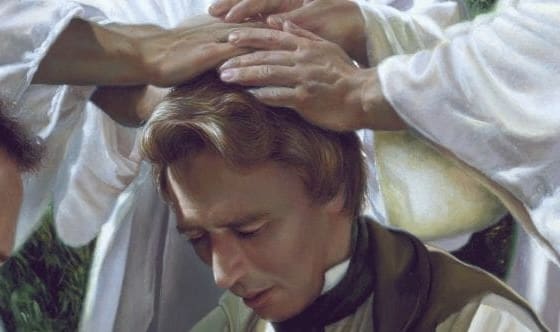
Cover image: Restoration, by Liz Lemon Swindle.
The restoration of priesthood power in 1829 had greatly blessed the Latter-day Saints in the early days of the Church. They could rest assured that the priesthood holders who baptized and confirmed them had the same authority that Christ gave to his apostles when he walked the earth during his ministry. But having access to the priesthood power is not the same thing as completely understanding it, and God had more he wanted His Saints to understand—particularly with the coming restoration of temple ordinances. The 1832 revelation on the priesthood, now Doctrine and Covenants 84, expanded the Saints’ vision of what the priesthood really is.
A Grand Overview
If we could ask the Lord to tell us in one sentence what the priesthood is, and what he wants us to do with it, he might say, I can do that.” How about three sentences… (verses 19–22).
19 And this greater priesthood administereth the gospel and holdeth the key of the mysteries of the kingdom, even the key of the knowledge of God.
20 Therefore, in the ordinances thereof, the power of godliness is manifest.
21 And without the ordinances thereof, and the authority of the priesthood, the power of godliness is not manifest unto men in the flesh;
22 For without this no man can see the face of God, even the Father, and live.
Much can be learned about the divine power that holds “the key of the knowledge of God,” that makes manifest “the power of godliness,” and that prepares us to “see the face of God, even the Father, and live,” that is, “in his presence.”
Speaking of the Melchizedek Priesthood, Joseph Smith said, “Its institution was prior to ‘the foundation of this earth, or the morning stars sang together, or the Sons of God shouted for joy,’ and is the highest and holiest Priesthood, and is after the order of the Son of God, and all other Priesthoods are only parts, ramifications, powers and blessings belonging to the same, and are held, controlled, and directed by it. It is the channel through which the Almighty commenced revealing His glory at the beginning of the creation of this earth, and through which He has continued to reveal Himself to the children of men to the present time, and through which He will make known His purposes to the end of time.” (Teachings of the Prophet Joseph Smith, 166-167, emphasis added)
Whatever knowledge comes, it comes through the Melchizedek Priesthood.
If we still insist on a one-sentence answer to our question, the Lord might say, “Here’s your sentence. Your calling is to seek diligently to sanctify the people so they can behold my face, enter into my rest, and enjoy a fullness of my glory.” (compare to Doctrine and Covenants 84:23)
If I’m a minister, what should I do? “You calling is to seek diligently to sanctify the people so they can behold my face, enter into my rest, and enjoy a fullness of my glory.”
If I am a parent — “Your calling is to seek diligently to sanctify the people so they can behold my face, enter into my rest, and enjoy a fullness of my glory.”
If I am a missionary — “You calling is to seek diligently to sanctify the people so they can behold my face, enter into my rest, and enjoy a fullness of my glory.”
Hearing this, I might ask, “Oh Lord, how do I do that?”
The Lord might explain, “You can’t do that without a temple.” You’ve got to have a temple. Let’s get things going because it’s in the temple that the people are sanctified.”
This hypothetical conversation might continue in this manner:
“How do I build a temple?”
“Well, you’ve got to gather the people.”
“How do I do that?”
“Proclaim the gospel. My sheep will hear my voice.”
Then I say, “I’ve proclaimed the gospel, and gathered them, and I’ve built the temple. Now what do I do?”
“Get them into the temple and get them sanctified.”
“Okay. Now what?”
“Now, I want you to get them to offer an offering that is acceptable to me.”
“What is that?”
“The record of your dead. Then I want you to covenant and BIND YOURSELF that you will do it. By the way, There will be some opposition.”
Then the Lord adds, “While you are gathering, building, and sanctifying, teach them to sing me a love song. Then I’ll know you’ve done all the rest, if they can sing me a love song.
Where do we get all that? It’s all in a few key sections of the Doctrine and Covenants. Let’s explore them.
Building Zion
Doctrine and Covenants 84:3: The whole context of the priesthood and what Moses was trying to do is sandwiched between temple language. We’re going to build Zion, right? Zion is described as being what kind of a people? One heart and one mind. Where do you learn to be one heart, one mind? In the temple. What people are sealed together in the temple? Husband to wife. Children to parents. Brother to sister. Man to God. Living to dead. You’re going to build Zion, but where do you begin? You begin at the temple lot.
Doctrine and Covenants 84:4: If we’re not careful, we might think that the place that the Lord is talking about is in Jackson County, but if you read a little more carefully, he will tell you what place you begin to build Zion from. What is the place? And it is Jackson County right now. You can’t sanctify the people without a temple, and if you can’t sanctify the people, you can’t magnify the priesthood. Without a temple, what is the purpose of God restoring the priesthood? As you start to notice that at the temple, you start to build Zion, you notice that in other sections, it is the same.
Every time the Saints move into a new place, God tells them to build a temple. Where does Zion begin in Kirtland? At the temple. (See Doctrine and Covenants 94:1) When they go to Far West, what happens? God commands them to build a temple. (See Doctrine and Covenants 115:8) That’s where Zion begins.
In Doctrine and Covenants 124:11, the Lord invites kings of the earth to bring their riches and come to Nauvoo. Why? Doctrine and Covenants 124:26-27 goes on to say that “swift messengers” will be sent to invite all those with “gold and silver,” “precious stones,” and the “precious things of the earth,” to “build me a house to my name, for the Most High to dwell therein.”
Brigham Young comes to Salt Lake, and what happens? He plants his walking stick after four days and says, “Here we’ll build a temple.” (As an aside here, as renovations to the Salt Lake temple have taken place, one soil engineer I know said, “Of all the places that the temple could have been built in the valley, that place was the best spot.”)
The Lord tells his priesthood holders to sanctify the people. That’s how you honor the priesthood. That’s your job. It’s not just to pass the sacrament, baptize, etc. All those things help to sanctify. The major job of the priesthood is to bring people to the altars of the temple. And then who takes over? The Lord. He then says, “OK, you’ve brought them here, I’ll take over.” So, if you are a minister, what’s your job? To make sure your people go to the temple. If you are a bishop, what’s your job? To make sure all the unendowed people in your ward get endowed. There is at least one time a year when the bishop meets with every member of the ward. Help them understand the temple. “Teach ye diligently” is always given in a temple context. Share insights with each other in the temple.
Doctrine and Covenants 84:5 – Which temple fulfilled the prophecy of a “cloud of glory resting upon it, which cloud shall even be the glory of the Lord, which shall fill the house?” The Kirtland temple.
In the next verses, Doctrine and Covenants 84:6-31, we are given a big parenthesis which gives Moses’s background, beginning with his ordination to the priesthood by his father-in-law Jethro. Who was Jethro? He was a high priest of the house of Midian. The Midianites are descendants of Abraham through his wife Keturah. (See Genesis 25:1-4) Abraham was ordained by the great high priest, Melchizedek, who received the priesthood “through the lineage of his fathers, even to Noah” (Doctrine and Covenants 84:14).
Doctrine and Covenants 84:21: The ordinances of the priesthood SYMBOLIZE the powers that God has in the eternities. Baptism is an ordinance that symbolizes the power of God to forgive sin. Sealing is an ordinance that symbolizes God’s power to seal families together for eternity.
(See Michael Wilcox, House of Glory, 113-116)
In Doctrine and Covenants 13, John the Baptist conferred the Aaronic Priesthood upon Joseph Smith and Oliver Cowdrey, promising that it would never be taken again from the earth, “until the sons of Levi do offer again an offering unto the Lord in righteousness.” Malachi 3:3 adds that when the Lord’s messenger appears to prepare the way for his coming, he will “purify the sons of Levi, and purge them as gold and silver, that they may offer unto the Lord an offering in righteousness.”
As the Restoration proceeded, more information was revealed and more keys were restored concerning the offering spoken of by John the Baptist. On September 22 and 23, 1832, the anniversary of Moroni’s visit, a great revelation was given on the priesthood. In this revelation, the words of Malachi’s and John the Baptist’s prophecies were repeated, but with different and added words that amplified and gave further clarification about the necessary offering: “The sons of Moses and also the sons of Aaron shall offer an acceptable offering and sacrifice in the house of the Lord.” (Doctrine and Covenants 84:31; emphasis added.)
Here we learn that the sons of Moses will be added to those that make the offering. Who are the sons of Moses and the sons of Aaron? What offering will they make? Why is that offering so critical that the priesthood will not be taken from the earth? Why is it so important that the priesthood itself was restored to allow the offering to be accomplished? What do purging and purifying have to do with the offering? Let us try to answer these questions by an appeal to the scriptures.
In biblical times, the sons of Levi kept “the charge of the tabernacle of the congregation, and the charge of the holy place.” (1 Chronicles 23:32) In other words, the sons of Levi were essentially the ancient temple ordinance workers.
The sons of Moses hold the Melchizedek priesthood—the sons of Aaron hold the Aaronic priesthood. Moses and Aaron were both from the tribe of Levi. John the Baptist’s promise refers to both priesthoods. We further learn that the offering will be made in “the house of the Lord.” That helps explain why the sons of Levi must be purged and purified. One must be clean and worthy both to enter the temple and also to exercise priesthood authority.
It is not surprising that an “offering and sacrifice” should be accomplished in the temple. Offerings and sacrifices were done anciently at altars, and the altars of the temple stand at the center of all we do in the house of the Lord. The Lord adds the word acceptable to the offering. When it is made, it will be made in such a manner that the Lord can receive it. The word becomes critically important later in understanding the exact nature of the offering.
The progress of the Restoration continued. The Kirtland Temple was built, and important keys were there restored. The major themes of the priesthood were there emphasized by angelic messengers. “Moses appeared . . . and committed . . . the keys of the gathering of Israel from the four parts of the earth.” The promise of Abraham was reiterated as “Elias appeared, and committed the dispensation of the gospel of Abraham, saying that in us and our seed all generations after us should be blessed.” Elijah then returned to complete the necessary authority to “turn the hearts of the fathers to the children, and the children to the fathers.” (Doctrine and Covenants 110:11, 12,15; emphasis added.) The gathering, the Abrahamic covenant, and the turning of hearts are all inseparably connected with temples. The proper authority was now in place, and the offering could now be made.
The Saints moved on to Nauvoo and, once again, were given the command to build a temple. They had learned in Missouri the importance of responding to that command. Their failure to do so was a major factor in their expulsion from Jackson County. (See Doctrine and Covenants 97; 101:43-54.) They had learned in Kirtland that when the Lord gave a command to build a temple, and the Saints did not immediately respond, they had “sinned a very grievous sin,” which the Lord compared to “walking in darkness at noon-day.” (Doctrine and Covenants 95:6.)
Now in Nauvoo, the Lord revealed the redeeming work for the dead and pressed upon the Saints the necessity of completing a temple in order to begin this great work in a place sacred enough for its importance. With the command to build his house, the Lord added a sobering warning: “I command you, all ye my saints, to build a house unto me; and I grant unto you a sufficient time to build a house unto me; . . . and if you do not these things at the end of the appointment ye shall be rejected as a church, with your dead, saith the Lord your God.” (Doctrine and Covenants 124:31-32.)
Notwithstanding all the other works of the Church and the priesthood, the failure to construct a temple (where the Lord could “restore again . . . the fulness of the priesthood” [Doctrine and Covenants 124:28] and where the offering could be made) would result in the rejection of the Church. In the minutes of the October 1841 conference, the Lord also instructed the Saints not to hold another conference until it could be held in the temple. Apparently, the Lord felt there was no need for further instructions until the most critical one of all was commenced. (History of the Church 4:426.)
The groundwork was now laid for the critical offering to be made, and it was looked forward to by all angelic messengers who had returned to earth to restore priesthood keys and authorities. However, Satan was not idle. Joseph Smith was in hiding. Knowing the Lord’s concern that the work not be stopped for any reason, Joseph gave instructions to the Saints through letters.
An Offering Worthy of All Acceptation
In a letter written September 1, 1842, Joseph gave the Saints the Lord’s encouragement: “Thus saith the Lord: Let the work of my temple and all the works which I have appointed unto you, be continued on and not cease; and let your diligence, and your perseverance, and patience, and your works be redoubled.” (Doctrine and Covenants 127:4.) Five days later, on September 6, 1842, in a letter to the Church, Joseph Smith described the “acceptable offering.” Quoting Malachi’s prophecy once again concerning the “sons of Levi,” Joseph then added this instruction: “Let us, therefore, as a church and a people and as Latter-day Saints, offer unto the Lord an offering in righteousness; and let us present in his holy temple, when it is finished, a book containing the records of our dead, which shall be worthy of all acceptation.” (Doctrine and Covenants 128:24; emphasis added.) At least part of the offering Malachi, John the Baptist, and other prophets had in view was a book containing the completed ordinance work for all the dead. It will take the Millennium to achieve that culmination and make it “worthy of all acceptation,” for how can the Lord accept it until all of his children who will receive salvation and eternal life have been provided with the opportunity?
As with many prophecies, the offering spoken of has other fulfillments, but it is significant that the one that the Lord chose to emphasize in the revelations of the Doctrine and Covenants is that of the work for the dead. Without that offering, the whole earth would be wasted at the Lord’s coming. How appropriate that the offering we are to place on the altars of the temple is a book. It is a fair exchange for the wonderful book our Father in Heaven has placed on those same altars as his offering and gift to us.
In summary, Moroni first quoted the Malachi prophecy and promised that the priesthood would be revealed. John the Baptist next came to begin its revelation and added that the priesthood would remain on the earth until the sons of Levi made an offering in righteousness to the Lord. (See Doctrine and Covenants 13) In section 84, the sons of Levi were identified as all priesthood holders, and it was revealed that the offering would be made in the temple. Finally, in Nauvoo, Joseph Smith’s letter now recorded as Doctrine and Covenants 128 invited all the Saints to participate in the offering, and the offering was identified. It would be a book containing all the records of ordinance work for the dead. Since that time, tremendous effort and resources have been expended to make the offering “acceptable” to the Lord by completing it.
In effect, God is saying, “The more people you have working on the offering, the faster we can make it. The more we preach the gospel, the more people we can gather, and the more temples we can build, and the faster we can make the offering.”
In Doctrine and Covenants 84:32 the Lord says, “I want you to BIND YOURSELF by covenant to do this.” I want you to say, “Yes, I will obtain the priesthood, and magnify the calling by sanctifying the people. I’m going to minister to get them there, and teach gospel doctrine to get them there.” Then the Lord communicates this idea: “If you’ll do that, you really are the sons of Moses, and all that I have is yours.”
Doctrine and Covenants 84:34 Worthy priesthood holders are not “adopted” in a legalistic sense into the families of Moses and Aaron. Rather, it is as though they are worthy of being counted as followers—persons who live after the same fashion—of Moses and Aaron.
Doctrine and Covenants 84:39 Oath — The Oath, which accompanies the reception of the priesthood, is an oath that God swears to man. God swears with an oath that every priesthood holder who abides by his part of the two-way promise (the covenant) shall receive incomprehensible blessings. There are two sides of the covenant — our side, and God’s side.
In Jacob 1:19, Jacob uses the word “diligence” to describe his responsibility to teach the word of God to the people and sanctify them. Otherwise, “their blood and sins would come upon our garments, and we would not be found spotless at the last day.” In section 84, both the words “blood” and “sins” are used. How do we get rid of the blood and sins of this generation and become clean? We can’t do that without a temple. Jacob sought to magnify his office, which he interpreted as a responsibility to TEACH his people. All the scriptures to do with the Priesthood have TEACHING mentioned.
The opposition has a plan: Let’s not talk about God’s word — something they can hang onto when they can’t see God’s love. This section has a strong LIGHT vs. DARKNESS motif — similar to Lehi’s dream. The Lord, in essence, is saying, “Make sure you get the light because the whole world lies in darkness.” What is the darkness for? To blind us to the light. Satan and his followers don’t want people to see God’s love (the tree), God’s word (the rod of iron), or the consequences of their actions (the filthy river), which are obscured by the mists of darkness. Satan just wants them to see the great and spacious building. That’s the world with its derision and pointing fingers. Satan and his followers don’t want us to know of God’s love; let’s make sure people can’t see that. Let’s keep the wars coming, one after another. (We’ll be introduced to this idea in sections 86 and 87.) And definitely don’t let them know where they’re going, don’t let them know the hell and misery they’re headed towards. Let them think that the generation in the building, pointing fingers, is the only reality. That’s the darkness the Lord is talking about. Priesthood is God’s front line to get people through that. So get that book in their hands, get them gathered, sanctified, and to the temple. That’s priesthood.
We spoke at the beginning of this article about learning to sing a love song to the Lord. Here, the Lord elaborates on it. Revelation 5:9, 14:3 refers to those who sang a new song before the throne of God. Nobody could sing that song but the 144,000 who lived a morally clean life. The Lord says, “Sing me a love song. And I’ll help you with half of it. I’ll give you the words, but I won’t reveal the tune. Joseph Smith is given the words for the new song in Doctrine and Covenants 84:99-102.
The Lord hath brought again Zion;
The Lord hath redeemed his people, Israel,
According to the election of grace
Which was brought to pass by the faith
And the covenant of their fathers.
The Lord hath redeemed his people;
And Satan is bound and time is no longer.
The Lord hath gathered all things in one.
The Lord hath brought down Zion from above.
The Lord hath brought up Zion from beneath.
The earth hath travailed and brought forth her strength;
And truth is established in her bowels;
And the heavens have smiled upon her;
And she is clothed with the glory of her God;
For he stands in the midst of his people.
Glory, and honor, and power, and might,
Be ascribed to our God; for he is full of mercy,
Justice, grace and truth, and peace,
Forever and ever, Amen.
So how do I learn how to sing it? How do I learn how to sing a song that no man can learn? If we receive all those gifts that God has given, nobody is going to have to tell you how to sing the love song. What are the gifts that God has given me? The scriptures, for one thing. The priesthood is a great gift. To be able to give school blessings. To see your 16-year-old baptize your eight-year-old. The temple. The commandments. Your heart will write the tune. And with all your soul, you’ll sing it. Your love for the Lord will write the tune.
Let me give you an example of somebody in the Doctrine and Covenants who sings this song. In which section does Joseph Smith wax eloquent about how he feels about the restoration? Doctrine and Covenants 128. It’s his version of the love song. What’s he thinking about when he writes it? The temple. The culmination of the whole Restoration and the great work for the dead.
Doctrine and Covenants 128:18: Sometimes we think that the oneness by which the hearts of the children are bound to their fathers refers to our ancestors whose temple work we’ve completed, and that “they without us cannot be made perfect,” refers to those whose work was NOT done and now we have done. But notice how he words it in Doctrine and Covenants 128:18. “They nor we can be made perfect without those who have died IN the gospel.” We don’t have to do their work. But we get all three groups: those whose work was not done but now is done, the ones now IN the gospel, and those who have died in the gospel.
Doctrine and Covenants 128:19: Have you ever heard a symphony start off with one voice and very little music behind it? That’s what is going on in the last part of Doctrine and Covenants 128. First, Michael, followed by the voice of the Lord, and then the dead all join in. In section 138, we hear that muffled, reverent sound as every knee bows to him. And then what do they do? They sing to him. What do they sing? Redeemer of Israel?
Doctrine and Covenants 128:23 What else sings? The mountains, then the valleys, the seas, and the dry lands. Rocks, the stars, and then all creation. Then the singing stops. We hear a voice from heaven proclaiming glory, honor, immortality, eternal life, kingdoms, principalities, and powers. Now you recognize those words spoken at a very sacred moment of your life. The Lord will give back to us what he promised us in his house. Revelation 5:9: You can judge because you have descended below all. A hundred million voices are joined by the creatures. So, while you’re doing all this as the priesthood, we see “eye to eye,” which means they are all right there with you.
Doctrine and Covenants 84:98 When do I stop exercising priesthood? The answer is when everybody knows. Then you can be released. From the highest king to the most poverty-stricken peasant on the streets of Calcutta. When they all can sing that love song, then you may say, “My priesthood responsibility is over.” It’s that same feeling that we’ve sensed all through the Doctrine and Covenants—that this work is MARVELOUS — a privilege.
Come, Follow Me Podcast: “The Power of Godliness”, Doctrine and Covenants 84

Maurine
Once in Nauvoo on a Sunday morning we attended Church with all the missionaries serving there. It was a beautiful sight to see! They were full of joy, enthusiasm, radiance, happiness and just plain excitement for being there. We talked to a number of the senior couples for a few minutes. “Oh, this is our seventh mission,” one sister said. “We love this work so much.” Another said, “Our only regret is we only get to serve here for two years. We so wish it could be longer!” Could these missionaries in Nauvoo be a testimony to the fulfillment of promises given by the Lord in Section 84 of the Doctrine and Covenants? We’ll talk about that in just a few minutes.
Scot
Hello dear friends! We are Scot and Maurine Proctor and this is Meridian Magazine’s Come Follow Me podcast. This week’s lesson is entitled “The Power of Godliness” and includes Section 84, the third longest section in the Doctrine and Covenants.
The Prophet Joseph designated this as a revelation on priesthood and it contains perhaps one of the greatest kept secrets in the Church—the Oath and Covenant of the Priesthood. We will talk about that in detail in this podcast. In the meantime, let’s get back to that scene of hundreds of missionaries in Nauvoo and their enthusiasm and their effervescence. There was something pretty obvious about them—even our Baptist bus driver noticed it.
Maurine
Yes, these are choice people, but they are being blessed by the Lord because of their service to Him. Let’s look at verse 80 for a moment, in section 84:
80 And any man that shall go and preach this gospel of the kingdom, and fail not to continue faithful in all things, shall not be weary in mind, neither darkened, neither in body, limb, nor joint; and a hair of his head shall not fall to the ground unnoticed. And they shall not go hungry, neither athirst.
Now, this may seem like a small thing we’re talking about, but it is not. These dear missionaries, both young and old gathered in such great numbers at Nauvoo were clearly being blessed. They are full of the Spirit of the Lord and they are not weary in mind, neither darkened, neither in body, limb, nor joint. Now, some of the older men had lost a few hairs of their head, but that hadn’t gone unnoticed!
Scot
We wanted to talk about this briefly because it was so clearly obvious as we were around all these missionaries, that they were being blessed and this is a fulfillment of the promise in Section 84 and we are witnesses of this!
And we are also witnesses of verse 88 in Section 84:
88 And whoso receiveth you, there I will be also, for I will go before your face. I will be on your right hand and on your left, and my Spirit shall be in your hearts, and mine angels round about you, to bear you up.
Maurine
A few years ago we were leading a tour and we attended Church on the first Sunday of the trip, as we always do, in the Fayette, New York ward. It was a particular Sunday when a group of six young service missionaries were giving their farewell talks. Each one struggled to say much, but the Spirit was with them and we all were moved to tears. These were young men who had each served in various capacities and were now on their way home.
After the meeting, one of our tour participants came up to us and said, “Did you see them? Did you see them?” We said, “Yes, they were wonderful, weren’t they?” “No! Did you see the angels round about them? In all my life I have never seen angels, but I saw them all around these precious missionaries.”
Scot
Then another tour participant, independent of the first one came up to us and said, “Did you see them?” We said, “Who?” She said, “The angels that were all around these dear missionaries? I’ve never seen angels before, but I saw them clearly today!”
That was a wonderful experience and so we stand as witnesses, not only in this one instance in Fayette, New York, but in multiple instances in the history of the Church and in our midst today.
Now, let’s look at verses three, four and five, speaking here of the New Jerusalem:
3 Which city shall be built, beginning at the temple lot, which is appointed by the finger of the Lord, in the western boundaries of the State of Missouri, and dedicated by the hand of Joseph Smith, Jun., and others with whom the Lord was well pleased.
4 Verily this is the word of the Lord, that the city New Jerusalem shall be built by the gathering of the saints, beginning at this place, even the place of the temple, which temple shall be reared in this generation.
Now, don’t get hung up on the word “generation”—it is interchangeable with the word “dispensation.” So, this very special temple, or complex of temples as the Prophet Joseph envisioned, will be built in this dispensation…
5 For verily this generation shall not all pass away until an house shall be built unto the Lord, and a cloud shall rest upon it, which cloud shall be even the glory of the Lord, which shall fill the house.
Maurine
This is ancient Israel talk, here; it is covenant language—and I always like to look for covenant language:
“And a cloud shall rest upon [the temple], which cloud shall be even the glory of the Lord…”
This is part of the covenant promises—to have the presence of the Lord in our midst. In ancient Israel this was the divine Shekinah—the presence of the Holy One of Israel. The Jews believe that this presence has never left the sacred and holy temple mount in Jerusalem. As you approach the temple mount, there is a sign that reads: “Dear Visitors. You are approaching the holy site of the Western Wall where the Divine Presence always rests. Please make sure you are appropriately and modestly dressed so as not to cause harm to this holy place or to the feelings of the worshippers. Sincerely, Rabbi of the Western Wall and Holy Sites.
They believe that this Divine Shekinah continues to this day.
Scot
There is even a special place of worship, underground, near the foundation of the Western Wall that some feel is the closest to the Divine Shekinah of anywhere in this ancient place. Women especially go to this spot to worship.
Back to the Temple in Independence, Missouri, or the complex of temples, the promise is that His presence, the cloud—even the glory of the Lord or the blessing of His divine presence will come and rest there. This is a wonderful and powerful promise and has not yet been fulfilled in this location.
Maurine
Now, Scot, you keep referring to a complex of temples in Independence. Will you help our listeners understand this?
Scot
Of course. In June 1833, the Prophet Joseph and his counselors in the First Presidency, Sidney Rigdon and Frederick G. Williams, prepared a plat map of the city of Zion—a layout of the City. Edward Partridge had purchased the original temple lot which was 63.27 acres. The plat for the City of Zion was for a square mile of land—640 acres. The center of the plat showed a complex of 24 temples, oriented north and south, twelve of which corresponded to quorums and functions of the Melchizedek Priesthood and twelve of which corresponded to the Aaronic Priesthood. Each temple had the inscription “Holiness to the Lord” engraved upon it. In August 1833, just two months later, a revised plat was drawn and the temples were re-oriented East and West and the plat called for 1 and one-half square miles—or 960 acres. Both plats called for a certain temple to be built first—this temple was to be a “house of the Lord for the First Presidency” and it was to be built on the spot of ground on the 2 acres which is now designated as the “temple lot.”
Now the reason we are going over these things in a little more detail than usual is because it has been 188 years since those plats were drawn and we are certainly getting close every day to the time when these prophecies will be fulfilled.
Maurine
That’s right. The way President Nelson says it is, “You and I get to participate in the ongoing Restoration of the gospel of Jesus Christ. It is wondrous! It is not man-made! It comes from the Lord, who said, “I will hasten my work in its time” (Doctrine and Covenants 88:73).
He also said: “Remember that the fulness of Christ’s ministry lies in the future. The prophecies of His Second Coming have yet to be fulfilled. We are just building up to the climax of this last dispensation—when the Savior’s Second Coming becomes a reality.
“In our time, a whole, complete, and perfect union of all dispensations, keys, and powers are to be welded together (see Doctrine and Covenants 128:18). For these sacred purposes, holy temples now dot the earth. I emphasize again that construction of these temples may not change your life, but your service in the temple surely will.
“The time is coming when those who do not obey the Lord will be separated from those who do (see Doctrine and Covenants 86:1–7). End quote. (Nelson, Russell M. The Future of the Church: Preparing the World for the Savior’s Second Coming, Ensign, April 2020).
We are living in exciting times. It has been fun, Scot, to stand on that Temple Lot in Western Missouri with you so many times. These things are real. All the prophecies will be fulfilled.
Scot
They certainly will.
Now, let’s jump to verse 33 and talk for a few minutes about the Oath and Covenant of the Priesthood.
Elder Bruce R. McConkie taught that “Every person upon whom the Melchizedek Priesthood is conferred receives his office and calling in this higher priesthood with an oath and a covenant. The covenant is to this effect:
“1. Man on his part solemnly agrees to magnify his calling in the priesthood, to keep the commandments of God, to live by every word that proceedeth forth from the mouth of Deity, and to walk in paths of righteousness and virtue; and
“2. God on his part agrees to give such persons an inheritance of exaltation and godhood in his everlasting presence. The oath is the solemn attestation of Deity, his sworn promise, that those who keep their part of the covenant shall come forth and inherit all things according to the promise.” (McConkie, Bruce R., Mormon Doctrine, Bookcraft, Salt Lake City, 1966, p. 480)
Maurine
Perhaps an easier way to remember this great and almost overwhelming covenant is thinking of it as “the oath and covenant of the Father to His faithful sons.” But let’s put this in perspective, speaking as a woman. As we read in Doctrine and Covenants, section 131:
1 In the celestial glory there are three heavens or degrees;
2 And in order to obtain the highest, a man must enter into this order of the priesthood [meaning the new and everlasting covenant of marriage];
3 And if he does not, he cannot obtain it.
So, for a man to obtain eternal life, or the life that the Father lives and all that He has, he cannot do so unless he, with his wife, has entered into the new and everlasting covenant of marriage.
Yes, when a man obtains the Melchizedek Priesthood and the oath and covenant of the priesthood, and is faithful, he can obtain all that the Father has, but he is not doing this alone.
Scot
So, we might say The Oath and Covenant of the Priesthood is an all-encompassing and eternal power that rests upon the worthy sons AND daughters of our Heavenly Father. It includes all the blessings of Abraham, Isaac, Jacob and Joseph AND the commensurate blessings of Sarah, Rebekah, Rachel and Asenath.
This kind of expands our view a bit. This is not a do-it-yourself program, it is a couple and all that we are talking about, including exaltation is as couples. But what of all the single sisters and single brothers in the Church? Or just you precious souls who are listening to the podcast today? All the blessings of the Father are promised to those who are true and faithful to His commandments. It brings us back to the great pre-mortal Council in Heaven when it was said:
25 And we will prove them herewith, to see if they will do all things whatsoever the Lord their God shall command them; (Abraham 3:25)
The ‘they’ there is not just sons of the Father, it is daughters and sons! We are all to be faithful and true, and as we are, all the blessings of the oath and covenant of the Father will be extended to each of us.
Maurine
And I believe that being sanctified by the Spirit unto the renewing of our bodies, which is one of the first blessings mentioned in verse 33, is not the culmination of blessings but the beginning of many that come unto the truly faithful. And all of this is given so that we can better do His work and fulfill His purposes. We become joint heirs because all that we do, all that we think, all that we purpose is for Him and His work. It is like unto Nephi the Disciple, who was given power over the heavens because the Lord knew he would only do His will.
Drs. Robert Millet and Kent Jackson have written:
“Bearing the Holy Priesthood is a sacred obligation, a trust that must not be taken lightly. From the beginning of time the Lord has bestowed the rights of priesthood upon his worthy sons, and at the same time he has counseled that the priesthood—like a double-edged sword—is the instrument for blessing as well as cursing. The worthy and pure recipient qualifies himself and his family for transcendent blessings; the man who receives God’s authority and then proves unwilling to assume the consequent commitments lays the foundation for unhappiness and punishment. God will not be mocked!…
Scot
Millet and Jackson continue:
“The Oath which accompanies the reception of the priesthood is an oath that God swears to man. Just as the Father swore that the Beloved Son should be a priest forever (Ps. 110:4), so also does God swear with an oath that every priesthood holder who abides by his part of the two-way promise (the covenant) shall receive incomprehensible blessings. The Covenant which accompanies the reception of the Melchizedek Priesthood…consists of: (1) those things man promises to do; and (2) those blessings God promises the faithful priesthood bearer. As given in verses 33-44, the Covenant might be represented as follows:
MAN PROMISES
- Obtain the Priesthood(v. 33)
- Magnify Callings in the Priesthood(v. 33)
- Receive the Lord’s Servants (v. 36)
- Beware Concerning Himself (v. 43)
- Give Diligent Heed to the Words of Eternal Life (v. 43)
- [And] Live by Every Word of God (v. 44)
Maurine
[And] GOD PROMISES, Millet and Jackson continue:
- Sanctify Man to the Renewal of the Body (v. 33)
- Man to Become a Son of Moses and Aaron (v. 34)
- Man to Become the Seed of Abraham (v. 34)
- Man to Become a Part of the Church and Kingdom of God (v. 34)
- Man to Become the Elect of God (v. 34)
- Man to Receive Christ and the Father (vv. 36-37)
- Man to Receive All the Father Has (v. 38)
“Man’s promises to God are penetrating but quite straight-forward. Faithful observance of those promises leads to remarkable blessings. Alma taught the people of Ammonihah that righteous priesthood bearers of the past had magnified their callings to such an extent that they “were sanctified, and their garments were washed white through the blood of the Lamb. Now they, after being sanctified by the Holy Ghost, having their garments made white, being pure and spotless before God, could not look upon sin save it were with abhorrence; and there were many, exceedingly great many, who were made pure and entered into the rest of the Lord their God” (Alma 13:11-12). Faithful priesthood service thus leads to the purification of the soul.” End of quote. (Robert L. Millet and Kent P. Jackson, Studies in Scripture, Vol. 1: The Doctrine and Covenants, Deseret Book Company, Salt Lake City, 1989, pp. 316-17.)
Scot
And, of course, we learn from the prophet Melchizedek and from Enoch himself that every one being ordained after this order and calling should have power, by faith, to break mountains, to divide the seas, to dry up waters, to turn them out of their course;
31 To put at defiance the armies of nations, to divide the earth, to break every band, to stand in the presence of God; to do all things according to his will, according to his command, subdue principalities and powers; and this by the will of the Son of God which was from before the foundation of the world. (JST Genesis 14: 30-31)
We’re talking tremendous power that is loaned to man from God. This is all part of the Oath and the Covenant of the Priesthood. I believe it is the assurance of revelation when revelation is needed—living by every word which proceedeth forth from the mouth of God. It is going beyond the reliance of the things of this world to the reliance, assurance and trust of Him Who is the Advocate with the Father. It is the trust of Enos who prayed all day and into the night and then he trusted all things that were said to him.
Maurine
It is the power and faith of Enoch and all the blessings outlined in Moses 7:13:
13 And so great was the faith of Enoch that he led the people of God, and their enemies came to battle against them; and he spake the word of the Lord, and the earth trembled, and the mountains fled, even according to his command; and the rivers of water were turned out of their course; and the roar of the lions was heard out of the wilderness; and all nations feared greatly, so powerful was the word of Enoch, and so great was the power of the language which God had given him.
I believe all of this is according to the oath of the covenant of the priesthood.
And I think we underutilize this power in our lives. I believe we often live in the shallows. We often shy away from all that the Father and the Son have given to us here in this life—for whatever reason.
Scot
I agree. And I think we see glimpses and snatches of these blessings throughout the scriptures and sometimes we don’t recognize that these are all part of the oath and covenant of the priesthood.
I believe that the blessings of the four sons of Mosiah are part of this as enumerated in Alma 26:22:
22 Yea, he that repenteth and exerciseth faith, and bringeth forth good works, and prayeth continually without ceasing—unto such it is given to know the mysteries of God; yea, unto such it shall be given to reveal things which never have been revealed; yea, and it shall be given unto such to bring thousands of souls to repentance, even as it has been given unto us to bring these our brethren to repentance. (Alma 26:22)
Maurine
Exactly! The blessings of knowing the thoughts and minds of others is included as with Alma and Amulek. I think it’s that same covenantal power where we see Joseph of Egypt rising from every situation, breaking every bond, being clothed upon with power and authority and wealth.
And the blessings and promises of Doctrine and Covenants Section 100, verses five through 8 are 5-8 are all part of this:
5 Therefore, verily I say unto you, lift up your voices unto this people; speak the thoughts that I shall put into your hearts, and you shall not be confounded before men;
6 For it shall be given you in the very hour, yea, in the very moment, what ye shall say.
7 But a commandment I give unto you, that ye shall declare whatsoever thing ye declare in my name, in solemnity of heart, in the spirit of meekness, in all things.
8 And I give unto you this promise, that inasmuch as ye do this the Holy Ghost shall be shed forth in bearing record unto all things whatsoever ye shall say.
Scot
And I believe that handbooks, if you will, and instructions for the oath and covenant of the priesthood have been given by President Boyd K. Packer, President Russell M. Nelson, President Gordon B. Hinckley, Elder Kim B. Clark and the Prophet Joseph and many others have been given. These seminal talks all point back to and guide righteous men and women to this Oath and Covenant of the Priesthood. For those of you who only listen to the podcast, you can come to the transcript at latterdaysaintmag.com/podcast and find the references to these various landmark talks.
(See for example the following talks:
David A. Bednar
April 2012
Boyd K. Packer
April 2010
Ministering with the Power and Authority of God
Russell M. Nelson
April 2018
Russell M. Nelson
April 2016
Personal Priesthood Responsibility
Russell M. Nelson
October 2003
We Can Do Better and Be Better
Russell M. Nelson
April 2019
Kim B. Clark
April 2019
The Doctrine of the Priesthood
Bruce R. McConkie
April 1982
The Ten Blessings of the Priesthood
Bruce R. McConkie
October 1977
The Melchizedek Priesthood and the Keys
Dallin H. Oaks
April 2020
Dallin H. Oaks
April 2018
Russell M. Nelson
October 2015)
We have listed a dozen talks in the podcast transcript with links. These seminal talks are just samples of what is available to lead us to a deeper understanding of the oath and covenant of the priesthood. We cannot give too much study, time and pondering to this deepest of topics.
Maurine
I find it interesting, Scot, in this great section 84 that Joseph designates as a revelation on priesthood, that the priesthood line is given for the great Prophet Moses. I think this is no accident. Of course, the Jews look upon Moses as the greatest of all the Prophets. Perhaps someday these twelve verses will play a role in their deeper understanding of the Restoration. And I’ve always found it wonderful that you, Scot, can just tell your priesthood lineage right off the top of your head.
Scot
I can. I was ordained a high priest by my father, Paul Dean Proctor. He was ordained by Mark E. Petersen. He was ordained an apostle by Heber J. Grant. He was ordained an apostle by George Q. Cannon who was ordained an apostle by Brigham Young who was ordained an apostle by the Three Witnesses who received their priesthood under the hands of Joseph Smith and Oliver Cowdery, who were ordained by Peter, James and John who received the holy apostleship from Jesus Christ.
That’s really not that far from me to the source of priesthood power. It’s very humbling.
Maurine
19 And this greater priesthood [or the Melchizedek Priesthood] administereth the gospel and holdeth the key of the mysteries of the kingdom, even the key of the knowledge of God.
20 Therefore, in the ordinances thereof, the power of godliness is manifest.
21 And without the ordinances thereof, and the authority of the priesthood, the power of godliness is not manifest unto men in the flesh;
22 For without this no man can see the face of God, even the Father, and live. (See D&C 84:19-22)
Scot
And, Maurine, I think the next two verses are very interesting, verses 23 and 24:
23 Now this Moses plainly taught to the children of Israel in the wilderness, and sought diligently to sanctify his people that they might behold the face of God;
24 But they hardened their hearts and could not endure his presence; therefore, the Lord in his wrath, for his anger was kindled against them, swore that they should not enter into his rest while in the wilderness, which rest is the fulness of his glory.
So, God was inviting his people in the wilderness to come before Him and to see His face. What an amazing invitation!
Maurine
And they rejected the invitation! In the Kirtland period the Lord issued a similar invitation:
15 And inasmuch as my people build a house unto me in the name of the Lord, and do not suffer any unclean thing to come into it, that it be not defiled, my glory shall rest upon it;
16 Yea, and my presence shall be there, for I will come into it, and all the pure in heart that shall come into it shall see God.
This is not a metaphor or symbolic language. It is about as clear as it can be. And, did this come to pass in anyone’s life? Yes! It did!
Scot
That’s right. We have numerous accounts of the saints having visions of the Savior during the Kirtland period, one of which was from John Murdock:
The visions of my mind were opened, and the eyes of my understanding were enlightened, and I saw the form of a man, most lovely! The visage of his face was sound and fair as the sun. His hair, a bright silver grey, curled in most majestic form, His eyes, a keen penetrating blue, and the skin of his neck a most beautiful white, and He was covered from the neck to the feet with a loose garment, pure white, whiter than any garment I have ever before seen. His countenance was most penetrating, and yet most lovely! And while I was endeavoring to comprehend the whole personage, from head to feet, it slipped from me, and the Vision was closed up. But it left on my mind the impression of love, for months, that I never before felt, to that degree. (Vision of John Murdock in the room of the School of the Prophets, Newel K. Whitney Store, March 18, 1833)
Maurine
I love that description he gives. And I love this account from the same day:
Zebedee Coltrin related that he also saw the Savior, following which he saw God the Father, who “was surrounded as with a flame of fire, which was so brilliant that I could not discover anything else but His person. I saw His hands, His legs, his feet, his eyes, nose, mouth, head and body in the shape and form of a perfect man. . . . This appearance was so grand and overwhelming that it seemed I should melt down in His presence, and the sensation was so powerful that it thrilled through my whole system and I felt it in the marrow of my bones.” (Anderson, Karl Ricks, Joseph Smith’s Kirtland, Deseret Book Company, Salt Lake City, 1989, p. 110).
What this says from these two witnesses is that the Savior issues invitations to His people to come into His presence and to see His face and many have done just that. And the invitation is issued a number of times in the Doctrine and Covenants to each one of us. (See D&C 67:10; D&C 93:1; D&C 38:8; D&C 88:68; D&C 101:23; D&C 130:3)
Scot
Now, this would be a good time to access the podcast script at latterdaysaintmag.com/podcast because we have listed six references that will enhance your studies.
When we came to this earth, the Lord dropped a veil of forgetfulness in our minds and yet, he invites us to pierce the veil with our faithfulness, obedience and our becoming pure in heart. That is one of the great teachings of the Restoration.
On another topic, Maurine, I just have to say how wonderful it is that the Lord gives us little truths and tidbits of knowledge all throughout the Doctrine and Covenants. For example, here in Section 84, in verses 27 and 28 we gain insights into John the Baptist that we have no other place in the scriptures:
27 Which gospel is the gospel of repentance and of baptism, and the remission of sins, and the law of carnal commandments, which the Lord in his wrath caused to continue with the house of Aaron among the children of Israel until John, whom God raised up, being filled with the Holy Ghost from his mother’s womb.
28 For he was baptized while he was yet in his childhood, and was ordained by the angel of God at the time he was eight days old unto this power, to overthrow the kingdom of the Jews, and to make straight the way of the Lord before the face of his people, to prepare them for the coming of the Lord, in whose hand is given all power. (D&C 84:27-28, emphasis added)
Maurine
Now, that’s a story we don’t have in the New Testament. We can ascertain from the practices of the Jews that John was brought to the temple at 8 days old to be circumcised and then was blessed by an angel of the Lord, most likely Gabriel, who is Noah and is also named Elias, unto this power to overthrow the kingdom of the Jews and to make straight the way of the Lord. That is a wonderful, tender scene to think about with aged Elizabeth and humbled Zacharias holding their little 8-day-old infant son and having this experience together with the angel of the Lord coming down from the presence of God. I’m sure they were never the same.
Scot
Speaking of powerful pieces of truth in the revelations, we see another one starting in verse 54 (and you will recognize this one from the administration of President Ezra Taft Benson):
54 And your minds in times past have been darkened because of unbelief, and because you have treated lightly the things you have received—
55 Which vanity and unbelief have brought the whole church under condemnation.
56 And this condemnation resteth upon the children of Zion, even all.
57 And they shall remain under this condemnation until they repent and remember the new covenant, even the Book of Mormon and the former commandments which I have given them, not only to say, but to do according to that which I have written. (D&C 84:54-57)
Can you imagine taking the Book of Mormon lightly? I guess that means if we don’t incorporate it into our daily studies and study and ponder it and immerse ourselves in it to draw closer to Jesus Christ.
Maurine
I remember when President Benson said:
My beloved brethren and sisters, today I would like to speak about one of the most significant gifts given to the world in modern times. The gift I am thinking of is more important than any of the inventions that have come out of the industrial and technological revolutions. This is a gift of greater value to mankind than even the many wonderful advances we have seen in modern medicine. It is of greater worth to mankind than the development of flight or space travel. I speak of the gift of the Book of Mormon…
“By His own mouth He has borne witness (1) that it is true (D&C 17:6), (2) that it contains the truth and His words (D&C 19:26), (3) that it was translated by power from on high (D&C 20:8), (4) that it contains the fulness of the gospel of Jesus Christ (D&C 20:9, D&C 42:12), (5) that it was given by inspiration and confirmed by the ministering of angels (D&C 20:10), (6) that it gives evidence that the holy scriptures are true (D&C 20:11), and (7) that those who receive it in faith shall receive eternal life (D&C 20:14).
Scot
President Benson continued:
“A second powerful testimony to the importance of the Book of Mormon is to note where the Lord placed its coming forth in the timetable of the unfolding Restoration. The only thing that preceded it was the First Vision…
“Think of that in terms of what it implies. The coming forth of the Book of Mormon preceded the restoration of the priesthood. It was published just a few days before the Church was organized. The Saints were given the Book of Mormon to read before they were given the revelations outlining such great doctrines as the three degrees of glory, celestial marriage, or work for the dead. It came before priesthood quorums and Church organization. Doesn’t this tell us something about how the Lord views this sacred work?
He then said:
“Every Latter-day Saint should make the study of this book a lifetime pursuit. Otherwise he is placing his soul in jeopardy and neglecting that which could give spiritual and intellectual unity to his whole life. There is a difference between a convert who is built on the rock of Christ through the Book of Mormon and stays hold of that iron rod, and one who is not.”
Maurine
And finally from President Benson:
“It is not just that the Book of Mormon teaches us truth, though it indeed does that. It is not just that the Book of Mormon bears testimony of Christ, though it indeed does that, too. But there is something more. There is a power in the book which will begin to flow into your lives the moment you begin a serious study of the book. You will find greater power to resist temptation. You will find the power to avoid deception. You will find the power to stay on the strait and narrow path. The scriptures are called “the words of life” (D&C 84:85), and nowhere is that more true than it is of the Book of Mormon. When you begin to hunger and thirst after those words, you will find life in greater and greater abundance.”
We can testify that this is true in our own lives. We love the Book of Mormon. We have made it an integral part of our family culture. The first scripture we ever taught to all of our children was from the Book of Mormon: “And I was led by the Spirit, not knowing beforehand the things which I should do.” (1 Nephi 4:6). The Book of Mormon blesses our lives each and every day.
Scot
And the revelations of the Doctrine and Covenants point us to the Book of Mormon and the Bible, which, taken together, contain the fulness of the Gospel of Jesus Christ.
That’s all for today. We have loved being with you. Obviously, with a revelation like Section 84 we could go on for hours—and you can do that in your own homes! Next week the lesson will cover Section 85-87 and is entitled: “Stand Ye in Holy Places.”
Thanks for to our good friend Paul Cardall for the music and to our daughter, Michaela Proctor Hutchins, who produced this show. Have a wonderful week and see you next time.
FEATURES