





Big Change in Sunday School Meeting Schedule

The goal is the same—to help members become lifelong disciples of Jesus Christ, but how to do that has changed according to the First Presidency of The Church of Jesus Christ of Latter-day Saints. They have made adjustments to the Sunday class meeting schedule which will begin the first Sunday in September, 2026.
According to the letter the First Presidency issued:
“In the new schedule, sacrament meeting will continue to be no longer than 60 minutes. After a 5-minute transition, youth and adults will attend a 25-minute Sunday School class each week. Following another 5-minute transition, they will attend a 25-minute priesthood quorum, Relief Society, or Young Women meeting. Primary will continue to meet weekly and will now last 55 minutes.
“Sunday School and Primary classes will study the scriptures using Come, Follow Me—For Home and Church. Elders quorums and Relief Societies will continue to study messages from the most recent general conference. Youth will use a new and expanded edition of For the Strength of Youth: A Guide for Making Choices, supported by material available in Church magazines. Quorums and classes will no longer counsel together about a specific topic prior to these lessons.”
In January 2019, the Church implemented a two-hour Sunday schedule to provide individuals and families with increased opportunities for home-centered gospel study. Members across the world have embraced these changes with faith and enthusiasm. Additional adjustments will be introduced to further enhance learning, fellowship, and worship.
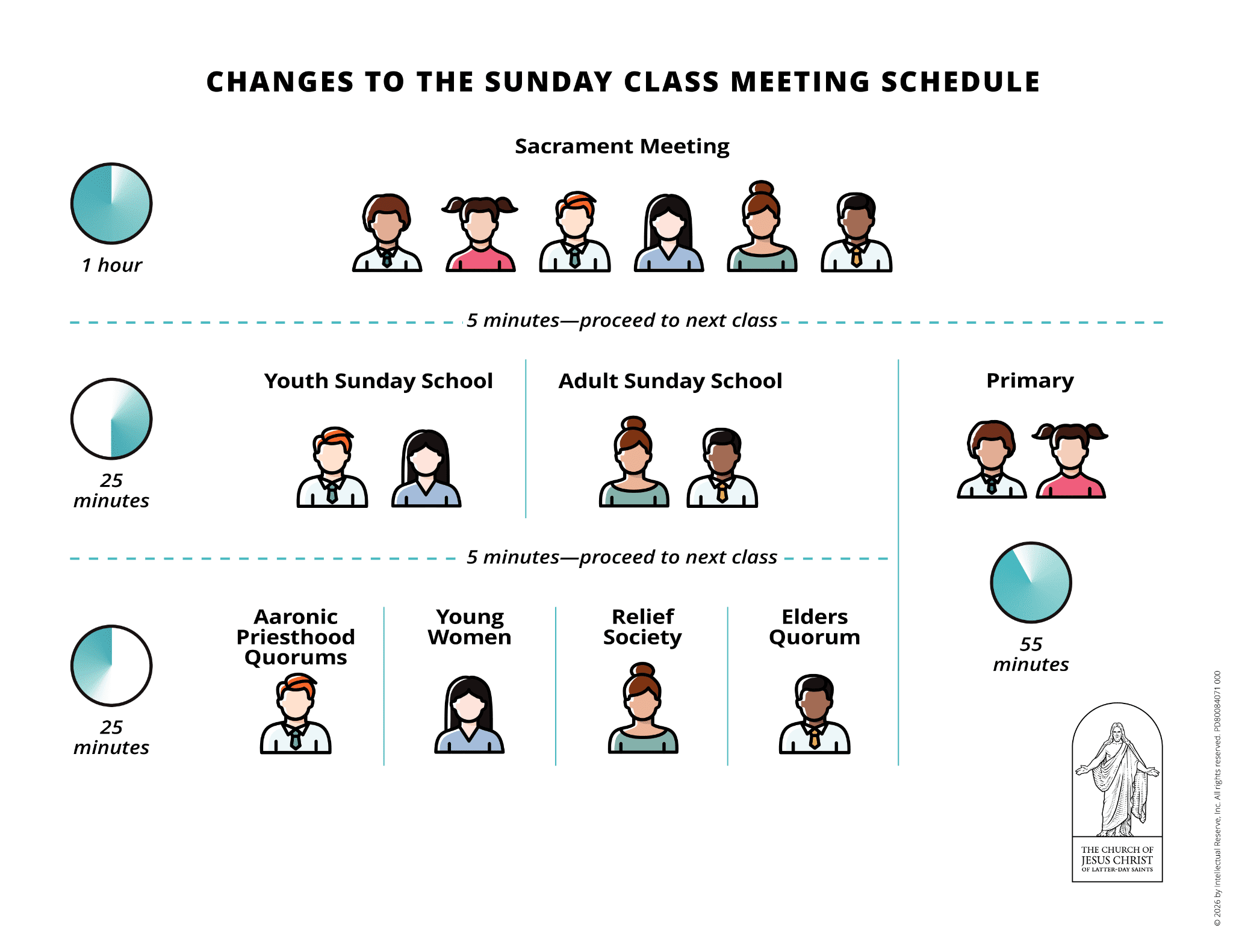
“Gathering weekly in every class helps deepen gospel learning by connecting it more closely to personal and family study,” said President Paul V. Johnson, Sunday School General President. “It also enhances the spiritual support that members get. Though the schedule looks different, the amount of time spent learning together remains the same.”
“Come, Follow Me” Alignment
Every age-group will continue participating in “Come, Follow Me” lessons that directly support home study.
Sunday School classes will continue using “Come, Follow Me—For Home and Church.”
Youth Curriculum: “For the Strength of Youth”
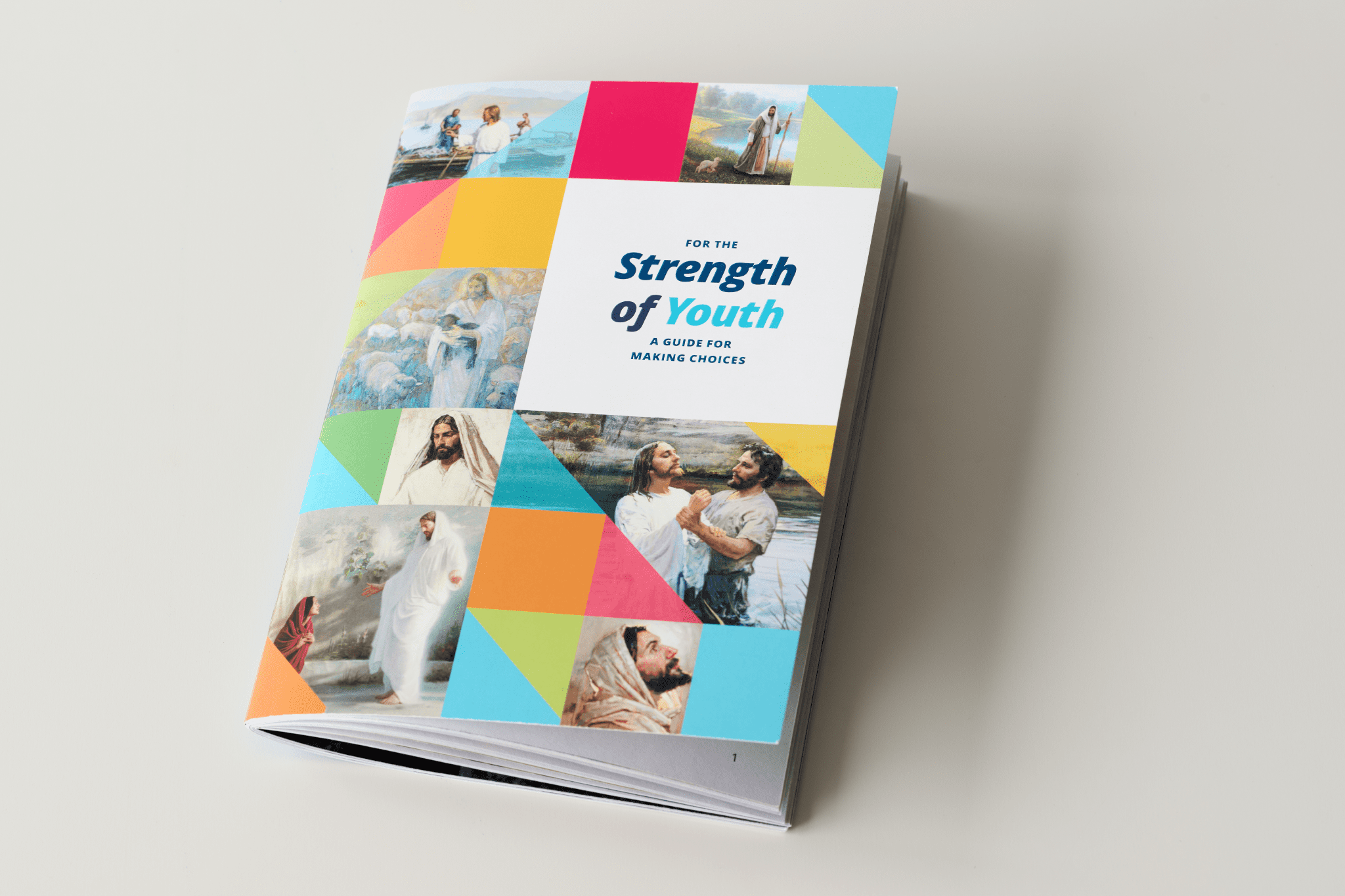
An updated “For the Strength of Youth: A Guide for Making Choices”—now available in the Gospel Library—features 12 chapters that align with monthly study. Physical copies are being shipped to units and do not need to be ordered by local leadership.
Beginning September 6, 2026, this guide will become the curriculum for Young Women classes and Aaronic Priesthood quorums. Additional supporting content will be provided through the “For the Strength of Youth” magazine, starting with the September 2026 issue.
“Living prophets have given us the FSY guide. It’s simple but powerful. It will help young men and young women focus on Christ, know His doctrine, and listen to the Spirit,” said President Timothy L. Farnes, Young Men General President. “This guide will help youth walk in confidence, rely on His power, and move forward with hope in a challenging world. I find it helpful as a daily part of my scripture study.”
The desired outcomes for youth who study this guide are that they will:
- Become lifelong disciples of Jesus Christ with a firm understanding of His gospel.
- Be prepared for the endowment with a deeper understanding of priesthood ordinances and covenant promises.
- Be prepared for a mission with a desire to serve the Lord.
- Be focused on their future family with an understanding that marriage between a man and a woman is ordained of God and that the family is central to the Father’s plan.
- Know Jesus Christ is their strength.
Young women, young men, their parents, and leaders are encouraged to subscribe their household to the “For the Strength of Youth” magazine at no cost. Those who would like to receive additional copies can purchase current issues at store.ChurchofJesusChrist.org or at retail stores. Current and past issues can be accessed digitally on ChurchofJesusChrist.org or the Gospel Library app. If members need help with subscriptions, they may contact their local magazine representative or ward clerk.
Relief Society and Elders Quorum
Weekly Relief Society and elders quorum meetings will continue to focus on messages from the most recent general conference. These discussions emphasize understanding prophetic teachings and applying them in daily life.
“There is additive strength that comes when we meet each week to counsel, learn, and support one another,” said President Camille N. Johnson, Relief Society General President. “When we gather in His name, the Spirit is there to teach us, testimonies are strengthened, and we lift each other in discipleship. This weekly time for connection will help us draw closer to the Savior and each other. We find joy in walking the covenant path together.”
Strengthening Worship in Sacrament Meeting
While the length of sacrament meeting remains unchanged, leaders are encouraged to deliberately consider ways to strengthen the quality of worship and help sacrament meeting become more central in the lives of Latter-day Saints. Members are invited to seek meaningful ways to enrich their own worship experience. Sacrament meeting is a time of joy, reverence, and welcoming fellowship centered on the Savior Jesus Christ.
The fifth Sunday in August 2026 will be dedicated for preparation and discussion by youth, their parents, and their leaders. Additional preparation and discussion for members will take place during the second hour on September 6, 2026. Resources, training materials, and answers to common questions will be made available in the coming weeks.
How Children Can Look Forward to the Youth Program

To read more from Larry Richman, read LDS365.
Leaving Primary the year they turn 12 can sometimes feel scary or even sad for children. Luckily, there are a lot of exciting things about turning 12 and joining a Young Women class or an Aaronic Priesthood quorum. The article “Looking Forward to the Youth Program” in the November issue of The Friend magazine outlines the following things to look forward to:
The Temple
Meet with your bishop to get a temple recommend and do baptisms for the dead in the temple. Read “Tips For Children on Their First Temple Trip.”
Activities and Events
Enjoy lots of activities with the Young Women or Aaronic Priesthood group. Go to youth camps and have fun with others while learning about Jesus Christ and His gospel.
Serve at Church
You may receive a calling to serve in a class or quorum presidency. You will also have opportunities to teach your class, help plan activities, and serve in other ways.
Seminary
In the year you turn 14, you can start attending seminary to learn more about Jesus Christ and His restored gospel.
FSY Conferences
In the year you turn 14, you can also attend FSY (For the Strength of Youth) conferences with other youth who love and want to follow Jesus Christ.
New Ways to Learn
- With a parent’s help, subscribe to the For the Strength of Youth magazine.
- Download the Gospel Living App. It has fun ideas for gospel learning and making goals for the Children and Youth program.
- Study For the Strength of Youth: A Guide for Making Choices. This booklet was written to help you follow Jesus Christ.
- Find uplifting stories, music, and announcements on the Strive to Be accounts on Facebook, Instagram, and YouTube.
2026 Youth Theme Website, Logo, Music Album Released

The following was originally published on the Church Newsroom. To visit their website, CLICK HERE.
Resources for the 2026 youth theme, including the logo and music album “Walk with Me,” are now available on the 2026 youth theme website of The Church of Jesus Christ of Latter-day Saints.
The music album and other resources support the 2026 youth theme, “Walk with Me,” from the scripture Moses 6:34, which reads in part, “And thou shalt abide in me, and I in you; therefore walk with me.”
The website is available in Chinese Traditional, English, French, Italian, German, Japanese, Korean, Portuguese, Russian and Spanish.
Each year, a youth theme is chosen to encourage, inspire and unite the rising generation around the world who are striving to follow Jesus Christ. The theme is typically a motto or a phrase based on a scriptural passage.
The Church creates songs, artwork such as posters, banners and stickers, and other materials to help youth and their leaders to incorporate the year’s theme in their activities, conferences and church meetings.
In the past few years, songs from the youth theme albums have been streamed hundreds of millions of times in dozens of languages and in more than 200 countries.
The full album of 13 new songs launched on Tuesday, October 28, and is available on the Church’s 2026 youth theme website, Gospel Library, Strive to Be YouTube channel, Spotify and Apple Music in English. Language versions of the album will be added to these platforms as they become available. The songs are:
- Walk with Me
- Stand Strong
- All For Me
- Moving the Mountains
- Your Presence
- Daughter of God
- His Kingdom
- More of You
- I’ll Hold On
- What Is This Joy
- Follow
- Made by God
- Eyes On You
The 2026 youth theme video will be released at a later time.
Additional resources will be available in the January issue of the “For the Strength of Youth” magazine. Youth will also have an opportunity in January 18, 2026, to hear more about the 2026 theme from Church leaders in a worldwide discussion.
Preregistration Is Open for 2026 FSY Conferences

The following was originally published on the Church Newsroom. To read the original article, CLICK HERE.
Preregistration for 2026 For the Strength of Youth (FSY) conferences in the United States and Canada is now open.
FSY conferences of The Church of Jesus Christ of Latter-day Saints are five-day experiences where youth gather to strengthen their faith in Jesus Christ, build lasting friendships, and have fun in a safe, uplifting environment. These conferences take place each year in locations around the world.
Each stake in the United States and Canada is assigned a cycle (even years or odd years) to attend local sessions. For youth in stakes that are on-cycle, they can preregister for a higher likelihood of obtaining a spot in one of their preferred sessions and attending FSY with up to five other youth of their choice, as well as more time to resolve registration and account issues. Please note that no preferences are given to youth who preregister first; all youth who preregister have the same chance of being assigned to their preferred sessions.
To see if your stake is on-cycle and, if so, the sessions assigned to your stake, view the stake assignment page.
Preregistration Information for On-Cycle Stakes
- Youth must be approved by their bishopric before they can preregister for FSY.
- Youth in on-cycle stakes can preregister from October 21, 2025, through January 13, 2026.
- Session assignments must be finalized during January 15–28, 2026, for preregistration to be completed.
- To preregister for FSY, please visit FSY.ChurchofJesusChrist.org.
If a youth in an on-cycle stake does not preregister, they can register later for remaining spaces. See the Registration Timeline for information and dates on the different phases of FSY registration.
Youth in off-cycle stakes who are interested in attending FSY in 2026 may visit the Registration Timeline for further updates.
Alternate FSY Sessions
Spanish and Spanish-supported sessions are available in select locations in the United States and are available during preregistration to stakes invited to those sessions. An American Sign Language (ASL) session and virtual sessions will be available for registration during On-Cycle Open Registration, beginning February 26, 2026.
Accommodations for dietary, disability, medical and other needs are also available. Learn more about FSY Conference Accessibility.
Why Attend FSY?
President Russell M. Nelson said, “I bless you to learn more about who you are and what your purpose really is, during this [FSY] conference” (“FSY Intro Video with President Nelson,” 2023).
FSY conferences are specifically designed to help youth have fun as they apply the gospel in all aspects of life. Youth at FSY have the opportunity to connect with peers from diverse backgrounds, learn from one another, practice gospel habits, and develop lasting friendships and powerful testimonies.
“To tell you the truth, I did not want to go to FSY,” says Eva, a former FSY participant. “I have anxiety, and I was purely terrified, … [but] throughout the week it became more and more clear to me that this was where I was supposed to be, and that was what I needed.” She continues, “[FSY] is the thing that will change your life. Your confidence is going to be boosted, you’re going to feel the Spirit, you’re going to come closer to Christ, and you’re going to come to know yourself.”
2026 Youth Theme: “Walk with Me”

The Church has announced that the youth theme for 2026 is “Walk with Me” (see Moses 6:34).
Corresponding resources (including the theme song, additional music, sheet music, and downloadable artwork) will begin publishing at youth.ChurchofJesusChrist.org in some languages on October 28, 2025. Additional languages will become available after October 28.
Additional resources will be available in the January 2026 issue of the For the Strength of Youth magazine.
Parents and youth leaders are encouraged to teach principles from the theme at home and at church throughout the year. In addition, youth can use the theme as a topic for sacrament meeting talks. The theme can also provide a focus for youth activities, including camps, youth conferences, and devotionals. The theme will be emphasized during For the Strength of Youth (FSY) conferences worldwide.
Each year’s youth theme comes from the book of scripture studied with that year’s Come, Follow Me—For Home and Church curriculum. In 2026, it will focus on study of the Old Testament.
Here is a list of the scriptures that have been used as themes over the years:
2026
“Walk with Me” (Moses 6:34).
2025
“Look unto Christ” (Doctrine and Covenants 6:36)
2024
“I am a disciple of Jesus Christ.” (3 Nephi 5:13)
2023
“I can do all things through Christ which strengtheneth me.” (Philippians 4:13)
2022
“Trust in the Lord with all thine heart; and lean not unto thine own understanding. In all thy ways acknowledge him, and he shall direct thy paths.” (Proverbs 3:5–6)
2021
“Wherefore, be not weary in well-doing, for ye are laying the foundation of a great work. And out of small things proceedeth that which is great. Behold, the Lord requireth the heart and a willing mind” (Doctrine and Covenants 64:33–34).
2020
“And it came to pass that I, Nephi, said unto my father: I will go and do the things which the Lord hath commanded, for I know that the Lord giveth no commandments unto the children of men, save he shall prepare a way for them that they may accomplish the thing which he commandeth them” (1 Nephi 3:7; emphasis added).
2019
“If ye love me, keep my commandments.” (John 14:15)
2018
“Learn of me, and listen to my words; walk in the meekness of my Spirit, and you shall have peace in me.” (Doctrine and Covenants 19:23)
2017
“If any of you lack wisdom, let him ask of God, that giveth to all men liberally, and upbraideth not; and it shall be given him. But let him ask in faith, nothing wavering. For he that wavereth is like a wave of the sea driven with the wind and tossed” (James 1:5–6, emphasis added)
2016
“Wherefore, ye must press forward with a steadfastness in Christ, having a perfect brightness of hope, and a love of God and of all men. Wherefore, if ye shall press forward, feasting upon the word of Christ, and endure to the end, behold, thus saith the Father: Ye shall have eternal life.” (2 Nephi 31:20, emphasis added)
2015
“O ye that embark in the service of God, see that ye serve him with all your heart, might, mind and strength, that ye may stand blameless before God at the last day” (D&C 4:2).
2014
“Yea, come unto Christ, and be perfected in him, and deny yourselves of all ungodliness; and if ye shall deny yourselves of all ungodliness, then is his grace sufficient for you, that by his grace ye may be perfect in Christ; and if by the grace of God ye are perfect in Christ, ye can in nowise deny the power of God” (Moroni 10:32).
2013
“Wherefore, stand ye in holy places, and be not moved, until the day of the Lord come; for behold, it cometh quickly, saith the Lord” (D&C 87:8).
2012
“Arise and shine forth, that thy light may be a standard for the nations” (D&C 115:5).
2011
“We believe in being honest, true, chaste, benevolent, virtuous, and in doing good to all men; indeed, we may say that we follow the admonition of Paul—We believe all things, we hope all things, we have endured many things, and hope to be able to endure all things. If there is anything virtuous, lovely, or of good report or praiseworthy, we seek after these things” (Articles of Faith 1:13).
2010
“Be strong and of a good courage; be not afraid, neither be thou dismayed: for the Lord thy God is with thee whithersoever thou goest” (Joshua 1:9).
2009
“Be thou an example of the believers, in word, in conversation, in charity, in spirit, in faith, in purity” (1 Timothy 4:12).
2008
“Be Steadfast and Immovable” (Mosiah 5:15)
2007
“Let Virtue Garnish Thy Thoughts” (D&C 121:45)
2006
“Arise and Shine Forth” (D&C 115:5) Repeated in 2012
2005
“A Great and a Marvelous Work” (1 Nephi 14:7)
2004
“Search, Pray, Believe” (D&C 90:24)
2003
“Be Steadfast in Christ” (2 Nephi 31:20) Repeated in 2016
2002 (first year for a global theme)
“Stand Ye in Holy Places” (D&C 87:8) Repeated in 2013
What impresses you as common threads through these scriptures?
How to Subscribe to the Free Church Magazines

Members can request a free print subscription to the Church magazines. Each household may sign up for one or all three global magazines: the Liahona (for adults), For the Strength of Youth (for youth ages 12–18), and the Friend (for children).
Anyone worldwide with a Church account may sign up for one annual subscription per household to one or more of these magazines. The Church’s magazines are published in 50 languages in both print and digital formats. Additional languages are available digitally only.
How to Order
An adult member with a Church account may manage subscriptions at MagazineSubscriptions.ChurchofJesusChrist.org. If you don’t have a Church account, you may get a free account at account.ChurchofJesusChrist.org.
Click the Subscribe button next to the magazine images and descriptions for a subscription to printed magazines. Enter your shipping address and language preference at the bottom of the page.
You will receive your first magazine six to eight weeks after subscribing. Additional copies of current issues of other magazines may be purchased at store.ChurchofJesusChrist.org or at retail stores. You may access past issues digitally in the Gospel Library.
To sign up for a monthly email notification when a new issue of a magazine is released online and in the Gospel Library, select the digital magazines wanted under Email for Online Magazines.
The ward council can subscribe for children and youth who do not have parents attending church as well as for members who need additional help. Leaders can do this by going to Leader and Clerk Resources (LCR) and selecting Reports and then Magazine Subscriptions. Subscribing for these groups will require permission from members who need additional help and from the children’s parents.
Learn more in the article “Church Magazine Subscriptions Now Available Worldwide at No Cost.”
FSY Conference Information for Stakes Attending in 2025 (United States and Canada)

To read more from Larry, visit LDS365.
For the Strength of Youth (FSY) conferences will be held in the United States and Canada in 2025. Youth attend every other year. (See the FSY schedule for your stake).
These five-day conferences, generally held at college campuses, are led by young single adults and session advisers and include activities, devotionals, and classes designed to strengthen youth and increase their faith in Jesus Christ. Youth can attend FSY beginning the year they turn 14 and may be no older than 18 by the end of the conference session they plan to attend. To learn more about what youth can expect at a session, see the FSY schedule.
Registration Information
Bishoprics can begin approving youth for FSY registration on September 10, 2024. Youth can then preregister for FSY from October 22, 2024, to January 14, 2025. During preregistration, youth can indicate their session and group preferences. This significantly improves their chances of attending their preferred session with up to five other youth if desired. See the complete registration timeline.
Refer to the notice sent to ward and stake leaders to learn more about FSY conference registration for 2025. Note that some processes have changed from previous years, including no longer accommodating requests for stakes to attend together.
Misunderstanding Modesty Part 2: Dr. Julie Hanks Responds to Comments

Thank you to those who posted thoughtful and articulate comments on my article “The Costs of Misunderstanding Modesty”. I had no idea that this blog post would spark such intense conversation and elicit so many varied responses and questions. No matter what you thought about the article, I think it is a good thing for us, as individuals and as a group, to reflect on and discuss our approach to teaching modesty.
I’d like to address a few themes and questions that prompted some to (passionately) disagree or take exception to (parts of) the article. It seems that some of you may have misunderstood my intent in writing it. Hopefully I can clarify some of those misunderstandings. The following are questions or concerns gathered from emails, messages, online comments and discussions:
Q: Are you are suggesting something different than the standards in the “For the Strength of Youth” (FTSOY) pamphlet? Are you saying that our girls can wear two-piece bathing suits and not have to worry about it?
Many of you seem concerned that I didn’t outline LDS modesty standards in this article, and that because I didn’t, I am suggesting that modest dress is not important. I made an assumption that if you are reading Meridian Magazine, you are already familiar with the Church’s teachings on modesty, that you have read FTSOY pamphlet, or that you are easily able to search the term modesty on LDS.org and find pages of articles defining and outlining modesty.
Here is a comment that exemplifies this concern:
Please, I beg of you to just read For The Strength of Youth. And also, why is nobody talking about the significance of garments? We need to be modest in dress ALWAYS. There should be no exceptions to God’s commandments.
To be crystal clear, I wholeheartedly support the guidelines in FTSOY and the Church’s doctrines on the sanctity of the body. I teach them to my children, and I strive to live them. We do need to be modest and strive to follow the commandments. I didn’t summarize those teachings in this article because the focus of this article was not to outline or to challenge the LDS modesty standards, but to open up a discussion about how we appear to be applying those guidelines in ways that may be harmful, particularly to women. In the opening paragraph, I mistakenly thought it was sufficient to say, “As someone who believes in the teachings of the restored gospel of Jesus Christ, I value and heed the counsel we’ve been given about modesty.”
It seems that including the word “modesty” in the title of the article set up an expectation for some readers that the article would be (or should be) a lesson on modesty focused on reiterating the Church’s guidelines for female clothing, or a sermon on the doctrine and principles behind modesty guidelines. This intense criticism partially illustrates my concern; that we have come to expect discussions on modesty to be about reiterating our dress guidelines. Teaching modesty guidelines to women is an important part of the modesty discussion, however, it is only one part of modesty as defined in the Church’s True to the Faith Manual:
Modesty is an attitude of humility and decency in dress, grooming, language, and behavior. If you are modest, you do not draw undue attention to yourself. Instead, you seek to “glorify God in your body, and in your spirit” (1 Corinthians 6:20; see also verse 19).
If you are unsure about whether your dress or grooming is modest, ask yourself, “Would I feel comfortable with my appearance if I were in the Lord’s presence?” You might ask yourself a similar question about your language and behavior: “Would I say these words or participate in these activities if the Lord were present?” Your honest answers to these questions may lead you to make important changes in your life… (LDS.org)
If you’ll notice, the focus of this quote is on us, as individuals, reflecting on our own dress, grooming, language, and behavior. “Would I feel comfortable wearing, saying, or doing this in the Lord’s presence?” Not “Should she feel comfortable wearing, saying or doing that in His presence?”

Q: Why didn’t you validate the boys’ assessment that a two-piece swimsuit is immodest? It says it in FTSOY. Why didn’t you approach the girl regarding the inappropriateness of her wearing a two-piece bathing suit?
For clarity, the conversation with the boys didn’t happen at a church event. The boys were talking about a girl’s “immodesty” in an attitude of judgment and gossip, after the fact. If they had been talking about another person (male or female) in a judgmental way by saying he/she was “fat”, for example, I would have interrupted their conversation whether or not the person they were talking about actually was overweight. I hope that if you overheard a group talking about my daughter (or son) in a negative light, you would step in and help those youth reflect on their behavior.
I didn’t address whether or not a two-piece was immodest, not because I disregard modesty or I am trying to promote immodesty. I didn’t address it because that wasn’t the issue at hand. What struck me was the irony of the situation. These wonderful boys appeared to feel completely comfortable and justified judging and talking about a young girl’s swimming attire, while disregarding a core and unchanging doctrine of Christ’s teachings: charity and love.
In my view, the FTSOY guidelines help our youth stay as far away as possible from potential hazards that would hinder their spiritual growth. However, does that mean any appearance that deviates from our recommended safety zone is automatically deemed immodest or provocative? If my female neighbor, who is not a member of any faith community, wears shorts 2 inches above her knee and a sleeveless top to the grocery store, is she dressing immodestly? If a little girl wears a tankini that shows 1/2 inch of her stomach, do we have the right to label her or her attire as immodest or provocative just because it doesn’t meet our Church modesty standards? I don’t think so. Just because it doesn’t meet our recommended guidelines doesn’t mean that it is, by default, immodest.
For those who were concerned that I chastised the boys unfairly, I didn’t approach them with an attitude of condemnation. I simply and calmly asked them questions that might encourage them to reflect on their own behavior in that moment. If I had focused on whether or not a two-piece bathing suit is immodest, I would have been reinforcing the troubling cultural pattern of openly judging female’s level of modesty that I am trying to address in this article. This comment summarizes my point well:
We teach that modesty is important because it invites people to pay attention to our personalities rather than our appearance. But if we’ve gotten to the point where we scrutinize women’s outfits to make sure that the sleeve reaches all the way to the edge of the shoulder and that the skirt reaches all the way to the knee, or if we make snap judgments about a woman’s character based on whether or not her outfit exactly meets the standards in For the Strength of Youth, then we’ve come back around to judging people based on their appearance, and the point of the principle has been lost.
Q: How can you say that we are overemphasizing modesty to young women? I am appalled at what some young women and women are wearing to church! It seems the problem is that modesty is not emphasized enough.
In the article, I suggested that we use a more holistic definition of modesty as defined by LDS.org website: modesty is “an attitude of propriety and decency in dress, grooming, language, and behavior. If we are modest, we do not draw undue attention to ourselves.”
I agree that the issue of modest clothing is a lot more of a concern for females than with males in the Church. However, one of my points is that definition of modesty encompasses a lot more than just one’s clothing and applies to both genders. I am concerned that we, as a people, have reduced the principle of modesty to the narrow definition of “what women wear,” which ironically can further objectify women’s bodies, and that have used this narrow definition as permission to police the attire of others. These guidelines, like all other guidelines and commandments are for us to evaluate ourselves. While appearance is certainly an important part of modesty, it is not the only aspect of it.

Q: How can you say that a woman is not responsible for man’s lustful thoughts if she is dressed immodestly? Doesn’t that discount biology?
I am very aware of the sexual attraction that goes on between human beings, that men (and women) are affected by the appearance of others, and that the appearance of an attractive person may trigger sexual thoughts and feelings, particularly in men. I address this in the article by identifying the distinction between women’s influence on vs. responsibility for men’s thoughts, feelings, and behavior. The way we dress has an impact on others, but we are ultimately responsible for our own feelings, thoughts, and behaviors. I appreciated the perspective of this commenter regarding attractiveness:
I’m attracted to men in suits. Should there be church rules against men in suits? Some males are into stockings. Should we women not wear stockings to church? People need to take responsibility for their own thoughts. It’s disgraceful that we’re holding women responsible for men’s thoughts. Women and men are attracted to each other. Of course they’re wired to look for/at what attracts them. The principle here is self-control. It is a trait we see in our Heavenly Father. Maybe we need to learn it.
Like this commenter, the number of comments indicating that women actually are responsible for men’s thoughts shocks me. If I am responsible for another person’s thoughts, feelings, and behaviors, doesn’t that disregard the important principle of agency upon which this whole plan of happiness hinges?
Many male commenters strongly criticized this article for not emphasizing that men are more visually stimulated than women and that’s why we do and should focus on women’s appearance. While research generally supports this belief, there seems to be a more complicated story than the “we are just wired that way” explanation. There are sociological factors and cultural narratives that teach us what is sexually attractive and inform our physiological responses.
For example, a 2008 study looking at arousal in men and women found that while both sexes were aroused by visual stimuli, different aspects of the visual cues aroused them. Of particular interest to this discussion are that scenarios in which men could objectify the person were associated with higher male arousal. The researchers suggested that arousal to objectification is likely a culturally learned response.
This leads me to question whether our cultural (not our core principles and doctrine) approach to teaching and applying modesty is weakening or strengthening this objectification response. Is it possible that by hyper focusing on which female body parts are covered or exposed we might be inadvertently strengthening the objectification? By culturally labeling exposed shoulders, knees, and stomachs as “immodest” are we unknowingly sexualizing parts of the female body that don’t need to be sexualized, and in doing so, making the situation even more difficult for men to control their thoughts? It’s something to consider. To be clear, I am not saying that we should abandon our modesty standards. I am just exploring the possibility that our approach to applying modest clothing guideline might actually be compounding the problem we are hoping to address for women and men.
Q: Why should we listen to you? You’re just a therapist. We already have everything we need to know about modesty from the FTSOY and from the brethren.
I’m not claiming any authority or saying you have to listen to me or agree with what I’ve written. It is an opinion article. I felt moved to share my perspective and concerns as a wife, as a mother of sons and daughters, as a primary teacher, and as a therapist who has worked with LDS families for over twenty years. You can take it or leave it.
But to those who say that there is no problem in how we are teaching and applying modesty in our communities, please consider the following comments:
Thank you, thank you, THANK YOU! Growing up, I developed a “womanly figure” really early, and after having it hammered into my head that a woman’s body is inherently sexual and that people will instantly objectify you if they see too much of your shape, I had a lot of shame and resentment regarding my body. I only just got over it, thanks to months of my husband’s patience and voice of reason.
My daughter was judged mercilessly for her “immodesty.” She is a gorgeous young woman, but we are far more proud of her intellect, loyalty and empathy than we are of her physical beauty. Still, because of, to quote Jessica Rabbit, how she was “drawn,” she couldn’t wear anything that hid the fact that she is 5’8″ and mostly legs with DD breasts. She literally duct-taped her breasts every day of high school because people made such harsh comments. Our remarkable young women deserve better than that. So I’m very grateful to you for using your voice to open the discussion and say something so meaningful!
Final Thoughts
The article was really about something much bigger than modesty. The larger concern is our tendency (myself included) to use our standards, teachings, and doctrine as self-righteous justification for judging others instead of looking at how we can improve ourselves and bring our lives in closer alignment to the teachings and doctrine of Jesus Christ. The topic of modesty could be replaced with keeping the Sabbath Day holy or following the Word of Wisdom, but the principle is the same. We would be wise to focus on improving our own lives rather than focusing on judging and policing the choices of others.
For additional resources visit DrJulieHanks.com and WasatchFamilyTherapy.com
Managing Attraction

Human beings experience all kinds of attraction that can complicate our lives and compromise our salvation. Same-gender attraction is only one of those dangerous attractions. We must be aware of all kinds of attraction that can interfere with our life’s goals.
In my counseling practice I have worked with married men attracted to their secretaries, married women attracted to their neighbors, adults attracted to children, men attracted to men, women attracted to women, therapists attracted to their clients and teenagers attracted to practically everybody.
Each of these types of attraction differs in some way. Yet, those who wish to manage their attraction and to avoid acting on that attraction, often benefit from the same wise practices.
The Cause of Attraction
Attraction is not as mysterious as we might imagine. We might think attraction is arbitrary, that we have absolutely no control over whom we find attractive. In fact, the cause of attraction is relatively easy to pinpoint. We can become attracted to someone because they appeal to us physically. We can also become attracted to someone because they appeal to us emotionally, sometimes leading to a desire for a physical connection.
Physically attractive people are often people whose faces possess great symmetry and whose bodies are in proportion. From an evolutionary perspective, women with physical characteristics that would hint at capable child-bearing become attractive to men who desire to become fathers. Men who look like they could overpower a saber-tooth tiger will often be attractive to women wanting protection.
Physical characteristics may not make the greatest contribution to attraction, however. When I assess a couple coming in for counseling, I ask what attracted them to one another in the first place. Sometimes the attraction was purely physical, but more often they were attracted to one another because they “clicked.” “We have the same sense of humor.” “He understood me like no one ever had before.” “I could tell that she cared.” “We have so much in common.” “We have the same goals,” they say.
Business professionals will often teach salesmen the way to bond with a customer is to find something that you have in common (whether it’s true or not!) Feeling like someone shares your world view, or your experiences will make them very attractive to you. Obviously, emotional connection does not lead to a desire for physical connection in every instance, but when it does, the feelings mandate attention.
Avoiding Attraction
Whether attraction is first physical or first emotional, it’s relatively easy to avoid an inappropriate attraction, and even easier to avoid acting on an initial attraction. Emotional attraction will not occur unless a conversation takes place that is more than casual. You’re not going to become emotionally attracted to someone you know little or nothing about. For example, if a boss takes his secretary to lunch and they only talk about business, he probably won’t find himself attracted to her emotionally. However, if he begins to talk about the problems in his marriage and she sounds infinitely sympathetic, attraction will be sparked.
Therefore, to avoid a risky emotional attraction, intimate conversations should be restricted to safe people. If a boss needs advice about his marriage, a single woman is the last place he will want to look for that advice. Casual conversations about sports, restaurants, movies, can be relatively innocuous. But when you begin to share feelings, the risk of attraction increases.
Should an individual find himself becoming attracted to someone because he shared a little more than was safe, it’s time to flee. The person might be mystified at suddenly receiving the cold shoulder after an intimate conversation but that is the only safe way to avoid further attraction. Further intimate conversations will lead to greater attraction.
Physical Attraction
Physical attraction may occur in an instant, but it grows because we feed it. If a young man is attracted to someone he spots in the locker room, the smartest thing to do is avert his eyes and check his thoughts. Physical attraction grows when the initial attraction is fed with daydreams and fantasies. A young man who ponders the abs and the biceps of the object of his affection will exacerbate the attraction without uttering a single word.
Rather than pondering the physical characteristics of the person that constitutes a dangerous attraction, it’s helpful to consider the entire person, not simply their body parts. A woman is not simply an assembly of breasts and buttocks. She is a daughter, perhaps a professional, perhaps an athlete, perhaps an artist, perhaps a mother, perhaps a wife. She has feelings. She is real. If you cut her she bleeds. She can get hurt. It’s harder to exploit a person than it is to exploit a body part. Therefore, if the body part becomes a person, the attraction may turn to respect or compassion. Allowing the person to be fully human makes it harder to use them for physical pleasure.
Helping Youth Manage Attraction
Youth with inappropriate attractions frequently have unmet emotional needs. They may feel insecure, lonely, inadequate, lost, confused, angry, depressed. Anybody who comes along to meet those needs, male or female, older or younger, will be embraced. Youth who “pour their hearts out” to a stranger on the internet may feel attraction to someone they have never met. Therefore, when a young person appears unhappy, it’s important to conscientiously address the cause of that unhappiness, rather than dismiss it with thoughts like, “It’s just a stage,” “It will pass.”
It’s also extremely important to help youth see one another as whole human beings, not just a collection of body parts. Because adolescents are changing so rapidly, and their new bodies often surprise them. They may want to celebrate their new bodies and show them off in exhibitionistic ways. We need to help youth see themselves, as well as others, as whole individuals, with magnificent bodies designed to help them fulfill their purpose in life, a purpose that requires a mind, a personality, their entire soul.
JeaNette Goates Smith is a Licensed Mental Health Counselor and Licensed Marriage and Family Therapist in Jacksonville, Florida. Her latest book is Unsteady Dating: Resisting the Rush to Romance available at www.amazon.com
Pre-Dating Relationships

We do a pretty good job, as parents, teachers and church leaders of teaching our Laurels and Priests about casual dating. We repeatedly instruct pre-missionaries to date in groups and to avoid going steady until after their missions. (See “Is Teenage Romance Harmless? Why do Adults Encourage It?”) We also give a great deal of counsel to returned missionaries. Once they return from their missions we encourage them to pair off and date exclusively.
Youth receive very little direction, however, about appropriate boy-girl relationships for 12 to 15 year-olds. Youth from 12 to 14 aren’t usually invited to our youth conferences or Especially for Youth activities. They don’t hear much about dating. As a result, our 12 to 15-year-olds often flounder, guess, and scramble for direction regarding their boy-girl relationships. Often times they copy older adolescents because they have no other paradigm to copy.
A friend of mine wanted to write a novel for pre-teens but she didn’t want the protagonists in her novel to pair off. She wanted her 14-year-old hero and heroine to be friends with one another, but not to form an exclusive relationship. Her publisher warned her that if her 14-year-old protagonists did not pair off the book would have to be marketed as juvenile literature. Novels where boys and girls simply remain friends are targeted to children. In novels directed to teenagers the boys and girls must at some point pair off, the editor claimed. Movies follow a similar model. Therefore, the message our 12-15 year-olds get from the media will encourage them to pair off. Beehives and Mia Maids, Deacons and Teachers have few role models of young people who are simply good friends.
With little to emulate, our Beehives and Mia Maids, Deacons and Teachers will likely experiment with one of two extremes: they either have nothing to do with one another, feeling shy and embarrassed in one another’s company, or they attempt to pair-off, sending one another notes in biology asking, “Will you go with me?” when they have never even had a real conversation.
All-or-nothing relationships cannot prepare teens for casual dating once they turn 16. Boys and girls who have had little interaction will not suddenly find it easy to relate to one another when they begin casual dating. The only prior communication they have had with one another is, “Do you like me?” not, “Do you like sports, or music, or drama or books?” Instead of asking, “What are your hobbies?” they are asking, “Will you be my girlfriend?”
Encouraging Friendship
Pre-sixteen year-olds should not be dating, according to modern-day prophets, but what should they be doing instead? Not dating doesn’t mean early teens should have nothing whatsoever to do with members of the opposite sex. Young teens need to learn to be friends with one another, without the relationship turning into an attraction.
Just because you “like” someone does not mean there has to be a physical element to the relationship. Because you “like” someone does not mean you can’t “like” someone else. It does not mean the person you “like” can’t “like” someone else too.
If a “date” is planned, “paid for” and “paired-off” (according to Elder Oaks) perhaps a non-date should be “not paired off” and “not paid for,” (See Pre-mission Dating: Who Foots the Bill?) perhaps even loosely planned. Perhaps it’s okay for early adolescents to get together in groups without making it a big deal.
Clearly, high school students need to be wary about simply hanging out. High school students need to avoid getting too physical and hanging out promotes this. College students need to be wary about simply hanging out because this is the time of life where they ought to pair off, and hanging out prohibits this.
Yet when gatherings are well-supervised, middle-school, or junior high students, may benefit from “hanging out.” One young lady recalls, “When we were teens we used to do all kinds of things as a group, and nobody paired off. There were never even numbers of boys and girls. Nobody needed to worry about opening someone’s door, or pulling out her chair. Nobody had to save up a bunch of money to go on a date. We just did stuff together that everybody liked doing.”
The boys and girls in this group learned to talk to one another without being self-conscious. They went to one person’s house to swim, to another person’s house to play ping-pong and foosball. At another person’s house there was a volleyball net set up in the backyard. Sometimes they watched movies, sometimes they made home made pizza. This group discovered they had things in common with members of the opposite sex besides mutual attraction. When groups of 12-15 year olds gather, their focus should be on enjoying the event, not necessarily on enjoying a particular person.
Spencer W. Kimball suggested, “In an evening of pleasurable dancing and conversation, one can become acquainted with many splendid young folk, every one of whom has admirable traits and may be superior to any one companion in at least some qualities. Here partners can begin to appraise and evaluate, noting qualities, attainments, and superiorities by comparison and contrast. Such perceptive friendships can be the basis for wise, selective occasional dating for those of sufficient age and maturity, this to be followed later in proper timing by steady dating, and later by proper courtship which culminates in a happy, never-ending marriage.” (Spencer W. Kimball, Miracle of Forgiveness p. 221-22)
JeaNette Goates Smith is a Licensed Marriage and Family Therapist and a Licensed Mental Health Counselor in Jacksonville, Florida. Her most recent book on relationships is Unsteady Dating: Resisting the Rush to Romance available at www.amazon.com
FEATURES