




What New Church Guidelines Say About Using Other Bible Translations

For Latter-day Saints, the Bible occupies a sacred place in both worship and memory. Its language has shaped sermons, prayers, and personal faith for generations. The King James Version, in particular, has long stood as a treasured companion in scripture study, valued for its beauty and its deep influence on Restoration scripture.
And yet, for some faithful readers, engaging the Bible has not always felt easy. The language can feel distant. The meaning can be difficult to grasp. For children, new converts, or those who struggle with reading or comprehension, the experience of scripture study can quietly become one of endurance rather than joy.
A recent update to The General Handbook: Serving in The Church of Jesus Christ of Latter-day Saints acknowledges that reality with both clarity and compassion. While reaffirming the King James Version as the Church’s preferred English edition for classes and meetings, the handbook now explicitly recognizes that some members “may benefit from translations that are doctrinally clear and also easier to understand.”
This is not a shift away from scripture. It is a reaffirmation of why scripture is given in the first place.
God Speaks So His Children Can Understand
Elder Dale G. Renlund of the Quorum of the Twelve Apostles, who chairs the Church’s Scriptures Committee, has noted that while the King James Version remains “beautiful and powerful,” it can also be difficult for some readers to understand.
That observation is grounded in modern revelation itself. As the Lord declared in Doctrine and Covenants 1:24, He speaks to His children “after the manner of their language, that they might come to understanding.” Understanding is not incidental to discipleship—it is essential to it.
When members are able to comprehend the words of scripture, they are better able to feel the Spirit, recognize truth, and follow the Savior with confidence. For that reason, the Church has identified examples of Bible translations that can support both clarity and doctrinal integrity in personal study.
Suggested English Bible Translations by Age

The handbook emphasizes that members should continue using a preferred or Church-published edition of the Bible in Church meetings in order to maintain clarity and unity in teaching. At the same time, it affirms that other translations may be used—particularly when they help individuals better grasp the meaning of the text.
Anchored by Restoration Scripture
Some may wonder whether using multiple Bible translations introduces doctrinal uncertainty. Elder Renlund has addressed that concern directly.
“We can confidently gain insights from multiple translations [of the Bible], in part because ‘we also believe the Book of Mormon to be the word of God.’ Latter-day scripture, including the teachings of living prophets, is a good standard for evaluating any doctrinal discrepancies that might come up in different Bible translations.”
This confidence is one of the quiet blessings of the Restoration. The Book of Mormon and modern revelation provide a doctrinal lens through which biblical passages can be understood, clarified, and confirmed. Rather than weakening faith, that lens strengthens it.
Clarity Does Not Diminish Doctrine
Elder Jörg Klebingat of the Seventy, also a member of the Scriptures Committee, has spoken to the concern that modern translations may dilute doctrine.
“There’s a misconception that modern translations of the Bible are less than faithful to the ancient sources—that in modernizing the language, translators have compromised or dumbed down the doctrine. In many cases, that simply isn’t true.”
Modern translators often work with manuscript evidence unavailable to earlier scholars, and many approach their work with deep conviction that the Bible is the word of God. Clear language, Elder Klebingat has noted, often supports understanding rather than undermining it.
A Global Church with a Unified Purpose
The use of preferred Bible editions across languages reflects the Church’s long-standing effort to balance unity with accessibility. In addition to the King James Version in English, the Church publishes the Reina-Valera 2009 in Spanish and the Almeida 2015 in Portuguese—each chosen for its doctrinal alignment and readability.
This approach reflects a broader truth: the gospel is meant to be understood by God’s children wherever they live, and however they learn.
A Quiet Act of Care
Sister Tamara W. Runia of the Young Women General Presidency has expressed the hope behind this guidance:
“We can all benefit from translations made by our Christian brothers and sisters to enhance our study and faith as disciples of Christ. Our hope is that everyone will feel welcome and respected, no matter the translation they connect with and choose to use.”
That spirit of welcome feels deeply consistent with the Savior’s own ministry. He taught plainly. He met people where they were. He wanted His words to reach the heart.
There is something deeply reassuring in the knowledge that the Lord does not require unnecessary barriers between His children and His word. He speaks so that we might understand, and He invites us to seek Him in ways that open rather than close the heart.
Apostolic Challenge Issued at Rootstech

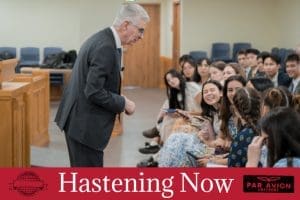
Elder Dale G. Renlund, speaking with his wife Ruth, and daughter Ashley, at the opening session of Rootstech Family Discovery Day, strengthened an apostolic challenge that has been given for the past two years.
Elder Neil L. Andersen challenged the youth two years ago, “Prepare as many names for the temple as baptisms you perform in the temple.” Then last year the challenge was strengthened to add this phrase: “and help someone else to do the same.”
Elder Renlund further beefed up the challenge and issued it to all, “Prepare as many names for the temple as ordinances you perform in the temple and teach others to do the same.”
If you do this, he said, blessings will flow to your family. You’ll find not only protection from the temptation and ills of this world but also power to change, power to repent, power to be sanctified, power to learn, power to bind your family together and heal that which needs healing.
Then he invited all to share their experiences on his Facebook page using #templechallenge as the hashtag.
The real power of family history and temple ordinances comes from combining the two together. Elder Renlund told a personal story to demonstrate why this matters so much.
In 1912, when there were only 756 missionaries in the whole world, a group from Sweden went to Larsmo, a small island off the coast, where they taught Elder Renlund’s grandparents Lena Sofia and Leander. They were baptized the next day and became members of the first branch in Finland.
Yet life was tough, and in 1917 Leander died of tuberculosis when Sofia was pregnant with their tenth child. She was an impoverished, peasant woman, who had to struggle to keep her family intact. He said, “For nearly two decades, she did not get a good night’s rest. She hustled at odd jobs during the day to scrape together enough food to eat. At night, she nursed dying family members.”
 In 1963, Elder Renlund’s father, a native of Finland who had immigrated to Salt Lake City, returned as a building missionary and took his family with him. It was during that visit he first met his grandmother. “I had just turned 11 and she was 87. She was stooped from a lifetime of hard labor. She was so bowed over that when she stood from her chair, her height did not change. The skin of her face and hands was weather-beaten, as tough and textured as worn leather. She stood as best she could and pointed to a photo of Leander on the wall and said to me, in Swedish, ‘Det här är min gubbe’—this is my hubby.”
 Elder Renlund, who had been studying Swedish at school, thought she had made a mistake in tense. Shouldn’t this be “This was my hubby”?
Of course, with time, he came to understand that she had made no mistake at all. She had a gospel perspective that had strengthened her all her difficult days. He said, “Lena Sofia knew that her long-dead husband was and would remain hers throughout the eternities. Through the doctrine of eternal families, Leander remained a presence in her life and part of her great hope for the future.”
He said, “In a blazing affirmation of her faith in the sealing authority, in 1938 Lena Sofia submitted the family records for her deceased children who were over 8 years of age when they died,” said Elder Renlund. “That way, their temple work could be performed, although she herself would not get to the temple during her lifetime.”
She was one of those described in Hebrews 11:13 who“died in faith, not having received the promises, but having seen them afar off, and were persuaded of them, and embraced them,”
Shortly after her death in 1966, Mariana, mother of Elder Renlund and daughter-in-law of Lena Sofia, took her name to the Genealogy Department of the Church. “The man behind the counter told her that Church policy stated that someone had to have been dead for at least a year before temple work could be done for that person,” Sister Ashley Renlund said. Grandma replied, ‘I don’t like that answer. Let me talk to someone who can give a different one. She’s waited long enough.’’
Mariana’s husband quipped, “I should probably feel sorry for the man downtown who said nothing could be done for at least a year.”
Elder Renlund’s mother was determined that Lena Sofia would receive those ordinances for which she had yearned her entire and difficult life. It worked. Less than two months later and with the authorization of the President of the Church, Lena Sofia’s temple work was completed. Now it is Church policy that a person who hasn’t been able to enjoy the blessings of the temple because of the distance doesn’t have to wait a whole year after their death for their ordinances to be completed. They have indeed waited long enough!
Elder Renlund and his family compared the power of combining family history and temple work with dynamite. Up until the mid 1800’s, black powder was the most powerful explosive in the world. It was regularly stable and safe.
Yet it didn’t have the potential that was soon to be found in a pure chemical compound called nitro-glycerin which could blast through mountains creating tunnels and mines. Still, nitro-glycerin had a terrible drawback. If it was dropped, it would blow up. It if got too cold, it would blow up. If it got too hot, it would blow up. If it was dropped, it would blow up. If it was put on a shelf and left alone in perfect circumstances, eventually it would blow up.
The only way to harness the full power of the nitro-glyerin was to couple it with Kieselguhr, a stabilizer. Together the two substances create dynamite, a tool that completely changed the world. “Dynamite wasn’t the discovery of a new material, but it involved putting two known materials together to make them safer, more effective, and more useful.”
 Family history and temple work are each powerful, but combined they are like the image described in Ezekiel 47 of a river flowing forth from the temple that grows larger and larger and heals everything in its path.
“The growth of the river is similar to the exponential growth of our family through the generations,” said Elder Renlund. “The Lord has a plan to overcome Lena Sofia’s personal misfortune, our loss, your tragedy, in fact everyone’s calamity. He restored to the earth His priesthood and His sealing authority. Lena Sofia knew that.”
The Testimony of the Three New Apostles + Memes


The three new apostles were asked to bear their testimonies in the Sunday morning session of General Conference. They spoke of how they were called, their sense of inadequacy and their witness of the Savior. Share the accompanying memes on your Facebook and other social media pages.

Ronald A. Rasband
Of the Quorum of the Twelve
A few days ago I had the great privilege to meet with the First Presidency and receive this call from our dear Prophet, President Thomas S Monson. I want to witness to all of you of the strength and love of President Monson as he said to me, “this call comes from the Lord Jesus Christ.”
I am overwhelmed, and shaken to my very core to consider the import and significance of those words so tenderly spoken by our loving Prophet. President Monson I love you and your counselors, and will serve the Lord and you, with all of my heart, might, mind and strength…
If I could leave one small message with you today it would be this; The Lord has said, “Love one another; as I have loved you.” I’m confident that there is no choice, sin, or mistake that you or anyone else can make that will change His love for you or for them. That does not mean He excuses or condones sinful conduct; l’m sure He does not; but, it does mean we are to reach out to our fellowman in love to invite, persuade, serve, and to rescue. Jesus Christ looked past people’s ethnicity, rank, and circumstances in order to teach them this profound truth.
I have been asked many times when did I receive my testimony.
I can’t remember not believing in Heavenly Father and Jesus Christ. I have loved them since I learned of them at the knees of my angel mother reading scripture and gospel stories. That early belief has now grown into a knowledge and witness of a Loving Heavenly Father who hears and answers our prayers. My testimony of Jesus Christ has been built from many special experiences where I have come to know His great love for each one of us. I’m grateful for our Savior’s Atonement and wish like Alma to shout it with the trump of an Angel.

Fullness of Times
Elder Gary E. Stevenson
Of the Quorum of the Twelve
And so it was on Tuesday morning of this week, just after 9:00 am as the Bishopric was beginning a meeting with the Asia Area Presidency, who are here for conference, that I was called to meet with President Monson, along with his counselors. Moments later, as I walked into the board room, adjacent to his office, I must have looked nervous sitting across the table, as he kindly spoke to calm my nerves. He commented, noting my age, that I seemed quite young, and even looked younger than my age.
Then, within a few moments, President Monson described that acting on the will of The Lord, a call to the Quorum of the Twelve was being extended to me. He asked me if I would accept this call, to which, following what I am sure was a very undignified audible gasp, in complete shock, I responded affirmatively. And then, before I could even verbalize a tsunami of indescribable emotion, most of which were feelings of inadequacy.
President Monson kindly reached out to me, describing how he was called many years ago as an apostle, by President David O. McKay, at which time he too felt inadequate. He calmly instructed me, “Bishop Stevenson, the Lord will qualify those whom he calls.” These soothing words of a prophet, have been a source of peace, a calm in a storm of painful self-examination and tender feelings in ensuing agonizing hours which have passed day and night since then…
I stand before you, as evidence of the words of the Lord recorded in the first section of the Doctrine and Covenants, “that the fullness of the gospel might be proclaimed by the weak and simple unto the ends of the world and before kings and rulers.” These words are proceeded by the Lord’s declaration which demonstrates the Love of a Father for his children, “Wherefore I the Lord, knowing the calamity which should come upon the inhabitants of the earth, called upon my servant Joseph Smith, Jun., and spake unto him from heaven; and gave him commandments.”
Our loving Heavenly Father and His Son Jehovah, with a knowledge of the end from the beginning, opened the heavens and a new dispensation to offset the calamities that They knew would come. The Apostle Paul described the forthcoming calamities as “perilous times.” For me this suggests that Heavenly Father’s generous compensation for living in perilous times is that we also live in the fullness of times.
As I agonized over my inadequacies this wee, I received a distinct impression which both chastened and comforted me: to focus not on what I can’t do, but rather on what I can do. I can testify of the plain and precious truths of the gospel.
These are words which I have shared hundreds of times with both those who belong to the Church and many who are not members: “God is our Heavenly Father. We are his children…He weeps with us when we suffer and rejoices when we do what is right. He wants to communicate with us and we can communicate with him through sincere prayer…Heavenly Father has provided us, His children, with a way to…return to live in His presence. Central to our Heavenly Fathers plan is Jesus Christ’s Atonement.”
Heavenly Father sent His Son to the earth to atone for the sins of all mankind and overcome death: “For God so loved the world, that he gave his only begotten Son.”

Through God’s Eyes
Elder Dale G. Renland
Of the Quorum of the Twelve
My call gives ample evidence to the truthfulness of the Lord’s statement early in this dispensation, “that the fulness of my gospel might be proclaimed by the weak and the simple unto the ends of the world…” I am one of those weak and simple.
When I was called to be the bishop of a ward in the eastern United States, my brother, slightly older and much wiser than I, called me on the phone. He said, “You need to know that the Lord hasn’t called you because of anything you have done. In your case, it is probably in spite what you have done. The Lord has called you for what He needs to do through you and that will only happen if you do it His way.” I recognize that this wisdom from an older brother applies even more today. In my past profession, I was a cardiologist specializing in heart failure and transplantation. Since many patients were critically ill, I saw many people die. My wife jokingly says that it was a bad prognostic sign to become one of my patients. Because of my experience with this patient population, I developed a kind of emotional distance when things went poorly. That way, feelings of sadness and disappointment were tempered.
In 1986, a young man named Chad developed heart failure and needed a heart transplant. He did very well for a decade and a half. Chad did all he could to stay healthy and live as normal a life as possible. He served a mission, worked, and was a devoted son to his parents. The last few years of his life, though, were challenging and he was in and out of the hospital frequently.
One evening, he was brought to the hospital’s emergency room in full cardiac arrest. My associates and I worked for a long time to restore his circulation. Finally, it became clear that Chad could not be revived. We stopped our futile efforts and I declared him dead. Although sad and disappointed, I thought to myself, “Chad has had good care. He has had many more years of life than he otherwise would have had.” That emotional distance was shattered, though, as his parents came into the emergency room bay and saw their deceased son lying on a stretcher. For the first time, I saw Chad through his mother’s and father’s eyes. I saw the great hopes and expectations they had had for him, the desire they had that he would live just a little bit longer and a little bit better. With this realization, I began to weep. In an ironic reversal of roles and in an act of kindness I will never forget, Chad’s parents comforted me.
I now realize that to effectively serve others, we must see them through a parent’s eyes, through Heavenly Father’s eyes. Only then can we begin to comprehend the true worth of a soul. Only then can we sense the love that Heavenly Father has for all of His children. Only then can we sense the Savior’s caring concern for them. We cannot completely fulfill our covenant obligation to mourn with those that mourn and comfort those who stand in need of comfort unless we see them through God’s eyes. This expanded perspective will open our hearts to others’ disappointments, fears, and heartaches. But, Heavenly Father will aid and comfort us, just as Chad’s parents comforted me in the emergency room years ago. We need to have eyes that see, ears that hear, and hearts that know and feel if we are to accomplish the rescue so frequently encouraged by President Thomas S. Monson.
Only when we see through Heavenly Father’s eyes can we be filled with “the pure love of Christ.” Every day we should plead with God for this charity. Mormon admonished: “Wherefore, my beloved brethren, pray unto the Father with all the energy of heart, that ye may be filled with this love, which he hath bestowed upon all who are true followers of his Son, Jesus Christ…”
With all my heart I want to be a true follower of Jesus Christ. I love Him. I adore Him. I witness of His living reality. I witness that He is the “Anointed One,” the Messiah. I am a witness of His incomparable mercy, compassion, and love.
FEATURES