



How Did Lehi Know That Adam and Eve Could Have Had No Children Before the Fall? Mother Eve’s Statement May Be the Answer

In Lehi’s magnificent speech near the end of his life in 2 Nephi 2, he makes a statement that has puzzled some Latter-day Saints such as my wife, Kendra Lindsay. If Adam had not fallen, “they would have had no children.” While this answers a long-standing debate about whether or not our first parents could have had children while in the Garden of Eden, the puzzle is how did Lehi know this? He does not state that he has received new revelation on this point, nor does he offer arguments to explain why this was so. He simply states it as a fact, as if it were something we should already know. But how?
Fortunately, Lehi gives us an important clue in this portion of his speech as he discusses the fall of Satan and the fall of man. Let’s begin with 2 Nephi 2:17:
And I, Lehi, according to the things which I have read, must needs suppose that an angel of God, according to that which is written, had fallen from heaven; wherefore, he became a devil, having sought that which was evil before God.
So he’s obviously referring to the scriptures. As we see in the verses that follow, it must be Genesis with its details about Satan through the serpent tempting Adam and Eve, leading to their fall and expulsion from the Garden. But the version of Genesis Lehi uses is obviously not the same version we have today. His version discusses the fall of Satan from heaven and calls him the serpent, as if he were the one tempting Adam and Eve, not a snake acting on his own.
Further, his version seems to add information about our free agency and contains a prophecy about the Messiah coming in the fullness of time to redeem us from the fall, for all these things are added in a continuous sequence as if he were still relaying written information he had recently read. Only in v. 28 does he signal a shift away from his midrash (as my wife calls it) on his version of Genesis to speak his thoughts to his sons.
For those who have been following some recent work on the connections between the Book of Moses and the Bookve of Mormon, it may come as no surprise to learn that a potentially plausible source for Lehi’s statement is found in Mother Eve’s words quoted in a text that may have been in a Brass Plates version of Genesis that is closely related to our Book of Moses. Her words are given in Moses 5:11, but let’s consider the context beginning with v. 9:
9 And in that day the Holy Ghost fell upon Adam, which beareth record of the Father and the Son, saying: I am the Only Begotten of the Father from the beginning, henceforth and forever, that as thou hast fallen thou mayest be redeemed, and all mankind, even as many as will.
10 And in that day Adam blessed God and was filled, and began to prophesy concerning all the families of the earth, saying: Blessed be the name of God, for because of my transgression my eyes are opened, and in this life I shall have joy, and again in the flesh I shall see God.
11 And Eve, his wife, heard all these things and was glad, saying: Were it not for our transgression we never should have had seed, and never should have known good and evil, and the joy of our redemption, and the eternal life which God giveth unto all the obedient.
Lehi did not know what factors made Eve certain of this, but she as a woman certainly knew.
Now let’s consider the context of Lehi’s statement, which shows extensive connections with the Book of Moses, as if something like it were on the Brass Plates.Here is 2 Nephi 2:17-28:
17 And I, Lehi, according to the things which I have read, must needs suppose that an angel of God, according to that which is written, had fallen from heaven; wherefore, he became a devil, having sought that which was evil before God.
18 And because he had fallen from heaven, and had become miserable forever, he sought also the misery of all mankind. Wherefore, he said unto Eve, yea, even that old serpent, who is the devil, who is the father of all lies, wherefore he said: Partake of the forbidden fruit, and ye shall not die, but ye shall be as God, knowing good and evil.
19 And after Adam and Eve had partaken of the forbidden fruit they were driven out of the garden of Eden, to till the earth.
20 And they have brought forth children; yea, even the family of all the earth.
21 And the days of the children of men were prolonged, according to the will of God, that they might repent while in the flesh; wherefore, their state became a state of probation, and their time was lengthened, according to the commandments which the Lord God gave unto the children of men. For he gave commandment that all men must repent; for he showed unto all men that they were lost, because of the transgression of their parents.
22 And now, behold, if Adam had not transgressed he would not have fallen, but he would have remained in the garden of Eden. And all things which were created must have remained in the same state in which they were after they were created; and they must have remained forever, and had no end.
23 And they would have had no children; wherefore they would have remained in a state of innocence, having no joy, for they knew no misery; doing no good, for they knew no sin.
24 But behold, all things have been done in the wisdom of him who knoweth all things.
25 Adam fell that men might be; and men are, that they might have joy.
26 And the Messiah cometh in the fulness of time, that he may redeem the children of men from the fall. And because that they are redeemed from the fall they have become free forever, knowing good from evil; to act for themselves and not to be acted upon, save it be by the punishment of the law at the great and last day, according to the commandments which God hath given.
27 Wherefore, men are free according to the flesh; and all things are given them which are expedient unto man. And they are free to choose liberty and eternal life, through the great Mediator of all men, or to choose captivity and death, according to the captivity and power of the devil; for he seeketh that all men might be miserable like unto himself.
28 And now, my sons, I would that ye should look to the great Mediator, and hearken unto his great commandments; and be faithful unto his words, and choose eternal life, according to the will of his Holy Spirit;
So what text is he working with in this midrash? It’s not our version of Genesis, but to use a term from Noel Reynolds, it could be a Brass Plates version of Genesis with remarkable similarities to our own Book of Moses, which was the first part of Joseph Smith’s translation of the Bible, related to Genesis 1 to 6:13. Noel Reynolds is the scholar who opened our eyes to the possibility of intricate connections between the Book of Moses and the Book of Mormon as if something like the Book of Moses were on the Brass Plates.
In his 1990 article, “The Brass Plates Version of Genesis,” he identified 33 parallels from a computer search linking the two texts, but sometimes with an evident “one-way direction of influence” from the Book of Moses to the Book of Mormon, as if the Book of Moses had concentrated passages of influence that affected multiple voices in the Book of Mormon, but with the Book of Moses serving as the logical source or backstory alluded to in the Book of Mormon.
Reynolds and I later collaborated in identifying many more parallels with added explanatory power and further evidence of one-way influence in a 2021 article, “‘Strong Like unto Moses’: The Case for Ancient Roots in the Book of Moses Based on Book of Mormon Usage of Related Content Apparently from the Brass Plates.” This was followed by “Further Evidence from the Book of Mormon for a Book of Moses-Like Text on the Brass Plates” in 2024 and a two-part article in 2025, “Parallels between the Book of Moses and the Book of Mormon,” with Part 1 examining the distribution of the parallels, the relationship to the rest of the JST, and other issues, while Part 2 offered more new and updated parallels in a list of 146 at the time. Since then the number of proposed parallels has grown to 186 in a regularly updated table provided at both AriseFromtheDust.com and JeffLindsay.com.
The quoted passage from 2 Nephi 2, where Lehi appears to be referring to a scriptural text that taught him about the fall of Satan and details of Adam and Eve, contains multiple parallels to the Book of Moses, including the following (parallels with the King James version of Genesis are excluded):
- Satan fell from heaven and became the devil (Moses 4:1-4)
- The devil is “the father of all lies” (Moses 4:4)
- The devil seeks our misery (Moses 7:37, 41; cf. Moses 4:3, 6)
- Without the Fall, Adam and Eve could have had no joy (Moses 5:10-11)
- Adam and Eve could not have had children prior to the Fall (Moses 5:11)
- We have free agency (cf. 2 Nephi 2:16) (Moses 4:3, 6:56)
- We can be redeemed from the Fall (Moses 5:9)
- Adam fell that men might be (Moses 6:48)
- The transgression of Adam and Eve brought the Fall and death (Moses 6:59)
- God calls on all men to repent (Moses 5:14, 6:23, cf. Moses 6:1, 50)
- Christ would come in the “meridian of time”/“fulness of time” (Moses 5:57, 6:57, 62, 7:46 — see the explanation in “Reflections on ‘the Meridian of Time’”)
- God’s knowledge of “all things” combined with wisdom (Moses 6:61, with respect to 2 Nephi 2:24)
- We can choose eternal life (Moses 1:39, 5:11, 6:59, 7:45)
In fact, Lehi, the student par excellence of the Brass Plates, seems to have the highest density of parallels to the Book of Moses in the Book of Mormon in 2 Nephi 2, many of which are found in the passage that begins with 2 Nephi 2:17, where he explicitly refers to what he has been learning from the scriptures (the Brass Plates). That passage resembles a midrash on the Book of Moses, and reflects the reality that something like the Book of Moses was a source of knowledge for Lehi that deeply mattered to him.
His midrash points us to a beautiful answer to an appropriate question for Mother’s Day: How did Lehi know that Adam and Eve could have no children before the Fall?
The answer is simple: marvelous Eve knew, and she said so in an ancient record similar to our Book of Moses that Lehi studied on the Brass Plates.
Reflections on “the Meridian of Time”

From the editors: When we formulated the idea of a magazine for Latter-day Saints, we wanted just the right name that would have our purpose in its meaning. We wanted a name that invited excellence and illumination, and so we chose Meridian. We knew that it meant the highest point of light in one sense and a measure of the world in another. Author Jeff Lindsay is on the same wavelength in this article.
Readers of Meridian Magazine may have thought about the meaning of “meridian” in the scriptures. There’s an interesting range of possibilities and a puzzle or two to ponder.
Four times the Book of Moses uses an extremely rare English term, “the meridian of time,” to describe the time when Christ would come:
For they would not hearken unto his voice, nor believe on his Only Begotten Son, even him whom he declared should come in the meridian of time, who was prepared from before the foundation of the world. (Moses 5:57)
Wherefore teach it unto your children, that all men, everywhere, must repent, or they can in nowise inherit the kingdom of God, for no unclean thing can dwell there, or dwell in his presence; for, in the language of Adam, Man of Holiness is his name, and the name of his Only Begotten is the Son of Man, even Jesus Christ, a righteous Judge, who shall come in the meridian of time. (Moses 6:57)
And now, behold, I say unto you: This is the plan of salvation unto all men, through the blood of mine Only Begotten, who shall come in the meridian of time. (Moses 6:62)
And it came to pass that Enoch looked; and from Noah, he beheld all the families of the earth; and he cried unto the Lord, saying: When shall the day of the Lord come? When shall the blood of the Righteous be shed, that all they that mourn may be sanctified and have eternal life?
And the Lord said: It shall be in the meridian of time, in the days of wickedness and vengeance.
And behold, Enoch saw the day of the coming of the Son of Man, even in the flesh; and his soul rejoiced, saying: The Righteous is lifted up, and the Lamb is slain from the foundation of the world; and through faith I am in the bosom of the Father, and behold, Zion is with me. (Moses 7:45–47)
We first consider relevant meanings of “meridian.” Linguist Stanford Carmack kindly sent me some definitions and examples of use from the extensive Oxford English Dictionary, 2nd edition:
2.2 The point at which the sun or a star attains its highest altitude.
c1450 Lydg. Secrees 347 Phebus‥In merydien fervent as the glede.1647 Crashaw Poems 130 Sharp-sighted as the eagle’s eye, that can Outstare the broad-beam’d day’s meridian.a1667 Cowley Ess., Greatness, There is in truth no Rising or Meridian of the Sun, but only in respect to several places.1728 Pope Dunc. iii. 195 note, The device, A Star rising to the Meridian, with this Motto, Ad Summa.1843 James Forest Days viii, The sun had declined about two hours and a half from the meridian.
b.2.b fig. The point or period of highest development or perfection, after which decline sets in; culmination, full splendour.
1613 Shakes. Hen. VIII, iii. ii. 224 And from that full Meridian of my Glory, I haste now to my Setting.1638 Sir T. Herbert Trav. (ed. 2) 93 Yet in the meridian of his hopes [he] is dejected by valiant Rustang.c1645 Howell Lett. (1655) III. ix. 17 Naturall human knowledg is not yet mounted to its Meridian, and highest point of elevation.1673 Temple United Prov. Wks. 1731 I. 67, I am of Opinion, That Trade has, for some Years ago, pass’d its Meridian, and begun sensibly to decay among them. 1700 Dryden Fables Pref. *Bb, Ovid liv’d when the Roman Tongue was in its Meridian; Chaucer, in the Dawning of our Language. a1761 Cawthorn Poems (1771) 61 My merit in its full meridian shone.a1859 Macaulay Hist. Eng. xxiii. (1861) V. 67 This was the moment at which the fortunes of Montague reached the meridian. The decline was close at hand.1893 G. Hill Hist. Eng. Dress II, 268 Dress was in its meridian of ugliness.
c.2.c The middle period of a man’s life, when his powers are at the full.
c1645 Howell Lett. i. vi. lx. (1655) 307 You seem to marvell I do not marry all this while, considering that I am past the Meridian of my age.1703 E. Ward Lond. Spy xvii. (1706) 406 As for her Age, I believe she was near upon the Meridian.1795 Mason Ch. Mus. ii. 133 When Purcel was in the meridian of his short life.1864 H. Ainsworth John Law Prol. iii. (1881) 19 Though long past his meridian, and derided as an antiquated beau by the fops of the day.1873 Hamerton Intell. Life iv. ii. (1875) 143 Any person who has passed the meridian of life.
The origins of the word “meridian” are explained at Etymology Online:
mid-14c., “noon, midday,” from Old French meridien “of the noon time, midday; the meridian; a southerner” (12c.), and directly from Latin meridianus “of midday, of noon, southerly, to the south,” from meridies “noon, south,” from meridie “at noon,” altered by dissimilation from pre-Latin *medi die, locative of medius “mid-” (from PIE root *medhyo- “middle”) + dies “day” (from PIE root *dyeu- “to shine”).
The cartographic sense of “a great circle or half-circle of a sphere passing through the poles” is attested from late 14c., originally astronomical. Figurative uses tend to suggest “point of highest development or fullest power,” implying a subsequent decline. [emphasis added]
“Meridian” is thus related to noon, the high point of time, the time of greatest light, with the figurative sense of fullest light or divine power, after which there would be a decline. While it has sometimes been understood as a chronological midpoint in 7,000 years of sacred history, it may be fruitful to consider more figurative meanings such as a high point, a time of fulness in power and authority, etc.
A Parallel to “the Meridian of Time” in the Book of Mormon?
One of the surprising things about the Book of Moses is that numerous passages in the small book are reflected in the Book of Mormon, sometimes with precisely matching language or language expressing related concepts, often with a common context – without being readily explained by an appeal to the King James Bible.
This possibility was first raised by Noel B. Reynolds in 1990 in “The Brass Plates Version of Genesis” where thirty-three parallels were found, including several that pointed to an unexpected direction of influence from the Book of Moses to the earlier translated Book of Mormon — a surprise that led Reynolds to hypothesize that a text related to our Book of Moses may have been on the brass plates.
In collaboration with Reynolds, that work was expanded in 2021 in “‘Strong Like unto Moses’: The Case for Ancient Roots in the Book of Moses,” bringing the number of proposed parallels up to ninety-six. In 2024, “Further Evidence from the Book of Mormon for a Book of Moses-Like Text on the Brass Plates” raised the number to 133, and then a project looking at statistics and the distribution of parallels further raised the number to 146 in a 2025 two-part publication (see Part 1 and Part 2 at Interpreter: A Journal of Latter-day Saint Faith and Scholarship).
Currently there are 162 proposed parallels. (The list is published at and will continue to be updated as needed at both AriseFromTheDust.com and JeffLindsay.com.) With that many parallels and with many of them occurring in multiple places in the Book of Mormon, 10.2% of the verses of the Book of Mormon (after excluding the chapters from the Bible that are essentially quoted in the Book of Mormon) are involved in one or more parallels with the Book of Moses.
That average of 10.2% comes from a highly non-uniform distribution, with parallels being nearly twice as frequent in the small plates text (15.8%) as in the remainder of the Book of Mormon (8.67%). The non-uniform distribution may in part be due to the high familiarity with the brass plates of early prophets such as Lehi, Nephi, and Jacob. On the other hand, in Mormon’s writings in his book of Mormon, the number is just under 4.0%.
A recently proposed and still tentative parallel, #162, involves the coming of Christ in the “meridian of time.” But how can this be a parallel when the Book of Mormon does not use the term “meridian of time” or even the word “meridian” at all? In this case, the parallel is not based on identical language but on semantically related language.
In light of the dictionary definitions and etymology of “meridian” discussed above, I propose that the “meridian of time” may be tantamount to “the fulness of time” used by Lehi twice in 2 Nephi 2 and by Nephi in 2 Nephi 11:
Wherefore, thy soul shall be blessed, and thou shalt dwell safely with thy brother, Nephi; and thy days shall be spent in the service of thy God. Wherefore, I know that thou art redeemed, because of the righteousness of thy Redeemer; for thou hast beheld that in the fulness of time he cometh to bring salvation unto men. (2 Nephi 2:3)
And the Messiah cometh in the fulness of time, that he may redeem the children of men from the fall. And because that they are redeemed from the fall they have become free forever, knowing good from evil; to act for themselves and not to be acted upon, save it be by the punishment of the law at the great and last day, according to the commandments which God hath given. (2 Nephi 2:26)
For if there be no Christ there be no God; and if there be no God we are not, for there could have been no creation. But there is a God, and he is Christ, and he cometh in the fulness of his own time. (2 Nephi 11:7)
Nephi appears to be reciting Lehi’s words, not just in using a phrase similar to “the fulness of time” but also Lehi’s words: “And if these things are not there is no God. And if there is no God we are not, neither the earth; for there could have been no creation of things” (2 Nephi 2:13).
Lehi’s phrasing may have other connections to the Book of Moses to consider. In 2 Nephi 2:3, Lehi includes the term “salvation” in “in the fulness of time he cometh to bring salvation unto men,” related to “This is the plan of salvation unto all men” in Moses 6:62 (Parallel 13).
Further, 2 Nephi 2:3 also includes “dwell safely,” perhaps influenced by another parallel with the Book of Moses, Parallel 93, “Dwell in safety forever,” involving Moses 7:20 and 2 Nephi 1:9.
Lehi’s words in 2 Nephi 2:26 include “to act for themselves and not to be acted upon,” which involve Parallel 125, “Agents unto themselves” with Moses 4:3 and 6:56, coupled with 2 Nephi 2:26, 10:23; Alma 12:13; and Helaman 14:30.
Connections to the Book of Moses are also evident in the adjacent verses around 2 Nephi 2:26, as shown with inline annotations:
Adam fell that men might be; and men are, that they might have joy [Parallel 144: “Adam fell that men/we might be” with Moses 6:48]. (2 Nephi 2:25)
Wherefore, men are free according to the flesh; and all things are given them which are expedient unto man. And they are free to choose liberty and eternal life [with v. 28, part of Parallel 14, “eternal life” with Moses 1:39] , through the great Mediator of all men, or to choose captivity and death, according to the captivity and power of the devil [with v. 29, part of Parallel 9, “devil-lead-captive-his will” with Moses 4:4]; for he seeketh that all men might be miserable like unto himself [with vv. 5, 11, 13, 18, and 23, part of Parallel 44, “Misery (either for Satan or his followers)”]. (2 Nephi 2:27)
2 Nephi 2 is one of the richest in the Book of Mormon for parallels with the Book of Moses. In terms of parallels per 1,000 words, it is essentially tied with Ether 8 for the most parallel-rich chapter (Ether 8 is rich in parallels pertaining to secret combinations, but lacks the thematic diversity of Lehi’s speech). Thirteen different parallels are found in its 30 verses, involving seventeen verses, seven of which have more than one parallel.
Lehi’s heavy use of Book of Moses-related material (material not easily explained by an appeal to the KJV Bible) in this chapter increases the likelihood that the reference to the time of the coming of the Messiah might have been influenced by the Book of Moses, even though “the meridian of time” was used in the English translation of the Book of Moses instead of “the fulness of time.”
Time(s) and Fulness in the New Testament
The parallel involving Lehi’s “fulness of time” and the Book of Moses is weakened by similar but not identical language in the New Testament that must be considered. While New Testament language would not have been available to influence Nephi or Lehi, it could have influenced Joseph Smith if or when the choice of wording was his, and likewise could have influenced the choice of English given to Joseph Smith in the translation process (e.g., it could have influenced wording choice by a hypothetical angelic agent assisting in the translation, if such were part of the translation process). Galatians 4:4 speaks of “the fulness of the time”:
But when the fulness of the time was come, God sent forth his Son, made of a woman, made under the law, . . .
“Fulness of the time” conveys an important difference relative to Lehi’s phrasing. It points to a specific time, with the concept of fully reaching a specific moment in time rather than an era that is the zenith of time or history. The Greek word chronos is used here for time, referring to a specific time, a chronological event. The New International Version of the Bible (NIV) has “when the set time had fully come,” while the New English Translation (NET) has “when the appropriate time had come.” Without the definite article before “time,” Lehi’s “fulness of time” seems more analogous to “the meridian of time.”
The other New Testament verse to consider is one often heard in Latter-day Saint discourse, Ephesians 1:10:
That in the dispensation of the fulness of times he might gather together in one all things in Christ, both which are in heaven, and which are on earth; even in him:
This is still slightly different from Lehi’s “fulness of time.” This verse is not about the time of Christ’s mortal ministry, nor about a precise time per se, but about a dispensation. The phrase “fulness of times” in this context may point to the completion of history or the culmination of time (or of multiple eras) when everything is finally put under Christ and united. Latter-day Saints generally understand our current era, called the “dispensation of the fulness of times,” to be the culminating era in the “last days” before the Second Coming of the Lord, preparing the world for the great Millennium.
Paul’s use of the term “dispensation” (sometimes translated as “administration”) can refer to the administrative era of the Restoration when authority and apostolic organization have been restored and the work of gathering begins in earnest, preparing mankind for the Millennium.
The era of “dispensation of the fulness of times,” a phrase used several times in the Doctrine and Covenants (see Doctrine & Covenants 27:13, 76:106, 112:30, and 124:41) can be considered to point to the era of the Restoration in the last days leading up to the Millennium. This need not be the same time as “the fulness of times” itself, as we glean from Doctrine and Covenants 76:106, referring to the punishment of the impenitent wicked:
These are they who are cast down to hell and suffer the wrath of Almighty God, until the fulness of times, when Christ shall have subdued all enemies under his feet, and shall have perfected his work.
In summary, “the dispensation of the fulness of times” begins with the Restoration and leads to the Millennium, while the “fulness of times” itself can point to the final completion of mortal time at the end of the Millennium when Christ has conquered all. But this is an entirely different issue than what Lehi refers to with “the fulness of time” when Christ shall come as a mortal to earth.
Neither of the two New Testament passages can adequately serve as the source for concepts and language in the Book of Mormon verses about the coming of Christ in “the fulness of time.” Thus, in spite of the overlapping New Testament language that weakens the parallel, it is still offered tentatively as a possible conceptual parallel for consideration.
More Puzzles: The Rarity of “Meridian of Time” and Its Presence in Doctrine & Covenants
A puzzling aspect of this inquiry into a potential parallel is how rare “meridian of time” is in English. Searching Google Books reveals no instances of this term before 1870 (obviously missing many Latter-day Saint publications). However, there are two instances of use in the Early Modern English Era, which ran from roughly the late 1500s to about 1700. For example, Sir Thomas Browne (1605-1682) wrote Hydriotaphia, urne-buriall, or, a discourse of the sepulchrall urnes lately found in Norfolk, published in 1658, accessible via Early English Books Online, which has this passage:
… even old ambitions had the advantage of ours, in the attempts of their vain-glories, who acting early, and before the probable meridian of time, have by this time found great accomplishment of their ddsignes [designs], whereby the ancient heroes have already out-lasted their monuments, and Mechanicall preservations: but in this latter scene of time we can not expect such mummies unto our memories, when ambition may fear the prophecy of elias that the world may last but fix [six] thousand years…
This does not seem to involve the coming of Christ, but about a future time — relative to more ancient days — of greater development with respect to the topic of burial urns.
Two more finds were shared with me by linguist Stanford Carmack, whose studies identifying Early Modern English influences on the originally dictated language of the Book of Mormon translation have opened significant new vistas of understanding. The first comes from Joseph Cooper in Misthoskopia, A prospect of heavenly glory for the comfort of Sion’s mourners, written no later than 1699 (the year of Cooper’s death) and published in 1700, roughly at the end of the Early Modern English era:
The good things of this Life, they are only calculated for the Meridian of Time, and do only shine with a borrowed light: So that when Death shall seize upon you, and Judgment overtake you, they will then be gone, and like a Shadow disappear for ever.
This seems to refer to the meridian of one’s mortal life, after which comes decline and death.
A second find also kindly provided by Carmack occurs shortly after the Early Modern English era in Benjamin Bennet (1674–1726), The christian oratory: or, the devotion of the closet (London: S. Chandler, 1725):
The RESOLUTION. ND am I immortal? Doth my Spirit at Death return to God, and exist for ever in a separate State? I wou’d henceforth resolve to live for Eternity, to prepare for my Return: In order to which I resolve Lord, help me by thy Grace to have my Eye fixed on the other World; and, in all my Designs, Undertakings and Ations [Actions], to preserve a constant Reference thither. I wou’d esteem every thing as little, as nothing comparatively, that’s calculated only for the Meridian of Time, that ferveth [serveth] only a present State. I resolve to chuse, prefer, pursue things, as they stand related to Eternity, judging of them by this Mark and Property.
This also refers to one’s fleeting mortal life, contrasting it with the eternal afterlife.
At least these finds may suggest that “the meridian of time” was a part, though perhaps a rare part, of Early Modern English, consistent with Stanford Carmack’s find that the dictated language of the Book of Moses reflects a strong Early Modern English component. This is related to his impressive work on examining the language of the originally dictated text of the Book of Mormon and finding a unique signature of Early Modern English influence that cannot be explained by imitating KJV language or by Joseph’s dialect, but points to elements of Early Modern English that sometimes significantly predate the King James Bible. For a collection of important papers on this topic, see Carmack’s list of publications at Interpreter: A Journal of Latter-day Saint Faith and Scholarship. For his work on the Book of Moses, see his 2021 paper, “The Original English of the Book of Moses and What It Indicates About the Book’s Authorship.” Carmack examined 30 different linguistic categories and compared their traits across the Book of Moses, the Book of Mormon, the King James Bible, Joseph’s early writings, and pseudo-archaic texts that sought to imitate archaic biblical syntax. Carmack’s findings are significant:
Joseph Smith’s native usage can explain 30 percent of Book of Moses usage, pseudo-archaism 44 percent, and King James usage 37 percent. The Book of Mormon, however, is able to account for most of the patterns and forms investigated: 86 percent of them, by this count. (It is possible, of course, to include other features, which would change the percentages somewhat.) But the Book of Mormon falls short of being able to explain a few of the linguistic features mentioned in table 2, most notably the past-tense usage. The few usage issues it cannot explain occur in the early modern period. Indeed, broader early modern usage (most of the time not Joseph Smith’s modern usage) accounts for all the linguistic features. Thus the simplest explanation of the Book of Moses’s English usage would be to adopt an early modern perspective—in other words, that a text showing true early modern sensibility in language use was revealed to Joseph Smith in 1830. [pp. 634–35]
The prominent use of the rare and apparently Early Modern English phrase “meridian of time” in the Book of Moses may be one more factor to consider regarding the linguistic influences on the Book of Moses text. As with the Book of Mormon, the existence of non-KJV Early Modern English in either the Book of Mormon or the Book of Moses is something that scholars did not expect. It is not a conclusion driven by any kind of apologetic agenda. It is based on objective data that may require us to reconsider common and sometimes simplistic assumptions about the translation process(es) related to both texts. Why that influence exists is still a matter of debate, though Early Modern English, especially the kind found in both texts, appears to be well suited to simplifying translation in many languages.
Yet another significant puzzle involves the Doctrine and Covenants, where the rare term “meridian of time” occurs twice, both shown here in context:
That as many as would believe and be baptized in his holy name, and endure in faith to the end, should be saved—
Not only those who believed after he came in the meridian of time, in the flesh, but all those from the beginning, even as many as were before he came, who believed in the words of the holy prophets, who spake as they were inspired by the gift of the Holy Ghost, who truly testified of him in all things, should have eternal life…. (Doctrine and Covenants 20:25–26)
Hearken and listen to the voice of him who is from all eternity to all eternity, the Great I Am, even Jesus Christ—
The light and the life of the world; a light which shineth in darkness and the darkness comprehendeth it not;
The same which came in the meridian of time unto mine own, and mine own received me not. (Doctrine and Covenants 39:1–3)
Section 39 was given in January 1831. According to the timeline for Joseph Smith’s work of his translation of the Bible given by Kent P. Jackson in Understanding Joseph Smith’s Translation of the Bible (Provo, UT: Religious Studies Center, Brigham Young University, and Salt Lake City: Deseret Book, 2022), pp. 3–4, the portion of that project that became the Book of Moses was given between June 1830 and December 30, 1830. Thus, it is logical that the 1831 text of Section 39 would employ a colorful and meaningful phrase from the unique Book of Moses.
The problem is that Section 20, which also uses “the meridian of time,” is based on revelation said to have been given in April 1830, although it was not published until 1835. The generally accepted April 1830 date is well before Joseph Smith began work on his translation of the Bible in June 1830. Was the term “meridian of time” something Joseph picked up from the dictation of the Book of Moses, that was later edited into our Section 20 of the Doctrine and Covenants? Was there a revelatory process associated with Section 20 that brought this term to Joseph’s mind for some reason? Or was “meridian of time” a term from the Book of Lehi in the lost 116 pages of the initial Book of Mormon translation?
While we don’t seem to have original manuscripts from 1830 related to Section 20, there are a few manuscripts prior to the 1835 Doctrine and Covenants that help us better understand the timing of the use of “the meridian of time.” One such source is provided in the Joseph Smith Papers website as “Articles and Covenants, circa April 1830, as Recorded in Gilbert, Notebook [D&C 20].” The Gilbert manuscript does not use “meridian” at all. Here is the passage corresponding to the part of Section 20 that has had “the meridian of time” at least since 1835:
[A]nd that he ascendid into heaven to sit down on the right hand of the Father to reign with Almighty power according to the will of the father that as many as would believe and be baptized in his name & endure in faith to the end should be saved, yea even as many as were before he came in the flesh from the beginning which believed in the words of the holy Prophets which were inspired by the gift of the Holy Ghost which truly testified of him in all things as well as they which should come after which should believe in the gifts & callings of God by the Holy Ghost, which beareth record of the Father & of the son, which father and son and the holy Ghost is one God infinite, eternal without end, Amen. [p. 4, emphasis added]
So in 1831, the relevant revelation had “even as many as were before he came in the flesh” instead of “those who believed after he came in the meridian of time, in the flesh” as we now have in Section 20.
A related manuscript on the Joseph Smith Papers website, “Articles and Covenants, circa April 1830, Symonds Rider Copy [D&C 20],” also contains a copy of the material related to Section 20. It was copied by Symonds Rider in May 1831, again without “the meridian of time.”
Surviving copies of the 1833 Book of Commandments, the publication of which was interrupted by a mob destroying the Church’s printing press, also show that “the meridian of time” had not yet entered what is now Section 20. Like the 1831 copies of the “Articles and Covenants,” it has “even as many as were before he came in the flesh, from the beginning,” with no mention of “the meridian of time.”
However, Chapter 41, with its January 1831 revelation related to our Section 39, has “The same which came in the meridian of time unto my own” in v. 2, the same as our Section 39. It seems plausible that in the final edits made for the 1835 publication, that Section 20 was edited to include its current language with the poetic phrase from the Book of Moses.
Conclusion
The “meridian of time” as used in the Book of Moses may be a particularly appropriate figurative and poetic term for describing the time of Christ’s mortal ministry and the spiritual revolution He brought. This was a meridian or a zenith of history in which the Son of God lived with humans on the earth, founded His church, and completed His infinite work. After the rapid growth of the church, there was decline in both the Old World and the New World that required correction by the Restoration in these last days.
When Lehi spoke of the coming of the Messiah that was to be in the “fulness of time,” his language may have been reflecting a concept he encountered in the brass plates having a version of Genesis closely related to our modern Book of Moses. The four passages there about the coming of Christ in “the meridian of time” may be reflected in Lehi’s related statements in 2 Nephi 2 associating the birth of Christ with “the fullness of time,” where “fullness” has connections to figurative meanings of “meridian,” possibly forming a parallel between the Book of Mormon and the Book of Moses, one of many. Given similar language in the New Testament and the conceptual nature of the parallel, this parallel may be one of the weakest among the 162 proposed so far, but may still be worth considering.
The English translation with “the fullness of time” may reflect word choices by Lehi from his speech, by Nephi in his written record, and by the translation process that gave us the English. When faced with the complex relationships between these inspired and miraculously translated texts, we generally cannot say exactly who intended what and why.
Nevertheless, much can be learned by exploring how similar words and concepts are used elsewhere and considering what that might suggest about the intent of authors or translators, or the depth of meaning in the texts. The word choices in the scriptures are often worth pondering.
Readers of Meridian Magazine may wish to reflect upon the meaning of “meridian” and related concepts in the scriptures, as well as the welcome role this publication plays in bringing more light into these troubled times before the Millennium.
The Temple Hidden in Genesis: Recovering the Sacred Architecture of the Covenant Path
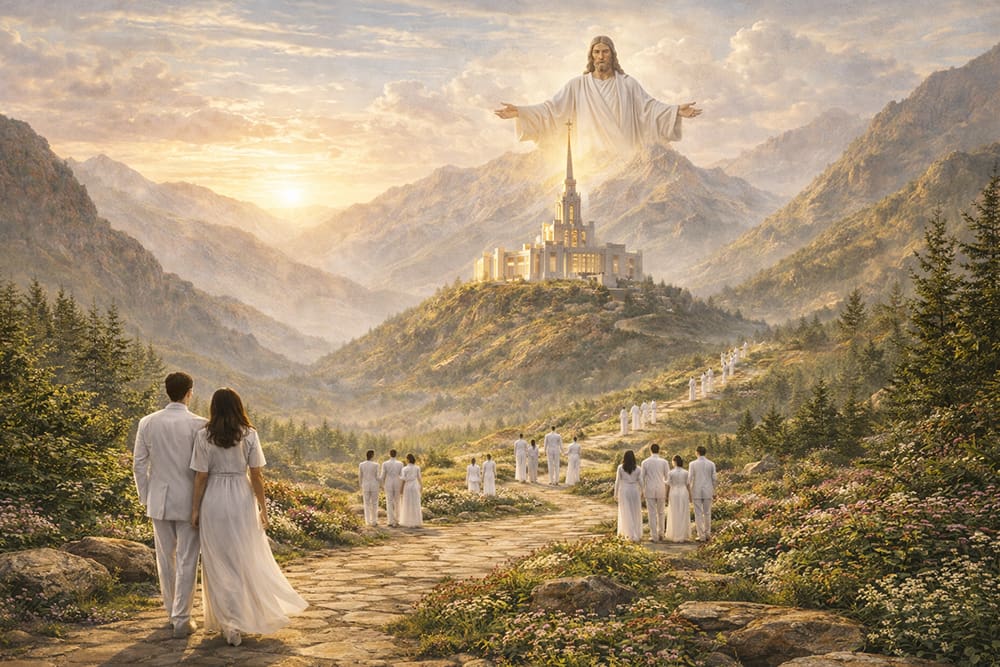
There is a way of reading Genesis that leaves us standing outside the text, admiring its antiquity the way one admires pottery behind museum glass. We note its literary structures, trace its documentary sources, catalog its ancient Near Eastern parallels, and move on—informed, perhaps, but entirely unchanged.
It is the peculiar tragedy of modern scholarship that it keeps immaculate records of things it has never really met. The text becomes a mere object of study: venerable, interesting, and firmly closed. A museum piece is lovely enough, but no one expects the pottery to suddenly speak; scripture, inconveniently for scholars, often does. A text that speaks has already smashed the glass case.

But there is another way of reading, older and stranger and more demanding, which insists that the text is a door rather than a display. The ancient rabbis who divided the Torah into its weekly portions understood this. They called each portion a Parashah, a “section,” but the word carries the scent of an opening up, an exposition. To read the Parashah was to enter it. The words cease to be ink and begin to behave like corridors. It was less like flipping a page and more like pushing open a well-oiled wooden door that creaks just enough to make you wonder what the Almighty is up to.
The God who once walked in gardens is not above meeting us again, even if we show up with dust on our shoes.
So did the early Christians who chanted the creation narrative over catechumens descending into baptismal waters, their bodies quietly doing what the words only dared to say.
And so, increasingly, do Latter-day Saints who recognize in these primordial stories the familiar architecture of their own temple worship—the same promise that the God who once walked in gardens is not above meeting us again, even if we show up with dust on our shoes. Heaven has never minded dust; it minds only distance.
The twelve Parashot of Genesis—from Bereshit to Vayechi—form a liturgical spiral. They trace humanity’s departure from the divine presence and chart the long, covenantal journey home. Read through the lens of restoration scripture, these ancient texts cease to be merely informative. They become transformative—a sacred cartography designed to lead the soul back through the veil and into the face of the Creator.1
The Cosmos as Sanctuary
Parashat Bereshit (Genesis 1:1–6:8)
The opening words of Genesis—Bereshit bara Elohim—have been parsed by grammarians for millennia. But grammar alone cannot account for the hush that falls over the reader who senses what is actually being described: the construction of a cosmic temple.2
The six days of creation follow a pattern that any temple-goer would recognize. Light is sundered from darkness as sacred space is carved out from chaos. Waters are gathered and bounded, echoing the great bronze sea that stood before Solomon’s sanctuary. Vegetation springs forth—the Tree of Life at the center—and luminaries are set in the heavens like the seven-branched menorah, casting their light into the Holy Place.3 It is as if creation begins by switching on the sanctuary lamp.
The temptation, the transgression, and the expulsion are the story of how humanity came to be separated from that sacred center, and how the long road back began.
The Sabbath, then, is no mere pause in labor. It is an enthronement—one in which the King sits down not because He is tired, but because creation is finally tidy enough for company. The Lord takes His seat within the completed sanctuary of the cosmos, and Adam and Eve are placed within the garden-temple as priests, clothed in glory, walking in the cool of the day with their Creator. The garden is the Holy of Holies. The man and woman are its ministers. And the narrative that follows—the temptation, the transgression, the expulsion—is the story of how humanity came to be separated from that sacred center, and how the long road back began.
The Book of Moses amplifies this drama with breathtaking intimacy. What Genesis compresses into spare prose, Moses expands into first-person revelation. The shifts in narrative voice—from “God said” to “I, the Lord God”—suggest what scholars have long suspected: these texts were performed.4
In early Christian baptismal rites, the creation and fall were recited as catechumens descended into the font and emerged, like Adam, into a new world. The text was script. It was the sort of theater where the stagehands are angels, the props are planets, and the audience keeps joining the cast midperformance.5 In such a drama, the surprise is not that the world is a stage but that the stage keeps expanding to fit new apprentices.
The Fall, in this rendering, is an expulsion from sacred space. Adam and Eve pass eastward, away from the Tree of Life, through the cherubim who now guard the way. But they do not leave empty-handed. God Himself clothes them in garments of skin—the first vestments, the original priesthood robes.6 Ancient Jewish sources understood these garments as more than covering for shame. They were investiture. They carried the authority and the promise that the way back would one day be opened.
The philosophers had asked for a Prime Mover; they received a Father with a broken heart.
And within this same Parashah, we encounter Enoch—a figure whose story Genesis barely sketches but whom the Book of Moses reveals in stunning fullness. Enoch sees something that shatters every assumption about divine impassivity: God weeps (see Moses 7:28-37).7
The universe is dry as mathematics until that moment when God, quite against the expectations of philosophers, reaches for a handkerchief. The vision is staggering. Enoch beholds the heavens weeping, the earth weeping, and at the center of it all, the God of heaven weeping over His children who have chosen darkness and imprisonment. “How is it that thou canst weep?” Enoch asks, bewildered.
The answer reorients everything: God’s tears flow because His children suffer. His anguish is not weakness but relation. He is not a distant architect; He is a Father watching His family wander into chains. A deity indifferent to suffering may be tidy, but He is not worth worshipping. This Enochic motif—preserved in ancient traditions and restored in the Pearl of Great Price—transforms the temple into a house of healing.
Heaven is not run by a celestial clerk stamping forms in triplicate; it is a Father flinging open prison doors. They are the means by which God’s tears are answered, by which the prisoners are released, and by which the breach between heaven and earth is finally repaired.
The Ark and the Altar
Parashat Noach (Genesis 6:9–11:32)
Parashat Noach recapitulates creation in reverse. The fountains of the deep burst open. The windows of heaven pour forth. The world returns to the watery chaos from which it was first organized. And in the midst of this un-creation, a single vessel floats: the Ark, with its three decks, its careful measurements, and its cargo of covenant life.
The rabbis noticed what modern readers often miss: the Ark’s dimensions mirror the later Tabernacle. Three levels. Increasing holiness. A microcosm of sacred space, preserving a remnant through the flood until the waters recede and the mountain emerges—the Even ha- Shetiyah, the Foundation Stone, the first solid ground of the new creation.8 The ark is less a boat than a boxedup future. The dove returns with an olive branch, and ancient tradition holds that she retrieved it from the Garden of Eden itself, whose gates had opened for her.9 The olive tree is the Tree of Life in miniature; its oil anoints priests and kings.
Noah’s first act on dry land is to build an altar. The smoke of his offering rises as a “restful smell,” and the Lord establishes His covenant with the sign of the bow in the cloud.10 The pattern is set: departure from the divine presence, preservation through trial, emergence into a renewed world, and the establishment of covenant through sacrifice. Every temple-goer walks this path.
Heaven, apparently, enforces the only building code that Babel consistently failed—humility.
Yet Noach also contains a warning. The builders of Babel seek to “make a name” for themselves, constructing a tower to storm the heavens by their own engineering.11 They are scattered. Their ascent fails because it is unauthorized, born of pride rather than covenant. Heaven, apparently, enforces the only building code that Babel consistently failed—humility.
By contrast, Enoch’s city—Zion—is “taken up” into the divine sphere, not by human effort but by divine invitation. The two paths diverge here and never converge: the Babylonian path of self-exaltation and the Zion path of covenantal purity.
The Call and the Covenant
Parashat Lech-Lecha (Genesis 12:1–17:27)
With Parashat Lech-Lecha, the narrative narrows. Universal history gives way to a single family, chosen and charged. Lekh lekha—”Go forth,” or better still, “Go to yourself”—is the divine command that sets Abraham on his journey toward a land he has never seen. It is the first great journey in which the destination is the traveler. It was a summons to lace up his sandals before he had the faintest idea what direction his feet would be taking.
Unlike the builders of Babel who sought to “make a name,” the Lord promises that He will make Abraham’s name great. The difference is everything.
The promises given to Abraham—posterity, land, a great name—are the blessings of the temple endowment, the conferral of priesthood power that will extend through his seed to all nations. Unlike the builders of Babel who sought to “make a name,” the Lord promises that He will make Abraham’s name great. The difference is everything. One name is carved on stone tablets by the Lord; the other is carved by men in wet bricks that don’t quite hold their shape. The name is given, not seized. It is received through covenant, not constructed through pride. And in the temple theology of the Restoration, this “great name” is understood as the sacred names and tokens that allow passage through the veil into the divine presence.
The covenant in Genesis 17 is notable for its inclusion of Sarah as an active participant.12 While previous iterations focused on Abraham, this version specifies that Sarah will be the mother of nations and that kings will arise from her. This reflects the Latter day Saint understanding of the “New and Everlasting Covenant of Marriage,” where both man and woman are required for the fullness of priesthood blessings.13 The covenant is not complete in the individual; it is completed in the union.
Divine Visitation and the Unthinkable Offering
Parashat Vayeira (Genesis 18:1–22:24)
Parashat Vayeira opens with three messengers appearing to Abraham at the oaks of Mamre. The domestic space becomes a site of revelation; the tent becomes a temple. Abraham washes their feet, serves them bread and meat, and receives the promise that Sarah will bear a son. The scene is a model of sacred hospitality—the proper reception of divine visitors that transforms ordinary space into holy ground. In Abraham’s tent, holiness arrives disguised as hungry travelers—proof that angels prefer supper to sermons. Hospitality, it seems, is the oldest liturgy.
But the Parashah culminates in the Akedah, the binding of Isaac, one of the most harrowing passages in all of scripture. God commands Abraham to offer his son—the child of promise, the heir of the covenant—as a burnt offering on Mount Moriah.14 The test goes contrary to reason, to prior commandments, and to every promise God has made. And yet Abraham rises early, saddles his donkey, and goes.
The heavens interrupt with that strange precision that feels like terrible timing only to those who cannot yet see the whole clock.
Ancient Jewish tradition identifies Mount Moriah with the future site of the Jerusalem Temple.15 The sacrifice of the ram in place of Isaac becomes the foundational act for the temple’s sacrificial system.
For Latter-day Saints, this underscores the necessity of the Atonement of our Lord as the ransom that allows humanity to escape the judgment foreseen by Enoch.16 Isaac is a type of Christ the beloved son, bound, laid upon the wood, willing to submit to the will of the Father.17 The angel’s intervention at the last moment is a reopening of the veil, a voice from heaven confirming Abraham’s faithfulness and renewing the covenant promises. The heavens interrupt with that strange precision that feels like terrible timing only to those who cannot yet see the whole clock.
Anchoring the Covenant in the Land
Parashat Chayei Sarah (Genesis 23:1–25:18)
Parashat Chayei Sarah begins with death—Sarah’s death—and Abraham’s purchase of the Cave of Machpelah as a burial site. This transaction is more than a funerary arrangement; it is the first legal acquisition of the Promised Land, a physical anchor for the covenant. The patriarchs and matriarchs will be gathered here: Abraham and Sarah, Isaac and Rebekah, Jacob and Leah. The cave becomes a family vault, a witness that the promise of land is not merely spiritual but tangible, rooted in specific soil. Faith may reach for the heavens, but it still insists on a deed to the soil. Faith may reach for the heavens, but it still insists on a deed to the soil.
The Parashah also narrates the search for a wife for Isaac—a meticulous quest to find a woman from Abraham’s own kindred, preserving the priesthood lineage.18 Rebekah’s willingness to leave her family and journey to an unknown land echoes Abraham’s own call. The pattern repeats: departure, trust, covenant.
The Birthright and the Blessing
Parashat Toledot (Genesis 25:19–28:9)
Parashat Toledot introduces the rivalry between Jacob and Esau, twins who struggled in the womb and whose conflict will shape the destiny of nations. Esau, the firstborn, is a man of the field; Jacob, the younger, dwells in tents.19 The “birthright” (bekhorah) is at stake—the right to preside over the family’s spiritual affairs, to hold the keys of the priesthood, and to receive the double portion. Esau sells his birthright for a bowl of lentil stew, despising it for immediate gratification.20 The stew was hot; the birthright was eternal. One cooled; the other endured. It is the oldest cautionary tale about trading eternity for lunch.
The stew was hot; the birthright was eternal. One cooled; the other endured. It is the oldest cautionary tale about trading eternity for lunch.
Jacob, by contrast, seeks the “blessings of the fathers” at any cost. The acquisition of Isaac’s blessing—while involving deception in the literal text—is interpreted in restoration scripture as the fulfillment of a pre-mortal election.21 The Lord had declared to Rebekah that “the elder shall serve the younger.” Jacob’s grasping, however morally ambiguous, aligns with a divine intention that precedes his birth.
The Ladder and the House of God
Parashat Vayetze (Genesis 28:10–32:3)
Fleeing from Esau’s wrath, Jacob lies down at a certain place with a stone for his pillow. In his dream, he sees a ladder—or perhaps a staircase, a ramp, a ziggurat of light—with angels ascending and descending, and the Lord standing above it.22 Joseph Smith taught that the three principal rounds of this ladder correspond to the three degrees of glory: telestial, terrestrial, and celestial.23
The path to heaven is the one staircase where the handrail is polished by constant angelic traffic.
Jacob discovers that heaven is not far—merely higher. Each rung is a covenant. Each step is an ordinance. The destination is the presence of God, who speaks from the top and renews to Jacob the promises given to Abraham and Isaac. Jacob awakens and declares, “This is none other than the house of God, and this is the gate of heaven” (Genesis 28:17). He names the place Beth-el—”House of God”—and sets up his stone pillow as a pillar, anointing it with oil. He has stumbled upon, or been led to, the prototype of every temple that would follow.
The ladder is the covenant path made visible, and Beth-el is the place where heaven and earth meet.24 It is the one staircase where the handrail is polished by constant angelic traffic. Jacob discovers that heaven is not far—merely higher.
The Embrace at Peniel
Parashat Vayishlach (Genesis 32:4–36:43)
Years pass. Jacob has wrestled with Laban, acquired wives and children and flocks, and now he must face the brother he wronged. The night before the reunion, he remains alone. And there, in the darkness, a man wrestles with him until dawn.
The Hebrew word for this wrestling—he’aveq—is peculiar. It may describe something more intimate than combat: a ritual embrace.25 In ancient temple liturgy, the “Sacred Embrace” was the moment when the god conferred upon the initiate three gifts: ankh (life), djed (stability), and was (dominion).26 These were transmitted through physical gesture—an embrace, a kiss, a clasping of hands. It appears that when the Windows of Heaven finally open, they do not reveal a lecture hall, but a living room; God, it seems, prefers a handshake to a dissertation. Revelation, like friendship, travels by touch more than theory. When the Windows of Heaven finally open, they do not reveal a lecture hall, but a living room; God, it seems, prefers a handshake to a dissertation. Revelation, like friendship, travels by touch more than theory.
Jacob emerges from this encounter with a limp and a new name: Israel, “one who has striven with God and prevailed”—or, as some ancient sources render it, “the man who has seen God.”27 He names the place Peniel, “the face of God,” and declares: “I have seen God face to face, and my life is preserved” (Genesis 32:30). When he meets Esau the next morning, Jacob says something extraordinary: “I have seen thy face, as though I had seen the face of God” (Genesis 33:10). The reconciliation with his brother is possible because he has first been reconciled with heaven. The embrace at Peniel has prepared him for the embrace at the ford. The temple makes peace possible.
The Garment of the Beloved Son
Parashat Vayeshev (Genesis 37:1–40:23)
The Joseph cycle begins with Parashat Vayeshev, introducing the theme of the beloved son and his rejection by his brethren. Central to this narrative is the ketonet passim, traditionally translated as a “coat of many colors” but understood in Latter-day Saint scholarship as a priesthood garment.28
The term passim likely refers not to colors but to marks or embroidery.29 The Greek chitona poikila suggests an ornamented tunic; the Vulgate’s tunicam polymitam refers to special needlework. This was the original garment of the priesthood, descended from Abraham to Isaac to Jacob and finally to Joseph—the younger son who held the birthright. The jealousy of the brothers was not over pretty colors but over authority. Ancient documents suggest that when Jacob felt the coat, he recognized it by three marks.
A man might find himself wearing the future before he has even lived through the afternoon.
This garment is linked to the garment of Adam in the Garden of Eden, which ancient sources claim was preserved through Noah and eventually reached Abraham. The “odor of the Garden of Eden” was said to cling to it, confirming its divine origin.30 The brothers strip Joseph of his garment, dip it in blood, and present it to their father as evidence of death. The imagery is unmistakable: the beloved son, rejected by his brethren, his priestly robe stained with sacrificial blood.
The coat of Joseph is a prophecy worn as clothing.31 It is hard to hide destiny when it hangs in your closet. It is a startling thought that the mind of God can be expressed in needlework, and that a man might find himself wearing the future before he has even lived through the afternoon.
The Revealer of Secrets
Parashat Miketz (Genesis 41:1–44:17)
Parashat Miketz depicts Joseph’s exaltation in the Egyptian court. Pharaoh gives him a new name—Zaphenath-paneah, variously interpreted as “the God has said: he will live” or “the revealer of secrets”—and a wife, Aseneth, the daughter of a priest of On.32 The disclosure of the new name is a vital element of temple ascent. God reveals His own name—and the new name of the disciple to those who approach the final gate.33
In the household of faith, even a wedding invitation is a summons to the cosmic stage.
Joseph’s elevation from prisoner to vizier mirrors the soul’s journey from bondage to glory, from the pit to the throne. The ancient book Joseph and Aseneth provides a temple-like expansion of the biblical text, explaining how a non-Israelite woman could marry a patriarch.34
In this narrative, Aseneth undergoes a conversion process that includes prayer, angelic visitation, and a ritual kiss that bestows upon her the spirit of life, wisdom, and truth. This ritualized marriage is an initiation into the covenant, mirroring the crowning of couples in ancient Christian wedding rites.35
It is the sort of romance that begins with an angel and ends with an altar, proving that in the household of faith, even a wedding invitation is a summons to the cosmic stage. In Egypt, Joseph rises by remembering the God whom Egypt had forgotten.
The Gatherer of Israel
Parashat Vayigash (Genesis 44:18–47:27)
In Parashat Vayigash, the reconciliation between Joseph and his brothers serves as a type of the final gathering of Israel. Joseph’s self-revelation—”I am Joseph your brother”—is a moment of profound emotional and spiritual turning (Genesis 45:3–4). The name Joseph connects to two Hebrew verbs: yasap (“to add”) and ‘asap (“to gather in”).36
This iterative divine action is a major theme in the Book of Mormon, where the Lord “sets his hand again the second time” to recover the remnant of His people.37 Joseph of Egypt is the gatherer of his family, providing them with provisions for the journey into a land of safety. Joseph’s role as a savior during the famine is a type of Christ.
Grace usually arrives in loaves long before it arrives in lectures.
Just as Joseph provided the physical bread of life to his brothers who had rejected him, Jesus Christ provides the spiritual bread of life to the house of Israel. The brothers who once found Joseph’s dreams intolerable now find his grain indispensable. Their envy had sold him; their hunger now summoned him.
It is the oldest proof that grace usually arrives in loaves long before it arrives in lectures. The remnant of the seed of Joseph is identified as a people of covenant who will play a key role in the latter-day harvest ingathering.
The Blessing of the Loins
Parashat Vayechi (Genesis 47:28–50:26)
The final Parashah, Vayechi, deals with Jacob’s last blessings upon his sons. The adoption of Ephraim and Manasseh as Jacob’s own sons ensures that the double portion of the birthright remains with Joseph’s house (see Genesis 48:5). The name Ephraim is a dual noun meaning “doubly fruitful,” signaling his destiny to become the firstborn in Israel.38
This fruitfulness is not merely physical; it is a priesthood fruitfulness that allows the descendants of Joseph to become a light to the nations and to deliver people from spiritual bondage. The brightest lamps are those lit from ancient fires.
In JST Genesis 48 and 50, Jacob prophesies of a future “choice seer” who would be raised up from the fruit of the loins of Joseph. This seer would be named after his father and after the patriarch Joseph, and he would do a marvelous work and a wonder to restore the knowledge of the covenants. The prophecy establishes a direct link between the Genesis patriarchs and the Restoration, framing the entire history of Israel as a single, unfolding temple drama.
The conclusion of Genesis is described as inhabiting the world to come. For Latter-day Saints, the “world to come” is the celestial kingdom, and the provisions for the journey are the covenants and ordinances revealed in the temple. We are like travelers packing for a country where the language is already familiar, and where even the stones seem to have been waiting for our arrival.
We are like travelers packing for a country where the language is already familiar, and where even the stones seem to have been waiting for our arrival. The turning initiated by Adam and Eve is completed when the house of Israel is reunited, blessed by their father, and looking forward to the day when they will return to the promised land—and beyond it, to the presence of God.
The Living Text
To read Genesis as a temple text is to refuse the role of spectator. The ancient Christians who performed the creation narrative over the baptismal font understood that scripture is not meant to be observed but inhabited. The marks on Joseph’s coat, the rungs of Jacob’s ladder, the embrace at Peniel—these are not antiquarian curiosities. They are invitations. They wait patiently, like hosts who knew you were coming even when you did not.
The twelve Parashot trace a path that every disciple walks—departure, trial, covenant, ascent, and return. The geography of Canaan becomes the architecture of the temple. The stories of the patriarchs become the pattern for our own lives. And at the end of the journey, as at the beginning, there is a face. “I have seen God face to face,” Jacob declared, “and my life is preserved” (Genesis 32:30).
Father is still waiting at the threshold, perhaps wondering why we took so long to find the key. The door, after all, was never locked.
This is the promise that Genesis holds out—not as history alone, but as prophecy. A prophecy that continues to be fulfilled every time a son or daughter of the covenant enters the house of the Lord and, through the ordinances there, is brought back into the presence from which humanity once departed.
The scroll is still unrolling—an ancient script that keeps adding characters who bear a suspicious resemblance to ourselves. The liturgy is still being sung, the door remains open, and the Father is still waiting at the threshold, perhaps wondering why we took so long to find the key. The door, after all, was never locked.
Footnotes
1 Jeffrey M. Bradshaw, The First Days and the Last Days: A Verse by Verse Commentary on the Book of Moses and JS–Matthew (Salt Lake City: Eborn Books, 2021). Bradshaw’s work synthesizes ancient Near Eastern temple theology with Latter-day Saint restoration scripture, arguing that the Book of Moses functions as a “temple text” designed to guide readers through the stages of the plan of salvation. See https://interpreterfoundation.org/books/the-first-days-and-the-last-days/
2 See https://latterdaysaintmag.com/the-creation-narratives-and-the-art-of-missing-the-point/
3 The menorah as cosmic symbol is discussed in Carol Meyers, The Tabernacle Menorah (Missoula, MT: Scholars Press, 1976).
4 The shifts in narrative voice in the Book of Moses—from third-person narration to first-person divine speech—have been analyzed by Bradshaw as evidence of a performative, ritual context. See Jeffrey M. Bradshaw, “The Ezekiel Mural at Dura Europos: A Tangible Witness of Philo’s Jewish Mysteries?” BYU Studies Quarterly 49, no. 1 (2010): 4–49.
5 The use of Genesis in early Christian baptismal liturgy is well attested. See Hugh Nibley, “The Early Christian Prayer Circle,” BYU Studies 19, no. 1 (1978): 41–78; and Bradshaw, “An Early Christian Context for the Book of Moses,” Interpreter: A Journal of Latter-day Saint Faith and Scholarship (2021), https://interpreterfoundation.org/journal/an-early-christian-context-for-the-book-of-moses
6 The “garments of skin” (kotnot ‘or) have been interpreted in Jewish tradition as priestly vestments. See Genesis Rabbah 20:12, which records a debate about whether the garments were of skin (‘or) or light (‘or, spelled differently). The Zohar elaborates on the garments as containing divine wisdom. For LDS interpretation, see Hugh Nibley, “Sacred Vestments,” in Temple and Cosmos (Salt Lake City: Deseret Book, 1992), 91–138.
7 The weeping God motif is unique to the Restoration and has no direct parallel in the Hebrew Bible, though it resonates with passages in Jeremiah and Hosea where God expresses grief over Israel. For analysis of the Enochic weeping tradition, see “Book of Moses Evidence: Themes of Weeping,” Scripture Central, https://scripturecentral.org/evidence/themes-of-weeping. See also Terryl Givens and Fiona Givens, The God Who Weeps: How Mormonism Makes Sense of Life (Salt Lake City: Ensign Peak, 2012).
8 The Even ha-Shetiyah (Foundation Stone) tradition is preserved in the Mishnah (Yoma 5:2) and elaborated in later midrashic sources.
9 The tradition that the dove retrieved the olive branch from the Garden of Eden is found in Genesis Rabbah 33:6. See also Bradshaw’s discussion of the olive tree as a symbol of the Tree of Life in “Temple Symbolism in the Garden of Noah,” Meridian Magazine, https://latterdaysaintmag.com/article-1-11852/
10 The “restful smell” (re’ach nichoach) of Noah’s sacrifice (Genesis 8:21) uses language that recurs throughout Leviticus in connection with the Tabernacle offerings, reinforcing the cultic context of the narrative.
11 The contrast between Babel and Zion is developed in Moses 7:18–21, where Enoch’s city is described as a community of “one heart and one mind” that is eventually “taken up into heaven.” See also Hugh Nibley, Enoch the Prophet (Salt Lake City: Deseret Book, 1986).
12 Genesis 17:15–16. Sarah’s inclusion in the covenant is emphasized by the change of her name from Sarai to Sarah and the explicit promise that she will be “a mother of nations.”
13 The “New and Everlasting Covenant of Marriage” is described in D&C 131:1–4 and 132:19–20. For the ancient roots of this concept, see Bradshaw’s discussion of the Abrahamic covenant in In God’s Image and Likeness 2: Enoch, Noah, and the Tower of Babel (Salt Lake City: Eborn Books, 2014).
14 Genesis 22:1–2. The command to sacrifice Isaac is introduced with the Hebrew word nissah (“tested”), indicating a trial of faith rather than a permanent demand.
15 2 Chronicles 3:1 identifies Mount Moriah as the site of Solomon’s Temple. The connection between the Akedah and the temple is developed extensively in Jewish tradition.
16 Moses 7:45–47. Enoch foresees the suffering of humanity and the necessity of the Atonement to redeem them from “measureless” judgment.
17 See Patrick D. Degn and David S. Christensen, Types and Shadows of the Old Testament: Jesus Christ and the Great Plan of Happiness (Salt Lake City: Deseret Book, 2018).
18 Genesis 24:1–67. The search for Rebekah emphasizes the importance of endogamy (marriage within the covenant community) for preserving the priesthood lineage.
19 Genesis 25:27. The contrast between Esau as “a man of the field” and Jacob as “a quiet man, dwelling in tents” has been interpreted symbolically: Esau represents the natural man, while Jacob represents the spiritual seeker.
20 Genesis 25:29–34. Esau’s sale of his birthright for “a mess of pottage” is cited in Hebrews 12:16 as an example of profanity—treating sacred things as common.
21 Genesis 25:23; see also Romans 9:10–13. The pre-mortal election of Jacob is a theme developed in restoration scripture; see 2 Nephi 3:4–5 and Abraham 3:22–23.
22 Genesis 28:12. The Hebrew sullam, traditionally translated “ladder,” may refer to a stairway or ramp, similar to the ziggurats of Mesopotamia.
23 Joseph Smith’s interpretation of Jacob’s ladder is recorded in Joseph Smith, discourse, 1843, in History, 1838–1856, volume D-1 [1 August 1842–1 July 1843], Joseph Smith Papers, Church History Library, The Church of Jesus Christ of Latter-day Saints, Salt Lake City, Utah, as excerpted in Teachings of the Prophet Joseph Smith, comp. Joseph Fielding Smith (Salt Lake City: Deseret Book, 1976), 304–5. See also Bradshaw, “In His Own Time, and in His Own Way: Jacob Ascends the Ladder of Exaltation,” https://latterdaysaintmag.com/in-his-own-time-and-in-his-own-way-jacob-ascends-the-ladder-of-exaltation/
24 Genesis 28:18–19. The anointing of the pillar with oil anticipates the later anointing of the Tabernacle and its furnishings (Exodus 40:9–11).
25 Jeffrey M. Bradshaw, drawing on Eugene Seaich, interprets the wrestling as a ritual embrace. See “In His Own Time, and in His Own Way: Jacob’s Ascent to the Heavenly Temple,” https://latterdaysaintmag.com/in-his-own-time-and-in-his-own-way-jacobs-ascent-to-the-heavenly-temple/
26 The Egyptian ankh, djed, and was symbols are well attested in temple iconography. For their ritual significance, see Erik Hornung, Conceptions of God in Ancient Egypt: The One and the Many, trans. John Baines (Ithaca, NY: Cornell University Press, 1982). Bradshaw applies this framework to the Peniel narrative in his Meridian Magazine and Interpreter articles.
27 The etymology of “Israel” (yisra’el) is debated. The folk etymology in Genesis 32:28 connects it to sarah (“to strive”). Other proposals include “God strives,” “God rules,” or “the one who sees God” (ish ra’ah El). President Russell M. Nelson taught, “With the help of two Hebrew scholars, I learned that one of the Hebraic meanings of the word Israel is ‘let God prevail.’ Thus the very name of Israel refers to a person who is willing to let God prevail in his or her life.” Russell M. Nelson, “Let God Prevail,” Ensign or Liahona, November 2020, 92–95, accessed February 4, 2026, https://www.churchofjesuschrist.org/study/general-conference/2020/10/46nelson.
28 Hugh Nibley, “The Garment of Adam,” in Temple and Cosmos (Salt Lake City: Deseret Book, 1992), 139–64.
29 The term passim in ketonet passim has been variously interpreted. The Septuagint renders it chitona poikilon (“ornamented tunic”), while the Vulgate has tunicam polymitam (“tunic of many threads”). Nibley and Bradshaw argue that the term refers to marks or embroidery indicating priestly authority.
30 The tradition that the garment of Adam carried the “odor of the Garden of Eden” is found in Pirke de-Rabbi Eliezer 24 and the Zohar.
31 The typological reading of Joseph as a Christ figure is ancient, appearing in patristic sources such as Ambrose’s De Joseph Patriarcha. For LDS development of this theme, see S. Kent Brown, “The Exodus Pattern in the Book of Mormon,” BYU Studies 30, no. 3 (1990): 111–26.
32 Genesis 41:45. The meaning of Zaphenath-paneah is debated; suggestions include “the God has said: ‘he will live’“ and “the revealer of secrets.” See Kenneth Kitchen, On the Reliability of the Old Testament (Grand Rapids: Eerdmans, 2003), 345.
33 The disclosure of the divine name and the new name of the initiate is a central element of temple theology. See D&C 130:11.
34 Joseph and Aseneth is a Jewish pseudepigraphal work, likely composed between 100 BCE and 115 CE, that narrates Aseneth’s conversion and marriage to Joseph in elaborate, ritual terms. See C. Burchard, “Joseph and Aseneth,” in The Old Testament Pseudepigrapha, ed. James H. Charlesworth (Garden City, NY: Doubleday, 1985), 2:177–247. For the “ritual kiss” and initiation motifs in Joseph and Aseneth, see Bradshaw’s discussion in “In His Own Time, and in His Own Way: Jacob’s Ascent to the Heavenly Temple.”
35 For Byzantine wedding rites, see Marriage in Byzantium: Christian Liturgical Rites from Betrothal to Consummation (Cambridge University Press, 2024).
36 Matthew L. Bowen, “‘I Shall Gather In’: The Name Joseph, Iterative Divine Action, and the Latter-day Harvest Ingathering of Israel,” Interpreter: A Journal of Latter-day Saint Faith and Scholarship (2020), https://scholarsarchive.byu.edu/cgi/viewcontent.cgi?article=1899&context=interpreter
37 2 Nephi 29:1; Isaiah 11:11. The “second time” motif emphasizes the iterative nature of God’s gathering work.
38 Genesis 41:52; Jeremiah 31:9. The name Ephraim (‘ephrayim) is a dual form, suggesting “double fruitfulness.” See Victor Hamilton, The Book of Genesis: Chapters 18–50, NICOT (Grand Rapids: Eerdmans, 1995), 510.
When the Earth Was Filled with Violence — and What Noah Teaches Us Now

Cover image: Illustration of Noah leaving the ark, by Sam Lawlor.
We can learn from the story of Noah how to save ourselves and our families even in a time of turmoil and wickedness: By obedience to the gospel of Jesus Christ.
“As the days of Noah were,” says the Lord, “so shall also the coming of the Son of man be” (Matt. 24:37). We live in those latter days when the Lord will come again, and the world we live in has embraced much of the wickedness Noah saw in his time.
It was a culture driven by ambition and violence. “In those days Satan had great dominion among men, and raged in their hearts; and from thenceforth came wars and bloodshed; and a man’s hand was against his own brother, in administering death, because of secret works, seeking for power” (Moses 6:15).
In his heart, every individual had nothing but enmity for his neighbor. “Every imagination of the thoughts of his heart was only evil continually” (Moses 8:22). The Hebrew word translated as “imagination” is yetser: “goal, aim, purpose, intent.” This enmity grew out of deep-rooted covetousness, for their governing goal was to “murder and get gain,” in the tradition of Cain, who slew Abel for his flocks (Moses 5:31).
This kind of wickedness led to genocidal wars and the environmental degradation of Noah’s world. For example, the powerful nation of Canaan utterly destroyed the people of Shum in order to take their land. Such great wars left the earth “barren and unfruitful,” cursed with “much heat,” and its “barrenness went forth forever.” Deadly famine blighted the land. According to an intriguing Middle Eastern legend, no children were allowed to be born in the forty years before the Flood (Etan Kohlberg, “Some Shī’ī Views of the Antediluvian World.” Studia Islamica, no. 52, 1980, 51).
The wickedness of Noah’s people took the form of organized crime. “For, from the days of Cain, there was a secret combination, and their works were in the dark. . . . all of them covenanted with Satan . . . their works were abominations, and began to spread among all the sons of men” (Moses 5:51-52). Jewish legend affirms these things: “The end of the dwellers upon the earth was near because they had learned the secrets of the angels, the misdeeds of Satan, and all the mysteries of the world which should have been hidden from them” (“Noah,” Jewish Encyclopedia). Their rites perverted the temple ordinances as they made covenants with Satan. In summary, “the earth was corrupt before God, and it was filled with violence” (Moses 7:7-8; 8:4, 28).
Knowing the calamity that was coming, the Lord called Noah, ordained him to the priesthood, and sent him to preach repentance to the people (Moses 8:19). We hear that “Noah was a just man and perfect in his generations, and Noah walked with God” (Gen. 6:9). The Hebrew word translated as “perfect” means “complete, full, sincere, sound, and undefiled.” Another possible translation is “whole-hearted” (NIV Gen. 6:9), meaning that his heart was wholly dedicated to serving the Lord. Thus, he “found grace” or favor in the eyes of the Lord.
“He continuously warned the people of the painful doom that was coming, and that nobody but God could save them. He said that the time of the deluge was appointed and could not be delayed, and that the people had to submit to God. As he was building the Ark, the chieftains passed by and mocked him” (“Islamic View of Noah,” Religion Wiki, religion.fandom.com).
They responded with apathy: “Are we not eating and drinking, and marrying and giving in marriage? And our wives bear unto us children, and the same are mighty men, which are like unto men of old, men of great renown” (Moses 8:21). In other words, “Everything’s fine. Our prospects look good. The markets are thriving. All our children are gifted. Why are you so gloomy?”
But according to Middle Eastern lore, they did much more than joke around with Noah. The scripture says, “They hearkened not unto the words of Noah.” The legends give more detail: “The people heeded not his words, they mocked at him, and used vile language; and Noah suffered violent persecution at their hands” (“Noah,” Jewish Encyclopedia). “Noah was constantly beaten by those to whom he preached. . . . He would remain unconscious for days at a time, blood flowing from his ears.”
The Quran says that the poor and powerless minority supported Noah at first, but “when it came to the ultimate crucial test of loyalty and belief, they too failed to rise to the occasion.” Noah complained, “They follow those whose wealth will hasten their perdition” (“Noah,” The Koran, Penguin Classics, 1990, 407). In the end, all people were either apostates or hypocrites. “Those who were destroyed had either called Noah a liar or had failed to oppose those who thus labeled him. . . . Neutrality in the face of injustice is the mark of the hypocrite” (Kohlberg, 49, 51, 52).
One of the striking things about Moses 8 is the close correspondence between its account of Noah and accounts from Middle Eastern sources that do not appear in the Bible. External accounts back up the Joseph Smith translation of Noah’s words below:
Believe and repent of your sins and be baptized in the name of Jesus Christ, the Son of God, even as our fathers, and ye shall receive the Holy Ghost, that ye may have all things made manifest; and if ye do not this, the floods will come in upon you; nevertheless they hearkened not (Moses 8:24).
There is not a word in the Bible about Noah’s missionary work among his people, yet the Book of Moses and extra-biblical sources tell the story in roughly the same way.
As in the time of Noah, our world is facing its last days. We too have seen titanic wars and genocides, and we will likely see more. As class and race distinctions harden, people divide into hostile tribes just as they did in Noah’s day and Mormon’s (see 4 Ne. 1:35, 40-41). Increasing political contention and the constant threat of warfare plague our lives, too.
In Noah’s day, bloodthirsty “men of renown” “began to sin against birds, wild beasts, reptiles, and fish. And their flesh was devoured the one by the other, and they drank blood. And then the earth brought an accusation against the oppressors.” The archangel Michael saw “much blood being shed upon the earth” (1 Enoch, 7: 5,6; 9:1). “The greatest acts of the mighty men . . . have been at the expense of the lives of the innocent—the blood of the oppressed,” wrote Joseph Smith. “Before them, the earth was a paradise, and behind them a desolate wilderness” (“The Government of God,” Times and Seasons 15 July 1842,” 855, The Joseph Smith Papers). The wicked were “de-creating” the beautiful world God created.
We too face climate upheavals and deteriorating biodiversity—scientists predict that human activity will extinguish more than a million species in the coming decades (“Species Extinction Rates Accelerating,” UN Report, May 6, 2019). In saving the animals, Noah preserved the biodiversity that was threatened by the “men of renown” who died in the flood. Thirst for blood among the wicked might have brought an end to all flesh human and animal even without the flood, but Noah prevented that destruction. How to forestall today’s “Noah’s Ark Problem” is an open question.
Like the people of Noah’s time, our civilization responds with apathy to these threats. Jesus foretold that the day of His coming will be as “the days that were before the flood” when “they were eating and drinking, marrying and giving in marriage, until the day that Noe entered into the ark” (Matt 24:38). And so it is. Regardless of great commotion in the world, so many remain indifferent to the calamity that will overtake them if they do not repent.
For Noah’s world, that calamity came in the form of a great flood. Elder John A. Widtsoe said, “The exact nature of the flood is not known” (Evidences and Reconciliations, Bookcraft, 1943, 110). “The waters prevailed, and were increased greatly upon the earth” (Gen. 7:18). The Hebrew word translated as “earth” (eretz) could mean the entire globe or a portion of it. In vision, Moses “beheld many lands; and each land was called earth [eretz]” (Moses 1:29), and the land of Israel is known as an eretz. So, we know that the water covered the “earth“ or “the land.”
Intriguingly, cultures around the world retain memories of a great flood. The man who survived the flood is known by many names: Sumerian Ziusudra (“Long Lived One”), Babylonian Utnapishtim (“Preserver of Life”), Indian Manu (“First Man”), Greek Deucalion (“Sweet Sailor”), and Maya Balam Quitze (the “Smiling Jaguar God” ). In each case, the “Survivor” we call Noah signifies the originator of a better world.
A puzzling structure, the ark of Noah was a large rectangular box with no means of propulsion. The Hebrew word tevah, “ark,” means a box, not a ship, and later refers to the Ark of the Covenant in the tabernacle of Moses. Both arks are plain symbols of the Atonement of Christ. One commentator notes that Noah’s ark “was designed as a temple. The ark’s three decks suggest both the three divisions of the tabernacle and the threefold layout of the Garden of Eden. Indeed, each of the three decks of Noah’s ark was exactly ‘the same height as the Tabernacle and three times the area of the Tabernacle court’” (Jeffrey M. Bradshaw, “The Ark and the Tent: Temple Symbolism in the Story of Noah,” in Temple Insights, Eborn Books, 2014, 25).
The ark’s design suggests a holy sanctuary, and so it was. A great symbol of the power of the Atonement of Christ, the ark carried its precious cargo of life safely through the thundering flood, which represented chaos to the minds of the ancients. In an analogy to baptism, the flood symbolizes cleansing of sin from the earth. It also marks a re-creation of the world after the wicked have “de-created” so much of it.
When the ark lands, Noah carries out his priestly duty of sacrifice on an altar. This ordinance included the making of a covenant. The Lord said to Noah, “I will establish my covenant with you, which I made unto your father Enoch, concerning your seed after you” (JST Gen. 9:15). This covenant encompassed more than simply a promise not to flood the earth again: it was much more far-reaching than that. The covenant of Enoch was the promise of eternal life through the Savior: “Blessed is he through whose seed Messiah shall come; for he saith—I am Messiah, the King of Zion, the Rock of Heaven, which is broad as eternity; whoso cometh in at the gate and climbeth up by me shall never fall” (Moses 7:52).
A token accompanies every covenant, and the token of the covenant of Enoch and Noah is the rainbow. Obviously associated with rain, the “bow in the cloud” symbolizes God’s promise never to flood the earth again. But the rainbow represents much more than that.
In Ezekiel’s vision of the heavenly temple, he sees the Lord’s throne encircled by “the bow that is in the cloud of the day of rain, so was the appearance of the brightness round about. This was the appearance of the likeness of the glory of the Lord” (Ezek. 1:29). Likewise in John’s vision in the book of Revelation, he sees a “rainbow round about the throne” of God (Rev. 4:3). The bow in the heavenly temple could signify the “eternal round” of the cosmos, in the center of which God sits enthroned. Perhaps the rainbow of Enoch and Noah symbolizes the promise of exaltation and eternal life as well as the promise of temporal salvation.
What lessons do we learn from the story of Noah? I see at least three insights.
First, we learn to obey the Lord promptly. Noah wasted no time in carrying out the Lord’s very detailed instructions on what to preach and how to save his family. If we want salvation for our families, we can see in the experience of Noah that exact obedience to the words of Christ is the only safe route through the storms of life.
Second, we learn to stay on the path set out by the Lord’s prophet. There would have been space in the ark for everyone who chose to seek safety; instead, people mocked or looked on with indifference. Some may have believed at first, but gradually lost faith and stopped listening.
President Henry B. Eyring has said, “The failure to take prophetic counsel lessens our power to take inspired counsel in the future. The best time to have decided to help Noah build the ark was the first time he asked. Each time he asked after that, each failure to respond would have lessened sensitivity to the Spirit. And so each time his request would have seemed more foolish, until the rain came. And then it was too late” (“Finding Safety in Counsel,” Ensign, May 1997, 25).
Third, we learn that we receive great blessings for keeping our covenants. We can journey securely through the harsh conditions of this life if we do what the Lord asks. The ark symbolizes the hand of the Savior. We are not the pilot or the oarsmen of our own ship. We build, we gather our families around us, we serve faithfully in our stewardships at His command; but He holds us firmly on course. And at the end, we receive all that His throne rainbow promises: peace in this life and eternal life in the world to come.
The Deep Questions of Noah’s Flood: Come Follow Me–Genesis 6-11, Moses 8

Maurine
On Tuesday, January 18, 2022, at 4:00 Eastern Time, a significant asteroid, approximately 3400 feet across, flew very close to the earth. It was larger than our tallest buildings. For scale, the Burj Khalifa in Dubai is 2717 ft. That would have been an explosive impact if it hadn’t missed us by 1.23 million miles. A more dramatic close encounter will be Friday, April 13, 2029 when the asteroid Apophis, at 1,120 feet across will pass within 19,000 miles of earth. Astronomers once thought Apophis would hit us, but that fear has been mitigated.
What is interesting is all the potential for danger around us that we do not see. Tectonic plates that move unannounced, until they split the earth. Underwater volcanoes that seem to erupt out of nowhere, sending tsunamis to crash with destruction upon the shore. Things are happening around us silently, steadily that we do not see, while we live blithely and blindly assuming we are safe.
The greatest potential for danger is one that we cannot afford to close our eyes to and miss. That is the growing wickedness around us that is seeping into our lives without announcement or warning flare. It just crawls on clawed feet into the hearts of ourselves and our children, as quietly as that asteroid did that swept close to earth. But wickedness is not a near miss. It is targeted, upon us, and more destructive than we have ever supposed.
Scot
Hello, we are Scot and Maurine Proctor and welcome to Meridian Magazine’s Come Follow Me podcast where we talk today about Noah and the Flood described in Genesis 6-11 and in Moses 8. It is easy to dismiss this as a child’s story, the stuff of legend, because, after all, it was one of the first stories we heard. We did puzzles or had models of an ark with lions, tigers, and elephants walking two by two into the door, and we may have understood this event with childlike mind.
Hugh Nibley said: “The stories of the Garden of Eden and the Flood have always furnished unbelievers with their best ammunition against believers, because they are the easiest to visualize, popularize, and satirize of any Bible accounts. Everyone has seen a garden and been caught in a pouring rain. It requires no effort of imagination for a six-year-old to convert concise and straightforward Sunday-school recitals into the vivid images that will stay with him for the rest of his life. These stories retain the form of the nursery tales they assume in the imaginations of small children, to be defended by grown-ups who refuse to distinguish between childlike faith and thinking as a child when it is time to “put away childish things.” It is equally easy and deceptive to fall into adolescent disillusionment and with one’s emancipated teachers to smile tolerantly at the simple gullibility of bygone days, while passing stern moral judgment on the savage old God who damns Adam for eating the fruit He put in his way and, overreacting with impetuous violence, wipes out Noah’s neighbors simply for making fun of his boat-building on a fine summer’s day.” (Hugh Nibley W. Enoch the Prophet. The Collected Works of Hugh Nibley 2. Salt Lake City, UT: Deseret Book, 1986.”
Maurine
Jeffrey M. Bradshaw said, “A thoughtful examination of the scriptural record of these characters will reveal not simply tales of ‘piety or … inspiring adventures’ but rather carefully crafted narratives from a highly sophisticated culture that preserve “deep memories” of revealed understanding. We do an injustice both to these marvelous records and to ourselves when we fail to pursue an appreciation of scripture beyond the initial level of cartoon cut-outs inculcated upon the minds of young children.” (Jeffrey M. Bradshaw, “The Sons of God and the Sons of Men,” https://interpreterfoundation.org/book-of-moses-essays-075/
Indeed, the deepest questions of eternity are pondered in this event of Noah and the flood. What is the true nature of wickedness? Do we foolishly let it grow among us and even embrace it, not seeing it for what it is? Why would anyone, let alone an entire word, love Satan more than God? Who is God that He would send a flood to destroy His children? Why would that be the only possibility? What is faith and how could Noah have stood so all alone against a mocking world? How do you find favor with God?
Scot
Perhaps most important is understanding the wickedness of a world that was fit for a deluge that would wipe it out, when we know we are in the latter days, a time when the Lord is preparing to come, but also a time when the world will be cleansed again—only this time by fire. What can we do in our time to be as Noah and call repentance to the world?
The world Noah knew fits the description Isaiah gave about the wicked, “We grope for the wall like the blind, and we grope as if we had no eyes, we stumble at noonday as in the night; we are desolate places as dead men.” (Isaiah 59: 10)
Maurine
If you want a sense of how blind wickedness is to itself, remember the teaching Jesus gave to his apostles on the Mount of Olives during his last week of life:
“For as in the days of [Noah] were, so shall also the coming of the Son of man be.
“For as in the days that were before the flood they were eating and drinking, marrying and giving in marriage, until the day that Noah entered the ark.
“And knew not until the flood came, and took them all away; so shall also the coming of the Son of man be” (Matthew 24: 37-39) The wicked were utterly surprised, naively shocked, even though they had been warned by a prophet. They had become so used to their depravity, they saw nothing wrong with it. They may have labeled it the good—taking evil for good and good for evil.
Scot
Let’s start with the most basic question. Who was Noah? First, Noah is not a legend or a myth. Mention of him occurs in every book of scripture. Don Parry noted, “Many prophets from two different continents and different eras have identified Noah as a historical, not a mythical, character. These include Enoch (see Moses 7:42–43), Abraham (see Abr. 1:19), Amulek (see Alma 10:22), Moroni (see Ether 6:7), Matthew (see JS—M 1:41–42), Peter (see 2 Pet. 2:5), Joseph Smith (see D&C 84:14–15; D&C 133:54), and Joseph F. Smith (see D&C 138:9, 41). The Lord Jesus Christ himself spoke to the Nephites of the “waters of Noah” (3 Ne. 22:9). Recent latter-day prophets and apostles have similarly spoken of Noah.” (Donald W. Parry, The Flood and the Tower of Babel) https://www.churchofjesuschrist.org/study/ensign/1998/01/the-flood-and-the-tower-of-babel?lang=eng
In the Doctrine and Covenants, Section 84, we are given a priesthood line of authority: “Abraham received the priesthood from Melchizedek, who received it through the lineage of his fathers, even till Noah. And from Noah till Enoch” (Sec. 84: 14, 15), then from Enoch to Abel to Adam.
Maurine
In Joseph F. Smith’s vision of the spirit world, which is Section 138, he records who he sees. Along with “Adam, the Ancient of Days” and “our glorious Mother Eve”, Abel and Seth, he sees “Noah, who gave warning of the flood; Shem the great high-priest” (Sec. 138:41).
Joseph Smith added a total of 57 verses to the King James Version, about this event, recorded as the Book of Moses. Jeffrey M. Bradshaw notes: Noah is given a place of notable prominence in modern revelation, standing second only to Adam in having dominion over every living creature. The Prophet Joseph Smith taught:
“The Priesthood was first given to Adam; he obtained the First Presidency, and held the keys of it from generation to generation. He obtained it in the Creation, before the world was formed… He had dominion given him over every living creature. He is Michael the Archangel, spoken of in the Scriptures. Then to Noah, who is Gabriel: called of God to this office, and was the father of all living in this day, and to him was given the dominion. These men held keys first on earth, and then in heaven.” (Bradshaw, https://interpreterfoundation.org/book-of-moses-essays-075/ )
Scot
Noah is the head of the third dispensation, a new Adam. He is the son of Lamech, the grandson of Methuselah, and the great grandson of Enoch, whose faithful city was taken up four years before Noah was born. He was ordained to the priesthood when he was ten years old. If you take the Bible chronology, Noah was born 1056 years after the fall and the deluge came when he was 600 years old, 1656 years after the fall. These numbers are to give you a sense of timing, rather than absolute years.
In Moses 7, when Enoch is given a vast, sweeping vision the Lord “told Enoch all the doings of the children of men…and looked upon their wickedness and their misery, and wept and stretched forth his arms”, he also saw “Noah and his family’ that the posterity of all the sons of Noah should be saved with a temporal salvation” (Moses 7:41,42). Enoch “saw that Noah built an ark; and that the Lord smiled upon it, and held it in his own hand” (Moses 7:42). This was a vision for Enoch of his own great grandson.
One last important point about Noah. Just as Adam is the angel Michael, Noah is Gabriel, whose mission included both the announcement of the upcoming birth of John the Baptist, as well as the annunciation to Mary, that she would be the mother of the Son of God. Some also believe he was the angel called Elias who came to the Kirtland Temple, Apr. 3, 1836 to give keys to Joseph. Elias is a name that means forerunner. So Noah is more vital to the world’s divine history than we usually understand, and he was called to a challenging mission—to warn a wicked world to repent or they would be destroyed by a flood.
It is fascinating to note how the idea of a universal flood exists in so many cultures across the ancient world.
Maurine
In Moses 8, the Lord said unto Noah: My Spirit shall not always strive with man, for he shall know that all flesh shall die; yet his days shall be an hundred and twenty years; and if men do not repent, I will send in the floods upon them” (Moses 8:17). This means essentially that a clock is ticking. He has 120 years to cry repentance and gather any righteous before the deluge.
This pattern or type will occur over and over in scripture. It is the wilderness journey motif. In scriptures, so many take a journey—Adam and Eve, Noah, Abraham, the Children of Israel led by Moses, and Lehi and his family. The list actually goes on and on. A similar pattern recurs in each type, in each story. Because of wickedness, a place is about to be destroyed. It may be Egypt, where the children of Israel are living; Jerusalem that is about to succumb to Babylon when Lehi and his family live there; or, in Noah’s case, it is the whole earth. Usually, it is the wicked who bring on self-destruction or the wicked destroy the wicked. What does a loving God do in these cases? He sends a prophet to preach repentance so that those who can hear will hear. He warns them to repent because of the impending destruction. We’ll talk more about this in another podcast, because it is such a prevalent theme in both the Old Testament and Book of Mormon. Remember, Noah is preaching to gather out the righteous.
Scot
Of course, we know that the people did not listen to his words. They not only disdained him, but sought to take his life. What a grueling and very lengthy mission to have no success. It is too much to comprehend, but we learn that “Noah continued his preaching unto the people” (Moses 8:23). In the face of hostility, with nothing to show for your work, with a sick and difficult world, you continue because you love and trust the Lord. The kind of faith that was required to build an ark was also on display in this fruitless, but necessary, work.
When the scriptures say, that there “were giants on the earth, and they sought Noah to take away his life”, the translation of giants is from the Hebrew Nephilim, which essentially means fallen ones.
But you have to wonder what was the nature of the wickedness that would be so evil that the Lord had no choice but to clean the slate and start again? We are told that the sons of God had married the daughters of men in Genesis, but also in Moses that the sons of men have taken the daughters of God, so the image is clear. The children of the righteous were attracted and “sold themselves to” the ungodly, and their children grew up separated from God. The rising generation forgot who they were.
Is this enough to warrant a flood? Hasn’t much of the earth’s history been brutal, bloodly and heartless? What was so wicked that this was a turning point for a whole generation?
Maurine
As I was praying about this, words of a poem came to mind that I hadn’t thought of for several years. Before World War l, people believed in the great myth of progress—that Western civilization was “marching inexorably forward, that humanity itself was maturing, evolving, advancing—that new vistas of political, cultural and spiritual achievement were within reach.” People believed that civilization would soon dispense with war altogether. Then came World War l that threw the whole world into chaos and disillusioned humanity. With new machinery of war and more advanced technology, the war was a nightmare. New possibilities for disaster were born. Modern society looked suddenly precarious. Moral structures were undone. Millions of young men across Europe died, and the scarred and broken left behind wondered why had fought for anything in this useless world.
Add to that the killing influenza of 1918, it was not just a time of loss, but of a specific loss—loss of faith. Thus in 1920, William Butler Yeats wrote a poem called “The Second Coming”. He wrote:
“Things fall apart; the center cannot hold; / Mere anarchy is loosed upon the world, / The blood-dimmed tide is loosed, and everywhere / The ceremony of innocence is drowned; / The best lack all conviction, while the worst / Are full of passionate intensity.”
That was the line that jumped out at me as I prayed, “The best lack all conviction, while the worst/ Are full of passionate intensity.” With that dynamic, evil wins. It is hard to fight the wicked “who are full of passionate intensity.”
So what followed in the 20th century were the horrors of the Holocaust and ideologies like Communism that slaughtered millions. But there were always the many quiet heroes who stood against the evil. That wasn’t the case in Noah’s world.
Scot
Noah’s world is described in the Book of Enoch and in Moses as “corrupt”, and I think that a good illustration of that is in a program on a computer. When a program becomes corrupt, the very data base is changed that is giving instructions for the operation of the computer. The corruption comes with the instruction to replicate itself and the computer does, if it does not recognize this virus as enemy. Once, several years ago, we got a Trojan horse virus in our database for Meridian Magazine. It sneaked in the back door and, to our existing program looked like just another piece of code, so our program did not protect itself. We had been hacked. Soon our magazine’s back end was spewing out nonsense and not following directions. Garbage was on the screen, instead of a magazine. The computer had interpreted an enemy as a friend. We were down several days, while a team of techs combed through thousands of lines of code trying to recognize and find the invader.
So it matters that we recognize evil for what it is, especially when it grabs control of your world and starts spewing out lies to replicate itself.
Since we love the earth and its beauties, since we feel heaven with our family and friends, since we worship God with knowledge of a restored gospel, since science has made our lives healthier and easier, we live in the best of times, and the prophets express optimism. At the same time, since we are citizens of a fallen world, we have to be aware that we also live in a world that is increasingly wicked and protect ourselves from the forces of evil and oppression that creep stealthily into our minds. Drowning in a world of many voices, evil ideas come gradually into our minds, disguising themselves as the good or the compassionate, and we, who take our cues from each other, can find ourselves distancing ourselves from God when we don’t realize it.
Maurine
President Ezra Taft Benson said this: “For nearly six thousand years, God has held you in reserve to make your appearance in the final days before the Second Coming of the Lord. Every previous gospel dispensation has drifted into apostasy, but ours will not. True, there will be some individuals who will fall away; but the kingdom of God will remain intact to welcome the return of its head—even Jesus Christ. While our generation will be comparable in wickedness to the days of Noah, when the Lord cleansed the earth by flood, there is a major difference this time. It is that God has saved for the final inning some of his strongest children, who will help bear off the Kingdom triumphantly. And that is where you come in, for you are the generation that must be prepared to meet your God.”
Scot
President Benson continued, “All through the ages the prophets have looked down through the corridors of time to our day. Billions of the deceased and those yet to be born have their eyes on us. Make no mistake about it—you are a marked generation. There has never been more expected of the faithful in such a short period of time as there is of us. Never before on the face of this earth have the forces of evil and the forces of good been as well organized. Now is the great day of the devil’s power, with the greatest mass murderers of all time living among us. But now is also the great day of the Lord’s power, with the greatest number ever of priesthood holders on the earth. And the showdown is fast approaching.
“Each day the forces of evil and the forces of good pick up new recruits. Each day we personally make many decisions that show where our support will go. The final outcome is certain—the forces of righteousness will finally win. What remains to be seen is where each of us personally, now and in the future, will stand in this fight—and how tall we will stand. Will we be true to our last-days, foreordained mission?” (Ezra Taft Benson https://speeches.byu.edu/talks/ezra-taft-benson/in-christs-steps/
Maurine
It is harrowing when a prophet compares the wickedness of our time to Noah’s. It is also harrowing when evil grows among us, and we don’t see it. In fact, let’s admit it, it is unfashionable to suggest that anything or any practice is evil or wicked or even a vice in our day. It would be so judgmental to say so. I am not talking about people here, but practices. We’ve lost the ability, even the language to suggest or even see that some things are completely unacceptable and bound to put people in bondage and make them miserable. Instead, we’ve embraced them. When we retreat from good and let those who do not know God redefine our language for us, we lose discernment. Words and images shape consciousness. Our downfall is wedded to the very order of our social system.
For instance, in our world, aborting a baby is just a choice. The U.S. Congress cannot even pass a law to help an aborted baby born alive. We used to talk about the importance of marriage, then we said traditional marriage, then we learned that you could be punished for believing what all generations before you had taken as a given.
Scot
When two law professors, Amy Wax and Larry Alexander suggested in a 2017 op ed that a return to earlier American cultural values would answer many of the nation’s problems, they were excoriated. A week later, fifty-four graduate students and alumni of the University of Pennsylvania, where Wax taught, published a statement condemning the essay as “malignant logic” and pushed for an informal investigation by the university president. Half the law school faculty joined in this denunciation, calling the essay racist and white supremacist.
What were the horrible contents of this essay that would deserve such a response? They said, “Get married before you have children and strive to stay married for their sake. Get the education you need for gainful employment, work hard, and avoid idleness. Go the extra mile for your employer or client. Be a patriot, ready to serve the country. Be neighborly, civil-minded and charitable. Avoid coarse language in public. Be respectful of authority. Eschew substance abuse and crime.” (https://www.phillymag.com/news/2017/08/11/penn-amy-wax-op-ed/)
We get the lesson here. You will be punished for stating a point of view that everyone used to accept. Be quiet or be marginalized.
Thus, the values that look very familiar to us, are now outcast and disdainful.
British essayist Alexander Pope said, “Vice is a monster of so frightful mien/As to be hated needs but to be seen; /Yet seen too oft, familiar with her face, We first endure, then pity, then embrace.”
Maurine
What we don’t see can hurt us. Ironically, Pope did not go far enough. What once seemed immoral becomes familiar and then not only embraced, but a society goes on to marginalize, wipe out and penalize moral or Godly ways.
Hugh Nibley, describes some of the evil of Noah’s time using various texts of the Book of Enoch. He said, “The peculiar evil of the times consisted not so much in the catalog of human viciousness as in the devilish and systematic efficiency with which corruption was being riveted permanently to the social order.” Society became fundamentally reordered first.
“Another Enoch text, first published in 1870, addresses the same issue: ‘Woe to you who write false teachings and things that lead astray and many lies, who twist the true accounts and wrest the eternal covenant and rationalize that you are without sin.’ This then was no mere naughtiness, but a clever inversion of values with forms and professions of loyalty to God that in its total piety and self-justification could never be set aright—it could only get worse.”
Scot
Nibley wrote, “According to the Psalm of Solomon, an early Syriac document discovered in 1906, ‘The secret places of the earth were doing evil, the son lay with the mother and the father with the daughter, all of them committed adultery with their neighbor’s wives, they made solemn covenants among themselves concerning these things, and God was justified in his judgments upon the nations of the earth.” In other words all sexual restrictions had been abandoned.” Violence reigned
In Moses we learn, that “Satan had a great chain in his hand, and it veiled the whole face of the earth with darkness; and he looked up and laughed and his angels rejoiced” (Moses 7:26). The Spirit of the Lord is withdrawn, which is also the spirit of order, harmony and love.
Nibley continues, “They are without affection, and they hate their own blood” is the Moses version. (7:33.) The texts say there were great disorders on the earth because of man who hates his neighbor and people who envy people: ‘A man does not withhold his hand from his son nor from his beloved to slay him nor from his brother.’
Maurine
Nibley said, “As a result, the order of the entire earth will change and every fruit and plant will change its season, awaiting the time of destruction. The earth itself will be shaken and lose all solidarity. It is the reversal of all values as men worship: ‘Not the righteous law; they deny the judgment and take my name in vain.’ This vicious order was riveted down by solemn oaths and covenants.”
“Instead of the flood sent over a surprised community one fine day, we have in Enoch the picture of a long period of preparation during which the mounting restlessness of the elements clearly admonishes the human race to mend its ways. In the Enoch story, the darkening heavens, the torrential rains, and all manner of meteoric disturbances alternate with periods of terrible drought, and of course that is very clear in the book of Moses version: Remember how the land was blackened and utterly deserted in other parts, but remember also how ‘the heavens weep, and shed forth their tears as the rain upon the mountains’ (Moses 7:28). Earth is responding.
Maurine
So it is a necessity and an act of mercy that God sends the flood. Nibley notes, “Why did God throw the universe out of gear?” and answers, “For a wise purpose, for those who are destroyed would have destroyed everything.” It would have been impossible for a child to come to earth and choose God.
God is not indifferent about this choice, even to destroy the wicked. No, He weeps. “One Enoch text says that “all the righteous and the saints break out in crying and lamenting with him.” In Moses 7 we see how “all the workmanship of my hands” shall weep at the destruction of the human race. The Lord says, ‘Wherefore should not the heavens weep, seeing these shall suffer?’ (Moses 7:37). Mercy is the point, not vengeance. In destroying the wicked. “The completest of world catastrophes, is shown in the book of Enoch to be the only solution to problems raised by the uniquely horrendous types of wickedness that were infesting the whole world with an order that was becoming fixed and immovable. There’s no other cure for it.” (Stephen D. Ricks, Hugh Nibley, Enoch the Prophet, Salt Lake City: Deseret Book Company, 1986).
Scot
In this world, there was one righteous man and his family—Noah–and his faith demonstates that even in the darkest times, one can stand apart. President Spencer W. Kimball said this, first quoting Paul, “’By faith Noah, being warned of God of things not seen as yet, moved with fear, prepared an ark to the saving of his house’ (Heb. 11:7).
“As yet there was no evidence of rain and flood. His people mocked and called him a fool. His preaching fell on deaf ears. His warnings were considered irrational. There was no precedent; never had it been known that a deluge could cover the earth. How foolish to build an ark on dry ground with the sun shining and life moving forward as usual! But time ran out. The ark was finished. The floods came. The disobedient and rebellious were drowned. The miracle of the ark followed the faith manifested in its building. (Spencer W. Kimball, Teachings of Presidents of the Church: Spencer W. Kimball [2006], 140–41).
Maurine
Elder Richard G. Scott gave a talk for us called “How to Live Well against Increasing Evil”. He said, “You have a choice. You can wring your hands and be consumed with concern for the future or choose to use the counsel the Lord has given to live with peace and happiness in a world awash with evil. If you choose to concentrate on the dark side, this is what you will see. Much of the world is being engulfed in a rising river of degenerate filth, with the abandonment of virtue, righteousness, personal integrity, traditional marriage, and family life… We cannot dry up the mounting river of evil influences, for they result from the exercise of moral agency divinely granted by our Father. But we can and must, with clarity, warn of the consequences of getting close to its enticing, destructive current…
“Now the brighter side. Despite pockets of evil, the world overall is majestically beautiful, filled with many good and sincere people. God has provided a way to live in this world and not be contaminated by the degrading pressures evil agents spread throughout it. You can live a virtuous, productive, righteous life by following the plan of protection created by your Father in Heaven: His plan of happiness.” (Richard G. Scott, “How to Live Well against Increasing Evil” https://abn.churchofjesuschrist.org/study/general-conference/2004/04/how-to-live-well-amid-increasing-evil?lang=eng&adobe_mc_ref=https%3A%2F%2Fwww.churchofjesuschrist.org%2Fstudy%2Fgeneral-conference%2F2004%2F04%2Fhow-to-live-well-amid-increasing-evil%3Flang%3Deng&adobe_mc_sdid=SDID%3D4895410A4858FEBB-01A47EAC64E66CCE%7CMCORGID%3D66C5485451E56AAE0A490D45%2540AdobeOrg%7CTS%3D1642187646 )
Scot
Just as Noah had to live with faith through a difficult time, faith will be our shield and protection in our times. Elder Jeffrey R. Holland said at a BYU Devotional: “You may be asked to face more [difficulties in life] than you think you can — and certainly more than you want…
“There is language in the very heart of one of the Book of Mormon sermons that implies trials and tests may come to us often in life. In his farewell address, King Benjamin taught that a fundamental purpose, perhaps the fundamental purpose of mortal life is to “become a Saint through the atonement of Christ the Lord” which will require as he goes on to say “to become as a child, submissive, meek, humble, patient, full of love, willing to submit to all things which the Lord seeth fit to inflict upon him, even as a child does submit to his father.”
What does that mean for us? It means, in part, at least, that struggle and strife, heartbreak and loss are not experiences that come somewhere else to someone else. It means in moments when faith feels frightfully difficult to hold on to are not reserved for bygone days of our persecution and martyrdom. No, times when becoming a Saint, through Christ the Lord, seems almost, almost, too much to achieve are still with us, and so will be until God has proven His people for their eternal reward. We will be asked to submit, to obey, to be childlike, and for some of us that is difficult now and it will be difficult then.
Maurine
Elder Holland said, “My plea today…is that we practice now and be strong now, for those times of affliction and refinement that surely will come…That’s when faith in God, faith in Christ, faith in The Church of Jesus Christ of Latter-day Saints will really count. That’s when faith will be unwavering, because it will be examined in the Refiner’s fire to see if it is more than “sounding brass or tinkling cymbal….
“When you stumble in the race of life, don’t crawl away from the very Physician who is unfailingly there to treat your injuries, lift you to your feet, and help you finish the course. We don’t know why all of the things that happen to us in life happen, why sometimes we are spared a tragedy and sometimes we are not. But that is where faith must truly mean something, or it is not faith at all.”
Scot
That is what we need for our times, and for Noah’s time he needed an ark which he built to specifications. The ark is another name for the Word. He and his family will be literally saved because of the Lord and His teachings. The Ark was also a temple.
Jeffrey Bradshaw notes, “It is significant that, apart from the Tabernacle of Moses and the Temple of Solomon, Noah’s ark is the only man-made structure mentioned in the Bible whose design was directly revealed by God. Indeed, each of the three decks of Noah’s Ark was exactly the same height as the Tabernacle and three times the area of the Tabernacle court…
“The motion of the Ark ‘upon the face of the waters,’ like the Spirit of God ‘upon the face of the waters’ at Creation, was a portent of the appearance of light and life. Within the Ark, a ‘mini replica of Creation,’ were the last vestiges of the original Creation, ‘an alternative earth for all living creatures,’ ‘a colony of heaven’ containing seedlings for the planting of a second Garden of Eden, the nucleus of a new world — all hidden within a vessel of rescue described in scripture, like the Tabernacle, as a likeness of God’s own traveling pavilion.”
Maurine
In scriptures, the size of the Ark is described in cubits, a Hebrew measurement that is generally estimated to be between 18 and 22 inches. If we take 18 inches as one cubit, the ark would be 450 feet long, 75 feet wide and 45 feet high, on three levels, a feat of engineering indeed.
Then there is the question of how did the boat get light and air, when there were certainly times when the boat was plunged under the water. We are aided here by noting the similarities between the barges the Jaredites built and Noah’s Ark. These barges, according to Ether, were patterned after Noah’s Ark (6:7), were “’tight like unto a dish’, peaked at both ends, and had holes that could be unplugged to allow ventilation…
Scot
Michael Ash notes, “Concerned about the lack of light in the barges, the brother of Jared asked the Lord for some means of illumination. Glass would break, the Lord replied, and they couldn’t light fires, so the Lord turned the problem back over to the brother of Jared. Having complete faith in the Lord’s abilities, the brother of Jared climbed a mountain, ‘did molten out of rock small transparent stones and asked the Lord to touch the stones so they would shine in their vessels.’
“While the tale of ‘shining stones’ has elicited the laughs of critics, we find that the story is perfectly at home in ancient lore. According to the ancient Palestine Talmud, for example, the Ark was illuminated with a miraculous light-giving stone. This precious stone supposedly glowed for 12 months inside the Ark and would dim during the day so that Noah knew if it was day or night outside”
(See Michael Ash “How did Noah’s boat get light and air? https://www.fairlatterdaysaints.org/blog/2014/12/14/fair-issues-75-noahs-ark-jaredite-barges-get-light-air
Maurine
So the precise day came when the flood began, while the preoccupied who rejected Noah, would be utterly surprised. Noah, and his sons, Shem, Ham, and Japheth, and their wives entered the ark. With them were seven of every clean beast, defined as those who were suitable for food or sacrifice and two of every unclean beast. Noah did not drive the animals into the ark for the beasts, cattle, creeping things, fowls, and birds “went in unto” him and “they went in…as God had commanded” (Gen. 7:14-16). Then it began to rain incessantly and non-stop for forty days and forty nights, accompanied by something even more formidable, the “fountains of the great deep” were broken up. This implies a great wrenching of the earth’s crust, a shifting of tectonic plates, devastating tsunamis, traveling at speeds approaching the speed of sound. We don’t know what this breaking up means entirely, but it implies great, physical turmoil.
Though it rained 40 days, Noah and his family were aboard the ark one year and ten days, before they emerged to form a new world and people a new creation, as “all flesh died that had moved upon the earth” (Gen. 7:21) As in the beginning, Noah’s family were called “to multiply and replenish the earth”.
Something fundamental must have changed about the earth, however, because from that time forward the life span of humans was greatly reduced from the hundreds of years they had lived before.
Scot
When Noah came forth from the Ark, he built an altar to the Lord in his gratitude. The Lord made a covenant with him, and as He said, “every living creature that is with you,” that “neither shall there any more be a flood to destroy the earth” and set as a token of that covenant “the bow in the cloud” (see Genesis 9:10-13).
Because Jesus Christ is the Savior and Redeemer, and the abundant giver, this was not the end of the people who were destroyed in the flood. Peter mentions this and so does Joseph F. Smith in Doctrine and Covenants 138. While the people from the days of Noah waited in spirit prison, Jesus came to organize the missionary work in the spirit world so that they could be taught the gospel and be saved, if they would, through the Savior’s atonement. We have such a generous God.
Maurine
That’s it for today. Next week we’ll be studying Genesis 12-17 and Abraham 1,2 in a lesson called “To Be a Greater Follower of Righteousness”. Thanks to Jenny Oaks Baker for the music accompanying this podcast and to Michaela Proctor Hutchins, our producer. You can find the transcripts for these podcasts at latterdaysaintmag.com/podcast. Sending our love until next time.
“Come, Thou Fount of Every Blessing” Performed by Jenny Oaks Baker. Used with permission © 2003 Shadow Mountain Records
The Weeping Voice of Enoch
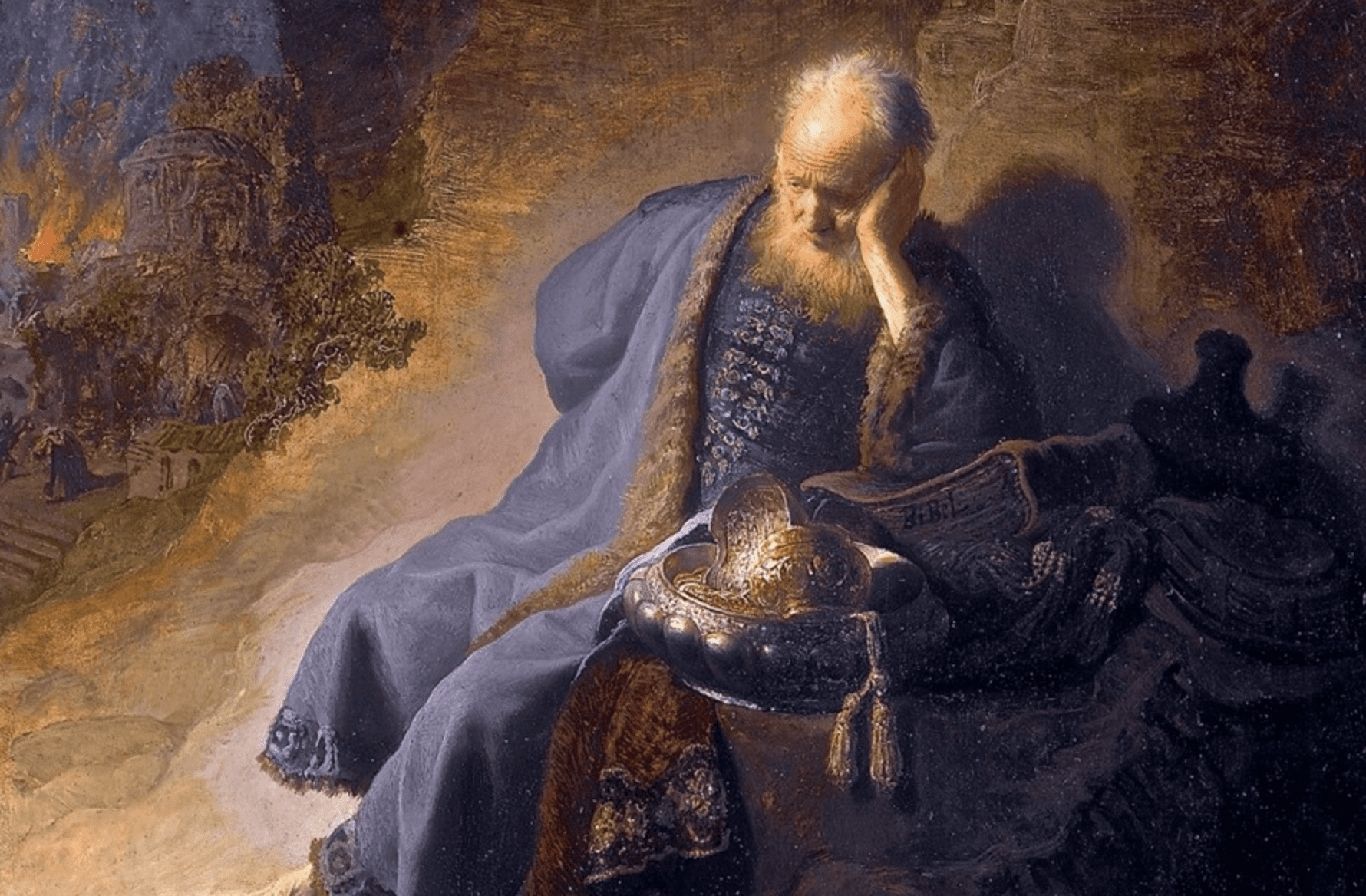
View the article on Pearl of Great Price Central.
Moses 7:28-43
The tradition of a weeping prophet is perhaps best exemplified by Jeremiah who cried out in sorrow:
Oh that my head were waters, and mine eyes a fountain of tears, that I might weep day and night for the slain of the daughter of my people!1
In another place, he wrote:
Let mine eyes run down with tears night and day, and let them not cease: for the virgin daughter of my people is broken with a great breach, with a very grievous blow.2
Less well-known is the ancient Jewish tradition of Enoch as a weeping prophet. In the pseudepigraphal book of 1 Enoch, his words are very near to those of Jeremiah:
O that my eyes were a [fountain]3 of water, that I might weep over you; I would pour out my tears as a cloud of water, and I would rest from the grief of my heart.4
We find the pseudepigraphal Enoch, like Enoch in the Book of Moses, weeping in response to visions of mankind’s wickedness. Following the second of these visions in 1 Enoch, he is recorded as saying:
And after that I wept bitterly, and my tears did not cease until I could no longer endure it, but they were running down because of what I had seen. … I wept because of it, and I was disturbed because I had seen the vision.5
In the Apocalypse of Paul, the apostle meets Enoch, “the scribe of righteousness”6 “within the gate of Paradise,” and, after having been cheerfully embraced and kissed,7 sees the prophet weep, and says to him, “‘Brother, why do you weep?’ And again sighing and lamenting he said, ‘We are hurt by men, and they grieve us greatly; for many are the good things which the Lord has prepared, and great is his promise, but many do not perceive them.’”8 A similar motif of Enoch weeping over the generations of mankind can be found in the pseudepigraphal book of 2 Enoch.9 “There is, to say the least,” writes Hugh Nibley “no gloating in heaven over the fate of the wicked world. [And it] is Enoch who leads the weeping.”10
It is surprising that so little has been done to compare modern revelation with ancient sources bearing on the weeping of Enoch.11 Mere coincidence is an insufficient explanation for Joseph Smith’s association of weeping with Enoch, as it is a motif that occurs nowhere in scripture or other sources where the Prophet might have seen it,12 and similar accounts of weeping are not associated with comparable figures in his translations and revelations.13
Besides Moses 7:41 and 49, we find two additional descriptions of Enoch’s weeping. The first instance is to be found in the words of a divinely-given song, recorded in Joseph Smith’s Revelation Book 2, where Enoch is said to have “gazed upon nature and the corruption of man, and mourned their sad fate, and wept.”14 The second instance is in Old Testament Manuscript 2 of the Joseph Smith Translation, where the revelatory account was corrected to say that it was Enoch rather than God who wept.


Did God or Enoch Weep in Moses 7:28?
The Prophet’s first dictation of Moses 7:28 follows the description of Old Testament Manuscript 1 (OT1), where it is God who weeps:
the g God of heaven looked upon the residue of the peop[le a]nd he wept15
and a subsequent revision, correcting the text so it reads that Enoch wept:
the God of Heaven look=ed upon the residue of the people & wept16
The first dictation above is the one that has been retained in the current canonical version of the Book of Moses. In line with narrative considerations discussed in a previous Essay,17 we think that it makes more sense in the context of the overall passage to understand Enoch as having deferred his weeping until Moses 7:41, after God completes his speech. Thus, for this and other reasons outlined elsewhere,18 we take the OT1 version of Moses 7:28, where the text states that God wept, to be the best reading of the verse, unless and until better arguments for the OT2 reading come along.19
Within the theme of the weeping Enoch, there are several
specific sub-themes that are common in both the Book of Moses and in ancient
literature:
· Weeping in similitude of God
· Weeping because the Divine withdraws from the earth
· Weeping because of the insulting words of the wicked
· Weeping followed by heavenly vision
We will discuss each of these in turn.
Weeping in Similitude of God
In the Midrash Rabbah on Lamentations, Enoch is portrayed as weeping in likeness of God when the Israelite temple was destroyed:
At that time the Holy One, blessed be He, wept and said, “Woe is Me! What have I done? I caused my Shekhinah to dwell below on earth for the sake of Israel; but now that they have sinned, I have returned to My former habitation…” At that time Metatron [who is Enoch in his glorified state] came, fell upon his face, and spake before the Holy One, blessed be He: “Sovereign of the Universe, let me weep, but do Thou not weep.” He replied to him: “if thou lettest Me not weep now, I will repair to a place which thou hast not permission to enter, and will weep there,” as it is said, “But if ye will not hear it, My soul shall weep in secret for pride.”20 21
The dialogue between God and Enoch in this passage is reminiscent of the one in Moses 7:28–41:
28 And it came to pass that the God of heaven looked upon the residue of the people, and he wept; and Enoch bore record of it, saying: How is it that the heavens weep, and shed forth their tears as the rain upon the mountains?
29 And Enoch said unto the Lord: How is it that thou canst weep, seeing thou art holy, and from all eternity to all eternity? …
Enoch, seeing God weep, was astonished at witnessing the emotional display of the holy, eternal God. In the Book of Moses account, God, in response, proceeds to show Enoch the wickedness of the people of the Earth and how much they will suffer in consequence. After seeing a vision of the misery that would come upon God’s children, Enoch will commiserate with God, weeping inconsolably.22
Speaking of prophets in general, Abraham Heschel explains that “what convulsed the prophet’s whole being was God. His condition was a state of suffering in sympathy with the divine pathos.”23 This view of prophets stands in stark contrast to the Philo of Alexandria’s parallel description of the relationship between the high priest and God in De Specialibus Legibus. In this passage, Philo is commenting upon the law in Leviticus 21:10–12 which prohibits the high priest from mourning for (or even approaching) the bodies of deceased parents, consistent with Greek philosophical conceptions.24
Philo’s view of a dispassionate, yet mediating high priest is not only at odds with the portrayal of Jesus as high priest presented in Hebrews 4:15 (“For we have not an high priest which cannot be touched with the feeling of our infirmities”),25 but also with Heschel’s perspective of mediating prophets as those who have entered into “a fellowship with the feelings of God.”26 As in the case of Enoch, a model of divine sympathy calls into question teachings regarding divine apathy.
This theme of shared sorrow between God and prophet is explored at length by theologian Terence Fretheim.27 According to Fretheim, “The prophet’s life was reflective of the divine life. This became increasingly apparent to Israel. God is seen to be present not only in what the prophet has to say, but in the word as embodied in the prophet’s life. To hear and see the prophet was to hear and see God, a God who was suffering on behalf of the people.”28 To a certain extent, so close was the association between God and prophet that the prophet’s very presence could serve as a sort of “ongoing theophany,”29 providing Israel with a very visible and tangible representation of God’s concern.30
Fretheim argues that the prophet’s “sympathy with the divine pathos” was not the result of contemplating the divine, but rather a result of the prophet’s participation in the divine council. He writes:
[T]he fact that the prophets are said to be a part of this council indicates something of the intimate relationship they had with God. The prophet was somehow drawn up into the very presence of God; even more, the prophet was in some sense admitted into the history of God. The prophet becomes a party to the divine story; the heart and mind of God pass over into that of the prophet to such an extent that the prophet becomes a veritable embodiment of God.31
In the case of Enoch, the prophet enters into the presence of God32 and witnesses the weeping of God and a heavenly host over the wickedness of humanity.33 As a result of this participation in the heavenly council, Enoch becomes divinely sensitized to the plight of the human race and begins to weep himself.34
Weeping Because the Divine Withdrawal from the Earth.
A full chorus of weeping that begins with the Messiah and expands to include the heavens and its angelic hosts is eloquently described in a Jewish mystical text called the Zohar:
Then the Messiah lifts up his voice and weeps, and the whole Garden of Eden quakes, and all the righteous and saints who are there break out in crying and lamentation with him. When the crying and weeping resound for the second time, the whole firmament above the Garden begins to shake, and the cry echoes from five hundred myriads of supernal hosts until it reaches the highest Throne.35
The reason for this weeping “of all the workmanship of [God’s] hands”36 is the loss of the temple—the withdrawal of the divine presence from the earth. In Jewish tradition, this withdrawal is portrayed as having occurred in a series of poignant stages. This is vividly illustrated in Ezekiel 9-11. Because of the priests’ wickedness within the temple precincts, the “glory of the God of Israel” moves from its resting place within the temple compound to the threshold of the temple,37 where it remains for a time. Finally, after surveying the extent of the wicked priests’ actions within the temple, Ezekiel sees the “glory of Yahweh” leave the temple, continue east through the city of Jerusalem, and finally come to rest upon the Mount of Olives.38
This departure of the God of Israel from the great city of Jerusalem was especially significant from the perspectives of the nations who surrounded Israel. According to the Hebrew Bible scholar Margaret Odell, “In ancient Near Eastern thought, a city could not be destroyed unless its god had abandoned it.”39 With the presence of God removed from the city, it now lay exposed and vulnerable to attack, a condition that was exploited by the Babylonians.
The withdrawal of the divine presence from the temple is a fitting analogue to the taking up of Enoch’s Zion from the earth. Whereas in the above passages, where God withdraws his presence, or his glory, due to the wickedness of the people, the Book of Moses40 has God removing the righteous city of Zion in its entirety from among the wicked nations that surround it.
The differences in the two pericopes may actually have more in common than is immediately apparent. In Jewish literature there is a significant correspondence between Zion and the Shekhinah (Divine Presence). Zion is often personified as the Bride of God.41 The word “Shekhinah” is a feminine noun in Hebrew, is often associated with the female personified Wisdom, and is likewise described in later Jewish writings as the Bride of God. The idea of Zion being taken up and the Shekhinah being withdrawn are parallel motifs.
Weeping Because of the Insulting Words of the Wicked
Pheme Perkins correctly argues that:
speech is much more carefully controlled and monitored in a traditional, hierarchical society than it is in modern democracies. We can hardly recapture the sense of horror at blasphemy that ancient society felt because for us words do not have the same power that they do in traditional societies. Words appear to have considerably less consequences than actions. In traditional societies, the word is a form of action.42
Consistent with this idea, a Manichaean text describes an Enoch who weeps because of the harsh words of the wicked:
I am Enoch the righteous. My sorrow was great, and a torrent of tears [streamed] from my eyes because I heard the insult which the wicked ones uttered.43
Elsewhere, Enoch is said to have prophesied a future judgment upon such “ungodly sinners” who have “uttered hard speeches… against [the Lord].”44
Rabbi Eliezer gives examples of such insults:
We don’t need Your drops of rain, neither do we need to walk in Your ways.45
Having been told by Noah that all mankind would be destroyed by the Flood if they did not repent, these same “sons of God” are said to have defiantly replied:
If this is the case, we will stop human reproduction and multiplying, and thus put an end to the lineage of the sons of men ourselves.46
Similarly, in Moses 8:21, we find these examples of truculent boasting in the mouths of the antediluvians:
Behold, we are the sons of God; have we not taken unto ourselves the daughters of men? And are we not eating and drinking, and marrying and giving in marriage? And our wives bear unto us children, and the same are mighty men, which are like unto men of old, men of great renown.
An ancient exegetical tradition cited by John Reeves associates the speech of Job in 21:7–15 “to events transpiring during the final years of the antediluvian era”47 rather than to the time of Job. Likewise, in 3 Enoch these verses are directly linked, not to Job, but to Enoch himself.48 In defiance of the Lord’s entreaty to “love one another, and… choose me, their Father,”49 the wicked are depicted as “say[ing] unto God”:
14 … Depart from us: for we desire not the knowledge of thy ways.
15 What is the Almighty, that we should serve him? And what profit should we have if we pray unto him?50
Reeves characterizes these words as “a blasphemous rejection of divine governance and guidance… wherein the wicked members of the Flood generation verbally reject God.”51
Weeping Followed by Heavenly Vision
In the Cologne Mani Codex, Enoch’s tearful sorrow was directly followed by an angelophany:
While the tears were still in my eyes and the prayer was yet on my lips, I beheld approaching me s[even] angels descending from heaven. [Upon seeing] them I was so moved by fear that my knees began knocking.52
A description of a similar set of events is found in 2 Enoch:
… in the first month, on the assigned day of the first month, I was in my house alone, weeping and grieving with my eyes. When I had lain down on my bed, I fell asleep. And two huge men appeared to me, the like of which I had never seen on earth.53
The same sequence of events, Enoch’s weeping and grieving followed by a heavenly vision, can be found in modern revelation within the song of Revelation Book 2 mentioned earlier:
Enoch… gazed upon nature and the corruption of man, and mourned their sad fate, and wept, and cried out with a loud voice, and heaved forth his sighs: “Omnipotence! Omnipotence! O may I see Thee!” And with His finger He touched his eyes54 and he saw heaven. He gazed on eternity and sang an angelic song.55
Noting that this pattern is not confined to Enoch, Reeves56 writes: “Prayer coordinated with weeping that leads to an angelophany is also a sequence prominent in [other] apocalyptic traditions.”57
Conclusions
Ancient and modern Saints know that all mortal sorrow will be done away at the end time when God shall “gather together in one all things in Christ, both which are in heaven, and which are on earth.”58 God said to Noah that in that day: “thy posterity shall embrace the truth, and look upward, then shall Zion look downward, and all the heavens shall shake with gladness, and the earth shall tremble with joy.”59 Describing the human dimension of the great at-one-ment of the heavenly and earthly Zion, when tears of joy shall replace tears of mourning, is the account of Enoch himself where we read, “Then shalt thou and all thy city meet them there, and we will receive them into our bosom, and they shall see us; and we will fall upon their necks, and they shall fall upon our necks, and we will kiss each other.”60
This article is adapted and expanded from Bradshaw, Jeffrey M., Jacob Rennaker, and David J. Larsen. “Revisiting the forgotten voices of weeping in Moses 7: A comparison with ancient texts.” Interpreter: A Journal of Latter-day Saint Faith and Scholarship 2 (2012): 41–71.
Further Reading
Bradshaw, Jeffrey M., Jacob Rennaker, and David J. Larsen. “Revisiting the forgotten voices of weeping in Moses 7: A comparison with ancient texts.” Interpreter: A Journal of Latter-day Saint Faith and Scholarship 2 (2012): 41–71.
Bradshaw, Jeffrey M., and David J. Larsen. Enoch, Noah, and the Tower of Babel. In God’s Image and Likeness 2. Salt Lake City, UT: The Interpreter Foundation and Eborn Books, 2014, pp. 110–115, 141–152.
Draper, Richard D., S. Kent Brown, and Michael D. Rhodes. The Pearl of Great Price: A Verse-by-Verse Commentary. Salt Lake City, UT: Deseret Book, 2005, pp. 133, 134–136.
Nibley, Hugh W. Enoch the Prophet. The Collected Works of Hugh Nibley 2. Salt Lake City, UT: Deseret Book, 1986, pp. 68–79.
Nibley, Hugh W. 1986. Teachings of the Pearl of Great Price. Provo, UT: Foundation for Ancient Research and Mormon Studies (FARMS), Brigham Young University, 2004, p. 284.
References
Alexander, Philip S. “3 (Hebrew Apocalypse of) Enoch.” In The Old Testament Pseudepigrapha, edited by James H. Charlesworth. 2 vols. Vol. 1, 223-315. Garden City, NY: Doubleday and Company, 1983.
Andersen, F. I. “2 (Slavonic Apocalypse of) Enoch.” In The Old Testament Pseudepigrapha, edited by James H. Charlesworth. 2 vols. Vol. 1, 91-221. Garden City, NY: Doubleday and Company, 1983.
Black, Jeremy A. “The new year ceremonies in ancient Babylon: ‘Taking Bel by the hand’ and a cultic picnic.” Religion 11, no. 1 (1981): 39-59. http://www.sciencedirect.com/science?_ob=ArticleURL&_udi=B6WWN-4MMD1NR-5&_user=9634938&_coverDate=01%2F31%2F1981&_rdoc=5&_fmt=high&_orig=browse&_origin=browse&_zone=rslt_list_item&_srch=doc-info(%23toc%237135%231981%23999889998%23639866%23FLP%23display%23Volume)&_cdi=7135&_sort=d&_docanchor=&_ct=10&_acct=C000050221&_version=1&_urlVersion=0&searchtype=a. (accessed September 16, 2010).
Bowen, Matthew L. E-mail message to Jeffrey M. Bradshaw, February 26, 2020.
Bradshaw, Jeffrey M., Jacob Rennaker, and David J. Larsen. “Revisiting the forgotten voices of weeping in Moses 7: A comparison with ancient texts.” Interpreter: A Journal of Mormon Scripture 2 (2012): 41-71. www.templethemes.net.
Bradshaw, Jeffrey M., and Ryan Dahle. “Textual criticism and the Book of Moses: A response to Colby Townsend’s “Returning to the sources”.” Interpreter: A Journal of Latter-day Saint Faith and Scholarship (2020): in press. www.templethemes.net.
Cameron, Ron, and Arthur J. Dewey, eds. The Cologne Mani Codex (P. Colon. inv. nr. 4780) ‘Concerning the Origin of His Body’. Texts and Translations 15, Early Christian Literature 3, ed. Birger A. Pearson. Missoula, Montana: Scholars Press, 1979.
Collins, John J. “Sibylline Oracles.” In The Old Testament Pseudepigrapha, edited by James H. Charlesworth. 2 vols. Vol. 2, 317-472. Garden City, NY: Doubleday and Company, 1983.
Dahl, Larry E. “The vision of the glories.” In The Doctrine and Covenants, edited by Robert L. Millet and Kent P. Jackson. Studies in Scripture 1, 279-308. Salt Lake City, UT: Deseret Book, 1989.
Elliott, J. K. “The Apocalypse of Paul (Visio Pauli).” In The Apocryphal New Testament: A Collection of Apocryphal Christian Literature in an English Translation, edited by J. K. Elliott, 616-44. Oxford, England: Oxford University Press, 2005.
Faulring, Scott H., Kent P. Jackson, and Robert J. Matthews, eds. Joseph Smith’s New Translation of the Bible: Original Manuscripts. Provo, UT: Religious Studies Center, Brigham Young University, 2004.
Faulring, Scott H., and Kent P. Jackson, eds. Joseph Smith’s Translation of the Bible Electronic Library (JSTEL) CD-ROM. Provo, UT: Brigham Young University. Religious Studies Center, Neal A. Maxwell Institute for Religious Scholarship, 2011.
Freedman, H., and Maurice Simon, eds. 1939. Midrash Rabbah 3rd ed. 10 vols. London, England: Soncino Press, 1983.
Fretheim, Terence. The Suffering of God: An Old Testament Perspective. Philadelphia, PA: Fortress Press, 1984.
Heschel, Abraham Joshua. 1962. The Prophets. Two Volumes in One ed. Peabody, MA: Hendrickson, 2007.
Klijn, A. F. J. “2 (Syriac Apocalypse of) Baruch.” In The Old Testament Pseudepigrapha, edited by James H. Charlesworth. 2 vols. Vol. 1, 615-52. Garden City, NY: Doubleday and Company, 1983.
Lichtheim, Miriam, ed. 1973-1980. Ancient Egyptian Literature: A Book of Readings. 3 vols. Berkeley, CA: The University of California Press, 2006.
MacRae, George W., William R. Murdock, and Douglas M. Parrott. “The Apocalypse of Paul (V, 2).” In The Nag Hammadi Library, edited by James M. Robinson. 3rd, Completely Revised ed, 256-59. San Francisco, CA: HarperSanFrancisco, 1990.
Neusner, Jacob, ed. The Mishnah: A New Translation. London, England: Yale University Press, 1988.
Nibley, Hugh W. Enoch the Prophet. The Collected Works of Hugh Nibley 2. Salt Lake City, UT: Deseret Book, 1986.
Nickelsburg, George W. E., ed. 1 Enoch 1: A Commentary on the Book of 1 Enoch, Chapters 1-36; 81-108. Hermeneia: A Critical and Historical Commentary on the Bible. Minneapolis, MN: Fortress Press, 2001.
Odell, Margaret. Ezekiel. Smyth and Helwys Bible Commenary. Macon, GA: Smyth and Helwys, 2005.
Ouaknin, Marc-Alain, and Éric Smilévitch, eds. 1983. Chapitres de Rabbi Éliézer (Pirqé de Rabbi Éliézer): Midrach sur Genèse, Exode, Nombres, Esther. Les Dix Paroles, ed. Charles Mopsik. Lagrasse, France: Éditions Verdier, 1992.
Perkins, Pheme. First and Second Peter, James, and Jude. Louisville, KY: John Knox, 1995.
Peterson, Daniel C. “On the motif of the weeping God in Moses 7.” In Reason, Revelation, and Faith: Essays in Honor of Truman G. Madsen, edited by Donald W. Parry, Daniel C. Peterson and Stephen D. Ricks, 285-317. Provo, UT: Foundation for Ancient Research and Mormon Studies, 2002.
Philo. b. 20 BCE. “The special laws, 1 (De specialibus legibus, 1).” In The Works of Philo: Complete and Unabridged, edited by C. D. Yonge. New Updated ed. Translated by C. D. Yonge, 534-67. Peabody, MA: Hendrickson Publishers, 2006.
Reeves, John C. Heralds of that Good Realm: Syro-Mesopotamian Gnosis and Jewish Traditions. Nag Hammadi and Manichaean Studies 41, ed. James M. Robinson and Hans-Joachim Klimkeit. Leiden, The Netherlands: E. J. Brill, 1996.
Sanders, E. P. “Testament of Abraham.” In The Old Testament Pseudepigrapha, edited by James H. Charlesworth. Vol. 1, 871-902. Garden City, NY: Doubleday and Company, 1983.
Sharp, Daniel, and Matthew L. Bowen. “Scripture note — ‘For this cause did King Benjamin keep them’: King Benjamin or King Mosiah?” Religious Educator 18, no. 1 (2017): 81-87. https://rsc.byu.edu/sites/default/files/pub_content/pdf/Scripture_Note%E2%80%94For_This_Cause_Did_King_Benjam%E2%80%8Bin_Keep_Them_King_Benjamin_or_King_Mosiah.pdf. (accessed February 26, 2020).
Smith, Joseph, Jr., Robin Scott Jensen, Robert J. Woodford, and Steven C. Harper. Manuscript Revelation Books, Facsimile Edition. The Joseph Smith Papers, Revelations and Translations, ed. Dean C. Jessee, Ronald K. Esplin and Richard Lyman Bushman. Salt Lake City, UT: The Church Historian’s Press, 2009.
———. Manuscript Revelation Books. The Joseph Smith Papers, Revelations and Translations 1, ed. Dean C. Jessee, Ronald K. Esplin and Richard Lyman Bushman. Salt Lake City, UT: The Church Historian’s Press, 2011.
Sparks, Kenton L. Ancient Texts for the Study of the Hebrew Bible: A Guide to the Background Literature. Peabody, MA: Hendrickson Publishers, 2005.
Sperling, Harry, Maurice Simon, and Paul P. Levertoff, eds. The Zohar: An English Translation. 5 vols. London, England: The Soncino Press, 1984.
Tang, Alex. 2006. A meditation on Rembrandt’s Jeremiah. In Random Musings from a Doctor’s Chair. http://draltang01.blogspot.com/2006/12/meditation-on-rembrandts-jeremiah.html. (accessed April 30, 2013).
Walker, Charles Lowell. Diary of Charles Lowell Walker. 2 vols, ed. A. Karl Larson and Katharine Miles Larson. Logan, UT: Utah State University Press, 1980.
Williams, Frederick Granger. “Singing the word of God: Five hymns by President Frederick G. Williams.” BYU Studies 48, no. 1 (2009): 57-88.
———. The Life of Dr. Frederick G. Williams, Counselor to the Prophet Joseph Smith. Provo, UT: BYU Studies, 2012.
Witherington, Ben, III. Letters and Homilies for Jewish Christians: A Socio-Rhetorical Commentary on Hebrews, James and Jude. Downers Grove, IL: IVP Academic, 2007.
Notes on Figures
Figure 1.
https://en.wikipedia.org/wiki/Jeremiah_Lamenting_the_Destruction_of_Jerusalem (accessed April 15, 2020). Public domain. Alex Tang describes the painting as follows (A. Tang, A meditation on Rembrandt’s Jeremiah):
This oil on panel painting is one of the finest works of Rembrandt’s Leiden period. For many years it was incorrectly identified but it certainly shows Jeremiah, who had prophesied the destruction of Jerusalem by King Nebuchadnezzar of Babylon (Jeremiah 32:28–35), lamenting over the destruction of the city. In the distance on the left a man at the top of the steps holds clenched fists to his eyes—this was the last king of Judah, Zedekiah, who was blinded by Nebuchadnezzar. The prominent burning domed building in the background is probably Solomon’s Temple.
Jeremiah’s pose, his head supported by his hand, is a traditional attitude of melancholy: his elbow rests on a large book which is inscribed ‘Bibel’ on the edge of the pages, probably a much later addition to the painting. The book is presumably meant to be his own book of Jeremiah or the book of Lamentations. Rembrandt is a master of light in art. The lighting of the figure is particularly effective with the foreground and the [left] side of the prophet’s face in shadow and his robe outlined against the rock. Jeremiah’s [gaze] rested on a few pieces of gold and silver vessels which he must have managed to salvage from the burning temple.
In Lamentations, we read of how Jeremiah’s sorrows were assuaged by hope: “For the Lord will not cast off for ever: But though he cause grief, yet will he have compassion according to the multitude of his mercies” (Lamentations 3:31–32. See also Jeremiah 32:36–44; 33:4–26).
Figure 2. S. H. Faulring et al., JST Electronic Library, OT 1–16—Moses 7:10b-28a, Genesis 7:12b-35a. Copyright Community of Christ, 2011. All rights reserved. Cf. J. Smith, Jr., Old Testament 1, p. 16, https://www.josephsmithpapers.org/paper-summary/old-testament-revision-1/18 (accessed February 19, 2020).
Figure 3. Ibid., OT 2–21 — Moses 7:15b-29b, Genesis 7:19b-35b. Copyright Community of Christ, 2011. All rights reserved. Cf. J. Smith, Jr., Old Testament 2, p. 21, https://www.josephsmithpapers.org/paper-summary/old-testament-revision-2/26 (accessed February 19, 2020).
Footnotes
1 Jeremiah 9:1. Cf. Isaiah 22:4: “Therefore said I, Look away from me; I will weep bitterly, labour not to comfort me, because of the spoiling of the daughter of my people.”
2 Jeremiah 14:17.
3 The text reads dammana [cloud], which Nickelsburg takes to be a corruption in the Aramaic (ibid., pp. 463-464). Nibley takes the motif of the “weeping” of clouds in this verse to plausibly be a parallel to Moses 7:28 (H. W. Nibley, Enoch, p. 199). On the other hand, Nibley’s translation of 1 Enoch 100:11–13 as describing a weeping of the heavens is surely a misreading (ibid., p. 198; cf. (G. W. E. Nickelsburg, 1 Enoch 1, 100:11-13, pp. 503).
4 G. W. E. Nickelsburg, 1 Enoch 1, 95:1, p. 460.
5 G. W. E. Nickelsburg, 1 Enoch 1, 90:41-42, p. 402.
6 Another instance of Enoch as a compassionate, “righteous scribe” appears in the Testament of Abraham. The archangel Michael opens to Abraham a vivid view of the heavenly judgment scene, whereupon Abraham asks (E. P. Sanders, Testament of Abraham, 11:1-10 [Recension B], p. 900):
“Lord, who is this judge? And who is the other one who brings the charges of sins?” And Michael said to Abraham, “Do you see the judge? This is Abel, who first bore witness, and God brought him here to judge. And the one who produces (the evidence) is the teacher of heaven and earth and the scribe of righteousness, Enoch. For the Lord sent them here in order that they might record the sins and the righteous deeds of each person.” And Abraham said, “And how can Enoch bear the weight of the souls, since he has not seen death? Or how can he give the sentence of all the souls?” And Michael said, “If he were to give sentence concerning them, it would not be accepted. But it is not Enoch’s business to give sentence; rather, the Lord is the one who gives sentence, and it is this one’s (Enoch’s) task only to write. For Enoch prayed to the Lord saying, ‘Lord, I do not want to give the sentence of the souls, lest I become oppressive to someone.’ And the Lord said to Enoch, ‘I shall command you to write the sins of a soul that makes atonement, and it will enter into life. And if the soul has not made atonement and repented, you will find its sins (already) written, and it will be cast into punishment.’”
Here, Abraham voices the concern that a relatively mortal Enoch (one who “has not seen death”) would not have the capacity to “bear the weight of the souls” who were being judged. However, Enoch exhibits his capacity for compassion and sympathy by taking into account the feelings of those being judged, fearing that he might “become oppressive to someone” should he judge amiss.
7 Following this encounter and embrace, Paul is told by an angel (J. K. Elliott, Apocalypse of Paul, 20, p. 628): “‘Whatever I now show you here, and whatever you shall hear, tell no one on earth.’ And he led me and showed me; and there I heard words which it is not lawful for a man to speak [2 Corinthians 12:4].” In the version of the Apocalypse of Paul found at Nag Hammadi, Paul’s encounter at the entrance to the seventh heaven is told differently (G. W. MacRae et al., Paul, 22:23-23:30, p. 259). At that entrance, Paul is challenged with a series of questions from Enoch. In answer to Enoch’s final question, Paul is instructed: “‘Give him [the] sign that you have, and [he will] open for you.’ And then I gave [him] the sign.” Whereupon “the [seventh] heaven opened.”
8 J. K. Elliott, Apocalypse of Paul, 20, p. 628.
9 F. I. Andersen, 2 Enoch, 41:1 [J], p. 166: “[And] I saw all those from the age of my ancestors, with Adam and Eve. And I sighed and burst into tears.”
10 H. W. Nibley, Enoch, p. 5.
11 Ibid., pp. 5-7, 14, 68, 189, 192, 205 addresses this topic, citing a handful of ancient parallels. D. C. Peterson, Weeping God, p. 296 cites part of the passage from Midrash Rabbah included later in this article, but his focus is on the weeping of God rather than that of Enoch. The present article draws on a 2012 publication: J. M. Bradshaw et al., Revisiting.
12 Richard Laurence first translated the book of Enoch into English in 1821, but it is very unlikely that Joseph Smith would have encountered this work. Revised editions were published in 1833, 1838, and 1842, but these appeared subsequent to the book of Moses account, which was received in 1830.
13 An exception is, of course, Jesus Christ, who is recorded as having wept both in the New Testament (John 11:35) and in the Book of Mormon (3 Nephi 17:21–22; cf. Jacob 5:41). In 2 Nephi 4:26, Nephi once asks “why should my heart weep and my soul linger in the valley of sorrow… ?”
14 J. Smith, Jr. et al., Manuscript Revelation Books, Facsimile Edition, Revelation Book 2, 48 [verso], 27 February 1833, pp. 508-509, spelling and punctuation modernized. The preface to the entry in the revelation book says that it was “sung by the gift of tongues and translated.” An expanded and versified version of this song that omits the weeping of Enoch was published in Evening and Morning Star, (Independence, MO and Kirtland, OH, 1832–1834; repr., Basel Switzerland: Eugene Wagner, 2 vols., 1969), 1:12, May 1833. It has been argued by a descendant of Frederick G. Williams that both the original and versified version of this song should be attributed to his ancestor and namesake. See F. G. Williams, Life, pp. 221-251; F. G. Williams, Singing, pp. 57–88. The editors of the relevant volume of the Joseph Smith Papers note: “An undated broadside of the hymn states that it was ‘sung in tongues’ by David W. Patten and ‘interpreted’ by Sidney Rigdon. (“Mysteries of God.” Church History Library.) This item was never canonized” J. Smith, Jr. et al., Manuscript Revelation Books, p. 377 n. 65.
15 S. H. Faulring et al., Original Manuscripts, OT 1–16—Moses 7:10b-28a, OT 1–17—Moses 7:28b-7:43, p. 106.
16 Ibid., OT2–21—Moses 7:15b-29a, OT2–22—Moses 7:29b-41a, p. 618.
17 Essay #25.
18 J. M. Bradshaw et al., Textual Criticism.
19 Though we admit it may seem more logical to operate on the assumption that the latest revisions of Joseph Smith’s translations and revelations are always the “best” versions, we have found in our experience that the earliest readings sometimes seem to be superior. After extensive discussion of a relevant example in the Book of Mormon, Matthew Bowen concludes: “We see abundant evidence in ancient New Testament manuscripts of scribes, clerks, and editors attempting to correct what they think are mistakes in the text, only to make the text worse with their corrections.[Joseph Smith and his associates sometimes] did similar things with the Book of Mormon text and with his early revelations” (M. L. Bowen, February 26 2020). For a good example of this in the Book of Mormon, see D. Sharp et al., Scripture Note — “For This Cause” For a discussion of the relative merits of the OT1 and OT2 manuscripts of the Book of Moses, see J. M. Bradshaw et al., Textual Criticism.
20 H. Freedman et al., Midrash, Lamentations 24, p. 41.
21 Jeremiah 13:17.
22 Cf. Noah’s expression of grief in J. J. Collins, Sibylline Oracles, 1:190-191, p. 339: “how much will I lament, how much will I weep in my wooden house, how many tears will I mingle with the waves?”
23 A. J. Heschel, Prophets, 1:118, cf. 1:80–85, 91–92, 105–127; 2:101–103.
24 Philo writes as follows (Philo, Specialibus 1, 1:113-116, pp. 165, 167, emphasis added):
[T]he high priest is precluded from all outward mourning and surely with good reason. For the services of the other priests can be performed by deputy, so that if some are in mourning none of the customary rites need suffer. But no one else is allowed to perform the functions of a high priest and therefore he must always continue undefiled, never coming in contact with a corpse, so that he may be ready to offer his prayers and sacrifices at the proper time without hinderance on behalf of the nation.
Further, since he is dedicated to God and has been made captain of the sacred regiment, he ought to be estranged from all the ties of birth and not be so overcome by affection to parents or children or brothers as to neglect or postpone any one of the religious duties which it were well to perform without any delay. He forbids him also either to rend his garments for his dead, even the nearest and dearest, or to take from his head the insignia of the priesthood, or on any account to leave the sacred precincts under the pretext of mourning. Thus, showing reverence both to the place and to the personal ornaments with which he is decked, he will have his feeling of pity under control and continue throughout free from sorrow.
For the law desires him to be endued with a nature higher than the merely human and to approximate to the Divine, on the border-line, we may truly say, between the two, that men may have a mediator through whom they may propitiate God and God a servitor to employ in extending the abundance of His boons to men.
25 J. Neusner, Mishnah, 1:4-1:6, p. 266 describes weeping as part of the rituals of the high priest on Yom Kippur:
1:4 A. All seven days they did not hold back food or drink from him.
B. [But] on the eve of the Day of Atonement at dusk they did not let him eat much,
C. for food brings on sleep.
1:5 A. The elders of the court handed him over to the elders of the priesthood,
B. who brought him up to the upper chamber of Abtinas.
C. And they imposed an oath on him and took their leave and went along.
D. [This is what] they said to him, “My lord, high priest: We are agents of the court, and you are our agent and agent of the court.
E. “We abjure you by Him who caused his name to rest upon this house, that you will not vary in any way from all which we have instructed you.”
F. He turns aside and weeps.
G. And they turn aside and weep.
1:6 A. If he was a sage, he expounds [the relevant Scriptures].
B. And if not, disciples of sages expound for him.
K. L. Sparks, Ancient Texts, p. 167. has noted that certain aspects of the Israelite Day of Atonement rite “seem to mimic” events of the Mesopotamian akītu festival. The Babylonian king, as part of the ceremonies of the akītu festival, was required to submit to a royal ordeal involving an initial period of suffering and ritual death. Once this phase was complete, the king washed his hands and entered the temple for the rites of (re)investiture, as described in Black’s reconstruction of events. Note the importance of the weeping of the king at this juncture (J. A. Black, New Year, pp. 44-45):
The šešgallu, who is in the sanctuary, comes out and divests the king of his staff of office, ring, mace, and crown. These insignia he takes into the sanctuary and places on a seat. Coming out again, he strikes the king across the face. He now leads him into the sanctuary and pulling him by the ears, forces him to kneel before the god. The king utters the formula:
I have not sinned, Lord of the lands,
I have not been negligent of your godhead.
I have not destroyed Babylon,
I have not ordered her to be dispersed.
I have not made Esagil quake,
I have not forgotten its rites.
I have not struck the privileged citizens in the faces,
I have not humiliated them.
I have paid attention to Babylon,
I have not destroyed her walls…
He leaves the sanctuary. The šešgallu replies to this with an assurance of Bel’s favor and indulgence towards the king: “He will destroy your enemies, defeat your adversaries,” and the king regains the customary composure of his expression and is reinvested with his insignia, fetched by the šešgallu from within the sanctuary. Once more he strikes the king across the face, for an omen: if the king’s tears flow, Bel is favorably disposed; if not, he is angry.
26 A. J. Heschel, Prophets, p. 31. More generally, this attitude opposes Alma’s description of the distinctive traits of any who are desirous to be called God’s covenant people in Mosiah 18:8–9 (“willing to bear one another’s burdens, that they may be light; … willing to mourn with those that mourn; yea, and comfort those that stand in need of comfort”; cf. D&C 42:45). This covenantal sympathy turns out later to be a sort of imitatio dei, as God states, “I know of the covenant which ye have made unto me; and I will covenant with my people and deliver them out of bondage. And I will also ease the burdens which are put upon your shoulders, that even you cannot feel them upon your backs, even while you are in bondage; and this will I do that ye may stand as witnesses for me hereafter, and that ye may know of a surety that I, the Lord God, do visit my people in their afflictions” (Mosiah 24:13–14, emphasis added). Note also the emphasis in both Mosiah 18:9 and 24:14 on standing “as witnesses” of God through this sympathetic interaction.
27 See T. Fretheim, Suffering, especially chapter 10, “Prophet, Theophany, and the Suffering of God” (pp. 149–166).
28 Ibid.., p. 149.
29 Ibid., p. 151.
30 Some of Israel’s neighbors also held this view. Humanity’s capacity to weep as the gods did is alluded to in the Middle Egyptian Coffin Text 1130. It reads, “I have created the gods from my sweat, and the people from the tears of my eye” (M. Lichtheim, Readings, p. 132). In making this association between the creation of humanity and the tears of the god, the author is playing on the Egyptian words for “people” (rmṯ) and “tears” (rmyt), suggesting a link between the two terms (cf. H. W. Nibley, Enoch, p. 43, citing Hornung). Nibley cites a very close association with our Book of Moses text in a manuscript, where, in a mention of the Ugaritic Enoch, it is asked: “Who is Krt that he should weep? Or shed tears, the Good one, the Lad of El?” (cited in ibid., p. 42). With respect to Enoch as a “lad,” see Essay #3.
31 T. Fretheim, Suffering, p. 150.
32 Moses 7:20.
33 Moses 7:28-31, 37, 40.
34 Moses 7:41, 44.
35 H. Sperling et al., Zohar, Shemoth 8a, 3:22. See also the mention of the “two tears of the Holy One …, namely two measures of chastisement, which comes from both of those tears” (ibid., Shemoth 19b, 3:62).
36 Moses 7:40.
37 Ezekiel 9:3.
38 Ezekiel 11:23.
39 M. Odell, Ezekiel, p. 119.
40 Moses 7:21, 23, 27, 31.
41 Revelation 21:2.
42 P. Perkins, First and Second, p. 154, cited in B. Witherington, III, Letters, Jude 14-16, p. 624.
43 J. C. Reeves, Heralds, p. 183. Cf. R. Cameron et al., CMC, 58:6-20, p. 45.
44 Jude 1:15, citing G. W. E. Nickelsburg, 1 Enoch 1, 1:9, p. 142. See also 1 Enoch 5:4, 27:2, 101:3. 2 Peter 2:5 labels this same generation as “ungodly.”
45 M.-A. Ouaknin et al., Rabbi Éliézer, 22, p. 134.
46 Ibid., 22, p. 136.
47 J. C. Reeves, Heralds, p. 187. For a list of ancient sources, see ibid., p. 183, p. 200 n. 17.
48 P. S. Alexander, 3 Enoch, 4:3, p. 258: “When the generation of the Flood sinned and turned to evil deeds, and said to God, ‘Go away! We do not choose to learn your ways’ [cf. Job 21:14], the Holy One, blessed be he, took me [Enoch] from their midst to be a witness against them in the heavenly height to all who should come into the world, so that they should not say, ‘The Merciful One is cruel! …’”
49 Moses 7:33. Cf. Isaiah 1:2-3, where Isaiah “pleads with us to understand the plight of a father whom his children have abandoned” (A. J. Heschel, Prophets, 1:80). For more on this theme, see Essay #25.
50 Job 21:14–15. Cf. Exodus 5:2, Malachi 3:13–15, Mosiah 11:27, Moses 5:16.
51 J. C. Reeves, Heralds, p. 188.
52 Ibid., p. 183.
53 F. I. Andersen, 2 Enoch, A (short version), 1:2-4, pp. 105, 107.
54 See also Moses 6:35–36, where Enoch is asked to anoint his eyes with clay prior to receiving a vision (cf. John 9:6–7). When the Lord spoke with Abraham face to face, He first put His hand upon the latter’s eyes to prepare him for his vision of the universe (see Abraham 3:11–12). Joseph Smith was reportedly so touched at the beginning of the First Vision, and perhaps prior to receiving D&C 76.
With respect to the First Vision, Charles Lowell Walker recorded the following (C. L. Walker, Diary, 2 February 1893, 2:755-756, punctuation and capitalization modernized):
Br. John Alger said while speaking of the Prophet Joseph, that when he, John, was a small boy he heard the Prophet Joseph relate his vision of seeing the Father and the Son. [He said t]hat God touched his eyes with his finger and said “Joseph, this is my beloved Son hear him.” As soon as the Lord had touched his eyes with his finger, he immediately saw the Savior. After meeting, a few of us questioned him about the matter and he told us at the bottom of the meeting house steps that he was in the house of Father Smith in Kirtland when Joseph made this declaration, and that Joseph while speaking of it put his finger to his right eye, suiting the action with the words so as to illustrate and at the same time impress the occurrence on the minds of those unto whom he was speaking. We enjoyed the conversation very much, as it was something that we had never seen in church history or heard of before.
Whether meant literally or figuratively, Joseph said that his eyes were also touched prior to his receiving the vision of the three degrees of glory:
… the Lord touched the eyes of our understandings, and they were opened, and the glory of the Lord shone round about.
And we beheld the glory of the Son, on the right hand of the Father, and received of his fulness. (see D&C 76:19-20.)
As in the First Vision, the initial result of the “touch” that opened Joseph Smith’s eyes was that he beheld the Savior in His glory. The statement that they “received of his fulness” is also remarkable. Here are the corresponding verses in the poetic rendition of D&C 76:
15. I marvel’d at these resurrections, indeed!
For it came unto me by the spirit direct:—
And while I did meditate what it all meant,
The Lord touch’d the eyes of my own intellect:—16. Hosanna forever! they open’d anon,
And the glory of God shone around where I was;
And there was the Son, at the Father’s right hand,
In a fulness of glory, and holy applause.
See J. Smith, Jr. (or W. W. Phelps), A Vision, 1 February 1843, stanzas 15–16, p. 82, reprinted in L. E. Dahl, Vision, p. 297, emphasis added. Thanks to Bryce Haymond for pointing out this reference.
55 J. Smith, Jr. et al., Manuscript Revelation Books, Facsimile Edition, Revelation Book 2, 48 [verso], 27 February 1833, pp. 508-509, spelling and punctuation modernized.
56 J. C. Reeves, Heralds, p. 189, citing 4 Ezra 5:13, 20; 6:35; 2 Apoc. Bar. 6:2–8:3; 9:2–10:1; 3 Apoc. Bar. 1:1–3; and Daniel 10:2–5. He also observes that weeping is a component of ritual mourning (see Deuteronomy 21:13).
57 The two accounts of Enoch mentioned previously can be profitably compared to the experience of Lehi who, “because of the things which he saw and heard he did quake and tremble exceedingly,” and “he cast himself upon his bed, being overcome with the Spirit” (1 Nephi 1:6-7). Whereupon the heavens were the opened to him (see 1 Nephi 1:8). See also, e.g., Baruch’s weeping for the loss of the temple (A. F. J. Klijn, 2 Baruch, 35:2, p. 632, quoting Jeremiah 9:1), which was also followed by a vision.
58 Ephesians 1:10.
59 JST Genesis 9:22.
60 Moses 7:6
Three Creation Accounts – One Divine Plan

In Latter-day Saint belief, the Creation is revealed through three complementary accounts: Genesis in the Old Testament, the Book of Moses, and the Book of Abraham in the Pearl of Great Price. These records do not compete with one another. Together, they offer a richer understanding of God’s nature, humanity’s identity, and the purpose behind the earth’s creation.
Genesis offers the most familiar account. Traditionally attributed to Moses as the author, it presents Creation in a majestic and orderly manner, describing how God formed the heavens and the earth, organized life, and created man and woman in His image. The language is formal and universal, emphasizing divine authority and the goodness of God’s work. Genesis teaches what happened—the world was created deliberately, with order and purpose. It preserves the core narrative upon which later revelation builds.
The Book of Moses expands the narrative through modern revelation. As Joseph Smith worked on the Joseph Smith Translation of the Bible, he received inspired clarification and restoration of Genesis material. The earliest portions of that work are now published as the Book of Moses, which can be understood as Genesis revealed anew rather than rewritten. This record strengthens the traditional view of Mosaic authorship by portraying Moses as a prophet who spoke directly with God and received divine instruction about Creation and humanity’s role within it.
The Book of Moses therefore shifts the focus from events to intent. Instead of opening with the formation of the earth, it begins with Moses learning who God is and why Creation matters. God declares, This is my work and my glory—to bring to pass the immortality and eternal life of man. Creation is framed as part of a plan centered on humanity. The earth exists not merely as a beautiful world, but as a place where God’s children can exercise agency, form families, and progress toward Him. The Fall of Adam and Eve is presented not as a failure, but as a necessary step toward making joy, growth, and redemption possible.
The Book of Abraham reaches even further back, describing events before the earth was formed. Abraham records a premortal council where God presented His plan to His spirit children. Creation is portrayed as a carefully organized process, carried out in stages through divine cooperation. This account emphasizes intention and preparation rather than sudden creation. It also teaches human beings existed as spirits before mortality and were known and instructed by God long before their birth on earth.
Read together, these accounts reveal Creation and salvation are inseparable. Genesis teaches what God did. The Book of Moses explains why He did it. The Book of Abraham shows how it was planned. Each prophet received revelation suited to his mission and audience, and God repeated the story not to correct earlier accounts, but to deepen understanding as His children were prepared to receive more.
This combined view also addresses common questions. The days of Creation need not be literal twenty-four-hour periods but can represent extended phases of organization. The Fall becomes a purposeful part of God’s design rather than a tragic disruption. Faith in Creation does not require rejecting science, since Latter-day Saint doctrine allows for divine direction working through natural processes.
Together, these records demonstrate how revelation works. God teaches gradually, adapting truth to the needs and understanding of His children. Genesis spoke to an ancient covenant people. The Book of Moses sought humanity’s place in an eternal plan. And the Book of Abraham contemplated the heavens and God’s work beyond the earth. Each account reflects both divine consistency and divine patience.
These Creation accounts also invite personal engagement. Believers are encouraged to seek understanding through study, prayer, and continuing revelation. The same God who instructed Moses and Abraham invites individuals to gain insight suited to their own lives. The Creation thus becomes more than doctrine—it becomes a witness of God’s involvement and care.
Above all, these accounts teach identity. If life existed before the earth, if a plan was prepared in heaven, and if the world was created with humanity in mind, then no person is an accident. Each individual has divine potential and an eternal purpose. The Creation story, as revealed in Genesis, and through Moses and Abraham, is ultimately about who we are, where we came from, and where God invites us to go. Together, these three witnesses testify the world was created with love, intention, and eternal purpose, and that every child of God has a place in His plan.
The Joseph Smith Translation: Three Creations

When contemplating the creation as found in Genesis 1-2, Moses 2-3, and Abraham 3-5, it is not uncommon to miss the fact that there were three separate creations, a spirit creation, a spiritual creation, and a natural or mortal, creation”, with Adam and Eve being the only humans to experience the spiritual creation. Using The Joseph Smith Translation, Red-Letter Edition (JST), Old Testament, the books of Moses and Abraham as well as other commentary, we can better understand this three-part aspect of the creation. Joseph Fielding McConkie and Robert L. Millet provide us with some context for this discussion.

“In order to understand fully the nature of the Creation, we must first grasp the reality that there were in fact three creations. The first creation is called the spirit creation and pertains to the birth of our spirits in premortality. The second creation, the spiritual creation, pertains to the nature of life on earth before our first parents were dismissed from Eden. The third creation or organization of things came as a result of the Fall; this, the natural creation, opened the door to mortality and corruption and death.”
(Joseph Fielding McConkie and Robert L. Millet, eds., The Man Adam [Salt Lake City: Bookcraft, 1990], 10 – 12.)
This article correlates with the January 5-11, 2026, lesson of the Come Follow Me curriculum. To more easily follow along with these articles which utilize The Joseph Smith Translation, Red-Letter Edition, Old and New Testament, the reader may obtain an eBook or hard copy at https://jstrle.com. Red text in the verses below are additions made by the JST while blue text are the words of the King James Version (KJV) as they previously read. Black text was unaltered by the JST.
In Genesis 2:4-7 (Moses 3:4-7) God was speaking to Moses, when He said:
Gen 2: 4 And now behold I say unto you that these
Theseare the generations of the Heavenheavensand of the Earthearthwhen they were created, in the day that I the Lord God made the Heaven and the Earth,earth and the heavens,5 And every plant of the field before it was in the Earth,
earth, and every herb of the field before it grew, for I the Lord God created all things of which I have spoken spiritually, before they were naturally upon the face of the Earth. For I the Lord God had not caused it to rain upon the Earth.earth,And I the Lord God had created all the children of men and not yetand there was nota man to till the ground, for in Heaven created I them. And there was not yet flesh upon the Earth neither in the water neither in the air,6 But I the Lord God spake and there went up a mist from the Earth
earth, and watered the whole face of the ground.7 And I the Lord
the LordGod formed man fromofthe dust of the ground, and breathed into his nostrils the breath of life, and man became a living soul the first flesh upon the Earth, the first man also, nevertheless, all things were before created; but spiritually were they created and made according to my word. (italics are mine)
Speaking of the creation, the Lord explained to Moses in verse 4 “these These are the generations of the Heaven heavens and of the Earth earth when they were created”. This verse is preceded by the record of the creative periods found in Genesis 1 and Moses 2. In this context, a generation might refer to each of the creative periods which God called ‘days’. It may also be reasonable to consider the “generations” as a reference to the spirit creation, the spiritual creation, and the natural or mortal creation. Whatever God meant by the descriptor “generations”, it preceded Genesis 2 and Moses 3.
Joseph Smith’s translation of these verses in Genesis, along with Moses and Abraham, help us understand the three creations. First, in a close reading of Abraham 3:21-24 we learn that at some time in our premortal state all intelligences were created as spirits. We have learned further that all things have intelligence, some being more intelligent than others, with man claiming the preeminent spot. Second, the earth, light, flora, fishes, fowls of the air, all living creatures, and every creeping thing, were created spiritually, “…for I the Lord God created all things of which I have spoken spiritually, before they were naturally upon the face of the Earth.” The capstone of that spiritual creation was Adam and Eve who were placed upon a physical-spiritual earth and given physical-spiritual forms. God continued by explaining “…for in Heaven created I them.” As revealed in Genesis 1:8 “Heaven” in this context pertains to the firmament of earth, “And I, God, called the firmament Heaven”. Third, upon the fall of Adam all things entered a mortal creation or state. God’s explanation that things were created “spiritually“ first, is followed by “…before they were naturally upon the face of the Earth.”, providing us with a clearer understanding of the third and final creation or what God referred to as being “naturally upon the face of the Earth”.
Numerous church leaders and scholars have commented on these three creations. I will only cite two more.
“The account of creation in Genesis was not a spirit creation, but it was in a particular sense, a spiritual creation. This, of course, needs some explanation. The account in Genesis, chapters one and two, is the account of the creation of the physical earth. The account of the placing of all life upon the earth, up and until the fall of Adam, is an account, in a sense, of the spiritual creation of all of these, but it was also a physical creation. When the Lord said he would create Adam, he had no reference to the creation of his spirit for that had taken place ages and ages before when he was in the world of spirits and known as Michael.” (Joseph Fielding Smith, Doctrines of Salvation, 3 vols., edited by Bruce R. McConkie [Salt Lake City: Bookcraft, 1954-1956], 1: 76.)
“The scriptural account of the Creation tells us that there was a spirit creation, but it does not give us a detailed record of it. All we know is that there was such a creation. All things, people, animals, plants, existed as spirits before anything existed physically on the earth.
In the garden Adam and Eve had physical bodies to house their eternal spirits, but those physical bodies were living subject to spiritual conditions. They were real bodies with tangible muscle and bone, but they did not contain blood. This was a physical creation under spiritual conditions. It was deathless. D&C 88:27 describes resurrected beings as spiritual. They are physical but also spiritual. Saying they are “spiritual” bodies is different than saying they are “spirit” bodies. This is the same sense in which Paul uses the term spiritual bodies in 1 Cor. 15:44, 1 Cor. 15:45, 1 Cor. 15:46.” (Robert J. Matthews, Professor of Religion, BYU, A Bible! A Bible! [Salt Lake City: Bookcraft, 1990], 172.)
The statement that Adam became “the first flesh upon the Earth the first man also.” may be a bit confusing since in the creation narrative, all animals having flesh and bone were created prior to Adam. However, we are indebted to Hugh Nibley’s explanation of how this can be.
“But when you look up in the big Hebrew lexicon as to what the word “flesh” means (the first flesh, as it says in the Bible), you find that the primary meaning of basar is “flesh” as opposed to bone. Flesh can only belong to an animal which also has bones. We never refer to the flesh of microorganisms. We don’t think of them as flesh. We don’t call them flesh, though they’re made of the same stuff the rest of us are. As it says, flesh has to be an animal that has bones, at least. That’s the first definition.
The second meaning is the figurative, meaning “first, a human being.” Basar is specifically a human being, the first flesh meaning the first human being…
But Moses here in this verse gives us the definition of flesh in which sense it is to be used. He says it is “the first flesh upon the earth, the first man also.” So when I say the first flesh, we mean the first man. That’s what we mean by first flesh. We mean it in that sense.” (Hugh Nibley, Ancient Documents and the Pearl of Great Price, edited by Robert Smith and Robert Smythe [n.p., n.d.], 8.)
As recipients of latter-day revelation, Latter-Day Saints revel in a more expansive and correct view of God’s creations. Moses’s simple query to God was “…Tell me, I pray thee, why these things are so, and by what thou madest them? “ (Moses 1:30) Through the efforts of Joseph Smith, Prophet, Seer, Revelator, and Translator, we are benefactors and recipients of God’s answer to that simple question posed by Moses long ago.
1 Between June 1830 when Joseph Smith began his New Translation of the Holy Bible, and March 7, 1831, and with the assistance of Oliver Cowdery, John Whitmer, Emma Smith, and Sidney Rigdon as scribes, Joseph received by revelation at least a portion of the book of Moses and Genesis 1-24. The history and chronology of the book of Moses, as well as the book of Abraham, are still a bit of a mystery. I would refer the reader to the excellent series of articles on the book of Abraham by Kerry Muhlestein which can be found at: https://latterdaysaintmag.com/author/kerry-muhlestein/.
The complete book of Moses does not appear as such in any of the three Joseph Smith Translation, Old Testament manuscripts. However, most of the text found in the book of Moses is also found in the JST book of Genesis. It is plausible that the book of Moses had a least partially been received prior to June 1830, when the work of translation officially began. Pursuant to the Lord’s instructions on March 7, 1831, Joseph’s translation efforts changed to the New Testament (D&C 45:60-62). He did not turn his attention back to the Old Testament until late July or early August 1832. During the period between June 1830 and March 1831, 25 sections of the Doctrine & Covenants were received, a number of which were received as a result of the work of translation that Joseph was engaged in.
The complete book of Moses does not appear as such in any of the three Joseph Smith Translation, Old Testament manuscripts. However, most of the text found in the book of Moses is also found in the JST book of Genesis. It is plausible that the book of Moses had a least partially been received prior to June 1830, when the work of translation officially began. Pursuant to the Lord’s instructions on March 7, 1831, Joseph’s translation efforts changed to the New Testament (D&C 45:60-62). He did not turn his attention back to the Old Testament until late July or early August 1832. During the period between June 1830 and March 1831, 25 sections of the Doctrine & Covenants were received, a number of which were received as a result of the work of translation that Joseph was engaged in.
2 Brigham Young, Journal of Discourses, 26 vols. [London: Latter-day Saints' Book Depot, 1854-1886], 3: 277. There is life in all matter, throughout the vast extent of all the eternities; it is in the rock, the sand, the dust, in water, air, the gases, and, in short, in every description and organization of matter, whether it be solid, liquid, or gaseous, particle operating with particle.Joseph Smith as Philosopher. by Dr. John A. Widtsoe, Director Department of Agriculture, Brigham Young University, Improvement Era, 1905, Vol. Ix. December, 1905. No. 2.
“It is not quite so well understood that the doctrine of the indestructibility of energy lies also at the foundation of “Mormon” theology, and was taught by Joseph Smith. It was clearly comprehended by the Prophet and his associates that intelligence is the vivifying force of all creation—animate or inanimate—that rock and tree and beast and man, have ascending degrees of intelligence. The intelligence there spoken of by the Prophet corresponds fully with the energy of science.”
Why does Genesis say that Enoch “Walked with God” and that “God took him”?

The following was originally pubslihed in Scripture Central. To read more from them, CLICK HERE.
The Know
The Book of Genesis contains many genealogies, most of which mention how old a person was when they had a child, and then how old they were when they died. But sometimes these genealogies break from the norm and provide additional details. In Genesis 5 the passage concerning Enoch begins as follows: “and Jared lived a hundred sixty-two years, and became the father of Enoch, and Jared lived after he became the father of Enoch eight hundred years, and had sons and daughters, and all the days of Jared were nine hundred sixty and two years, and he died. Enoch lived sixty-five years and became the father of Methuselah” (Gen. 5:18–21). But then, suddenly, Enoch’s genealogy mentions something odd as it adds: “And Enoch walked with God after he became the father of Methuselah three hundred years, and had sons and daughters, and all the days of Enoch were three hundred sixty-five years, and Enoch walked with God and he was not, for God took him” (Genesis 5:22–24). These two additional details raise some questions. For example, why does Enoch particularly receive this additional attention? Also, what does it mean that Enoch “walked with God” or “was not” because “God took him”? Although Enoch is never mentioned again in the Old Testament, he is mentioned in the New Testament (Hebrews 11:5), and beyond that, many Enochic texts and traditions appear in ancient and medieval sources, as well as in the Pearl of Great Price (see generally Moses 5:42, 6:21-8:1), that provide fascinating insights into these questions.1
Four main apocryphal books focus on Enoch particularly, namely 1 Enoch, the Book of Giants, 2 Enoch, and 3 Enoch.2 Given that the earliest of these Enoch-related texts comes from the Dead Sea Scrolls, it may be easy to assume that the Enoch traditions developed many years after Genesis 5 was written to expand the few lines about Enoch recorded there. However, given the large corpus of material concerning Enoch in the ancient world, and the many overlaps they share, it is possible that they are all reflecting a strong oral or even written tradition of Enoch that goes much farther back into antiquity. As Enoch scholar Loren T. Stuckenbruck said, “There is no reason to assume that any of the extant materials to 1 Enoch, including the fragments recovered from the Qumran caves, preserve for us anything approaching an ‘original.’”3 In other words, the Qumran texts and even the few lines in the Bible may simply be preserving parts of a much earlier tradition that has been passed down, rather than such a large tradition growing out of a few simple lines in Genesis. Although the origin of the Book of Moses is a complicated issue, it is possible that these later Enoch traditions derive from a text like the Enoch material in the Book of Moses that existed in ancient times.4
The oldest surviving apocryphal text about Enoch, 1 Enoch, was likely written over time between roughly 250 and 100 BC, probably in Aramaic.5 1 Enoch was among the texts discovered with the Dead Sea Scrolls and is part of the canon in the Ethiopian orthodox church, most of it only surviving in the ancient Ethiopian language Ge’ez.6 These texts explain the meaning of “god took him” in an interesting way. In these texts, Enoch physically goes up to heaven and stays with God, never tasting death.
The first section of 1 Enoch, called The Book of the Watchers, begins by explaining that because of his righteousness, Enoch’s eyes were opened, and he is given visions by God about the future as well as about God’s judgement of humanity. It also tells the story of a group of fallen angels, known as “Watchers” who have intercourse with women who in turn give birth to evil, half-angel giants. These giants wreak havoc on humans and animals and the great flood is called down upon the earth to kill them. This does not permanently solve the problem, however, as their spirits are then unleashed to do evil deeds on the earth until the end of time.7
The Book of the Similitudes, the second section of 1 Enoch, recounts more of Enoch’s visions and the angels who help him understand them. Enoch sees a divine being called the Son of Man who will participate in the final judgement which will condemn the wicked and justify the righteous. The third section of 1 Enoch, the Book of Astronomical Writings, contains visions of things that will happen both in heaven and on earth. It argues for a 364-day solar calendar instead of the lunar calendar (an issue which was surprisingly important during the time the book was written).8 Enoch then tells his son Methuselah about a tour of the stars which he was given by an angel named Uriel.9
Enoch continues to tell Methuselah about his visions in the fourth section of 1 Enoch, the Book of Dream Visions. One vision describes the sky falling, and the second is an allegory telling the history of humankind from beginning to end.
Another section, the Book of the Epistle of Enoch is a letter Enoch writes for people living in later times. It emphasizes the point that righteousness will be rewarded and that God will punish the wicked, trying to convince the reader to prepare for the final judgement. In this text Enoch never dies, but goes to heaven without tasting death.10
A book which is related to 1 Enoch is called the Book of Giants from the Dead Sea Scrolls. It tells the story of the “Watchers” having intercourse with human women who give birth to giants, as 1 Enoch does. These beings devastate humanity, as in 1 Enoch, but in this text they reveal the mysteries of heaven to humanity, information they were not supposed to expose. When Enoch hears about this, he tells God about it, and God tells him to preach to people to counteract the negative impact of the Watchers on humanity. God even gives divine dreams to some of the giants who then try to get their companions to repent. Troubled by the dreams, they send a giant named Mahway to Enoch, and Enoch preaches to Mahway and the Watchers continue to rebel against God.11
2 Enoch is another ancient text about Enoch, likely written sometime between 100 BC and 100 AD. Although originally written in Greek, or perhaps Aramaic, the complete text only survives in a medieval Eastern European language called Church Slavonic.12 2 Enoch builds on the earlier traditions about Enoch.
2 Enoch begins with Enoch being given a tour of heaven by two angels. In this text, heaven is divided into ten sections or levels, and Enoch gets a tour of each one. The angel Gabriel takes him to the tenth heaven where he sees God face to face and speaks with him. Enoch is then anointed by Michael and looks like an angel after this. It then recounts the story of an angel who attempts to put himself above God but is cast down for his rebellion. The angels who follow him are the ones who tempt Eve.13
Enoch is then taught all knowledge by an angel and then by God himself, finding out the full history of the earth from the creation through the flood. Enoch then teaches his sons important ethical and moral lessons such as love for all creatures, after which he is taken into heaven permanently. Finally, after Enoch leaves for heaven, the people ask Enoch’s son, Methuselah as well as Methuselah’s grandson to be a priest. It then recounts the miraculous virgin birth of Melchizedek and his priestly role.14
3 Enoch is yet another Enoch text, its version was written likely from sometime between 500 and 700 AD in Hebrew. It recounts the vision of Rabbi Ishmael ben Elisha, who ascends to heaven and sees the divine chariot that God rides on. He then sees Enoch, also known as Metatron. It then explains a few things about angels, as well as giving some information about the last judgement and the heavenly court. It then goes over God’s chariot throne in more detail. Enoch reveals secrets to Rabbi Ishmael, including the names of God, as well as the names of Enoch.15
The Why
These many sources collectively may help to explain the unusual words in Genesis 5 that Enoch “walked with God,” and that “God took him.” All these traditions seem to understand that the phrases “walking with God” and “God took Enoch” refer to the revelatory experiences that Enoch was given as he was taken up into heaven and shown significant things about God and the reality of God’s divine plan. This is similar to the Christian tradition which claims, “By faith Enoch was translated (metatethḕ) that he should not see death” (Hebrews 11:5 KJV). That Greek word in Hebrews 11 for “translated” is the same word (metethḕken) used in the Septuagint (the Greek Old Testament) version of Genesis to indicate that God “took him” (Genesis 5:24 KJV).16 The combined sense of all these passages is that Enoch was taken up into heaven and changed from a mortal state into a state wherein he would not experience death. This supposition is supported by texts like 2 Kings 2:11, in which Ellijah was “carried up by a whirlwind into heaven,” or Deuteronomy 34:5–6, in which Moses is buried by the Lord, understood by some to mean that he ascended without tasting death.17 Moses 7:69 in the Pearl of Great Price supports this idea: ”And Enoch … dwelt in the midst of Zion; and it came to pass that Zion was not, for God received it up into his own bosom.”
Because this understanding was widespread, it is possible that all these texts could preserve or reflect an older understanding of the phrase “walking with God” to mean something more than just physical walking but spiritually revelatory.18 The traditions about Enoch all present the possibility that, when Enoch is said to have been walking with God in the heavens, and that “God took him,” his heavenly condition eventually became permanent.
“Walking with God” can also have the metaphorical meaning of having a close relationship with God or doing things that God desires—i.e., being “in-step” with Him. Here the Septuagint or Greek version of the Old Testament renders this phrase in Genesis as Enoch was “well-pleasing to God” (euḕrestḕse tōi theōi). Noah, Abraham, and Isaac are also described as walking with God (Genesis 6:9; 17:1; 24:40; 48:15), where that phrase appears in connection with their making a covenant with God. Hence, walking with God may refer to the formal creation of a relationship with God through making and keeping sacred covenant bonds and obligations.
Even though the Bible only spends a few verses on Enoch, the many traditions about Enoch preserved in other sources help modern readers to make sense of why a simple ancient biblical genealogy went out of its way to include these additional details concerning him. The many books and traditions which later arose about Enoch show that even a seemingly-insignificant biblical character such as Enoch can be seen as being more important than casual readers might assume. Indeed, early Christians looked to Enoch as a prophet whose life and teachings were important (Hebrews 11:5; see also Jude 1:14-15); and likewise for Latter-day Saints, the Book of Moses (6:21-8:1) rightly gives important insights into his life and work that also help shed light on the divine roles of Jesus Christ and his salvific mission.
The Naming of Animals, Angels, Adam, and Eve

To view this post on Pearl of Great Price Central, CLICK HERE.
In the depiction of the Garden of Eden above, Jan Brueghel the Elder masterfully fills the foreground of the scene with the abundance, happiness, and beauty of newly created life. From there, however, he skillfully draws our eyes toward the two tiny figures in the background ominously reaching for the fruit of the Tree of Knowledge.
However, it should not be forgotten that prior to that event wherein Eve and Adam received crucial knowledge as a consequence of their transgression, an important test for knowledge was administered to Adam when he was required to go through a test of naming.
Though the story of the naming of the animals is couched in the Bible as a proof of Adam’s dominion and as a motivating prelude to the creation of Eve, there are hints in competing versions of the event that the account may not be as straightforward as it seems. Building on the foundation of Essay #39 that discussed a series of sacred names given to Moses representing important junctures in his mortal journey and heavenly ascent, this Essay describes an alternative Islamic interpretation of the event that understands Adam to be engaged, not in naming the animals, but rather in demonstrating his knowledge of secret names to the angels.
Animals or Angels?
Moses 3:19 recounts the well-known story of how Adam gave names to all the animals:
And out of the ground I, the Lord God, formed every beast of the field, and every fowl of the air; and commanded that they should come unto Adam, to see what he would call them; and they were also living souls; for I, God, breathed into them the breath of life, and commanded that whatsoever Adam called every living creature, that should be the name thereof.
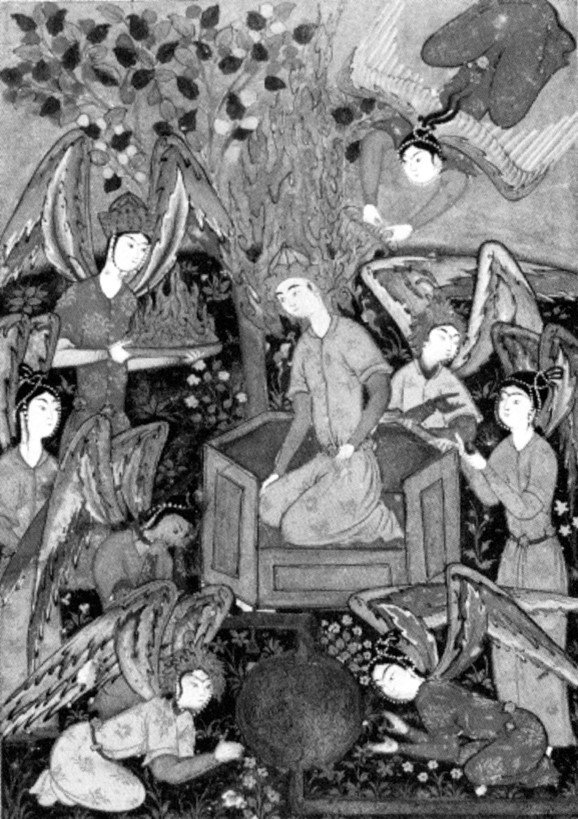
Intriguingly, the story in Jewish writings of what happened afterward differs significantly from other ancient sources. Whereas some strands of Jewish tradition, consistent with the thrust of the biblical account, record that the animals subsequently bowed to Adam, other Jewish, Christian, and Islamic accounts insist that it was the angels who paid homage to him.1
While it is impossible to reconstruct how and why these two versions of the story differ, it has been argued that some scriptural passages relating to angels were controversial and subject to tampering by Jewish scribes during the second temple period.2 We also know from the book of Revelation about the close association between beasts and angels, who worship together at God’s throne in heaven.3 It does not seem impossible that in some contexts “beasts” were interpreted as “angels” by readers familiar with such imagery.
With these considerations in mind, we will consider a parallel tradition from Islamic sources that appears in place of the episode of the naming of animals.4 In a manner similar to temple initiates in other cultures, Adam — before the Fall and after having been given instruction by God — is said in these sources to have been directed to recite a series of secret names to the angels in order prove that he was worthy of the elevated status of priest and king that had been conferred upon him.5
What Was the Nature of the Test?
It is seen specifically as a test of knowledge. Ida Zilio-Grandi comments that:
While in the Bible God lets Adam choose the names of things, in the Qur’an it is God who teaches — who reveals therefore—the names to Adam. … Extremely high value is attributed to knowledge. … Indeed, it is not by obedience that the ability to represent God in the governance of the world is measured, but by knowledge.6
What Was the Nature of the Names Involved?
There are several different opinions about the nature of the names involved. With respect to Adam’s purported premortal accomplishment, Qur’an commentators themselves “dispute which particular names were involved; various theories [taking the position that] they were the names of all things animate and inanimate, the names of the angels, the names of his own descendants, or the names of God.”7
Mahmoud Ayoub writes similarly of the diversity of opinions on the matter:
Much disagreement has arisen among commentators regarding the words that Adam received from his Lord. … Ibn ‘Arabi says that these were ‘lights and states or stations of the realm of dominion and power and the realm of the subtle spirits. … It may also be that Adam received from God gnoses [hidden knowledge], sciences, and truths.’8
Regardless of the specifics, Al-Mizan asserts that this was not a simple dictionary recital showing off the power of Adam’s memory, but rather “something totally different from what we understand from the knowledge of names.”9 Alusi concludes that Adam’s saying of these names is “in the end, like saying the names of God, for power concerns God Himself in His ruling of the world.”10
The Names As Helps in Repentance and Reconciliation
Additional passages from Islamic sources connect the knowledge said to have been given to Adam in a general way to temple-related practices to effect repentance and reconciliation elsewhere in the ancient Near East. Though Islamic sources studiously avoid any reference to atonement rituals connected with the Jewish temple, a penitential function is accorded to a knowledge of certain words given to Adam. Describing a separate incident that was said to have occurred after the Fall, Islamic writings recount that “Adam received (some) words from his Lord”11 that enabled him to repent and return to good standing with God, so he could eventually go back to the Garden of Eden.12
While Al-Mizan declines speculation about what specific words were revealed, it likewise elaborates on their function:
It was this learning of the words that paved the way for the repentance of Adam. … Probably, the words received at the time of repentance were related to the names taught to him in the beginning. … There must have been something in those names to wipe out every injustice, to erase every sin and to cure every spiritual and moral disease; … those names were sublime creations hidden from the heavens and the earth; they were intermediaries to convey the grace and bounties of Allàh to His creation; and no creature would be able to attain to its perfection without their assistance.13
The Names As Required Knowledge for Heavenly or Ritual Ascent
In the Qur’an, the specific means by which these “words” were meant to assist in the attainment of Adam’s perfection is left unspecified. However, an exchange of sacred words is implied in the accounts of conversations between Muhammad and heavenly guardians during his “night journey” (isra), when he ascended on a golden ladder (mi’raj) to the highest heaven.14 Moreover, the literature of mystical Judaism and Christian Gnosticism abounds with accounts of righteous prophets and sages who were taught how to advance past a series of celestial gatekeepers toward the presence of God by the memorization and use of sacred names and phrases.15
Is it possible that Adam himself received his name as part of the episode reported in Moses 3:19?16 It is difficult to say because the Hebrew word for Adam is used as a generic term for “the man” in the early chapters of Genesis. However, it seems significant that the final instance of naming in the story of the Garden and the Fall — Adam’s bestowal of a permanent proper name on Eve — occurs in immediate proximity to the account of God’s making coats of skin for the couple.17 In this connection, it may be significant that Islamic traditions associate a test of naming with the marriage of Adam and Eve.18
Just as the episode reported in 3:19 was considered by Islamic commentators to be a test of Adam’s knowledge of certain names as a measure of worthiness for his exalted role, so also was the story of the naming of Eve seen in precisely the same way. Thus, the test of Adam’s knowledge of certain names culminated in an examination to determine whether Adam could identify Eve and recite her name. Notice the words al-Tha’labi uses to describe the incident:19
When Adam awoke from his sleep he saw [Eve] sitting at his head. The angels said to Adam, testing his knowledge: “What is this, Adam?” He answered: “A woman.” They asked: “And what is her name?” he replied: “Eve (hawwa).”
Al-Tha’labi precises that when Adam and Eve were rejoined after the Fall “they recognized each other by questioning on a day of questioning. So, the place was named Arafat (= questions) and the day, ‘Irfah [= knowledge or recognition].”20
Conclusions
Whether or not traditions that revise the story of Adam’s naming of the animals and of Eve to refer to something like ancient temple naming practices are authentic, Latter-day Saints certainly have no quarrel with the idea that Adam and Eve received the fulness of the saving ordinances. Indeed, Joseph Smith taught explicitly that the origins of modern temple ordinances go back beyond the foundation of the world. For example, in 1835, as the Saints prepared to receive the ordinances that would be available to them in the Kirtland Temple, the Prophet stated:
The order of the house of God has been, and ever will be, the same, even after Christ comes; and after the termination of the thousand years, it will be the same; and we shall finally enter into the celestial kingdom of God, and enjoy it forever.21
Adapted from Jeffrey M. Bradshaw. Creation, Fall, and the Story of Adam and Eve. 2014 Updated ed. In God’s Image and Likeness 1. Salt Lake City, UT: Eborn Books, 2014. https://archive.org/details/140123IGIL12014ReadingS, pp. 177–180, 183–184.
Further Reading
Bradshaw, Jeffrey M. Creation, Fall, and the Story of Adam and Eve. 2014 Updated ed. In God’s Image and Likeness 1. Salt Lake City, UT: Eborn Books, 2014. https://archive.org/details/140123IGIL12014ReadingS, pp. 177–180, 183–184.
Bradshaw, Jeffrey, and Matthew L. Bowen. “‘Made Stronger Than Many Waters’: The Names of Moses as Keywords in the Heavenly Ascent of Moses.” In Tracing Ancient Threads in the Book of Moses: New Perspectives on Literary, Historical, and Textual Aspects of a Divinely Inspired Work, edited by Jeffrey M. Bradshaw, David R. Seely, John W. Welch and Scott Gordon. Orem, UT; Springville, UT; Reading, CA; Toole, UT: The Interpreter Foundation, Book of Mormon Central, FAIR, and Eborn Books, 2021, in preparation.
Draper, Richard D., S. Kent Brown, and Michael D. Rhodes. The Pearl of Great Price: A Verse-by-Verse Commentary. Salt Lake City, UT: Deseret Book, 2005, pp. 234–235.
References
Adam and Eve. In Wikipedia. http://en.wikipedia.org/wiki/Adam_and_Eve. (accessed September 27, 2008).
al-Kisa’i, Muhammad ibn Abd Allah. ca. 1000-1100. Tales of the Prophets (Qisas al-anbiya). Translated by Wheeler M. Thackston, Jr. Great Books of the Islamic World, ed. Seyyed Hossein Nasr. Chicago, IL: KAZI Publications, 1997.
al-Tabari. d. 923. The History of al-Tabari: General Introduction and From the Creation to the Flood. Vol. 1. Translated by Franz Rosenthal. Biblioteca Persica, ed. Ehsan Yar-Shater. Albany, NY: State University of New York Press, 1989.
al-Tha’labi, Abu Ishaq Ahmad Ibn Muhammad Ibn Ibrahim. d. 1035. ‘Ara’is Al-Majalis Fi Qisas Al-Anbiya’ or “Lives of the Prophets”. Translated by William M. Brinner. Studies in Arabic Literature, Supplements to the Journal of Arabic Literature, Volume 24, ed. Suzanne Pinckney Stetkevych. Leiden, Netherlands: Brill, 2002.
at-Tabataba’i, Allamah as-Sayyid Muhammad Husayn. 1973. Al-Mizan: An Exegesis of the Qur’an. Translated by Sayyid Saeed Akhtar Rizvi. 3rd ed. Tehran, Iran: World Organization for Islamic Services, 1983.
Ayoub, Mahmoud M. The Qur’an and Its Interpreters. Vol. 1. Albany, NY: State University of New York Press, 1984.
Barker, Margaret. “Beyond the veil of the temple: The high priestly origin of the apocalypses.” In The Great High Priest: The Temple Roots of Christian Liturgy, edited by Margaret Barker, 188-201. London, England: T & T Clark, 2003.
———. The Great High Priest: The Temple Roots of Christian Liturgy. London, England: T & T Clark, 2003.
———. The Hidden Tradition of the Kingdom of God. London, England: Society for Promoting Christian Knowledge (SPCK), 2007.
Bednar, David A. “Honorably hold a name and standing.” Ensign 39, May 2009, 97-100.
bin Gorion, Micha Joseph (Berdichevsky), and Emanuel bin Gorion, eds. 1939-1945. Mimekor Yisrael: Classical Jewish Folktales. 3 vols. Translated by I. M. Lask. Bloomington, IN: Indiana University Press, 1976.
Bradshaw, Jeffrey, and Matthew L. Bowen. “‘Made Stronger Than Many Waters’: The Names of Moses as Keywords in the Heavenly Ascent of Moses.” In Tracing Ancient Threads in the Book of Moses: New Perspectives on Literary, Historical, and Textual Aspects of a Divinely Inspired Work, edited by Jeffrey M. Bradshaw, David R. Seely, John W. Welch and Scott Gordon. Orem, UT; Springville, UT; Reading, CA; Toole, UT: The Interpreter Foundation, Book of Mormon Central, FAIR, and Eborn Books, 2021.
Bradshaw, Jeffrey M. Ancient and Modern Perspectives on the Book of Moses. In God’s Image and Likeness 1. Salt Lake City, UT: Eborn Publishing, 2010.
———. Creation, Fall, and the Story of Adam and Eve. 2014 Updated ed. In God’s Image and Likeness 1. Salt Lake City, UT: Eborn Books, 2014. https://archive.org/download/140123IGIL12014ReadingS.
Budge, E. A. Wallis, ed. The Book of the Cave of Treasures. London, England: The Religious Tract Society, 1927. Reprint, New York City, NY: Cosimo Classics, 2005.
Gee, John. “The keeper of the gate.” In The Temple in Time and Eternity, edited by Donald W. Parry and Stephen D. Ricks. Temples Throughout the Ages 2, 233-73. Provo, UT: FARMS at Brigham Young University, 1999.
Ginzberg, Louis, ed. The Legends of the Jews. 7 vols. Translated by Henrietta Szold and Paul Radin. Philadelphia, PA: The Jewish Publication Society of America, 1909-1938. Reprint, Baltimore, MD: Johns Hopkins University Press, 1998.
Hamblin, William J., and David Rolph Seely. Solomon’s Temple: Myth and History. London, England: Thames & Hudson, 2007.
Josephus, Flavius. 37-ca. 97. “The Wars of the Jews.” In The Genuine Works of Flavius Josephus, the Jewish Historian. Translated from the Original Greek, according to Havercamp’s Accurate Edition. Translated by William Whiston, 427-605. London, England: W. Bowyer, 1737. Reprint, Grand Rapids, MI: Kregel Publications, 1980.
Madsen, Truman G. “‘Putting on the names’: A Jewish-Christian legacy.” In By Study and Also by Faith: Essays in Honor of Hugh W. Nibley, edited by John M. Lundquist and Stephen D. Ricks. 2 vols. Vol. 1, 458-81. Salt Lake City, UT: Deseret Book, 1990.
Mathews, Edward G., Jr. “The Armenian commentary on Genesis attributed to Ephrem the Syrian.” In The Book of Genesis in Jewish and Oriental Christian Interpretation: A Collection of Essays, edited by Judith Frishman and Lucas Van Rompay. Traditio Exegetica Graeca 5, 143-61. Louvain, Belgium: Editions Peeters, 1997.
Milstein, Rachel, Karin Rührdanz, and Barbara Schmitz. Stories of the Prophets: Illustrated Manuscripts of Qisas al-Anbiya. Islamic Art and Architecture Series 8, ed. Abbas Daneshvari, Robert Hillenbrand and Bernard O’Kane. Costa Mesa, CA: Mazda Publishers, 1999.
Monneret, Jean-Luc. Les Grands Thèmes du Coran. Paris, France: Éditions Dervy, 2003.
Morray-Jones, Christopher R. A. “Divine names, celestial sanctuaries, and visionary ascents: Approaching the New Testament from the perspective of Merkava traditions.” In The Mystery of God: Early Jewish Mysticism and the New Testament, edited by Christopher Rowland and Christopher R. A. Morray-Jones. Compendia Rerum Iudaicarum ad Novum Testamentum 12, eds. Pieter Willem van der Horst and Peter J. Tomson, 219-498. Leiden, The Netherlands: Brill, 2009.
Neusner, Jacob, ed. Genesis Rabbah: The Judaic Commentary to the Book of Genesis, A New American Translation. 3 vols. Vol. 1: Parashiyyot One through Thirty-Three on Genesis 1:1 to 8:14. Brown Judaic Studies 104, ed. Jacob Neusner. Atlanta, GA: Scholars Press, 1985.
Oaks, Dallin H. “Taking upon us the name of Jesus Christ.” Ensign 15, May 1985, 80-83. https://www.lds.org/general-conference/1985/04/taking-upon-us-the-name-of-jesus-christ?lang=eng. (accessed October 22, 2016).
Ostler, Blake T. “Clothed upon: A unique aspect of Christian antiquity.” BYU Studies 22, no. 1 (1981): 1-15.
Ouaknin, Marc-Alain, and Éric Smilévitch, eds. 1983. Chapitres de Rabbi Éliézer (Pirqé de Rabbi Éliézer): Midrach sur Genèse, Exode, Nombres, Esther. Les Dix Paroles, ed. Charles Mopsik. Lagrasse, France: Éditions Verdier, 1992.
Porter, Bruce H., and Stephen D. Ricks. “Names in antiquity: Old, new, and hidden.” In By Study and Also by Faith, edited by John M. Lundquist and Stephen D. Ricks. 2 vols. Vol. 1, 501-22. Salt Lake City, UT: Deseret Book, 1990.
Pritchard, James B. “The God and his unknown name of power.” In Ancient Near Eastern Texts Relating to the Old Testament, edited by James B. Pritchard, 12-14. Princeton, NJ: Princeton University Press, 1972.
Schimmel, Annemarie. Mystical Dimensions of Islam. Chapel Hill, NC: The University of North Carolina Press, 1975.
Smith, Joseph, Jr. 1938. Teachings of the Prophet Joseph Smith. Salt Lake City, UT: Deseret Book, 1969.
Townsend, John T., ed. Midrash Tanhuma. 3 vols. Jersey City, NJ: Ktav Publishing, 1989-2003.
Weil, G., ed. 1846. The Bible, the Koran, and the Talmud or, Biblical Legends of the Mussulmans, Compiled from Arabic Sources, and Compared with Jewish Traditions, Translated from the German. New York City, NY: Harper and Brothers, 1863. Reprint, Kila, MT: Kessinger Publishing, 2006. http://books.google.com/books?id=_jYMAAAAIAAJ. (accessed September 8).
Young, Brigham. 1853. “Necessity of building temples; the endowment (Oration delivered in the South-East Cornerstone of the Temple at Great Salt Lake City, after the First Presidency and the Patriarch had laid the Stone, 6 April 1853).” In Journal of Discourses. 26 vols. Vol. 2, 29-33. Liverpool and London, England: Latter-day Saints Book Depot, 1853-1886. Reprint, Salt Lake City, UT: Bookcraft, 1966.
Zilio-Grandi, Ida. “Paradise in the Koran and in the Muslim exegetical tradition.” In The Earthly Paradise: The Garden of Eden from Antiquity to Modernity, edited by F. Regina Psaki and Charles Hindley. International Studies in Formative Christianity and Judaism, 75-90. Binghamton, NY: Academic Studies in the History of Judaism, Global Publications, State University of New York at Binghamton, 2002.
Notes on Figures
Figure 1. Picture Library, The Royal Collection, with the assistance of Karen Lawson. Copyright 2007 Her Majesty Queen Elizabeth II.
Figure 2. With the kind permission of Rachel Milstein. From R. Milstein, et al., Stories. Original in Topkapi Saray Museum Library, H. 1227: Ms. T-7, Istanbul, Turkey. For more detailed explanation of this figures, see J. M. Bradshaw, God’s Image 1, Figure 4-7, p. 225.
Footnotes
1 See J. M. Bradshaw, God’s Image 1, pp. 225–226, 582–583 for a discussion of these traditions.
2 M. Barker, Beyond, pp. 195-196; M. Barker, Great High Priest: Temple Roots, p. 157.
3 Revelation 4:6-9, 19:4; D&C 77:2-4.
4 J.-L. Monneret, Grands, p. 481 n. 12; cf. M. i. A. A. al-Kisa’i, Tales, p. 28; al-Tabari, Creation, 1:94-97, pp. 266-269; G. Weil, Legends, p. 22.
5 Qur’an 2:30-33; cf. the idea of the naming as a test for Adam (vs. Satan) in al-Tabari, Creation, 1:97, p. 269; M. J. B. bin Gorion et al., Mimekor, 3, 1:6-7; L. Ginzberg, Legends, 1:62-64, 5:84-86 n. 35; E. G. Mathews, Jr., Armenian, p. 148 and n. 35; J. Neusner, Genesis Rabbah 1, 17:4:2, p. 183; M.-A. Ouaknin et al., Rabbi Éliézer, 13, pp. 87-88.
6 I. Zilio-Grandi, Paradise, pp. 84, 87; cf. D&C 107:18-19, 130:18-19, 131:5-6. This is a theme often mentioned in the teachings of Joseph Smith.
7 Adam and Eve, Adam and Eve. Compare J. T. Townsend, Tanhuma, 6:12, 3:171.
8 M. M. Ayoub, Qur’an (Vol. 1), p. 85.
9 A. a.-S. M. H. at-Tabataba’i, Al-Mizan, 1:163.
10 Cited in I. Zilio-Grandi, Paradise, pp. 86-87.
11 Qur’an 2:37.
12 A. I. A. I. M. I. I. al-Tha’labi, Lives, p. 59; cf. M. i. A. A. al-Kisa’i, Tales, p. 60.
13 A. a.-S. M. H. at-Tabataba’i, Al-Mizan, 1:188-189, 211.
14 J. M. Bradshaw, God’s Image 1, p. 39.
15 See, e.g., C. R. A. Morray-Jones, Divine Names, passim. See also J. Gee, Keeper, p. 235. Among other ancient documents from around the world, the Egyptian Book of the Dead takes up a similar theme as it describes the manner in which initiates were to advance past a series of gatekeepers through his knowledge of certain names (B. T. Ostler, Clothed, pp. 8-10). For a detailed analysis specifically relating to the sacred names of Moses, see J. Bradshaw et al., ‘Made Stronger Than Many Waters’ (Ancient Threads).
Descriptions of this sort recall President Brigham Young’s succinct definition of the modern endowment ordinance: “Your endowment is to receive all those ordinances in the House of the Lord, which are necessary for you, after you have departed this life, to enable you to walk back to the presence of the Father, passing the angels who stand as sentinels, being able to give them the key words, the signs and tokens, pertaining to the Holy Priesthood, and gain your eternal exaltation in spite of earth and hell” (B. Young, 6 April 1853 – B, p. 31).
Examples of the use of naming in similar functions abound. The Coptic Discourse on Abbaton explicitly associates “absolute authority” over the angels with a knowledge of their names (E. A. W. Budge, Cave, pp. 58-59; cf. Judges 13:17-18) and, elsewhere, Josephus records that the Essenes were under a vow to preserve the names of the angels (F. Josephus, Wars, 2:8:7, p. 477). Hence, the frequent theme of danger for any possessor of the name who revealed it to an unauthorized party (J. B. Pritchard, Unknown Name; cf. Judges 16:4-20; B. H. Porter et al., Names, pp. 508-513). Truman G. Madsen proposes that the idea that the “proper use of the name YHWH constitutes a covenant between Israel and her God” may be the reason behind the third commandment (T. G. Madsen, Putting, p. 459. According to Schimmel, a scholar of Islamic mysticism: “The Hope of discovering the Greatest Name of God has inspired many a Sufi who dreamed of reaching the highest bliss in this world and the next by means of this blessed name” (A. Schimmel, Mystical, p. 25; cf. B. H. Porter et al., Names, pp. 510-512). The dedicatory prayer for Solomon’s temple stressed that it was not meant to be a residence for God, since He “lived in his ‘dwelling place in heaven’ but that the ‘name of God’ dwelt in the Temple” (W. J. Hamblin et al., Solomon’s Temple, p. 27, cf. p. 182. See also 1 Kings 8:27-30; Doctrine and Covenants 110:7). The shout of the people at Christ’s triumphal entry becomes more understandable when translated as “Blessed is he who comes with the Name of the Lord” (“With” = “in’” in Hebrew (M. Barker, Hidden, p. 44; cf. Matthew 21:9). The meaning of being “willing to take upon [us] the name of Jesus Christ” in the sacrament is clear in light of temple ordinances (D. H. Oaks, Taking Upon Us; D. A. Bednar, Name, p. 98; Doctrine and Covenants 20:77; 109:22, 26, 79).
16 Revelation 2:17; D&C 130:11.
17 See the discussion of the nakedness and clothing of Adam and Eve in J. M. Bradshaw, God’s Image 1, pp. 234-240.
18 J.-L. Monneret, Grands, p. 481 n. 12; cf. M. i. A. A. al-Kisa’i, Tales, p. 28; al-Tabari, Creation, 1:94-97, pp. 266-269; G. Weil, Legends, p. 22.
19 A. I. A. I. M. I. I. al-Tha’labi, Lives, p. 48. Cf. p. 54. See also al-Tabari, Creation, 1:120, p. 291.
20 A. I. A. I. M. I. I. al-Tha’labi, Lives, p. 54. Cf. al-Tabari, Creation, 1:120, p. 291.
21 J. Smith, Jr., Teachings, 12 November 1835, p. 91; cf. https://www.josephsmithpapers.org/paper-summary/discourse-12-november-1835/4. Of course, the Nauvoo Temple ordinances had not been given to the Saints at the time these statements were made, so it is evident that the Prophet is making a broad claim about the antiquity of saving ordinances here, including the general “order of the house of God,” and not making an assertion about the completeness and exactness in every detail of the ordinances the Saints had then received. After the Nauvoo endowment was administered on 4 May 1842, Elder Willard Richards wrote: “In this council was instituted the ancient order of things for the first time in these last days” (ibid., 4 May 1842, p. 237; cf. https://www.josephsmithpapers.org/paper-summary/journal-december-1841-december-1842/25) — asserting both the antiquity of the ordinance and the fact that this order was new to the select group to whom it had been given.
FEATURES