





Why Did Nephi Say Serpents Could Fly?

Sign up for Meridian’s Free Newsletter, please CLICK HERE
View the article at Book of Mormon Central.
“He sent fiery flying serpents among them”
1 Nephi 17:41
The Know
When Nephi’s brothers were mocking him for attempting to build a boat, Nephi reminded them of the miracles the Lord worked for their ancestors when they wandered in the wilderness, after having been led out of Egypt (1 Nephi 17:17–42). As Nephi told the story of the brazen serpent, he spoke of “flying fiery serpents” (1 Nephi 17:41),[1] instead of simply “fiery serpents” as found in the biblical narrative (Numbers 21:6, 8; Deuteronomy 8:15).
Although the biblical accounts of the brazen serpent in the books of Numbers and Deuteronomy do not mention flying serpents, Isaiah twice mentions “fiery flying serpents” (Isaiah 14:29; 30:6; 2 Nephi 24:29). One of these is in reference to “the beasts of the south,” (Isaiah 30:6), meaning the Negev desert—the very place where the Israelites were when the brazen serpent incident happened.[2]

In every case in Isaiah, Numbers, and Deuteronomy, the Hebrew uses seraphim for fiery serpents.[3] This is the same word used in Isaiah 6 to describe the fiery, winged beings protecting the throne of God (Isaiah 6:2, 6; 2 Nephi 16:2, 6), leading many scholars to suspect that the seraphim of Isaiah’s vision were winged, serpent-like creatures.[4]
Winged serpents are commonly depicted on artifacts in Egypt and Israel from the eighth and seventh centuries BC.[5] One noteworthy example is a stamp seal with a four-winged serpent, found in a seventh century BC home on the slopes of the western hill in Jerusalem.[6] This region of Jerusalem was settled by refugees from the northern Israelite tribes in the late 8th century BC,[7] leading some LDS scholars to believe that this is where Lehi and his family lived (cf. 1 Nephi 5:14–16; Alma 10:3).[8]
Most scholars believe that the “winged snake, cobra-like hybrid” depicted on these artifacts should be “identified with the Biblical saraf,” or “fiery serpent.”[9] Some scholars even think Moses’s brazen serpent mounted on a pole was a winged serpent.[10]
According to J.J.M. Roberts, these winged serpents were seen as “protective spirits closely associated with Judah’s imperial god, and hence protectors of his chosen Davidic kings,” and were thus sometimes used “to symbolize Judean kingship.”[11]
The Why

As attested by the many artifacts from Israel, Nephi was likely immersed in imagery of winged serpents while growing up in Jerusalem. These winged serpents were probably associated with the “fiery serpents” mentioned in biblical passages, and although the brazen serpent had already been destroyed before Lehi’s lifetime (2 Kings 18:4), its form—probably with wings—was likely still remembered. So when Nephi rehearsed the story of the Israelites being bitten by snakes in the wilderness, he naturally called them “flying fiery serpents.”
Given the protective role of the seraphim, one way to interpret the role of the serpents in the wilderness was as protectors of the promised land—keeping the wicked away from those sacred grounds. But the Lord provided a way for the Israelites to enter the promised land—repent, and look to the brazen serpent, raised upon a pole (Numbers 21:4–9).
When Nephi told the story a second time, he drew parallels between the brazen serpent and Jesus Christ (2 Nephi 25:20). Later Nephite prophets “saw the raised brass serpent as a prophetic metaphor for Jesus’ crucifixion” (see Alma 33:19–23; Helaman 8:14–15).[12] Such associations make sense in light of the Israelite connections between the winged serpent and the Davidic king. Nephi understood that it was ultimately a sign of the Messiah—the true Davidic king.
The people of Jerusalem had become wicked, and were going to be destroyed. Like the Israelites of Moses’ day, Lehi’s family had fled into the wilderness and needed to look to the Messiah—“lifted upon the cross” (1 Nephi 11:33)—to live.
Further Reading
- Kent Brown, “Brazen Serpent,” in Book of Mormon Reference Companion, ed. Dennis L. Largey (Salt Lake City, UT: Deseret Book, 2003), 171–172.
- Kent Brown, “Fiery Flying Serpents,” in Book of Mormon Reference Companion, ed. Dennis L. Largey (Salt Lake City, UT: Deseret Book, 2003), 270.
Andrew C. Skinner, “Serpent Symbols and Salvation in the Ancient Near East and the Book of Mormon,” Journal of Book of Mormon Studies 10, no. 2 (2001): 42–55, 70–71.
[1] Royal Skousen, ed., The Book of Mormon: The Earliest Text (New Haven, CT: Yale University Press, 2009), 54. The word order, with flying coming before fiery, is found in the original manuscript. See Royal Skousen, ed., The Original Manuscript of the Book of Mormon: Typographical Facsimile of the Extent Text, The Book of Mormon Critical Text Project, Volume 1 (Provo, UT: FARMS, 2001), 142, line 15. As it appears in Isaiah 14:29 and 30:6, the phrase “fiery flying serpents” (discussed above) is a translation of seraph meopheph, with seraph alone meaning “fiery serpent.” Assuming similar language underlies the translation of Nephi’s statement in 1 Nephi 17:41, the original word order, with flying before fiery, more accurately reflects the Hebrew. See Royal Skousen, Analysis of Textual Variants of the Book of Mormon: Part One, 1 Nephi 1–2 Nephi 10, The Book of Mormon Critical Text Project, Volume 4 (Provo, UT: FARMS, 2004), 369–370.
[2] The Hebrew term translated as south in the KJV is negeb or negev, and refers to the desert between Judah and Egypt. See Joel F. Drinkard Jr., “Negev,” in HarperCollins Bible Dictionary, rev. ed., ed. Mark Allan Powell (New York, NY: HarperOne, 2011), 694–695; Lynn Tatum, “Negeb,” in Eerdmans Dictionary of the Bible, ed. David Noel Freedman (Grand Rapids, MI: Wm. B. Eerdmans, 2000), 955. See alternative translations such as the NIV, NRSV, and JPS, which make it clearer that the Negev is what is being referred to. On the children of Israel being in this area during the brazen serpent incident, see K.A. Kitchen, On the Reliability of the Old Testament (Grand Rapids, MI: Wm. B. Eerdmans, 2003), 193–194. Other historical accounts also mention “flying serpents” in this desert region. See Wallace E. Hunt Jr., “Moses’ Brazen Serpent as It Relates to Serpent Worship in Mesoamerica,” Journal of Book of Mormon Studies 2, no. 2 (1993): 127–129. For a proposed candidate for the “fiery flying serpent,” see Ronald P. Millet and John P. Pratt, “What Fiery Flying Serpent Symbolized Christ?” Meridian Magazine, June 9, 2000. See also, Elder Glen O. Jenson, “Look and Live,” Ensign, March 2002, online at lds.org.
[3] In both Numbers 21:6 and Deuteronomy 8:15, seraph is used with nahas, “serpent,” where as in Numbers 21:8 and Isaiah 14:29; 30:6 it is simply seraph, which are clearly serpents in context.
[4] See J.J.M. Roberts, First Isaiah, Hermeneia—A Critical and Historical Commentary on the Bible (Minneapolis, MN: Fortress Press, 2015), 95–98; Marvin A. Sweeney, “Seraphim,” in HarperCollins Bible Dictionary, 935–936; William B. Nelson, “Seraphim,” in Eerdmans Dictionary, 1186; Matthew A. Thomas, “Serpent,” in Eerdmans Dictionary, 1188; Abigail Stocker and John D. Barry, “Seraphim,” in Lexham Bible Dictionary (Bellingham, WA: Lexham Press, 2016).
[5] Roberts, First Isaiah, 96–97, 226.
[6] Shlomit Weksler-Bdolah, Alexander Onn, Shua Kisilevitz, and Brigitte Ouahnouna, “Layers of Ancient Jerusalem,” Biblical Archaeology Review 38, no. 1 (January/February 2012): 40.
[7] Kitchen, On the Reliability, 52, 59; Mordechai Cogan, “Into Exile: From Assyrian Conquest of Israel to the Fall of Babylon,” in The Oxford History of the Biblical World, ed. Michael D. Coogan (New York, NY: Oxford University Press, 1998), 325; Steven L. McKenzie, “Judah, Kingdom of,” in Eerdmans Dictionary, 746; Israel Finkelstein and Neil Asher Silberman, The Bible Unearthed: Archaeology’s New Vision of Ancient Israel and the Origin of its Sacred Texts (New York, NY: Touchstone, 2001), 243; Charles H. Miller, “Jerusalem,” in HarperCollins Bible Dictionary, 447; Nicholas R. Werse, “Hezekiah, King of Judah,” in Lexham Bible Dictionary.
[8] Jeffrey R. Chadwick, “Lehi’s House at Jerusalem and the Land of his Inheritance,” in Glimpses of Lehi’s Jerusalem, ed. John W. Welch, David Rolph Seely, and Jo Ann H. Seely, (Provo, UT: FARMS, 2004), 87–99, 118–124; Brant A. Gardner, Second Witness: Analytical and Contextual Commentary on the Book of Mormon, 6 vols. (Salt Lake City, UT: Greg Kofford Books, 2007), 1:32; Brant A. Gardner, Traditions of the Fathers: The Book of Mormon as History (Salt Lake City, UT: Greg Kofford Books, 2015), 65–67.
[9] Weksler-Bdolah, et al., “Layers of Ancient Jerusalem,” 40.
[10] Roberts, First Isaiah, 95–96.
[11] Roberts, First Isaiah, 226.
[12] S. Kent Brown, “Brazen Serpent,” in Book of Mormon Reference Companion, ed. Dennis L. Largey (Salt Lake City, UT: Deseret Book, 2003), 172.
Come Follow Me Podcast #49: “To Keep Them in the Right Way”, Moroni 1-6

Scot
Moroni did not know when he would die, attacked by Lamanites or some other deadly surprise, in his 36-year wandering. He tells his latter-day readers goodbye more than once on the plates. Yet even living with that insecurity, not knowing his own mortal future, Moroni trudges on with absolute faith.
Maurine
Hello, we are Scot and Maurine Proctor and this is Meridian Magazine’s “Come Follow Me” podcast where today we will study Moroni 1-6, “To Keep Them in the Right Way”.
With Christmas coming, you worry about what you are going to get people the people you love. Here’s an idea. Give them something stunning for their wall that reminds them of their heritage. With Scot’s beautiful photography of the Joseph Smith family farm just outside of Palmyra, the Come Follow Me Church History calendar is a great addition to your home. You can have not only weekly reminders of the Come Follow Me lessons, but a visual tour of the place Joseph knew when he had his First Vision, was visited by Moroni, and first studied the plates. At only $15, the calendar is a must for your gift-giving list. Buy many. We have many who multiples. Go to latterdaysaintmag.com/2025 to see the calendar. That’s latterdaysaintmag.com/2025
Maurine
Moroni writes such lonely words:
“Now I, Moroni, after having made an end of abridging the account of the people of Jared, I had supposed anot to have written more, but I have not as yet perished; and I make not myself known to the Lamanites lest they should destroy me.
“For behold, their awars are exceedingly fierce among themselves; and because of their bhatred they cput to death every Nephite that will not deny the Christ” (Moroni 1:1,2).
Every day of life for him beyond that last great battle and the ultimate death of his father demanded such great courage.
Scot
A life dedicated to God will always demand courage. In no age of time has following God’s word been popular. Devoted disciples of Christ have been murdered in the Roman coliseum, burned at the stake like Abinadi, burned en masse like the people of Ammonihah, cast into the lion’s den like Daniel. They have had to stand up against great opposition for their beliefs against those who hate them for those very beliefs.
In our own immediate history, we have seen converts driven out of Kirtland, Independence, Far West and Nauvoo. We have seen a 3,000 strong Missouri militia attack defenseless Saints at Far West, shootings and murder on what had been a peaceful afternoon at Haun’s Mill.
In these more recent days, the costs of discipleship may be no less.
Maurine
Elder Holland said, “A sister missionary recently wrote to me: ‘My companion and I saw a man sitting on a bench in the town square eating his lunch. As we drew near, he looked up and saw our missionary name tags. With a terrible look in his eye, he jumped up and raised his hand to hit me. I ducked just in time, only to have him spit his food all over me and start swearing the most horrible things at us. We walked away saying nothing. I tried to wipe the food off of my face, only to feel a clump of mashed potato hit me in the back of the head. Sometimes it is hard being a missionary because right then I wanted to go back, grab that little man, and say, ‘EXCUSE ME!’ But I didn’t.”
Scot
Elder Holland said, “To this devoted missionary I say, dear child, you have in your own humble way stepped into a circle of very distinguished women and men who have, as the Book of Mormon prophet Jacob said, ‘view[ed Christ’s] death, and suffer[ed] his cross and [borne] the shame of the world.’
“Indeed, of Jesus Himself, Jacob’s brother Nephi wrote: ‘And the world, because of their iniquity, shall judge him to be a thing of naught; wherefore they scourge him, and he suffereth it; and they smite him, and he suffereth it. Yea, they spit upon him, and he suffereth it, because of his loving kindness and his long-suffering towards the children of men.’
“In keeping with the Savior’s own experience, there has been a long history of rejection and a painfully high price paid by prophets and apostles, missionaries and members in every generation—all those who have tried to honor God’s call to lift the human family to “a more excellent way.”
Maurine
“’And what shall I more say [of them]?’ the writer of the book of Hebrews asks.
“’[They] who … stopped the mouths of lions,
“’Quenched the violence of fire, escaped the edge of the sword, … waxed valiant in fight, turned [armies] to flight …
“’[Saw] their dead raised to life [while] others were tortured, …
“’And … had trial of cruel mockings and scourgings, … of bonds and imprisonment:
“’They were stoned, … were sawn asunder, were tempted, were slain with the sword: … wandered about in sheepskins and goatskins; being destitute, afflicted, [and] tormented’”
Scot
“’([They] of whom the world was not worthy:) … wandered in deserts, and in mountains, and in dens and caves of the earth.’
Elder Holland continued, “Surely the angels of heaven wept as they recorded this cost of discipleship in a world that is often hostile to the commandments of God. The Savior Himself shed His own tears over those who for hundreds of years had been rejected and slain in His service. And now He was being rejected and about to be slain.
“’O Jerusalem, Jerusalem,’ Jesus cried, ‘thou that killest the prophets, and stonest them which are sent unto thee, how often would I have gathered thy children together, even as a hen gathereth her chickens under her wings, and ye would not!’” (Elder Jeffrey R. Holland “The Cost—and Blessings of Discipleship” https://www.churchofjesuschrist.org/study/general-conference/2014/04/the-cost-and-blessings-of-discipleship?lang=eng
Maurine
It might be tempting to think that this treatment of prophets and believers was then, and this is now, but we have every indication that it will take as much unswerving courage to live the gospel today as it ever was. Times are radically changing and not always in happy ways for religious freedom. In 1993, in the United States, when there seemed some incursion on religious freedom, the Religious Freedom and Restoration Act was passed to “ensure that interests in religious freedom are protected.” It passed the House unanimously and with 97 affirmative votes in the Senate.
Yet in 2015 when Indiana passed a similar law that applied to the state, thousands protested, the state was boycotted, and Indiana finally had to repeal the law.
Scot
We are not in a time when some people, at least in our country, hold freedom of religion and freedom of conscience with the same regard as before. For your deepest beliefs, held with the authority of conscience, you may lose your job, you may be canceled, you may lose the opportunity for accreditation in your profession. If you are a child, you may be bullied at school, you may be bullied by a teacher. You may be called names. You may be called hateful. You may be called bigoted. You may be unfriended on social media. The stakes are high how you respond to this.
Religious freedom may be in the Bill of Rights, but it can be hollowed out if it is not practiced in real life and the religious are disdained and disrespected.
Maurine
This reminds me of Lehi’s vision of the Tree of Life. Remember many are pressing forward, holding on to the rod, but they get lost in the mists of darkness. This is particularly because those in the great and spacious building are pointing fingers at them and mocking them. It is so extremely hard to be called foolish. Disdain really burns, especially when there is this basic human need to be liked and regarded.
What’s more and almost unbelievable, some of those who actually made it to the tree and tasted of the fruit that was sweeter than any other, became “ashamed, because of those that were scoffing at them; and they fell away into forbidden paths and were lost” (1 Nephi 8:28).
Scot
So, moving forward, courage will be essential to discipleship. In order to be steady, we will have to teach ourselves to be courageous. We will have to consciously teach our children to be courageous. We will have to give them lessons in it. If popularity becomes their highest value, they will not be able to stand in days ahead. We will have to teach our children to be centered in Christ rather than be knocked over in the first storm.
This courage that is called for may not just be in the public square, but also in our own families as children, grandchildren or siblings turn away from the church and mock you and your life for staying. How hard it is to have someone you love turn from you because you love the Lord. This is not the time for compromise of your beliefs, but a doubling down in devotion, so your prayers can be effective in their behalf and you can have faith to sustain yourself in the barrage.
Maurine
President Monson said, “We live in a world where moral values have, in great measure, been tossed aside, where sin is flagrantly on display, and where temptations to stray from the strait and narrow path surround us. We are faced with persistent pressures and insidious influences tearing down what is decent and attempting to substitute the shallow philosophies and practices of a secular society.
“Because of these and other challenges, decisions are constantly before us which can determine our destiny. In order for us to make the correct decisions, courage is needed—the courage to say no when we should, the courage to say yes when that is appropriate, the courage to do the right thing because it is right.
Inasmuch as the trend in society today is rapidly moving away from the values and principles the Lord has given us, we will almost certainly be called upon to defend that which we believe. Will we have the courage to do so?
Scot
“Said President J. Reuben Clark Jr., who for many years was a member of the First Presidency: ‘Not unknown are cases where [those] of presumed faith … have felt that, since by affirming their full faith they might call down upon themselves the ridicule of their unbelieving colleagues, they must either modify or explain away their faith, or destructively dilute it, or even pretend to cast it away. Such are hypocrites.’ None of us would wish to wear such a label, and yet are we reluctant to declare our faith in some circumstances?
President Monson continued, “The call for courage comes constantly to each of us. Every day of our lives courage is needed—not just for the momentous events but more often as we make decisions or respond to circumstances around us. Said Scottish poet and novelist Robert Louis Stevenson: ‘Everyday courage has few witnesses. But yours is no less noble because no drum beats for you and no crowds shout your name.’
Maurine
He said, “Courage comes in many forms. Wrote the Christian author Charles Swindoll: ‘Courage is not limited to the battlefield … or bravely catching a thief in your house. The real tests of courage are much quieter. They are inner tests, like remaining faithful when no one’s looking, … like standing alone when you’re misunderstood.’ I would add that this inner courage also includes doing the right thing even though we may be afraid, defending our beliefs at the risk of being ridiculed, and maintaining those beliefs even when threatened with a loss of friends or of social status. He who stands steadfastly for that which is right must risk becoming at times disapproved and unpopular.
“While serving in the United States Navy in World War II, I learned of brave deeds, instances of valor, and examples of courage. One which I shall never forget was the quiet courage of an 18-year-old seaman—not of our faith—who was not too proud to pray. Of 250 men in the company, he was the only one who each night knelt down by the side of his bunk, at times amidst the jeers of bullies and the jests of unbelievers. With bowed head, he prayed to God. He never wavered. He never faltered. He had courage.”
Scot
President Monson said, “It is impossible to stand upright when one plants his roots in the shifting sands of popular opinion and approval. Needed is the courage of a Daniel, an Abinadi, a Moroni, or a Joseph Smith in order for us to hold strong and fast to that which we know is right. They had the courage to do not that which was easy but that which was right.
“We will all face fear, experience ridicule, and meet opposition. Let us—all of us—have the courage to defy the consensus, the courage to stand for principle. Courage, not compromise, brings the smile of God’s approval. Courage becomes a living and an attractive virtue when it is regarded not only as a willingness to die manfully but also as the determination to live decently. As we move forward, striving to live as we should, we will surely receive help from the Lord and can find comfort in His words. I love His promise recorded in the book of Joshua:
Maurine
“I will not fail thee, nor forsake thee. …
“’… Be strong and of a good courage; be not afraid, neither be thou dismayed: for the Lord thy God is with thee whithersoever thou goest.” (President Thomas S. Monson, “Be Strong and of a Good Courage” https://www.churchofjesuschrist.org/study/general-conference/2014/04/be-strong-and-of-a-good-courage?lang=eng)
It makes me want to act with courage knowing the Lord is watching.
Now, turning back to Moroni, he has courage because he has faith in the Lord Jesus Christ that will not be shaken. In the record he had assembled, in Ether 3:11, 12, the Lord asks the brother of Jared a powerful question.
Jehovah said, “Believest thou the words which I shall speak?
“And the Brother of Jared answered: Yea, Lord, I know that thou speakest the truth, for thou art a God of truth, and acanst not lie.”
Scot
That is the kind of faith that Moroni and all those who have suffered courageously for the cause of Christ have had. They have come to know God so well that they really understand, cell deep, that He can’st not lie, and everything he asks is for our good. It is to bring us back into His presence. They know that it is not in His nature to condemn us or neglect us or make us promises that He won’t fulfill. It is not in his nature to change or play games with us. He weeps for us. He hopes for us. He works for us.
If the Lord asks us to believe the words that He has spoken, we can absolutely say yes. But if the Lord asks if we believe the words he shall speak, our answer can be just as assured. Yes, I believe everything that thou shalt speak because I know thee.
Maurine
When we grow to that place where we begin to know Him, we can stop taking our spiritual temperature every day to see if we believe. We can stop looking for our prayers to be answered immediately. We can work when we don’t see the immediate reward. When the Lord says, “Believest the words that I shall speak”, He is also saying, “Can you trust the experiences I will allow you to have in your life, including those that make you weep? Can you hold on to your faith when it appears your promises have not been fulfilled?
Those who answer yes are the sure and steady ones. This is Moroni all alone and wondering when he will perish or Daniel walking into a lion’s den or Shadrack, Meshack and Abednego walking into a blazing furnace, so hot it consumed the guards. I trust all that you shall speak and all that you shall do or not do in my behalf.
Scot
It may seem that the Book of Mormon has an unhappy ending, with one lone survivor who eventually dies without family around him. That’s hard because we like happy endings. It all works out. Yet, in fact, it does all work out for Moroni, because he comes back as a glorious angel to Joseph Smith. He has important work to do in the dispensation of the fulness of times. For those who love the Lord, it will always all work out.
Now, with Moroni’s time left, he gives us special jewels of wisdom—teaching how to give the gift of the Holy Ghost, how to administer the sacrament, how to do priesthood ordinations, how to run meetings. How would we know how to do these ordinances without this specific instruction and, of course, authority? You could search the whole world over and never find this precious gift of how to repent and access God, if the prophets didn’t teach us. What strikes us immediately is that the sacrament prayers look like ours, revealed in the Doctrine and Covenants.
Maurine
The scholars at Book of Mormon Central make an interesting point. They say, “One may wonder why Moroni would [write 10 more chapters] when his life was so bleak and uncertain. After all, his people had been killed, and he already completed his father’s work of abridging the Nephite and Jaredite records. Among many other reasons, he may have written these chapters to explain more fully something his father had only hinted at.
“In his account of Christ’s visit to the Americas, Mormon mentioned that Jesus laid His hands on His disciples and “gave them power to give the Holy Ghost” (3 Nephi 18:36–37). Mormon promised to later demonstrate how this was fulfilled and how the disciples were able to give the gift of the Holy Ghost (v. 37). While Mormon alluded to the giving of the Holy Ghost several times, he did not provide some of the details about this event that the reader might like to have.
Scot
They continue, “Thankfully for all readers of the Book of Mormon, Moroni seems to have noticed this gap, and decided to deliver on his father’s promise. To do this, he reported Christ’s exact words to His disciples, showing “that the record is true” (3 Nephi 18:37).4 This may be the reason for Moroni 2. Moroni finally told his readers about “the words of Christ, which he spake unto his disciples … saying: Ye shall call on the Father in my name … and after ye have done this ye shall have power that to him upon whom ye shall lay your hands, ye shall give the Holy Ghost” (Moroni 2:1–2).
“Although it is impossible to be sure of this, it is likely that Moroni assisted Mormon in his work. If this is the case, he may have recalled that his father never fulfilled this particular promise to his readers. After living long enough to abridge the book of Ether, another loose end his father had left behind, Moroni may have decided to tie up this loose end as well. This would explain why this note on the gift of the Holy Ghost was one of the first things he wrote. He may have wanted to make sure that, no matter what else happened, his father’s promise was fulfilled.”
Maurine
This is what the Savior said in Moroni chapter 2, about how to confer the gift of the Holy Ghost. “Ye shall call on the Father in my name, in mighty prayer.” What is mighty prayer? That is a lifetime exploration because what could matter more than knowing how to connect to heaven? Of course, the biggest clue here is that you call on the Father in Christ’s name. It is His name and His atoning sacrifice that delivers those prayers, so of course, prayer is an act of great reverence and love for the Savior.
One woman, Kersten Campbell, wrote about her trying to learn about mighty prayer and to find that real two-way communication with God.
Scot
She said, “I started by making a list of the things I thought would work. My main problem was falling asleep during my prayers.”
She said, “I thought I might try longer prayers, like Enos. Surely that would let Heavenly Father know that I really wanted to communicate with Him. Nothing changed. And although I was sure Heavenly Father was blessing me and listening to my prayers, I wanted to feel closer to Him than I was feeling.
“Over a period of time I tried many other techniques, such as concentrating harder, writing down everything I needed to pray for so I wouldn’t forget anything, and praying out loud. Nothing seemed to make my prayers feel mighty.”
Maurine
Then it changed for her. She said, “I was participating in a pioneer trek, and it was the last day. We hadn’t eaten much for breakfast, and the day before we had hiked for many miles. That morning we had pulled our handcarts to the banks of a very large pond, and we were going to ferry them across in order to experience in a small way what it must have been like to cross a river with handcarts. It had rained that morning, and we all stood in the sun, trying to dry ourselves as we waited for our turn to cross. While we waited, our stake president told us the story of the Sweetwater rescue—how several young men had put their own lives in peril in order to carry the desperate Saints of the Martin Handcart Company across an icy river in the middle of winter. As I stood listening to the story, I felt the love and sacrifice of those boys, and the Spirit swelled in my heart. I felt a desire to be like those great young men and help rescue all those needing spiritual help in our day, including my own family.
“In my mind, I uttered one of the shortest prayers I’ve ever said, but it was one of the most powerful: ‘Heavenly Father, help me to be a rescuer.’
Scot
“At that moment,” she said, “I again felt that soft, warm, peaceful feeling of heaven close around me, and I knew through the Spirit that my will and my Heavenly Father’s will were one.
“It was then that I understood the difference between…“mighty” prayers and all the others. It was the Spirit. In those… prayers, the Holy Ghost was present and taught my heart and mind what to say so that my will was in line with the will of my Heavenly Father. The Spirit had helped to make my prayers mighty.” (https://www.churchofjesuschrist.org/study/new-era/2011/12/what-is-mighty-prayer?lang=eng)
Maurine
Elder Bruce R. McConkie talked about mighty prayer, “It is pleasing to that God whose we are when we fast and pray and seek his blessings; when we plead with all the energy of our souls for those things we so much desire; when, as Paul says, we “come boldly unto the throne of grace, that we may obtain mercy, and find grace to help in time of need.” (Heb. 4:16.)
Prayer is the way and means, given us by our Creator, whereby we can counsel and communicate with him. It is one of the chief cornerstones of pure and perfect worship…
“We do not give memorized, ritualistic, or repetitious prayers. We seek the guidance of the Spirit and suit every prayer to the needs of the moment, with no thought of using the same words on successive occasions. But it would be appropriate for us to use words that convey such thoughts as these in our prayers:
Scot
“Father, we ask thee, in the name of Jesus Christ, to hear the words of our mouth, to discern with thy all-seeing eye the thoughts and intents of our heart, and to grant us our righteous desires.
“We feel it is a great privilege to come into thy presence, to bow before thy throne, to address thee as Father; and we know thou wilt hear our cries. May we speak by the power of thy Holy Ghost.
Maurine
Then, in thanking the Lord for the blessings of mortal life, and the hope of immortality and eternal life, we might properly say such things as:
“Father, we thank thee for life itself, for this mortal probation in which we as pilgrims, far from our heavenly home, are gaining experiences that could be gained in no other way.
“We thank thee that thou didst ordain and establish the great and eternal plan of salvation whereby we, as thy spirit children, are given power, if faithful and true in all things, to advance and progress and become like thee.
“We thank thee for sending thy Holy Son Jesus to be the Savior and Redeemer; to put into full operation all of the terms and conditions of thy great and eternal plan of salvation; to save us from death, hell, the devil, and endless torment.”
Scot
He continues, “Of our reconciliation with the Father, through the atonement of his Son, it would be proper to say such things as:
“Father, thou hast given us the word of reconciliation and hast poured out revelations and visions upon us. We are thy people, and we desire to be worthy of the calling and election that is ours.
“Thou hast wrought miracles in our midst; given us the holy scriptures, particularly thy word manifest in our day; conferred upon us the gift of the Holy Ghost by which we are guided into all truth, and by which our souls are sanctified.
“For all these things we are grateful beyond any measure of expression, and because of them we shall praise thy holy name forever.
“We confess our sins before thee and seek remission thereof, lest anything stand between us and thee in receiving a free flow of thy Spirit.”
Maurine
Elder McConkie said, “As to our own temporal needs, I would feel no hesitancy in saying such things as:
“We cry unto thee over our flocks and our herds, over the fruits of our fields and the increase of our vines and trees. Wilt thou temper the elements and preserve us from disasters, that our basket and store may be full.
“We need food, clothing, and shelter; we need schooling and proper employment; we need wisdom in our business and professional enterprises.
“Grant us according to our needs, giving us neither poverty nor riches, but feeding us with food convenient for us”. Elder Bruce R. McConkie, “Patterns of Prayer,” https://www.churchofjesuschrist.org/study/general-conference/1984/04/patterns-of-prayer?lang=eng
Scot
In this General Conference address, called “Patterns of Prayer”, Elder McConkie goes on and on in many categories. It is worth reading because he opens our minds up about how to pray.
At the same time, we don’t have to think that the only mighty prayers are eloquent prayers. One of the most effective prayers in our lives was a one-word prayer.
Maurine
When our daughter, Julie, was in college, she and a girlfriend went to Puerto Vallarda, Mexico for spring break. One day they were out on the beach, and Julie was thirsty, so she went back to the hotel pool area to get some water. No one exactly knows what happened then—whether she was pushed or faint from dehydration, but she fell straight back like a tree onto the cement, hitting her head hard and causing 20 bleeds in her brain. She was rushed to a Mexican hospital in an ambulance, and we got a call from the hospital asking for our credit card number so they could treat her.
Scot
We flew down quickly to be in that hospital with our daughter whose brain had been so badly injured. She also had a subdural hematoma and the midline of her brain had moved. This was not a minor brain injury. We envisioned terrible scenarios about what might lie ahead for our sweet, vivacious, bright-eyed, dark-haired daughter. Would she have lifelong mental disadvantages? Would she know us again? Would she be in a coma? Had her life been forever altered by this hideous accident? How would she be when she awoke? We took photos of her brothers and sisters and placed them around her room to help her remember their names.
Maurine
Julie was not in a coma, but she slept nearly round the clock for days. When she roused just a little, we asked her if she knew who we were. We asked her if she knew who she was. I was beyond distraught, worried that she would suffer the profound effects of brain injury for her life and be just a shell of who she had once been. With only one lone cot in Julie’s hospital room, I slept there, while Scot got hotel room. During those many long nights while she was in the hospital I was more anxious and desperate than I had ever remembered being. I worried that the bleeds were putting pressure in her head. I worried about the quality of care in this little hospital where the doctors only spoke Spanish and we didn’t. I worried about a huge bill that was mounting and would not be covered by American insurance. But mostly I worried that we had lost the girl we knew forever. I just couldn’t have been more miserable.
I wanted to give a mighty prayer. I was desperate to connect with heaven. I wanted to be eloquent and faithful and ask for blessings to cover every nuance of our situation, but the words were chocked in my throat. I could hardly pray at all except this one word, “Help,” cried over and over again and directed to our Father in Heaven in the name of His Son.
That was a mighty prayer and we were given mighty answers. Our daughter emerged from this accident without any longtime impairment except a loss of smell. Very soon she was on a road to recovery. Three different doctors looked at her brain scans and said, “These are injuries of a very grave nature, and the patient I see here does not match these scans.” She was a walking miracle.
Scot
Mighty prayers may be, on occasion, one word, but they issue from people who are fully immersed in their quest to find God. If we are casual in our study or our prayer, if other things are the constant focus of our lives, we will be left in the shallows and far away from mighty prayers. I see so many whose lives are wracked with problems and they focus more and more on their misery, instead of refocusing on the Lord and let Him carry the burden. We must immerse ourselves in our discipleship. Jump in wholeheartedly to find God. Open our hearts instead of keeping them shuttered in meaningless distraction.
Maurine
That’s all for today. We’re Scot and Maurine Proctor and this has been Meridian Magazine’s Come Follow Me podcast. Next week we will study Moroni 7-9 called “May Christ Lift Thee Up.” Thanks to Paul Cardall for the music and to Michaela Proctor Hutchins who produces this show. See you next week.
How Are the Words of the Book of Mormon Like “One That Hath a Familiar Spirit”?

Sign up for Meridian’s Free Newsletter, please CLICK HERE
View the article on Book of Mormon Central. Cover image: “Moroni Burying the Plates” by Tom Lovell.
“For those who shall be destroyed shall speak unto them out of the ground, and their speech shall be low out of the dust, and their voice shall be as one that hath a familiar spirit.” 2 Nephi 26:16
The Know
In his prophecies about the last days, Nephi declared that “those who shall be destroyed shall speak … out of the ground, and their speech shall be low out of the dust, and their voice shall be as one that hath a familiar spirit” (2 Nephi 26:16). This passage is a reference to peoples in the Book of Mormon who were destroyed long ago. Readers may wonder, though, what a “familiar spirit” is and why the voice of deceased Nephites was being compared to an individual who possessed such a spirit.
First of all, it should be recognized that Nephi’s use of this term is an allusion to Isaiah 29:4.1 The relevant passages and their shared words and phrases are highlighted in the following chart:2

Before trying to figure out what Nephi meant by a “familiar spirit,” readers first need to understand what Isaiah had in mind. Throughout the Old Testament, “familiar spirits” are almost exclusively discussed in a negative way. A familiar spirit was typically understood as the ghost of someone who had passed away. And those who consulted such spirits, usually to divine the future, were called necromancers.3Several biblical passages, such as Leviticus 19:31, expressly prohibited Israelites from seeking out such spirit mediums: “Regard not them that have familiar spirits, neither seek after wizards, to be defiled by them.”4
Isaiah’s use of “familiar spirit” in Isaiah 29, however, is quite unusual.5 Isaiah prophesied that after being besieged and presumably destroyed, Ariel (Jerusalem)6 would “speak out of the ground, and thy speech shall be low out of the dust, and thy voice shall be, as of one that hath a familiar spirit” (Isaiah 29:4). Isaiah’s use of “familiar spirit” clearly evokes the concept of necromancy or communicating with the dead.7 His purpose was to warn the people of their impending destruction. If they wanted to communicate with the living, they would have to do so as spirits because their physical bodies would soon be destroyed.8 Yet the appropriateness and purpose of this communication, as well as how literal or figurative it may be, is less than clear in the text.
What is clear is that Nephi felt at liberty to “liken” this metaphor to his own people, just as Isaiah had done with the people of Jerusalem.9 Much like deceased spirits were thought to be able to communicate with the living, Book of Mormon prophets knew that their words would speak to future generations “out of the dust” long after they had passed away (2 Nephi 26:16).10 Joseph Smith can be seen as a divinely prepared messenger through which these words have been conveyed to future generations (see 2 Nephi 27:19–22).11 And just as the familiar spirits were often sought to predict the future, the Book of Mormon contains many prophecies about the last days, including warnings of impending calamities if people don’t repent.12
The Why
Obviously, Isaiah’s prophecy did not approve of illicit necromancy (Isaiah 8:20; 19:3–4). Instead, he was saying that fallen Jerusalem’s ability to communicate to future generations would be similar to the voice of a spirit of a dead person. In other words, Isaiah was using necromancy as a metaphor for the sake of comparison.13 It is therefore natural and appropriate that Book of Mormon prophets felt they could follow Isaiah’s prophetic example.
Yet, like all metaphors, there is a point where the Book of Mormon’s similarities with necromancy end and important differences begin. Ancient necromancy or soothsaying sought to bring information to light through the use of unauthorized, illegitimate means. In particular, ancient mediums were thought to summon spirits from the underworld who chirped and moaned to the living.14 In stark contrast, the Book of Mormon was literally brought forth from the dust of upstate New York by an exalted heavenly being to share its powerful truths and testimony of Jesus Christ with the world today.15
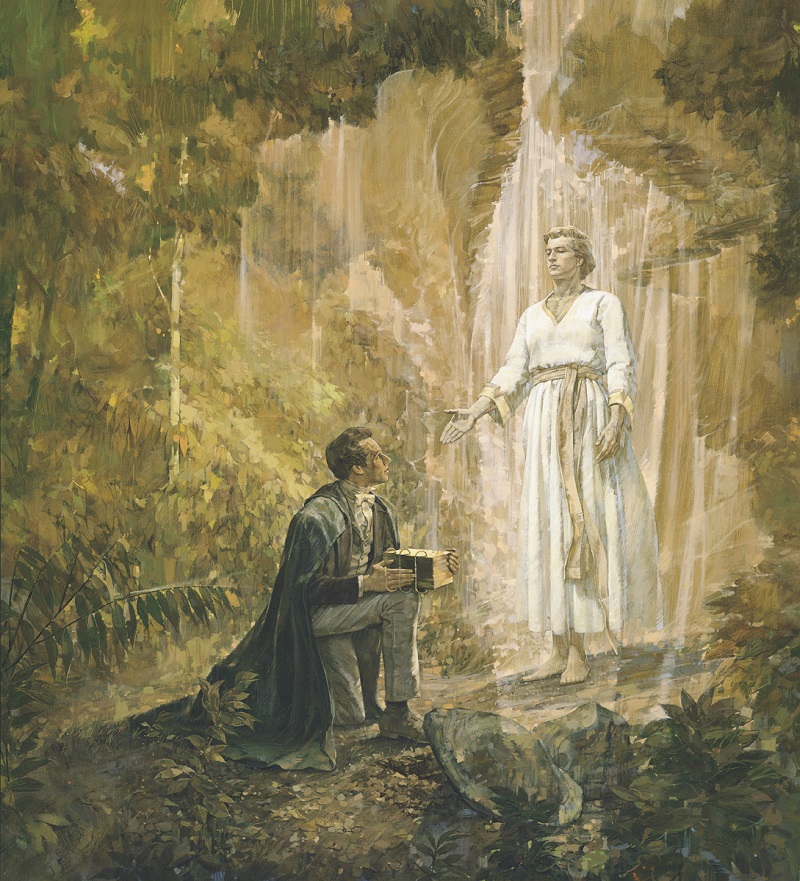
“Joseph Smith Receives the Gold Plates” by Kenneth Riley.
In bringing forth the Book of Mormon, God allowed the dead to communicate the law and testimony of the Lord with the living (see Isaiah 8:19). This was done by sending His angel Moroni to speak clearly to Joseph Smith and also through the miraculous translation of the Book of Mormon itself.16 Unlike the mumbling of the diviners of ancient times, God did this through His own “gift and power” (1 Nephi 13:35; cf. 2 Nephi 27:12–26), as Lord of both the living and the dead (Romans 14:9).17
In a way, the Book of Mormon shows that God’s ability to allow the dead to speak to the living is superior to the forbidden practice of necromancy condemned in the Old Testament. Taking an otherwise negative topic and transforming it into a positive spiritual message is not uncommon in the Bible.18 Old Testament prophets, for instance, would sometimes compare the God of Israel to the false gods of surrounding nations and show how He surpassed them in every way.19 When viewed in this light, the production of the Book of Mormon can be seen as a divinely orchestrated miracle that turns the traditional concept of necromancy on its head.20
Thus, rather than being brought forth through an unsanctioned act of divination, the Book of Mormon has been brought forth to the world of the living by the power of Christ.21 Its words symbolically connect people living today with deceased prophets from long ago.22 Some of these prophets, like Nephi and Moroni, even saw our day. They knew that we would have their record, and in some cases, they wrote as if they were speaking directly to us from the past.23 As we open our hearts to their message, it will be as if they are speaking to us from the dust, as a true and living voice from the past.
Further Reading
Amanda Colleen Brown, “Out of the Dust: An Examination of Necromancy as a Literary Construct in the Book of Mormon,” Studia Antiqua 14, no. 2 (2016): 27–37.
Grant Hardy, “2 Nephi 26 and 27 as Midrash,” Insights 24, no. 5 (2004): 2–3.
Robert A. Cloward, “Isaiah 29 and the Book of Mormon,” in Isaiah in the Book of Mormon, ed. Donald W. Parry and John W. Welch (Provo, UT: FARMS, 1998), 191–247.
Why Does Nephi Begin by Saying “I, Nephi . . .”?

Sign up for Meridian’s Free Newsletter, please CLICK HERE
I, Nephi, having been born of goodly parents, . . . therefore I make a record of my proceedings in my days.” 1 Nephi 1:1
The Know
The best-known words in all of the Book of Mormon may very well be Nephi’s opening line: “I, Nephi, having been born of goodly parents…” (1 Nephi 1:1). While many Latter-day Saints know these words by heart, most people may not be aware that many ancient Near Eastern texts begin this way, and these texts help explain why Nephi would start his record the same way.
In fact, these words may have signaled his authority in writing as king and ruler over his people. A few of the best examples of inscriptions beginning this way come from a king named Barrakab, who put up three large monuments in ancient Syria commemorating his triumphs as king.1 They all begin with the words, “I, Barrakab, son of Panammu…”2 Another inscription begins with the words, “I, Panammu, son of Qirel…”3 These all date to around 750 BC, from before the time of Lehi.4 And these are not the only inscriptions like this. There is one from Moab from 835 BC,5 and three from Phoenicia from 820, 690, and the fifth century BC.6 Just like 1 Nephi 1:1, many of these texts, when translated literally, could be rendered as “I, (name), having been born of (reference to parentage).”7
The wide distribution of these texts, both in time and place, suggest that this formula was a common way to begin monuments during the time of Lehi. First-person usage is not completely unheard of in ancient texts, as appears periodically throughout the Book of Mormon, but this introductory formula is not the only similarity between 1 Nephi and these texts. 1 Nephi 1:1 goes on to state, “having seen many afflictions in the course of my days, nevertheless, having been highly favored of the Lord in all my days…” Some of the ancient Near Eastern inscriptions also continue, immediately after the introductory formula, to discuss their afflictions and the mercy and blessings of their god upon them, just like 1 Nephi does.
One stela, written by King Mesha of Moab around 835 BC, is a good example of this.8 It begins with the words “I, Mesha, son of Chemosh-yatti …” and quickly transitions to a discussion of the afflictions he and his people had suffered, and how his god Chemosh saved his people from their oppressors.9 The inscription by Panammu similarly states that the people suffered “devastation” but that the gods “restored” the land.10 Even the use of the phrase, “in my days,” in 1 Nephi 1:1 resonates with these inscriptions. Four of these inscriptions use this exact phrase to talk about the writer’s own life, as Nephi did.11
The Why
Writing a book introduction that was similar to the introduction on a monumental inscription might seem strange at first. What connection could Nephi’s record possibly have to these inscriptions?12 Yet when both 1 Nephi and the inscriptions are viewed in their context, this connection makes sense.13 These monumental inscriptions were often put up to commemorate the victory of the king over his enemies.14
Nephi was a king as well. The title of 1 Nephi specifically mentions this: “The First Book of Nephi, His Reign and Ministry.” Like the kings who created the monuments, Nephi spent much of his life dealing with challenges. He had to achieve victory over many opponents, first over Laban, and then over his brothers. So, writing something commemorating these victories would be a reasonable thing for him to do.
Moreover, these inscriptions also contain an important element that may have attracted Nephi: they attribute their victories to the gods. Nephi knew that he owed all his victories to the true God, and that He was the one who had helped him through all his trials. He expresses this clearly in 1 Nephi 1:1, “having had a great knowledge of the goodness and the mysteries of God…”

“Lehi en el desierto2” by Jorge Cocco.
Another possible consideration for Nephi when writing his introduction this way was the opportunity for Nephi to show his appreciation to his parents. The other inscriptions all mention the king’s father, but it is interesting that Nephi mentions his “parents” rather than just his father. This sign of appreciation for both his father and his mother is significant by its contrast to the standard for that just mentions the king’s father.
There may also have been one final thing that could have attracted Nephi to this style of introduction: its ability to communicate to future generations. Monumental inscriptions were carved on stone so they would be permanent, telling future generations about the king’s struggles and the role of the deities in overcoming those struggles. One of them even stated, “What I, Matiel, have written will serve as a reminder to my son and to my grandson who come after me.”15 Nephi likely wanted his record to serve the same purpose: to tell future generations of his struggles and triumphs, and the role God played in helping him through all his trials.
The permanence of both stone monuments and metal plates can remind us of the importance of preserving records for the next generation, just as the Church is careful to do today. By beginning the way it does, Nephi’s account can remind all its readers that God can help us overcome our challenges in life, and that our stories can likewise be told in a way that can bring hope to others.
Further Reading
Book of Mormon Central, “Why Did Book of Mormon Authors Use Colophons?” (1 Nephi 1:3),” KnoWhy 443 (June 21, 2018).
John A. Tvedtnes and David E. Bokovoy, “Colophons and Superscripts,” in Testaments: Links Between the Book of Mormon and the Hebrew Bible (Toelle, UT: Heritage Press, 2003), 107–116.
John A. Tvedtnes, “Colophons in the Book of Mormon,” in Reexploring the Book of Mormon: A Decade of New Research, ed. John W. Welch (Salt Lake City and Provo, UT: Deseret Book and FARMS, 1992), 13–16.
Why Can Nephi’s Vision Be Called an Apocalypse?

Sign up for Meridian’s Free Newsletter, please CLICK HERE
View the article at Book of Mormon Central.
And the Spirit said unto me: Behold, what desirest thou? And I said: I desire to behold the things which my father saw.
(1 Nephi 11:2–3)
The Know
In 1 Nephi 11–14, Nephi had a vision in which heavenly messengers showed him various things that would happen in the future. They also explained to him the symbolic vision of his father. Nephi’s vision is similar in many ways to accounts known as apocalyptic texts, such as the Book of Daniel and the Book of Enoch. [1]It is even more similar to texts in the Old Testament, like Zechariah, that are generally considered to be the forerunners of fully developed apocalyptic literature. [2]Yet because those texts were written well after Lehi and Nephi left Jerusalem, one might wonder how a vision, like the ones found in 1 Nephi, could turn up in the sixth century BC. New evidence from an Assyrian text provides a possible explanation for the apocalyptic nature of Nephi’s vision.
A text called The Underworld Vision of an Assyrian Prince, written in the Akkadian language, depicts a visionary named Kummay, who was shown a vision of the underworld. [3]According to Richard J. Clifford, a scholar of apocalypticism, this text is of interest “as a precedent for the tours of heaven and hell that are popular in later … apocalypses.” [4]This text is especially interesting for Book of Mormon studies because it dates from the early seventh-century BC, shortly before the time of Lehi.

Ancient Parthian relief carving of the god Nergal from Hatra
This text is similar to 1 Nephi 11–14. In it, the Assyrian prince Kummay experienced an expansive vision. [5]In a similar way Nephi, who would eventually become king, experienced a significant vision. Such elevating experiences typically validated royal prerogatives.
The Assyrian prince asked to receive the vision, and consequently the gods granted his desire.[6]Nephi likewise asked the Spirit of the Lord if he could see what his father had seen, and was granted a vision based on this request (1 Nephi 11:3).
Kummay was shown an ideal king called the exalted shepherd, who was given responsibility over many things by the god of the underworld. [7]Nephi was similarly told that “there is one God and one Shepherd over all the earth” (1 Nephi 13:41), and in his vision the kingdom of Christ was celebrated (see v. 37).
Kummay saw strange symbolic objects, as did Nephi, and the god Nergal explained to Kummay some of what he was seeing, just as the Spirit of the Lord did for Nephi. [8]
In the Assyrian text, the god Nergal decreed broad destruction on Kummay’s people: “may distress, acts of violence and rebellion together bow you down so that, by their oppressive clamour, sleep may not come to you.” [9]Nephi was similarly told that his people would experience calamities, and even that they would eventually be destroyed (1 Nephi 12:19–20).
In addition, Kummay was told that if he forgot this important god, then the god would “pass a verdict of annihilation” on him. [10]This idea also occurs in the Book of Mormon (see 2 Nephi 1:20).
Biblical scholar Robert Gnuse has argued that some parts of the Old Testament, written in northern Israel, show signs of Assyrian influence. According to him, some these texts date roughly 100 years before Lehi. [11]Because Lehi was from the tribe of Manasseh, in northern Israel, these connections make sense. With this in mind, the similarities between this Assyrian text and the Book of Mormon suggest Nephi’s vision is not anachronistic or out of place. Nephi’s vision is similar to texts from the Ancient Near East that people like Lehi and Nephi would have known about.
Some material in the book of Isaiah helps to support this idea. Isaiah 24–27is generally known as the “Isaiah Apocalypse,” and contains some ideas that one also finds in later apocalyptic literature. Many biblical scholars have assumed that this part of Isaiah was written many years after Lehi left Jerusalem. However, Christopher Hays has argued, based on the language of those chapters, that they were likely written well before Lehi left Jerusalem. [12]Matthew Scott Stenson has noted that Isaiah 49:23–26is similar to apocalyptic as well. [13]This helps to explain how apocalyptic texts could have appeared in the Book of Mormon.
The Why
Because The Underworld Vision of an Assyrian Prince was not discovered until 1849, well after the Book of Mormon was published, the similarities between this ancient Assyrian text and the Book of Mormon serve as evidence for the authenticity of the Book of Mormon. Because of this historically early instance of apocalyptic experience and expression, it is not inappropriate to include Nephi’s account of his expansive vision in 1 Nephi 11–14as apocalyptic.

“Nephi’s Vision of the Virgin Mary” by CCA Christensen
The discovery of this Assyrian text does something else as well: it helps us see in Nephi’s writing one way that God communicates with His children. God could have answered Nephi’s prayer and explained Lehi’s vision using many modes of revelation and communication. But above all, God appears to have explained Lehi’s vision to Nephi in a manner that Nephi was likely familiar with. Because of texts like The Underworld Vision of an Assyrian Prince, Nephi could well have been already familiar with the rudiments of the early apocalyptic tradition, so when he experienced his vision, the way in which he experienced it would have made good sense to him.
We experience things similarly today.[14]God reveals truths to us individually and to prophets speaking to us collectively today in ways that allow us to understand in our own cultural context, just as He did in ancient times. The Lord revealed in the early days of this dispensation of the gospel: “Behold, I am God and have spoken it; these commandments are of me, and were given unto my servants in their weakness, after the manner of their language, that they might come to understanding” (D&C 1:24). Applying this principle, BYU Professor Mark Wright has helpfully noted, “Modern Latter-day Saints believe in continuing revelation, collectively and individually, and cultural context continues to influence the manner in which divine manifestations are received by individuals entrenched within the various cultures that comprise the worldwide church.” [15]
Further Reading
Nicholas J. Frederick, “Mosiah 3 as an Apocalyptic Text,” Religious Educator15, no. 2 (2014): 40–63.
Matthew Scott Stenson, “Lehi’s Dream and Nephi’s Vision Apocalyptic Revelations in Narrative Context,” BYU Studies Quarterly, 51, no. 4 (2012): 155–179.
Jared M. Halverson, “Lehi’s Dream and Nephi’s Vision as Apocalyptic Literature,” in The Things Which My Father Saw: Approaches to Lehi’s Dream and Nephi’s Vision (2011 Sperry Symposium), ed. Daniel L. Belnap, Gaye Strathearn, and Stanley A. Johnson (Salt Lake City and Provo, UT: Deseret Book and Religious Studies Center, Brigham Young University, 2011), 53–69.
Notes:
[1]For more on apocalyptic, see Christopher Rowland, The Open Heaven: A Study of Apocalyptic in Judaism and Early Christianity(Eugene, OR: Wipf and Stock, 1982),49–70; Klaus Koch, The Rediscovery of Apocalyptic(Naperville, IL: Allenson, 1970), 28; John J. Collins, “From Prophecy to Apocalypticism: The Expectation of the End,” in The Encyclopedia of Apocalypticism, ed. John J. Collins (Lexington: The Continuum Publishing Company, 1998), 1:145–159.
[2]Isaiah 24–27, as well as Ezekiel are also seen as forerunners of apocalyptic. See Silviu Bunta, “In Heaven or on Earth: A Misplaced Temple Question About Ezekiel’s Visions,” in With Letters of Light: Studies in the Dead Sea Scrolls, Early Jewish Apocalypticism, Magic, and Mysticism in Honor of Rachel Elior, ed. Daphna V. Arbel and Andrei A. Orlov, Ekstasis: Religious Experience from Antiquity to the Middle Ages, 2(Berlin: De Gruyter, 2011), 28–44.Some have assumed that this material from Isaiah was written after Lehi’s time, however, linguistic analysis shows that it dates from before the time of Lehi. See Christopher Hays, “Hebrew Diachrony and Linguistic Dating in the Book of Isaiah,” presentation given at the 2017 Society of Biblical Literature Annual Meeting.
[3]See Richard J. Clifford, “The Roots of Apocalypticism in Near Eastern Myth,” The Encyclopedia of Apocalypticism, 3 vols., ed. John J. Collins (New York, NY: Continuum Publishing Company, 2000), 1:14–15.
[4]Clifford, “The Roots of Apocalypticism,” 1:15.
[5]For more on the role of visions in apocalyptic, see Rowland, The Open Heaven, 70, as well as John J. Collins, “Toward the Morphology of a Genre,” Semeia14 (1979): 9.
[6]See Seth L. Sanders, “The First Tour of Hell: From Neo-Assyrian Propagands to Early Jewish Revelation,”Journal of Ancient Near Eastern Religions 9, no. 2 (2009): 157.
[7]See Clifford, “The Roots of Apocalypticism,” 1:15.
[8]See Clifford, “The Roots of Apocalypticism,” 1:15.
[9]Alasdair Livingstone, Court Poetry and Literary Miscellanea, State Archives of Assyria 3 (Helsinki, FI: Helsinki University Press, 1989), 74.
[10]Livingstone, Court Poetry, 74.
[11]Robert Karl Gnuse, The Elohist: A Seventh-Century Theological Tradition (Eugene, OR: Cascade Books, 2017), 63.
[12]See Christopher Hays, “Hebrew Diachrony and Linguistic Dating in the Book of Isaiah,” SBL Presentation(Boston, MA, 2017).
[13]Matthew Scott Stenson, “Lehi’s Dream and Nephi’s Vision Apocalyptic Revelations in Narrative Context,” BYU Studies Quarterly, 51, no. 4 (2012): 155–179.
[14]See Book of Mormon Central, “Why Does the Lord Speak to Men ‘According to Their Language’? (2 Nephi 31:3),” KnoWhy 258 (January 6, 2017).
[15]Mark Alan Wright, “‘According to Their Language, unto Their Understanding’: The Cultural Context of Hierophanies and Theophanies in Latter-day Saint Canon,” Studies in the Bible and Antiquity 3 (2011): 65.
Why Was It Significant that Nephi Was Made ‘a Ruler and a Teacher’ Over His Brethren?

Sign up for Meridian’s Free Newsletter, please CLICK HERE
View the article at Book of Mormon Central.
Cover image via LDS.org.
“And inasmuch as thou shalt keep my commandments, thou shalt be made a ruler and a teacher over thy brethren.”
1 Nephi 2:22
The Know
Early on in the book of 1 Nephi, the Lord promised Nephi that if he would keep God’s commandments he would “be made a ruler and a teacher over [his] brethren” (1 Nephi 2:22). As their family’s wilderness journey progressed, this prophecy began to be fulfilled.[1] Yet Nephi’s brothers complained that Nephi had taken this position of ruler and teacher upon himself, which led them to be angry with Nephi and rebellious towards God (1 Nephi 16:37–38).
Many years later, after the family had arrived and settled in the promised land, Nephi was asked by his people to become their king. Although he preferred that they have no king, he accepted the position anyway. It seems this was at least partly due to Nephi remembering the Lord’s prophecy about him being a ruler:
And behold, the words of the Lord had been fulfilled unto my brethren, which he spake concerning them, that I should be their ruler and their teacher. Wherefore, I had been their ruler and their teacher, according to the commandments of the Lord, until the time they sought to take away my life. (2 Nephi 5:19)
Although it defied cultural expectations, the elevation of a younger brother over his elder siblings is a recurring theme in the sacred writings of ancient Israel. Some of the great patriarchs and kings of Israel—including Jacob, Joseph, Judah, Ephraim, David, and Solomon—were given similar promises by the Lord and chosen over elder brothers. As in Nephi’s account, the fulfillment of those promises is clearly demonstrated in the scriptures.

Figure 1 “The Meeting of Esau and Jacob” by James Tissot.
Although Jacob and his brother Esau were twins, Esau was born first and therefore should have received the birthright. In the turn of events in which Jacob was able to secure the birthright blessing in place of his older brother, their father Isaac pronounced the following upon Jacob:
“Let people serve thee, and nations bow down to thee: be lord over thy brethren, and let thy mother’s sons bow down to thee” (Genesis 27:29). The kingdom of Edom, populated by Esau’s descendants, would eventually become a vassal state to Israel after they were conquered by King David (2 Samuel 8:14).
David, whose lineage was to sit on the throne of Israel for all time, was of the tribe of Judah.[2] Judah had been promised, in a blessing from his father, Jacob, that he would rule over his siblings. Although he was the fourth-born son, his patriarchal blessing declared: “Judah, thou art he whom thy brethren shall praise: thy hand shall be in the neck of thine enemies; thy father’s children shall bow down before thee” (Genesis 49:8). Additionally, he was promised that “the scepter shall not depart from Judah” until the time of the Messiah (Genesis 49:10).

Figure 2 Joseph and His Brothers by Harold Copping
Joseph, another son of Jacob, received a similar blessing from the Lord. One of Jacob’s youngest sons, Joseph was shown in dreams that his family members would eventually bow down before him (Genesis 37:6–10). Just as Nephi’s brothers were angry with him, the biblical record states that Joseph’s brothers “hated him yet the more for his dreams, and for his words” (Genesis 37:7).[3]
Joseph’s brothers were so upset by his perceived pretentiousness that they sold him as a slave into Egypt. Ironically, this event eventually led to Joseph becoming a governor over that land (a vice-regent to Pharaoh) and to the fulfillment of his prophetic dreams. When his family was in need and came to Egypt for food, “Joseph’s brethren came, and bowed down themselves before him with their faces to the earth,” just as he had foreseen (Genesis 42:6).
This pattern continued with Joseph’s own sons, Manasseh and Ephraim, who, when their grandfather Jacob blessed them, he put his right hand on younger Ephraim’s head for the birthright blessing rather than on the eldest son Manasseh’s (Genesis 49:13–14).
The Why

Figure 3 Nephi Rebuking his Rebellious Brothers by Arnold Friberg. Image via lds.org
These connections show that Nephi ruled over his older brothers much like his ancestor Joseph did, as well as a line of early patriarchal figures including Joseph’s son Ephraim, his older brother Judah, his father Jacob, and also figures like Moses and David.[4] So, while Nephi’s ascendency over his brothers defied the cultural expectations and patriarchal order of his day, it was still supported by ample scriptural precedent.
Although the birthright was typically passed on to the firstborn son even if the father’s preferences were otherwise (Deuteronomy 21:15–17), the scriptures record many instances in which that blessing and inheritance were granted to a younger son. In general, the reason for this seems to have been that the younger son was simply more righteous. For example, in the case of the first sibling rivalry recorded in the Bible, between Cain and Abel, the Lord favored Abel because of his greater obedience (Moses 5:16–23).
This was the case with Nephi as well. When Lehi saved his family by leading them into the wilderness, his oldest sons, Laman and Lemuel, murmured against him “because they knew not the dealings of that God who had created them” (1 Nephi 2:12). Nephi, although he was the younger son, repeatedly turned to the Lord for answers. As a result, Nephi noted, the Lord “did soften my heart that I did believe all the words which had been spoken by my father; wherefore, I did not rebel against him like unto my brothers” (1 Nephi 2:16).
Whereas Laman and Lemuel were eventually “cut off from the presence of the Lord” for their rebellion, Nephi was “blessed” and given greater responsibility because of his faith (1 Nephi 2:19, 21). The examples of Nephi and others demonstrate that no matter what our situation or position is in life, which is often out of our control, the Lord will judge us based upon our righteousness and bless us accordingly. “For the Lord seeth not as man seeth; for man looketh on the outward appearance, but the Lord looketh on the heart” (1 Samuel 16:7).
Further Reading
Alan Goff, “A Hermeneutic of Sacred Texts: Historicism, Revisionism, Positivism, and the Bible and Book of Mormon,” (MA dissertation, Brigham Young University, 1989), 104–132.
Book of Mormon Central, “Why Was the Sword of Laban So Important to Nephite Leaders? (Words of Mormon 1:13),” KnoWhy 411 (February 27, 2018).
Samuel Tongue, “Sibling Rivalries and Younger Sons,” Bible Odyssey, online.
Notes:
[1] See Book of Mormon Central, “Why Did Nephi Include the Story of the Broken Bow? (1 Nephi 16:23),” KnoWhy 421 (April 3, 2018); Book of Mormon Central, “Why Was the Sword of Laban So Important to Nephite Leaders? (Words of Mormon 1:13),” KnoWhy 411 (February 27, 2018).
[2] David was also a younger son who was elevated over his brethren because the Lord looked “not on his countenance, or on the height of his stature,” his “outward appearance,” but looked “on the heart” (1 Samuel 16:7). His kingdom continued through his son Solomon, also a later-born son.
[3] For a wordplay on the name Joseph and its relationship to his brother’s anger, see Matthew L. Bowen, “‘Their Anger Did Increase Against Me’: Nephi’s Autobiographical Permutation of a Biblical Wordplay on the Name Joseph,” Interpreter: A Journal of Mormon Scripture 23 (2017): 115–136. For more similarities between Nephi and Joseph, see Book of Mormon Central, “How Was Nephi Similar to Joseph of Egypt? (1 Nephi 18:18),” KnoWhy 416 (March 15, 2018).
[4] See Alan Goff, “A Hermeneutic of Sacred Texts: Historicism, Revisionism, Positivism, and the Bible and Book of Mormon,” (MA dissertation, Brigham Young University, 1989), 104–132; Grant Hardy, Understanding the Book of Mormon: A Reader’s Guide (New York, NY: Oxford University Press, 2010), 42–44; Brant A. Gardner, Second Witness: Analytical and Contextual Commentary on the Book of Mormon, 6 vols. (Salt Lake City, UT: Greg Kofford Books, 2007), 1:47; Book of Mormon Central, “How Was Nephi Similar to Joseph of Egypt? (1 Nephi 18:18),” KnoWhy 416 (March 15, 2018).
Is there Evidence of Sunken Cities in Ancient America?

Yea, and the city of Onihah and the inhabitants thereof, and the city of Mocum and the inhabitants thereof, and the city of Jerusalem and the inhabitants thereof; and waters have I caused to come up in the stead thereof.” 3 Nephi 9:7
The Know
After the great destruction which was recorded in 3 Nephi, the Lord’s voice was heard among the people, declaring that the “great city Moroni have I caused to be sunk in the depths of the sea, and the inhabitants thereof to be drowned” (3 Nephi 9:4). The cities of Onihah, Mocum, and Jerusalem suffered similar fates. Concerning them, the Lord declared that “waters have I caused to come up in the stead thereof” (v. 7).
Some may wonder, based on these passages, if there is any evidence that cities were flooded in this manner in the ancient Americas. In the 1990s, Roberto Samayoa noticed ruins on an underwater plateau while he was scuba diving in Lake Atitlan, located in the highlands of Guatemala. The site was named Samabaj, which is partly derived from Roberto’s own last name, and eventually trained archaeologists began to seriously study the area.1 A geophysical survey using side sonar scanning revealed even more man-made structures at other underwater locations along Lake Atitlan’s southern shore.2
Concerning Samabaj, anthropologist John Sorenson noted that the “buildings appear to have been undamaged before their submersion, implying a sudden rise of the water.”3 Journalist Roger Atwood called it an “underwater time capsule unmolested by looters and untouched by urbanization.”4
Researchers have found “about 30 ancient homes, a plaza, staircases, and even saunas, among the submerged ruins of Samabaj.”5 It also features “no fewer than 16 religious structures,” including “at least seven stelas, standing stone markers that often signified power and authority in antiquity.”6 Sonya Medrano, an archaeologist involved with the site’s recent underwater excavation and mapping, has described it as “a place of public rituals and pilgrimage.”7
The sudden rise in water, which left the 30-acre island submerged under 12 to 30 meters of water, was likely due to local volcanic activity.8 Based on ceramic remains, Sorenson felt that the ruins were from the “Late Pre-Classic period, probably around the time of Christ,”9 and Medrano dated “the island’s moment of destruction to no later than A.D. 300.”10
The Why
Samabaj offers a perfect example of the type of destruction experienced by the cities of Onihah, Mocum, and Jerusalem, as explained by the voice of the Lord. Rather than sinking into the sea or having a flash flood come crashing down upon them from above, the Lord declared that “waters have I caused to come up in the stead thereof” (3 Nephi 9:7; emphasis added). This is exactly what happened at Samabaj—the water level of its surrounding lake quickly arose and submerged it. This underwater settlement, which until recent times lay undetected at the bottom of a popular resort lake, demonstrates that the type of flooding mentioned in 3 Nephi is anything but farfetched.
Interestingly, long before the discovery of Samabaj, several LDS scholars identified the region of Lake Atitlan with the waters of Mormon and placed Jerusalem, one of the sunken cities, near its shores.11 It remains uncertain, however, if Samabaj and its sudden flooding had anything to do with Book of Mormon peoples or the destruction reported in 3 Nephi.
After discussing the symbolic and religious significance that Samabaj’s destruction may have held for its inhabitants, Atwood asked, “Did the ancient Maya know why the island was disappearing?”12 It may be similarly relevant to ask if Book of Mormon peoples knew why their cities were being covered with water. From heaven, the Lord’s voice was heard among the people, explaining that this was done “to hide their wickedness and abominations from before my face, that the blood of the prophets and the saints shall not come up any more unto me against them” (3 Nephi 9:7).
This reasoning is actually quite similar to the Lord’s justification for sending the flood in Noah’s time. In Moses 6:28 the Lord explained to Enoch that He would send the flood because “in [the people’s] own abominations have they devised murder, and have not kept the commandments.” These “abominations” were first introduced by Cain, who slew his brother Abel (Moses 5:25). In response to Cain’s murder, the Lord declared, “The voice of thy brother’s blood cries unto me from the ground” (v. 35).
Thus, in both accounts, the floods were sent because of “abominations” which are scripturally linked with the shedding of innocent blood—blood which symbolically calls out from the ground for divine justice.13 The Lord wanted the people to understand that He was bound by His own law to exact justice for the spilling of innocent blood. The rising waters symbolically hid the people’s wickedness and abominations from before the face of the Lord,14 while at the same time cleansing the earth from sin.15
Further Reading
Paul Y. Hoskisson and Stephen O. Smoot, “Was Noah’s Flood the Baptism of the Earth?” in Let Us Reason Together: Essays in Honor of the Life’s Work of Robert L. Millet, ed. Spencer Fluhman and Brent L. Top (Salt Lake City and Provo, UT: Deseret Book, Neal A. Maxwell Institute of Religious Scholarship, and Religious Studies Center, Brigham Young University, 2016).
John L. Sorenson, Mormon’s Codex: An Ancient American Book (Salt Lake City and Provo, UT: Deseret Book and FARMS, 2013), 133–135, 647–648, 664.
John L. Sorenson, “The Submergence of the City of Jerusalem in the Land of Nephi,” Insights 22, no. 155 (2002): 2–3.
- 1.Roger Atwood, “Lost Island of the Maya,” Archeology 68, no. 4 (2015): 42.
- 2.Based on an unpublished geophysical survey examined by Book of Mormon Central staff.
- 3.John L. Sorenson, Mormon’s Codex: An Ancient American Book (Salt Lake City and Provo, UT: Deseret Book and FARMS, 2013), 647.
- 4.Atwood, “Lost Island of the Maya,” 42.
- 5.Atwood, “Lost Island of the Maya,” 43.
- 6.Atwood, “Lost Island of the Maya,” 42–43.
- 7.Atwood, “Lost Island of the Maya,” 43.
- 8.Based on an unpublished geophysical survey. See also, Atwood, “Lost Island of the Maya,” 42. For information about the natural disasters in 3 Nephi and their likely connection to volcanic and geological activity, see Book of Mormon Central, “What Caused the Darkness and Destruction in the 34th Year? (3 Nephi 8:20),” KnoWhy 197 (September 28, 2016).
- 9.Sorenson, Mormon’s Codex, 647. According to Sorenson, his proposed Book of Mormon geography “plausibly places the city of Jerusalem on the south shore of the Lake Atitlan. The near agreement in time between the flooding described in the Book of Mormon city and the rise of the lake waters over Samabaj, as well as the seemingly abrupt manner of that rise, is striking.” Although the timing of Samabaj’s flooding may be too late, Sorenson’s geographical correlation is still intriguing and deserves further consideration and exploration.
- 10.Atwood, “Lost Island of the Maya,” 42.
- 11.John L. Sorenson, An Ancient American Setting for the Book of Mormon (Salt Lake City and Provo, UT: Deseret Book and FARMS, 1985), 175–176, 223–225; Bruce W. Warren and Thomas Stuart Ferguson, The Messiah in Ancient America (Provo, UT: Book of Mormon Research Foundation, 1987), 44; Joseph L. Allen and Blake J. Allen, Exploring the Lands of the Book of Mormon, rev. ed. (American Fork, UT: Covenant, 2011), 637–646, 737–740.
- 12.Atwood, “Lost Island of the Maya,” 45.
- 13.Notably, it was immediately after the flood in Genesis that the Lord explained the symbolic importance of blood to Noah: “Every moving thing that liveth shall be meat for you … But flesh with the life thereof, which is the blood thereof, shall ye not eat. And surely your blood of your lives will I require; at the hand of every beast will I require it, and at the hand of man; at the hand of every man’s brother will I require the life of man” (Genesis 9:4–5).
- 14.The symbolism of hiding or covering sins from before the Lord’s face hearkens back to the story of Adam and Eve, who, after partaking of the fruit of the tree of knowledge, “hid themselves from the presence of the Lord God” (Genesis 3:8). See also 2 Nephi 9:14, Mormon 9:5; Lamentations 1:8; Isaiah 47:3; Revelation 3:18.
- 15.See Paul Y. Hoskisson and Stephen O. Smoot, “Was Noah’s Flood the Baptism of the Earth?” in Let Us Reason Together: Essays in Honor of the Life’s Work of Robert L. Millet, ed. Spencer Fluhman and Brent L. Top (Salt Lake City and Provo, UT: Deseret Book, Neal A. Maxwell Institute of Religious Scholarship, and Religious Studies Center, Brigham Young University, 2016) 163–188.
How a Tangent About Foreordination Helps Explain Repentance

View the article at Book of Mormon Central.
“And this is the manner after which they were ordained—being called and prepared from the foundation of the world according to the foreknowledge of God, on account of their exceeding faith and good works; in the first place being left to choose good or evil; therefore they having chosen good, and exercising exceedingly great faith, are called with a holy calling, yea, with that holy calling which was prepared with, and according to, a preparatory redemption for such.”
Alma 13:3
The Know
When Alma, son of Alma, was speaking to the people in Ammonihah, he taught them about the premortal existence: “And this is the manner after which they were ordained—being called and prepared from the foundation of the world” (Alma 13:3). Yet the rest of Alma’s address is about repentance. This poses the question: Why would Alma interrupt a sermon about repentance with a discussion about the pre-mortal life?[1] A careful reading of Alma’s speech shows that he may actually have brought this up as part of his effort to get them to repent.[2]
One detail that supports this point is that it is often the manner of ordination that Alma focused on: “And those priests were ordained after the order of his Son, in a manner that thereby the people might know in what manner to look forward to his Son for redemption. And this is the manner after which they were ordained…” (Alma 13:2–3).[3] Thus, as A. Keith Thompson has noted, “it is the manner of ordination to the Priesthood on the earth that was foreordained in the pre-existence.”[4] Ultimately, “it is ‘exceeding faith and good works’ on earth that would qualify men for ordination to the Priesthood” or, in other words, adherence to the standards of obedience that were ordained in the pre-mortal life.[5]

The phrase “called and prepared” also supports this interpretation. As Thompson noted, “the words calling and called, in verses 4, 5, 6, 8, and 11 all refer to an ordination in mortality seem to confirm” that Alma “anticipated an ordination following exceeding faith and good works in mortality.”[6] Thus, “those who do not exercise exceeding faith and good works in mortality will not be ordained to the Priesthood.”[7] Ultimately, even though the “calling” was “prepared in the pre-existence, it is extended only in earth life after faith and good works have been demonstrated” (see Alma 13:4–5).[8]
Alma further stated that many “were ordained and became high priests of God; and it was on account of their exceeding faith and repentance, and their righteousness before God, they choosing to repent and work righteousness rather than to perish” (Alma 13:10). This verse suggests, according to Thompson, “that it is the exceeding faith of righteous men on earth that leads to their ordination to the Priesthood and the office of high priest within that Priesthood.”[9]
The importance of righteousness in mortality is made clear in Alma 13:13, “And now, my brethren, I would that ye should humble yourselves before God, and bring forth fruit meet for repentance, that ye may also enter into that rest.” This verse helps to clarify why Alma brought up the pre-mortal life in the first place. He wanted to show that the priesthood, with its associated standards of worthiness, had been prepared before the foundation of the world. All they had to do to receive it was repent and live up to that eternal standard.
The Why

This is one occasion, among many, when the Book of Mormon can help us understand another book of scripture. Abraham 3:22–23 states that God showed Abraham “the intelligences that were organized before the world was; and among all these there were many of the noble and great ones; And God saw these souls that they were good, and he stood in the midst of them, and he said: These I will make my rulers.” Scriptures like this might cause some people to wonder, if so much was determined in the premortal life, what good is repentance and righteousness in this life?
Alma 13 answers this question. It shows that repentance and faith in this life is of the utmost importance, and that faith and repentance today is what matters.[10] As Thompson stated, “Alma was identifying the foreordained worthiness standard as a second witness or proof that repentance and righteousness to a high priestly level was a completely legitimate expectation of all the children of God.”[11]
Joseph Smith stated that everyone “who has a calling to minister to the inhabitants of the world was ordained to that very purpose in the Grand Council of heaven before this world was.”[12] But Alma 13 makes it clear that repentance and faithfulness in this life are still essential, foreordination or not. Alma 13 also helps to give depth to the words of Abraham 3:25–26: “And we will prove them herewith, to see if they will do all things whatsoever the Lord their God shall command them.” Being chosen in the premortal life is not some kind of an eternal free ride.[13] Rather, through our faith and repentance in this life, we live up to the eternal standards that have existed since before the world was.[14]
Through our faith and repentance in this life, not just our inherent goodness or premortal faithfulness, we become the kinds of people Heavenly Father wants us to be, and live up to our divine potential as children of God.
Further Reading
- Keith Thompson, “Were We Foreordained to the Priesthood, or Was the Standard of Worthiness Foreordained? Alma 13 Reconsidered,” Interpreter: A Journal of Mormon Scripture21 (2016): 249–274.
James T. Duke, “The Literary Structure and Doctrinal Significance of Alma 13:1–9,” Journal of Book of Mormon Studies 5, no. 1 (1996): 103–118.
Robert L. Millet, “The Holy Order of God,” in Alma, The Testimony of the Word, Book of Mormon Symposium Series, Volume 6, ed. Monte S. Nyman and Charles D. Tate, Jr. (Provo, UT: Religious Studies Center, Brigham Young University, 1993), 61–88.
[1] For a careful analysis of this chapter, see James T. Duke, “The Literary Structure and Doctrinal Significance of Alma 13:1–9,” Journal of Book of Mormon Studies 5, no. 1 (1996): 103–118.
[2] For another perspective, see Robert L. Millet, “The Holy Order of God,” in Alma, The Testimony of the Word, Book of Mormon Symposium Series, Volume 6, ed. Monte S. Nyman and Charles D. Tate, Jr. (Provo, UT: Religious Studies Center, Brigham Young University, 1993), 61–88.
[3] Emphasis added.
[4] A. Keith Thompson, “Were We Foreordained to the Priesthood, or Was the Standard of Worthiness Foreordained? Alma 13 Reconsidered,” Interpreter: A Journal of Mormon Scripture 21 (2016): 259.
[5] Thompson, “Alma 13 Reconsidered,” 259.
[6] Thompson, “Alma 13 Reconsidered,” 259.
[7] Thompson, “Alma 13 Reconsidered,” 259.
[8] Thompson, “Alma 13 Reconsidered,” 259.
[9] Thompson, “Alma 13 Reconsidered,” 261.
[10] Claims that people were punished with black skin because of premortal unfaithfulness, for example, is clearly wrong. See “Race and the Priesthood,” online at lds.org.
[11] Thompson, “Alma 13 Reconsidered,” 265.
[12] See Joseph Smith, Teachings of the Prophet Joseph Smith, comp. Joseph Fielding Smith (Salt Lake City, UT: Deseret Book, 1972), 365.
[13] For a thorough treatment of the premortal existence, and its relationship to mortality, see Joseph F. McConkie, “Premortal Existence, Foreordinations and Heavenly Councils,” in Apocryphal Writings and the Latter-day Saints, ed. C. Wilfred Griggs (Provo, UT: Religious Studies Center, Brigham Young University, 1986), 173–198.
[14] See Joseph Fielding McConkie and Robert L. Millet, Doctrinal Commentary on the Book of Mormon, 4 vols. (Salt Lake City, UT: Bookcraft, 1987–1992), 3:94.
Why Is David Whitmer’s Witness of the Book of Mormon So Compelling?


View the article at Book of Mormon Central.
“They were perfectly honest and upright in all things; and they were firm in the faith of Christ, even unto the end.”
Alma 27:27
The Know
After traveling nearly 100 miles to reach Harmony, Pennsylvania, David Whitmer met Joseph Smith for the first time at the end of May 1829.[1] David had received word from Oliver Cowdery that Joseph had an ancient record, that he had begun translating it, and that harassment from locals in Harmony was deterring their progress.[2] After remaining long enough to observe the young Prophet in action, which included receiving a personal revelation at Joseph’s hands (Doctrine and Covenants 14), David was satisfied “of the divine inspiration of Joseph Smith.”[3]
With this conviction in place, David used his team and wagon to transport Joseph and Oliver to the home of his parents in Fayette, New York.[4] This allowed the translation to move forward to completion without interruption.[5] The Whitmer home proved to be a vital refuge for the Book of Mormon translation project,[6] and David’s personal interest in it grew as he witnessed Joseph Smith dictate the Book of Mormon, day after day, until its completion at the end of June.[7] As a result of his faith and service, David was chosen as one of the Three Witnesses of the Book of Mormon.[8]

David served in a number of important leadership capacities in the early days of the Church,[9] and his unwavering testimony of the Book of Mormon often inspired those around him. For instance, in 1833 nearly 500 men marched Whitmer and other Church leaders into a town square, stripped them, and tarred and feathered them. Then, with guns cocked and aimed at the prisoners, the mob “threaten[ed] them with instant death unless they denied the Book of Mormon and confessed it to be a fraud.” In response, David “lifted up his hands and bore witness that the Book of Mormon was the Word of God.”[10] Upon seeing the resolve of their prisoners, the mob set them free.
Sadly, David had a falling out with Joseph Smith and was excommunicated for dissension in 1838.[11] Although each of the Three Witnesses fell away from the Church at some point, David was the only one who didn’t eventually return to full fellowship with the Saints. Instead, he lived out a long and reputable life in Richmond, Missouri, where he owned a livery business, actively participated in public events, served multiple terms as a city councilman, and was even elected as mayor.[12]
Despite being separated from the church for over 50 years, David never disavowed his testimony of the Book of Mormon. He took his responsibility as a witness seriously and hosted numerous visitors who were curious about his testimony of the Book of Mormon. He said that “thousands came to inquire,”[13] and in interview after interview he boldly reaffirmed his original statements about seeing the angel, beholding the plates and other Nephite artifacts, and hearing a voice from heaven.[14]

David was known as an honest, upright, hard-working, and capable individual, and his stubborn integrity often perplexed those who knew him well and yet were skeptical of the Book of Mormon. As historian Richard Anderson explained, “Relatively few people in Richmond could wholly accept [David’s] testimony, but none doubted his intelligence or complete honesty.”[15]
On one occasion, a skeptical military officer suggested, in David’s presence, that perhaps David had merely experienced some sort of hallucination. David, having none of this, drew himself up and declared, “No sir! I was not under any hallucination, nor was I deceived! I saw with these eyes, and heard with these ears! I know whereof I speak!” After encountering David’s bold testimony, the officer admitted, “[O]ne thing is certain—no man could hear him make his affirmation, as he has to us in there, and doubt for one moment the honesty and sincerity of the man himself. He fully believes he saw and heard, just as he stated he did.”[16]
On another occasion, James Moyle, a young lawyer, cross-examined David Whitmer and pled with him to disclose any fraud or deceit about his testimony if any existed. As Moyle put it, “I begged of him not to let me go through life believing in a vital falsehood.”[17] David’s reaffirmation left no doubt in Moyle’s mind that he was telling the truth according to his knowledge. After coming away from the interview, Moyle felt that it was “impossible” for David Whitmer to have been insincere.[18]
Like Oliver Cowdery and Martin Harris, David Whitmer remained true to his original convictions about the Book of Mormon, even in the face of death. Nearly two weeks before his passing, David declared that “if God ever uttered a truth, the testimony I now bear is true. I did see the angel of God, and I beheld the glory of the Lord, and he declared the record true.”[19]
The Why
For a number of reasons, David Whitmer’s lifelong testimony is uniquely valuable. For one thing, he was the most interviewed of the Three Witnesses and often seemed to go out of his way to fulfill his duty to testify of the Book of Mormon.[20] Whitmer’s consistent and persistent reaffirmations of his original testimony survive in more than seventy interviews and statements recorded in his own writings and by those who personally discussed the matter with him.[21]
David was also known to correct those whom he felt had significantly misrepresented his views. Especially important is his clarification of the nature of the visionary experience shared by the Three Witnesses and Joseph Smith. Some individuals have tried to claim that because there was a spiritual component to the vision, that it was merely imagined or somehow less than real.[22] To these concerns and misrepresentations, David explained, “Of course we were in the spirit when we had the view, for no man can behold the face of an angel, except in a spiritual view, but we were in the body also, and everything was as natural to us, as it is at any time.”[23]
Perhaps the most powerful aspect of David Whitmer’s testimony is that he remained so absolutely committed to his original statements, while at the same time being so completely separated from the Church. If David never had the vision he claimed, and if he felt slighted by Joseph Smith and other members of the church, then, in the words of his grandson, he would have “had all to gain and nothing to lose” by telling the truth of the matter.[24] Instead, with his dying breaths, David affirmed the truthfulness of the Book of Mormon once and for all.[25]
Whatever his shortcomings may have been and whatever his personal reasons were for distancing himself from the Church,[26] his commitment to telling the truth about his miraculous experience will forever define him as a man of integrity. After reviewing David Whitmer’s contributions as one of the Three Witnesses, Anderson concluded, “Impeccable in reputation, consistent in scores of recorded interviews, obviously sincere, and personally capable of detecting delusion—no witness is more compelling than David Whitmer.”[27]
Further Reading
Kenneth W. Godfrey, “David Whitmer and the Shaping of Latter-day Saint History,” in The Disciple as Witness: Essays on Latter-day Saint History and Doctrine in Honor of Richard Lloyd Anderson, ed. Stephen D. Ricks, Donald W. Parry, and Andrew H. Hedges (Provo, UT: FARMS, 2000), 223–256.
Keith W. Perkins, “Whitmer, David,” Encyclopedia of Mormonism, ed. Daniel H. Ludlow, 4 vols. (New York, NY: Macmillan, 1992), 4:1565–1566.
Lyndon W. Cook, ed., David Whitmer Interviews: A Restoration Witness (Orem, UT: Grandin Book Company, 1991).
Richard Lloyd Anderson, Investigating the Book of Mormon Witnesses (Salt Lake City, UT: Deseret Book, 1981), 67–92.
[1] See John W. Welch, “The Miraculous Timing of the Translation of the Book of Mormon,” in Opening the Heavens: Accounts of Divine Manifestations 1820–1844, 2nd edition, ed. by John W. Welch (Salt Lake City and Provo, UT: Deseret Book and BYU Press, 2017), 108, 168.
[2] For insights concerning Oliver Cowdery’s contributions to the coming forth of the Book of Mormon, see Book of Mormon Central, “How Important was Oliver Cowdery in Bringing Forth the Book of Mormon? (2 Nephi 27:9),” KnoWhy 270 (February 3, 2017).
[3] Welch, “The Miraculous Timing of the Translation,” 176, doc. 99. Several miracles related to this journey helped David Whitmer have faith that he was on the Lord’s errand. These include his fields being miraculously plowed and fertilized as well as Joseph Smith seeing the details of his journey through the Urim and Thummim. See Richard Lloyd Anderson, “The Whitmers: A Family That Nourished the Church,” Ensign, August 1979, online at lds.org; Keith W. Perkins, “True to the Book of Mormon—The Whitmers,” Ensign, February 1989, online at lds.org.
[4] Emma apparently joined them a short time later. See Welch, “The Miraculous Timing of the Translation,” 108, 170.
[5] This blessing, however, didn’t come without sacrifice. Because of the strain of caring for so many extra people, Mary Whitmer (David’s mother) became exhausted and discouraged. Several reports indicate that while she was out milking her cows one day, she was visited by a messenger who showed her the plates. See Larry C. Porter, “The Peter Whitmer Log Home: Cradle of Mormonism,” Religious Educator 12, no. 3 (2011): 179–180; Royal Skousen, “Another Account of Mary Whitmer’s Viewing of the Golden Plates,” Interpreter: A Journal of Mormon Scripture 10 (2014): 35–44.
[6] Porter, “The Peter Whitmer Log Home,” 177–182.
[7] See Welch, “The Miraculous Timing of the Translation,” 112–114. See also, Book of Mormon Central, “Why Did the Book of Mormon Come Forth as a Miracle? (2 Nephi 27:23),” KnoWhy 273 (February 10, 2017).
[8] See Book of Mormon Central, “Why Were Three Key Witnesses Chosen to Testify of the Book of Mormon? (Ether 5:4),” KnoWhy (January 27, 2017).
[9] These included being called on a mission, serving as the president of the church in Missouri, helping establish the Quorum of the Twelve Apostles, and drafting rules and regulations for the Kirtland temple. See Keith W. Perkins, “Whitmer, David,” in Encyclopedia of Mormonism, ed. Daniel H. Ludlow, 4 vols. (New York, NY: Macmillan, 1992), 4:1565.
[10] Richard Lloyd Anderson, Investigating the Book of Mormon Witnesses (Salt Lake City, UT: Deseret Book, 1981), 83–84.
[11] Perkins, “Whitmer, David,” 4:1565.
[12] See Anderson, Investigating the Book of Mormon Witnesses, 72.
[13] Anderson, Investigating the Book of Mormon Witnesses, 79.
[14] See Anderson, Investigating the Book of Mormon Witnesses, 79–105.
[15] Anderson, Investigating the Book of Mormon Witnesses, 74.
[16] Anderson, Investigating the Book of Mormon Witnesses, 88.
[17] Anderson, Investigating the Book of Mormon Witnesses, 85.
[18] Anderson, Investigating the Book of Mormon Witnesses, 85.
[19] Anderson, Investigating the Book of Mormon Witnesses, 90.
[20] For a valuable collection of these interviews, see Lyndon W. Cook, ed., David Whitmer Interviews: A Restoration Witness (Orem, UT: Grandin Book Company, 1991). For reviews of this resource, see Richard Lloyd Anderson, “Review of David Whitmer Interviews: A Restoration Witness,” Journal of Mormon History 20, no. 1 (1994): 186–193; Daniel C. Peterson, “Review of David Whitmer Interviews: A Restoration Witness,” Review of Books on the Book of Mormon 5, no. 1 (1993): 113–115.
[21] Anderson reported to have “over fifty” interviews in Anderson, Investigating the Book of Mormon Witnesses, 79. However, in a FairMormon presentation, given in 2004, Anderson had collected “a minimum of 70” interviews for David Whitmer. See Richard Lloyd Anderson, “Explaining Away the Book of Mormon Witnesses,” FairMormon presentation, 2004, online at bookofmormoncentral.org. See also, Peterson, “Review of David Whitmer Interviews,” 113: “Lyndon W. Cook has done us a considerable service in gathering together all the reports of all the known interviews given by David Whitmer on the subject of the Book of Mormon, to which he was a witness. Seventy-two different accounts, ranging over the half-century from 1838 to 1888, are supplemented by eighteen letters and newspaper statements from Whitmer and others.”
[22] For responses to these views, see Richard Lloyd Anderson, “Attempts to Redefine the Experience of the Eight Witnesses,” Journal of Book of Mormon Studies 14, no. 1 (2005): 18–31, 125–27; Anderson, “Explaining Away the Book of Mormon Witnesses,” online at bookofmormoncentral.org; Daniel C. Peterson, “Tangible Restoration: The Witnesses and What They Experienced,” FairMormon presentation, 2004, 9–33, online at fairmormon.org; Steven C. Harper, “The Eleven Witnesses,” in The Coming Forth of the Book of Mormon: A Marvelous Work and a Wonder, ed. Dennis L. Largey, Andrew H. Hedges, John Hilton III, and Kerry Hull (Salt Lake City and Provo, UT: Deseret Book and Religious Studies Center, Brigham Young University, 2015), 117–132; an earlier and shorter version of this article was published as “Evaluating the Book of Mormon Witnesses” Religious Educator 11, no. 2 (2010): 36–49.
[23] Anderson, Investigating the Book of Mormon Witnesses, 87.
[24] Anderson, Investigating the Book of Mormon Witnesses, 86.
[25] Anderson, Investigating the Book of Mormon Witnesses, 90.
[26] For a treatment of David’s relationship with the church and his later views toward Mormonism, see Kenneth W. Godfrey, “David Whitmer and the Shaping of Latter-day Saint History,” in The Disciple as Witness: Essays on Latter-day Saint History and Doctrine in Honor of Richard Lloyd Anderson, ed. Stephen D. Ricks, Donald W. Parry, and Andrew H. Hedges (Provo, UT: FARMS, 2000), 223–256.
[27] Anderson, Investigating the Book of Mormon Witnesses, 90.
How Can the Book of Mormon Survivors Give Us Hope?

View the article on Book of Mormon Central.
“I even remain alone to write the sad tale of the destruction of my people.”
Mormon 8:3
The Know
Hugh Nibley once described the Book of Mormon as a “tragic book” which begins and ends with destruction and lone survivors.[1] Its prophetic authors had great cause to mourn, yet the fact that its message of hope in Christ was conveyed by those who had witnessed and survived the worst of human depravity only strengthens its spiritual power. As Steve Walker expressed, “If ever hope were earned, it is this optimism pervading the Book of Mormon narrative, even in the face of the end of all things.”[2]
Lehi, Nephi, and Jacob
When Lehi was called as a prophet, he was shown “great and marvelous things … concerning the destruction of Jerusalem” (1 Nephi 1:18). Years later, Nephi not only revealed that this destruction had taken place (2 Nephi 25:10), but he saw that in the future his own people would suffer a similar fate: “O the pain, and the anguish of my soul for the loss of the slain of my people! For I, Nephi, have seen it, and it well nigh consumeth me before the presence of the Lord” (2 Nephi 26:7).
Lehi’s son, Jacob, wrote that his people were “wanderers, cast out from Jerusalem, born in tribulation, in a wilderness, and hated of our brethren, which caused wars and contentions; wherefore, we did mourn out our days” (Jacob 7:26). In light of such sobering statements, Lisa Hawkins and Gordon Thomasson noted that “Lehi’s entire family can be considered survivor-witnesses of a sort, fleeing from … Jerusalem to save Lehi’s life.”[3] Yet Lehi, Nephi, and Jacob all rejoiced in Christ and the Plan of Salvation on numerous occasions, even in the midst of sorrow and suffering.[4]
Alma the Elder

Alma can be seen as a survivor-witness of Abinadi’s prophecies and tragic martyrdom. After risking his own life by pleading on Abinadi’s behalf, Alma went into hiding, wrote down Abinadi’s words, and used them to gather a following (Mosiah 17:2–4). Sadly, Alma’s followers were forced to flee into the wilderness to escape King Noah’s soldiers, only to fall into bondage under Amulon and his Lamanite army a short time later. In the midst of these trying circumstances, the Lord declared to His people that He would ease their burdens so that they could “stand as witnesses for me hereafter, and that ye may know of a surety that I, the Lord God, do visit my people in their afflictions” (Mosiah 24:14).[5]
Alma the Younger and Amulek
While witnessing the terrible martyrdom of women and children by fire, “Amulek said unto Alma: Behold, perhaps they will burn us also. And Alma said: Be it according to the will of the Lord. But, behold, our work is not finished; therefore they burn us not.” (Alma 14:12–13).[6] Alma and Amulek survived this ordeal when others didn’t, so that they could witness of and testify against the “the chief judge, and the lawyers, and priests, and teachers” who had committed such terrible crimes.[7] While Alma and Amulek were being persecuted by their captors, an earthquake caused the surrounding prison walls to fall, and “every soul within the walls thereof, save it were Alma and Amulek, was slain” (Alma 14:28).[8]
Mormon
Mormon’s lament for the destruction of his people is filled with terrible anguish: “O ye fair sons and daughters, ye fathers and mothers, ye husbands and wives, ye fair ones, how is it that ye could have fallen! But behold, ye are gone, and my sorrows cannot bring your return” (Mormon 6:19–20).[9] As a survivor-witness, Mormon declared, “I did stand as an idle witness to manifest unto the world the things which I saw and heard” (Mormon 3:16).[10] Yet, despite such sorrow, Mormon also stated that he was “filled with charity” (Moroni 8:17) which “rejoiceth in the truth, beareth all things, believeth all things, hopeth all things, endureth all things” (Moroni 7:45).
Ether and Moroni

For years, Ether hid himself in the “cavity of a rock” while he witnessed and recorded the entire destruction of his people (Ether 13:18–24). Similarly, Moroni explained, “I even remain alone to write the sad tale of the destruction of my people” (Mormon 8:3).[11] Yet at the very end, these faithful survivor-witnesses saw a bright future beyond death.
Ether could say, “Whether the Lord will that I be translated, or that I suffer the will of the Lord in the flesh, it mattereth not, if it so be that I am saved in the kingdom of God” (Ether 15:34). And in his final words, Moroni remarked, “I soon go to rest in the paradise of God, until my spirit and body shall again reunite, and I am brought forth triumphant through the air” (Moroni 10:34).
The Why
In a remarkable study on those who have survived terrible atrocities, Terrence Des Pres explained that having their story told is “enormously important to people facing extinction. In the survivor’s own case … it becomes a way to transcend the helplessness which withers hope and self-respect.”[12] This certainly seems to be the case with the Book of Mormon prophets who, in the midst of tragic episodes of grief and suffering, diligently recorded their experiences for future generations.[13]
In our own day, millions suffer from having experienced or witnessed terrible things. Soldiers who experience combat often suffer from post-traumatic stress disorder (PTSD).[14] Countless individuals struggle with feelings of depression, loneliness, heartache, disappointment, disinterest, and a number of other personal sorrows, mental limitations, and emotional scars. Some of these feelings are due to severe chemical imbalances. Others may be caused by different circumstances out of an individual’s control. And sometimes those who suffer simply don’t have good answers for why they feel so unhappy.[15]

The Book of Mormon offers a powerful message of hope to those who for whatever reason have cause to mourn. It shows that while the suffering of its prophetic survivors was real and acute, their overwhelming sorrow was ultimately “swallowed up in the joy of Christ” (Alma 31:38). They mourned for the pain and suffering of their people, but they also looked to the future with hope. They knew that by witnessing and recording these sad experiences, they could help future generations avoid unnecessary sorrows. Elder Dallin H. Oaks has taught that “Lord will not only consecrate our afflictions for our gain, but He will use them to bless the lives of countless others.”[16]
In each case, the Book of Mormon’s sad tales of human atrocities help us refocus our minds and hearts on Jesus Christ—whose infinite sacrifice gives meaning and purpose to our very existence. Not only did Christ experience His own excruciating trials, but through His divine power, He willingly witnessed and participated in our suffering in a way that is personal to each of us.[17] He is the ultimate survivor-witness. He descended below all things, witnessed the worst of death and hell,[18] and yet rose again with hope and “healing in His wings.”[19] Elder Jeffrey R. Holland taught, “It is only an appreciation of this divine love that will make our own lesser suffering first bearable, then understandable, and finally redemptive.”[20]
Further Reading
Jeffrey R. Holland, “Like a Broken Vessel,” Ensign, November 2013, 40–42, online at lds.org
Gordon C. Thomasson, “The Survivor and the Will to Bear Witness,” in Reexploring the Book of Mormon: A Decade of New Research, ed. John W. Welch (Provo, UT: FARMS, 1992), 266–268.
Lisa Bolin Hawkins and Gordon Thomasson, “I Only Am Escaped Alone to Tell Thee: Survivor Witnesses in the Book of Mormon” FARMS Preliminary Reports (1984): 1–13.
[1] Hugh Nibley, Teachings of the Book of Mormon, 4 vols. (Provo, UT: FARMS, 1993), 1:62. In literary perspective, a comedy is a story where everything starts out well, descends into chaos, but then eventually ends well, following a pattern of the letter “V” or “W” (if there are multiple falls and returns). Tragedy, on the other hand, is where everything goes from bad, to worse, to unimaginably terrible, and the story does not end well, following the pattern of the letter “Z”.
[2] Steve Walker, “Last Words: 4 Nephi–Moroni,” in The Reader’s Book of Mormon, ed. Robert A. Rees and Eugene England, Volume 7 (Salt Lake City, UT: Signature Books, 2008), xvii.
[3] Lisa Bolin Hawkins and Gordon Thomasson, “I Only Am Escaped Alone to Tell Thee: Survivor Witnesses in the Book of Mormon” FARMS Preliminary Reports (1984): 8.
[4] For examples, see 2 Nephi 2:25; 2 Nephi 4:30; 2 Nephi 9:18. See also, Allan D. Rau, “Cheer Up Your Hearts: Jacob’s Message of Hope in Christ,” Religious Educator 14 no. 3 (2013): 49–63.
[5] Emphasis added. See Book of Mormon Central, “How Does the Lord Make Our Burdens Light? (Mosiah 24:15),” KnoWhy 102 (May 18, 2016).
[6] See Book of Mormon Central, “Why Does God Sometimes Allow His Saints to Be Martyred? (Alma 14:11),” KnoWhy 351 (August 11, 2017).
[7] John W. Welch, Legal Cases in the Book of Mormon (Provo, UT: BYU Press and Neal A. Maxwell Institute for Religious Scholarship, 2008), 262–263.
[8] See Book of Mormon Central, “What Kind of Earthquake Caused the Prison Walls to Fall? (Alma 14:29),” KnoWhy 121 (June 14, 2016).
[9] See Book of Mormon Central, “Why Did Mormon Write So Little about His Own Time Period? (Mormon 2:18),” KnoWhy 227 (November 9, 2016).
[10] See Book of Mormon Central, “What Was Mormon’s Purpose in Writing the Book of Mormon? (Mormon 5:14),” KnoWhy 226 (November 8, 2016).
[11] See Book of Mormon Central, “Why Did Moroni Write So Many Farewells? (Mormon 8:1),” KnoWhy 233 (November 17, 2016); Mark D. Thomas, “Moroni: The Final Voice,” Journal of Book of Mormon Studies 12, no. 1 (2003): 88–99, 119–120.
[12] Terrence Des Pres, “Survivors and the Will to Bear Witness,” Social Research 40 no. 4 (1973): 678.
[13] See Hawkins and Thomasson, “I Only Am Escaped Alone to Tell Thee,” 1–13; Gordon C. Thomasson, “The Survivor and the Will to Bear Witness,” in Reexploring the Book of Mormon: A Decade of New Research, ed. John W. Welch (Provo, UT: FARMS, 1992), 266–268.
[14] For the likelihood that several Book of Mormon prophets experienced the emotional and physical scars of war, see Morgan Deane, “Experiencing Battle in the Book of Mormon,” Interpreter: A Journal of Mormon Scripture 23 (2017): 250–252.
[15] For a discussion of mental illness, depression, and hope in Christ, see Jeffrey R. Holland, “Like a Broken Vessel,” Ensign, November 2013, 40–42, online at lds.org
[16] Dallin H. Oaks, “Give Thanks in All Things,” Ensign, 2003, online at lds.org.
[17] See Dallin H. Oaks, “Strengthened by the Atonement of Jesus Christ,” Ensign, November 2015, 61–64, online at lds.org.
[18] See Psalm 116:3; 2 Nephi 9:10–26; Revelation 1:18.
[19] See 2 Nephi 25:13; 3 Nephi 25:2; Malachi 4:2.
[20] Jeffrey R. Holland, “Like a Broken Vessel,” Ensign, November 2013, 40, online at lds.org
FEATURES