











Yesterday, my husband and I received an email that brought broad smiles. It came from one of our missionaries we served with in the Dominican Republic. I’ll call him Elder Castro. We had not heard from him for nearly 11 years.
He had arrived in our mission as a shy missionary from a Central American country known for its drug gangs and violence. We sent him to an area in Santiago to work. His companion was an effective and confident missionary. We were hoping that his training companion would be able to instill some of his own confidence in this new, young, hesitant missionary.
Elder Castro was diminutive in stature and seemed even smaller as he tended to shrink inside himself with a steady downward gaze and downward-sloping shoulders when others addressed him. He rarely engaged with others or smiled.
Shoes, Laughter, and a Turning Point
A few weeks later, when my husband, John, was counseling with Elder Castro’s trainer, I sought out Elder Castro and, with my halting Spanish, tried to get him to share some of his thoughts. His companion had contacted John to complain that Elder Castro was impossible to deal with. For example, the day before, as they had been walking down a country road, Elder Castro had abruptly stopped in the middle of the road and refused to go any further. His companion tried to coax him out of the middle of the road as the cars were having to go around him, honking loudly with irritation. But he refused to move, staring intently at the ground and not responding to his companion.
Minutes passed. Nothing broke the impasse. His companion finally sat on the side of the road for what seemed like half an hour until Elder Castro slowly shuffled out of the middle of the road, and without a word, headed home to their apartment.
As I watched this young Elder struggle, one day during a break in a zone conference, I pulled him aside and felt inspired to tell him a funny story I had heard the day before. To my surprise, he laughed at the punch line. He was still staring at the ground. I told him a related funny experience. We both laughed again. His head was now up, and he was looking into my eyes. A third story rolled out. We both laughed together.
I told him I had heard a fourth story, but only he knew the punch line. I told him about an Elder who had suddenly stopped in the middle of a country road and refused to go any further. “Now you finish the story,” I suggested.
At first, a guarded look flitted across his face. Then, hesitantly, he confided in me that he was the Elder in this story.
“And . . . . . ?” I asked expectantly.
Instead of pulling back inside himself as I feared he might, he confessed, “I did it because the bottom had completely fallen off one of my shoes. My shoes are cheap. I was too embarrassed to tell my companion. He has nice clothes. He doesn’t know what it’s like to be ashamed of your appearance.” I wanted to cry, but instead I laughed. He lifted his downcast eyes and slowly began laughing with me. Smiling gently, I told him that sometimes missionaries left shoes when they returned home. Would he like me to see if I could find a pair that would fit him? He seemed struck with disbelief. “Could you do that? Then I could stay on my mission.”
John and I had a friend back in the States who would often send us money while we were serving, with instructions to use it to bless someone’s life. He knew that we were serving in a country that struggled with a great deal of poverty, and he trusted us to use his donations carefully. Later that day, I went shopping and found a pair of shoes for Elder Castro. We dropped them off at his apartment before heading back to the mission home that evening. Elder Castro seemed dumbstruck.
Growing Up Afraid
A short time later, we had a Zone conference in his zone, focused on the Atonement. After returning to the mission home, we were surprised to get a call from Elder Castro. He said he needed to drop by. A few minutes later, Elder Castro arrived carrying a fairly large cardboard box. He opened it to reveal an assortment of cellphones and video game players, along with a plethora of video games. There were dozens of them. As John gaped at the contents of the box, Elder Castro explained that all these items had been stolen. He had stolen them from investigators and members.
I’ve not often seen my husband speechless, but the silence that followed the opening of the box was long and heavy. Elder Castro haltingly explained that he had spent his life living on the streets of a drug-infested neighborhood in Central America—streets that were controlled by the drug gangs and “tigres”. He lived in fear of these thugs. His father had abandoned the family. His mother, desperate to feed her two children, finally got entangled in the drug trade. It enabled her to buy a small second-story apartment and to put food on the table. All went reasonably well until his mother was caught by the police and sentenced to several years in prison.
Elder Castro and his little sister now had to fend for themselves, not an easy task for two young children. After losing his mother, he had stopped attending school because his clothes were so ragged and the other students made fun of him.
The two of them lived alone and in constant fear of physical violence or of being killed. Two young children alone on the streets are too often prey to the shady characters who inhabit the drug neighborhoods. So they lived in the shadows to avoid the “tigres”. Every day was a fight to stay alive. They tried to protect each other and soon learned that they could feed themselves only by stealing.
I had noticed that his left eye seemed damaged and didn’t track with his right eye. I asked him if that had been a birth defect. He told me of one time when he had found an unused firecracker on the streets. As any normal boy would be, he was very excited. He found a small hole in a brick wall. It had been created when a piece of the cement holding the bricks together broke and fell, leaving a small hole.
He carefully wedged the firecracker in the hole, lit it, and waited breathlessly. After about 30 seconds, the firecracker had not gone off. Disappointed, he assumed it was a dud. He put his eye up to the small hole to see what had happened. At that moment, the firecracker exploded, shooting a searing pain into his eye. Hearing this story, I wanted to cry. Here was this vulnerable kid, with no money for a doctor, damaging his eye permanently. It broke my heart.
Missionaries on the Stairwell
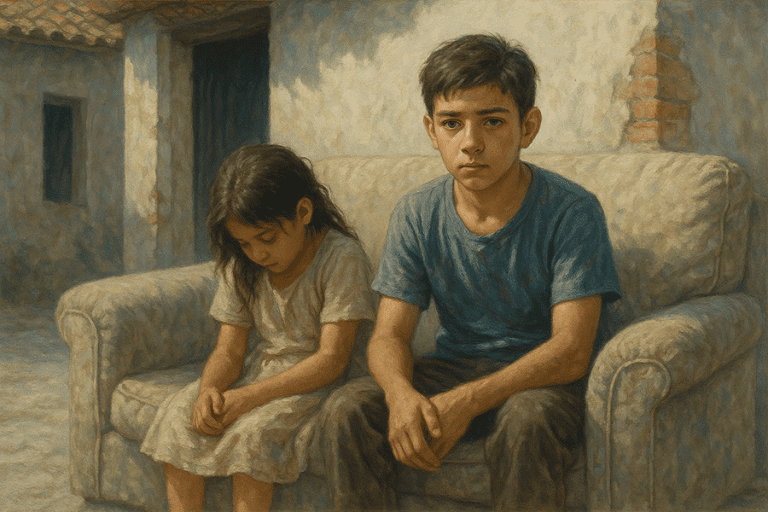
Later, he and his sister found an old couch discarded next to a dumpster. What a find! They had nowhere to sit in their mother’s apartment. They struggled to get the couch through the streets. When they finally got to their apartment building, they nearly despaired of getting it up the narrow stairs into their apartment. They started, but couldn’t even get it past the first turn. They slumped down on the tilted couch stuck in the corner of the stairwell.
Just then, he heard a voice behind him. “Necessita ayuda?” spoken in a thick foreign accent. Turning, he saw two young men dressed in business suits, smiling. They were both wearing a nametag that read, The Church of Jesus Christ of Latter-day Saints. He and his sister were happy for the help, and soon all four were sitting, catching their breath on the couch in their apartment.
The two young men were missionaries. They shared a spiritual message with the two kids and left. Every few days, the missionaries dropped in on them to see how they were faring. They taught them about the restored Church of Jesus Christ.
Slowly, he began to realize that he mattered. He wanted to be “good”. He wanted God not give up on him. More than anything, he wanted to become a missionary and teach other forgotten and discarded people that they mattered and were important to God. He wanted to become like the missionaries who had been so good to him.
As soon as he was baptized, he told his Bishop he wanted to become a missionary. His Bishop worked with him, helping him prepare to serve. He had to go back to school and graduate. Elder Castro said that getting his call was the happiest day of his life.
The Impossible Decision
He arrived in the mission field full of high hopes, but feeling inferior to all the missionaries who not only had nice clothes, but who understood so much more than him of the Gospel. He was disappointed in himself when he realized he couldn’t stop stealing. It seemed to be a survival drive that was out of his control.
He told us that he had been touched by our talks on the Atonement and realized he needed to confess and make amends. He had spent so much of his life living by stealing objects that he said he couldn’t NOT steal an object that was unprotected. He hated that he did it, but said he couldn’t help himself. When John suggested to him that he return every stolen item, he was crestfallen, confessing that he couldn’t even remember who he had stolen them all from, as there were so many.
John made an appointment for him to meet with a psychologist who had helped several of our missionaries who seemed to be struggling with intractable challenges. After spending several hours with Elder Castro, the psychologist informed John that, unfortunately, Elder Castro’s psychological challenges were too deep and complex to be resolved without intensive, daily counseling for an extended period of time. He would need to be committed to a psych hospital.
John had been communicating with his advisor in the missionary department of the Church. It was strongly recommended to him to send Elder Castro home. The Area Presidency also insisted that he be sent home. But John hesitated, because he knew that Elder Castro had no family and no resources to seek the mental health intervention that he so desperately needed. But it was clear we couldn’t keep him in the mission field. The missionary program wasn’t set up to provide months of intervention in a mental health facility.
It was also clear that we couldn’t have a missionary stealing from his investigators and converts! And so it was that with a heavy heart, the decision was made to send him home.
A Heartbreaking Goodbye
During the time that all these decisions were being made, Elder Castro was talking to me in the kitchen of the mission home. He asked me if there was any hope for him to remain on his mission. I told him I was hoping against hope but was worried about the counsel John would be receiving from his superiors. Elder Castro looked at me with tears in his eyes and told me I was the only person, other than the two missionaries in Honduras, who had ever shown him love. All because I had provided him with a pair of shoes. I couldn’t help but think of what a low bar that was.
He pulled out of his backpack a small handbag that had been crocheted. He shyly extended it toward me. It had a heart in the middle of a fascinating design. He told me he had crocheted it for me when I had given him the shoes, but was too embarrassed to give it to me. Now he was hoping I wouldn’t be too ashamed of him to accept his simple gift. With tears flowing, I accepted his gift and hugged it to my chest.
John returned from all his phone calls with the unhappy news that we would have to send Elder Castro home. He told us that he had called Elder Castro’s Bishop and Stake President. They both had promised to help him in every way possible. John had committed to providing the financial resources necessary for his treatment. By now, we were all three crying together. It was one of the unhappiest days of my mission.
I have saved that precious handbag for all these years. Every time I see it, I get a pang of sorrow for the young orphan missionary that we had loved so dearly.
What the Atonement Makes Possible
Imagine our delight to receive a letter from him this past week! He is doing well. He is working and supporting himself and his sister. He is active in the Church and is very proud of all that he has been able to accomplish. He hoped that we had been able to forgive him. Forgive him?? Absolutely!!! Our hearts were filled to overflowing with joy to hear of his success.
I fervently believe that God loves every son and daughter, regardless of their struggles. I believe that He forgives, strengthens, and blesses every child who desires to be good, regardless of their past mistakes and sins. I also know how tempting it is for those of us who have not had debilitating struggles to judge others who have wrestled with them. What a beautiful reminder this was to me of the infinite power and love of the Atonement. How grateful I am for a Savior who provided a pathway for each of us to return to Him regardless of our failings and shortcomings.




Janene ZimmermanDecember 28, 2025
This is a beautiful story of a missionary plagued by trauma from his childhood survival. It shows that love can make all the difference in a life that can seem hopeless. Those that intervened and showed that love got him on the right track. He can be a cycle breaker making changes in the trajectory of his life. A miracle here.
MarciDecember 16, 2025
Oh what a heartbreaking, tender story! I am so glad that it was the Douglas' that were there to help him. And give us all the powerful reminder of the Savior and the Atonement. How grateful I am! Thank you Becky, for this story!