









We’ve had our grandson JJ Tomsick with us this last week since he qualified to play in a special golf tournament for the American Junior Golf Association here in Puerto Rico. For several days he played on the Grand Reserve Golf Club, a course lined with palm trees, the Caribbean blue ocean, and a tidal river, all providing considerable obstacles for the eager players hoping to land their balls in the hole.
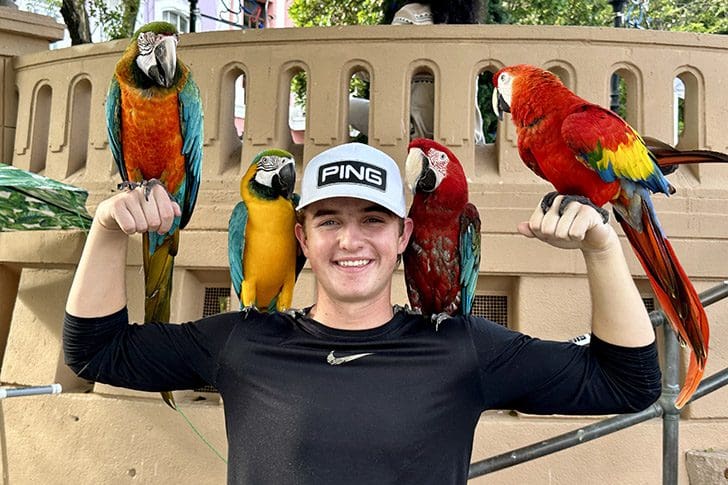
We loved to get this vacation taste of Puerto Rico. In Old San Juan, we stopped at Columbus Square where JJ got the full Caribbean treatment with four macaws loaded on his arms and head. For five bucks, we got 42 photos and one video. That’s a bargain.
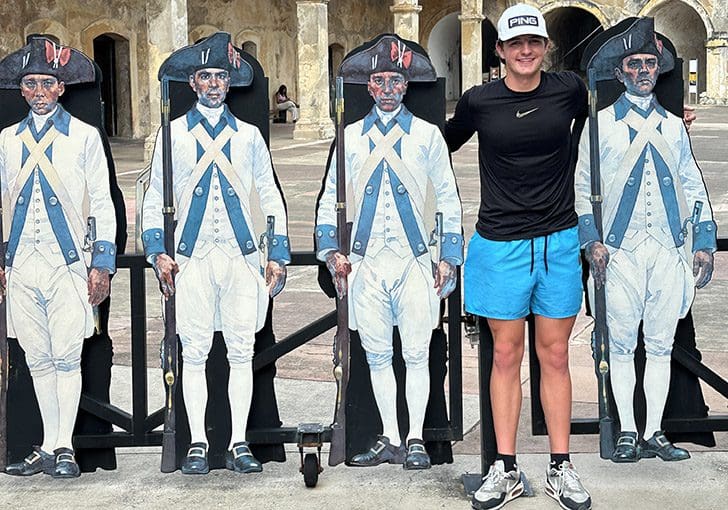 JJ also lined up with the soldiers at the Castillo San Cristóbal.
Still, our favorite moment with him was at the temple. He had mentioned weeks before he came that, within that busy sports schedule, he really wanted to go to the temple.
Because my husband, Scot, mentally counts things, I know that the temple is only 117 steps from my front door and, thus, in the landscape of my mind, the temple shines close and brightly. We told JJ that this temple was more like a home of the Lord. It is small enough that you feel you are invited into a sacred, small and personal space—His living room. You can just feel His arms around you as you enter.
Certainly, part of this is because it hasn’t taken very many visits before we know the temple workers. Their faces are familiar and loving. They put their arms around us and sometimes we are greeted with a kiss on the cheek.
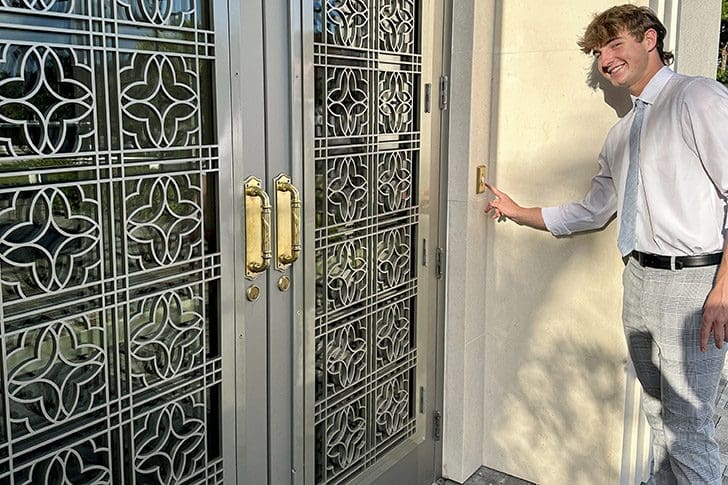
We also told JJ that this House of the Lord had a doorbell, and if the door wasn’t unlocked when you got there, you could just step forward and ring the bell to be let in. He wanted to ring the bell, but we said, “You know the temple is already open. That probably isn’t a good idea.” Instead, we decided to pose a picture of him as if he were ringing the bell, but to the surprise of all of us, the temple was still locked. He got to ring the doorbell to enter God’s own place.
So, JJ and I sat on the bench, watching the baptisms and suddenly this happiness just came over us like a river. It was a happiness only God can give and I knew we both felt it, long before we talked about it later.
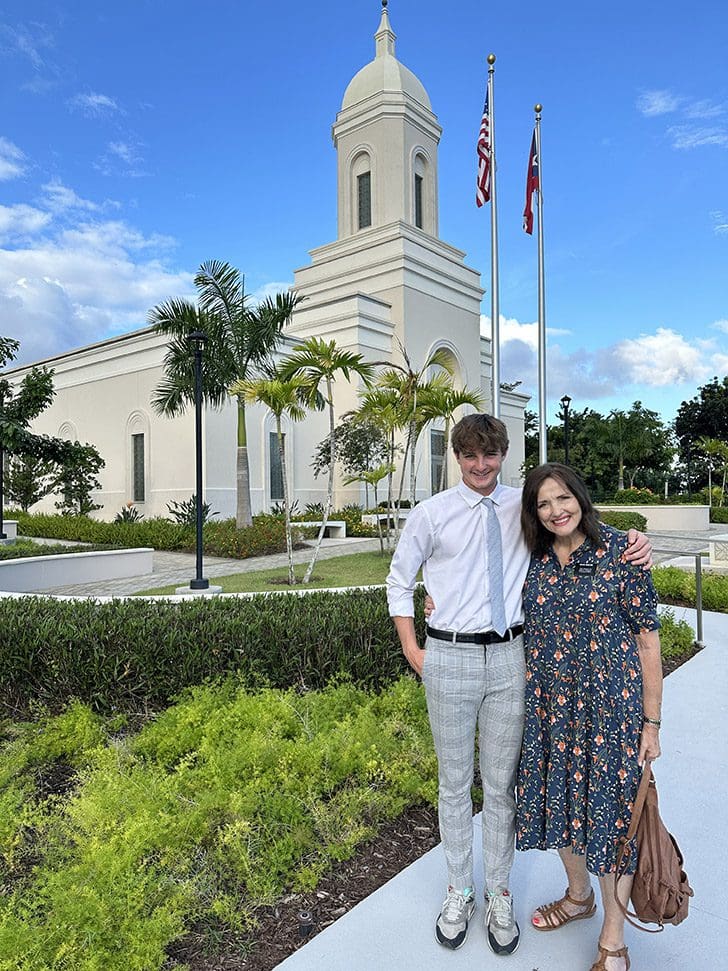
Because he is a tall and strong, young 17-year-old, JJ was recruited to do the baptisms for more than 50 people that afternoon. He looked so full of radiance, I felt an enormous sense of gratitude and love for this grandson who stood for so long performing ordinances in the water. Usually at baptisms, I pass out towels or am a witness. It is more rare these days that I actually put on white clothing and get into the font, but this time I did, and our grandson baptized me for people who had been waiting a very long time (some over 700 years).
Family History Booths Swell Excitement
I have seen more than ever before how deeply missionary work is entwined with the temple and family history—that it is all one work. Our mission president, Paul Horstmeier, said, that as he studied and prayed about his new calling before he came, one image hovered in his mind. It was the temple. Yet, he said to himself, that he was called to the mission, not the temple.
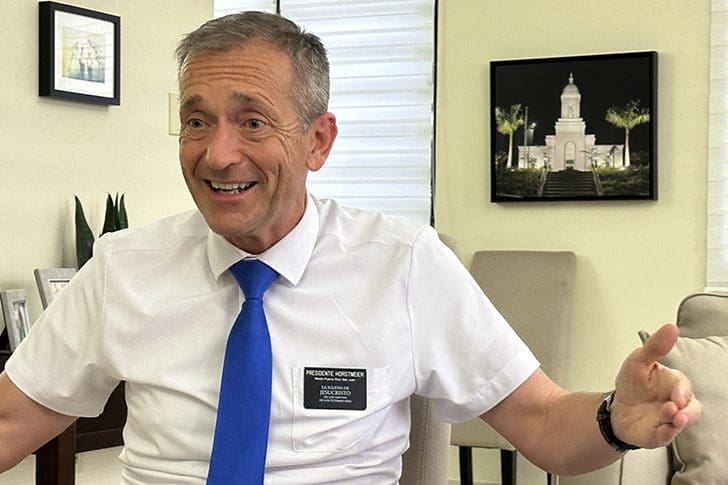
As time passed and he was immersed in spiritual preparations, it became clear that the missionaries who served with him should take a family history approach to finding new friends who will listen to the gospel. Most everybody feels a strong yearning to know about their ancestors. It is as if our stories, heartaches and rejoicings are coded right into our DNA, which then, turns us to the temple. As Latter-day Saints we have such a remarkable doctrine that people are yearning to hear because those ancestors live, breathe and act out their reality inside us. Scot and I say that whenever we get close to our family history, or the places our ancestors knew, our genes start jumping. We feel tangibly tied to them.
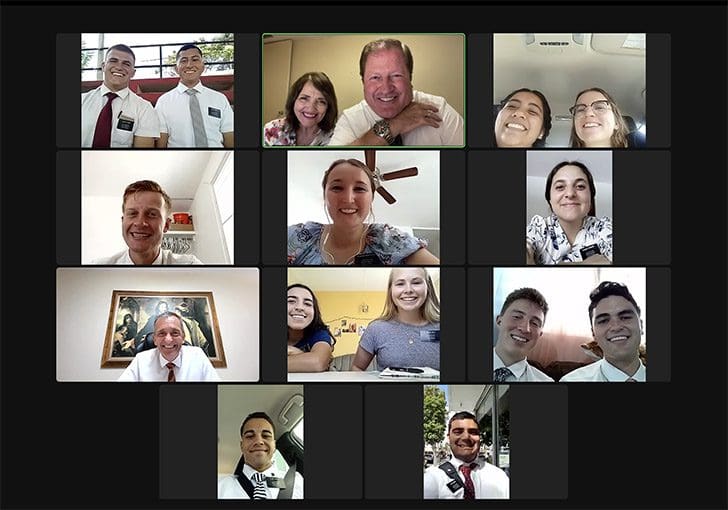
So, of course, our missionaries are on fire with this new approach, which has been introduced to them in carefully crafted phases. Now, we have missionaries representing every area of Puerto Rico who sit on a family council in a weekly zoom meeting to talk about where to set up booths in their areas—at festivals, markets, and other gatherings, to invite people to learn where their names originated and to find a name or two—or maybe many more—in their family lines.
We are carefully teaching how to contact mayors, organizers, and others who are in charge of the public spaces in their area, but the missionaries are so excited they get ahead of us. The meeting bursts with ideas and reports of what they’ve already done.
Light a match and don’t be surprised if you get a fire. The missionaries are stoked.
“We talked to a policeman who told us a spot has opened up for us on the plaza. It’s a small spot, but we can make it work.”
Another elder takes us on a walk through a plaza near him. “See the columns. There are spots near here and the market meets every week.”
Two elders whip out the written report they have already created for the mayor about the activity. They tell us that you can’t get permission for a booth until the authorities thoroughly understand what we are doing. They are all ready to deliver their report.
Part of our work will also be to get the word out that we can find a person’s ancestors by talking about it on social media. Our mission’s social media team has created this VIDEO, which deeply moved us and they will create many more.
Helping our Ward Find Names
As missionaries, we are assigned to wards where we search out the less active and help those with needs of any kind, like doing their family history. We have many youth in our ward—50 on the roll– and the temple is reserved for them this coming Saturday morning to do baptisms for the dead.
The goal for them is to bring their own names, so Scot and I gave a presentation to the youth and adults last Sunday about how to use FamilySearch to find names for the temple. We created a power point to walk step by step through the process using a phone and told many stories along the way.

We followed up with a night where we helped every one of the youth to have at least ten names to bring to the temple for proxy baptism.
We decided years ago to be very intentional in sharing our family history stories with our children and grandchildren. We want them to know who they are. Studies show that children who grow up connected to their roots, to their foundation and to their family’s story are more responsible, grounded and happy than their peers who do not know their family story.
We wanted our family to have strength, resilience and joy woven right into their systems and their outlook.
For instance, with our grandson here last week, Scot told him a story. Years ago, we went to live in England for the summer, taking our two youngest daughters. Our goal was to see this place we had always loved from a distance, but also to delve into the local records, looking for ancestors.
Long before we left, Scot had the impression that he should do pushups every day. He started with three sets of ten every day for a week, moved up to three sets of twelve, moved up to fourteen and so forth until he got to the point he was doing three sets of 50 pushups every day.
He assumed that he had received this impression because he would be lifting heavy bags or acting as our protector in some sense. The reality was very different.
The first day we arrived we were pulling our suitcases through the city and went down into the subway, called the London Underground. The girls and I were ahead, making our way through the crowds near the tracks, and Scot was behind, always watching out for us. Then, we came to a large pillar, and not knowing our direction from there, the girls and I went on the left side of the pillar and Scot went on the right. That suddenly put him first, standing before the very long escalator, just in time to see a terrible accident.
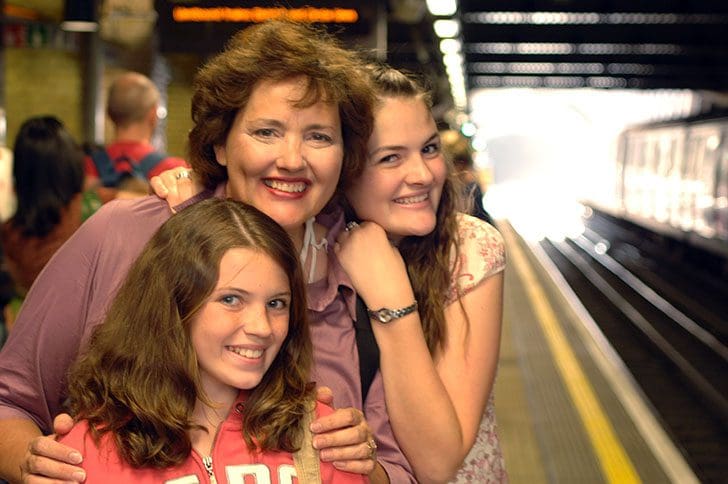
A man carrying a very heavy suitcase fell backwards on the escalator, his longish hair caught in the moving stairs and his head getting stuck in the stair as it moved. He still clutched his bag, with one outstretched arm, akimbo, and he was in dire, helpless trouble. Blood was spurting out of a gash in his head. His hair was blood-soaked, his face a mask of terror, and his helplessness worsened as his hit head smashed against the stair and was heading to that top step.
But Scot was right there, and if it had been the girls and me, this wouldn’t have happened. Strengthened by months of pushups, Scot was up the escalator in one bound to rescue him. He pulled him off the stairs, grabbed his suitcase and his whole body, and grasped his head immediately out of the grate of the escalator.
The scene was dramatic. Bobbies came rushing. Medics followed. The man was traumatized and badly injured. In all the hub bub, we didn’t meet him, and to this day, we would not recognize him or know him if we saw him. Falling at the top of those moving stairs, he could have been any man. Scot possibly saved his life and at that moment, the Spirit whispered to him, “This is why I had you do pushups—for this man.”
To us he represented Every Man who needs us to be strengthened to help when he falls or when he is barren, gashed and bleeding.
When Scot told this story at our table here, JJ exclaimed, “Grandpa! I’ve never heard that story. That is awesome.”
JJ now carries that story within him, and, even bits of memory of it will be a firm place in his soul. He will also always remember ringing the doorbell at the temple as an entrance to the kingdom of God, just as these proxy baptisms are an entrance to the kingdom of God for those who are waiting.
The youth in our ward laugh with excitement when they find names they can take to the temple. This means even more when they hear their parents’ stories or read the memory about an ancestor on FamilySearch.
A world of purpose and meaning is suddenly opened up for them. It means you can do something really important for someone else and feel it reverberate back to you.
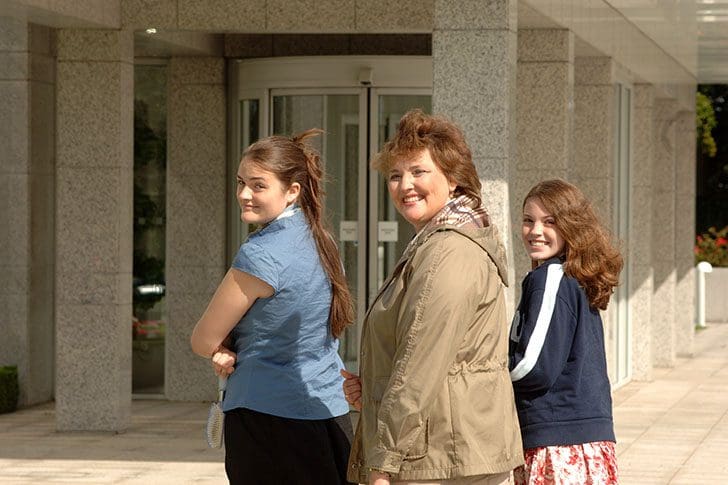
When we were in England that summer our youngest daughter was 12 and she did her first baptisms for the dead at the Preston Temple. When she was finished a venerable temple worker came up and with his proper British English said that he had worked for the Royal Air Force. He had the opportunity to be near the queen and he told us that each year the queen came to Westminster Abby to lay a wreath at the tomb of the Unknown Warrior and he had been there many times. “But today,” he said to her and her sister, “you have done more for the dead than the queen could ever do with all her wreaths.”
So, we surge in this mission. Family history to the temple to the Savior which is one work, one eternal round.
The Man Who Shares Our Wall
We call our home a casita (not a casa) because it is so small. On either side are long apartments that line the length of the house with Airbnb’s for rent. We never know who’s going to be there, sharing a wall with us.
One night this week we started hearing horrible noises coming from our shared wall, including a loud banging as if a bomb were bursting, the shattering of glass, the wall shaking like an earthquake, things thrown, shouting. Then the noise moved into the street with more glass exploding. As we peeked out the window, we saw a man breaking a mailbox and slamming it to the ground. Then a second mailbox had the same fate, as the man seemed on a crazy, delirious, hell-bent rampage, just full of anger.
Seventeen neighbors gathered in the street. Five police cars came with their blue lights pulsing. We only peeked out our window as the Church taught us at the MTC to stay away from any conflict because, with our badges, we won’t only be representing ourselves. The man was handcuffed and carried away into custody.
The next morning, early, Scot arose and went outside to sweep up all the shards. That small act we could do.
Reports of the situation began to funnel in from our neighbors. The man was from Ukraine. He had rented the apartment only a couple of days before. Last week the policeman had stopped him from jumping off a bridge.
Here was another man we never saw nor met, but, despite the uproar and the damage, our hearts were broken for him. We wondered what his story was and how he had traveled to a place of such desperation.
I can’t save the man next door, but I can urge everyone, including myself, to bring names to the temple for saving ordinances. I don’t have to stand helpless before this desperate world. There is this privileged work God said I could do.
The Spirit of Revelation
Our Tuesday morning devotional this week was based on Elder David A. Bednar’s talk, “The Spirit of Revelation” from the April 2011 General Conference. Here in Puerto Rico where the sun begins in the morning by sending mere glints across the ocean, Elder Bednar’s talk resonates with the way we receive our revelation, which comes in daily light.
Do you recall the slow and almost imperceptible increase in light on the horizon? In contrast to turning on a light in a dark room, the light from the rising sun did not immediately burst forth. Rather, gradually and steadily the intensity of the light increased, and the darkness of night was replaced by the radiance of morning. Eventually, the sun did dawn over the skyline. But the visual evidence of the sun’s impending arrival was apparent hours before the sun actually appeared over the horizon. This experience was characterized by subtle and gradual discernment of light…
The gradual increase of light radiating from the rising sun is like receiving a message from God “line upon line, precept upon precept” (2 Nephi 28:30). Most frequently, revelation comes in small increments over time and is granted according to our desire, worthiness, and preparation. Such communications from Heavenly Father gradually and gently “distil upon [our souls] as the dews from heaven” (D&C 121:45). This pattern of revelation tends to be more common than rare and is evident in the experiences of Nephi as he tried several different approaches before successfully obtaining the plates of brass from Laban (see 1 Nephi 3–4). Ultimately, he was led by the Spirit to Jerusalem, “not knowing beforehand the things which [he] should do” (1 Nephi 4:6). And he did not learn how to build a ship of curious workmanship all at one time; rather, Nephi was shown by the Lord “from time to time after what manner [he] should work the timbers of the ship” (1 Nephi 18:1).
Here in Puerto Rico, we are learning more and more about how to receive that personal revelation so that we can bless His children as much as we possibly can in the time that we have. We pray every day that the Lord will guide us, enlighten our minds and give us eyes to see.



Robin C.January 23, 2024
I served in Puerto Rico many years ago and absolutely fell in love with the island and the wonderful people there. Reading about your experiences and seeing your pictures brings back so many memories! I wept when I heard the temple announced there. When I served the few members that could manage it went to the Washington D. C. Temple to perform their sacred ordinances. What a blessing to have a temple there! Thank you so much for sharing your experiences. I’ve listened to your podcast for years and was so delighted when you were called to the PRSJM! (The best mission in the world)!
Robert LeifsonJanuary 21, 2024
Thank you for sharing your experiences! My son is serving in the Puerto Rico Mission and I personally appreciate your service to the missionaries. Your witness and testimony of gathering the House of Israel from both sides of the veil is powerful. Hearing the miracles that are happening since the dedication of the temple in San Juan is inspiring. May God bless you in your service.