










This is part 4 in a four-part series. To see the previous installments, click here.
From Accra, Ghana, we drove to Elmina, the site of the largest slave castle in the world. In this fortress, once a standard market for fruits, fabrics, etc., slaves were kept in captivity before going through “the point of no return” to a ship which would take them through the “middle passage” and then to a new land—far away from Africa. They would never see their homeland again.
We saw the dungeon, where “unruly” slaves were starved to death; the courtyard, where the Portuguese governor would select a woman from the newly arrived slaves; the dark, almost impassable walkways to the single portal leading out to the water.

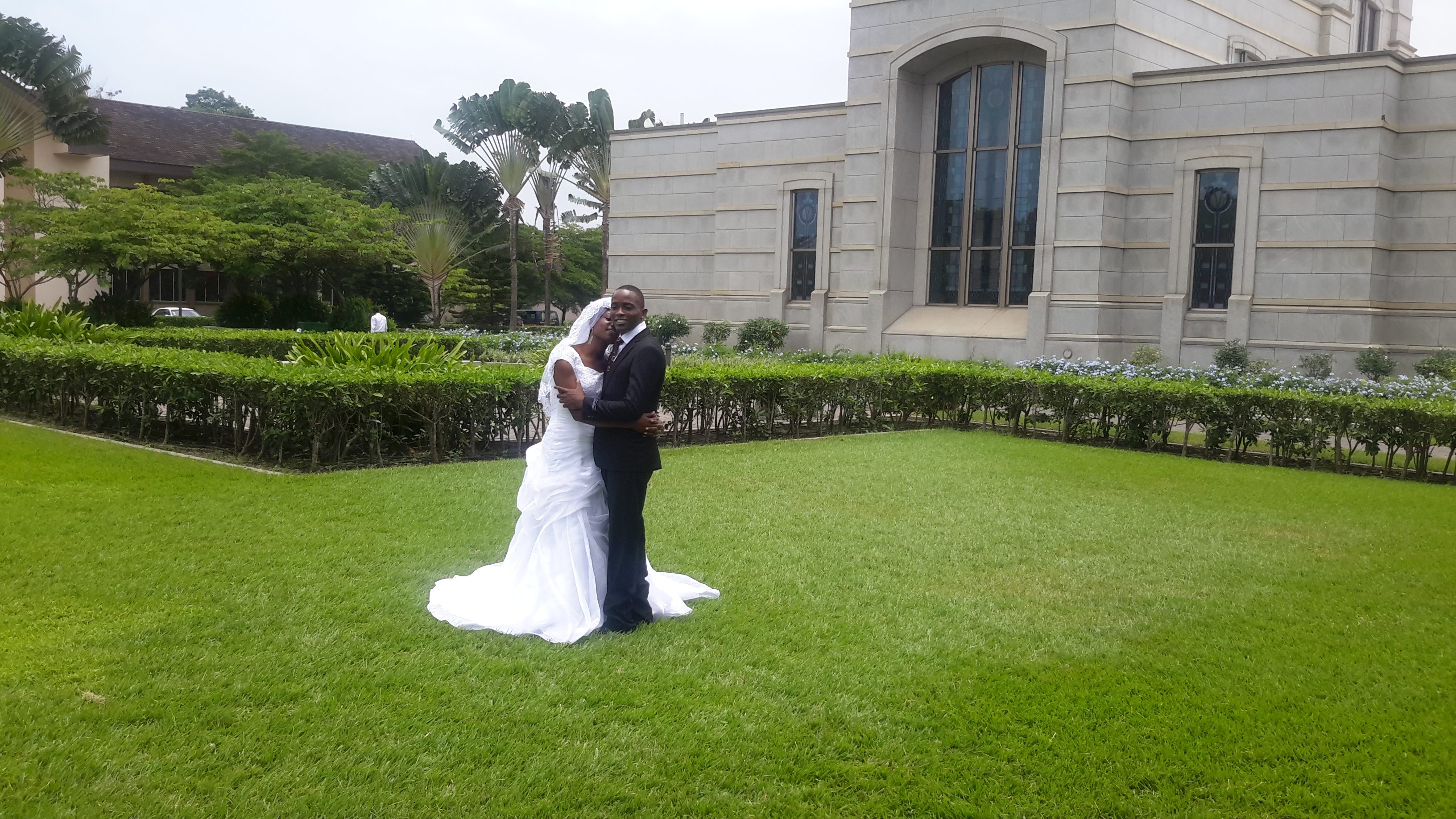
Throughout the tour, I watched Aime and Steffy, newly sealed, looking at the remains of the castle. I contemplated their union—that sacred bond which slavers in earlier centuries refused to honor because their captives were African. Who can calculate the consequences of that capricious family division? What generational ramifications do we see even today because a man’s wife, or a woman’s husband could be “sold off”? When Darius Gray was working on the Freedman’s Bank genealogical records, he found documents naming all of the children in the family, and listing who had been “sold off first.”

Even in our own LDS history, the great pioneer Samuel Chambers came to Utah with his second wife, his first having been “sold off.”[i] Vanguard pioneer Green Flake was told that his mother had died and didn’t learn until years later that she was still alive. He had been told that lie so that he wouldn’t run away to get back to her. Slavery affects our own history in tragic ways.

As I have contemplated the sealing of my dear friends and the beginning of their family, I have thought about birthright.
We choose the other parent for our children. If we do this wisely, we choose a legacy. As Latter-day saints, our children will be born into a worldview which teaches them that they are eternal, that mortality is only one part of forever.
I have contemplated the phrasing we use in our proxy work—that we do temple ordinances “for and in behalf of” someone. A husband and wife, facing each other across the altar, are also making covenants “for and in behalf of” their unborn children as they choose a godly foundation. We could almost add the words, “For and in behalf of my future children, I choose you—not just because you attract me, not just because you are talented—but because you honor me and this sacred covenant; because you honor God; because you will, with me, set our children on a path that includes an eternal vision of who they are.
For and in behalf of our future children, I choose you so that they may enjoy patriarchal blessings, focus on missionary service, focus on service of all kinds. I choose you so that our children may be turned towards the Savior and experience their own conversions. I choose you so that they will be raised with parents who are loyal to each other, who do not use addictive substances, who do their best at making their home a refuge. I choose you so that the House of the Lord will open its doors for our children as well as for us.”
This is not to diminish marriages in other religions, for a good marriage in any denomination is a godly thing. But as I contrast the realities of today’s freedom to choose an eternal marriage with the marriage-defying bondage which could befall any African in centuries past, and which can befall any of us today—speaking of different kinds of bondage—I see glorious possibilities.
A temple will be built in Kinshasa, Democratic Republic of Congo. It has been announced and the ground has been selected. Political problems have kept it from becoming a reality as yet.

Youth fireside in the chapel next to the temple site. Notice the reverence.
I have walked the grounds where that temple will stand. I plan on being in the DR-C when it is completed, and hope to help newly called ordinance workers. Therefore, I am learning French and Lingala so that I may speak the holy words they will understand.
I titled this series “The Revolutionary Takes a Bride”—which might seem inappropriate now that you have seen this “revolutionary” far from his camp and in the temple. But Aime Mbuyi IS a revolutionary, as is his wife. They are revolutionaries who will help break the chains of oppression in the Congo through gospel principles, and who will speak peace where there has been war.
I close with a plea for all of my readers to pray for Africa, and in particular for the Democratic Republic of Congo. I have felt the spirit of hastening there, but I also see the opposition lined up as a dark army. I know that the Heavenly hosts which are with us are greater than those dark hosts with the opposition. I know that God will prevail. I do not know how it will happen.
Pray for those who have already been prepared to see this work through. Pray to know if you might be one of them. Have faith that if you are, God will prepare a way.

POSTSCRIPT:
I cannot predict where we will film Heart of Africa. I hope we might do it in Kinshasa. Regardless of where we film it, we will show it throughout the DR-C. You can follow our progress on the Heart of Africa Film facebook page.
[1] Expert Bill Hartley says that Sam’s first wife either died or was sold off. We have no records indicating which.




DonnaFebruary 24, 2015
Thanks for your quest to bring light to "the dark continent" and our brothers and sisters there. My prayers are united with theirs as well as yours.