







I remember watching the opening session of general conference on Saturday, April 1, 2023—the day before Palm Sunday. Elder Gary E. Stevenson gave the first talk, and one sentence immediately caught my attention. He spoke of a growing effort among Latter-day Saints to make Easter more Christ-centered, including a greater recognition of Palm Sunday and Good Friday, similar to traditions observed by other Christians around the world.
That moment stayed with me. In decades of listening to conference, I could hardly remember hearing Palm Sunday mentioned at all. Yet during that single conference, it was referenced in 9 talks. The Church has always been centered on Jesus Christ, but something felt different. There seemed to be a new willingness to focus more deliberately on the events of Holy Week and the Savior’s Atonement.
Now, in 2026, that trend reaches a remarkable moment. General conference once again falls on Easter Sunday—a rare occurrence—and it comes during a time when Church leaders have been placing increasing emphasis on centering more completely on the Savior at Easter, His Atonement, and the sacred events leading to the Resurrection.
This article will take a by-the-numbers look at 1) the Church’s increasing emphasis on Holy Week and 2) the convergence of general conference, Easter and April 6.
For those interested in taking a closer look at the data, it is available at searchgeneralconference.com.1
Easter Sunday General Conferences
Since 1980, there have been 45 April conferences – 10 of those have been on Easter.2 In 1980, a rare triple convergence occurred when general conference was held on Easter Sunday, April 6. The next time this will happen is April 6, 2042.
Here is a timeline that shows when general conference has occurred on Easter:
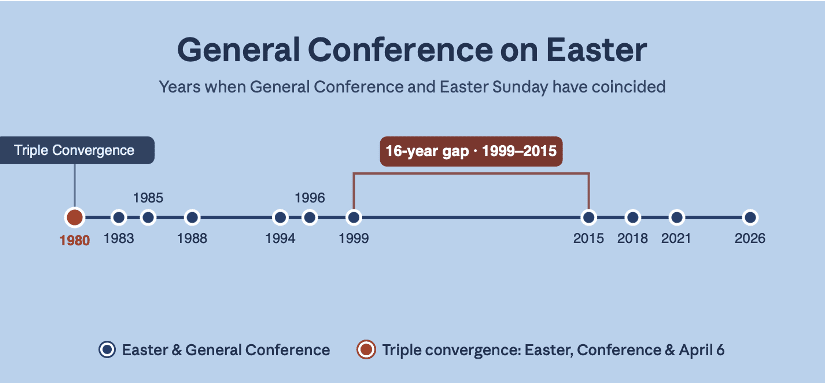
Since 1980 there have been 195 general conference talks that reference Easter. Nearly half of those—98 talks—were given on Easter Sunday itself. Most of these include a brief acknowledgment of the holiday, but some go further, reflecting on the deeper meaning of the Resurrection and, occasionally, on the significance of holding general conference on that sacred day.
A few conferences stand out:
1980 — A Rare Triple Convergence
April 6, 1980, marked an extraordinary moment in Church history. That day was:
- Easter Sunday
- The 150th anniversary of the organization of the Church
- The anniversary of the Restoration
President Spencer W. Kimball opened the Sunday morning session from the reconstructed Peter Whitmer farmhouse in Fayette, New York—the very place where the Church had been organized on April 6, 1830. Portions of the conference were broadcast from that sacred site while other sessions continued from the Tabernacle on Temple Square.
President Kimball testified:
“Of this I testify this beautiful Easter Sunday, on this great anniversary of the restoration and organization of the Church on this very spot 150 years ago… He is the risen Lord, the Great Presiding High Priest, and he stands at the head of the Church.”
That weekend linked the Resurrection of Jesus Christ with the Restoration of His gospel in a powerful and memorable way.
1994 — Remembering the Prophet
The year 1994 marked the 150th anniversary of the martyrdom of Joseph and Hyrum Smith. Speaking on Easter Sunday that year, President Gordon B. Hinckley reflected, “This year we commemorate the 150th anniversary of the death of the Prophet Joseph Smith, on the sultry afternoon of 27 June 1844.” He then reminded listeners of the Prophet’s profound sacrifice, quoting John Taylor’s well-known tribute: “Joseph Smith, the Prophet and Seer of the Lord, has done more, save Jesus only, for the salvation of men in this world, than any other man that ever lived in it…”
The message connected the sacrifice of the Prophet with the greater sacrifice of the Savior.
2018 — Worshipping the Risen Lord
When conference again fell on Easter in April 2018, President Russell M. Nelson said:
“What a glorious privilege it has been to celebrate Easter with you on this Sunday of general conference! Nothing could be more fitting than to commemorate the most important event that ever occurred on this earth by worshipping the most important being who ever walked this earth.”
President Henry B. Eyring likewise expressed gratitude for the opportunity to speak during “this Easter season,” reminding listeners that the purpose of conference is to draw closer to the Savior.
Mentions of Palm Sunday and Good Friday
Historically, references to Palm Sunday and Good Friday in general conference have been very rare.
Since 1980:
- 19 talks mention Palm Sunday – 14 of those since 2020 and 9 in 2023
- 4 talks mention Good Friday – all of them since 2020
There has been a clear change in emphasis since 2020. What was once seldom mentioned is now becoming part of the language of Latter-day Saint worship.
A Growing Emphasis on Holy Week
The April 2026 conference will be the eleventh time since 1980 that general conference has taken place on Easter Sunday, but this time the connection is being openly acknowledged. Church announcements have highlighted the significance of Easter weekend, and members worldwide have been invited to hold special Palm Sunday sacrament meetings centered on the Savior.
Although the shift has become more noticeable in recent years, the trend has been building for decades.
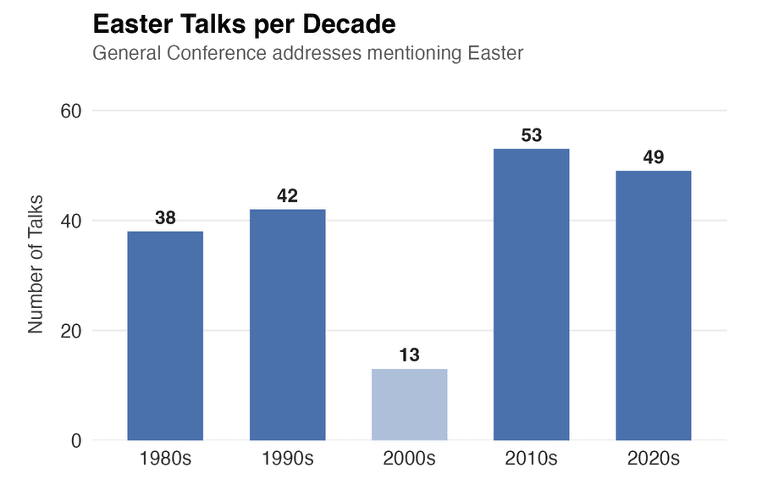
One interesting pattern appears in the 2000s, when relatively few conference talks mentioned Easter. A likely explanation is that from 1999 to 2015 general conference never fell on Easter. Nearly half of all Easter references occur when conference actually takes place on Easter Sunday, so the absence of overlap naturally reduced the number of mentions.3
A Cultural Shift Toward Remembering Holy Week
Near the end of the 16-year gap from 1999 to 2015, several influences began to shape Latter-day Saint culture in ways that encouraged a deeper focus on the Savior’s final week.
In 2010, Rob Gardner’s oratorio The Lamb of God premiered. What began as a single performance has grown into a worldwide Easter tradition. Each spring, thousands of volunteer musicians perform the work in chapels, concert halls, and large venues—including the Salt Lake Tabernacle and even the Metropolitan Opera House in New York City—helping audiences relive the events of Holy Week through music and testimony.
In 2015, Emily Belle Freeman published Celebrating a Christ-Centered Easter, a book that has become widely used by families and teachers. By telling the story of Holy Week through the eyes of those who were there, the book has helped many members experience the Savior’s final days in a more personal way.
President Russell M. Nelson’s ministry has also reinforced this Christ-centered focus. After becoming President of the Church in 2018, he repeatedly taught that Jesus Christ must be at the center of our worship, our doctrine, and our lives.
In October 2018, he emphasized the importance of using the full name of the Church, reminding us that the Savior Himself stands at its head.
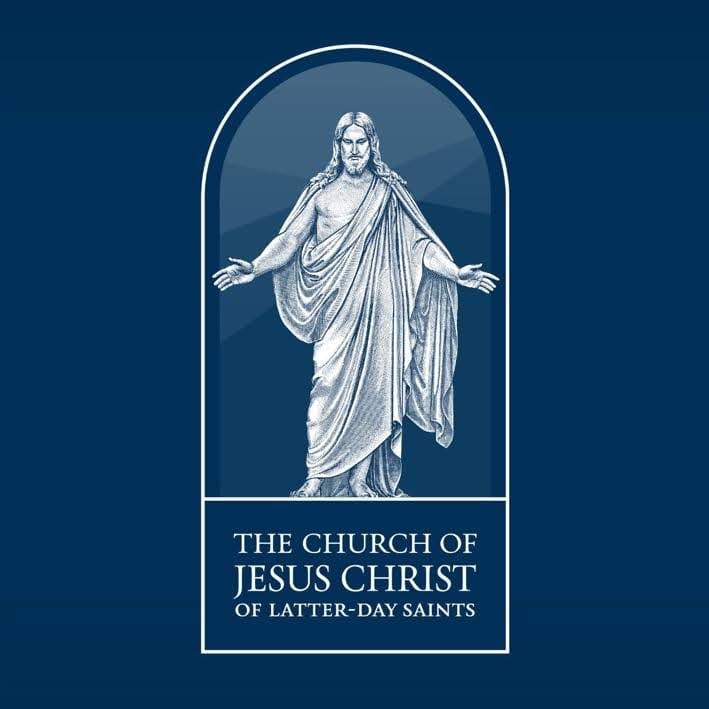
In 2020, the Church logo changed to place the image of the resurrected Christ at its center:
to this
In the April 2020 conference, President Nelson invited a worldwide fast on Good Friday. He said “I invite all, including those not of our faith, to fast and pray on Good Friday, April 10, that the present pandemic may be controlled, caregivers protected, the economy strengthened, and life normalized.”
In March 2021, President Russell M. Nelson released a short video message titled The Peace and Hope of Easter, where he invited people worldwide to focus on Jesus Christ during the week leading up to Easter. He said:
“On this Palm Sunday, I invite you to make this coming week truly holy by remembering—not just the palms that were waved to honor the entrance of Jesus into Jerusalem—but by remembering the palms of His hands.” (Isaiah 49:16: “Behold, I have graven thee upon the palms of my hands.”) He continued: “After all that Jesus Christ did for you, I invite you to do something this week to follow His teachings. … This Easter, I encourage you to focus on the Savior.”
In April 2023, Elder Gary E. Stevenson spoke of the growing effort among Latter-day Saints to recognize Palm Sunday and Good Friday more thoughtfully. He said:
“I observe a growing effort among Latter-day Saints toward a more Christ-centered Easter. This includes a greater and more thoughtful recognition of Palm Sunday and Good Friday as practiced by some of our Christian cousins. We might also adopt appropriate Christ-centered Easter traditions found in the cultures and practices of countries worldwide.”
In April 2025, Elder Gerrit W. Gong taught that the timing of Easter and general conference should not be seen as accidental:
“Their convergent proximity is not by coincidence or accident; it is sacred and symbolic.”
The 2026 Come, Follow Me manual also includes a Holy Week study guide, inviting members to reflect on the Savior’s final days and His Resurrection, including His appearance to the people in the Book of Mormon.
The increasing emphasis on Holy Week does not appear to be the result of cultural trends alone. Rather, it reflects prophetic invitations to place Jesus Christ more deliberately at the center of our lives.
The Rising Emphasis on the Atonement
Alongside the growing attention to Holy Week, references to the Atonement in general conference have steadily increased for more than fifty years. In the early 1970s, about ten talks per year mentioned the Atonement. Today the number is closer to thirty-five.
One of the clearest explanations of the atonement was given by then Elder Dallin H. Oaks in his October 2015 general conference address Strengthened by the Atonement of Jesus Christ. Elder Oaks taught that because the Savior descended below all things, He understands every sorrow, every weakness, and every burden we carry. His Atonement not only forgives—it strengthens, heals, and lifts.
A Sacred Weekend Ahead
This Easter weekend, millions of Latter-day Saints will gather for general conference while Christians around the world remember the Savior’s victory over sin and death.
The invitation to focus on Palm Sunday, the growing number of conference messages about the Atonement, and the increasing attention given to Holy Week all point in the same direction.
The convergence of conference and Easter is more than a calendar coincidence.
It is an invitation.
An invitation to remember the Savior’s final week.
An invitation to reflect on His sacrifice.
An invitation to rejoice in His Resurrection.
Because He lives, we live.
Because of His Atonement, we can be healed.
Because of the Restoration, we know the fulness of His gospel.
He is risen.
Hosanna to God and the Lamb!
——-
[1] searchgeneralconference.com is a free, publicly available search service that indexes every general conference address since 1971 and allows anyone to explore trends, keywords, and patterns in prophetic teachings.
[2] In February 1977, the First Presidency announced significant changes to the format of general conference, effective with the April sessions that year. Previously, the April general conference had traditionally spanned three days (and sometimes more) and was deliberately scheduled to include April 6—the anniversary of the Church’s organization in 1830—regardless of what day of the week that date fell on. This often meant sessions occurring on weekdays, which created challenges for attendance by members who had work or school commitments, as well as logistical difficulties for broader participation.
[3] To address these practical considerations and better accommodate the growing worldwide membership, the conference was standardized to a consistent two-day weekend format: the first Saturday and first Sunday of April (and similarly for October). This shift eliminated the rigid tie to April 6 as a required session date, though April 6 continues to be commemorated in other ways, such as through messages or events when it aligns naturally with the weekend schedule. The change was part of a broader effort to streamline proceedings while maintaining the sacred purpose of gathering the Saints to receive guidance from living prophets. (See the First Presidency announcement in the February 1977 Ensign: General Conferences to Be Two-Day Conferences.)