







When it’s Pioneer Day celebration time, “Family History in Focus” has to take a little time to honor and celebrate pioneers of all kinds. This week’s column is a smorgasbord of sorts – a tip or two on thinking about pioneers, a tool or two for personal history with pioneers, and a story or two from my pioneer history to encourage your own remembrances.
Pioneer Day and Remembrance
Pioneer Day is all about remembrance. First celebrated in Utah on July 24th in 1857, Pioneer Day emerged as a holiday to remember the courage, endurance, faith and sacrifices of early Latter-day Saint pioneers. The activities and festivities that take place in honor of Pioneer Day are wide-ranging and diverse. Families and communities participate in picnics, parades, outings, historical re-enactments, festivals, rodeos, contests—and much, much more. The point is to remember those who came before and pointed the way toward a more hopeful future.
Many social media posts and other varieties of remembrance were played out on Pioneer Day, but we need not limit ourselves to July 24th to remember our ancestors or others we revere as pioneers. To end the month of July, I’m going to encourage you to do four things to celebrate Pioneer Day-Month! Read along and find a few things to do!
1) Reach out to a Pioneer
Who exactly should we celebrate as a “pioneer” anyway? Is it only those folks who crossed oceans or prairies in the gathering of early Latter-day Saints? No—let’s dig a little further.
President Thomas S. Monson spoke beautifully of the pioneer spirit, and he noted:
“We’ve heard much about the pioneers of 1847 and their trek across the plains and entrance into the Salt Lake Valley. We shall hear more as this sesquicentennial year (1997) moves along. Not surprisingly, as the pioneer theme is presented, each goes back in memory to his or her own family line. There are usually examples to identify and which fit the definition of a pioneer: ‘one who goes before, showing others the way to follow.’” (“Pioneers All,” April 1997).
There are many, many individuals who work and strive today to forge a new future for themselves and their loved ones. Perhaps you are inspired by a Latter-day Saint ancestor. Perhaps you take courage from a fellow faith community member, neighbor or friend who has managed challenges or quietly inspired you. In noting that we are “pioneers all,” President Monson encourages us to be attentive to examples all around us and celebrate them.
So, for our first act of pioneer remembrance, I encourage you to reach out to a pioneer that you identify that is living today. Let them know that you have noticed them. Let them know that they have inspired you. Let them know you appreciate their pioneering efforts in life. Write a note or call them – and write at least 4-5 lines or call for at least a few minutes. Remembrance starts with recognition of those who have “gone before, showing others the way to follow.”
2) Discover a Pioneer Relative or Link
Pioneer Day is also an opportunity to learn about possible pioneer ancestors that we may not know much about. Who knows where there might be a connection?
FamilySearch is making this process a bit easier through a couple of its currently available activities online. Either log in or create your free account after you find your way to the FamilySearch website at www.familysearch.org. Then, take advantage of the following tools to find a pioneer connection:
- Discover a Pioneer – Go to the following page in FamilySearch, https://www.familysearch.org/en/campaign/pioneers – or, find it under the “Activities” link (“Pioneers”). This page will allow you to see names and information of pioneer relatives, your relationship to them, and any further information about their life and experiences.
- My Female Pioneers – Under “Activities,” find the “Female Pioneers” link or go to https://www.familysearch.org/en/campaign/femalepioneer and learn about the women that shaped your family experience! I celebrate women like May Louise Hunt, Annie Campbell, Mary McQuarrie, and Emeline Whiting.
- Pioneer Child – Walk a Mile in Their Shoes – This link under “Activities” allows you to take a brief quiz, a fun activity to do with a child or grandchild in your life, that links you to a pioneer child by comparing traits. Engage a child and take the quiz! Go to https://www.familysearch.org/en/campaign/pioneerchild.
3) Share a Pioneer Story
Part of the fun of personal and family history is sharing experiences and stories! So, pick one that is of interest to you, and then share it with those you care about via a social media site you use, a family group chat, or in a phone call or email.
This means you need to take a little time and maybe call a relative who will know a good ancestral story from a pioneer or two, or pull out that family history and dust it off and do a little reading, or . . . you get the picture. Dig a little. Learn a little. Ask some questions. Be curious. Learn a story and share it with others.
If you struggle to find a story from your own ancestral history, then find another that inspires you and share it. The world is full of great stories.
4) Listen to a Couple Stories from Family History
Since part of the purpose for this feature column is to pass along some stories, here are a couple for you to enjoy in celebration of Pioneer Day. Both come from the life of one Sylvester Henry Earl, my great-great-grandfather on my mother’s side. Sylvester Henry Earl was born in 1815 and died in 1873.
Sylvester Henry Earl first heard the message of the restored gospel in 1836 in Ohio, then subsequently spent time in Illinois and received baptism in early 1837 as a new Latter-day Saint. He was soon engaged in missionary labors and through these efforts met the woman who would become his future wife, Lois Caroline Owen. Here is the story of their meeting and her baptism in 1838, as told by their son Joseph Ira Earl in a letter. The story follows:
“Following the death and burial of his mother, Sylvester and his two brothers, Wilber and James, traveled to Schuyler County, Illinois, and there Sylvester held a series of proselyting meetings in the fall of 1838 in the vicinity where Ira Owen and his family lived.
(Note by writer, Ken Earl: Several Missionaries, including Charles C. Rich and Solomon Wixom, wrote in their journals of having proselyted in Schuyler County and the surrounding area starting back in 1832 after Rich joined the Church. John T. Earl, Sylvester’s brother, lived in Morgan County, not far away, where Rich and Wixom had visited and stayed many times.)
The following is paraphrased from Joseph’s letter to his son Ira:
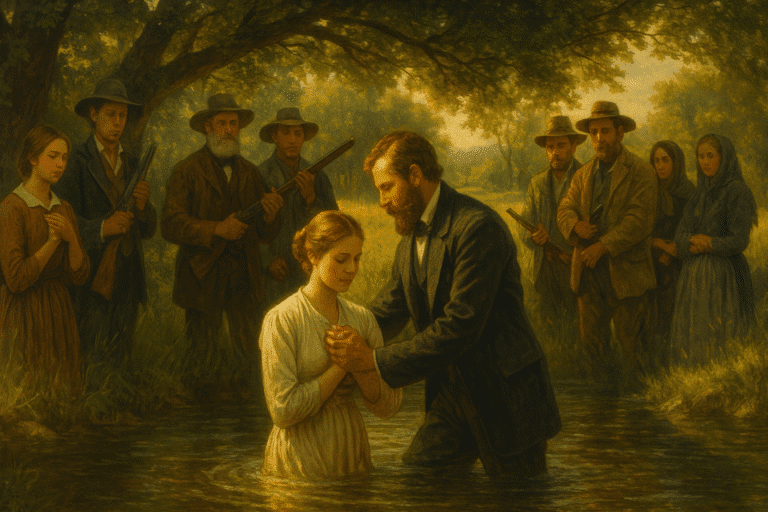
At the close of one of the meetings, Sylvester announced that a baptismal service would be held at 4:00 P.M. at a river site near the bridge crossing the LaMoine River (commonly called Crooked Creek, which was situated a half mile or so east of where Ira Owen’s family lived), and that anyone wishing to be baptized should now make it known. A 20-year old girl by the name of Lois Caroline Owen was the only person who offered to be baptized. Those in attendance were amazed, her parents, Ira and Betsy Ann Castle Owen, were astonished, and her brothers were enraged. Disapproving, too, were male cousins of Lois. Sylvester dismissed the meeting and everyone went to their homes. Her parents tried to get Lois to change her mind, but she would not. Her mind was made up, though she shed many tears as she struggled with the thought of doing something of which her parents and family disapproved. Yet she knew that the Spirit had borne witness to her spirit that what the Latter-day Saint Elder, Sylvester Earl, had taught in those meetings was true. She despaired as her brothers got down their guns and commenced to clean and load them, declaring that no Mormon would baptize their sister. A couple of Lois’ cousins, also came with guns and with the same determination that her brothers had. Even so, as she pondered and prayed about the decision she had made, peace and joy came into her soul; God had heard her prayers; she knew that all was going to be well with her.
As the hour drew near for the baptismal services, Lois and her friends went to the river’s edge. Townspeople also gathered as Ira and Betsy Owen walked slowly to the appointed place. The six young men, with loaded guns, were also present.
Soon Elder Sylvester Earl was seen approaching the river bank with quick step and head erect, surveying the situation as he walked to the river’s edge. He called the meeting to order and asked that they join in singing a hymn, but certainly one which they did not know, for it had been written by a Mormon convert, Parley P. Pratt; hence, he likely sang it alone, or with his companions:
‘The morning breaks, the shadows flee
Lo, Zion’s standard is unfurled,
The dawning of a brighter day
Majestic rises on the world.
The clouds of error disappear
Before the rays of truth divine,
The glory bursting from afar
Wide o’er the nations soon will shine.’
A prayer was offered in which the Lord was implored to shed forth His light upon the assembled congregation and that peace and quietness would prevail. Sylvester then stepped onto a nearby log and for the next half hour or so held the assembled crowd’s attention as he told them about the restoration of the Gospel of Jesus Christ: that the authority to baptize in the name of Christ had been restored, that the ordinances of God could now be administered with authority, that the Zion of the last days was to be built up, that Israel was to be gathered from the nations of the world, and a people prepared to meet the Savior at his coming. His sermon and Lois’ continuing determination must have had the desired effect of dispelling the plans of those who had come to make sure that Lois would not be baptized, for he then stepped down from the log, took Lois Caroline Owen by the hand and led her down into the stream of water where he baptized her with the words: “Lois Caroline Owen, having been commissioned of Jesus Christ, I baptize you in the name of the Father and of the Son and of the Holy Ghost, Amen.” Lois then sat down on the log and he confirmed her a member of the Church.
During this entire service – the speaking, the baptism and confirmation – not a word was spoken by anyone in the assembled crowd. In fact, Lois’ brothers and cousins had sat on the grass with their guns in hand and heads bowed. After she was confirmed, Ira and Betsy Owen embraced Lois and told her that, despite their disapproval of her decision to be baptized and their harsh words earlier, she was welcome in their home.” (from Volume 1, “Joseph Ira Earl, Calista and Viola Earl: Southern Nevada Pioneers,” 1988).
While the story reflects the missionary effort of Sylvester Henry Earl, it also reflects the courage of Lois Caroline Owen and the faith it took for her to move forward, and the willingness of her parents and other family members to make peace with her spiritual decision.
What’s the second Sylvester Henry Earl story – well, I share it since it ties into those early 1847 Latter-day Saint Pioneers. Sylvester Henry Earl was a member of the 147-strong group that led the emigration efforts and traveled to the Salt Lake Valley in 1847 with Brigham Young and other leaders. According to family legend and available documents, he was one of ten men assigned as part of a “gun crew” responsible for a cannon that was towed along with the wagon train, though it was likely never used. One family member has told me that Sylvester got tossed out of camp one day for “fighting,” but I’m still trying to track that story down—see how one story leads on to another story in family history?
Well, enjoy reflections on the pioneers in your life, and take a little time to pursue these remembrance activities as part of your Pioneer Day-Month activities!