











I get asked about different aspects of family history on a fairly regular basis, and one particular inquiry seems to pop up repeatedly in these conversations. The topic is simply this:
- What questions should I ask my loved one or friend about their life?
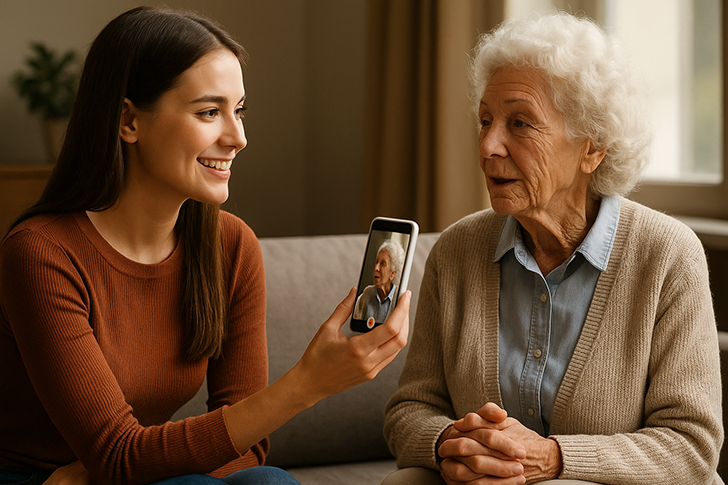
If you have a desire to assist a loved one in recording their life stories, especially if they are in their later years, then you may struggle to figure out where to begin and what questions to ask. This is completely normal.
It has been said that learning about aspects of the restored gospel is often facilitated by asking and exploring great questions. Similarly, we can gain greater insight into someone’s life and unearth stories to share if we try to ask interesting, curious or exploratory questions. We should also, as needed, respect boundaries and perhaps not ask some questions if a person is uncomfortable in sharing particular aspects of their personal history.
As we ask questions in family history, it is often helpful for us to move from a general inquiry to questions that are more specific and searching. For example, think of this question: “Do you remember anything about growing up?” The question is so general and non-specific that it won’t bring about too many responses, unless the person being interviewed likes to talk and has a great memory. Instead, more specific questions in asking about a person’s youth might be:
- Did you have a favorite dessert while growing up, and can you tell me about it? Do you have any specific memories about making or eating that dessert?
- Did you ever visit an amusement park while growing up? Did you go on rides at the county fair? Do you remember riding a roller coaster for the first time?
These types of questions, which are more specific and exploratory, work well to discover specific memories, especially when they are paired with the invitation to share and explain one’s life experiences.
To prompt some ideas about asking great questions in family history, let me briefly share examples of asking questions using games and asking questions about life periods.
The Un-Game, Chat Packs, and Other Conversation Starters
Part of the purpose of family history is to share and learn from experiences across generations within a family. Games provide a great resource to accomplish this goal. Specifically, you might use games or resources that engage you in thinking about and talking about unique questions with each other.
My friend, Nate Lambert, recently shared a brief Facebook post in which he commented on the goal of trying to build connections across generations. Then he shared this point, which resonated with me:
“One of the best traditions from my childhood… is now transforming my own family. Growing up, my dad introduced us to something called The UN Game—a deck of cards filled with open-ended questions designed to spark deep, meaningful conversation. And let me tell you—he loved that game.
We’d sit around as a family, taking turns asking questions like: What are you afraid of? What do you love? What are your biggest dreams? We didn’t just play for fun—we played to understand each other.
And it didn’t stop there . . . Before anyone got married, they had to play the UN Game with their potential spouse. It was his way of making sure we really knew who we were choosing.
Fast forward to today . . . I noticed some of our kids struggling with social confidence and communication, so I decided to bring back this spirit of connection—but with a new twist.
We call it “pinging.” It works like this: One person asks a sibling a thoughtful question. That sibling answers, and then returns the “ping” by asking someone else a question. The goal? Listen deeply, ask follow-ups, and grow closer.
We started doing it in the car, at dinner, during downtime—and wow. It’s been a game-changer. The conversations have been incredible. My kids are learning about my childhood . . . and I’m learning about theirs. It’s helping them build confidence, connection, and conversation skills that will bless them for life. It’s been a game-changer. The conversations have been incredible. My kids are learning about my childhood . . . and I’m learning about theirs. It’s helping them build confidence, connection, and conversation skills that will bless them for life.
Sometimes the smallest things—like a question—can unlock the deepest moments.” (Nate Lambert, August 1, 2025)
Sometimes the smallest things—like a question—can unlock the deepest moments.
I appreciated Nate’s story because I also had a parent who introduced us to the “UN-Game,” which consists of a pack of conversation cards that players respond to and share as others listen. So, if you want a set of interesting and useful questions to prompt family members to share a bit more deeply, you might start with the Ungame and its set of cards. You can find the Ungame for sale online at various retail stores or often at local toy stores.
Another simple tool we have used in our family or with church groups is a “chat pack,” designed as a set of questions on cards that will spark conversations. We keep this “chat pack” in the car, and one or another of our kids will often pull it out to prompt a discussion. My youngest son recently pulled it out while on a two-hour drive to a young men’s encampment in our stake, and he and several other deacons quizzed each other back and forth for over an hour while we traveled. The “chat pack” has a variety of questions such as “What is the most interesting course you have ever taken in school?” and “If you were making a list of the 5 things (not people) that make you happiest in life, what 5 things would you write down?” The creators of the “chat pack” resource have a plethora of question books, topic-specific “chat packs,” and even a custom option, all of which can be learned about or accessed at www.thequestionguys.com.
As a Primary teacher, I’ve also learned that there are some great resources using a game approach that work well with kids or grandkids. If you go to the Church resource website, they have a section under “Resources for Teaching Children” that includes some great things for use. The “Resources by Category” list is alphabetized and I would point out the following items that help children have fun, ask questions and learn more: “Family Fun Time” resources; “Family History Mystery” resources; and, the variety of “Funstuff” games and resources. These are directly provided by the Church and a fun starting point with kids as you think about games to help share good times and family memories. The link is https://www.churchofjesuschrist.org/children/resources/.
Questions About Different Periods of Life
One of the most simple ways to get started in exploring personal and family history is to break a person’s life down into periods of time. I like to increments of 6 to 10 years to explore a person’s life story. So, life periods that you might explore include:
- Early Childhood (Birth to 6-8 Years)
- School-Age Years (Ages 6-8 to 12-14)
- The Teen Years (Ages 12-14 to 18-19)
- The Young Adult Years (Ages 18-19 to 26-30)
Once a person reaches age 30, there may be different ways to explore their life experiences from that point forward. You might divide it by decade, such as ages 30 to 40, 40 to 50, 50 to 60, and so on, or by other periods that make sense, such as time spent living in particular areas or passing through particular seasons of life.
Within each of these life periods, you’ll want to brainstorm a variety of questions and also think about specific questions that can apply to the person you want to learn about. Even if a person is deceased, it helps to break their life up into such periods and then gather any information you know about each period of time. For example, when I organized my father’s life into such time periods, I got into the “Teen Years” and realized that he had probably been involved in the Scouting program through his youth experiences in Church. From that realization, I asked him about it and soon learned to my surprise that he had attended the first National Boy Scout jamboree that was held west of the Mississippi River in California in the 1950’s. A variety of fun and interesting stories emerged. By asking questions about what a person may have been involved in during that period of life, there is much that you might learn.
As a different example, I began to interview my wife’s paternal grandmother, Lila Bean Walch, about her life experiences many years ago when we first met. She had a very interesting life and was a great storyteller. When we got to her young adult years following high school, I asked her about different jobs held, and she listed several. Then, I began to ask her for details about each job, such as how she got the job, what she learned, tasks on the job, and any memorable experiences on the job. She told me about working in eastern Oregon at a root beer stand with her close friend, and one weekend they decided to put out an advertisement in the local paper for a root beer and a hamburger for just 15 cents—a combo deal. The result was hilarious. They had cars backed up down the street for hundreds of yards, but only a small hot plate that cooked four burgers at a time. As the car hop, Lila kept busy trying to meet the orders, and noted that at one point she had 54 burgers on order and all the patrons and cars waiting, honking their horns and such—total chaos! They had to close down early as they ran out of ingredients, but they learned some valuable lessons and took away a great story! (Lila Bean Walch’s life story, Conversations with Lila, is available at: https://www.amazon.com/Conversations-Lila-Experiences-Reminiscences-Walch/dp/B0FGDGTHKW/ref=sr_1_1?crid=205E8A7PQD6CD&dib=eyJ2IjoiMSJ9.5ZJTYbebMQP6zi7aQUvmAw.2mjINtJfNJ-HyOVki8MCTEU4G88r5tzkWBnFcTifbTk&dib_tag=se&keywords=lila+walch&qid=1754264888&sprefix=lila+walch%2Caps%2C179&sr=8-1).
There are some very good books and resources for personal and family history that suggest many questions that might be asked about different periods of a person’s life. I encourage you to begin with brainstorming questions of your own linked to the major activities in a person’s life—family, friends, religion, work, recreation—and then go forward from there. I will share more on such resources in future columns.
One more resource that might help you get started is at FamilySearch – a listing of “Questions for Interviewing Family Members.” There are over 30 questions on this list—a good beginning. The list is available online here: https://www.familysearch.org/en/wiki/img_auth.php/4/4a/Interview_Questions.pdf





Jason BAugust 4, 2025
This is fantastic! I have been working with my 82-year-old mother to record her memories and am excited to incorporate many of the resources you mentioned here into my questions for her. I am also hoping to learn more about the UN-Game and chat packs to kick start conversations with my family! Thank you.