







Death can be a touchy subject. It happens to everyone eventually, at long last for some and far too soon for others, but the effort to avoid or ignore the reality of dying is almost as universal as death itself. Culturally and socially, the issue is often taboo, spoken of in hushed and whispered tones and with airy euphemisms. The two books in today’s column address this uncomfortable topic frankly, directly and from almost every angle imaginable, each with a delightfully irreverent tone that is, at the same time oddly enough, respectful as well.
“Of all the traits that distinguish human beings from other animals…perhaps the most fundamental is our awareness of our own inevitable deaths.”
The Whole Death Catalog: A Lively Guide to the Bitter End
By Harold Schechter
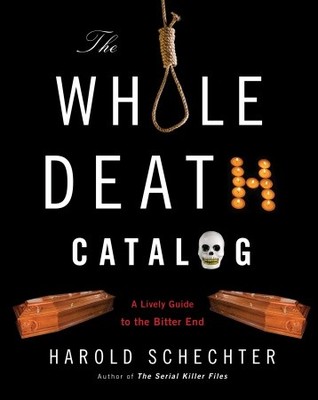 Dr. Schechter truly covers the gamut on this morbidly fascinating topic. Pieces on intriguing historical insights alternate with essays on the ethical implications of cremation versus burial and humorous anecdotes nestle next to rankings of “Ten Cemeteries to See Before You Die.” There’s even a “recipe” for making your very own mummy. (No guarantees on the outcome of that one…) The Whole Death Catalog is an entertaining and, yes, “lively” one-stop source for all things dead and dying.
Each of the seven chapters in The Whole Death Catalog contains dozens of short articles roughly grouped together by subject matter. Dr. Schechter kicks things off with a general overview of death myths from across the world – an Indonesian myth blames mortality on the first man and woman selecting the short-lived banana instead of the undying stone – and touches on how religious beliefs affect a culture’s approach to dying. For example, Hinduism teaches successive reincarnation; thus death is simply “a natural stage in the evolution of the soul” as it progresses toward oneness with God. The history of attitudes toward death in Western culture receives a bit more attention in this first section, from the bleak Puritan graveyards of colonial times to the “sentimental excess” of Victorian postmortem portraits and funereal poetry. You can also take a brief 25-question quiz to determine where you fall on the Death Anxiety Scale and ponder Emily Dickinson’s classic poem “I Heard a Fly Buzz When I Died.” It’s not all theoretical or historical offerings, though; there’s plenty of gore, too. If you have a weak stomach, I’d suggest skipping the detailed descriptions of the decomposition process, as well as the definition of adipocere. Ew.
Next you’ll learn to “Be Prepared,” as the title of the second chapter promises. Brush up on Elisabeth Kubler-Ross’s “five stages of grief” and get some useful tips on how to discuss funeral planning (either yours or theirs) with a parent or other family member. Read about some odd bequests in wills and how to tend to the terminally ill, making a loved one’s final hours as comfortable as possible. And don’t forget to choose (and rehearse) your last words oh so carefully!
With that, we’re on to funerals! Starting with the ceremonial burials by the prehistoric Cro-Magnons, Dr. Schechter touches on burial practices from the Ashanti of Ghana, the Jivaro people of the Andes, and rural Romania as well as from various religious traditions. Ever wonder just what a funeral director’s job description is? It’s in this chapter, along with a handy translation of common “funeralspeak” euphemisms. You’ll learn the difference between coffins and caskets and where you can purchase a “theme coffin” that will reflect your personality and passion – oversized ballet shoes, corkscrews and guitars are only a few of the novelty-shaped coffins available to house your mortal remains.
Dr. Schechter goes on to cover graveyards, “resurrectionists,” taphophiles, premature burials, and less traditional methods of corpse disposal. If you’re looking for something a bit more adventurous than a traditional burial or cremation, you could consider a sea burial, or having your ashes sent into outer space, or turning your cremains into a diamond or perhaps even part of a coral reef. He also lists dozens of classic poems, short stories and songs about death, and several don’t-miss mortuary museums throughout the United States.
Perusing these pages you’ll discover more than you ever wanted to know about the history and the modern practice of embalming, notable death scenes in movies, how to build your own casket (or rent one, if you prefer), and cryonic preservation. You’ll also glean valuable information about living wills, writing eulogies, and where to find a motorcycle hearse for your biker burial. The eminently practical, the seriously quirky, and the disturbingly macabre are inseparably intertwined throughout The Whole Death Catalog, bringing a dose of approachability and even hilarity to what can be an intimidating subject.
“Death. It doesn’t have to be boring.”
Stiff: The Curious Lives of Human Cadavers
By Mary Roach
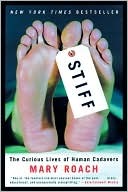 There are certain topics that polite society just doesn’t generally talk about, and only thinks about when absolutely unavoidable. One of these untouchable topics is dead bodies. Cadavers. Corpses. What’s left on earth when the spirit has shuffled off this mortal coil. Ms. Roach delves right in to the heart of, er, the meat of – no, well, let’s say the middle of this sticky subject, shall we?
I had no idea cadavers had such varied experiences! According to Ms. Roach’s exhaustively researched book, a head might end up on its own as part of a continuing medical education course for plastic surgeons so a physician can practice the techniques s/he is learning before using them on live patients, or, still attached to its body, as a college student’s three-dimensional textbook in Gross Anatomy. A body donated to science may lay partially clothed on a sunny hillside or shallowly buried in a particular type of soil at a field research facility to help forensic scientists better understand how to approximate time of death. Or it may serve as a human crash test dummy to ensure car safety features will protect the living. Studies with cadavers have been used to bring the validity of the Shroud of Turin into question, to test footwear for land mine clearance teams, and to determine the stopping power of various ballistics, among many, many other purposes.
Ms. Roach personally visited with dozens of researchers and scientists, often relating their conversations word for word, including her probing and off-the-wall questions, with her dry and unorthodox sense of humor. She interviewed an injury analyst who studies corpses from plane crashes and other fatal events to determine the cause of the accident, spoke with organ recovery surgeons who remove healthy organs from “beating-heart cadavers” to transfer them to patients who need them to continue living, and shadowed an adjunct research professor of forensic anthropology around the Anthropological Research Facility to observe corpses in various states of decay.
Talk about dedication to her craft! In addition to these up-close-and-personal interactions, Ms. Roach weaves a historical perspective in, too, describing, for example, the difficulties of obtaining corpses for dissection in medical schools in the early 1800s and various experiments done by Robert Whytt in the mid 1700s to try to pinpoint just where in the body the soul resided.
Like the previous book, Stiff has passages that it’s best not to read while eating. Minute, step-by-step descriptions of putrefaction and embalming are not warm, fuzzy bedtime stories – at least not for me, and I suspect, many others. Nor is the section on the efforts of several French physicians to reanimate decapitated heads in the late 19th century. Or the chapter on mellification and other medicinal cannibalism, also called “human-sourced pharmaceuticals.” I think my face wore a permanent grimace for that entire chapter. Ugh.
In short, cadavers have been instrumental in many medical, scientific and safety advances and continue to literally save lives every day. Ms. Roach’s book manages to pull back the curtain on these truly noble and selfless efforts, highlighting the absurdity of the human condition while at the same time preserving their human dignity.
**************************
On My Bedside Table…
Just finished: Persuasion by Jane Austen
Now reading: Cheaper by the Dozen by Frank B. Gilbreth, Jr, & Ernestine Gilbreth Carey
On deck: Women of Faith in the Latter Days: Volume 1: 1775-1820, edited by Richard E. Turley, Jr. & Brittany A. Chapman
**************************
More on death, dying, and decaying next time! Come find me on goodreads.com or email suggestions, comments, and feedback to egeddesbooks (at) gmail (dot) com.