







Several years ago in Relief Society, we studied some of Brigham Young’s teachings that really stuck with me. He said, “We believe in all good. If you can find a truth in heaven, earth or hell, it belongs to our doctrine. We believe it; it is ours; we claim it.” A few paragraphs later he is quoted saying, “Our religion is simply the truth. It is all said in this one expression—it embraces all truth, wherever found, in all the works of God and man that are visible or invisible to mortal eye.”1
Then, just a few weeks ago during General Conference, Elder L. Tom Perry of the Quorum of the Twelve encouraged us to “engage [your friends] in a two-way conversation—share something about your religious beliefs but also ask them about their beliefs.”2 I immediately thought about an intriguing website I stumbled on several months ago. “Project Conversion: Twelve Months of Spiritual Promiscuity” documents Andrew Bowen’s yearlong exploration of twelve different religions. Reading his blog, I was struck by his sincerity, his total commitment and his willingness to learn about each faith on its own terms. Every month this year he has immersed himself, with the assistance of members of each faith acting as mentors, into a single religion’s practices, holy books, beliefs, and community as fully as possible in such a short time. Since beginning his project back in January, Andrew has lived as a Hindu, a Baha’i, a Jew, a Muslim, a Sikh, a Buddhist, a Wiccan, a Zoroastrian, and, yes, even a Mormon.
The online community surrounding this project (playfully dubbed “the Congregation”) has grown throughout the year both at the website and on facebook and, with remarkably few exceptions, has been welcoming, respectful, friendly, and curious. During July, the month dedicated to The Church of Jesus Christ of Latter-day Saints, I had the opportunity to share my beliefs and testimony, answering questions and clarifying misconceptions. Every month I have been able to learn, ask questions of others and expand my understanding. The interactions I’ve had with those of so many other faiths have enriched my life and deepened my appreciation for the good and the truth that is to be found in every religion. The books below are excellent resources for learning the basics of some major world religions, and provide a good starting point for conversations with those of other faiths.
“Religion is a force far too powerful to ignore”
God Is Not One: The Eight Rival Religions That Run the World – and Why Their Differences Matter
by Stephen R. Prothero
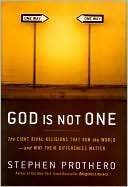
God Is Not One provides an overview of eight major world religions and is particularly insightful as a companion to the author’s earlier Religious Literacy. The premise is simple and straightforward: in order to have true tolerance and respect for other religions, it’s necessary to understand what it is we are being tolerant and respectful of. In his words: “What is required in any relationship is knowing who the other person really is…In relationships and religions, denying differences is a recipe for disaster. What works is understanding the differences and then coming to accept, and perhaps even to revel in, them.” We can’t truly comprehend the personal, social, economic, and political motivations of those in other cultures and of other faiths if we whitewash or ignore the religious differences that influence them.
Stephen (he asks even his undergrad students to call him by his first name, so I’m taking that liberty as well) provides a narrative for eight religions: Christianity, Judaism, Islam, Hinduism, Confucianism, Buddhism, Daoism, and Yoruba. He makes great efforts to avoid a Western bias as he describes the religions. For example, at one point he explains that “faith” and “belief” are not salient parts of some religions – an odd thought for those coming from, say, a Christian background – but an observation that makes Confucianism, Buddhism, and Daoism much easier to understand. He covers each religion’s origins (if known), how it defines the “problem” of life and the “solution” it proposes, the techniques the religion uses to reach the solution, and the exemplars it provides as guides along the way. This consistent approach to explaining each religion allows for an easy compare/contrast and highlights both the similarities and differences along the way. Of course, each of these religions is so complex and has so much diversity within the religion that 30 or 40 pages is not sufficient to cover every single aspect of all variants, but this book is a solid place to start.
(If the book cover looks familiar, it may be because I selected God Is Not One as one of my top twelve books for 2010. It’s that good. Really.)
“In America, religion is highly fluid”
American Grace: How Religion Divides and Unites Us
by Robert D. Putnam & David E. Campbell
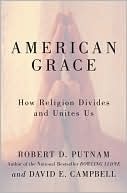
American Grace provides some fascinating insights into religious life in the United States over the past seventy or so years. Putnam and Campbell trace the “shock and two aftershocks” that prompted major shifts in spirituality, religious identification, religious activity, even stretching into politics and social life. No surprise, the first major shock was “the sexually libertine 1960s,” which was followed by “a prudish aftershock of growth in conservative religion.” Finally, another opposing reaction occurred as “a growing number of…young people have come to disavow religion” in response to the greater association between religion and conservative politics. Within that general framework, the authors discovered a remarkable fluidity to American religious life.
At 550 pages, this is not a quick read, but on the plus side, the print is not minuscule and there are plenty of graphs and charts (some a bit more obtuse than others) that take up considerable space, too. Putnam and Campbell cover almost every imaginable angle of the data they have gathered: gender, ethnicity, politics, class, income, level of religious activity, trends within religions and between religious traditions, friendships and relationships with neighbors, measures of tolerance and inter-faith conversion. Interspersed between chapters cram-packed with data and statistics, are vignettes describing worship services for different faiths that provide a more personal, intimate counterpoint to all the numbers and trends being discussed.
The sections on the interplay between religion and politics yielded some very interesting results as the authors clearly state “God in American history has not been a consistent partisan of left or right.” They point out religion’s influence on both ends of the political spectrum and provide some plausible explanations for why the political right seems to have such claim over religion in the public sphere today.
Naturally, being LDS I was most intrigued by what the authors (one of whom is also LDS) had to say about Mormons. It’s always fascinating to catch a glimpse of how others perceive us from the outside. Here are some highlights:
* “Even among the most heavily Republican religious group in the country [Mormons] there is still some degree of political diversity, as 20 percent of highly religious Mormons identify as Democrats.” [Another 10% claim political independence from either party – so as much as one-third of “highly religious” or “active” Mormons are not politically conservative.
]
* “Mormon women are overwhelmingly opposed to women as (lay) priests, but Mormon men have more mixed views: 90 percent of Mormon women as compared to 52 percent of Mormon men.
In short, Mormons, especially Mormon women, appear to be the only substantial holdouts against the growing and substantial consensus across the religious spectrum in favor of women playing a fuller role in church leadership.”
* Regarding the results of a survey asking members of certain faiths their impression or “warmth level” toward those of other faiths: “Mormons like everyone else, while almost everyone else dislikes Mormons. Jews are the exception, as they give Mormons [the only!] net positive rating.”
(One more note of interest: Elder Quentin L. Cook quoted some of this book’s findings in his April 2011 General Conference address, “LDS Women Are Incredible!”)
A weakness of American Grace is that Putnam and Campbell focus almost exclusively on Christian faiths. While I would have liked more info on Buddhists, Muslims, Hindus and Sikhs in the United States, I recognize that the authors had to work with the data they had, which shows that all of those “other faiths” together comprise a total of only about 3% of the population. They mention this in their introduction, explaining the limitations of their data: “Since the Faith Matters survey was administered to a randomly selected representative sample of the United States, it contains the correct proportion of each group. But the absolute number of these other faiths is too small to permit reliable analysis. We are thus limited in what we can report about these disparate faiths.”
American Grace is a fascinating, in-depth study of religion in the United States over the past several decades. It’s definitely not light reading, but it provides valuable insight into religious life in the United States and how that faith interacts with practically every other aspect of existence.
1. “Chapter 2: The Gospel Defined,” Teachings of the Presidents of the Church: Brigham Young
2. Elder L. Tom Perry, “Perfect Love Casteth out Fear,” October 2011 General Conference
**************************
On My Bedside Table…
Just finished: Life’s Lessons Learned: Personal Reflections by Dallin H. Oaks
Now reading: The Great Divorce by C.S. Lewis
On deck: The Boy from Baby House 10 by Alan Philps and John Lahutsky
**************************
More on world religions next time… What do you want to learn on this topic? Come find me on goodreads.com or email suggestions, comments, and feedback to egeddesbooks (at) gmail (dot) com!