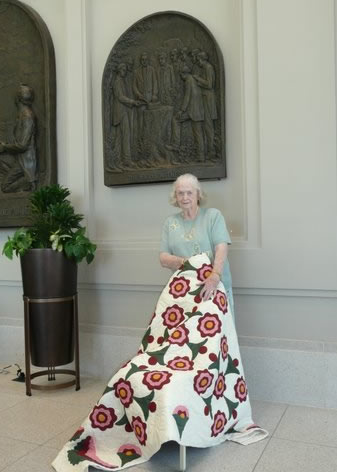
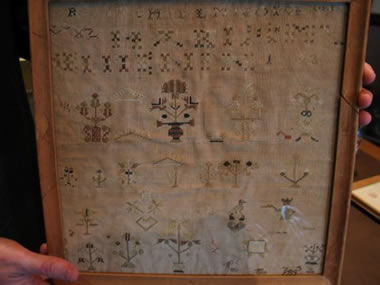
Editors’ Note: Sister Lorene Pollard, great, great granddaughter of John Whitmer, attended the dedication of the Church History Library and also donated a Whitmer heirloom quilt to the Church.
In March of 1838, John Whitmer wrote in his personal history of several individuals (including himself) whose membership in the Church had been recently terminated. John ended his entry with the words, “Therefore I close this history of the church of Latter Day Saints, Hoping that I may be forgiven of my faults, and my sins be blotted out, and in the last day be saved in the kingdom of God, notwithstanding my private situation, which I hope will soon be bettered, and I find favor in the eyes of God, all men and his Saints. Farewell.”
That winter, as the Saints were driven from their homes in Far West, Missouri, John Whitmer and the other members of his extended family remained behind. With the city virtually abandoned, John purchased additional property and remained near the temple site for the remainder of his life. He and his wife are buried in the nearby Kingston Cemetery. John’s brother, David Whitmer, lived just a few miles away in Richmond where he served twice as mayor. He is buried in Richmond as are other members of the family including Peter Whitmer Sr., his wife Mary, Jacob Whitmer, and Oliver Cowdery (related by marriage). John’s sister Catherine and her husband, Hiram Page, also lived close by in Excelsior Springs. Though John Whitmer left the Church, as did the other family members, he never denied his written testimony as one of the Eight Witnesses.
As I have visited the gravesites of many of the Whitmer family members, I’ve often wondered how they felt — to have stayed behind when the other members of the Church moved on. I have read from accounts of Church leaders who returned many years later to visit and talk with John, including Joseph F. Smith who was born in Far West. But I had never heard of any of John’s descendants who had chosen to come back into the Church. That is, until about seven years ago.
It began with a phone call. A woman at the other end of the line introduced herself as Dr. Lorene Pollard, the great, great, grand daughter of John Whitmer. Having heard that I had written a travel guide concerning Church history sites in Missouri, Dr. Pollard wondered if she might add some additional insights. After that first call, a year’s worth of phone conversations had to pacify my intense desire to meet her in person. In October 2003, my husband and I finally had the opportunity to spend several hours with Lorene at her home.
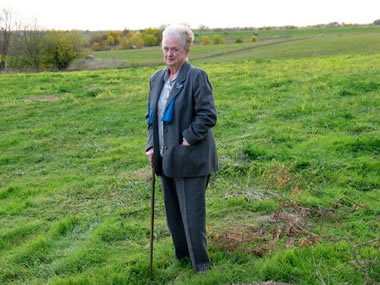
In addition to providing us with many interesting facts and stories, she also graciously answered my questions. Later, she went with us as we drove through the Far West area. Lorene pointed out where several Whitmer structures had been located and reminisced about earlier times. We walked to the area where John Whitmer’s home once stood and took Lorene’s picture on the site. John passed away while living here. Still vivid are Lorene’s memories associated with John’s home and family stories passed down from generation to generation. Lorene has been blessed with a family legacy steeped in early Church history.
John Whitmer was born on August 27, 1802 in Fayette Township, New York. He was the third of eight children born to Peter Whitmer Sr. and Mary Musselman. (The family has several items showing her name as “Mariam.”) In June 1829, when John was twenty-six, the Prophet Joseph Smith accepted the Whitmers’ invitation to come and stay at their home in Fayette, New York. During the Prophet’s brief stay, the translation of the Book of Mormon was completed and the Church was officially organized.
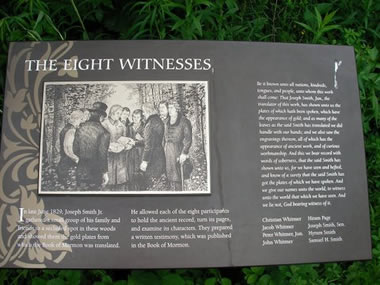
David Whitmer and Oliver Cowdery (married to Elizabeth Ann Whitmer) were privileged to view the sacred plates near the family home and sign their names as two of the Three Witnesses. Soon after, four additional sons of Peter Whitmer Sr. (John, Christian, Jacob, and Peter Jr.) together with Hiram Page (married to Catherine Whitmer) also saw the plates in the privacy of the Sacred Grove and signed their testimony as five of the Eight Witnesses. David Whitmer recorded that his mother, Mariam Musselman, was also given the special privilege of seeing the plates (see Church History In The Fulness of Times, p. 57.) Among other important events that occurred in the Whitmer home were the first three general conferences of the Church.
The Lord’s love for John Whitmer is recorded in D&C 15. He served for a brief time as a scribe for the translation of the Book of Mormon and later acted for a time as a scribe in the Bible translation. After responding to the Lord’s call in D&C 30:9 to proclaim the gospel, John was later called to serve as Church historian (see D&C 47). In Independence he offered himself up to an angry mob in hopes of stopping the violence, served as a member of the Church presidency in Missouri, and helped purchase land for a newly created town called Far West.
Sadly, John Whitmer later lost his membership in the Church over several charges, including the misuse of Church funds. David also lost his membership due to his rejection of the Prophet Joseph’s leadership and eventually all the members of the Whitmer family dissociated themselves from the Church. Although they remained steadfast in their written testimony of the truthfulness of the Book of Mormon, neither John nor David nor any of the other Whitmer family members rejoined the Church. (Oliver Cowdery, a relative to the Whitmers by marriage, was rebaptized.) It would be several generations before any of the Whitmer descendants joined the Church.
During our visit, I learned that Lorene Pollard was actually the first of John Whitmer’s descendants to finally enter the waters of baptism. She can easily trace her family line back to John Whitmer and his wife Sarah Maria. The couple’s third child, Sarah Elizabeth Whitmer, married John E. Johnson. Their son, John Edward Johnson, married Stella Smith and they had three children. One of those children, Constance Johnson Burdick, was Lorene Pollard’s mother. Lorene, born in 1923, is the oldest of four children. Her two younger brothers have both passed away but her younger sister, Marjorie, lives not far away in Iowa. The two sisters also have something else in common; they are married to brothers.
Lorene and Clifford Pollard were married for 66 years before he passed away in August 2008, on Lorene’s 85th birthday.
They are the parents of two sons and three grandchildren.
After graduating from William Jewel College, Lorene earned her Master’s and later a Ph.
D. in education. From 1969 until 1991, Lorene taught 5th and 6th grade. And for the next ten years, after retiring from teaching, she and her son owned and ran the first private jail in Missouri. Lorene has lived in her current home for the past 56 years.
Not far from Lorene’s home is the home of her husband’s family. Not only was Clifford born in this home, it sometimes housed a guest by the name of Jesse James. Jesse preferred to stay in a particular room because its windows conveniently provided a view of the roads in either direction. This afforded Jesse a speedy departure if needed. The home, now renamed the Whitmer Inn, contains Whitmer family memorabilia and was once used as a bed & breakfast.
Knowing we would be visiting Lorene, I came prepared to ask questions about her childhood. Lorene was kind enough to answer all of my questions.
Question: What are some of your earliest recollections of your extended Whitmer family?
Lorene: I have several memories from when I was only four or five years old. As a young child, my family lived in a small home located just east of the big house (John Whitmer’s home). I remember going over to the big house quite often. Members of the Church would also continuously come for a visit. I remember where the chicken houses were located and where the icehouse once stood down by Shoal Creek. Once, when a big storm came, all of my family ran to the big house for protection. I also remember the funeral of my Aunt Ella (John Whitmer’s granddaughter), which was held in the big house. During the funeral, my baby brother was in a basket under the kitchen cabinet. The Whitmer family lived in this home until I was about twelve. Then in about 1935, the big home was rented out and our smaller home became the hired hands home.
Question: What eventually happened to John Whitmer’s home?
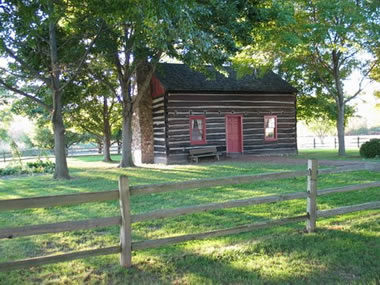
Lorene: Someone from Utah purchased the home and surrounding land. Ironically, one of my brothers worked with heavy machinery and he was hired to bulldoze the house. (This was John Whitmer’s second home, sometimes referred to as the big Whitmer house. His first home in Far West was a small cabin located just to the east of the Temple site. The cabin and surrounding land were sold to the Church in 1908.)
Question: As a child, did you or your siblings realize the important part your ancestors played in the restoration of the gospel?
Lorene: Truly we did, although we never thought too much about how we could get re-involved in it. We were raised in the Methodist faith and attended church every week.
Question: As you learned about your family history, did anything in particular stand out in your mind?
Lorene: When I was about thirteen or fourteen years old, my mother took me to the Methodist Church to hear a talk about the Mormons. The presentation was given by a lady in the Methodist Church who had previously lived close to Palmyra, New York. She was the banker’s daughter and rather aristocratic. She spoke very favorably about the Mormons, and I felt very proud knowing that my family had played an important part in its early beginnings. Ever since that day, my family history has been very important to me. At school we would have to write reports about our ancestry. I still have some of those reports that I wrote.
Question: Didn’t you once tell me that your mother gave something to the LDS Church?
Lorene: Yes. In 1938, my mother and her sister, Ethel, gave John Whitmer’s Bible to the Church in Salt Lake City.
Question: What year did you join the Church?
Lorene: I was baptized in 1963 when I was forty years old.
Question: What finally attracted you to the Church?
Lorene: There was too much truth not to join.
Question: Will you share the story of your conversion?
Lorene: My mother died in 1962. She was originally a member of the Congregational church but had later joined the Methodist church in Polo, Missouri. She had always been a Sunday school teacher and attended church every week to teach her lessons. Mother became ill at Thanksgiving time and died in January. She was hospitalized from when she became ill until she died. During her entire stay in the hospital, the minister of her church never came to visit. I was so disappointed and felt it was such a tragedy that he never came to see her. As I was in the hospital the last night before her death, someone appeared to me and talked with me. This person talked very seriously about death and told me not to be frightened of it. He said it was a thing we should look forward to, and then he was gone. One of my brothers was married to a woman in the RLDS Church (now Community of Christ). When they married, he became a member of her church and their children were raised in that church. Though it was a little unusual, their RLDS minister did the services for my mother in the Methodist Church. The funeral service was beautiful and the minister called it her final graduation day. After my mother’s death, the RLDS minister started coming to our home to give us lessons. I’m really not sure why, but the LDS missionaries also started coming to my house. The RLDS minister would come once a week and the LDS Elders also came once a week. It was really very interesting and wonderful. My sister was living in Emporia, Kansas and also had the LDS Elders coming to her home. Both families were baptized in Liberty, Missouri in 1963.
Question: Was your husband baptized too?
Lorene: No, he wasn’t. But my sons, my sister, and her husband (now deceased) were all baptized. Lorene’s sister has 6 children, 27 grandchildren, and 7 great grandchildren.
Question: How did your two brothers feel about you and your sister joining the LDS Church? How did the extended family feel?
Lorene: My brothers were very supportive of our decision to be baptized. In fact, I don’t think anyone was distressed by it.
Question: Do you know if any other members of the Whitmer family have since joined the Church?
Lorene: We were the only members for a long, long time. A few family members, through other siblings, have now joined too.
Question: I know your husband was an invalid for many years. You mentioned that it had been difficult to go to church.
Lorene: Yes, I didn’t get to go to church too often. When I did attend, the bishop usually announced: “the oldest member of the ward is here with us today.”
Having thoroughly enjoyed my visit with Lorene, I was thrilled to learn that she has finished a book entitled Whitmer Memoirs: 1793 – 2003. Included in her memoirs are stories of the early Whitmer family and memories of a Far West still dotted at that time with homes, a store, and even a school. (Today Far West consists almost entirely of open fields.
) Memories of everyday experiences – butchering animals, making soap, filling the icehouse, and feeding great grandmother Sarah’s chickens, all make for interesting reading.
Accompanying the stories are numerous pictures, some never viewed beyond the extended Whitmer family. The Whitmer’s role in the founding of the Church was so prominent that we naturally have an interest in the experiences of this remarkable family.