







When you make an LDS movie on the handcart pioneers, the entire ward may be extras, and you might receive an added surprise at the end.
Our movie career began and ended all on one hot August Saturday. My husband, daughter, four of our grandchildren, and I were extras in a movie being produced by our neighbor Ron Tanner and his cousin T.C. Christensen. (Ron and T.C. previously made Only A Stonecutter and Treasure in Heaven: The John Tanner Story. T.C. has been the director and/or cinemaphotographer for numerous films including Touch of the Master’s Hand, Praise to the Man, Gordon B. Hinckley: A Giant Among Men, Joseph Smith: Prophet of the Restoration, Emma Smith: My Story, and The Testaments.) Their new feature-length movie, 17 Miracles, is about the combined experiences of the 1856 Willie and Martin handcart companies.
One of Ron’s responsibilities has been to gather enough extras to be in the background for various scenes, so he has called on many friends and ward members. For us, watching the movie when it is released will be like attending a ward reunion.
After arriving at the BYU Motion Picture Studio in Provo, Utah, our family, along with many others, was fitted out in pioneer clothing, had our hair and make-up done, and then were placed amidst handcarts set up in a clearing in a grove of trees. For us film novices, it was fascinating to see first-hand the process of making a movie. There were quite a number of crew members and more equipment than I had imagined. Throughout the day, make-up artists kept applying more “dirt” to our faces and hands and arranging our hair and clothing.

The first scenes we were involved in were early in the trek saga as the Saints were deciding whether to follow Levi Savage’s counsel to wait until spring to go to Zion or to leave in late summer as James Willie urged. Each scene was filmed many times. We soon could recite Levi Savage’s speech word for word: “Brethren and sisters, what I have said I know to be true, but seeing you are to go forward, I will go with you, will help you all I can, will work with you, will rest with you, will suffer with you, and if necessary I will die with you. May God have mercy and bless and preserve us.”
There was a palpable spirit of the pioneers on that set. Some of the 60+ extras were descendants of those handcart pioneers, and we learned more about their ancestors’ experiences in between takes. When I saw several precious babies in thin bonnets and dresses, I thought, “They’re not going to make it; they’re going to die of cold and exposure on the trek.”
They were safe from the cold, however, on this particular film day as it was hot; females dressed in layers of petticoats, dresses, aprons, shawls, and bonnets and males had long-sleeved shirts, vests, hats, heavy pants, and boots.
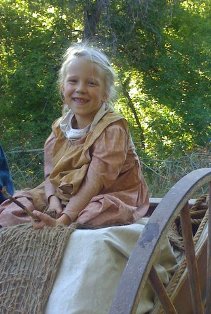
Pulling and pushing handcarts through the deluge of rain from the rain machine was refreshing. Unlike the pioneers, in between takes we got treats and cold drinks galore and a catered meal in the evening.
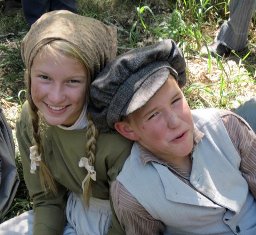
Our four grandchildren, ranging in ages from 3 to 14, with their blonde hair looked as if they had just arrived from Sweden. And with my red hair, I appeared a wee bit Scottish—which I am. As the day wore on, the children’s enthusiasm increased, and the youngest, a normally very active boy, was amazingly cooperative.
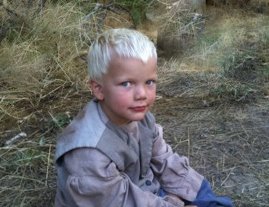
The older children’s appreciation for the handcart experience grew considerably, even though their participation was only for one day and was not at all hard. My husband didn’t have to act to look weary as we were directed because he had risen at 4:00 a.m. that morning to run a half marathon. We stayed at the studio grounds for almost twelve hours.
The highlight of the whole experience, however, came after we were dismissed. When Larry and I were walking to our car near midnight, a man, who had a small speaking part that day (though as Jens Nielsen more visibility on other filming days), asked if he could trouble us for a ride. We said sure and he got in the car and introduced himself.
He had a vaguely familiar look and the most intense blue eyes and kindest countenance. We asked why he had come all the way from Denmark for this film. He said he had worked with T.C. before and had been in The Testaments. In a figurative way, we had picked up the Savior by the side of the road!
This gave new meaning to us for Matthew 25:40: “Inasmuch as ye have done it unto the least of these my brethren, ye have done it unto me.”