







How to Chronicle a Life
By Sherlene Hall Bartholomew
[Editor’s note: Our condolences to Sherlene, whose mother died March 7, 2005.]
My mother, Ida-Rose Langford Hall, is dying of cancer, at age eighty-four. We have known this time would come. It doesn’t seem that long ago when we anxiously conferred with her surgeon, after waiting long hours while he removed a large tumor. Then he only gave her two more Christmases.
Thanks to wonderful care – especially by my sisters Nancy and Charlotte – and sweet answer to prayer, Dad and we, their seven children, have celebrated three holiday seasons with Mom! So as her days wind down, you’d think I could get used to the idea that my seemingly invincible mother is mortal, after all.
With her usual foresight and practicality, Mom asked me the other day to write her obituary: “I’m not dying any time soon,” she insisted. “I’m just giving you some lead time.”
It is clear however, that she is in rapid decline. Mom has suffered several small strokes, and last night her nurse ordered a double morphine dose so she could finally get some sleep. We keep thinking it’s the end and do our best to say goodbye. Then with that incredible Langford verve, Mom rallies. We know she does it for Dad, who has Alzheimers and sometimes wanders and gets lost. She worried all her life that he, with his less vigorous health, would go first. Now she just wants to be there for the sake of her friend and companion of sixty-five years.
My parents don’t know that those who take turns caring for them, day and night, have rigged up a monitor, so they can hear from a nearby room if either gets out of bed. This way, they can be helped in getting around, and falls can be prevented. From time to time, my sister Charlotte has sat in this room by the monitor speaker, typing some of the sweet and funny conversations Mom and Dad have with each other. Today she forwarded some of this to us siblings.
As oldest child, I remember a time when there was some tension in their marriage (their youngest children would deny this, I am glad to say). So important to me, my parents stuck with it and worked out their differences. I got to watch these two strong persons from such different backgrounds, with almost opposite personalities, learn to appreciate, rather than combat differences. They developed a fun and tender relationship that is a model for us all.
Some of the pillow-talk of these lovers in their mid-eighties, as recorded by Charlotte, illustrates my point. All the chemotherapies have aggravated Mom’s short-term memory, and Dad sometimes thinks like a child, but their bantering remains habitually fun and loving:
Mom: “Have you got enough pillow?”
Dad: “I think so. Push against my hand” (he’s always concerned that she is losing her strength). She does, and he says, “You are so strong!”
Mom: “Strong enough to take you by the left leg and throw you down the stairs.” [This is a threat for bad behavior that came down in Mom’s family, through the generations. We have no idea where it came from, but it has startled a few of her grandchildren, until they realized she was joking.]
Mom: “Is my elbow bothering you?”
Dad: “No.”
Mom: “No sense, no feeling.” [Long Pause]
Mom: “Whose boy are you, anyhow?” [Familiar start to their sweet banters]
Dad: “I’m yours forever. You can’t get rid of me.”
Mom: “Where are you?”
Dad: “Are you going to hug me, or am I going to hug you? Ida-Rose, I love you.”

Mom & Dad clown at our family reunion in Midway, Utah, before Mom got sick. Photo by dau. Charlotte Weight.
Mom: “Don’t squeeze too hard, or you’ll break me in half. Then you’ll have two of me. Then you’ll be a bachelor. [They laugh, and another long pause.]
Mom [always the more talkative one]: “Maybe I’ll die, and you’ll remarry. But if you do, I’ll come back and haunt you … I’ll come back and wake you up at night. When you go back to sleep, I’ll wake you up again, and I’ll do it all night. So if that happens, you’ll know it was me!” [She knows he sleeps fitfully, anyway, so she’s haunting him already.]
Dad: [Silence, no doubt taking that all in.]
Mom: “I’m sure glad that Hall boy got a crush on me!” [Another mantra we hear often.]
Dad: “You picked the best one.”
Mom: “I got the best one. I wouldn’t settle for just any boy. I don’t deserve you, but there’s nothing you can do about it. You could walk out of the house, but I would follow you and drag you back! … My greatest blessing is my husband and children.”
Dad: “I’m sufficiently safonified [sic]. Ida-Rose, I love you.”
You better know I’m never going to let anybody put a monitor in my room!
Blessed Basics
Well, it’s time to cut the fun stuff and get down to business. I tried several times last week to fill Mom’s assignment and couldn’t even get through that first, stark sentence. You’d think someone as opinionated as I about what makes a good obit would jump at the chance – especially for someone as important to me as my mother.
Instead, I’ll procrastinate by telling you what years of reading obituaries and extracting information from them has taught me. I hope in this way to shore myself up for the task at hand and plant some ideas that may help when your turn comes.
Monday Madness
First, make it a point to always print the full date of death (and birth and marriage) and full names, as part of the text. It does not help when I find an obituary about an ancestor in a file at a historical society that says, “Mildred M. Booth departed this life and was blessed to meet her Maker on Monday.” Even when some librarian hand writes a date at the top of the obit, we don’t know if that date is for her death or is the date her obit was published. If we know it is the date of publication, we have to do all kinds of acrobatics to find out what day it was printed, so we can count days back and figure out the death date.
It is equally frustrating when Mildred’s maiden name is initialized and thereby erased. I may have been trying to find her maiden name for two decades, and now I only know that it starts with “M.” It soothes my soul when someone writes:
Mildred Madden Booth died at her residence in Lima, Allen County, Ohio, on May 15, 1840. She was born on April 1, 1790, in Ada, Hardin, Ohio, to Earl Douglas Booth and Alice Ann Davis.
Wow! Now I know her mother’s maiden name, as well. I can always look up the county, if I know the city and state – I do, though, adore chroniclers and newspaper editors who include the county, as well, since all good genealogy databases ask for it.
Stay alert!
In more secure days, the full address of the deceased was listed, if she died at home – always of interest to us family historians. In today’s world, where thieves scour obits to learn when the family will be at a funeral, it is best to detail only the city, county, and state and provide for house sitters at times when the family will be gone.
Next, let’s make sure to get the dates right. People do all kinds of things to alleviate their grief when a loved one dies. I have learned not to always trust death information, even when published to the world or engraved in stone. Family members coping with grief do not always think clearly or bother to proofread those final, so-very-important records. It may be a good idea to save the valium until after the obit is written and double-checked for accuracy.
Speaking of drugs, I’m sure I’m not the only one who has read obits obviously written while “under the influence,” as I must have just now been, sharing my parents’ pillow talk. But this is a column, not Mom’s official obituary, so I like to think I can be less formal.
Death is a very personal and private matter, so what becomes public record, as part of a person’s obituary, deserves some dignity. I’m sure I don’t need to detail what I’m thinking here. Death announcements should not be fodder for those crass souls who read obits for laughs.
The obituary is usually a person’s last account of her hope to make a difference in this world. This life-review at least deserves complete sentences. If I don’t know how to write such, then I must find someone who does, rather than present my loved one’s life as hopelessly fragmented.
Pass it by!
Some of us are afraid of that word “died,” so think up creative euphemisms to get around that unsavory detail. I’ve become an avid reader of obits, these last few days, so have learned that people in my community usually either “pass on,” “pass away,” or “go fishing.”
It was refreshing to read about the life of Elder Nelson’s wife Dantzel and see how they were not afraid to come right out and say that she died:
Opposition in All Things (2 Nephi 2: 11)
Most obituaries are paid for by the inch and number of photos. Some very private persons might not like to have a lot said, and their desires must be honored. From my point of view, I’d rather put my money into print than flowers. I would give my last piece of chocolate to find obits about my ancestors that are filled with rich, lengthy accounts about their lives. I want to know it all – about their families, travels and settling – anything at all about their religious and recreational interests. I am especially motivated and inspired to learn about trials they might have overcome, if someone has the insight to include some of that, along with the usual glorified accounts about their achievements.
I read an obituary last week that was no doubt for real, but that woman sounded so perfect, I felt discouraged, just reading about her. Chalk it up to my insecure nature, but I do believe the most delightful thing I ever heard about my forever-sainted great-great Mormon pioneer ancestor was that she smoked a corncob pipe all her way, crossing the plains. For all I know, the account isn’t even true, but that little detail endeared her to me as a finally real human being!
More lengthy accounts can be included in our personal and family histories. But let’s face it – those usually end up on somebody’s shelf, not in the public domain, where one of hundreds of descendants might look to find it. So though we must first make sure all those basic, important dates, names, and relationships are included, I always look for some detail that helps me sense the decedent’s personhood. (And next time, let’s order extra copies of that family history from the printer to donate to the Family History Library, Library of Congress, and other archives and repositories.)
I read the obit of Masao Watabe in the Deseret Morning News last week, and so enjoyed meeting him the first time, by reading the account about his conversion to the Church and where that led him and his family. He was another super-achiever, but I found the way his rich life was presented more inspiring than intimidating. Following what was shared about his life path made me wish I could sit down and talk with this good man.
Tap Earlier Accounts
How can we be objective, writing about a loved one, while deeply grieving? Here’s another good reason to write about our parents while they are comparatively young and well.
My mother once surprised me by showing up on a day I knew she had important conflicts, to hear a talk I gave about “Womanhood in Changing Seasons” at a BYU-Relief Society women’s conference. She was so fascinated with what I had to say, she went to sleep during part of it. I do say she perked up a bit when I started talking about her and then asked her to stand up, so all could see this woman I am blessed to call “Mother.”
My presentation was later published, [i] and though written from the perspective of a somewhat homesick daughter, having just come home from life in New York, I did mention some of Mom’s interests and achievements that impressed me back then, in 1994 – aspects that I might have forgotten by now, some dozen years later.
I also suggested in that talk that my mother no doubt had trials, but that as I grew up, I chose to overlook them, seeing each year of their lives as more prosperous and more reflective of the kind of life I hoped to live.
Now, however, as I look back on Mom’s life, the way she overcame trials shines even more brightly than the good times she helped create. It taught and inspired me to watch her grapple with everyday problems, along with what she, with much frustration, viewed as her worst fault. I of course will only hint at some of this in her obit, but I do hope those reading it will see a real person, behind my highlight of her virtues.
At this point, in this column, I listed some of the trials I saw Mom so admirably tackle. However, Mom seldom dwelled on her pains or rehashed the past, so neither shall I. I have lifted that long list to my private PAF notes for her. I will say that compiling some of her disappointments burnished her accomplishments as even more dear to my memory. I feel certain that, in looking back, all of us will someday thank God for those trials that strengthened and shaped us.
When I was a young mother, living in Illinois, and too broke to send Mom flowers, I wrote her a poem, instead. You will quickly see that I should stick with column writing. Reviewing my thoughts then, however, did remind me now about some of Mom’s qualities that have endured, as gifts to us, her children, through the years:
MY MOTHER
(I always have such a hard time choosing flowers for her):
Pansies wilt too simply,
Pinks with time turn pale,
Daffodils expire so soon,
Petunias look quite frail.
Lilies of the Valley do
Seem delicate and pure,
But hide amid the shadows
Weeping dewdrops – too demure!
Cacti are so prickly,
Violets verily shrink.
Snap dragons are snippity,
And marigolds do stink!
Orchids are exquisite –
More exotic, if you please.
Mom grows them by the hundreds, though.
Besides, I hear they freeze!
Roses are appropriate:
Elegant, yet sweet,
Symbolic of true womanhood –
Firm, yet soft – elite.
Others, though, give roses
To their mothers any week.
Roses are too common.
Meine Mutter ist unique!
Carnations are enduring,
Fragrant and discreet –
So prevalent at funerals, though.
Can no flower compete
To match her strength and vigor,
Warmth, wit, tenacity,
Thrift, industry, raw courage,
Love, and practicality . . .
Common sense stability,
Creative love of living,
Truth exempling, serving sainthood,
Unheralded neighboring?
Is no flower, then, quite worthy
Of a place in Mother’s sun?
The Sego Lily might come close:
Only God can grow one.
I would like to pass a law
Protecting Mother’s diadem.
No foot would tread her bright, white bloom,
Nor bruise her striving stem.
And should, with time, her Gardener
Look down and find it moot
To gather her to His bouquet,
She yet would leave us root.
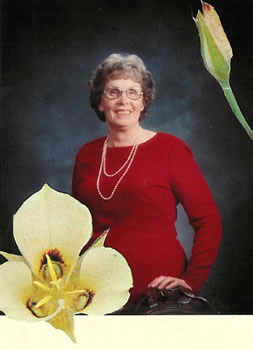
Ida-Rose Langford Hall, b. 20 Feb 1921, in 1980
Show some spirit!
Having compiled the qualities you wish to highlight, do put some thought into their presentation. It saddens me to read an obit that sounds like a filled-out form sprinkled with weak punctuation. Every person is a child of God, so a spark of that divinity can warm each published life account. I like to find a biographical sketch that tells about our subject’s personality – that shows the writer has worn numbers off keys, selecting better words to describe a loved one’s nature and reflect the family’s caring.
It also helps if the writer taps other family members to get their insights and suggestions. After starting this column, I finally got courage to start on Mom’s obit and sent an early draft to my children, as I can trust them to provide candid responses. I also forwarded it to my brother-in-law, Barry Wood, and my brother’s “wife emeritus,” as we like to call her, Betsy Huntington Hall, both of whose opinions, writing, and editing I greatly respect.
I also enlisted a review from BYU’s retired professor Don Norton, whose classes on writing family history my parents and I enjoyed taking more than once. He also graciously gave a look-see and caught some kinks, though I confess we kept cutting and revising, so he is not accountable for my sins, added since. We do hold Brother Norton responsible for the priceless collection of short life episodes my parents wrote regularly for his classes, inspired as we were by his motivating instruction and blessed by his invaluable editing and suggestions.
All this input, through many drafts, greatly blessed my effort, though I learned that even with all the revising, I can’t hope to please all. Especially when mourning a loved one, feelings run deep. What one person loves best, another wants deleted. At times, through this process, I felt like Goldilocks: one thought my tone too warm – another, too cold. I doubt I got it “just right” for anyone in our strong-minded family.
There’s nothing like a funeral to bring out sibling rivalries and coalitions. There’s also nothing like a well-planned funeral to bond siblings more closely together and bring healing, after we’ve inflicted and suffered our bruises. Though reactions to what you write will be as varied as its readers, each will help balance your perspective and contribute to the end result. So take a deep breath and involve the rest of the family, after you’ve shaped what you thought was your final draft. While staying open to all opinions, remember that you are the one asked to write this obituary. Don’t be afraid to finally assert yourself and stop the bucks at your desk.

H. Tracy and Ida-Rose L. Hall family gathers for Mom and Dad’s 60th wedding Anniversary, September, 2001. Front L-R: Dan & Sherlene Bartholomew, Ida-Rose L. and H. Tracy Hall, Helen & H. Tracy Hall, Jr.; Back L-R: Nancy & Doug Mecham, Marty & Elizabeth Neil; Karen & David Hall; Barry & Virginia Wood, Bryan & Charlotte Weight.
I must admit that along the way, writing to honor Mom, I developed more and more empathy for the one mentioned earlier, who wrote about that overwhelmingly Super Mother I decided, ultimately, that living life, trials and all, is a supernal achievement that can be celebrated without apology.
Relative Matter
Now comes that end part of the obit all large LDS families dread assembling. Despite my obsession for wanting to include every genealogical detail, I decided that it was not practical to name all thirty-five grandchildren and twenty-eight great-grandchildren. Though it breaks my heart when I find an ancestor’s obit, and it does not name all those numbered descendants, I admit that in this digital age, those names are not as likely to be lost. We can post all that information on the ‘net from our home computer database and submit it to the Pedigree Resource File (while of course protecting privacy rights of the still-living).
Barry, himself an avid genealogist, also convinced me that for these same reasons, I need not list full names of all surviving relatives – just those they are called by on a daily basis. (It is best to use the formal name, however, i.e., Elizabeth, instead of “Betsy.”) Likewise, and also for reasons of privacy, maiden names of living female spouses can be omitted.
One fact newspaper editors like to include is the town in which surviving relatives live, so readers in those places can identify them as neighbors and offer their condolences. In a huge family like ours, it took the better part of a couple of days to make needed calls all over the country, trying to update contact information – not only for Mom’s obit, but also for our use as a family, keeping our relatives advised about her progress towards what their bishop called her “graduation.”
I enjoyed this excuse to call aunts, uncles, and cousins, getting updates on their lives to share with all the family. I invited all I called to ask their branch of the family for short bios, updating us on their lives, so we as a family can know each other better, as we come together from distant places to comfort each other and honor Mom. I am so glad I got a head start on this process, because when my mother died on Monday, March 7, I had no idea how involved funeral preparations can be, nor how grieving slows us down. How grateful I am for my mother’s foresight, assigning each of us early to various stewardships in the saying of our last goodbyes.
Cut, clip!
I like the trend to use two photos of the deceased, especially if she lived a long life. However, if you order two views, sometimes they are reduced so much, one larger print might have been better. If you want both photos to be the same size one would have been, be sure to specify that and get a cost estimate to forestall unwelcome surprises.
Length alone was quite an issue, as several in our family, for good reason, prefer short, factual obits. I have too much of the genealogist and writer in me. Believe it or not, I did cut what I thought was my final copy in half, especially after I saw how much of the obit length involved listing Mom’s survivors. I thought it was important to list survivors in Dad’s family, as well, though this also added to the length. My final obit is longer than most, as I wanted to reveal about Mom’s identity what I so wanted to see in obits of my ancestors. I did learn, however, that we pay well for this privilege. When I learned the cost to run Mom’s obit for only one day (prices usually decline for subsequent runs), I got more conservative in a hurry. It hurt to cut some of my favorite parts, after all that work. I suggest calling the news desk ahead of time, so you know what each word is worth before it gets on your page in the first place. There’s no such thing, these days, as adding only your two cents.
Still, if the choice is between gold-plated coffin handles and having a slightly longer obit and an extra photo, my vote goes with what stays above ground.
Move over, Murph!
I was proud of myself for getting the obit to the mortuary right on time, by twelve noon, the day before I wanted it published. I had gone over and over it, though I had worked on so many versions, it was starting to swim in layers before me. I even had it formatted in columns to match what I saw in the newspapers (not helpful, I later learned). I thought my copy had to be an obit desk editor’s dream. With a little luck that piece would fly off their desk and practically print itself!
Little did I guess that I would spend the next 3.5 hours on the phone, talking with editors who were not familiar with the fabulous editing program Barry introduced me to when he returned my copy showing his suggested changes. This MS Word “Track Changes” program draws colored lines from each change to a box at the right that details the edits. That’s great when viewing someone else’s edits, but I could not figure out how to remove the edit marks when I felt ready to send clean copy. In frustration, I turned it over to my man Dan, who was also new to this program. While my back was turned, he must have pushed some lever deep inside the computer to make it look “clean.” Then he took off for work.
‘Trouble is, it only looked clean at my end. Something happened, in transfer to the mortuary that got even worse when they tried to submit it to the newspapers. Suddenly I got calls saying that the mortuary’s sends were corrupted, so they had to have pure copy, straight from my machine. Even with my direct sends, the copy still arrived showing all those editing lines and boxes.
Dan coached me over the phone, while we tried transferring copy in language news desks could decipher. Murphy, however, prevailed, time and time again. Finally, only a half hour before four, when copy had to fly to reach the morning papers, one editor thought to have me cut and paste the obit from my word processing program to the text-space of an e-mail message to them. I told the other editor about the idea and copied the result to both, in the same exchange. Voila! Finally, it worked-barely in time!
[Barry has since told us that the way to get rid of all the prior edit markings is to hit the “accept change” icon to the right of the “final with markup” etc. box on the top of a MS Word 2003 or 2004 screen. Then, after “accepting” the changes, you save it again.]
Of course I had other important plans for that afternoon. Having read this, you will know better than to plan anything the rest of the day, after your obit copy is due. Send Murphy out to lunch, while you man the phones. Maybe then you’ll get some lunch, too!
Finally, store it right!
When you clip an obit, try to remember to attach the paper’s headline, date, and page information before storing it in an album. Remember that news paper is acidic and will quickly discolor and decay. It is best to make a photocopy of that clipping on acid-free paper, before storing it in archival sheet protectors.
Welcome surprise
Writing an obituary may seem daunting at first, but as with all hard tasks, this opportunity can be a meaningful learning and growth experience. Writing is a useful exercise that helps sort thoughts and feelings, for better focus. Sometimes when I struggle for the right words, trying to write about an ancestor or loved one, I experience a flash of insight and sense that the Spirit is teaching me. Perhaps some of that will reflect in my writing and influence subsequent generations, as well.
When I finally opened our morning papers to see my obit printed, I was unprepared for the outpouring of the Spirit that I felt as I reviewed what I, with gracious aid of so many, wrote about my mother. This reassurance helped me know that love for a mother communicates through the Word, not by my word. Understanding is a gift from God that opens between what is on the printed page and sensitive readers. It is our honor and blessing to be a humble part of that sweet experience.
Here is the link to Mom’s obit, as posted by the Deseret Morning News. Now you can see if I followed my own advice or should have listened to yours. I do hope that along the way, reading this, you found ideas that will someday help you chronicle a loved one’s life, well lived.
[i] Bartholomew, Sherlene Hall, “Good Seasons and Hot Pepper in a String Bean Casserole,” To Rejoice as Women, ed. By Suzette Fletcher Green and Dawn Hall Anderson (Salt Lake City: Deseret Book Co., 1995), pp. 77-87.
2005 Meridian Magazine. All Rights Reserved.