





Planning a Trip to Palmyra This Summer?
By Becky Cardon Smith
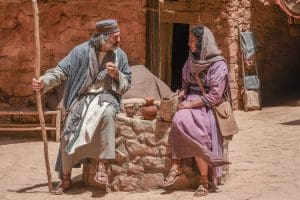
In the late 1700s, the Palmyra area became a desired destination for settlers looking for fertile farmland to grow crops and to raise a family. The nearby lakes and densely wooded forests provided the water and lumber necessary to begin a new life in this undeveloped territory. Both the village and township went through a series of name changes until 1798 when they were named “Palmyra,” after an ancient city in Syria. This city had been built around a desert oasis near an important trade route used by the Roman and Persian empires. Like its namesake, modern Palmyra also became an important village, near the waters of a flourishing trade route, upon completion of the Erie Canal in 1825. Many citizens of Palmyra prospered during the Canal Period of 1822 to1853. Several homes built during this period still stand today, silent reminders of a storied past.
For Latter-day Saints, visiting the Palmyra/Manchester area provides a tangible reminder of a very special and sacred time in early Church history. A small rebuilt log cabin beside a grove of trees reminds us of one of the most significant events that has occurred since the resurrection of Jesus Christ. The nearby frame home evokes stories of joyful moments, harrowing escapes, and personal hardships. To the east stands a wooded “drumlin” or hill with the Angel Moroni Monument atop. It was on this hillside that the angel Moroni delivered the gold plates, containing a record of the history of his people, to a young man named Joseph Smith. A home site reminds us of one individual’s personal sacrifice in offering his farm as payment for the printing of this translated record. A tour inside a restored red brick building will explain the process used to print the Book of Mormon.
SITES TO SEE
- Hill Cumorah Visitors’ Center – This beautiful visitors’ center, dedicated in 2002 by President Hinckley, is a great place to begin your visit in the Palmyra area. Allow at least one hour to tour the center, see the displays and hear the presentations. Be sure to pick up a handout on the significant events in the history of the Hill Cumorah and a very useful map of the restored historic sites both for this area and for Fayette. The visitors’ center is located next to the Hill Cumorah at 603 Route 21.
- Hill Cumorah -The angel Moroni first showed Joseph Smith the gold plates at this hillside on September 22, 1823. These ancient records contained a history of former inhabitants on the American continent. Forbidden to take the plates at that time, the young Prophet returned on the same date for the next four years to receive additional instruction. On September 22, 1827, Joseph returned with his new bride, Emma, who remained in the wagon while he climbed the hill to receive the plates. The center portion of the hill has been cleared of trees and is tiered to provide added staging for the Hill Cumorah Pageant. A road on the left side of the visitors’ center will take you to the top. Those wishing to walk can take a path located on either side of the hill. At the top you will find a grassy area with picnic tables. Overlooking the hill are benches providing a wonderful place to sit, read, and reflect. You can’t help but feel the spiritual significance of this special site while standing here.
- Angel Moroni Monument – Moroni became the sole survivor of the great Nephite civilization, having seen his father and all his kinfolk slain in battle (Mormon 8:5). He buried the record of his people, written on gold plates, in the hillside of Cumorah around A. D. 421 and prophesied that these records would eventually be brought from the darkness into the light to shine forth (Mormon 8:16). It was this same Moroni who, as an angel, delivered the gold plates to the Prophet Joseph Smith in 1827. As you visit the monument, notice the embossed panels on all four sides, read the inscriptions and signs, and learn what the shaft, ornamentation, and lines of light on the monument represent. President Heber J. Grant dedicated the Angel Moroni Monument on July 21, 1935. As you sit at the monument, read some of Moroni’s last written words to each of us. Feel the power of his testimony about the Book of Mormon and the sincerity of his plea for us to “come unto Christ” (Moroni 10:32).

- Palmyra New York Temple – In February of 1999, the announcement of the 100th temple was met with great joy in the “Cradle of Restoration.” The Palmyra Temple sits atop a hill overlooking the Smith family farm and Sacred Grove, bordering the towns of Palmyra and Manchester. At the groundbreaking ceremony, President Hinckley spoke of its special significance saying, “I regard this temple as perhaps the most significant, in one respect, in the entire Church. It was right here in the Sacred Grove where it all began” (Church News, May 29, 1999).President Hinckley dedicated the 10,700 square-foot temple on April 6, 2000. The temple’s beautiful stained glass windows, depicting scenes from the Sacred Grove, and the white granite exterior add to its majestic sacredness. All sessions are by appointment only and there is no clothing rental available at this temple. For questions, to schedule a session, or to do baptisms, call 315-597-6001.

- Welcome Center at The Joseph Smith Farm – Your visit to the log home, frame home, Smith farm, and the Sacred Grove should begin here. Allow at least two hours to tour the two homes, visit the Sacred Grove and walk about the farm reading the many markers. It is located at 843 Stafford Road.

- Smith Family Log Home – Joseph Sr., Lucy, and their nine children first lived in their 1 -story log home from 1818 until the fall of 1825 (their youngest child, Lucy, was born here). Some of the most significant events ever to occur took place in and around the small log home. Joseph went from this home into the woods to pray in the early spring of 1820 and received the First Vision. On the evening of September 21, 1823 and through the night into Sept. 22, the angel Moroni appeared three times to Joseph Smith in an upstairs room. Later that day, Joseph went to the Hill Cumorah and first saw the gold plates. Less than two months later, the Prophet’s beloved older brother Alvin died at this home on November 19, 1823. Hyrum and his wife Jerusha lived here from late 1826 through late 1830. Two of their daughters were born during their stay. After the financial loss of their frame home, the Joseph Sr. family moved back into the log home with Hyrum’s family in the spring of 1829. The Smith log cabin was not only the hub of family life, it was also the center of Church activities going on in this area. Hyrum supervised the first printing of the Book of Mormon while living here. On a family visit from his home in Harmony, the Prophet received the revelations which are recorded in D&C 19, 22, and 23. The Smith family moved from this home in the fall of 1830. Joseph Sr. and Lucy lived for a brief time in Waterloo (near Fayette) before moving on to Ohio with the other Saints. Though the log home was eventually torn down or destroyed, it has been rebuilt on its original foundation and was dedicated by President Hinckley on March 27, 1998. As you walk through the rebuilt home, notice the small birthing room (added on by the Smiths) and imagine family life as it once was. Walk upstairs and read from Joseph’s own words the account of his sacred experience (JS-H 1:29-54).

- Sacred Grove – On a beautiful spring day in 1820, fourteen-year-old Joseph went into the woods near the family’s log home, seeking answers to his questions about religion. While Joseph was kneeling in prayer, as directed in James 1:5, both God the Father and His Son, Jesus Christ, appeared and spoke to Joseph. Though Joseph would be persecuted for the rest of his life for his account of the First Vision, he would never deny what he knew to be true. Joseph said, “Why persecute me for telling the truth? . For I had seen a vision; I knew it, and I knew that God knew it, and I could not deny it .” (JS-H 1:25). Nine years later, after receiving the gold plates and completing their translation, Joseph was permitted to show these same plates to eight witnesses in the privacy of this sacred grove of trees (HC pp.57-58). The benches located throughout the grove provide wonderful places to sit and read Joseph’s account of the First Vision found in JS-H 1:5-20.

- Smith Family Frame Home – Alvin initially began construction on this New England style home in 1822. On his deathbed in November of 1823, he asked Hyrum to see that the home was completed for their parents (HJS p.116). Joseph Sr. and Lucy finally moved into their almost completed frame home towards the end of 1825. Unfortunately, they would have to leave this home in 1829 because of the dishonest actions of a neighbor, Russell Stoddard (for more details read HJS pp. 129-135). For the Smith family, the almost four-year stay in this home was full of both joyful events and difficult moments. In January of 1827, Joseph and his new bride, Emma, came here to live with his family. On September 22nd of that same year, Joseph returned to the Hill Cumorah where he met with the angel Moroni and received the gold plates. When others sought to steal the plates, they were hidden for a time under the brick hearthstone in this home (HJS p.149). After moving to Harmony, Joseph returned to his family home in July of 1828, concerned about the 116 translated pages that were entrusted to Martin Harris. As you look at the kitchen table, it isn’t hard to visualize the Smith family gathered together while listening to Joseph tell of his incredible experiences or to imagine the Prophet as he sat at the kitchen table in almost inconsolable grief upon hearing Martin Harris report that the manuscript had been stolen (HJS pp. 164-166).

- Soon after, a new boarder at the Smith home, Oliver Cowdery, became an important help for Joseph as he continued the translation of the plates. In 2000, the original Smith frame home was restored as it was in the Smith family era. As you enter the home, notice to your left some of the original whitewashed wallboards, the replica of the wooden box used to hold the gold plates, the fireplace hearth under which the plates were once hidden, and a painted oilcloth rug. (Lucy painted oilcloths that were used for tablecloths, blinds, and rugs.) Joseph and Lucy’s bedroom and sitting room, just to the right of the front door, has some of the original flooring. (Oliver and the Smith children slept upstairs.) In the kitchen, notice three items of luxury (but not the originals) that Lucy had in this home: the herb drying rack (notice that it is almost in the original location), a limestone dry sink, and the brick oven. Be sure to notice the small cutout portion of wallboard behind the kitchen table. You can still see the original dated newspaper used for insulation. Free guided tours of the frame home are given daily (schedule previously mentioned – Welcome Center at Sacred Grove). The frame home is located just a short walking distance south of the Smith log home.

- Threshing Barn, Cooper Shop, Farm – The 100-acre Smith farm is also referred to as the Manchester farm although the Smith log home actually lies just inside the Town of Palmyra. The reconstructed threshing barn and cooper shop (barrel-making) help you visualize the farm as it was during the Prophet’s stay. The gold plates were once hidden in the loft of the cooper shop and though the building was ransacked by an angry mob, the hidden plates were not discovered (HJS p.149). Take time to stroll around the farm and read the many informative markers. Imagine how hard the Smith family worked as they felled several thousand trees, nurtured their apple orchard, tapped over a thousand sugar maple trees, and grew wheat, corn, and many other crops.
- William Stafford Home – This is one of the few remaining homes from the Smith family era. The children of Joseph Sr. and Lucy attended school with the Stafford children. It is very likely that both the school and the road were named after the Staffords. The home is located at 405 Stafford Road (about 1.6 miles south from the Smith farm parking lot).
- Porter Rockwell Home Site – The Orin and Sarah Rockwell family lived less than two miles from the Joseph Sr. and Lucy Smith family. Their children attended school together and the two families became good friends. One of the Rockwell children, Orrin Porter Rockwell, forged a lifelong friendship with the 7 year older Joseph Jr. When Joseph and his parents would come to visit, Porter would beg his mother to let him stay up to hear the conversations. He even picked berries by moonlight and gathered wood to sell so that the proceeds could help print the Book of Mormon. Porter was an early convert and was baptized on April 6, 1830, the day the Church was officially organized (HC 1:79). Porter’s colorful personality and his close friendship with the Prophet, fueled stories that were often part truth and part myth. Sometimes referred to as “the destroying angel” or “Joseph’s bodyguard,” Porter Rockwell was a pioneer, rancher, scout, deputy marshal, marksman, and a man of unwavering loyalty to friends. After the Prophet was martyred, he went west with the Saints and died of natural causes in Salt Lake City at the age of 65. The Rockwell home was probably located about .1 mile directly south of the Stafford home on Stafford Road.
- Original Site of Stafford School – The younger Smith children attended the Stafford School which was originally located at this site. In 1827, a young man named Oliver Cowdery was hired to teach at the school. He also boarded with the Smith family in their frame home (HJS p.180). While residing with the Smith family, Oliver became well acquainted with the family and ultimately heard about Joseph’s having received the gold plates. At this time, Joseph was living in Harmony with Emma. Wanting to meet the Prophet himself, Oliver went to Harmony where the two met for the first time on April 5, 1829 (HC 1:32). Two days after Oliver’s arrival, Joseph recommenced translation of the Book of Mormon with Oliver acting as scribe. Oliver played an important part in early Church history, later becoming one of the Three Witnesses. The 1848 cobblestone building located at this site is not the original schoolhouse (see the following site for original building). It is privately owned and not available for tours. The Stafford School was located at 498 Stafford Road (about 2.1 miles south from the Smith farm parking lot).
- Stafford District School House – This is the original wood-framed Stafford Schoolhouse but it is not on the original site. (The original part of the school is the main section of the home.) The home is privately owned and not available for tours. It is located at 520 Stafford Road.
- Corner of the Four Churches – This interesting intersection of Church Street (Route 21) and Main Street (Route 31) was once listed in Ripley’s “Believe It or Not.” It is unique because a different church is located on each of the four corners. Though members of the Episcopalian, Baptist, Presbyterian, and Methodist faiths were all living here at the time the Prophet and his family also lived here, these four churches had not yet been built. The earliest church located at this intersection dates from 1832 (Presbyterian Church) and the Smith family had left the Palmyra area by the middle of 1831.

- Dr. Alexander McIntyre Home – One of the oldest homes in Palmyra is also the former home of Dr. Alexander McIntyre. He was the Smith family physician but was unfortunately out of town when Alvin first became ill. Upon his return two days later, Dr. McIntyre was one of the doctors who tried unsuccessfully to save Alvin’s life and later helped perform the autopsy, discovering a gangrenous stomach blockage that caused his death (HJS p.118). Later, as persecution against the Smith family increased, Lucy Smith recorded two separate occasions when Dr. McIntyre either chose not to participate or actually warned Joseph of the danger. As Joseph and Emma were planning to move to Harmony to work on the translation, a mob of 50 men made plans to stop the couple’s departure and to seize the “Gold Bible.” The mob asked Dr. McIntyre to be their leader, but he refused (HJS p.154). Several years later, when Joseph was about to leave for a meeting with E.B. Grandin, Dr. McIntyre came to warn the Prophet that a mob of 40 men was waiting to attack him. Dr. McIntyre had once again been asked to be their leader, and once again, had refused. (HJS p. 203). The yellow home with white trim is located at 109 West Main Street (just to the left of the First Methodist Church on the northwest corner of the Main intersection). It is privately owned and not available for tours.

- Book of Mormon Publishing Site – In 1828, after the completion of the Erie Canal, a four-bay red brick building was constructed just east of the Main intersection. Several months later, E. B. Grandin rented the three-story westernmost bay for his printing and publishing business. Grandin’s bookstore was located on the first floor; his book bindery and an office (rented by an attorney) were located on the second floor, while the print shop was located on the top floor. When Joseph first approached Grandin about printing the Book of Mormon, E. B. Grandin initially refused the job. He later consented to print 5,000 copies for $3,000 after some of his concerns were addressed and Martin Harris agreed to mortgage his farm to guarantee payment. The printing of the Book of Mormon began in August of 1829 and the first copies were finished on March 26, 1830.

- The 592-page book was sold at Grandin’s bookstore for $1.25, a two-day wage in that day. On April 7, 1831, Martin Harris sold a large portion of his farm in order to make the agreed-upon payment. The first two bays of the original Grandin building have been purchased by the Church and have been restored. This site was dedicated by President Hinckley on March 26, 1998, the anniversary of the completion of the first printing of the Book of Mormon. Free tours are given daily (same hours as the other restored sites). Allow an hour stay to take the tour and learn about the detailed printing process, view an informative video, and see many historical objects including an original printer’s proof sheet, two copies of the first-edition Book of Mormon, a representation of the Smith cabin in Harmony, and a replica of the single-pull Smith Patented Improved Press (original is in the Church Historical Museum in Salt Lake). Notice the pulley system used to lower the print and the indentation left by the printer’s feet in the original wood floor underneath the older press. Children will also enjoy the interactive display on the main floor. It is located at 219 East Main Street.
- Pliny Sexton Home – This home was built in 1827 and is one of the few homes remaining from the Joseph Smith era. Notice the historic marker in front of the building denoting that this home was used as part of the Underground Railroad system, which aided the escape of slaves in the Civil War period. Pliny Sexton’s son, Pliny T., was born at this home in 1840. Pliny T. became a lawyer and ultimately owned many items of interest including the E. B. Grandin building, the original Smith press used to print the Book of Mormon, printer’s proof sheets used in the first printing, and a portion of the land now referred to as the Hill Cumorah. The home is privately owned and not available for tours. It is located at 322 East Main Street.
- Palmyra Village Cemetery – Persons of some note in Church history who are interred here include: E.B. Grandin (publisher of Book of Mormon), Harriet Rogers (Grandin’s wife), other Grandin family members, John Gilbert and family (typesetter of Book of Mormon), Pliny T. Sexton (son of Pliny Sexton), Lucy Harris (wife of Martin Harris) and other members of the Harris family. Information can be obtained in the cemetery office on walking tours to see the above-mentioned graves and other sites of interest including the graves of Ambrose and Clarissa Hall, great-grandparents of Sir Winston Churchill. The cemetery is located on Vienna Street (which runs parallel to Main Street). To see E.B. Grandin’s grave, go through the arched entrance and turn right on Linden Avenue. You will see a large obelisk monument with the name Frederick Smith on your left. It sits inside a small chained enclosure. Harriet’s headstone is in the far left corner within this enclosure. Egbert is buried to her right.

- Swift Cemetery – This small cemetery was named after General Jonathan Swift (founder of Palmyra) who was killed during the war of 1812. His headstone is located in the middle of the grassy area. The modern granite headstone of Alvin Smith is on the far left side. Alvin was the oldest child of Joseph Sr. and Lucy and was idolized by his younger brother Joseph. In November 1823, Alvin became very ill. Unable to find their regular doctor, the Smiths summoned another doctor who prescribed a dose of calomel (a laxative which was often given for a variety of ailments). Unfamiliar with the doctor, Alvin first refused to take the medicine but finally consented. Unfortunately, it lodged in his stomach and became gangrenous. After suffering for four days, Alvin passed away on November 19, 1823 at the age of 25. Knowing that he was dying, he counseled each of his siblings. To Joseph he urged “I want you to be a good boy and do everything that lies in your power to obtain the record. Be faithful in receiving instruction, and in keeping every commandment that is given you” (HJS p.116). Although Alvin had not yet been baptized, Joseph later had a vision in the Kirtland Temple in which he saw his brother in the celestial kingdom (D&C 137). To view Alvin’s headstone, climb the stairs located next to the blue and gold sign that says “First School House” and walk directly back along the left side of the cemetery. (Notice the original marker is embedded in the back of the new headstone.) A Presbyterian church once stood in the area just to the south of Alvin’s grave. Lucy Mack Smith and several of her children, including Hyrum, were members of this faith before Joseph had the First Vision. Alvin’s funeral took place at this church. The Swift Cemetery is located almost immediately north of the Main intersection, on the west side of Church Street, and across from St. Anne’s Roman Catholic Church.
- Original Section of Erie Canal – While driving from Swift Cemetery to the Martin Harris Farm on Church Street, you will pass a section of the 1820 Erie Canal. The original canal was only 4 feet deep and 44 feet wide. Stop to see the canal or take a walk along the towpath where the mules walked as they pulled the boats. The original canal is located on the west side of the road about .2 miles north of the Main intersection. Just past the original canal, you will pass over a small bridge spanning the present-day Erie Canal. This canal was completed in 1918 and is 12 feet deep.

- Martin Harris Farm – Martin Harris once lived here in a 1-story white framed home. (His father, Nathan Harris, owned a large farm just a little further to the south.) New owners built the cobblestone home at this site after Martin’s original home burned down in 1849. (You may notice several other cobblestone homes in the Palmyra/Manchester area that were also built during this same period by the canal masons.) Martin first met the Smith family when he hired Joseph to work in the fields (for .50/day), and Joseph Sr. and Hyrum to dig a well on his farm. After receiving a spiritual witness to the truthfulness of Joseph’s work, Martin gave Joseph and Emma $50 to help them pay off their debts and move to Harmony to begin translation of the gold plates. Martin, more than twenty years older than Joseph, soon joined the couple in Harmony and served as the Prophet’s scribe. In June of 1828, Martin was allowed to take the first 116 pages of translated manuscript back to his home in Palmyra with the promise that he would show the pages only to his wife and a few specifically mentioned individuals. However, Martin failed to keep his word as the manuscript was shown to additional people. Subsequently, the pages were stolen and never recovered. In her history, Lucy Mack Smith tells of the blessings Martin lost not only spiritually but temporally in consequence of his actions. “The same day on which the foregoing circumstance took place, a heavy fog swept over Mr. Harris’s fields and blighted all his wheat, so that he lost about two-thirds of his crop, while the fields on the opposite side of the road remained untouched” (HJS p. 171). Though Martin did not act as scribe again, he did mortgage his farm to guarantee payment for the publication of the Book of Mormon and later sold 150 acres to make the $3,000 payment. Martin was privileged to be one of the Three Witnesses to the Book of Mormon. He was present when the Church was officially organized and was baptized the same day. After his wife died, Martin followed the Prophet to Kirtland, married a niece of Brigham Young, and marched with Zion’s Camp. Martin ultimately left the Church in 1837, when many other prominent early members were also apostatizing, and did not go with his wife Caroline and their children to Utah. Remaining in Kirtland, he lovingly cared for the deserted Kirtland Temple, and was eventually rebaptized. At the age of 73, Martin crossed the plains to rejoin his family in Utah. He died on July 10, 1875, having never denied his written testimony as one of the Three Witnesses. The Martin Harris farm is located 1.5 miles north of the Main intersection at 1962 Maple Avenue (Church Street turns into Maple). The home is owned by the Church but is not available for tours.
- Lucy Harris Home – Martin married Lucy, his first cousin, in March of 1808. Though Martin believed Joseph to be a Prophet of God, Lucy did not. She was critical of both the time and money spent by her husband to help Joseph with the translation. It is very likely that she was involved with the theft of the 116 manuscript pages entrusted to her husband. Martin’s involvement in the Church, culminated by the loss of a large portion of their farm to pay off the $3,000 printing payment, led to a final separation between Lucy and Martin. She and the children moved to this two-story farm home, situated on about 80 acres, which was deeded over to her by Martin in 1825. She died at the age of 44 in the summer of 1836 and is buried in Palmyra Village Cemetery. To see the home, continue past the Martin Harris farm .5 miles and turn left at Macedon Center Road. Continue .4 mile west and you will see the white two-story framed home on your right at 2827 Macedon Center Road. It is privately owned and not available for tours.
THINGS TO DO

- Aqueduct Park & Lock #29 – This is a great park for picnics, biking, enjoying the beautiful scenery, and to see a lock on the Erie Canal. Though the original canal had over 80 locks, the newer canal has fewer than half that number (33 state locks). If you’re lucky, you may see the locktender at work helping a boat through the lock. We found the tenders very knowledgeable and willing to answer all of our questions. Children will enjoy the free Erie Canal activity book available at the locktender’s small office next to the canal. Also notice the remains of one of the original aqueducts built in 1856 over Ganargua Creek. When the original Erie Canal had to cross over a river, an aqueduct was built to route the river beneath the canal.
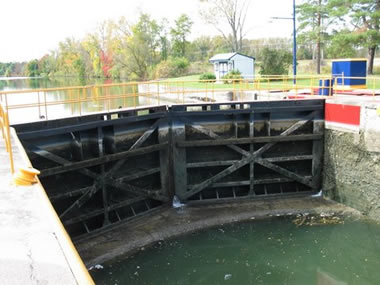
- To locate the park, drive west on Main Street about .7 miles from the Main intersection. The entrance to the park will be on your right next to the “Town of Macedon” sign. After entering the park you will see a recently restored 1858 crossover bridge to your right; the aqueduct and children’s playground is to your left. To see the Erie Canal and Lock #29, walk across the one-lane bridge located north of the parking lot.
- Alling Coverlet Museum – Did you know that Martin Harris was an accomplished weaver, had 13 looms, and won several awards for his work? In fact most of the weavers during this time period were men. This museum features the largest collection of hand-woven coverlets in the country (none made by Martin). Also displayed are about 200 quilts and miniature rugs, and an on-site gift store. Open daily 1 p.m.-4 p.m., from June 1 thru September, or by appointment. Located at 122 William Street (near Grandin Bldg.) 315-597-6981.
- William Phelps General Store Museum – Step back in time as you enter this general store once owned by William Phelps (no relation to W.W. Phelps). The 1890s grocery store remains almost as he left it – including the original eggs in their carton. The tour of the upstairs family living quarters on the second floor is interesting. Open Tuesday thru Saturday, 1 p.m.-4 p.m. from June thru mid September, or by appointment. Located at 140 Market Street. 315-597-6981.
- Print Shop Museum – In 1860, John Jones began a printing business which continued for the next 63 years. See the original Palmyra-made Platen Printing Presses, learn about the printing process, and enjoy hands-on activities. Open Tuesday thru Saturday, 11 a.m.- 4 p.m. from June 1 thru mid September, or by appointment. Located at 138 Market Street. 315-597-6981.
- Palmyra Historical Museum – Once a hotel, this museum features many items from Palmyra’s past including village records, furniture, military items, children’s toys, etc. Notice the special Smith family exhibit called “Life in Palmyra 1820-1840.” Open Tuesday thru Saturday, 11 a.m.- 4 p.m. on weekends from June thru mid September, or by appointment. Located at 132 Market Street. 315-597-6981.
Interested in joining us on our 2009 Fall Church History Tour – please visit www.ldsfamilytravels.com.