





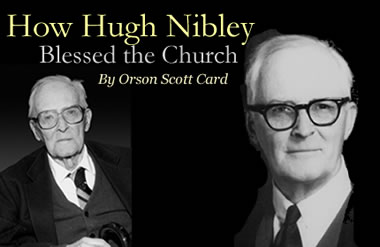
Editor’s Note: Hugh Nibley, noted LDS scholar, died Feb. 24, 2005, at his home in Provo, Utah, of causes incident to age. He was 94. Survived by his wife, eight children, and numerous grandchildren, Hugh left a legacy of scholarship on LDS scripture. A noted author of many books, he was a frequent contributor to Church magazines, a popular teacher at Brigham Young University, and a speaker who was beloved by all.
Hugh Nibley‘ s death leaves a gap in the Church that it would take two dozen people to fill, if it can ever be filled at all.
At the same time, it’s hard to think of any Mormon except Joseph Smith himself who left behind so many wide-ranging and profoundly transformative writings. Hugh Nibley opened the scriptures to us and applied them to every aspect of LDS life.
Thanks to a FARMS (Foundation for Ancient Research and Mormon Studies) publishing program, virtually all of Nibley’s scholarly and popular works are in print. He will go on teaching us for generations to come.
But to Hugh Nibley’s family and friends, his passing is personal and his loss will be keenly felt. Though his last months were spent in physical frailty, his presence has been so powerful throughout his life that his absence will be noticed again and again.
He was fearless in word and deed. He followed truth wherever it led him and spoke the truth whenever he found it, to whoever most needed to hear it.
His body was slight, but we had a giant among us.
*
Like most Latter-day Saints, I first met Hugh Nibley through his writing.
As a child, I quickly graduated from Emma Marr Peterson‘s Book of Mormon Stories for Young Latter-day Saints to the scripture itself. Even that wasn’t enough, though — I wanted to know more. But, as with the Bible, the Book of Mormon was the only source for almost all the information it contained.
I tried a few popular writings on Book of Mormon archaeology, but I was skeptical enough that I soon rejected the apologetics. I wanted something substantive. Something real. Not faith-promoting fantasy, not logic-stretching attempts at proof — I didn’t need proof, I had the book itself! What I wanted was genuine scholarly thought that reached outside the covers of the scripture.
That’s when my father gave me an old, well-thumbed copy of a book that combined two titles: Lehi in the Desert and The World of the Jaredites.
It was an intellectual sunrise for me. Nibley wasn’t proving anything, he was simply putting the events of the Book of Mormon in context.
Nibley’s premise in these works was that there were two places where the Book of Mormon takes place within a known culture.
The Book of Ether begins in Asia, in a nomadic culture, and so The World of the Jaredites examined what was known at the time about central Asian nomadic cultures. Using a wide-reaching scholarly tradition that I have since recognized in the works of James Frazer (The Golden Bough) and Northrop Frye (Anatomy of Criticism), Nibley drew together cultural patterns that were endemic among the nomads that swept out of the Steppes of Central Asia to conquer great empires again and again, and found that those same patterns were clearly visible in the equally warlike Jaredite culture.
Just as the First Book of Nephi is personal, so also is Lehi in the Desert, which ties Lehi and his family to the culture of Jerusalem in the late seventh century B.C.
Just as important to me as the actual content of Nibley’s work — which was brilliant and illuminating — was Hugh Nibley’s attitude. He did not waste time trying to prove anything. He started from the premise that the Book of Mormon described real cultures, that it was precisely what it purported to be, and that we could understand it better by recovering the culture of the people by whom and to whom it was written.
As far as I have been capable, I have spent the rest of my life looking at the scriptures that same way. In effect, I still see the scriptures through Hugh Nibley’s eyes. It’s hard to think of a way to gain greater clarity than that.
The scholars who have followed in his path — not apologists, but explicators — may have brought new discoveries and insights to add to, or occasionally correct, what Nibley himself found, but only because they, too, were looking through Nibley’s eyes, with Nibley’s attitude of faith coupled with a relentless commitment to the truth.
It’s an important distinction. The apologists who are trying to prove the Book of Mormon — or any other aspect of our faith — are prone to self-deception. The slightest resemblance between an archaeological artifact and the scripture leads to far-fetched and unjustified conclusions; and any evidence that seems to contradict their view of the scriptures is ignored or explained away.
But the scholars who follow in Nibley’s footsteps have faith in the scriptures — but they are perfectly skeptical of their own interpretations of it. When the scriptures and the real-world evidence seem contradictory, those who see through Nibley’s eyes reexamine the common interpretation of the scientific evidence and of the scripture.
There’s a back-and-forth trade. The Book of Mormon helps to clarify the archaeological record, and the archaeological record helps illuminate the Book of Mormon. And in the few places where the current interpretations of both seem irreconcilable, then Nibley — and those who see through his eyes — are simply patient. It is not a crisis of faith, merely a temporary delay in understanding.
*
That’s a lot to learn from a single book, but that‘s how it worked. Nibley taught, not just by the content of his books and essays and speeches, but also by the man he was.
I clearly remember the epiphany I had as a child: If someone this smart, this rigorous of thought, this widely and deeply educated believes that Joseph Smith was a prophet, the Book of Mormon is true, and the Church is God’s kingdom on earth, then I will not let myself get swept away by whatever questions come up during my life. I’ll question my questions, I’ll doubt my doubts, confident that one way or another, everything will be reconciled.
In other words, truth is truth, but our understanding of it at any point in time is bound to be so limited that even our knowledge contains enough ignorance that it’s foolish to jettison something important and good merely because of slight, temporary contradictions.
In my early teens, I was given (again by my father) yet another Nibley book: No, Ma‘am, That’s Not History, Hugh‘ s answer to Fawn Brodie’s fanciful and disparaging “psychobiography” of Joseph Smith. His scorn for made-up assertions that can’t be justified by credible sources was a two-edged sword — but Nibley was not afraid of either edge. The truth is not torn down, but polished by healthy skepticism.
The only thing that makes “intellectuals” lose their testimony of the truth of the gospel is their own failure to be skeptical of their skepticism — their failure to subject their worldly “evidence” to the same level of rigorous questioning they apply to the gospel.
In other words, the problem isn’t that they have doubts — it’s that they don’t have enough doubts. They strain at some gnat in the gospel, while swallowing camels from the outside world.
Hugh Nibley never had such a problem. He subjected everything to rigorous examination, and those of us who determined to see the world through his eyes stayed firmly within the Church, for the obvious reason that the core of the gospel always holds up just fine, while most of the world’s intellectual fads are left in tatters.
All that the Nibley method causes us to lose are our misconceptions and false assumptions about scripture and Church history — and we‘ re better off without those.
*
As I came closer to the orbit of BYU after we moved to Utah, I began to hear more and more of the Hugh Nibley absent-minded-professor folklore. Frankly, I didn’t care (and wasn’t amused) at the idea that he sometimes mismatched his socks or otherwise lost track of the “real world.”
No, the tales that I treasured about the man were the ones that pitted him against mindless custom. Like the story that he once publicly called academic costumes “the robes of a false priesthood.” Or his sharp comments about shoddy scholarship or faulty thinking, no matter who it was who fell into error. Hugh Nibley became, for me, the only living example of a truly Socratic mind.
At the same time, Nibley was the unscalable wall. Even though I entered BYU as an archaeology major, I had to face the fact that no matter where I looked, Nibley had been there before me. While others have been undaunted by his presence and have added much to our understanding beyond what Nibley himself discovered, I realized that I simply didn’t have it within me to walk Nibley’s road.
Instead, I moved into the theatre department at BYU, which is where I was spending all my free time anyway. Ironically, that was how I eventually came to know Hugh Nibley directly, instead of through his books.
Hugh’s son Tom was a fellow student of mine at Brigham Young High School for the last year of its existence. He was at least as colorful and delightful a character as his father, and I got a chance to know him as I shared drama class, the school production of Harvey, and other plays with him. I came to admire and like Tom entirely for his own sake; Hugh was still a figure of legend, while Tom was real — and extraordinarily intelligent and talented.
He was also a year ahead of me in school and I was too much in awe of him even to attempt to become friends.
But in college, I started running into Tom’s younger siblings Charlie (who now goes by his middle name, Alex) and Becky. Every bit as smart and talented as Tom, they were also younger than me and more approachable. Quite to my surprise, I gradually found myself visiting in the Nibley home, getting to know everybody but Hugh.
*
It would be foolish to pretend that a visitor can come to know what goes on inside a family, just because he hangs out in their living room from time to time. Still, there‘ s a feel you get for a family’s life — in fact, when I was interviewing Mormon families back when I was writing a series of articles for the Ensign, I found that within ten minutes in a home I knew whether I was going to get anything useful out of the interview.
Families are either open or closed — and the Nibley home was as open as any family I have ever known. There was no pretense, though of course there was privacy. No one was trying to impress anybody. Brilliant people were coming in and out of the house all the time, each intent on their own errands — and almost all of them were named “Nibley.”
Hugh’s wife (and Tom’s and Charlie’s and Becky’s mom), Phyllis, became one of my favorite people. I remember thinking: Hugh Nibley is not one of those men who has to marry a woman who will hide her intelligence and talent so he never feels challenged. She was endlessly excited about everything important — including all the interests of her children. I got the feeling that she was never really surprised by each new achievement of her extraordinary family, but she was delighted by it.
I remember sitting in their kitchen talking with Phyllis on the afternoon of the first day of school one year. Martha and Zina trooped into the house like a hurricane — Martha being the hurricane and Zina being the calmer eye of the storm. Like any mother, Phyllis asked how it went — whereupon Martha held forth, hilariously and at great length, on the subject of why this year at school was going to be an even more appalling waste of time than usual.
Maybe the conversation would not have been so entertaining if a visitor had not been present — born showmen, all the Nibley kids knew how to play to the audience — but what I saw was a family that could be themselves at home. I never saw anyone in the Nibley family try to push anyone into being anything other than what they chose to be.
It was only a handful of times, really, that I actually saw Hugh himself there in his home. He would come downstairs without fanfare and join us, and the moment he did, he of course was the center of attention — but not because he demanded it. He actually seemed to try to fit in with whatever was going on. He did, however, have control of the family stereo system, commenting on the music that he chose to play for us. But he was happy to let the conversation flow wherever it did.
There was no subject on which he did not have something to say that was worth hearing; but he was also willing to listen, even to a callow kid like me, and seemed to feel no need to put anyone down, no matter how idiotic their comments. At the same time, he would offer helpful information to relieve truly painful ignorance, but when I was so corrected, I never felt that I had been reprimanded or humiliated. He had a gift for saying potentially harsh things with a gentle twinkle in his eye, as his speech went in bursts and hesitations.
I remember leaving their home after one of those conversations with Hugh and thinking, Was this what it was like to know Socrates? Not the like constructed dialogues of Plato, where his fictional Socrates seems bent on deflating opponents in argument, but the real Socrates, the beloved one who was irritating enough to powerful people that they wanted him dead, but teacher enough that his students weren’t rebels, they were thinkers.
Here’s the thing about Hugh Nibley: There was never a hint that he wanted disciples. He wasn’t collecting people. He wasn’t leading a movement. The movement already existed — it was the LDS Church — and Hugh Nibley was merely one of the disciples.
He wasn’t blind to his own intellectual and verbal gifts — I never saw any false modesty or perfunctory self-effacement. At the same time, I never saw him act impressed with himself. He was excited about whatever he was researching at the time — but he was also excited about many other things in which he played no leading role. But it mattered not a whit whether you were impressed with him.
*
Maybe that’s because Hugh Nibley was obviously playing to a greater audience than whoever happened to be in his living room at the moment. He had an audience that consisted entirely of God’s family, and he was at least as pleasantly at ease in that home as I was in the Nibleys’. Hugh was a teacher above all, and a good one. He expected others to be as rigorous as he was himself, and if you were, he was a kind and patient helper.
Now he has moved beyond those sheaves of note cards containing his sources and ideas which were so often spread around his office. He has all the original sources to hand, and instead of learning even more languages than the dozens he mastered in his lifetime, he can communicate with his witnesses with pure understanding that transcends language. Instead of having to approximate the truth he can simply have it for the asking.
I can imagine him saying, Yes, that’s so clear now! And maybe he’s amused at how far his best guesses were from the full truth.
But we here, left behind by the passing of the giant, are still amazed at how close, not how far, he came. We still perch on his shoulders, hoping to see a little farther because he took us so far down the road and up the hill to where the air was clearer.
We often talk of living in someone’s shadow. But I think that for someone to be in Hugh Nibley’s shadow, they would have had to get something big between him and them — because most of us were lucky enough to live in Hugh Nibley’s light.
*
Hugh Winder Nibley died on 24 February, 2005, in his home in Provo, Utah. Old age finally caught up to him, and it’s hard to imagine anyone who had less to fear from death.
No doubt he regarded his life’s work as being unfinished, and no doubt there are many who would have benefited if he had lived a little longer, written another book, given another speech, or just sat down and talked with a troubled, questioning soul.
But it is hard for most of us to grieve at the end of a life so well and thoroughly lived. From his birth on 27 March 1910, through all the wanderings of his life — from wilderness hikes to military service, from scholarship to speeches, from his sharp and dancing pen to his generous, witty conversation — he enjoyed the journey and made it far easier and better for his fellow travelers.
*
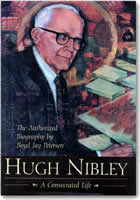
For a far more complete treatment of Hugh Nibley‘s life, read Boyd Peterson‘ s fine book, Hugh Nibley: A Consecrated Life: The Authorized Biography
And if you haven‘t already read any of Nibley’s works, you might try working your way through the whole collection published by FARMS and available from the websites belonging to BYU Bookstore or Deseret Book.
FEATURES