








The Trailblazer for Today’s Mormon Media Composers: Crawford Gates Celebrates his 80th with Music
by Ron Simpson
Utah Songwriter Advocate and General Manager, Tantara Records
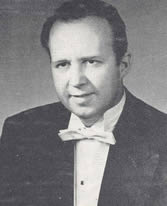
No matter how long I spend in the music business, I still get a flutter and a feeling of “why me?” or “there must be some mistake” when the mailman brings invitations to gala events where Important People are to be assembled.
Certainly that was the case as I opened the invitation to Crawford Gates’ 80th Birthday Concert to be held on New Year’s Day 2002 in Salt Lake City. I thought, did I get invited because he and I are both originally from Palo Alto? Or is it because he remembers me as a young songwriter seeking advice from the Music Department Chairman as I transferred to BYU to get a music education in the early sixties? Or because my mother had been such a fan of Georgia Gates’ San Francisco family, the Laupers, and made me promise to meet and date Georgia’s younger sister Bonnie Lauper, who was about my age and played the piano?
Hmm, now that last scenario is almost probable. Bonnie-now Bonnie Goodliffe-is one of the organists on Temple Square and a great friend to all in the Utah music-making community. (And so, Mom, even though I may not have met Bonnie and therefore couldn’t have taken her out when you were after me in the high school years, I certainly met her later, in Utah, working on projects for Temple Square and things like the Sesquicentennial Spectacular.)
But nope. Gotta check the box marked “E-none of the above.” I’m invited simply because I’m a record guy.
I recall that Tantara has recently put out a recording played by Laurence Lowe that Crawford Gates describes as one of the best performances ever of his stunning and difficult Sonata for Horn. A national magazine has praised the Tantara recording-and especially the Gates Sonata-glowingly. And we’re also about to release a concert recording from Ricks College containing one of Gates’ several medleys of Mormon hymns set for the symphony orchestra.
As I take my seat on New Year’s Day, Larry Lowe is indeed there among the performers, ready with a movement of the Horn Sonata. And so is Gates’ contemporary, Robert Cundick, composer of “The Redeemer,” the oratorio which is another Tantara release. Cundick will play a Crawford Gates organ duet, “Summit,” with Bonnie Goodliffe. A surprise participant is Georgia Gates, who will play the piano accompaniments to “The Wind is a Lion” and several more of the Gates evergreens not only with precise accuracy but also with a definite flair for the style. Another guest accompanist, Elizabeth Ballantyne, someone I’ve heard about, will play some of the tougher material for Larry Lowe and others, and will prove herself a force to be reckoned with.
I also spot flutist Erich Graff with pianist Ricklen Nobis on the front row-musicians of great skill and reputation, and with no ties to the Mormon music community. It seems to me their participation is a huge compliment to the reputation of Dr. Gates. Erich will play “Joy” from a 1994 suite, Lyric Dances, a wonderful piece that demands total control of the instrument. Crawford, introducing him, explains that Erich has been in the Symphony for many years, and always encouraged Gates in his earlier outings as guest conductor of the Utah Symphony.
Utah violinist Kelly Parkinson is also seated in the front, ready to play an extended setting of the beloved Gates hymn melody, “Our Savior’s Love.” She’s another Tantara artist, having played on the ambitious Discovering Helen Taylor CD, with legendary Utah-born pianist and Gates contemporary, Grant Johannesen.
Gates himself will play three interludes from his Pentameron, a work that Grant Johannesen commissioned the composer to write for Johannesen and the Utah Symphony as part of the Utah Sesquicentennial celebration. The interludes are based on “Come, Come Ye Saints,” and remind us of Gates the pianist, and also Gates the arranger, and the prodigious harmonic tools which resulted in Gates the songwriter. Perhaps these latter two are the Gates incarnations that hooked me first, and probably were responsible for wresting this California boy out of his comfort zone to Utah in search of a Mormon musical mentor.
I am transported back into an early memory.
Seated for a musical program in the Palo Alto Ward, I’m a high school student, hearing my friend Nancy Peery (now Marriott) sing for the first time. The song is “The Wind is a Lion,” and it’s also the first time I’ve heard anything by Crawford Gates, whose name is already something of a legend in the Church. Long gone from Palo Alto, Crawford left his folks behind in a stucco house near ours on Lowell Avenue. I have been their paper boy.
Written about ten years before, “The Wind is a Lion” earns my admiration as a strong example of the state of the art of popular song in its time. The memorability of the title line gives way to some interior modulations that are clever and smooth. The musical language is what I would later describe as “the musical theater language of common practice-essentially blind to time and place.” It works for settings in turn-of-the-century Oklahoma, for mythical Brigadoon, for London (My Fair Lady), for Paris (Gigi), or, for that matter, for Crawford Gates and the Mormon pioneers.
Before long I would find a white-jacketed vinyl LP, with Crawford Gates conducting the Hollywood Sinfonia in his own arrangements of Mormon hymns. Some of the passages sounded cinematic to me. The harmonies were thick and romantic, contemporary for their times, and the sound was just what I had been looking for to learn and follow. My record-business eye of today would identify that white album with the elegant gold type as a custom album, and the Hollywood Sinfonia as a pickup studio-call orchestra. Heard in the wonderful naivete of youth it was the big sound, romantic and contemporary. Hollywood sound, and coming from a musical source I just had to be close to.
At the Pearl Awards, presented in the summer of 2000, Kurt Bestor delivered a stirring tribute to Crawford Gates, crediting him with establishing the niche now known as Mormon media composition all by himself. Kurt was in top form; the tribute was heartfelt, magnificent.
I’m interrupted by the doorbell. It’s our friend Roger Burr, recently retired and laden with an armload of vinyl LP’s he can no longer play. As I look through them, there’s that white album with the gold type-Crawford Gates playing his arrangements of Mormon hymns, a Dvorak cello sonata, marches by the Coldstream Guards from England, and-wow-my favorite Tabernacle Choir album from my adolescent years: The Lord’s Prayer, recorded at the end of the 50s with Eugene Ormandy and the Philadelphia Orchestra. Featured is the work of Gates’ mentor, Utah composer Leroy Robertson, who is often dubbed the dean of Mormon composers. Not only Robertson’s setting of “The Lord’s Prayer” took my 19-year-old breath away, but also his magnificent, somehow understated “Come Come Ye Saints.” That Crawford Gates and Robert Cundick would have been Robertson protegs is easy to understand from this recorded source material: Cundick would perhaps be the more austere, the more intellectual of the two; Gates the more romantic and passionate. On this same Columbia album was Crawford Gates’ setting of “O My Father.” Why aren’t these wonderful choral-orchestral pieces performed more? It seems to me that all three would have stood the test of time.
At 80 Crawford Gates still has the personal sparkle and wit that were his trademark as a teacher and conductor, and he is still composing. True, he has been punished physically by heart trouble, and his step may be just a beat slower.
He makes occasional comments during the program, and at one point pays spontaneous tribute to his lifetime friend, organist and composer Robert Cundick, whose arrangement of Gates’ melody, “Our Savior’s Love,” is the one we sing in the green hymnal. He says of Cundick, “When I was at BYU we presented his oratorio, Song of Nephi, and I conducted it. I thought it was such an important work that I memorized it-just because it was Bob Cundick.”
Well, Crawford, thanks for the invitation, and happy 80th. I treasure both the warm memories of the past and the anticipation of music yet to be born.
It was an honor to be in the same room with all of you.
2001 Meridian Magazine. All Rights Reserved.