








Cooking as Therapy
By Janet Peterson
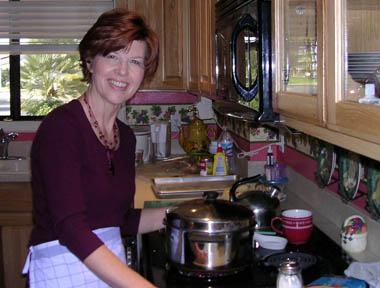
Cooking as therapy? How can getting out pots, pans, bowls, mixers, knives, and cutting boards be considered therapeutic – especially when you have to not only use them, but also to clean and put them away again? Cooking, however, need not be just a task. It can also be therapy as one immerses oneself in the sensory pleasures of the kitchen. After a day of household chores of washing clothes, vacuuming, cleaning bathrooms, or a long afternoon of carpooling, or sitting at a computer, or standing in front of a classroom, cooking dinner can be a welcome change and relief from the busyness of other activities. Cooking is a change of pace, a change of venue, and a change of mind. Even on rushed nights when time is short and notices of “I’m hungry – when’s dinner?” come from all corners of the home, cooking, if approached with a good attitude, can be the calming factor in a hectic household. As the aromas of oregano, basil, or cinnamon, sauted onions, or browning meat waft from the kitchen, family members happily anticipate what’s to come. Kitchen duties can make for memorable times, as you work to excite the senses of your family members. Marion Burros, author of Cooking for Comfort, claims: “For some people it is not just the act of eating the meat loaf or lemon meringue pie that is soothing; it is the act of cooking them. Taking time to put something together offers concrete proof of effort. Cooking takes a certain amount of concentration; it’s hard to think of the complex and sometimes frightening problems of the day over which you have no control when you have to think about something over which you actually can exercise control – what you are doing right now.”[2] There is something magical about the process of transforming raw, solitary ingredients into a savory amalgamation of flavor, smell, taste, texture, and color. There is also something very satisfying about creating a soup, a main course, a salad, a dessert oneself. In front of you is tangible evidence of your efforts. And that’s before you and your family even start eating. There is also a reward in knowing that by cooking for your family, you are fulfilling your role as caretaker, nurturer, wife, and mother – in other words, you’re “doing your job.” My British friend, Sharon Martin, expresses how cooking makes her feel: “I love to cook for my family. I love to choose the freshest ingredients. Almost always the simplest and freshest work best! I love to see the color of various fresh leafy, green, yellow, red, and multi-colored vegetables and fruits. It makes me happy! I love to make fresh baked bread, sometimes adding in herbs, sometimes fruits or dried fruits. There’s nothing like the aroma of bread or cookies or muffins baking in the oven! I love to go to markets where I can experience a whole array of different fresh fish and seafood. I don’t always know even what they are, but I still love to see such a variety of God’s given fare!” Former United States Senator Jake Garn (Utah) found that baking bread was great therapy for him. He recounted: “I grew up with a wonderful mother who also happened to be a fantastic cook and baker. I knew I could live with many changes in my life as I left home to be married and serve as a Navy pilot; but I also knew I could not exist without my mother’s whole wheat bread. I asked my wife if she planned to bake bread just like my mother’s, and her answer was: ‘No!’ “There was only one solution to this problem and that was to ask my mother to teach me how to bake bread and continue the family tradition… “So, decades ago, with much trial and error I became a baker. While I was mayor of Salt Lake City, and during all the years that I had the honor of representing Utah in the United States Senate, I baked at least four loaves of bread a week to keep my family supplied with their grandmother’s bread… “There was another benefit to my breadmaking. Often, in the Senate, I could put in an eighteen-hour day and, at the conclusion of the session, ask myself what had been accomplished that day. The answer would be ‘nothing.’ At home, when my bread came out of the oven, however, there was a sense of accomplishment. I could smell the wonderful aroma and see the hot loaves and say, ‘I did that! It gave me a tangible sense of accomplishment.”[3] Simple Abundance author, Sarah Ban Breathnach, records: “Whenever I don’t know what to do – whether it’s writing or living, I seek discoveries in the kitchen… The worst that can happen is that the experiment’s a flop and we end up eating sandwiches before bed. The best is that my pleasant brainstorming and the supper that results provide a new taste sensation, reminding me that nothing need be taken for granted – especially moments of doubt, frustration, and hunger. ” ‘…you can never re-create the past. But you can shape your own future. And you can make a cake.’ “This week, try making a cake from scratch as a meditation. Think of the most luscious cake you can imagine, the cake of your dreams, the cake you’ve always wanted to eat but never had the time to make. Take time, make time, make your cake… Slowly, carefully, and mindfully gather together the raw materials for your creation: flour, eggs, milk, baking powder, baking soda, salt, spices, and sugar.”[4] Try making a cake – or cinnamon rolls or chicken noodle soup or enchiladas – and enjoy the process as well as the product. Such therapy is inexpensive, fun, and tasty! [1] Frank Mentesana and Jerome Audureau, Once Upon A Tart (New York: Alfred Knopf, 2003), back cover. [2] Marion Burros, Cooking for Comfort (New York: Simon & Schuster, 2003) 4. [3]Jake Garn, quoted in Elaine Cannon, Five-Star Recipes (Salt Lake City: Deseret Book, 2002), 20. [4] Sarah Ban Breathnach, Simple Abundance (New York: Warner Books, 1995), July 11. “We believe that the primary reason for cooking is to enjoy yourself while you’re doing it.”[1]
2006 Meridian Magazine. All Rights Reserved.