





By Becky Cardon Smith
Photos courtesy Riley Smith
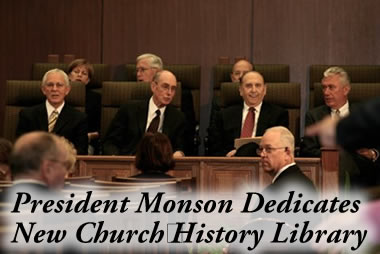
After fifteen years of planning and nearly four years of construction, the new Church History Library was dedicated by President Thomas S. Monson on Saturday, June 20, 2009.
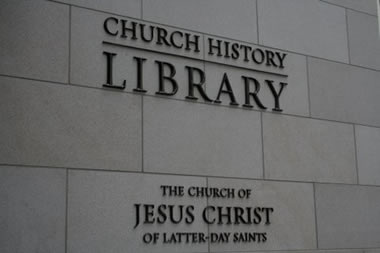
The dedication of the 230,000 square foot state-of-the-art library represents the culmination of a long line of storage facilities for Church historical documents which had very simple beginnings. Elder Marlin K. Jensen, Church Historian and Recorder, explained, “The available facilities for housing the Church historical collections and work have not always been as grand as those provided by this new library.”
He further explained that in the early pioneer years, “record keeping was done in a variety of places including the Prophet Joseph Smith’s home, his smokehouse, the Kirtland printing office, the Kirtland temple, an upper room in the Red Brick Store in Nauvoo and a room in the Nauvoo Temple.”
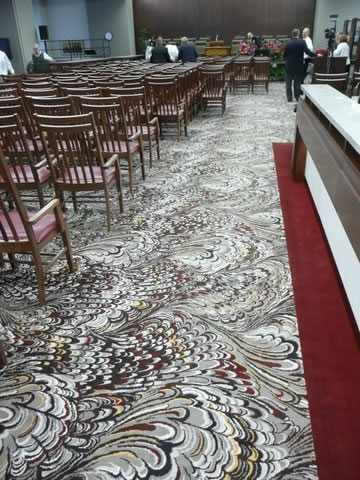
What began with two large boxes of items sent westward in 1846 and entrusted to Willard Richards, has grown to a collection that includes 270,000 books, pamphlets, magazines and manuals; 500,000 historical photographs, posters and maps; 23,000 audio and video recordings; 120,000 local histories for LDS Church units; 150,000 journals, diaries, papers, and manuscripts, 20,000 rolls of microfilm; and 3.5 million patriarchal blessings received by LDS Church members.
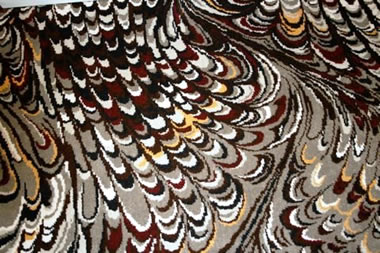
Carpet was designed to look like the inside cover sheets of old books.
Bishop H. David Burton thanked all who worked in making the library a reality. “Generations of our Father in Heaven’s children will be blessed. Because of your skills, your efforts, we will all enjoy the fruits of your labors. May testimonies be strengthened and families blessed, as a result of this marvelous facility.”
Elder Russell M. Nelson of the Quorum of the Twelve stated that this structure was an “answer to many fervent prayers.” In his remarks he commented that the collection of sacred documents which are now available will “bless the lives of generations yet unborn.” He also explained that in this library we can learn hidden treasures of knowledge about our ancestors – what our ancestors did and why they did it.”
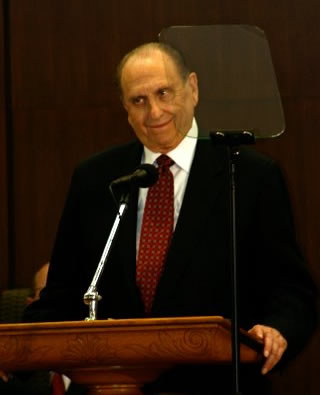
President Monson spoke of the mandate given to the Prophet Joseph Smith, on the day that the Church was organized, that “a record should be kept.” In accordance, President Monson explained that the Church has taken the guardianship of its history “most seriously.”
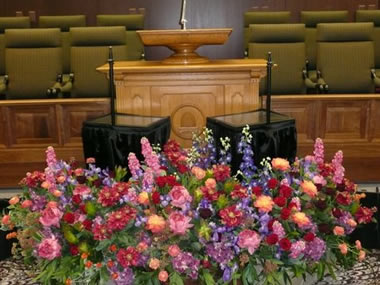
President Monson spoke from the same pulpit he once stood at in his youth while giving his first 2 ½ minute talk in Sunday school. He spoke of preparing for his 2 1/2 minute talk given at the podium as a young boy. He said that he had always been fascinated by birds and so he had decided to speak about the story of the seagulls descending on the crickets. In preparation, he went to Temple Square to see the Seagull Monument. Everyone in the audience, including President Monson, had a big laugh as he recalled that the first thing that caught his eye was the coins in the water and he wondered how he might get some without being seen.
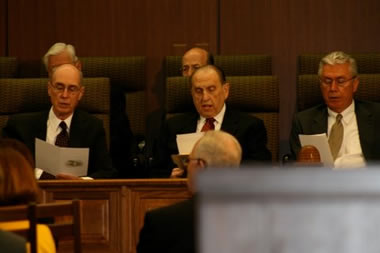
It is also the same pulpit he spoke from as a bishop many years ago. “Every bishop needs a sacred grove to which he can retire to meditate and pray for guidance” President Monson remarked. “Mine, as a very young bishop, was beside this pulpit in our ward chapel. I can not begin to count the occasions when on a dark night, at a late hour, I would make my way to the stand. I would kneel and share with my Heavenly Father my thoughts, my concerns, my problems. Those prayers were always answered in one way or another. This pulpit is to me, a cherished remembrance of sacred experiences.”

Before giving the dedicatory prayer, President Monson finished his remarks by expressing the hope that “lessons of the past provide strength for today and hope for the future.”
In his dedicatory prayer, President Monson asked that those who came to the Church History Library would be inspired. “In this beautiful structure, we have the legacy of the past, the opportunities of the present, and the brightness of the future.” He also asked that the building and its contents would be protected saying, “May no act of nature or man mar its beauty.”
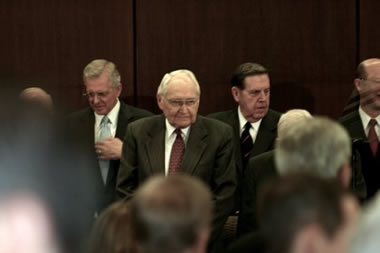
The new Church History Library is now open to the public from 9:00 a.m. to 5:00 p.m., Monday thru Friday; however it will stay open until 9:00 p.m. on Thursday. The library is open on Saturday from 9:00 a.m. to 2:00 p.m.
Lorene Pollard, 85, was among those attending the dedication. She is a direct descendant of John Whitmer, who was called to serve as Church historian as recorded in D&C 47. Speaking of the dedication of the new Church History Library, Lorene exclaimed, “It was incredible to be here today – to participate in the dedication of this marvelous repository which contains the history of the Church from the time of my great, great, grand father John Whitmer. As a child, I was often in the family home, which was built in 1858, in Far West, Caldwell County, Missouri. I have made several trips to Utah, giving artifacts to the Church, including two samplers. One of the samplers was made by Mariam Musselman Whitmer in 1793.”
As she has done several times in the past, Lorene brought another item to donate to the Church. On Friday, the day before the dedication, she presented the Whitmer family quilt to the library. In explaining why she had decided to give the quilt she remarked, “The preservation of the quilt made by the Whitmer woman will be protected for future generations to see. I hope that many will profit from studying the workmanship.”
*****
Interested in going on a Fall Church history tour with Becky – visit their web site at www.ldsfamilytravels.com.