

The Ancient America Foundation (AAF) is pleased to present AAF Notes: a series of research articles by scholars of Book of Mormon culture and history and reviewed by AAF editors. Visit our website (https://www.ancientamerica.org).
Alma 18:9 states that “the king had commanded his servants — that they should prepare his horses and chariots, and conduct him forth to the land of Nephi .” Two major questions have been raised by anti-LDS critics of the Book of Mormon concerning the statement that there were “horses and chariots” on the American continents before the time of Christ (see Alma 18:9).
These critics have maintained that:
- no horses existed on the American continents before the time of Columbus ; and
- the people who lived on the American continents did not know the principle of the wheel before the coming of Columbus.
However, since the publication of the Book of Mormon, considerable archaeological evidence has come forth to reinforce its claims that there were horses on the American continents before the time of Columbus and that these early peoples did know the principles of the wheel. ( Daniel H. Ludlow , A Companion to Your Study of the Book of Mormon , p. 206)
Horses:
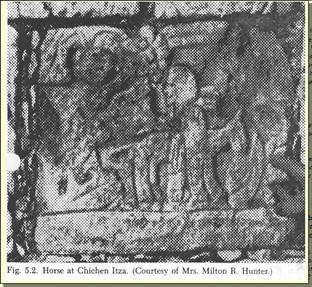
According to Hunter and Ferguson, the claim made by the Book of Mormon that horses were on this continent and used in ancient America for purposes similar to the uses we make of them today finds strong support in the numerous fossil remains of horses that have been obtained from the asphalt deposits of Rancho La Brea in southern California . Of course, it is claimed that those fossil remains pre-date Book of Mormon times. However, there is no logical reason for believing, since horses were here prior to the arrival of the Jaredites and the Nephites, that horses could not have still been in America during the period in which those ancient civilizations flourished … We could do no better at this point in dealing with this subject than to quote from an official publication of the Los Angeles County Museum on the subject of the existence of horses in early times in America :
The presence of herds of horses in the vicinity of the asphalt deposits during the period of accumulation is clearly testified to by the numerous remains of these mammals found at Rancho La Brea. While many individuals are recorded in the collections, all of them belong to a single species, the extinct western horse (Equus occidentalis Leidy). In stage of evolution and in general body structure this type resembles the modern horse, although differing from it in a number of specific details. Standing on the average about 14 1/2 hands (4 feet, 10 inches) at the withers, this animal was of the height of a modern Arab horse. It was, however, of considerably heavier build …
Horses were among the more common types of hoofed mammals on the North American continent during Pleistocene time and several distinct species have been described from fossil remains. The abundance and widespread distribution of horses in North America make the apparent disappearance of the group in this region prior to the advent of the white man an added and an unusual feature of their long and eventful career. (Milton R. Hunter and Thomas Stuart Ferguson, Ancient America and the Book of Mormon , pp. 312-313)
Chariots:
According the Diane Wirth, Nephite and Lamanite “chariots” ( Alma 18:9) may or may not have had wheels: the argument does not hinge on whether they did or not but rather on whether people of the Book of Mormon knew about–and used–wheels. . . . Mesoamericans most certainly had knowledge of the wheel. In 1973, Stanley Boggs stated that sixty examples of wheeled objects had been found. Many more have been found since the publication appeared.
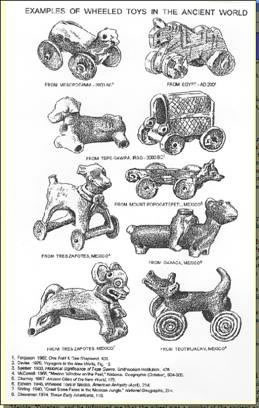
Dr. Gordon F. Ekholm, of the Department of Anthropology at the American Museum of Natural History in New York , reports:
During the winter of 1942, while I was making some excavations in Panuco and in the vicinity of Tampico , I found a certain number of small discs that I suspected of having been the wheels of rolling toys like those found by Dr. Stirling in Tres Zapotes and by Charnay in Popocatepetl . In the excavations of Panuco I felt most happy when my helper informed me of the finding of a complete toy with wheels just after having left the place myself and only a few meters from my excavation. This finding, together with the other known examples, convinced me that the Mexican Indians, before the conquest, had made small vehicles with wheels in the form of animals and therefore had some knowledge of the principle of the wheel.
Scholars have found that five ways to attach wheels were used. This suggests that early Mesoamericans were not novices on the use of the axle. If these small clay figures were modeled after larger, practical vehicles, we may never know exactly how they were used, since in all likelihood, they were made of wood — and wood deteriorates with time. (Diane E. Wirth, A Challenge to the Critics , pp. 59, 62)
Desire de Charnay, a traveled Frenchman, published Ancient Cities of the New World . In his visits in Mexico he had excavated a number of ancient burials found on the slopes of Popocatepetl in which he had found a number of small clay objects that had the appearance of pull toys, but more importantly had wheels and axles connecting the wheels. On page 175, Charnay also quoted and commented on a statement by an early Indian historian who used an ambiguous word meaning both chariot and transport. He further referred to a drawing in the writings of Father Duran, which showed a “rude chariot with clog wheels, drawn by a multitude of Indians.”
According to Verneil Simmons , we have no idea what these “chariots” looked like. They could have been two-wheeled carts or even flatbed bodies on four wheels that would have been practical for moving their goods. The toys come in two-wheeled and four-wheeled models and indicate that both types were possible. Since we assume they would have been constructed of wood, it is unlikely that no evidence would survive until today. (Verneil W. Simmons, Peoples, Places And Prophecies , pp. 134-135)
Verneil Simmons also writes about an interesting phenomenon of archaeological “scholarship.” He comments that until very recently, almost the first thing one read in a textbook or was told in the classroom was the supposed fact that the principle of the wheel was unknown to the ancient inhabitants of this continent. However, as excavations increased more wheeled toys were found in the state of Veracruz and in other areas of Mexico . Eventually the cumulative evidence reached the point that the books had to be rewritten and public confession made that the wheeled toys had been hidden in museum storage rooms for decades (because it was a well known fact that the principle of the wheel was unknown in ancient America!). (Verneil W. Simmons, Peoples, Places and Prophecies , p. 134)
Copyright © 1999-2002 Ancient America Foundation. This message may be forwarded with identifying information. For more information or to subscribe or unsubscribe to AAF Notes or utilize the AAF order form, visit <a href="https://rs6.
net/tn.jsp?e=001W21106uoIUZVQ-idTlnty1JfN7lh7cnQ8mVcrhr1gkZZ6sD4t__H8hijTFt0zr6yqVGofp5X2cfSWGLSpi4PcNbuSLXQzyx4XdB4FMv8ZmHZ7pIr7JxrUw==” target=”_blank”>https://www.ancientamerica.org and click “Contact us”. Refer, by e-mail, comments or questions to [email protected].