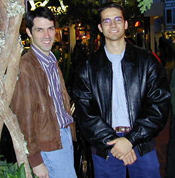


Call for a New Mormon Cinema: Richard Dutcher and God’s Army
by Jonathan Walker
At last, someone has made a theatrically-released movie about us and for us.
Richard Dutcher, in his letterman-style jacket and iron-rimmed glasses, fields questions from the crowd which came to see his new film God’s Army. A couple of years earlier he was standing over some coals barbecuing hamburgers on the back patio of his home in Southern California. He had taken stock in his life and didn’t like where the Hollywood dream had taken him. He had stopped attending church weekly, and when he did go, he often sneaked out during priesthood to see what was happening at a nearby bookstore. He was rubbing shoulders with people who argued incessantly for inserting nudity into his low-budget romantic-comedy Girl Crazy so that it could get distribution.
At that point, Dutcher made a decision that he has since coined his Abrahamic sacrifice: he decided to leave filmmaking. After chasing this life-long dream, he realized he was not being the kind of Latter-day Saint he wanted to be. In his circumstance, he felt he had to make a decision between being a faithful member of the church or become a filmmaker. He would miss film, but the decision was made.
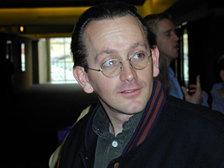
Richard Dutcher
While minding the barbecue, Dutcher looked at the calendar section of the L.A. Times which was spread out in front of him. Like a penniless child staring in the confectionery’s window, Dutcher noted the niche cinemas that had constant and reliable distribution: imported Indian films, gay and lesbian cinema, “black” cinema . . . Then the thought hit him with force, “Where’s the Mormon cinema?” Surely there are enough Mormons to support a niche film distribution.
This solitary thought led Dutcher on a trek to produce a film specifically for a Mormon audience. After writing a screenplay for an historical epic, he found funding hard to come by. After numerous rejections, he reassessed his approach. He wrote a new story, much simpler and again sought funding. Eventually, through the process he made the film that would be known as God’s Army.
God’s Army is a fictional story about an LDS missionary, Elder Allen (Matthew Brown), in his first area in Los Angeles. His senior companion, Elder Dalton (played by Dutcher himself) is a straight arrow with a hard-driving feel for the work, which just makes the transition that much more difficult for Elder Allen. But, Dutcher doesn’t sensationalize the story. He makes you understand the people, feel for their quirks and hardships, and then you enjoy their stories. Dutcher, who served a mission in the Veracruz region of Southern Mexico, clearly draws on personal experience to capture the ups and downs, and quirks of mission life. (See accompanying review in Meridian).
Coming out of a showing of God’s Army at the sparkling new Jordan Commons in the Salt Lake Valley, many people wanted to talk to Dutcher. He produced, wrote, directed, and starred in the film and could consequently answer any question about it. Many were curious to know which actors were members, whether anybody was converted in the making of the film, or whether he thought the world would accept it. Dutcher is unconcerned with the particulars of such a line of questions. He made this film for Mormons as entertainment.

God’s Army Film Director, Richard Dutcher
Dutcher doesn’t want God’s Army to be a unique film. He wants it to be the first of many. “For me it’s not just God’s Army. It’s God’s Army as a beginning of an LDS movement.” His tone of voice lacks pretension, aggressiveness, or even boldness. But, his words speak for themselves. He sees a new movement emerging and nothing in his mind will stand in it’s way. “I’m going to continue making films somehow, someway, regardless of how [God’s Army] does at the box office.” Nevertheless, he does hope that it will prove what he’s been trying to convince people of for the last several years, “which is [that] there’s enough interest and there’s enough of an LDS market to sustain our own little film community.”
Dutcher is utilizing what’s called a platform release for his film. This means instead of opening across the country simultaneously, it opens in one region, in this case, the Wasatch Front. As it gains an audience, he will spread it into new cities and areas of the country. Hollywood uses this distribution method for reaching niche markets, especially “art films,” and relies heavily on the film’s quality or audience demand. (Those interested in seeing God’s Army can track which theaters it’s in and request it to their city or region by visiting www.zionfilms.com.)

Greenie missionary Brandon Allen (Matthew Brown) shares his feelings with seasoned sister missionary, Janine Fronk (Jacque Gray).
Dutcher’s vision of the future of a Mormon cinema doesn’t end with an infrequent distribution of Mormon-themed films. And he recoils at the notion that a G rating has become a quality stamp for our family entertainment. He’s more concerned with stories that entertain, enlighten, and resonate with us. God’s Army doesn’t sanitize missionary life, but it also lacks skepticism or cynicism. This is a film by a believer. “I wanted to honor missionaries and missionary service. And really elevate it and hold it up, but I felt like to do that you had to be true to it.” That meant including many things that might make some members raise an eyebrow, like the puckish behavior present in the elders’ apartment. “One thing that I think is so impressive [is] that you do have these guys who are nineteen and twenty years old and they do behave like nineteen, twenty, twenty-one year olds, but when it comes time for them to do their job, . . . when it’s time for them to become strong, they step up to the mark and they perform, these guys who a few hours earlier were goofing off and being kids.”
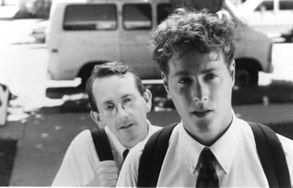
Elder Dalton (Richard Dutcher) teaches his new companion, Elder Allen (Matthew Brown) how to do a little tracting.
While he doesn’t say as much, it’s clear that Dutcher also sees the instructional value of telling our own stories. He understands that many young people in the church have a hard time seeing themselves serving a mission because missionaries are portrayed as always mature, perfect individuals.
“I remember myself, when you put on the name tag and the neck tie and it doesn’t feel right. You feel like you’re pretending. All these other missionaries are these perfect people and you’re going to try to sneak by and not let anybody find out that you’re not. But, you know, that’s the reality of it. The reality of it is that we’re all human beings and the Lord uses us with all of our weakness to do His work. And so I wanted to show this, so an eighteen-year-old kid who thought, ‘I can’t be a missionary,’ can see that ‘Yes, you can.’ In fact, you should be, because whatever your weaknesses are, the Lord can use those and your strengths to get His work done.”
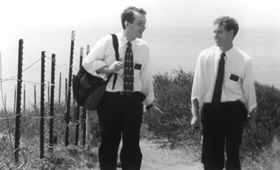
Elder Dalton (Richard Dutcher) Elder Allen (Matthew Brown) share a moment of joy.
Dutcher figures that he can produce one film a year. This means that other filmmakers have to join the movement to support the latent demand that he’s confident is there. The success of the movement is not in question. His only doubt is when it will come to maturity. For Dutcher, the LDS filmmakers in Hollywood are like the Israelites in Egypt. And perhaps because of his own experience, he reserves sharp language for calling them back to Canaan. “I think one of the reasons we haven’t [started a Mormon cinema] yet, is because Mormon filmmakers have been worldly cowards. To be really honest. I think we’ve been really focused on worldly success and we’ve been really ashamed of Mormonism, of our faith. I think it’s really criminal and I think we need to repent.”
The New Mormon Cinema wouldn’t ignore Hollywood completely. Instead, there will develop a more respectful and symbiotic relationship between the LDS market and the nation’s mass media. Not only will Mormons be respected as a people that deserve representation, but they will be openly courted. After all, Hollywood, like any other business, cares only about the bottom line. When it sees that there’s money to be had in the Mormon community, it will go after it. Dutcher believes that Mormons can enjoy their own stories and produce their own films, and not have to take everything Hollywood hands them. But, likewise, he sees a mature Mormon cinema as a potential producer for occasional mainstream movies.
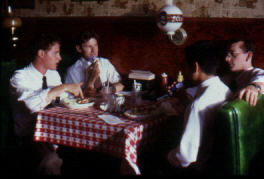
Four of the Elders in God’s Army share some thoughts and discuss philosophy at the local diner.
Dutcher quotes a General Conference talk that almost all LDS artists are familiar with. “When President Kimball gave his great talk in 1977…” Dutcher emphasizes the 1977 with the incredulous surprise of how long ago that was. “[President Kimball] talked about all the arts, but also he singled out filmmakers, and said that tomorrow we should be able to make these films that will fill the world with our faith and our culture and they’ll play in every movie center in every part of the world.”
Clearly, Richard Dutcher believes that the Mormon community is on the cusp of just such a future.
[The world premier of God’s Army will be Wednesday, March 8th at Jordan Commons in Sandy, UT. For tickets call Zion Films customer Relations at (801) 304-4576. All proceeds go to the Homeless Children’s Foundation. General release across the Wasatch Front begins Friday, March 10th.]