





A Spiritual Experience and a Wealth of Talent
Different Cinematic Angle on Missionary Work
by Rose Datoc Dall
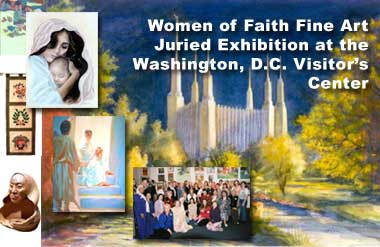
In an exhibit that continues through the end of April, the visitors’ center at the Washington D.C. Temple is hosting a Women of Faith Fine Art exhibit and Meridian readers can enjoy part of the display in this article.
The Fine Art Exhibit entitled “Women of Faith” attracted over 110 women artists either living in or with ties to in the Washington, D.C. area, most of which are Latter-day Saints and others attracted to the show from the local community. The show features over 250 pieces of art in about two dozen media, including painting, drawing, sculpture, ceramics, fiber art, quilting, jewelry, multi-media, photography, film and video, to name a few.
The quality is what is most astonishing about this show, urging one to ask, “Who are all these women? Where did they come from? Where have they all been hiding? Have they been here in our backyard all this time? How come I have never heard of them before?”
As a collective whole, the show has an air about it that is very difficult to quantify, something profound and wonderful. The success of the show may seem enigmatic, since it is nothing less than the sum of a series of small miracles and profound moments for those involved in its planning, from its inception to exhibition.
The staff never hesitates to acknowledge help from above, a higher purpose; a sense that it was meant to be. This event, like all events at the Visitor’s Center, is planned by inspiration and much prayer. And when this process is done properly, “the show [takes] on a life of its own,” as Alice Hemming, one of the Exhibition Coordinators, points out.
There is often a build-it-and-they-will-come attitude in the approach of many happenings in the Church. Give artists the opportunity and watch them not only rise to the occasion, but watch them shine. Truly, this assessment is fairly accurate and is part of the miracle of this show. Alice Hemming and Ellen Williams, Exhibition Coordinators from the Visitors’ Center Cultural Arts Committee, stressed that they always felt “that they were part of something bigger.”
The show has a “special spirit about it,” says Alice. Indeed, the mandate of any exhibition at the Visitors Center is to reflect what Latter-day Saints believe, to be in full harmony with the gospel Sisters Hemming and Williams, when daunted with the task of putting this show together were worried that they might not attract enough of a response in the community to pull off a show. Were they ever wrong. Women artists came in droves. They were so overwhelmed at the response and the size of the show that they were worried that all the artwork would not fit in the Visitor’s Center Gallery.
It is a reflection of the fantastic resources that lie in this religious community of networking and of the tremendous talent within it that has just barely begun to be recognized and appreciated as a wealth untapped.
This show also has a spirit that is not usually present in your average juried art show at any local exhibition. So often, art shows in the community are an eclectic hodgepodge of art created by artists who actually do not have any real connection with the larger exhibiting group. Too often, juried exhibitions are just another “gig,” and lack a cohesive center or agenda. Truly, this is not the case in this instance.
The one element that this show possesses is a cohesiveness that lies deep in the identity of this group of artists with shared beliefs, not in any one particular style, medium or approach. While the vast majority of 110 exhibitors are Latter-day Saints, 18 of the group are not of that same faith, but their submitted art was at home and in harmony with the body of work, which often reflects a spiritual tone.
At the opening reception, the air was electric as one artist networked with another, talked about their art, and shared similar stories about the struggles of being an artist. It is truly remarkable and exhilarating to be a part of this show and to witness the way many of these women have latched onto each other. It is like discovering new best friends. Many of these women felt like they were “part of something bigger,” a larger network of artists.
So, who are these women? Where did they come from and where have they been hiding? Why haven’t we seen them or heard them before?
What is most remarkable about these women is that they are a Relief Society President, a visiting teacher, a neighbor, a friend, a primary teacher, a mother, a grandmother, a wife, a member of the PTA, a homemaker, a working-mother, an immigrant. They walk the ordinary paths of life, struggling like the rest of us, sacrificing much for their families, and perhaps even setting aside, many times, worldly pursuits, such as their art for a time, for their families.
One of the most common elements among these women is that of sacrifice, and as a hallmark of most Latter-day Saints, “we are a practical people,” points out Alice Hemming. These women are no different. While some are professional artists, most of these women are part-time artists and full-time moms, creating quietly, in their homes when they can. Others are career women looking forward to the day when they can turn more attention to their art. They are also women playing catch-up in their mature years after the kids have grown to pursue art.
These women struggle to do their very best with all of the many demands placed on them and with their callings and hope that there is something left in the spiritual well for creativity. This struggle to stay artistically afloat is very poignant and relative topic to them.
The show reflects “women in all seasons of their lives [who are] asked to be more than ever before. Women’s Month celebrates victories won, hardships overcome, insights gained, and offers encouragement for what lies ahead. It is an opportunity to come together to strengthen our common sisterhood.” (Prospectus, “Women of Faith Juried Art Show,” 2003)
Even though many of these women have sacrificed, talent is not wanting. It is yet another hallmark of the Latter-day Saint culture to place a high value on developing talents. In fact, many of these women have found a way to be creative in other areas of their lives as well and possess talents in many different areas.
Latter-day Saints, in particular hope for balance in all areas of our lives as well as an emphasis on life-long learning. Because of this emphasis, these women are often very well rounded, capable women who are good organizers, homemakers, career women, leaders in their Church, and volunteers in community. They are articulate and more importantly, well-adjusted individuals who, in general, are relatively happy. They often have to become jacks-of-all-traits and the wearer-of-many-hats.
Due to the layman structure of the Church, the LDS culture offers many opportunities for growth in diverse areas of leadership. It is often “the-jack[s]-of-all-trades [which] make the best artists” remarks Ellen Williams, a jack-of-all-trades herself; because they often bring to the table a wealth of practical experience and skills that not all artists possess, such as management and people-skills. They know how to execute projects, large and small and how to access resources to accomplish them. They are hard workers. They are often cross-media artists as well. Renaissance women? Perhaps.
Since it is not particularly a Latter-day Saint interest to follow the trends in the world or to seek its accolades, the directive for art for the Latter-day Saint is often different. What then is the purpose for art to the Latter-day Saint culture? Talent, like any other gift is a tool to be used wisely and can be used to enlighten, inspire and edify, to serve as a conduit for truth on the one hand, or can be used to shock, to degrade, and to explore depravity, spinning off into the excesses of the world of “me.”
The women in this exhibition overwhelmingly reflect the former idea and choose to inspire and uplift. As practical and busy as these women artists are, they don’t have time to waste with all of the many demands place on them. Therefore, they feel the need to create something with meaning, something in which they can believe.
Many pieces in the show are women’s testimonies in clay, on canvas or in whatever medium they have chosen. Subject matter in the Women’s Exhibition varies but deals with a host of issues through a woman’s experience: motherhood, parenthood, family, compassion, scriptural and religious subject matter, ordinary life, whimsy, beauty of sheer design, beauty in nature, patriotism, and optimism through struggle.
Since a hallmark of the Latter-day Saint culture is that of optimism, the colors are vibrant and “cheerful, and reflects who we are,” said Alice Hemming. Both Williams and Hemming agree that the show was a spiritual experience for them both.
“The art is inspiring because of the people who create it,” remarked Ellen Williams, teary-eyed in an interview. Indeed it was a spiritual experience for many of the artists as well, who too have been “yearning for this opportunity,” said Alice. Yearning, perhaps because few opportunities exist for groups of artists to exhibit who are Latter-day Saints, Christians, or for artists who cling to traditional or moral values and choose to reflect this in their art or in the way that they choose to live. There is a real need for this type of exhibition opportunity, and it is exciting that the Church has recognized this and encouraged its artistic members in their creative endeavors.
In planning the exhibition, Alice Hemming and Ellen Williams have felt that something larger was at play than the works of art or the artists, probably more than one can comprehend. It has something to do with the edification of all those involved.
That very spirit is the embodiment of the show and is evident in the generosity of time donated. It is also evident in the way that everyone, artists and staff, treated each other with such genuine affability, encouragement, and consideration. There is an atmosphere of respect, love, and newfound friendship amongst the staff and artists. The Spirit is present in this group show.
As a collection, the visual impact is powerful, and the exhibit carries an amazement that such talent exists under our very noses-and may not have received recognition without this kind of exhibit. There is a sense that more is to come from a culture coming of age and beginning to shine. Many of these artists do not realize that they are part of an ever-growing movement of emerging LDS artists. As a collective whole, all over the Church, it is actually quite an impressive bunch.
On a larger scale, this Women’s Show, while long overdue, is part of a series of resurgent events occurring all over the Church, more frequently within the past decade or so. There is a true need for these artists “yearning for [an] opportunity,” visual artists, performing artists, writers, film makers, musicians etc. to have an outlet to give relevance for their creative endeavors in a Latter-day Saint culture and in the world at large.
LDS artist groups emerge and events pop up every now and then, all over the country. For example, the Mormon Art Group is a group of New York based LDS artists of all disciplines and writers who periodically produce collaborative projects such as books, cds and group exhibitions. Handcart Ensemble is a performing arts group of mostly Latter-day Saint players in New York City. In the year 2000, the Manhattan Stake Fine Arts Festival was an astounding event which attracted participation from a high concentration of professional visual artists, performers, film makers, writers, musicians living in the Manhattan area who were able to display, to hold workshops, and to discuss pertinent issues regarding art from an LDS perspective. Zion East Foundation for the Arts (ZEFA), a non-profit arts organization, hosted the Washington LDS Music and Arts Festival in 1999 (LDStival) in Bull Run Virginia, which was an all-day event showcasing the most recognizable LDS recording artists as well as a Fine Art Juried Exhibition. Other entities exist such as the Washington Family Theater in Maryland and a new performing arts group called Ark Light Theater Co. in Virginia which are dedicated to a standard in theater which is in harmony with the Gospel. These are just a few groups and events on the East Coast.
There are many more outcroppings of events and similar groups in the west from California, to Texas, to Utah. The Springville Museum in Utah has built a new wing onto the museum in anticipation of a large influx of LDS visual art in this new century, according to Director, Vernon Swanson. These are just a few events which mirror the efforts by the Church itself to initiate its International Art Competition at the Museum of Church History and Art which began in the late 80’s to encourage artists to produce art that is a reflective of Latter-day Saint culture. The Church has built a spectacular Theater adjacent to its new Conference Center and formed the Temple Square Orchestra, which not only attracts the best in LDS talent, but creates the setting for artistry at its highest level.
No doubt, the 2002 Olympics in Salt Lake City brought the attention of the entire world to an LDS culture which pleasantly surprised the world with its many graces, including a wealth of talent amongst its volunteer performers and organizers. In addition, one of the most recognizable American icons, the Mormon Tabernacle Choir. is revered as one of the very best in the world. Moreover, individual visual artists, filmmakers, writers, and performers alike who are LDS are getting attention and acclaim from broader audiences in the American public.
It has become ever apparent that creativity is part of the heritage of Latter-day Saints, more so than ever. There is an excitement and a buzz in the air when one assesses the tremendous activity from afar. The Women’s Exhibition, as well as all the other pockets of movement, are truly part of something much bigger! Perhaps we are beginning to approach President Kimball’s vision of the arts when he said, “For long have I had a vision of the Church greatly increasing their already strong positions of excellence till the eyes of the world are upon us.” (“The Gospel Vision of the Arts,” The Ensign, July 1977, p. 2.) President Kimball then referred to President John Taylor’s vision: “You mark my words, and then write them down and see if they do not come to pass. You will see that Zion will be far ahead of the outside world in everything pertaining to learning of every kind as we are today in regard to religious subject matters. God expects Zion to become the praise of the whole earth, so that kings hearing of her fame will come and gaze upon her glory.” (Sermon, September 20, 1857: See the Messenger, July 1953)
Are we at the beginning of a Mormon Renaissance, a term which has been floating around loosely for a few years? Time will tell. As artists, we only need to embrace it, live worthy to contribute to it, and it will take shape all its own. One thing is for certain: it is nothing less than a thrilling time to be a Latter-day Saint and to be an artist. It is only getting better.
2002Meridian Magazine. All Rights Reserved.