






By Janet Kay Jensen
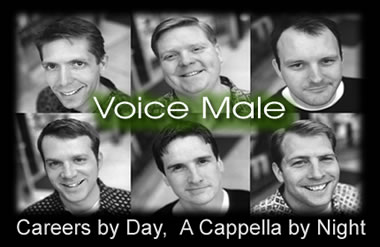
Assemble the following: a commercial real estate agent, accountant, software product manager, graduate student in graphic design, accounts manager and an attorney, who have served missions respectively in Ventura California Spanish Speaking, Leipzig/Dresden Germany, England Leeds, Taiwan Taipei, Missouri St. Louis, and Japan Okayama.
Add these church callings to the mixture: Sunday School President, Elders Quorum Presidency, Ward Choir Director, YM Presidency, Counselor in the YM Presidency, Scoutmaster, Deacons Quorum Advisor, and Ward Volunteer Committee Member.
Blow on a pitch pipe and ask John Luthy, Phil Kesler, Mike Beardon, John Huff, Richard McAllister and Mike Wilson to hum a note. The result is what they like to call “beautiful chords.”
These chords belong to Voice Male, a men’s A cappella group formed nearly ten years ago. The blend began to develop when the double quartet “The Hooligans” was formed within Utah State University ‘s LDS Institute New Horizons Choir. In 1994, Hooligan member John Luthy heard Vocal Point, a nine-man a capella group at Brigham Young University , led by Bob Ahlander and Dave Boyce. John was intrigued by their sound and later met with Ahlander. Following Bob’s generous mentoring, John returned to Logan with the tools to implement his inspiration for Voice Male, a group which originated with nine members and now features six singers, who all live on the Wasatch Front.
In the early days they spent many hours rehearsing in the Luthy home, about ten hours a week, developing a unique vocal style “using only voices to make something sound great,” according to Richard, while all attended USU. In the ensuing ten years they have recorded seven CDs, (two of hymns). They have also performed up and down the Wasatch Front , California , Arizona , Nevada , Wyoming , Idaho , Arkansas , Kansas , Missouri and Florida .
Elements of Harmony
The group’s musical components include, according to spokesman and tenor John Huff, “percussion, bass, usually three in the background, and a lead. The lead changes, but the rest usually stays the same. Our style of singing is what’s known as ‘contemporary A cappella.’ We sing music that would traditionally be sung by a band, but we do it all with voices. So even the bass guitar and drum sounds are handled by voices rather than instruments. We sing mostly pop music from the latter half of the 20 th century and funny songs with a little country, barbershop, and old fashioned stuff thrown in there for good measure.”
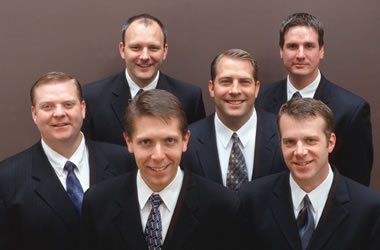
Bass Mike Wilson explained, “With contemporary A cappella, there’s no preconceived notion of what the music will sound like. This allows us to sing anything from U2 to ‘Breakfast at Tiffany’s.'”
Second Tenor Mike Beardon added, “We find our comfort zone to be in the contemporary or comedy styles of music with vocal percussion.”
Many of their arrangements are original, by members John Luthy and Mike Beardon. Some of Mike’s include “Only One,” “Celebration” and “Light in Your Eyes.” Mike has also written the original songs that the group performs: “Give Them a Vision,” “You Lift Me Up” and “Voice Male.”
John Luthy has applied his creativity to songs including “My Maria,” “The Shadow of your Smile” and “Been There.”
Sometimes the whole group experiments and creates arrangement together (“The Lion Sleeps Tonight” and “It’s a Small World”) that capitalize on their individual vocal strengths and their remarkable ability to blend six voices into harmonious chords.
Composition
Richard McAllister , a commercial real estate agent, sings First and Second Tenor. “Not being a real tenor, I’m lucky that my falsetto blends into the group,” he said. His favorite hymn is “There is a Green Hill Far Away,” “because it recreates the way I felt when I first heard the arrangement during General Conference.”
Richard’s parents insisted that every child in the family should play a musical instrument, “so I played piano first, then the trumpet to get out of piano, and then baritone to pay for college.” Finally, he said, he joined the LDS choirs in college “to socialize and get married.”
His contribution to the group: “I just do the best I can at what is asked of me. They other guys never ask me to do hard rhythms, unless they are trying to be mean or funny.” His list of favorite songs includes “I Can See Clearly Now,” “Pride” and “A Million Ways.”
An accountant for American Express Travel Related Services, Mike Beardon sings Second Tenor and is responsible for many of the group’s vocal arrangements. “As Second Tenor, it’s often the melody or lead. This part along with the others when sung by a baritone helps make the overall blend quite nice.”
A hymn with special significance for Mike is “Where Can I Turn For Peace?” “I like the message centered in Christ as well as the great melodies,” he explained.
Software product manager John Huff describes his part as “barely-tenor, a little known part of the vocal landscape that a surprising large number of guys in Voice Male also sing.”
As a boy, he developed a unique sound effect that he calls a nose harmonica, “a special instrument that only eleven-year-old boys know how to play. As I haven’t really grown up, I’m also able to play it. I developed the nose harmonica as a kid by constantly making weird sounds and utilizing my brother (and his beating on me) to figure out which ones were the most annoying. After finding one of the most truly annoying sounds (a piercing nasal horn kind of sound) I figured out that if I waved my hands in front of my mouth while making such a sound, that I could sound like a harmonica.” This sound effect is featured in “Been There.”
When it comes to serious music, his favorite hymn is “I Need Thee Every Hour.” “The words are just wonderful, the melody is comforting, and I think the chorus really captures supplication in song. There’s just such a beautiful feeling any time that hymn is sung.”
Phil Kesler , a graduate student in Graphic Design at USU and the lone bachelor of the group, said, “I’m one of the four Baritones. Sometimes I sing the lead on mushy songs (they’re trying to get me married), and most often I fill in the middle part. It’s nice to hear them singing without me,” he admitted, “to know there’s a hole in there somewhere that needs me.”
Phil’s favorite Voice Male song is “Silent Night.” “I know it’s not ‘our’ song,” he said, “but it touches me every time we sing it. Part of it is the Christmas thing. I love Christmas music. Part of it is Mike Beardon’s arrangement. He gives us beautiful chords. And the rest of it is the quiet stillness in the room, a reverent celebration with the audience of the moment of the birth of Christ.” A hymn that’s close to Phil’s heart is “Jesus, the Very Thought of Thee.” “The poetry of the words moves me. It’s an expression of pure love for Jesus, and an appreciation of His pure love for us.”
John Luthy , an attorney whose interest in A cappella singing originally sparked the creation of the group, sings Bass and is the Vocal Percussionist. A vocal percussionist, he explained, “makes a drum or percussion sounds with his mouth. In a contemporary A cappella group, or ‘vocal band,’ the vocal percussionist fills the same role that the drummer would in a traditional band. Just as the percussion in popular music can vary, from synthesized drums and effects to a standard drum set, vocal percussionists’ approaches also vary.”
Learning vocal percussion takes both developing sounds and then learning how to fit those sounds together in a steady rhythm. His approach is “to try and imitate a standard drum set,” including kick drum, snare drum, tom drums, high hat and cymbal sounds. His focus, he says, has been “to provide basic, solid drum set percussion and let the real vocalists build the music on top of that.” It’s a skill that has taken a long time to develop. “Thanks to the steady rhythm and their patience, the guys put up with my amateur sounds as I improved.”
Learning to produce these effects has also meant “a lot of time drumming along to the radio while driving, and drumming in the shower or while walking across campus.” He credits his sense of rhythm to performing in high school marching and symphonic bands. “I trace much of the music theory that I rely on in arranging songs and appreciating music in general to what I learned from my piano teacher, Sister McAllister (no relation to Richard), before I even turned twelve.”
He spoke of the spiritual impact of music in his life: “I love the soft organ music in the temple chapel, and I often get teary-eyed when the Primary sings in Sacrament Meeting . . . I particularly like hearing how the arrangement of “How Firm a Foundation” translated from my head to real voices,” he said. “I love the message of that hymn, too, especially in the later verses that don’t often get sung in church.” He has always loved the hymn “I Need Thee Every Hour” and often sings it when he is alone and wanting to feel closer to the Spirit.
Mike Wilson , an accounts manager for Microsoft, solidifies the group’s sound as Bass. “As for my vocal contribution, I add a sound underneath that is more felt than heard. Kind of a carryover from what my mother used to say . . . you know, better heard than seen?”
He recalled several occasions when he’s had throat problems that have made singing difficult. “The show must go on, though, right? Let’s just say the song “Mr. Bass Man” can be very difficult under these conditions.”
A hymn with special significance for him is “There is a Green Hill Far Away.” “I love the feeling of that song,” he explained. “The arrangement is awesome.”
Assorted Tones
Combining personal and vocal harmony, John Huff calls the group “the smallest little bureaucracy you ever did see. A bunch of aging and enlarging family men with careers, who love entertaining when they can find time to still have fun together on stage and entertain an audience.”
Phil sees Voice Male as “a group of guys with day jobs who need each other to sound good. We have the best of intentions, no matter what comes out.”
Music is their Passion
Each of the members is passionate about music. For Mike Wilson, his love of singing proved to be an asset on his mission, when he had a companion “who insisted that I sing at every door, whether we got in or not. Of course, I hated him for this. Then, after a while, I started to appreciate the way only a song can carry the Spirit to the listener. When I got home from my mission, I tried out for a singing group called the Ascension at Snow College , and have been singing ever since.”
John Luthy recalled discovering popular music on the radio at age 10. “I heard ‘Ebony and Ivory’ on a little handheld radio while playing in the back yard and was surprised and excited at what a happy feeling hearing a little tune coming from someplace that I couldn’t see could make me feel. Since then, I have enjoyed popular music that is simple, upbeat and happy. As I got older and participated in instrumental music, I also learned to appreciate and love classical, religious, and Broadway-type music as well.”
Mike Beardon said, “Great melodic harmonies have always been important to me. I love putting a few seemingly insignificant parts together and making sweet chords. It has always been a profound way of strengthening my testimony of the gospel.”
Music, Richard reflected, “has always been a huge blessing in my life. My first remembrance is singing ‘I hope They Call Me on a Mission ‘ for the Relief Society at a young age.”
“Music has been in my life longer than anything else,” Phil said. “I think it has brought me closer to God.”
To John Huff, it is “one of the most powerful mediums of communication that exists. Music can alter one’s whole environment, mood or feelings. I love good music and can’t imagine life without the joy that it brings to my life.”
“A Powerful Synergy”
The group likes to have fun, and it’s contagious. They also appreciate knowing that their music has made a difference. “We always like to hear about people’s experience with our music because it helps us to keep going despite our busy lives with families, careers and church callings.” For John Huff, the best part of performing is “the energy that builds between us and the audience during a show. It’s just so enjoyable when you’re up on stage having a great time and you feel what a great time the audience is having right along with you. There’s a powerful synergy that results that I absolutely love.”
They have been deeply touched by the effect “Prayer of the Children,” has on audiences, when, Richard explained, “it’s very quiet and the audience listens to the song, words, and meaning. It’s incredible to share that song with them in the right setting.” Mike Beardon added that on one occasion, in Logan , the song was followed by “the longest standing ovation I have ever stood in front of. The room was filled with the spirit. It was amazing how 1600 people could all be feeling the same way. It must have lasted over a minute, which is an eternity when you speak of applause.”
Phil recalled singing “Prayer of the Children” at a funeral for a small child. “That was pretty humbling. The song had come to mean something both to the girl and her family. It was a sad thing, but a powerful thing to be a part of.”
Other highlights in their ten-year history: Singing to a full house in Salt Lake City ‘s Abravanel Hall, a special performance for the Quorum of the Seventy, and singing “Called to Serve” with missionaries at the MTC. “It brought back many wonderful powerful memories and feelings,” said Richard. The best part of performing, he added, is “watching children to grandparents enjoying something together as extended families.” For Richard, another special experience was “singing in the stairwell at USU, having a great time.”
Voice Male’s music appeals to all ages. On their website guestbook, a father reported that his son had recently turned nine, and that all he wanted for his birthday was tickets to a Voice Male Concert. Another wrote that his two children under the age of two enjoy listening to Voice Male. A young student said she was writing a report on them for school. Parents appreciate the opportunity to share upbeat, positive modern music with their teenagers. Fans ask about upcoming concerts and request their favorite songs. Phil gets invitations to go on dates. And families with missionaries appreciate the experiences shared by the group.
One of the rewards of performing, according to Phil, is “when the parents of little kids come to us and thank us for doing shows that they can bring their kids to and that they can all enjoy.”
Performance Notes
Humor is an important element for Voice Male. They laugh about a memorable event at a Christmas concert in Logan , as they sang “We Wish You a Merry Christmas.” “When we reached the line, ‘We all want some figgy pudding,’ Richard said, “some fans thought it would be fun to deliver the pudding,” by tossing packages of pudding on the stage. Blinded by the spotlights, he couldn’t see them coming and therefore didn’t duck. “A four-serving snack pack of chocolate pudding came flying from the back of the audience and hit Richard squarely on the head,” laughed Phil. “It was funny. Couldn’t have happened to a better guy. Didn’t knock him out, though.”
They remember with chagrin a performance they’d rather forget, when they were hired to sing background music for a corporate Christmas dinner party. “They had us sing while people were eating and it didn’t go at all well. The audience ate and talked (like you’d expect) and completely ignored us. In fact, it seemed like a lot of people were annoyed that we were disturbing their meal. It was miserable. To make things worse, we had to wait for two hours after the show before we could even take down our equipment. Right after that performance we made the unanimous decision that we would not be dinner or background music ever again. People have to be paying attention and involved to really enjoy our show.”
A segment of every concert is devoted to featuring the different languages they learned as missionaries. Each member shares a short anecdote in the language of his mission, and then it’s loosely “translated” into English by the others, with hilarious results. They conclude this portion of the concert with a cleverly choreographed rendition of “It’s a Small World,” Mike Beardon’s favorite number. “I love to share our comedic little language translations and see everyone’s faces light up as we attempt to mimic the popular Disneyland ride,” he said.
Every performance includes a testimony of the gospel of Jesus Christ, whether expressly stated and accompanied by a hymn, or communicated simply through the spirit that characterizes each Voice Male show.
Production Notes
Voice Male’s last four albums have been recorded with Mike Roskelley at The Platinum Lab in Salt Lake City , Utah . Other professionals involved in their recordings throughout the years include John Carter of Logan and Cliff Maag in Provo . Bob Ahlander and members John Luthy and John Huff, have been involved in production, with the group’s own Mike Beardon producing the most recent albums.
Mike Wilson commented that technology has changed significantly since the first CD was recorded, and that now they’re able to do things they only wished they could do originally.
Phil built and manages the website, and is credited as “the keeper of Voice Male’s visual presentation, whether it is on the CDs, the website, advertising for concerts, or even the clothes we wear onstage. . . Phil is the one who deals with where the rubber meets the road.”
Production Credits
“John Luthy was the one who provided the leadership, vision and goals that really got Voice Male off the ground and eventually doing things no one had really done before. Jason Gerber, a former member, really played a big part in choosing a lot of the original music we learned (much of which we still sing today) and in being the person who really rehearsed us, pushed us, and insisted that we always get better musically.”
Bob Ahlander, the originator of BYU’s highly successful Vocal Point, “has always been there for us. He taught us how to produce a CD . . . he taught us what a press kit is and how to produce one, he helped us understand the need for national retail distribution when we signed our agreement with Excel, and has been always been a good sounding board for us. We are so thankful to Bob and always will be for being such a great mentor and helping us make some of the most crucial decisions in the early going of Voice Male. Most importantly, we’re grateful to Bob for being such a good friend.”
The group also credits Duane Huff, John’s father, for his “wonderful insight and experience from directing choirs, Church pageants, New Horizons shows, Institute Choirs, etc. for most of his life. He believed in us more than we believed in ourselves and always supported us without trying to direct us. He was filled with positive comments and energy, evangelized us to everyone he met, worked as our sound guy, never missed a performance, made great suggestions about the show, and many other things. To listen to him, you’d think we were the greatest a capella group to ever walk the earth and we love him for it.”
Other individuals key to the group’s growth and success include USU Institute’s Brent Farley “for giving us so much support and so many opportunities to perform,” John Luthy’s and Phil Kesler’s parents for the use of their homes for rehearsal and “for being second parents to all of us,” and former members David Briggs, Darrin Dickey, Lynn Nelson, Jason Gerber, James Lyman and Joel Johnson, “who all brought unique things to the group and added an important part of what Voice Male has since become.”
John’s brother Steven Huff functioned for many years as “the seventh man” as sound producer until he moved on to graduate school. The position is now capably filled by Bodie Brower, who also compiled, transcribed and edited the new HIMS ll Song Book (released April 2004 on the Voice Male Music label).
Family Support
Our wives have seen more voice male shows than any human should ever have to endure . . . for example, think of your favorite food . . . would it still be your favorite if you ate it every day for ten years? My guess is no. But despite that, our families still support and allow us to keep doing this even though it steals time from family and family life. That doesn’t mean they don’t get sick of it at times (my wife is afraid we’re going to end up like the Beach Boys -old men wearing Hawaiian shirts singing the same songs about college we sang 40 years earlier), but overall they’ve been very supportive and we couldn’t do it without them.”
Future Notes
Regarding Voice Male’s future, Mike Wilson speculates, “I see less hair, more children, one more wife [for Phil] and hopefully an enduring friendship. I hope we can still have fun, and sometimes make a difference.”
Phil concluded, “I think about the last eight years of my life with these guys, and I think of all those parents and their CD changers and the seven albums we’ve recorded and sold, and I still wonder what we are doing. . . If there are good things left for us to do together, I hope we do them.”