








A wide array of studies of respected institutions, unconnected with the LDS Church, confirms the “fruits of Mormonism” in many areas including the following: Charity, Youth Development, Health, Longevity, Mormon Women’s Political Firsts, Education, Science, Observations of Guru Peter Drucker.
Part 7: Science
The Mormons are an unusual religion in having, from their beginning, sought to learn everything possible from science.
Brigham Young, admonished: “Let [the members] be educated in every useful branch of learning…” He wrote: “How gladly would we understand every principle pertaining to science and art, and become thoroughly acquainted with every intricate operation of nature and with all the chemical changes that are constantly going on around us!” He emphasized that: “‘Mormonism’ embraces all truth” including “scientific”.
Brigham Young asserted: “Our religion will not clash with or contradict the facts of science in any particular.”
Multiple studies have shown that, in relation to population, Utah was number one in spawning scientists; that proportionately many more of the scientists produced from Utah are LDS than the LDS proportion of the Utah population; and that two recent studies indicate that over 90 percent of the LDS scientists believe that “Joseph Smith, Jr. was inspired by God in the formation of the Mormon Church.”People only become scientists by proving their intellect, their rational pursuit of truth based upon demonstrable evidence, and their skepticism of that which is not readily credible. So, the remarkable record of an overabundance of objective scientists who believe in and are faithful to, and active in, the Church must be astounding to people with frozen preconceptions. It appears that no other Church can demonstrate its overwhelming believability to a great many scientists.
More specifically, in the production of scientists, LDS have been extraordinarily fruitful.
Since science promotes objective rational thinking and progress, E.L. Thorndike, of Columbia University researched the states of birth of scientists listed in the 1938 edition of American Men of Science for the Carnegie Foundation. He unexpectedly found that Utah (which was majority LDS) was the highest of all states in producing scientists as a percentage of the population. See graph. Utah was 45 percent higher than the second highest state, Colorado, which also had LDS citizens. (E.L. Thorndike, “The Production, Retention and Attraction of American Men of Science”, Science, 92 (August 16, 1940): 137-41. See also E.L. Thorndike, Science News Letter, August 31, 1940. In order to compare populations among the states that were comparable, these studies were of the white populations of each state.)
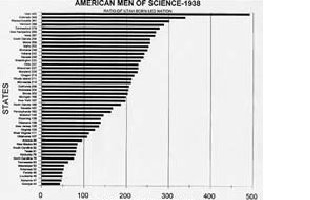 Dr. Thorndike later studied the origins of outstanding men using Who’s Who, Leaders in
Education and American Men of Science. Utah again was the most productive state, far ahead of Massachusetts, the second ranking state. (E.L. Thorndike, “The Origin of Superior Men”, The Scientific Monthly, 56 (May, 1943): 424-33.) Many of these high achievers were born in the 1800s when Utah was struggling to make the arid desert blossom as a rose. Despite privation, the teachings of the Church and the quality of the members caused many to sacrifice and strive to obtain excellent educations and to contribute to the larger society. (One of Utah’s statues in Statuary Hall in the U.S. Capitol is of Philo Farnesworth, a key pioneer of television who was one of many major contributors among Mormon scientists.)
A study by H. E. Zabel of American Men of Science – 1944 found that Utah was again first as the birthplace of 1065 scientists per million. The second state was Colorado with 657 per million. (H.E. Zabel, “Iowa’s contribution to American Men of Science, Seventh Edition”, cited in Richard T. Wootton, Saints and Scientists, (Mesa, Arizona: EduTech, 1992, opposite p. 25.)
The number of scientists in the 1949 edition of American Men of Science had nearly doubled since Thorndike’s original study of the 1938 edition. A University of Utah doctoral dissertation by Richard T. Wootton showed Utah as the most productive of scientists, followed by Idaho, the state with the second highest LDS population. (Richard T. Wootton, Op. Cit., pp. 24-5.)
The number of scientists in the 1962 edition of American Men of Science almost doubled again. Despite almost quadruple the scientists in the original Thorndike study, Utah still had a commanding lead for first in the number of scientists born in the state per million population, followed by Idaho which had a large LDS population. (21. H.E. Zabel, “Statistical Abstract of American Men of Science, Tenth Edition”, cited in Wootton, Op. Cit., p. 25.)
Using a different approach, the University of Chicago Press published a study of the institutions from which scientists in the 1921 and 1944 editions of American Men of Science had obtained their undergraduate degrees. In relation to their number of graduates, Mormon-owned Brigham Young University (BYU) and Utah State and University of Utah produced future scientists at an average rate of 150 percent of the rates of MIT and Harvard, 200 percent of Stanford, 300 percent of Duke, 1,280 percent of University of Southern California, and 4,700% of Georgetown University. (22. R.J. Knapp and J.B. Goodrich, Origins of American Scientists (Chicago: University of Chicago Press, 1952), pp. 12, 325-27.
 Richard Wootton, former President of the BYU Hawaii campus and professor emeritus of Arizona State University did a more recent study of the locations of the undergraduate degrees of American Men and Women of Science: 17th edition, 1990. Utah was again the top state in production of scientists and was substantially higher-21 percent-than the second highest state, Delaware. (Wootton, Op. Cit., table opposite p. 58)
The results of the studies up to and including 1992 were so remarkable that I asked Dr. Wootton if he would be willing to redo his 1992 study in the year 2000 to see if his findings held up in the fast changing contemporary world. He proceeded to study the states that awarded undergraduate degrees to scientists listed in the 1998-99 Edition of American Men and Women of Science. Utah again was number one. However, its lead over second state, Delaware, undoubtedly influenced by the increasing number of children of Du Pont scientists who also became scientists, was narrowed.
Highlights on Mormon Productivity of Scholars and Scientists
Although other states’ rankings changed, Utah has consistently been the highest state, and generally much higher than the second highest state, in producing scholars and scientists listed from 1920 to 1999. Also, Idaho, with the second highest percentage of Mormons, consistently ranked high in ratio of scientists who were born in Idaho to population.
To test the impact of the LDS Church, Wootton studied the proportion of LDS and non-LDS scientists from Utah in his studies of scientists. He found that LDS scientists were a substantially higher share of Utah produced scientists than the LDS percentage of the general population in Utah. (Wootton, Op. Cit., p. 27 ff.) For example, Wootton reported that the LDS proportion of Utah’s population in 1906 was 55 percent. Whereas the proportion of Utah-born scientists who were LDS in Wootton’s study of American Men of Science in 1949 was 76 percent – almost 40 percent higher than the LDS share of the population near the median birth year of the scientists.
That so many of these scholars and scientists work heavily with secularists yet retain their faith and spiritual vitality is remarkable evidence of the attractions to and fruits of Mormonism. (See Articles on Latter-day Saints and Science in Meridian Magazine. Also see my 3 articles on Mormons and Science in www.fruitsofmormonism.com
Read Part One: How the World Evaluates Mormonism: Charity
Part Two: How the World Evaluates Mormonism: Youth
Part Three: How the World Evaluates Mormonism: Health
Part Four: How the World Evaluates Mormonism: Longevity
Part Five: How the World Evaluates Mormonism: Mormon Women’s Political Firsts
Part Six: How the World Evaluates Mormonism: Education
Tomorrow: Observations of Guru Peter Drucker
Mark W. Cannon has a Ph.D. in Political Economy and Government from Harvard. He has been a Guest Scholar at the Woodrow Wilson International Center for Scholars; Staff Director for Commission on the Bicentennial of the U.S. Constitution; Administrative Assistant to Chief Justice Burger (13 years); Director, Institute of Public Administration, New York; Chairman, BYU Political Science Department; Staff, Senator Wallace Bennett; Administrative Asst. Congressman Henry Aldous Dixon.