






Today’s books go a bit deeper into some basic topics about Mormonism: the Book of Mormon and early Church history.
“The Book of Mormon is perhaps the most religiously influential, hotly contested, and, in the popular press at least, intellectually underinvestigated book in America.”
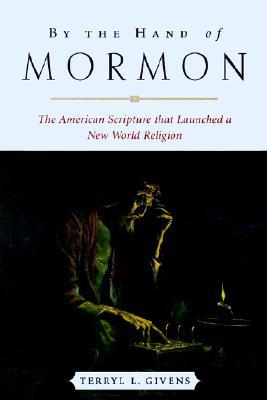 By the Hand of Mormon: The American Scripture That Launched a New World Religion
By Terryl L. Givens
In By the Hand of Mormon, Dr. Givens, whom you may recall as the co-author The God Who Weeps which I reviewed two weeks ago, takes a look at the Book of Mormon’s role in The Church of Jesus Christ of Latter-day Saints over its 180+ year history. Written by a faithful member of the Church for a non-member audience, this book had quite a bit to teach me (a life-long member of the Church) about this book of scripture that I’ve read a dozen times or more.
Dr. Givens approaches the early history of the Church by putting Mormonism in the context of the times. It was eye-opening for me to learn that the early church really didn’t stand out at first in an age that was a “paradise of heterodoxy.” Visions and other spiritual manifestations were fairly common; Dr. Givens reports that Richard Bushman has discovered at least 32 pamphlets published between 1783 and 1815 that related individuals’ personal visions – and that’s only the published stories. And with the fascination of the times with Native Americans’ origins, the Book of Mormon was not even the only source that connected them with Israel – though most other suggestions linked them to the Ten Lost Tribes rather than through Joseph.
Also interesting was the fact that for much of the Church’s history, the text of the Book of Mormon has held less importance than its origin story or its role as a vehicle of personal revelation. In fact, it wasn’t until 1961 that BYU required students to study the Book of Mormon and it wasn’t until 1972 that it was formally made part of the Sunday School curriculum. Of course, President Benson took the focus on the Book of Mormon to a whole new level in 1986 and today it is absolutely central to both public worship and personal study.
Dr. Givens addresses many of the arguments against the validity of the Book of Mormon, including a discussion of Hebrew and Egyptian language and form, overlap with the King James Version of the Bible, names in the Book of Mormon, and apparent anachronisms. He provides plausible explanations for many of the issues raised and describes how several points that seemed to argue against the Book of Mormon’s historical validity have been found to be possible with further archaeological and scientific research. By the Hand of Mormon is a good summation for those wanting to better understand a linguistic, cultural and spiritual context for the Book of Mormon.
“By the time of his death, [Joseph] Smith had revealed a polyvalent family system, a utopian communitarianism grounded in mystical traditions about Enoch, a temple liturgy that taught his followers how to negotiate the afterlife and promised them postmortal divinity, and a scandalously anthropomorphic God whom all humans could call Father.”
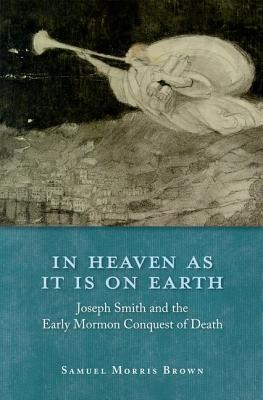 In Heaven as It Is on Earth: Joseph Smith and the Early Mormon Conquest of Death
By Samuel Morris Brown
This is an absolutely fascinating treatment of Joseph Smith and the early history of the Church of Jesus Christ of Latter-day Saints, In Heaven as It Is on Earth deals with the persistent human problem of death through the lens of Smith’s Mormon theology as it emerged. Dr. Brown provides deep insights into early LDS perspectives on death, dying, family (including polygamy), sealing, and temple worship, all within the larger context of antebellum Protestant America.
Many aspects of early LDS history that seem fairly odd to us today, when put in the context of their contemporaries, were not at all uncommon. For example, speaking of Joseph’s title and role as a “seer,” Dr. Brown points out that “in antebellum folkways, seers were people blessed with supernatural sight. Such visionaries were not rare…” Also, in reference to Joseph’s translation of the Book of Abraham from papyri, Dr. Brown mentions that “Egypt loomed large in the worldview of nineteenth-century America, spurred by the Napoleonic seizure of Egyptian national artifacts and an ongoing quest to decipher hieroglyphics…Antebellum America at times seemed to hum with Egyptomania…”
And again, on another topic, “All antebellum Americans were struggling with changes in family life in one way or another. Evangelicals encouraged regeneration, seeing personal conversion and piety as the building blocks of a new world. Secularists welcomed changes in social structure as liberation from outmoded religion, while conservatives battled to strengthen their theologies in the face of religious voluntarism. Masons and other fraternal organizations worked to establish extraecclesial ties. What set Smith and his followers apart was not their struggle against social disorder. It was their intense otherworldliness, their fierce rejection of Protestant theologies, their potent sacramentalism, their simultaneously domestic and hierarchical model.” Dr. Brown excels at providing comparisons and context that help the reader better comprehend the deeper meanings of Joseph’s teachings.
Also enlightening for me was the discussion of the overlap between Masonry and Mormon temple rites and the evolution of the term “seal”. I enjoyed this characterization of Joseph: “In public pronouncements that irritated estranged followers and Protestant neighbors, Smith announced publicly that he preferred hell with his friends to heaven alone.” Dr. Brown emphasized the infinite reach of LDS theology encompassed in Smith’s teachings: “Smith spent years developing a ritual and theological system that recast community and the relationship to God as a binding and saving pedigree…Smith’s sacerdotal genealogy brought the universe’s powers to bear in defense of extended human associations, even as they gave the universe a decidedly familial face.”
One helpful hint: In Heaven as It Is on Earth is pretty dense, and you’ll definitely want easy access to a dictionary. (If you go look up the word “sacerdotal” right now, you’ll have a bit of a head start; it’s on just about every page.)
**************************
On My Bedside Table…
Just finished: Around the World in Eighty Days by Jules Verne
Now reading: Teach Your Children Well: Parenting for Authentic Success by Madeline Levine
On deck: Divergent by Veronica Roth
**************************
I’ll have a few more books about the Church and related topics next time.
Come find me on goodreads.com or email suggestions, comments, and feedback to egeddesbooks (at) gmail (dot) com.