





“The horses’ hoofs clop-clopped with a dull sound, the wagon wheels went crunching. . . All around the wagon there was nothing but empty and silent space.“
As an adult writing about her journey to Kansas from the big woods of Wisconsin, Laura Ingalls Wilder described these sensory childhood experiences and other pioneer journey stories in Little House on the Prairie (1935). As with Wilder, each of us has journey stories to tell. Our stories may involve trips to unfamiliar places or permanent changes in location. They may be spiritual, emotional, or social journeys. They may be tales from our personal heritage. What connections might we make with the past? How do we share our journey stories?
After 15 months of intense preparation, “Journey Stories” is in Nauvoo from September 29 through November 10, 2012. Each year Museum on Main Street takes Smithsonian traveling exhibits to towns across America and requires each community to showcase its strengths and contributions. This year the Smithsonian “Journey Stories” exhibit has visited six Illinois towns.
This national exhibit explores how we and our ancestors came to America. Display boards, audio clips, music, maps, and artifacts describe those who left families and possessions for a new life across the ocean, continent, region, or state. The effect of transportation on American society reveals who we are and how our society has grown and changed.
Smithsonian Float and Passport Souvenirs
To advertise the “Journey Stories” exhibit, volunteers built a float which they entered in parades in neighboring communities, such as Carthage, Keokuk, Macomb, and Nauvoo. The Nauvoo Grape Festival’s bride and groom and other volunteers rode on, or walked beside, the float with its carriage and gazebo.

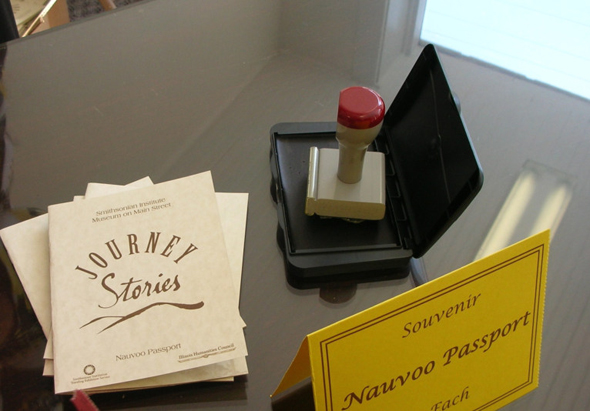
During the six-week period the Smithsonian exhibit is in Nauvoo, individuals may have passport souvenirs stamped as they visit the “Journey Stories” and Nauvoo exhibits, Weld and Reinberger museums, LDS and Community of Christ visitor centers, Baxter’s Vineyards, and Hotel Nauvoo. The passport system invites visitors to learn about various journeys that impacted Nauvoo residents past and present.
Smithsonian “Journey Stories”
The Smithsonian “Journey Stories” exhibit is housed in the remodeled Kraus Furniture showroom at 1285 Mulholland Street, Nauvoo, Illinois. A ribbon-cutting ceremony took place on September 29, 2012, with a reception following the grand opening at Hotel Nauvoo.
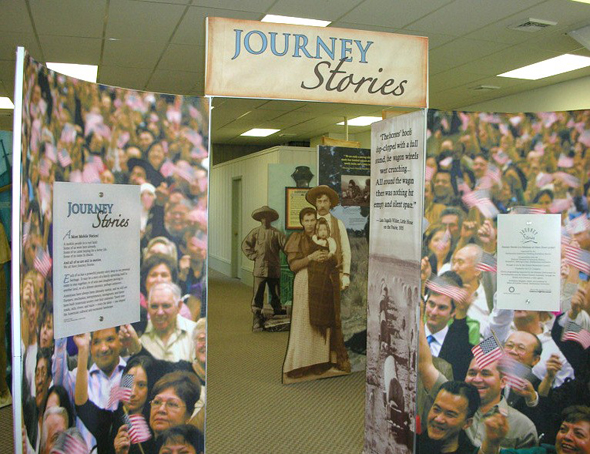
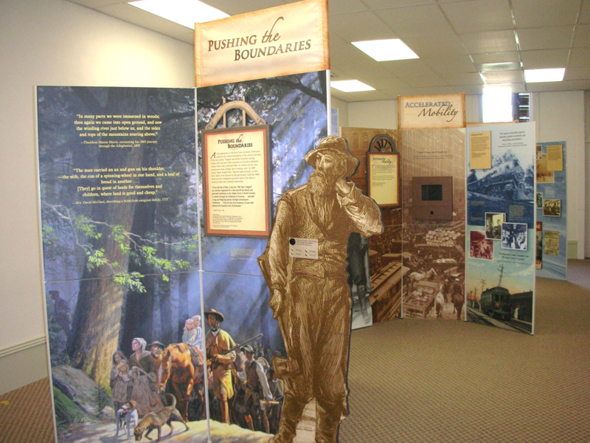
As guests explore the “Journey Stories” kiosks, they learn how transportation has shaped American society. The kiosk titled “One Way Trip” encourages visitors to reflect on colonists who traveled to America for religious freedom, consider those who for centuries inhabited this land, or wonder about those who came to America against their will. Soon people on the East Coast uprooted and embarked on new journeys, “Pushing the Boundaries” toward the Mississippi River.
Assuming that the Great Plains region was too dry to farm, settlers and homesteaders packed up their belongings and moved “Across the Great Desert’ to the West.” Some pushed on to the Pacific coast, while others moved to the Intermountain West. Pioneer families expressed hopes and promises of fresh starts as they faced challenges along the trail and at their destinations. This kiosk encourages visitors with pioneer heritage to ponder journey stories of their forebears who traveled by covered wagon or handcart. Visitors with Native American blood may consider their ancestors relocating on the trails of tears.
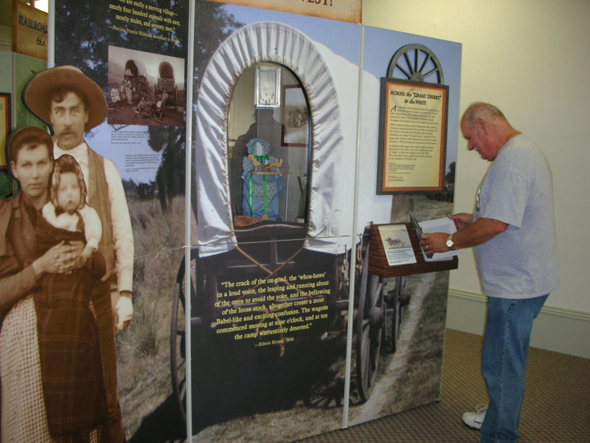 Co-chair Ron Yockey at pioneer kiosk
The “Railroads Span the Nation” kiosk describes how the four-to-five-month trip across the nation decreased to four days as a result of the transcontinental railroad. During the 20th century, “Accelerated Mobility” of automobiles and airplanes made it possible to travel greater distances for work and pleasure. The American attitude became “everything in life is somewhere else, and you need a car to get there” (E.B. White).
 “Accelerated Mobility” kiosk
Today, in “Our Expanded World,” we’re still traveling, and “it’s been quite a ride.” Transportation has impacted our personal journeys, and “our global community is more tightly interconnected because of the millions of journey stories unfolding every day” (kiosk quotations).
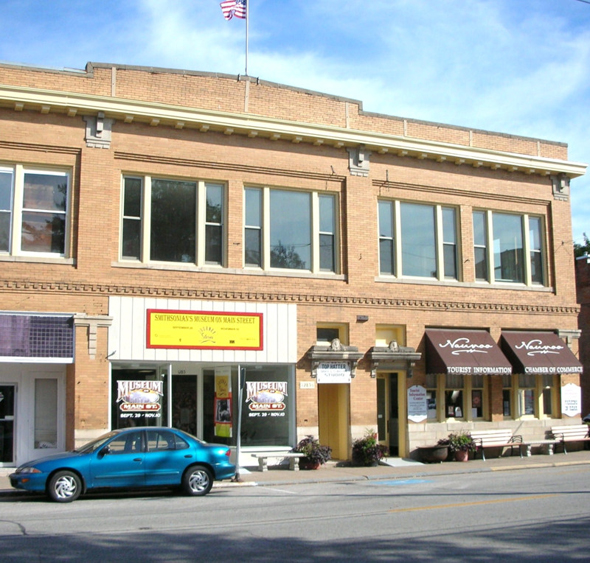 Smithsonian and Nauvoo exhibit buildings
Nauvoo’s Journey Stories
Before the “Journey Stories” exhibit came to Nauvoo, the community was required to develop a local exhibit and three programs unique to the city. The Nauvoo Tourism Office, Historical Society, Chamber of Commerce, Historic Nauvoo, Joseph Smith Historic Site, and volunteers pulled together and made it happen. After a committee researched and prepared text and photos, Mayor John McCarty constructed the exhibit story boards, which are housed in the Tourist Information Center at 1495 Mulholland Street. This exhibit portrays the journeys of a few who came to Nauvoo; however, time and space constraints limited what stories could be told.
 Co-chair Kim Orth setting up Nauvoo displays
“Nauvoo became a gathering place for people who hoped for a better life.” Some stayed and some left. “Those who moved on left evidence that they lived in and called Nauvoo home.” Each group who came defined how life should be lived and this caused conflict and at times violence. Although differences exist in Nauvoo today, residents are seeking unity in spite of their diversity.
Nauvoo’s exhibit contains two parts:
- “Hope for a Better Life in Nauvoo: Mormons, Icarians, Germans, Catholics”
- “Journey Interrupted: A Brief History of the Des Moines Rapids” and its effect on Nauvoo
“Hope for a Better Life in Nauvoo”
Four groups who came to Nauvoo hoping for a better life were Mormons, Icarians, Germans, and Catholics.
To obtain data for the local exhibit, students from Western Illinois University’s oral history class interviewed descendants of families from each group. Questions focused on each family’s journey, beliefs, and values and how these qualities impacted the Nauvoo community.

“Bring Them to Zion,” the Mormon story board, features Emma Smith and her son Joseph Smith III, whose stories revolved around Nauvoo. When British Saints arrived in Nauvoo in the 1840s, the Thornber, Pilkington, Ellison, and Clark families came with them. After the Prophet Joseph Smith died, some of these families remained in the area while many others joined the migration to Utah.
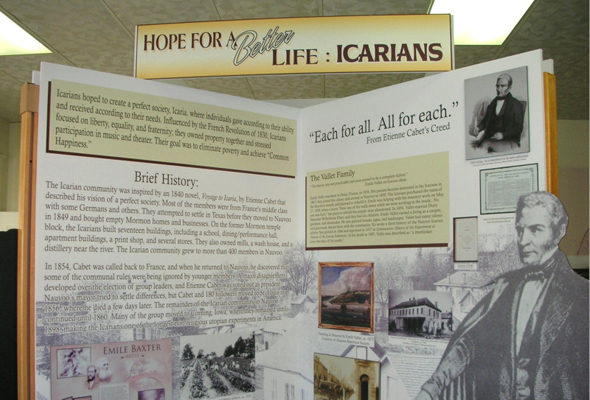
After the Mormons vacated the city, a French Icarian group under the leadership of Etienne Cabet moved to Nauvoo in 1849 to establish a utopian community. The Icarians purchased empty houses, businesses, and the Mormon Temple, which was destroyed a year later by a tornado. These people built 17 buildings on the temple block and owned property on the flat. The colony grew to over 500 members until Cabet was voted out as president. He and his followers went to St. Louis in 1856; others moved Corning, Iowa. One Icarian family named Baxter stayed in Nauvoo and cultivated grapes. The family’s vineyard/winery has passed down through four generations and continues today as Baxter’s Vineyards.

Inexpensive land offered incentive for German-speaking people to settle in the “New Rhine River Valley” of Nauvoo. Germans moving to Illinois in the mid- to late 1800s were trained in trades and professions. By the end of the 19th century, Nauvoo had become the most German-speaking town in Illinois. Churches offered Sunday services in German and English, and many schools were conducted in German. Joseph Kirschbaum arrived in Nauvoo in 1858 and documented post-Mormon Nauvoo with his artistic sketches. The Schenk and Kraus families established businesses, and today the Kraus family still owns Grandpa John’s Caf, Hotel Nauvoo, and a furniture store.

In the 1840s, a potato blight caused mass starvation in Ireland, and many Irish Catholics fled to America. Irish and German Catholics sought freedom and liberty, good land, and jobs, and they found opportunities in the Midwest. Three Reimbold brothers moved to Nauvoo in 1848. Peter Reimbold’s son operated a hardware store for 50 years, and Father John Reimbold spearheaded the building of Sts. Peter and Paul Catholic Church and Catholic education in the area. For over 140 years, Catholics have been the largest single group in the Nauvoo community.
Mormons, Icarians, Germans, Catholics, and other groups came to Nauvoo for a better life. Their journey stories intersected to make this community what it is today.
“Journey Interrupted”
According to Ron Yockey, “the Mississippi River has been an important part of our city. Many people have come and gone by way of the river. The river has had quite an impact on our town.”

The Des Moines Rapids between Nauvoo and Keokuk, Iowa, have influenced Nauvoo’s history. “Journey Interrupted: A Brief History of the Des Moines Rapids” explores the impact of the rapids on travelers in the 19th and early 20th centuries. The rapids prevented commercial navigation between Keokuk and Nauvoo, especially during low water. As a result, cargo was unloaded and towed upstream on shore by draft animals or pushed upstream by men with long poles on small boats. In 1913, a dam was built on the Mississippi River, causing Lake Cooper to submerge the 11-mile stretch of rapids between Nauvoo and Keokuk.
Community Programs
Three community programs–“Journeying through Music,” “Icarian Life as Showcased in Their Furniture Design,” and “Nauviews”-enhance Nauvoo’s local exhibit.
“Journeying through Music” was presented in Sts. Peter and Paul Catholic Church on September 28, the night before the exhibit’s grand opening. Catholic and LDS choirs, a male quartet, the community orchestra, an organist, and congregational singing performed hymns and music from Catholics, Icarians, Mormons, and Germans with narration connecting each piece.

On October 20, a local artisan demonstrated “Icarian Life as Showcased in Their Furniture Design,” a program that described early woodworking techniques. The Icarian colony emphasized communal living, and refectory chairs were numbered and assigned to people to eat in shifts in the dining hall. Simplicity was a common feature of communal furniture during the 1840s, with household items being utilitarian rather than beautiful. The simple furniture design of the Icarians illustrates the colony’s tenet of equality.
 Original Icarian refectory chair #246
The final program titled “Nauviews” will be presented November 3 at the Historic Nauvoo Visitors’ Center. Narration with twenty sketches, paintings, and photographs of Nauvoo from the Mississippi River or Montrose, Iowa, will illustrate Nauvoo’s changing landscape between 1848 and 1920. These images will be set against a backdrop that identifies the timeline of Nauvoo’s history and will showcase the landscape as the timeline progresses. What do the pictures mean? How accurate are the sketches and paintings? A few artists borrowed existing photos or sketches to create their own perceptions of Nauvoo’s landscape. Were the landscapes stereotyped or idealized? One reconstructed image placed Sts. Peter and Paul Church on a big hill when it really is not.
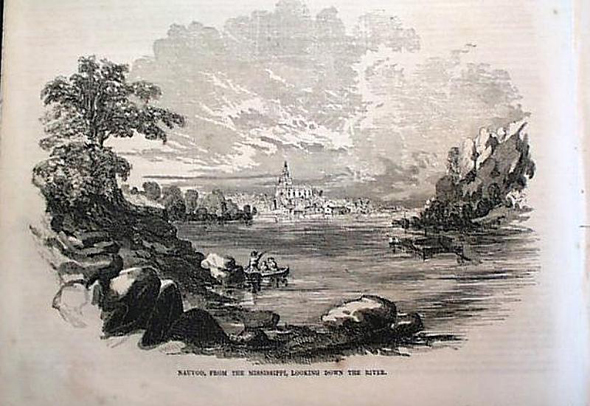 Sketch from Gleason’s Pictorial
Personal Connections
During 2012, six cities in Illinois are displaying the Smithsonian Institution’s traveling exhibit “Journey Stories,” the newest of the Smithsonian’s Museum on Main Street exhibitions. “Journey Stories” will be in Nauvoo from September 29 through November 10, 2012, with hours from 1:00 to 6:00 p.m. Monday through Friday and 1:00 to 5:00 p.m. Saturday and Sunday. This exhibit has been made possible by the Smithsonian Institution, Illinois Humanities Council, local donations and grants, and support from the United States Congress.
The “Journey Stories” exhibit engages visitors to interpret and personalize how they and their ancestors came to America. Nauvoo’s display offers greater understanding of people who hoped for a better life and brought beliefs and values that impacted the community.
Each of us has journey stories to tell. We travel, pull up stakes, and search for new opportunities. Our stories need to be told and connected with the past and our heritage. Fifty years from now our stories may be projected on similar story boards. What do we want remembered? What interpretations might be made? Thanks to the Smithsonian display, we can choose to personalize and document our own journey stories.
Rosemary Palmer is the Nauvoo, Illinois, correspondent for Meridian Magazine.