






The story of the birth of Christ is so much a part of our lives that it is hard to believe that Hollywood has never before brought it to the big screen, but as The Nativity Story opens in theaters across the United States, it is a first to concentrate solely on this story that has been the subject of church pageants for as long as anybody can remember.
In a world where every kind of twist on adventure, spy thrillers, violent shoot-em-ups and historical themes are Hollywood fare, it has been surprisingly considered daring and brash in recent decades to focus on religious topics. Yet emboldened by the blockbuster success of Mel Gibson’s The Passion, Hollywood is beginning to remember that, yes indeed, there are Christians in the audience.

Produced by Time Warners’ New Line Cinema, The Nativity Story was created by a big studio with big marketing.
While the holiday-movie season is crowded with offerings such as The Santa Clause 3: The Escape Clause, this time the producers remembered that if 200 million Americans consider themselves Christians, that is more than a little niche and it is worth pursuing.
Most faith-based movies are made on micro-budgets, designed for small markets, but not this time.
Hollywood is acknowledging the power of churches as they hope to spread the word about the film. The premiere showing to an audience of 7,000 was at the Vatican on Sunday, November 26th and the word is the audience loved it.
According to USA Today, Lamar Keener, publisher of the Christian Examiner, says he doubts The Nativity Story will reach Passion levels, but many churches are renting theaters for this film and acting as ticket brokers for the faithful. Evangelical Christians are "very excited about the movie because they understand it’s very biblically accurate," he says.

Filming a Significant Story
The question, of course, is how do you take a story so beloved and familiar and create a script? Do you put words in the characters’ mouths that aren’t in the scripture? Do you create new characters and side plots? How can you possibly portray Mary in more than the glimpses we get in scripture?
That was the challenge for director Catherine Hardwicke who previously made a couple of unlikely Indie films as warm-ups. She had directed Lords of Dogtown, about youths who make their mark by extreme skateboarding styles, and Thirteen, the story of a teenage girl swept up in her friend’s life of petty crime and drugs.

With this background, the script was an unlikely choice for Hardwicke, but last January (that’s right only – 11 months ago) when she received the script, she thought about the possibilities of chronicling this significant story from its personal impact.
Hardwicke said, “I read it and started getting excited about the idea of going deeper than they had ever gone into these characters. Usually, you just think of them with their halos, not as humans. So I thought, this is fascinating and I want to explore that world. And I went in with a big pitch – ideas and photographs and talked about how I really wanted Mary to be someone from the region, not to look Swedish, not a blonde blue-eyed Mary, but somebody who looked like she could live in that Mediterranean region with that beautiful olive skin tones. I wanted her to be 13 or 14 years old.
“People think that most people know the story, and I don’t know how many of us grew up Christian, but you don’t really think about them as real people with problems we would all have. You don’t think about them on the first level as being Jewish. We barely know anything about the story, and we don’t think very deeply about it usually, even though it’s a beautiful, magical story that has endured forever.”
Hardwicke said she was interested to get inside of Mary, to understand how she might think and how she would feel. She had made movies about teenagers before, and here was a teenage unwed mother, finding herself with a terrific burden and privilege.

"The film is about this young woman’s spiritual journey," Shoreh Aghdashloo, who plays Elizabeth, said. "It’s about Joseph’s pure love for this woman. It’s not an easy thing for a man to share his wife with God."
Historically Accurate
Hardwicke was also interested in being historically accurate. She said that you hear this story your whole life and forget that Joseph and Mary were Jewish, following the traditions they knew. She brought in many scholars to help. An ancient astronomy professor came in to explain what instruments the wise men would have used in their calculations. A Jewish scholar came from Rome to help create a small synagogue for their set. She created a Nazareth boot camp, that was like a full-on total immersion system in milking goats, weaving cloth and baking bread.
She felt like other Biblical movies that Hollywood had undertaken in decades past were too stiff and formal, and she wanted the action to be accurate, intimate and personal.
She also had the formidable challenge of finding a cast who could be Middle Eastern in appearance. She wondered, “Who on earth am I going to cast? There’s no A-list actors or nobody from the Middle East.”

She finally turned to Keisha Castle-Hughes, late of Whale Rider, to play the part of Mary. Oscar Isaac, of Guatemalan heritage, was cast as Joseph, and Shohreh Aghdashloo (a Muslim actress from Iran) plays Mary’s much older cousin, Elizabeth, who becomes the mother of John the Baptist. Ciarn Hinds plays Herod with an intensity that makes his insane slaying of the innocents believable.
The Results
So with this approach, how does The Nativity Story work? It begins with the heart-grabbing slaying of the children by Herod and then flashes back to Mary. The film is strongest where it is exploring the relationship of Mary and Joseph. She is a teenager with a problem – a responsibility of nearly overwhelming weight and a pregnancy that almost gets her the adulteress’s stoning.
When Mary is away at Elizabeth’s during her first months of pregnancy, Joseph misses her, and then is dismayed at her obvious condition on her return. Joseph is gentle, but wracked with doubt, and when the angel finally brings him around, he becomes a most gentle and loving protector.
Mary’s dilemma finds her ostracized in Nazareth, a condition that apparently follows her throughout her life. In scripture, when Christ returns to Nazareth, he is called “Mary’s son” instead of “Joseph’s son,” an indication that the town had not forgotten.
The journey to Bethlehem is etched clearly as the film portrays the real hardship it was for a people to be asked to make the journey back to their place of birth, the dismay and discomfort Mary felt on a donkey’s back for an 85-mile journey, the hunger they sometimes felt as they were thrust into this wilderness.

Herod, who had his own wife killed in his maniacal obsession with power, has placed guards at the entrance to the city, knowing that the king who has been prophesied will be born there. He tells them to look for somebody noteworthy who might be the king. Joseph and Mary are passed over as hopelessly insignificant.
Yet it is Joseph and Mary’s shared dilemmas that knit them and they grow from a confused, newly-married couple overwhelmed with an incomprehensible responsibility to greater strength.
It is easy to consider the nativity story peopled with statues like we have in our crches, rather than people with warmth and humanity, pain and confusion, but The Nativity Story succeeds at enlivening the imagination about who Joseph and Mary were and how they might have felt.
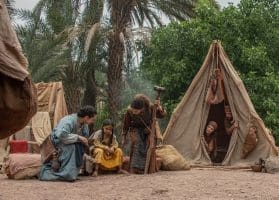
It is also noteworthy how faithful the script is to the King James story – without invented subplots or characters. In addition, Hardwicke achieved her goal in making the story feel Middle Eastern and Jewish, right down to the detail of everyday life and Mezuzah on the door. This is not a show of pageant and color, but life in Nazareth.
Yet, for all its strengths, The Nativity Story does not and cannot reach the film that we have played in our minds all these years. It is glum compared to that story of light played out in our hearts. Mary seems too often one-dimensional, without vibrancy or depth. Her face seems to carry one worried, depressed look and many times it is the vibrancy of Joseph that carries the scene.

A stony part of Italy is the background for the Holy Land, and Elliot Davis’ photography feels too often grim and monochromatic. This is a story of hardship, but what viewers may miss is a sense of joy.
Latter-day Saints who have seen Kieth Merrill’
Gifts, Cherie Call, produced by Scott Wiley and Tyler Castleton
Compilation Album
The Best of Jenny Oaks Baker, Deseret Book
Male Recording Artist
Sam Payne
Female Recording Artist
Jenny Jordan Frogley
Instrumental Recording Artist
Michael Dowdle
Group Recording Artist (tie)
Mormon Tabernacle Choir
Nashville Tribute Band
New Recording Artist
Jenny Jordan Frogley
Performing Artist
Alex Boye
Songwriter
Cherie Call
Arranger
Tyler Castleton
Producer
Tyler Castleton
Studio Musician
Aaron Ashton, violinist
Studio Vocalist
April Meservy
Studio Engineer
Steve Lerud
Album Design
Gifts – Meredith Ethington
Record Label
Deseret Book
Radio Show
Steven Kapp Perry (Soft Sunday Sounds – FM 100)
Retail Manager
Joanne Rapp (Nauvoo Book – Houston, Texas)