



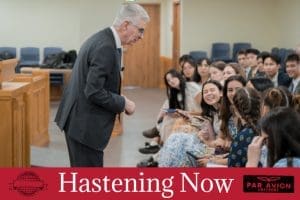









Good morning I am so overwhelmed by your love and support! My name is Jocelyn Osmond and today I get set apart as “Hermana Osmond” to serve in the Texas Dallas East Mission.
Let me tell you a story. One most people in the world have never heard of. Before this world was created, there was a council in heaven. Heavenly Father asked a question that would change everything:
- Who will go?
- Who will save them from their sins, their pain, their hurt, their addictions, their loneliness?
- Who will give them justice when they are wronged — and mercy when they disappoint?
And one stepped forward. His name was Jesus Christ. And the first words we ever hear Him speak are these:
“Hineni.”
The translation from Hebrew is in my mission scripture, Abraham 3:27: Here am I. Send me. Thy will be done, and the glory be Thine forever. Everyone who is now on this earth believed in Him. The scriptures say we shouted for joy. We trusted Him. We chose Him, and then — one by one — we each said it too.
“Here am I. Send me.”
Excited to come to earth. Excited to live a mortal life. Excited to learn, to grow, to love, and to have a body. Those are the words we each said to our Heavenly Father before we came here. And today, I stand before you and say them again — as I prepare to serve a mission in Dallas,Texas: “Hineni. Here am I, send me.”
Hineni is not a casual word in scripture. It is only spoken when someone is being called by God. And what is remarkable is not who says it —but how they feel when they do.
Hineni is spoken by people who feel afraid, inadequate, unprepared, or in pain. Which tells us something important about God doesn’t it?
God does not wait for us to feel ready. He calls us while we are broken. When Moses is called from the burning bush, his response is not confidence. It is fear.
He says: “Who am I… that I should go?” “I am slow of speech.” “Please send someone else.”
Moses feels unworthy because of his past. He feels incapable because of his weaknesses.
And God never tells Moses he is enough and doesn’t need to try. Instead, God says this: “I will be with you.”
That is what hineni really means.
Not “I am strong.” But “I will stand here even while I am weak.”

I feel like Moses. Since I opened my mission call, it has been hard to feel motivated, hard to feel important, hard to understand why God would even need me in His plan. I look at my mistakes. The broken pieces in my life, my doubts, and sometimes I wonder why God would choose me.
But I also know this —He knows me and he loves me unconditionally, and he’s given me so much that if I do not go, I will regret not going for the rest of my life.
We all ask God for things. We ask for love, for success, for glory on our names, for freedom from pain, for answers, for angels to bless us. We ask to feel important, to belong, to be healed, to matter.
But God does not usually answer by making us impressive to the world. Instead, He calls the outcasts. Take Mary Magdalene. Once broken and persecuted, she was one of the Lord’s most beloved and became the first witness of His Resurrection.
The widow gave two small coins, all that she had, as others meagerly gave small bits of their giant financial earnings, and Christ said she gave more than all. Esther, an orphan in exile, saved an entire nation. Moroni sat alone in a cave, afraid, watching his people die, yet still faithful.
God does not seek perfection. He seeks the forgotten. The wounded. The doubting. The ones who don’t think they matter. Those who have even a little faith left. Because when He heals them, His glory is unmistakable.
Joseph Smith was only fourteen when he saw God the Father and His son Jesus Christ.
He ran to tell his preacher — someone he trusted — and that man ridiculed him and silenced him, told him to never speak of his so-called blasphemy again. Joseph later in life wrote that it felt like he had been thrown into deep waters, that he would drown if God did not rescue him. That trauma stayed with him.
We all feel this way at times. Joseph was mocked, persecuted, lonely, and eventually martyred for His faith and yet — God still called him and entrusted him.
Joseph didn’t say hineni because life was easy or fair. He said it because God was real and he could not deny it.

Here’s my personal witness:
My decision to serve a mission did not come from comfort. It came from brokenness. When my parents divorced, my world fell apart. I questioned my faith, my purpose, and my worth.
In high school I was in a bad relationship. I lost friends. I sat alone in the back, depressed in a seminary class, and there was a boy I was assigned to sit by named Justus — JB — who sat next to me when I felt invisible.
He too struggled to fit in and to have friends. During that time, God gave me the opportunity to see Christ through him, as he noticed me and I him. He passed away by taking his life the next year on the first day of my senior year.
Not many knew him and I was mourning his loss. Through my struggles as I faced this new school year feeling alone, I often asked God and JB where their presence was.
A week later, without explaining why I needed one, I asked for and received a blessing from a trusted older friend. He spoke of an angel near me — pleading with Heavenly Father on my behalf to minister to me and have his presence be assigned to me.
The man who gave me the blessing didn’t know the story of JB, but I did. He said God had been trying to speak to me for a long time, that my righteous desires were like a beacon from earth to heaven, that individuals in the very moment were praying for the arrival of my presence.
In that moment, I knew. That was the other answer to my pleadings this priesthood holder didn’t know about. I received my witness that I was going to serve a mission.
To add to the miracle, one of my best friends inspired me to get endowed. I chose a date — not knowing it was the one-year anniversary of JB’s passing. Having spaced it in the chaos of life, I found out the morning I went to the temple. I prayed to see him in the temple.
When I arrived, I saw his little brother who looked just like him in the foyer. Then his family came out and told me that the hour before my appointment, they had just completed JB’s temple work. I know he wanted me there. I know he wanted me to make the same covenants he had along with him.
My second witness to go on a mission came as I sat in the Stake President’s office, overwhelmed by the reality that I was about to submit my mission papers. I remember thinking, “Heavenly Father, is this really the right decision? Everything I’ve worked for in my personal life over the last few years has been leading to this.”
I felt anxious, inadequate, and I felt prompted to open my Gospel Library app and read the quote of the day. It said: “When we say yes to serve, we say yes to Jesus Christ.”
When Heavenly Father asked who would go — who would suffer, who would carry every sin, every grief, every loneliness, Christ stepped forward and He said: “Hineni.”
Fear became salvation.
Inadequacy became deliverance.
Pain became eternal freedom.
Families became forever and the sting of death ceased to exist.
Not all of us will wear a black name tag, but every one of us has been called to be a missionary in this life. You say hineni when you choose kindness. When you sit next to someone who feels invisible. When you stand up for the outcast. When you stay strong to continue striving for a boundary or a standard you set for yourself. When you share hope!
There are people around you praying for answers, people you may have promised you would help before you came here to earth, and you might be the answer.
I am not perfect.
I struggle.
I doubt.
I fall.
But I am His.
God does not need me —He wants me. He wants you.
To my Lord —the God of the universe who knows my name and loves me unconditionally —
Even when it’s hard to get through the day. Even when I feel unworthy. Even when my soul is tired and imperfect I say again to you: “Hineni. Here am I, send me.”







Jen AshcraftMarch 15, 2026
Jocelyn, thank you for sharing your beautiful experience with Justus. It has brought us so much comfort and joy. You were a bright light to him and he admired you so much. Leading up to the anniversary of his death I was really struggling and was dreading the day. My husband had decided a few months before that we should do his temple work on the anniversary of his death. It was a most remarkable experience and I could feel him and his infectious energy and joy the whole time we were in the temple. That day I had been dreading turned out to be a day of rejoicing for me! I felt his joy and love the whole time! It wasn't a coincidence that you received your endowment that same day. It absolutely makes sense that he would plead to be able to minister to you as a guardian angel. He always cared so deeply for his friends. Thank you for your goodness, your loving and accepting spirit and your beautiful testimony.
Heather OsmondMarch 15, 2026
I am proud to heed the invitation…Here am I send me! We love you Jocelyn!